The Periodic Table of Elements lists the 118 chemical elements that make up everything in our world. Some you’re familiar with—Hydrogen, Oxygen, Nitrogen, etc. Others maybe less so—Vanadium, Germanium, and Yttrium.
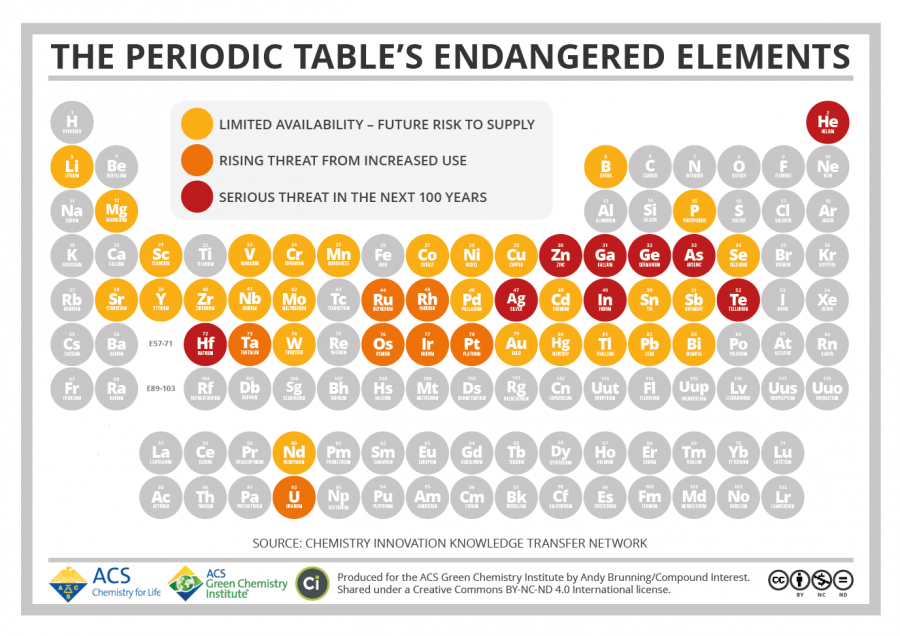
According to the American Chemical Society, 44 of those 118 elements might disappear by century’s end. Enter the Periodic Table of Endangered Elements (shown above). The most endangered ones, highlighted in red, are Zinc, Gallium, Germanium, Arsenic (is this a good or very bad thing?), Silver, Indium, Tellurium, and Hafnium. Made available under a Creative Commons license, the Periodic Table of Endangered Elements can be viewed in a larger format here.
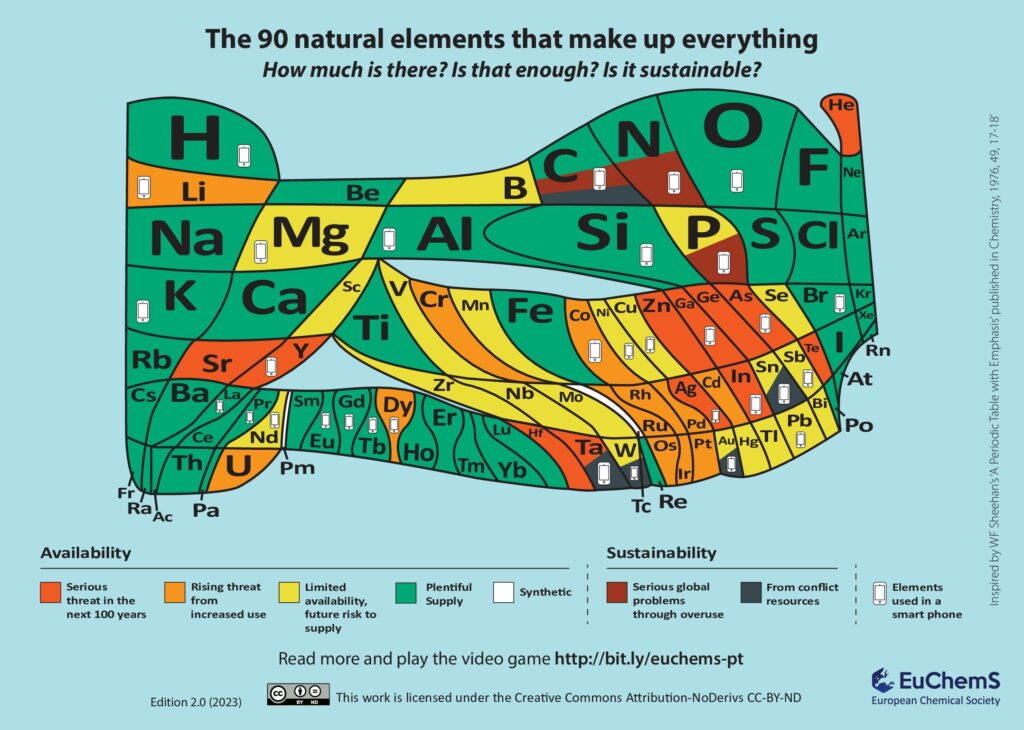
The original image (top of the page), created in 2015, was updated by EuChemS in 2023 (above). The updated table features the current-day availability of all 90 elements, rather than just the endangered 44 elements, adds an axis for sustainability, and flags elements used in smartphone production.
If you would like to support the mission of Open Culture, consider making a donation to our site. It’s hard to rely 100% on ads, and your contributions will help us continue providing the best free cultural and educational materials to learners everywhere. You can contribute through PayPal, Patreon, and Venmo (@openculture). Thanks!
Related Content:
The Periodic Table of Elements Scaled to Show The Elements’ Actual Abundance on Earth
Periodic Table Battleship!: A Fun Way To Learn the Elements
“The Periodic Table Table” — All The Elements in Hand-Carved Wood
World’s Smallest Periodic Table on a Human Hair
“The Periodic Table of Storytelling” Reveals the Elements of Telling a Good Story
Chemistry on YouTube: “Periodic Table of Videos” Wins SPORE Prize
Free Online Chemistry Courses




…for those who do not understand “conservation of mass.”
How do you mean your unnessary statement. We can NOT SYNTHESIZE elements on a large scale. Conservation of mass has no merit on what you say.
For those who do not understand industrial manufacturing, waste, recycling. For those who do not live in the real world.
>Supply of elements vs conservation of mass
I’ve taken some college chemistry classes and want to add that often, when elements are used in manufacturing, they often aren’t returned for human use. For example, if we fill a bunch of helium balloons, then the helium will almost always be lost to the atmosphere and become very difficult to retrieve.
OK, please explain how a chemical element that is NOT radioactive, just “disappear”? Or is this just an alarmist approach to assuming we’re just collectively too damn lazy or greedy to recover these from devices, materials, or structures that have outlived their usefulness?
The element doesn’t disappear but rather becomes difficult to recover. For example, if each phone has a very small quantity of indium used in production and a large portion of phones aren’t recycled, then we would eventually have to spend a lot of resources going into landfills to dig through garbage, find the phones, and extract indium/indium components from them.
OK, I understand the helium part, but, on balance, I can’t help but regarding that scenario as exceptional. As for most of the rest, I see “aren’t returned for human use” as a decision, rather than an inevitability. As I don’t have the sort of engineering background to propose solutions, I’m reasonably certain there should be those who can address these sorts of problems.
It is this simple. Technology does NOT exist that we can manipulate the nuclus of the atom to manufacture elements on a large scale. You need extremely powerful particle accelerators smashing into other nuclei just to create single or perhaps several nuclei that is desired. It is so bad that we are nowhere in the near future even enough to break away from natural resources that are currently available. The best in the foreseeable future is mining asteroids. That being said when the A.I. superintelligence finds new physics then it may become possible. Further it takes MORE energy to create a element than the total rest mass energy of the element you wish to create. Simple physical nuclear chemistry 101. Thankyou.
I forgot to add the exception for nuclear reactors using Uranium 238 bombardment with neutrons from uranium 235 to synthesize plutonium 239 and Americium 241. Americium is found in smoke detectors as a alpha partical emitter. Plutonium 239 is used for the power source for long range outer planet exploration robots and the 1st stage in thermonucular weapons.
Elements don’t die, so they don’t disappear either. Only an idiot would write such an article.
Where did I say elements just dissappear? Elements above the element iron are fissile below that threshold elements they fuse to create larger elements. Why the idiot statement BTW? Your behaviour is very puzzling…
This is…incredibly misleading? That’s the nicest way of saying it. If the ‘openculture’ authors had actually read the ACS site, they’d know that none of these elements are going to ‘disappear’. What the ACS is actually communicating is that without attention to being able to recover these elements when used through recycling or other means, they could become economically infeasible to extract from the remaining sources.
I understand (OK, and here’s the “but”), however, we collectively should perhaps be more mindful of the fact that difficult ≠ impossible. Before some of this actually somehow becomes impossible.
Maybe your brain is part of the Elements above iron because it just Fizzled away. Below it would Fuse into something… Gosh Awful.