In 1883, Antoni Gaudí, the great Catalan architect, began working on his magnum opus, the Sagrada Família, the church that has become one of the most popular tourist attractions in Barcelona. Before his death in 1925, Gaudí managed to complete the crypt, apse and part of the Nativity facade. Work on the basilica slowed during the 1930s and 40s, especially during the Spanish Civil War, but picked up again in the 1950s. A series of architects carried on Gaudí’s work, completing new towers and facades. In 2000, the central nave vaulting was completed, and, since then, modern technology has put architects on track to complete the church decades ahead of schedule. The new target date is 2026 — the centenary of Gaudí’s death. Thanks to a computer-generated video released by the Sagrada Familia Foundation, you can see what the basilica, almost 150 years in the making, will look like when it’s all done. You can also take a virtual tour of the interior of the UNESCO landmark here.
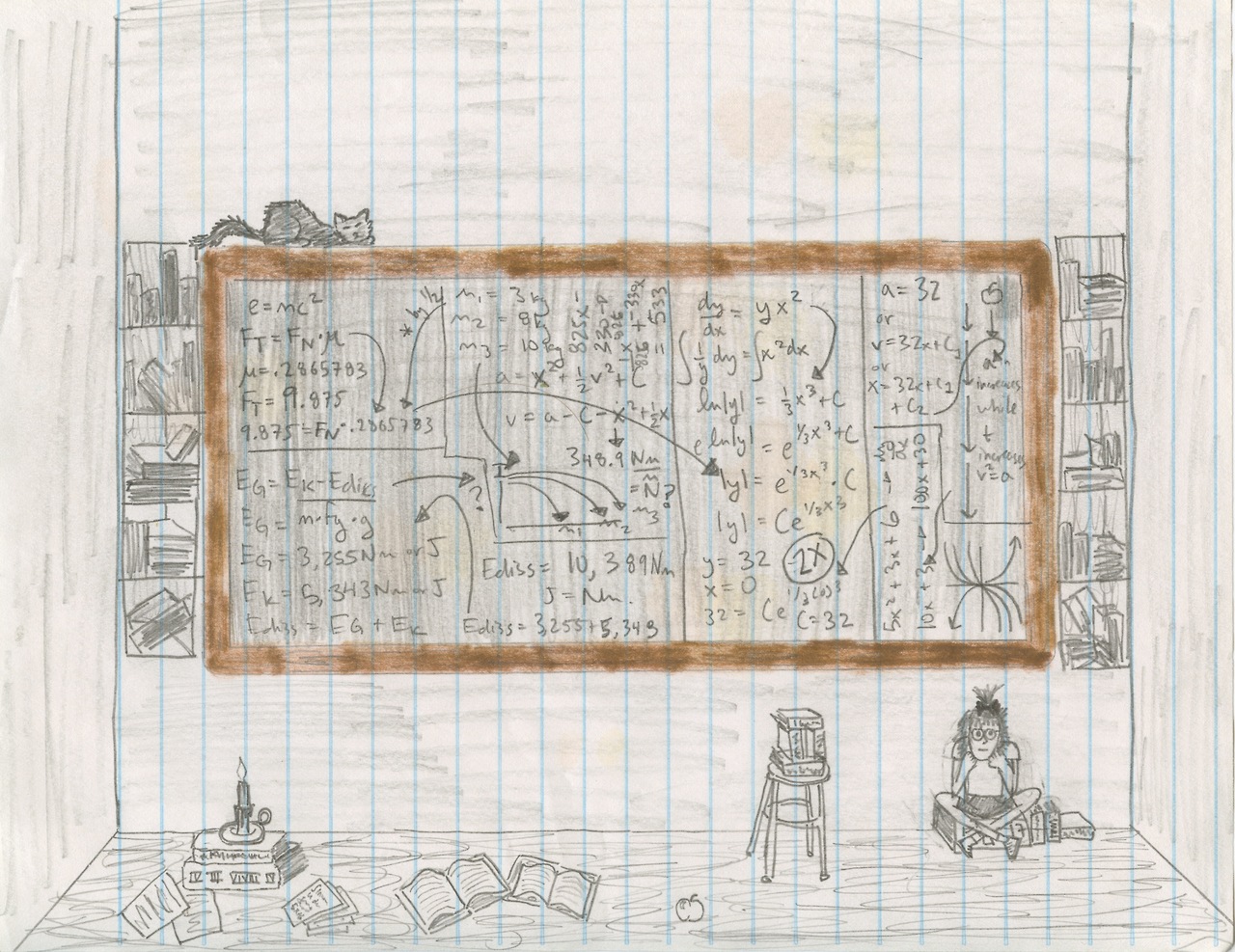
The Tumblr called Philosophers at Work has gathered together a fun series of drawings by 10th graders from Madison WI, who were asked by their teacher to — you guessed it — “draw a philosopher at work.” I will leave it to you to peruse the gallery of drawings. But I’ll just say this: Whatever their virtues, the drawings don’t look anything like real philosophers. (For some pictures of real philosophers, see, of course, the Looks Philosophical tumblr.) Nor do tenth graders, no disrespect to them, depict philosophers nearly as artistically as Renée Jorgensen Bolinger, whose paintings of Wittgenstein, Frege and Russell we showed you a few weeks back. If you missed her paintings, I’d encourage you to see Philosopher Portraits: Famous Philosophers Painted in the Style of Influential Artists. Enjoy your weekend.
Note: if you click on the images above and below, you can see each in an expanded format.
One of the most stunning views a traveler can have in Paris is to round a corner and see the massive four-legged base of the Eiffel Tower. One of the beautiful things about Eiffel’s tower is that it is so colossal and yet so airy and delicate.
The view from the top is also amazing (though truth be told the views from Notre Dame and Sacré-Coeur may be better because they include the Eiffel Tower too)—so much so that Google photographers hoisted their panoramic Street View camera into the tower and recorded breathtaking views from the three main levels.
The day Google showed up was a typically overcast Paris day. The sky is even a little threatening. After so much gazing out at the city, you might want to dip into a café for un petit café crème.
But keep your laptop with you. The Street View exhibit is one of three that Google now offers about the tower. Google’s Cultural Institute collaborated with the Eiffel Tower Operating Company to create three additional exhibits: The Birth of the Eiffel Tower, the tower’s construction, and another about its inauguration and early visitors.
Built to display France’s engineering prowess at the centenary of the French Revolution, the tower’s construction is amazing to contemplate. Four men were needed to install one rivet: one to heat it up, another to hold it in place, a third to shape the head and a fourth to beat it with a sledgehammer. A total of 2,500,000 rivets were used to hold the tower together.
For a much older view of the ride up the tower’s elevator, check out this film by the Lumière brothers, made the year the tower opened in 1898.
UK’s Open University has developed a fun way to market their design courses: a series of six short animations called “Design in a Nutshell” that briefly survey important movements in the arts and architecture—from the late-nineteenth century Gothic Revival to late-twentieth century Postmodermism. While the former looked far into the past, seeking to preserve tradition, the latter looked everywhere, gleefully dismantling, recycling, and recombining fragmented and irrecoverable histories.
Between the two extremes, three inter-related post-WWI movements sought to make peace with the industrial present and design for a harmonious future. The first one featured, the Bauhaus movement (above)—founded in Weimar, Germany by Walter Gropius in 1919—integrated the fine arts and industrial design into one school. Famous teachers included artists Paul Klee and Wassily Kandinsky. Bauhaus designs permeate the larger movement known as Modernism.
The animation above gives us the briefest gist of Modernism, a sweeping umbrella term for a host of radical ‑isms in the arts, literature, design, and architecture—impressionism, cubism, fauvism, futurism, brutalism, surrealism…. European and American artists turned their back on the old-world past after the mass slaughter of World War One. Not all Modernists found solace in the breakdown of the old order. Writers like T.S. Eliot found much reason to despair. But designers like Eero Saarinen and the husband and wife team Charles and Ray Eames embraced industrial techniques and mass production to create forward-looking, minimalist furniture and buildings that still define the way we live now.
The episode above, “American Industrial Design,” describes how industrial designers made innovative use of new materials and production methods to create sleek, streamlined products that reinvigorated the American market in the midst of the Great Depression. Designers like Norman Bel Geddes created a futuristic landscape that inspired faith in technological progress, even as much of the country still lived on struggling farms.
Bel Geddes’ most notable achievement was his design of the “Futurama” ride (which gave the animated show its name) at the 1939–40 World’s Fair. Part of the General Motors exhibit, “Futurama” whisked riders past detailed miniatures of “the world of tomorrow.” The optimism of some Modernist designers would be shattered by the technological horrors of World War Two. But for a few brief decades, the future looked entirely manageable with the right designs, techniques, materials, and savvy marketing.
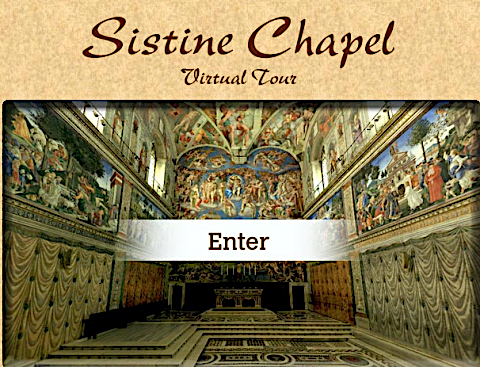
Forget the airports, the ticket lines, and the crowds. Now you can step right into the Vatican’s most sacred spaces and inspect the wonders of Renaissance art and architecture with just a click of a mouse. The Vatican has posted a series of virtual tours created by students and faculty in the communication and computing science departments at Pennsylvania’s Villanova University. The four Papal Basilicas are included, along with the smaller Sistine and Pauline chapels. Here are six links to six amazing virtual tours:
Basilica of St. Peter: Designed by Michelangelo and others, St. Peter’s is the focal point of the Vatican, and perhaps the most famous example of Renaissance architecture. You can scroll up and down to inspect the walls and ceilings–including the famous dome–and zoom in for a close look at Michelangelo’s masterpiece the Pietà or Bernini’s ornate canopy, or baldachin, over the Papal Altar.
The Sistine Chapel: The most famous building in the Vatican, after St. Peter’s, is the Sistine Chapel, a part of the Pope’s official residence, the Apostolic Palace. Frescoes by Raphael, Bernini, Botticelli and others adorn the walls–and on the ceiling, one of the great masterpieces in the history of art: Michelangelo’s early 16th century depiction of scenes from the Book of Genesis, covering some 12,000 square feet. On a walking tour you would barely have enough time to recognize some of the major scenes. With this virtual tour you can spend all the time you want scanning around and zooming in to study the details.
Archbasilica of St. John Lateran: The Pope’s official ecclesiastical seat, St. John Lateran is the oldest Papal Basilica. But many of its most famous features are relatively recent. The basilica is perhaps best known for its neoclassical façade by Alessandro Galilei, completed in 1735.
Basilica of Paul Outside-the-Walls: Built outside the old city walls, this basilica contains the tomb of St. Paul. You can see the tomb and other features of the graceful church (which was rebuilt in the 19th century after a devastating fire) on the tour.
Basilica of St. Mary Major: This basilica is actually located outside the Vatican City compound, in Rome, but has extraterritorial status similar to that of a foreign embassy. Built in the fifth century, with some later additions, the basilica is a beautiful example of classical Roman architecture.
The Pauline Chapel: Another chapel in the Apostolic Palace, the Pauline Chapel is separated from the Sistine Chapel by the Sala Regia, or “Regal Room.” Although less well-known than the Sistine Chapel, the Pauline Chapel houses two great frescoes by Michelangelo: “The Conversion of Saul” and “The Crucifixion of St. Peter.”
If you would like to support the mission of Open Culture, consider making a donation to our site. It’s hard to rely 100% on ads, and your contributions will help us continue providing the best free cultural and educational materials to learners everywhere. You can contribute through PayPal, Patreon, and Venmo (@openculture). Thanks!
Everyone on the internet knows the bitter disappointment of clicking on lists that sound more interesting than they turn out to be, just as enthusiasts of American history have grown weary of hearing claims about what has or hasn’t “changed America.” (Last year, comedy writer Alison Agosti elegantly smacked down both trends in one tweet.) But I have a feeling that PBS and station WTTW’s new series Ten Buildings that Changed America can pull the combination off with snappiness and insight. Hosted by Geoffrey Baer, television personality and noted enthusiast of Chicago (an American built environment if ever there was one), the show promises a look at, among other architectural windows onto the American spirit, “a state capitol that Thomas Jefferson designed to resemble a Roman temple, the home of Henry Ford’s first assembly line, the first indoor regional shopping mall,” and “an airport with a swooping concrete roof that seems to float on air.”
You can watch the debut episode of Ten Buildings that Changed America online. It begins the cross-country architectural road trip in Richmond, Virginia, where Baer visits future President Thomas Jefferson’s state capitol building. “As a founding father of the United States, Thomas Jefferson was passionate about America’s independence from Britain,” says the show’s page on the building. “He was no fan of the king of England and, by extension, no fan of the Georgian architecture that bore the kings’ name,” an inclination which got him looking toward France for inspiration. Subsequent episodes will examine other striking, innovative, influential, and oft-imitated American buildings: Frank Lloyd Wright’s Robie House in Baer’s beloved Chicago, Mies van der Rohe’s Seagram Building in New York City, and even Frank Gehry’s Disney Concert Hall, the still-controversial new icon of the downtown Los Angeles where I type this very post.
Frank Lloyd Wright was one of the most admired and influential architects of the 20th century. He was a flamboyant, unabashedly arrogant man who viewed himself from an early age as a genius. Others tended to agree. In 1991, The American Institute of Architects named Wright the greatest American architect of all time.
Wright believed that the adage “form follows function” was something of a misstatement. “Form and function should be one,” he said, “joined in a spiritual union.” A sense of spiritual union ran all through Wright’s work. He identified God with Nature (which he spelled with a capital “N”) and strove to design buildings that were in harmony with their natural surroundings. “No house should ever be on a hill or on anything,” Wright wrote in his 1932 autobiography. “It should be of the hill. Belonging to it. Hill and house should live together each the happier for the other.”
Wright spoke about life and the creativity of man in mystical terms. In this rare recording from June 18, 1957, a 90-year-old Wright describes his philosophy. “Man is a phase of Nature,” he says, “and only as he is related to Nature does he matter, does he have any account whatever above the dust.”
As a new-ish parent, I’ve been inundated with alphabet books from well-meaning friends and family, and I am most grateful for them all. But I’m especially glad for a set that uses images from the Metropolitan Museum of Art to illustrate each letter. My daughter gets lost in the paintings, prints, etchings, etc., and you know what? So do I. It’s that rare meeting of adult high art and kid formatting that keeps us both engaged.
The above video, while not strictly for children, could certainly work as well. A concept of the Argentine group Ombu Architecture and graphic designer Federico Gonzalez, “The ABC of Architects” is a vintage flipbook tribute to the last 100 years or so in international architecture, set to a jaunty, golden-age-of-radio score by Eugene C. Rose and George Ruble (which you can download for free here).
With the kind of quaint globe-hopping (but without the passé racism) of a Tintin comic, “The ABC of Architects” skips through its list of twenty-six revered names from almost as many countries–from Finish Alvar Aalto to Iraqi-British Zaha Hadid. There are many names I don’t know and many familiar favorites. I can imagine this appealing to preschoolers or serious students, and for some of the same reasons. While the creators express grief at having to leave out so many artists, “The ABC of Architects” is nothing less than joyous and inspiring.
We're hoping to rely on loyal readers, rather than erratic ads. Please click the Donate button and support Open Culture. You can use Paypal, Venmo, Patreon, even Crypto! We thank you!
Open Culture scours the web for the best educational media. We find the free courses and audio books you need, the language lessons & educational videos you want, and plenty of enlightenment in between.