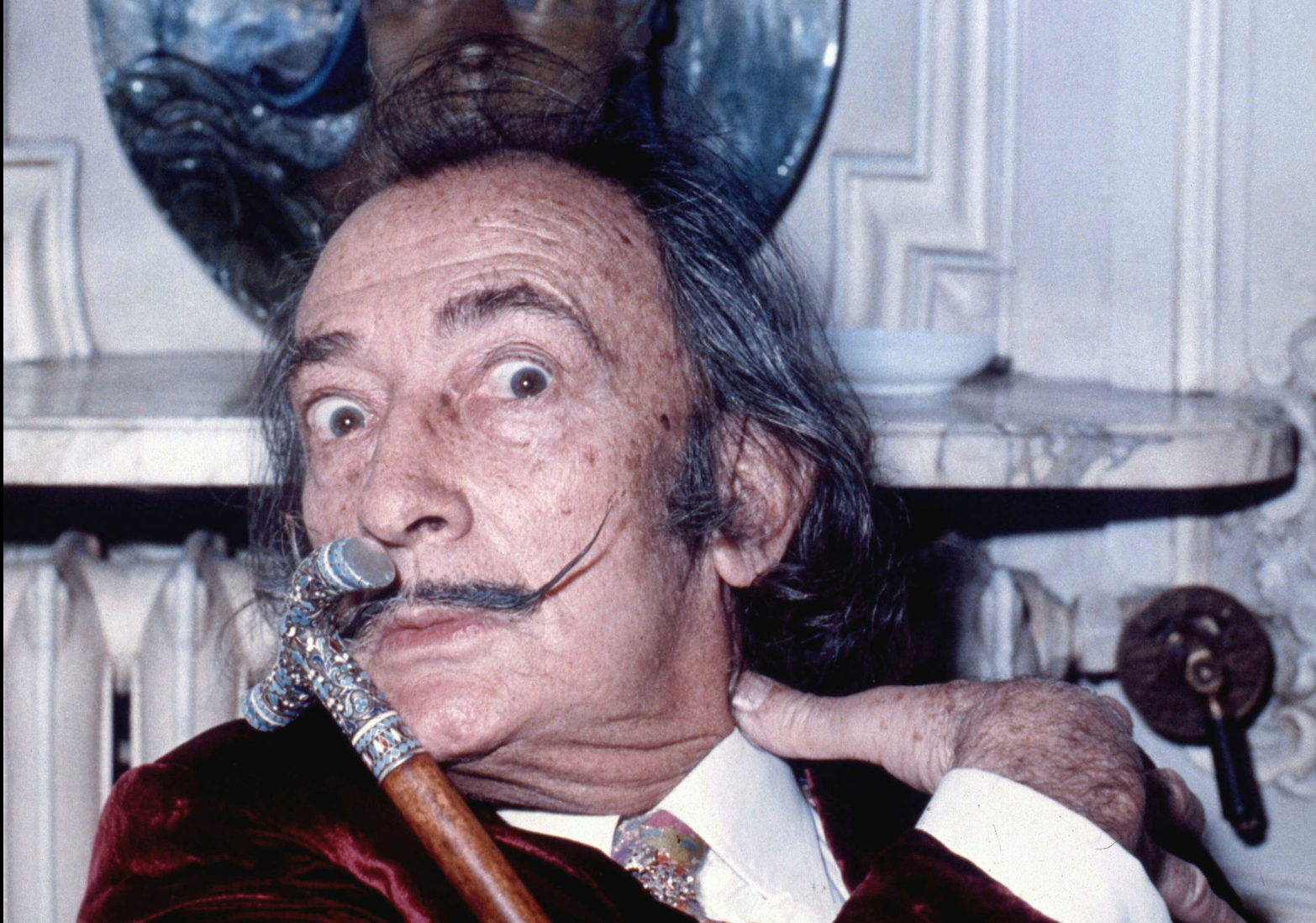
Last month, a Spanish court ordered the exhumation of Salvador Dalí’s, to see whether–as a paternity case claims–he’s the father of María Pilar Abel Martínez, a tarot card reader born in 1956. When experts opened his crypt on Thursday night, they encountered a pretty remarkable scene. According to Narcís Bardalet, the doctor who embalmed the artist’s body back in 1989, Dalí’s face was covered with a silk handkerchief – a magnificent handkerchief.” “When it was removed, I was delighted to see his moustache was intact … I was quite moved. You could also see his hair.” “His moustache is still intact, [like clock hands at] 10 past 10, just as he liked it. It’s a miracle.” “The moustache is still there and will be for centuries.” That’s perhaps the last surviving trace of Dalí’s schtick that will remain.
If you would like to support the mission of Open Culture, consider making a donation to our site. It’s hard to rely 100% on ads, and your contributions will help us continue providing the best free cultural and educational materials to learners everywhere. You can contribute through PayPal, Patreon, and Venmo (@openculture). Thanks!
We think of Johannes Gutenberg’s printing press (circa 1440) to have begun the era of the printed book, since his invention allowed for mass production of books on a scale unheard of before. But we must date the invention of printing itself much earlier—nearly 600 years earlier—to the Chinese method of xylography, a form of woodblock printing. Also used in Japan and Korea, this elegant method allowed for the reproduction of hundreds of books from the 9th century to the time of Gutenberg, most of them Buddhist texts created by monks. In the 11th century, writes Elizabeth Palermo at Live Science, a Chinese peasant named Bi Sheng (Pi Sheng) developed the world’s first movable type.” The technology may have also arisen independently in the 14th century Yuan Dynasty and in Korea around the same time.
Despite these innovations, xylography remained the primary method of printing in Asia. The “daunting task” of casting the thousands of characters in Chinese, Japanese, and Korean “may have made woodblocks seem like a more efficient option for printing these languages.” This still-labor-intensive process produced books and illustrations for several centuries, a good many of them incredible works of art in their own right.
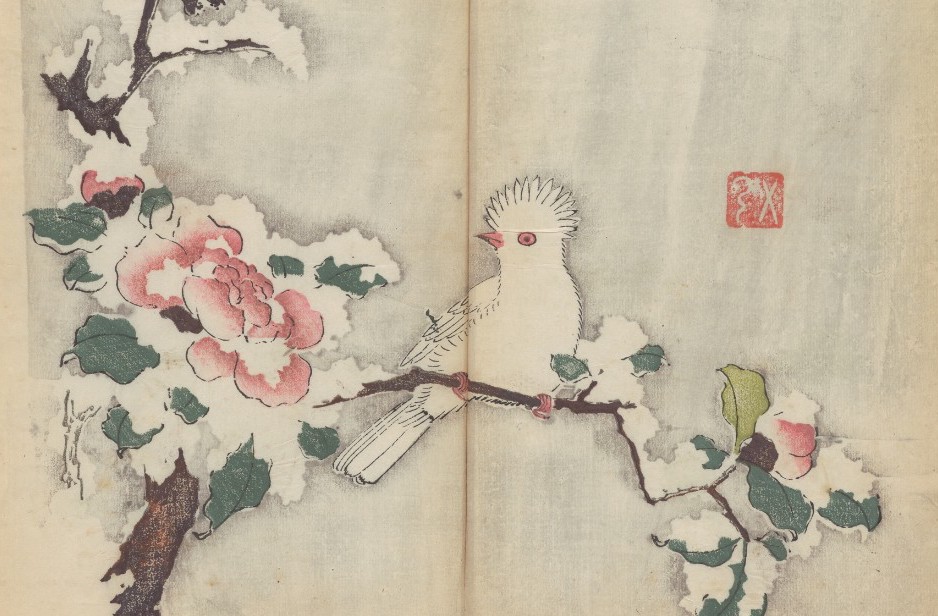
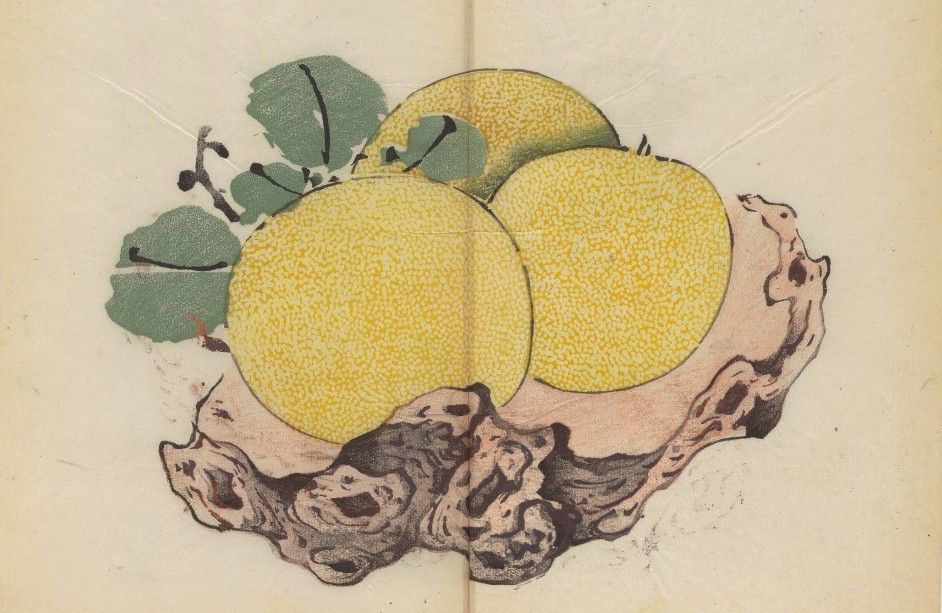
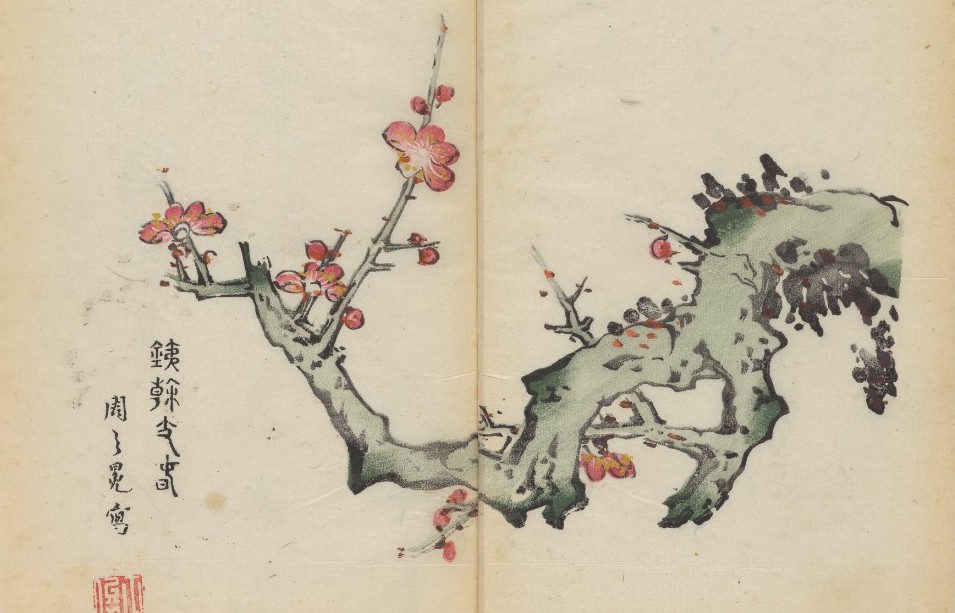
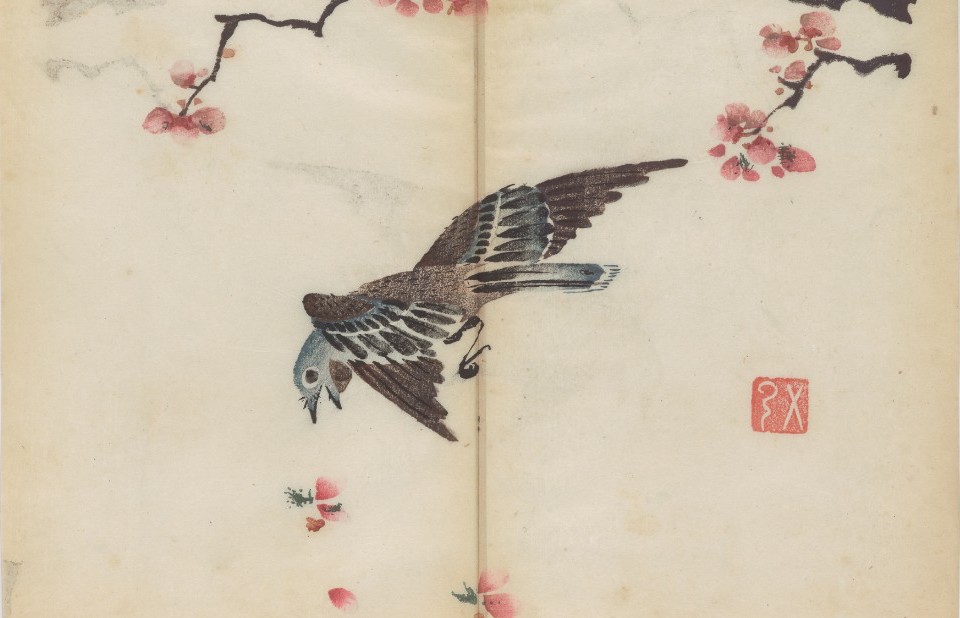
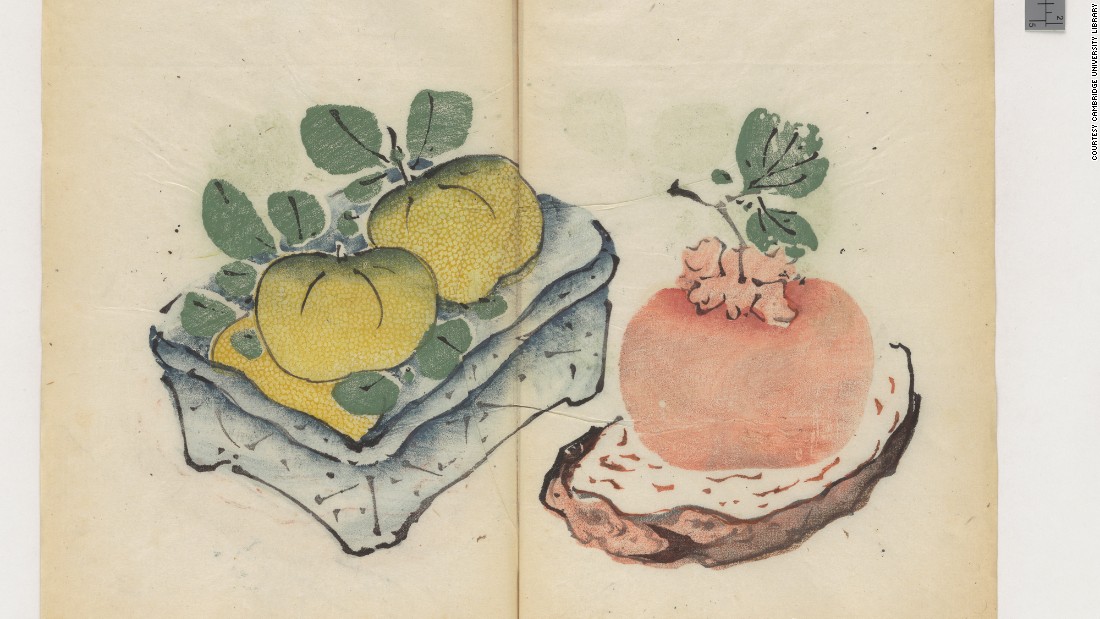
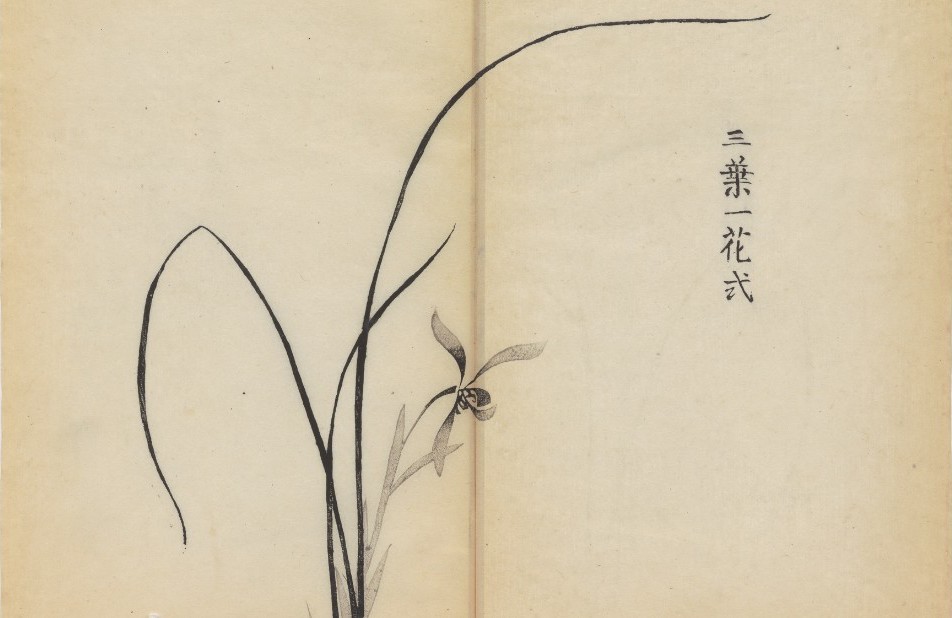
Published by Hu Zhengyan’s Ten Bamboo Studio in Nanjiang, this manual for teachers contains 138 pages of multicolor prints by fifty different artists and calligraphers and 250 pages of accompanying text. “The method” that produced the stunning artifact “involves the use of multiple printing blocks which successively apply different coloured inks to the paper to reproduce the effect of watercolour painting.” Kept untouched in Cambridge’s “most secure vaults,” the book was unsealed for the first time just a couple years ago. “What surprised us,” remarked Charles Aylmer, head of the Library’s Chinese Department, “was the amazing freshness of the images, as if they had never been looked at for over 300 years.”
The 17th century copy is “unique in being complete, in perfect condition and in its original binding.” (Another, incomplete, copy was acquired in 2014 by the Huntington Library in San Marino, CA.) The book contains many “detailed instructions on brush techniques,” writes CNN, “but its phenomenal beauty has meant from the outset that it has held a greater position” than other such manuals. Like another gorgeous multicolor painting textbook, the Manual of the Mustard Seed Garden, made in 1679, this text had a significant impact on the arts in both China and Japan, “where it inspired a whole new branch of printing.”
If you want to see where art began, go to a cave. Not just any cave, but not just one cave either. You’ll find the best-known cave paintings at Lascaux, an area of southwestern France with a cave complex whose walls feature over 600 images of animals, humans, and symbols, all of them more than 17,000 years old, but other caves elsewhere in the world reveal other chapters of art’s early history. Some of those chapters have only just come into legibility, as in the case of the cave near the Ethiopian city of Dire Dawa recently determined to be the world’s oldest “art studio.”
“The Porc-Epic cave was discovered by Pierre Teilhard de Chardin and Henry de Monfreid in 1929 and thought to date to about 43,000 to 42,000 years ago, during the Middle Stone Age,” writes Sarah Cascone at Artnet.
There, archaeologists have found “a stash of 4213 pieces, or nearly 90 pounds, of ochre, the largest such collection ever discovered at a prehistoric site in East Africa.” The “ancient visitors to the site processed the iron-rich ochre stones there by flaking and grinding the raw materials to produce a fine-grained and bright red powder,” a substance useful for “symbolic activities, such as body painting, the production of patterns on different media, or for signalling.”
In other words, those who used this ochre-rich cave over its 4,500 years of service used it to produce their tools, which functioned like proto-stamps and crayons. You can read about these findings in much more detail in the paper “Patterns of change and continuity in ochre use during the late Middle Stone Age (MSA) of the Horn of Africa: The Porc-Epic Cave record” by Daniela Eugenia Rosso of the University of Barcelona and Francesco d’Errico and Alain Queffelec of the University of Bordeaux. In it, the authors “identify patterns of continuity in ochre acquisition, treatment and use reflecting both persistent use of the same geological resources and similar uses of iron-rich rocks by late MSA Porc-Epic inhabitants.”
The Ethiopian site contains so much ochre, in fact, that “this continuity can be interpreted as the expression of a cohesive cultural adaptation, largely shared by all community members and consistently transmitted through time.” The more evidence sites like the Porc-Epic cave provide, the greater the level of detail in which we’ll be able to piece together the story of not just art, but culture itself. Culture, as Brian Eno so neatly defined it, is everything you don’t have to do, and though drawing in ochre might well have proven useful for the prehistoric inhabitants of modern-day Ethiopia, one of them had to give it a try before it had any acknowledged purpose. Little could they have imagined what that action would lead to over the next few tens of thousands of years.
When television appeared in Japan in the 1950s, most people in that still-poor country could only satisfy their curiosity about it by watching the display models in store windows. But by the 1980s, the Japanese had become not just astonishingly rich but world leaders in technology as well. It took something special to make Tokyoites stop on the streets of Akihabara, the city’s go-to district for high technology, but stop they did in 1990 when, in the windows of Sony Town, appeared Infinite Escher.
Produced by Sony HDVS Soft Center as a showcase for the company’s brand new high-definition video technology, this short film caused passersby, according to the video description, to “gasp in amazement at the clarity and sharp crisp focus of the picture.”
Running seven and a half minutes, it tells the story of a bespectacled New York City teenager (played by a young Sean Lennon, son of John Lennon and Yoko Ono) who steps off the school bus one afternoon to find M.C. Escher-style visual motifs in the urban landscape all around him: a jigsaw puzzle piece-shaped curbside puddle, a transparent geometrically patterned basketball.
When he goes home to sketch a few artistic-mathematical ideas of his own, he looks into an awfully familiar-looking reflecting sphere and gets sucked into a completely Escherian realm. This sequence demonstrates not just the look of Sony’s high-definition video, but the then-state-of-the-art techniques for dropping real-life characters into computer-generated settings and vice versa. In addition to the visions of the Dutch graphic designer who not just imagined but rendered the impossible, Sony also brought in two of the other powerful creative minds, Japanese musician Ryuichi Sakamoto to create the score and Korean video artist Nam June Paik to do the art direction.
Watching Infinite Escher today may first underscore just how far high-definition video and computer graphics have come over the past 27 years, but it ultimately shows another example of how Escher’s visions, even after the artist’s death in 1972, have remained so compelling that each era — with its own technological, cultural, and aesthetic trends — pays its own kind of tribute to them.
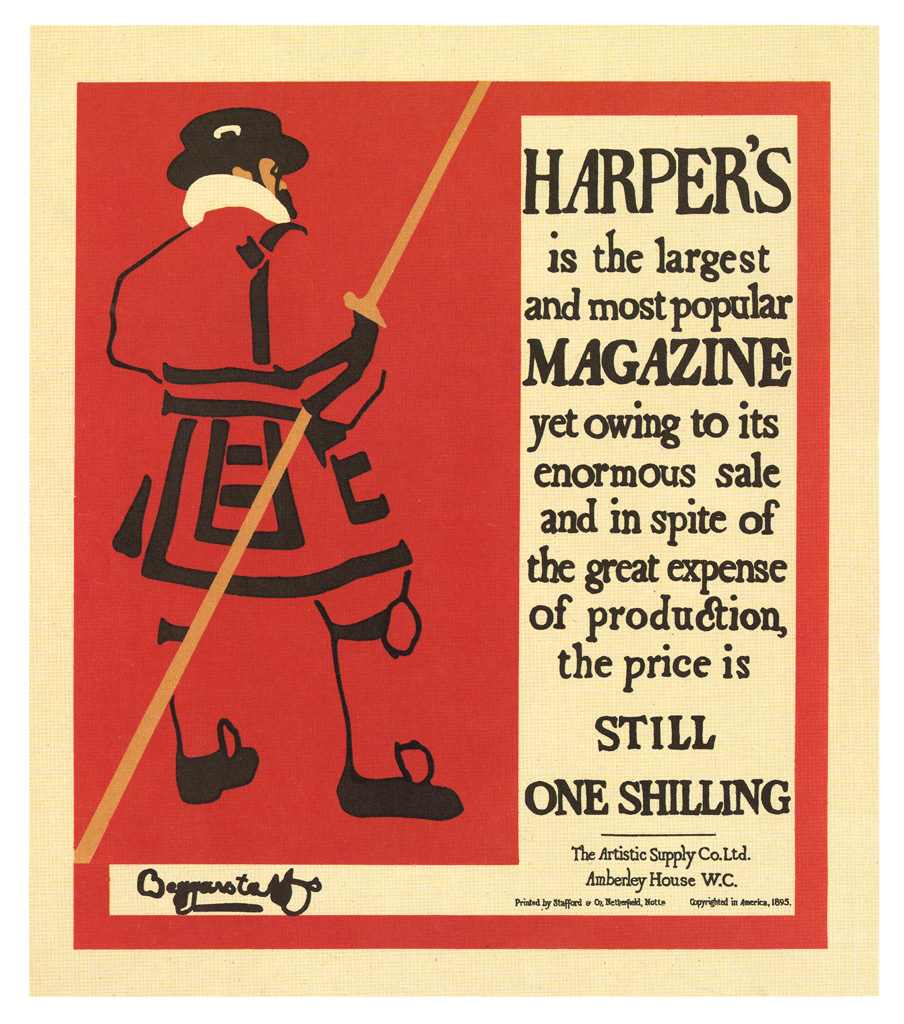
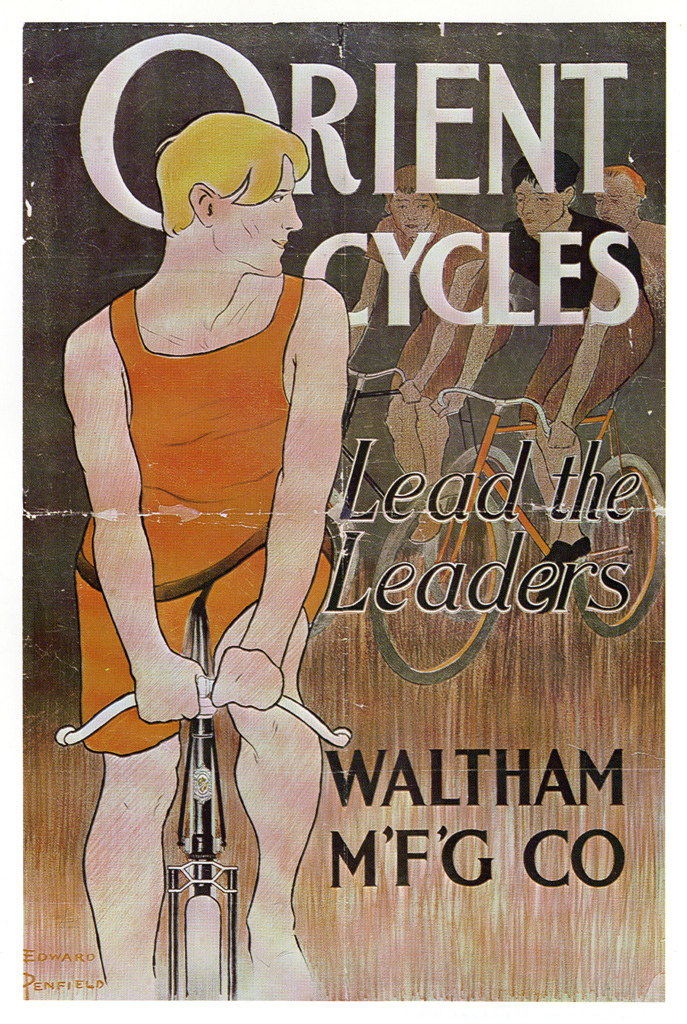
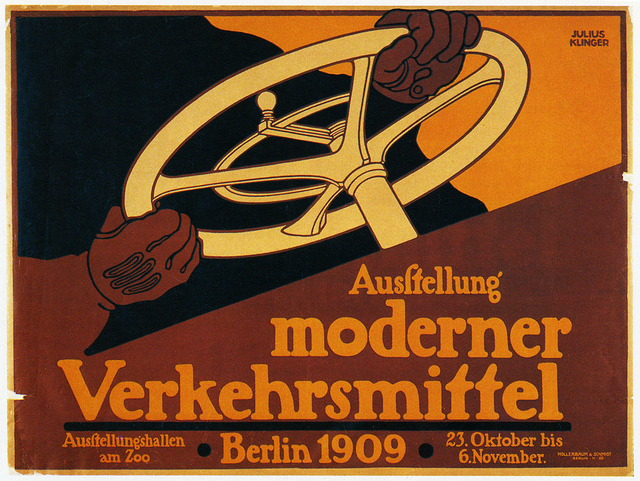
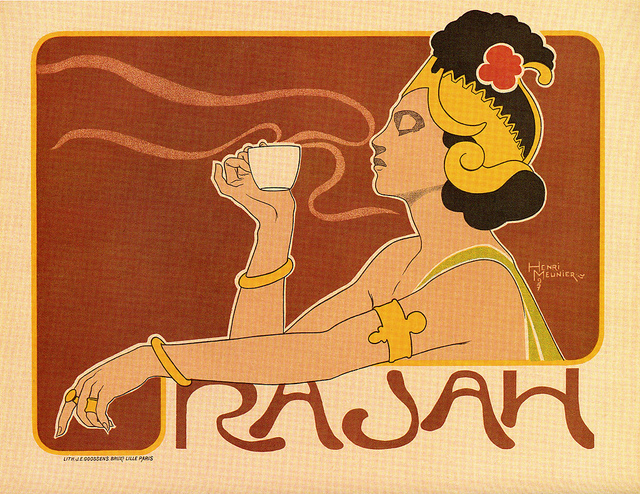
Europe at the end of the nineteenth century and beginning of the twentieth: what a time and place to be alive. Or rather, what a time and place to be alive for people in the right countries and, more importantly, of the right classes, those who saw a new world taking shape around them and partook of it with all possible heartiness. The period between the end of the Franco-Prussian War in 1871 and the outbreak of World War I in 1914, best known by its French name La Belle Époque, saw not just peace in Europe and empires at their zenith, but all manner of technological, social, and cultural innovations at home as well.
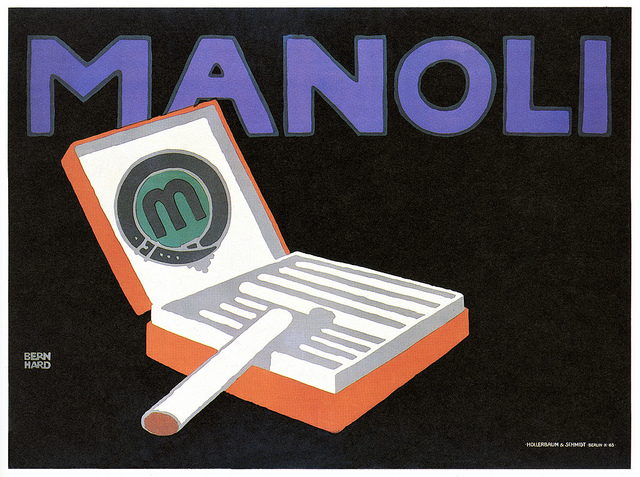
“In the late nineteenth century, lithographers began to use mass-produced zinc plates rather than stones in their printing process,” says the accompanying text. “This innovation allowed them to prepare multiple plates, each with a different color ink, and to print these with close registration on the same sheet of paper. Posters in a range of colors and variety of sizes could now be produced quickly, at modest cost.”
Like other of the most fruitful technological advancements of the era, this leap forward in poster-printing drew the attention, and soon the efforts, of artists: well-regarded illustrators and graphic designers like Alphonse Mucha, Jules Chéret, Eugène Grasset, and Henri de Toulouse-Lautrec took to the new method, and “The ‘Golden Age of the Poster’ was the spectacular result.” While many of the best-remembered posters of that Golden Age come from France, it touched the streets of every major city in western Europe as well as those of England and America, all places whose well-heeled populations found themselves newly and avidly interested in art, photography, motion pictures, magazines, bicycles, automobiles, absinthe, coffee, cigarettes, and world travel.
The companies behind all those exciting things had, of course, to advertise, but unlike in earlier times, they couldn’t settle for getting the word out; they had to use images, and the most vivid ones possible at that. They had to use them in such a way as to associate what they had to offer with the abundant spirit of the time, whether they called that time La Belle Époque, the Wilhelmine period, the late Victorian and Edwardian era, or the Gilded Age. All those names, of course, were applied only in retrospect, after it became clear how bad times could get in the twentieth century. But then, none of us ever realize we’re living through a golden age before it comes to its inevitable end; until that time, best just to enjoy it. You can enter the poster archive here.
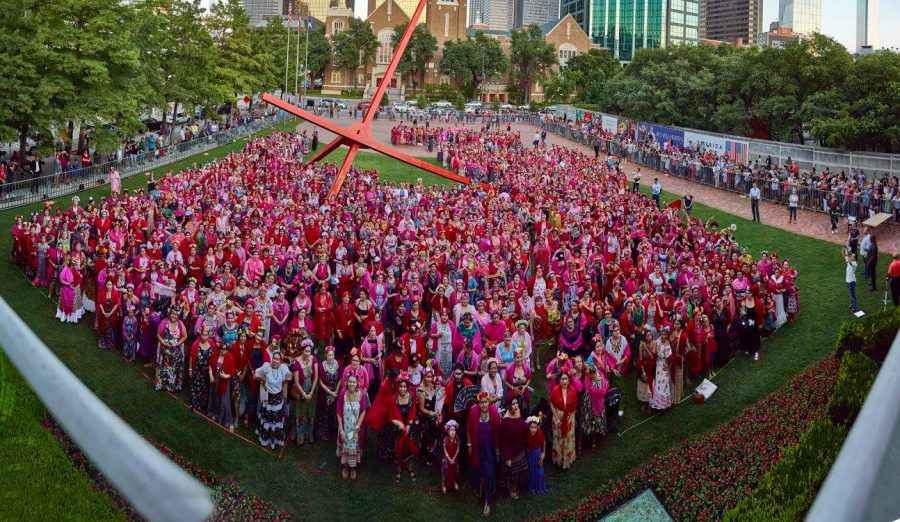
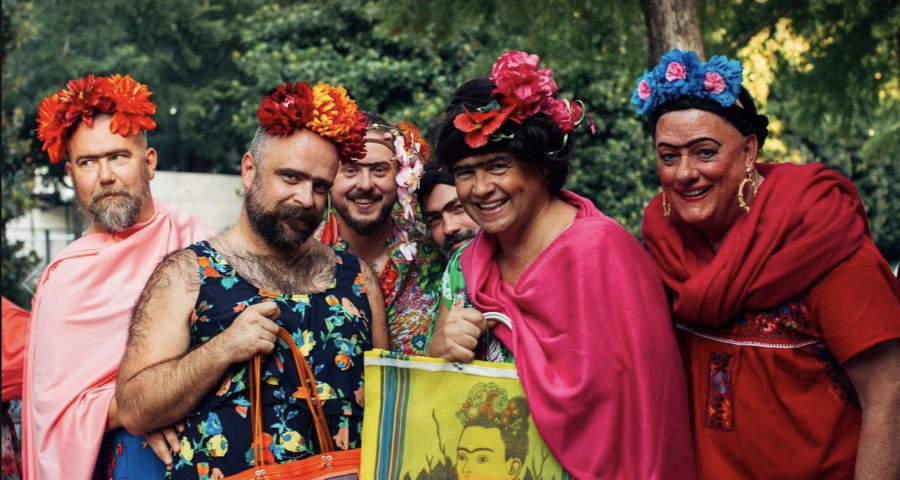
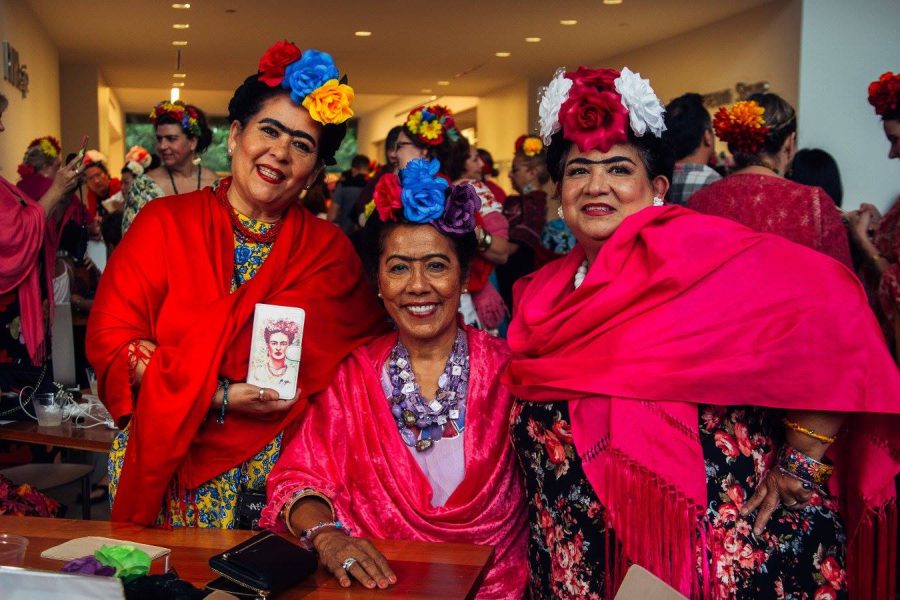
According to the rules of Frida Fest, to participate in the record attempt, individuals had to provide their own costume, and make sure their costumes included the following elements:
A unibrow drawn onto the face joining the eyebrows. This can be done with make-up or by sticking hair.
Artificial flowers worn in the hair, a minimum of three artificial flowers must be worn.
A red or pink shawl.
A flower-printed dress that extends to below the knees on all sides; the dress must not have any slits up the side.
Notes NPR, there’s “no official word yet on whether a record was set, but prior to Thursday, there didn’t appear to be another record-holder listed in the Guinness World Records.”
If you would like to support the mission of Open Culture, consider making a donation to our site. It’s hard to rely 100% on ads, and your contributions will help us continue providing the best free cultural and educational materials to learners everywhere. You can contribute through PayPal, Patreon, and Venmo (@openculture). Thanks!
The San Francisco Museum of Modern Art–otherwise simply known as SFMOMA–has 34,678 artworks in its collections, only 5% of which it can put on display at any given time. That creates an accessibility problem. So the museum asked itself: “How can we provide a more comprehensive experience of our collection?” And they developed Send Me SFMOMA in response.
Send Me SFMOMA is “an SMS service that provides an approachable, personal, and creative method of sharing the breadth of SFMOMA’s collection with the public.” Here’s how it works:
Text 572–51 with the words “send me” followed by a keyword, a color, or even an emoji and you’ll receive a related artwork image and caption via text message. For example “send me the ocean” might get you Pirkle Jones’ Breaking Wave, Golden Gate; “send me something blue” could result in Éponge (SE180) by Yves Klein; and “send me 💐” might return Yasumasa Morimura’s An Inner Dialogue with Frida Kahlo (Collar of Thorns). Each text message triggers a query to the SFMOMA collection API, which then responds with an artwork matching your request.
Give it a spin. See what piece of the SFMOMA collection you get.
If you would like to support the mission of Open Culture, consider making a donation to our site. It’s hard to rely 100% on ads, and your contributions will help us continue providing the best free cultural and educational materials to learners everywhere. You can contribute through PayPal, Patreon, and Venmo (@openculture). Thanks!
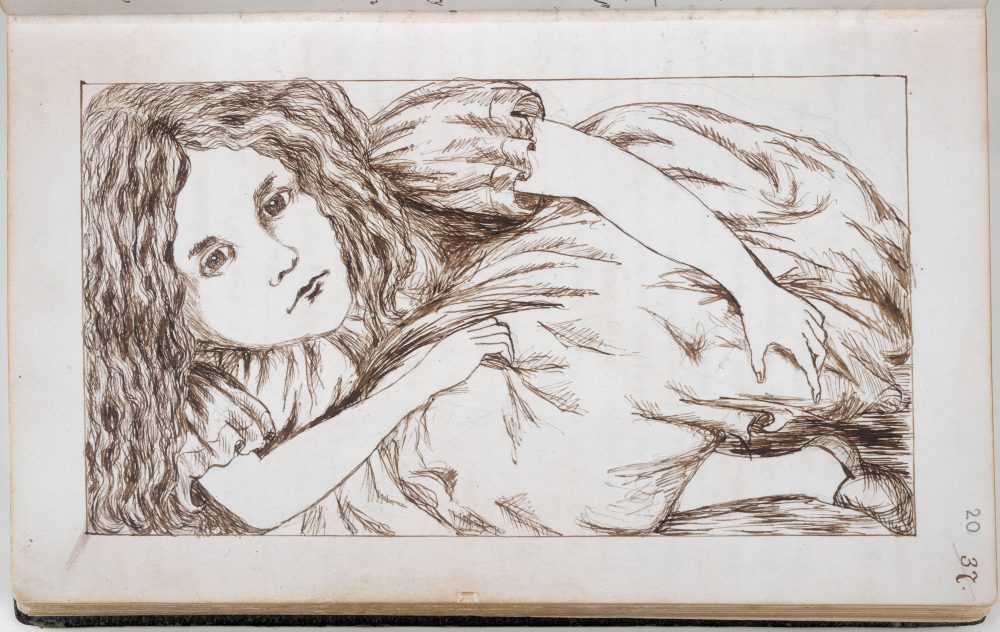
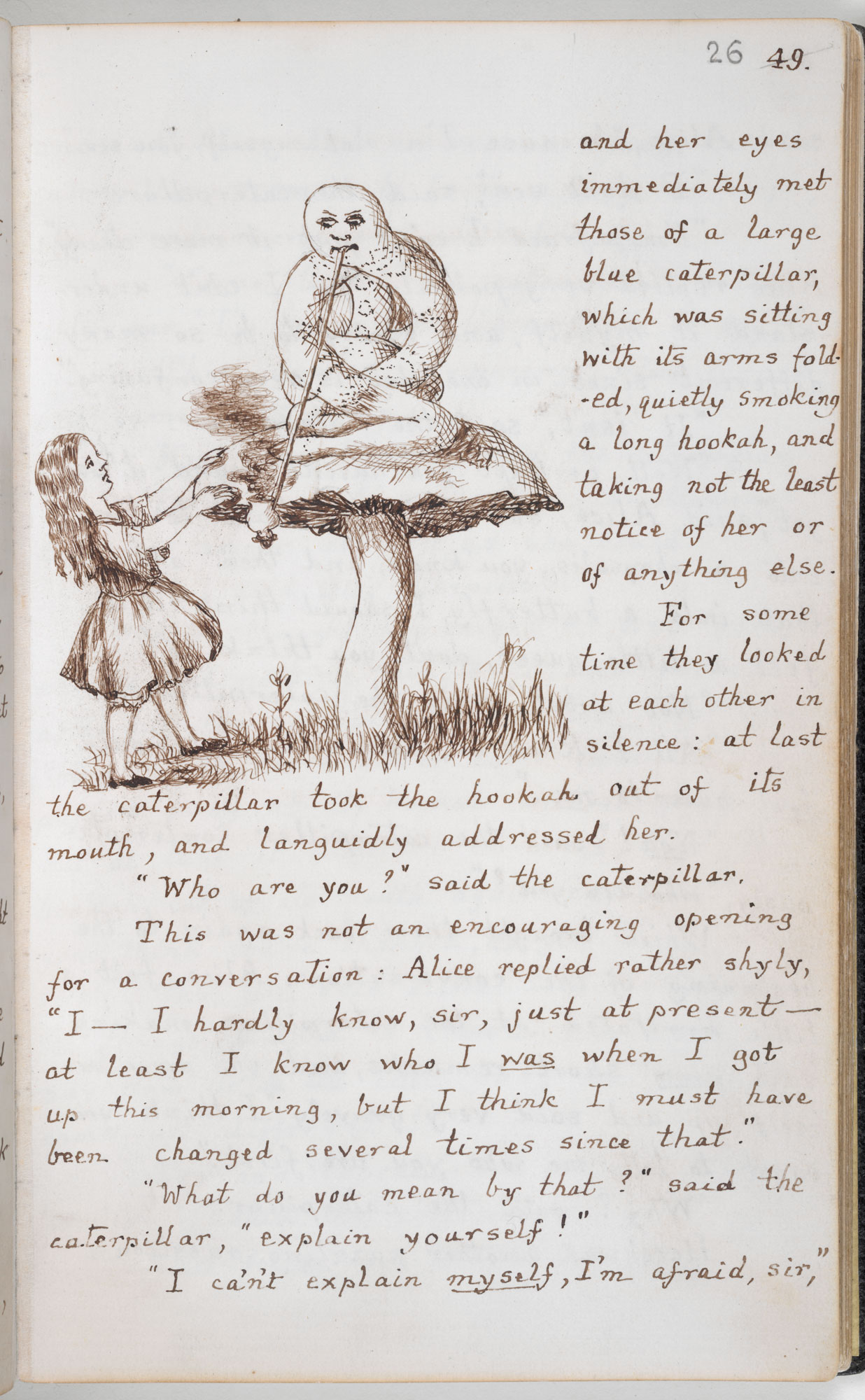
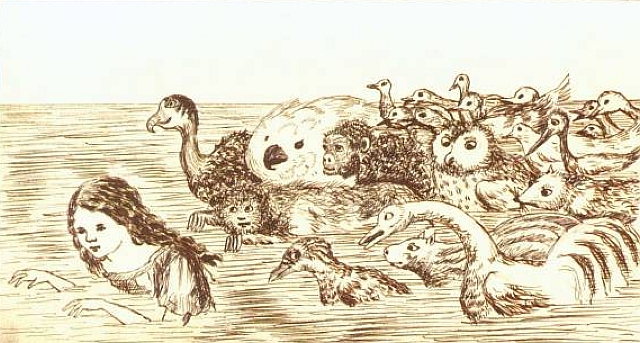
Almost exactly 155 years ago, Lewis Carroll told three young sisters a story. He’d come up with it to enliven a long boat trip up the River Thames, and one of the children aboard, a certain Alice Liddell, enjoyed it so much that she insisted that Carroll commit it to paper. Thus, so the legend has it, was Alice’s Adventures in Wonderland born, although Lewis Carroll, then best known as Oxford mathematics tutor Charles Lutwidge Dodgson, hadn’t taken up his famous pen name yet, and when he did write down Alice’s Adventures in Wonderland, it took its first form as Alice’s Adventures Under Ground. You can read that handwritten manuscript, complete with illustrations.
Carroll presented the fictional Alice’s namesake with the manuscript, according to the British Library, as an early Christmas present in 1864. When his friends encouraged him to publish it, he performed a few revisions, “removing some of the family references included for the amusement of the Liddell children,” adding a couple of chapters (the beloved Cheshire Cat and the Mad Hatter’s tea party being among their new material), and enlisting John Tenniel, a Punch magazine cartoonist known for his illustrations of Aesop’s Fables, to create professional art to accompany it. The result, retitled Alice’s Adventures in Wonderland, came out in 1865 and has never gone out of print.
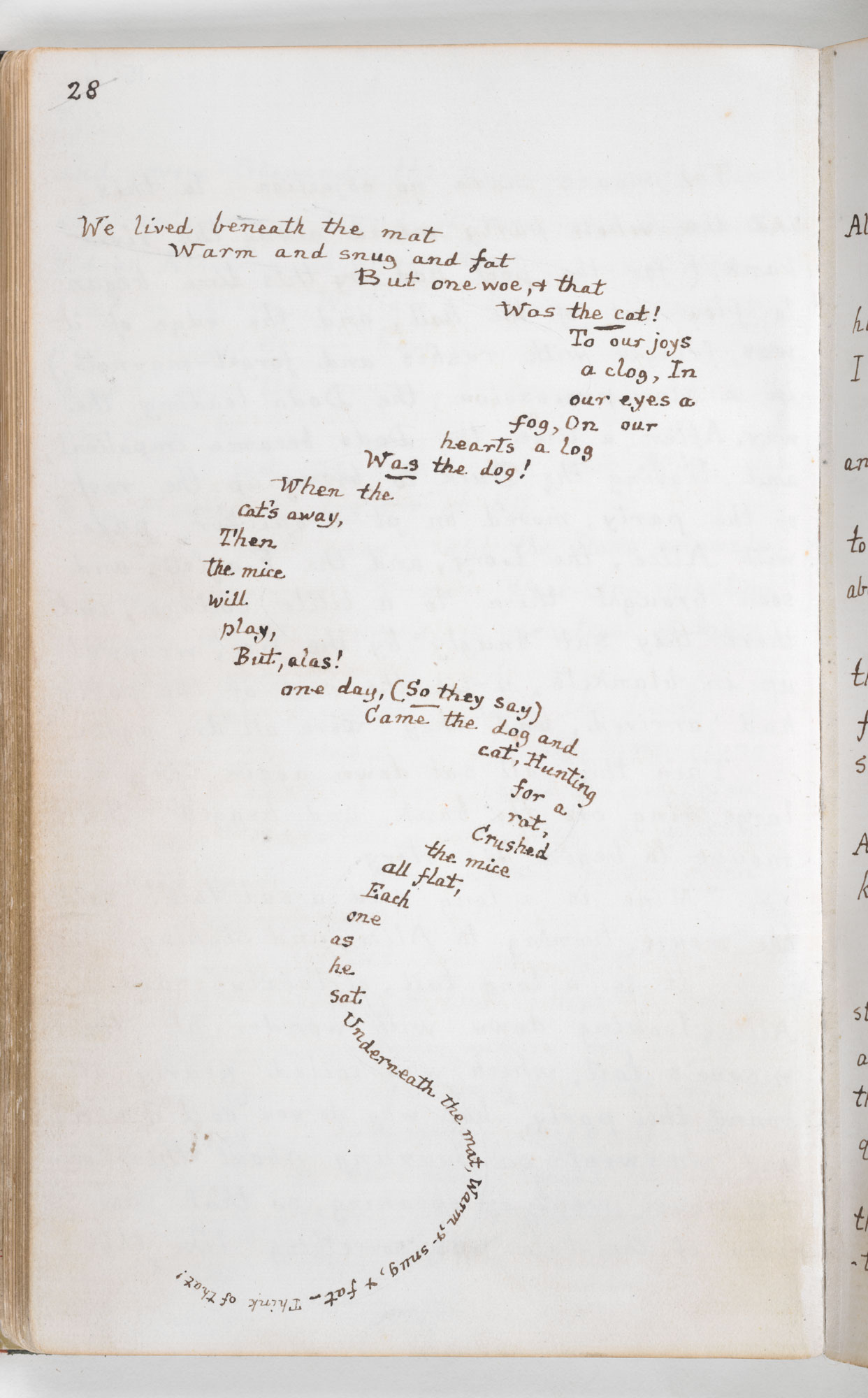
Though Tenniel’s vivid renderings of Alice and the eccentric characters she encounters have remained definitive, plenty of other artists, including Salvador Dalí and Ralph Steadman, have attempted the surely almost irresistible challenge of illustrating Carroll’s highly imaginative story. But today, says Skidmore College professor Catherine J. Golden at The Victorian Web, “critics have reevaluated Carroll’s caricature-style illustration. Carroll expertly intertwines his handwritten text with his pictures to advance the growth motif. His conception of the mouse’s ‘tale’ shaped like an actual mouse’s ‘tail’ is an excellent example of emblematic verse.”
Tenniel, Golden argues, “essentially refashioned with realism and improved upon many of Carroll’s sketchy or anatomically incorrect illustrations, adding domestic interiors and landscapes that appealed to middle-class consumers of the 1860s.” Even “late twentieth-century graphic novel adaptations of Alice in Wonderland recall many of Carroll’s inventive designs as well as those of Tenniel,” which gives Carroll’s original manuscript more claim to having provided the visual basis, not just the textual one, for the following century and a half of sequels official and unofficial, as well as adaptations, reenvisionings, and reimaginings of this “Christmas gift to a dear child in memory of a summer day.”
We're hoping to rely on loyal readers, rather than erratic ads. Please click the Donate button and support Open Culture. You can use Paypal, Venmo, Patreon, even Crypto! We thank you!
Open Culture scours the web for the best educational media. We find the free courses and audio books you need, the language lessons & educational videos you want, and plenty of enlightenment in between.