“When I got off the boat from France years ago, the first person I met was Salvador Dalí, and I realized I was born surrealist,” said Isabelle Collin Dufresne, better known by her artistic nom-de-plume Ultra Violet. Dufresne died Saturday in New York City after years of battling cancer. She may have been inspired by Dalí, but she was also a legitimate artist in her own right.
Though perhaps not as well known as other “superstars” linked to Andy Warhol such as Edie Sedgwick or the Velvet Underground, Ultra Violet worked in a similar pop style. Her creations were symbolic, approachable and vibrant. Of course, she associated strongly with the color in her namesake—violet was one of the most important colors in her palette.
“It’s in my color, my signature, but it’s also in the color of mourning, the royal color,” she said of a violet memoriam to the events of September 11.
A New Yorker by choice, Ultra Violet was one of probably thousands to create art after the September 11, 2001 terrorist attacks. “IXXI” was distinctly non-political. It neither attacks nor defends; it only memorializes. It portrays the Roman numerals for nine and 11. A palindrome, she noted.
Once allegedly “exorcised” in her hometown in France, Dufresne grew up in a conservative, religious household. It wasn’t until she came to the United States that she became a serious participant in the art world.
The youthful energy around many of the Factory artists didn’t always age well. As an older woman, Ultra Violet sometimes looked strange with her violet hair and flamboyant clothing, and she was sometimes criticized for producing sloppy work instead of developing a tighter style with age.
Pieces like 2007’s “Electric Love Chair” even reference the glory days of Pop Art, but Ultra Violet spent most of her life experimenting with new ideas and technologies for the production of art.
“I’m interested more in the future than in the past,” she told Ernie Manouse in a 2005 interview.
This is a guest post from Zach Lindsey, an English as a Second Language Teacher living in Austin, Texas. He’s written about artists’ muses before, for Lehigh Valley Style and Be About It.
The manuscript for Murphy, comprising six notebooks, was auctioned off last year by Sotheby’s to the tune of £962,500 (or over $1.6 million). The book was written between the years of 1935 to 1936 and the manuscript shows numerous revisions. It also contains this doodle (above) of Charlie Chaplin, who would later influence his seminal play Waiting for Godot. Beckett’s doodle of James Joyce appears beneath it.
For someone who made a career exploring heavy themes like nothingness and futility, his drawings are nothing like the stark, angular doodles of Franz Kafka. Beckett’s pictures are curvy, light-hearted and whimsical. Look at the drawing below. I really don’t know what’s going on there but it sort of looks like a man in earmuffs giving birth to a hat.
And this one is of a couple golfers.
Beckett’s second novel Watt, the last book he wrote in English, also took up six notebooks. According to Beckett’s recollections, Watt was written “in drips and drabs” while he was in living in France during WWII. In the first notebook, alongside an X‑ed out page of text is this odd drawing of a long-haired centaur in a top hat.
And this page, in the second notebook, features a bunch of terrific, strikingly graphic doodles including one that looks like Morley Safer in an Asian cone hat. (Again with the hats.)
Jonathan Crow is a Los Angeles-based writer and filmmaker whose work has appeared in Yahoo!, The Hollywood Reporter, and other publications. You can follow him at @jonccrow.
Unlikely collaborations in pop music abound: Run DMC and Aerosmith? It works! U2 and Luciano Pavarotti? Why not? Robert Plant and Alison Krauss? Sure! Anyone and Kermit the Frog? Yes. They don’t always work out, but the attempts, whether kismet or trainwreck, tend to reveal a great deal about the partners’ strengths and weaknesses. Unlikely collaborations in feature film are somewhat rarer, though not for lack of wishing. I would guess the high financial stakes have something to do with this, as well as the sheer number of people required for the average production. One particularly salient example of an ostensible mismatch in animated movies—a planned co-creation by surrealist Salvador Dalí and populist Walt Disney—offers a fascinating look at how the two artists’ careers could have taken very different creative directions. The collaboration may also have fallen victim to a film industry whose economics discourage experimental duets.
We’ve previously featured the animated short— Destino—at the top of the post. The 6 and a half minute film shows us what Dalí and Disney’s planned project might have looked like. Recreated from 17 seconds of original animation and storyboards drawn by Dalí and released in 2003 by Disney’s nephew Roy, Destino gives us an almost perfect symbiosis of the two creators’ sensibilities, with Walt Disney’s Fantasia-like flights smoothly animating Dalí’s fluid dream imagery. According to Chris Pallant, author of Demystifying Disney, work between the two on the original project also moved smoothly, with little friction between the two artists. Meeting in 1945, Dalí and Disney “quickly developed an industrious working relationship” and “ease of collaboration.” Pallant writes that “Disney’s desire for absolute creative control changed, and, for the first time, the animators working within the studio felt the influence of other artistic forces.” I imagine it might prove difficult, if not impossible, to micromanage Salvador Dalí. In any case, the fruitful relationship produced results:
Destino reached a relatively advanced stage before being abandoned. By mid-1946 the Disney- Dalí collaboration encompassed approximately ’80 pen-and-ink sketches’ and numerous ‘storyboards, drawings and paintings that were created over nine months in 1945 and 1946.’
Roy E. Disney discovered Dalí’s Destino artwork in the late 90s, leading to his short re-creation of what might have been. Above, you can flip through a slideshow of twelve of those drawings and storyboards, courtesy of Park West Gallery, who represent the work. The Destino materials went on display at the Drawings Room in Figueres, Spain. The exhibition featured “1 oil painting, 1 watercolour, 15 preparatory drawings—10 of which are unpublished—and 9 photographs of Dalí in the creative process of this material, of the Disney couple in Port Lligat in 1957, and the Dalí couple in Burbank.” You can see many of those photographs in the exhibit’s pamphlet (in pdf here, in Spanish and English; cover image below), which offers a detailed description of the original project, including its narrative concept, a “love story” between a dancer and “baseball-player-cum-god Cronos” meant to represent “the importance of time as we wait for destiny to act on our lives.”
Inspired by a Mexican song by Armando Dominguez, Destino, on its face, seems like a very strange choice for Disney, who generally trafficked in more recognizable (and European) folk-tale sources. And yet, the exhibition pamphlet asserts, the co-production made a great deal of sense for Dalí, “if we consider that one Dalinian constant is his bringing together of the elitist artistic idea and mass culture (and vice versa) […]. Destino becomes a unique artistic product in which Dalinian expressiveness is combined with Disney’s fantasy and sonority, making it a film in which Dalí’s images take on movement and Disney’s figures become ‘Dalinised.’ ”
And yet, while both Dalí and Disney worked excitedly on the project, it was ultimately not to be, at least until almost sixty years later. Destino would have been part of a “package film,” like Fantasia, a compilation of short vignettes. John Hench, a Disney artist who worked on the project with Dalí, speculated that the company “foresaw the end” of such features. Pallant, however, goes further in speculating the film “would have resembled a potential box-office bomb” for Disney, who remarked later that is was “no fault of Dalí’s that the project… was not completed—it was simply a case of policy changes in our distribution plans.”
This cryptic remark, writes Pallant, alludes to Disney’s plans to focus his creative energy on “safe” feature-length projects “to strengthen the company’s position within the film industry.” While such a decision might have made good business sense, it probably doomed many more Destino-like ideas that might have made the Walt Disney company a very different entity indeed. One can only imagine what the studio might have become had Disney opted to pursue experiments like this instead of taking the more profitable route. Of course, given the market pressures on the movie industry, it’s also possible the studio might not have survived at all.
Upon his tragic early death at 40, John Lennon left behind a body of work few popular artists could hope to equal. And that’s only the published stuff. As we pointed out in a recent post on his home demos, the former Beatle also left hundreds of hours of tape recordings for his fans to sift through, and, as if that weren’t enough, Sotheby’s recently auctioned off a storehouse of original manuscripts and autographed drawings for two books Lennon wrote in the mid-sixties, In His Own Write (1964) and A Spaniard in the Works (1965), a Sherlock Holmes parody.
Lennon’s playful sense of humor and surreal imagination shine through the stories and poems in both books, as does his more moody broody side. If anything, Lennon’s wordplay and out-there line drawings closely resemble the work of Shel Silverstein, who was probably not an influence but certainly a kindred spirit. Sotheby’s specialist Gabriel Heaton cites as Lennon’s influence “the nonsense tradition of English literature,” and indeed Lewis Carroll comes to mind when reading his work. See, for example, “About The Awful,” his author’s statement for In His Own Write:
I was bored on the 9th of Octover 1940 when, I believe, the Nasties were still booming us led by Madolf Heatlump (who only had one). Anyway they didn’t get me. I attended to varicous schools in Liddypol. And still didn’t pass — much to my Aunties supplies. As a member of the most publified Beatles my (P, G, and R’s) records might seem funnier to some of you than this book, but as far as I’m conceived this correction of short writty is the most wonderfoul larf I’ve every ready.
God help and breed you all.
And then there’s the artwork. At the top, see an untitled ink drawing of a vicar leering at a nude couple (and holding in his hand “That Book”). The drawing above shows a clique of naked partiers, with the caption “Puffing and globbering they drugged theyselves rampling or dancing with wild abdomen, stubbing in wild postumes amonst themselves…”
Recalling the artwork in Silverstein’s The Giving Tree, directly above we have a simple illustration for a poem called “I Sat Belonely,” captioned with the poem’s first two lines: “I Sat Belonely Down a Tree, Humbled Fat and Small” (read the full poem here).
Another Silversteinian drawing is titled “A Lot of Flies on His Wife” from a short story called “No Flies on Frank,” whose title character speaks in an argot right out of James Joyce: “I carn’t not believe this incredible fact of truth about my very body which has not gained fat since mother begat me at childburn. Yea, though I wart through the valet of thy shadowy hut I will feed no norman. What grate qualmsy hath taken me thus into such a fatty hardbuckle.”
Just above, Lennon sketches a Picasso-like four-eyed guitarist in this untitled drawing (notice the tiny cyclist at his feet)—estimated by Sotheby’s between $15,000 and $25,000. The eighty nine lots that went up for auction included many other drawings (see more here) and some handwritten notes from Paul McCartney. All told, the sale netted close to $3 million, though for Lennon devotees, these artifacts are priceless. .
Every true Renaissance man needed a wealthy patron, and many Italian artist-inventor-scholar-poets found theirs in Lorenzo de’Medici, scion of a Florentine dynasty and himself a scholar and poet. Lorenzo either sponsored directly or helped secure commissions for such 15th century art stars as Michelangelo Buonaroti and Leonardo da Vinci.
Among Lorenzo’s many artist friends was a painter who mostly disappeared from history until the late nineteenth century, when the rediscovery of his Primavera and Birth of Venus made him one of the most popular of Renaissance artists. I’m referring of course, to Sandro Botticelli, portraitist of Lorenzo de’Medici, his father, and grandfather and also, it turns out, illustrator of Dante Alighieri’s Divine Comedy.
In 1550, the so-called “father of art history” Giorgio Vasari recorded that “since Botticelli was a learned man, he wrote a commentary on part of Dante’s poem, and after illustrating the Inferno, he printed the work.” The painter also made a portrait of Dante, Vasari tells us, and drew sketches for engravings in the first Florentine edition of The Divine Comedy in 1481.
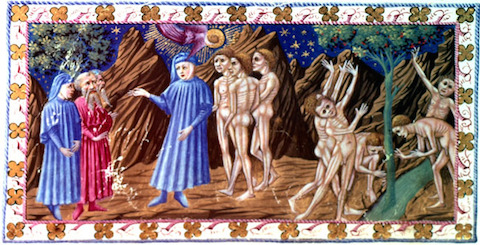
It seems, however, that Botticelli’s interest in Dante went much further than even Vasari knew. Sometime late in his career—after he had already achieved local renown in Florence—Botticelli promised his patron Lorenzo an illustrated Divine Comedy on sheepskin with a separate image for each Canto, something no artist had yet attempted. 92 of those illustrations survive, in various stages of completion, such as the two above, “Panderers, Flatterers” (top–the only drawing in color) and “Giants” (above), both from the Inferno.
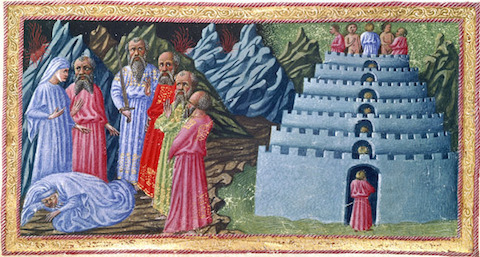
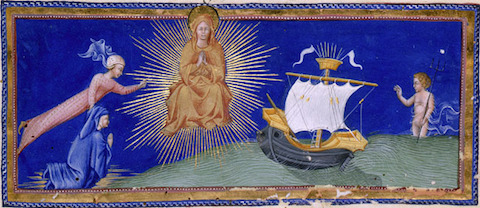
These are two of the most fully realized of the collection. According to art historian Jonathan K. Nelson, “Botticelli completed the outline drawings for nearly all the cantos, but only added colors for a few. The artist shows his ‘learning’ and artistic skill by representing each of the three realms each in a distinctive way.” Many of Botticelli’s drawings for the Purgatorio and Paradiso survive as well, but—like the books themselves—these are increasingly less detailed (and arguably less interesting). See “Dante’s Confession” from the Purgatorio above, his “Map of Hell” at the top, “Jacob’s Ladder” from the Paradiso below, and the remaining 88 illustrations at World of Dante.
Given the detail with which J.R.R. Tolkien describes his fantastical yet earthily grounded characters and landscapes, you’d think illustrators would have an easy time putting pictures to the words. You might even assume that any artist who tried his or her hand at the job would produce more or less the same visual interpretation. And yet the history of illustrated editions of The Hobbit and the Lord of the Rings trilogy hasn’t gone that way at all. Different publishers at different times and different places have commissioned very stylistically different things. We have shown you examples of Tolkien’s Personal Book Cover Designs for The Lord of the Rings Trilogy as well as what Where the Wild Things Are author Maurice Sendak could come up with. And, in March, we featured a playfully visualized Soviet LOTR edition from 1976. Now, take a look at the large set of images here, pulled from a 1993 edition illustrated by Sergey Yuhimov (more information, albeit in Russian, here and here), and you’ll get the sense that the Russians may have a knack for visualizing the goings-on of Middle-Earth.
Still, the illustrations from Russia’s Hobbit and almost 30-years-newer Lord of the Rings could hardly share less of a sensibility. A Metafilter post on the latter draw a number of attempted descriptions by Tolkien fans: “LOTR translated almost as Christian iconography.” “They leap around about 1000 years of art history.” “Mad, but also charming.” “They would make great tarot cards.”
Objections may arise to the accuracy of the characters portrayed — as always — as well as the artist’s adherence (or lack thereof) to the traits of one period of art or another, but we can hardly ignore what an aesthetic impact these illustrations make even just on first glance. Some of the Metafilter commenters express their wishes for The Adventures of HuckleberryFinn (“used in Russian primary school curricula, or was during the Communist era”) illustrated this way, or maybe a Lord of the Rings “in the style of Hieronymus Bosch.” But from these vivid, stylistically Medieval, religious-icon-saturated images, I personally take away one conclusion: when the idea first came to find a director to bring Tolkien to the screen, they really should’ve hired Andrei Tarkovsky.
Now comes another 30,000 images from the Museum of New Zealand. On their blog, they write: “Today we are extremely happy to let you know about our latest development; over 30,000 images downloadable, for free, in the highest resolution we have them.” “Over 14,000 images are available under a Creative Commons licence CC BY-NC-ND,” (which means you can make non-commercial use of these images, so long as you give attribution to the artist.) “But even better are the 17,000 images that are downloadable for any use, any use at all. These images have no known copyright restrictions.” Find more information on this open art initiative here. Or enter the collections right here.
Up top, you will find the photograph called “Cleopatra in Domain Cricket Ground,” taken in Auckland, by Robert Walrond, in 1914.
The second image is from a series called “Five cats,” made in China during the late 18th century, by an unknown artist.
Presenting at the 18th annual Webby Awards last week, Godmother of Punk Patti Smith managed to Adele Dazeem street art provocateur Banksy not once, but twice. Banksky? Ban-ski? It’s a measure of the lady’s august standing that emcee Patton Oswalt passed on the comic opportunities of this giant blunder. He did call her “fucking adorable,” but I like to think he did so with the kindest of intentions.
As to why an artist famous for using the real world as his canvas should be dubbed “Person of the Year” by an outfit that recognizes excellence on the Internet, Smith was nothing short of eloquent. The impermanence of his oft-illegally installed creations make them the perfect candidate “to be archived, shared and stored … through the World Wide Web.” (Apparently, she only just realized this is a synonym for the Internet, but no matter. I’m with Oswalt! It would be a cringeworthy admission in just about anybody else, but from her, it’s pretty dang cute.)
The necessarily low-profile honoree surprised no one by failing to accept his award in person. Rather than sending Sacheen Littlefeather as his proxy, he proffered a delightful, self-mocking short film, which you can see above.
The short revisits some of the high points of “Better In Than Out,” last fall’s month-long, piece-a-day takeover of New York City. Keep your eyes peeled for Sirens of the Lambs, a truck hauling a load of squeaking, ostensibly doomed plush farm animal toys and Queens, an inflatable tag thrown up on his final day as “Artist in Residence for the City of New York.”
My favorite work from his autumnal siege of my city was Art Sale, in which he stocked a Central Park vendor table with half a million dollars’ worth of uncredited stencil art, then installed a decidedly unhip-looking senior citizen to man it. The day’s receipts totaled $420 from a handful of tourists, one of whom successfully bargained her way into a 2‑for‑1 deal.
I want to know more about these people who unwittingly lucked into such a lucrative role in 21st-century art history, but to my consternation, they seem to be flying incognito, just like the artist who so increased their value. You know, the guy who’s all over the internet, without revealing his identity? The Webby Awards’ Person of the Year!?
Maybe if I spend another hour poking around online… (A bad use of time, for all but Patti Smith, who claimed it took her 48 minutes to unsuccessfully download the video we can click with such ease, above.)
We're hoping to rely on loyal readers, rather than erratic ads. Please click the Donate button and support Open Culture. You can use Paypal, Venmo, Patreon, even Crypto! We thank you!
Open Culture scours the web for the best educational media. We find the free courses and audio books you need, the language lessons & educational videos you want, and plenty of enlightenment in between.