What do we have here? Painter Paul Gauguin playing a harmonium at the Paris studio of Alphonse Mucha, a Czech Art Nouveau painter, in or around 1895. How this came about — how Gauguin decided to strip off his pants and shoes and start playing that pump organ — we’ll probably never know. But we’re certainly glad that this light moment was saved for posterity.
If you would like to sign up for Open Culture’s free email newsletter, please find it here. It’s a great way to see our new posts, all bundled in one email, each day.
If you would like to support the mission of Open Culture, consider making a donation to our site. It’s hard to rely 100% on ads, and your contributions will help us continue providing the best free cultural and educational materials to learners everywhere. You can contribute through PayPal, Patreon, and Venmo (@openculture). Thanks!
As a young amateur painter and future art school dropout, I frequently found myself haunted by the faces of two artists, that famously odd couple from my favorite art history novelization—and Kirk Douglas role and Iggy Pop song—Lust for Life. Vincent van Gogh and Paul Gauguin, above and below respectively, the tormented Dutch fanatic and burly French bully—how, I still wonder, could such a pair have ever co-existed, however briefly? How could such beautifully skewed visions of life have existed at all?
Van Gogh and Gauguin’s several self-portraits still inspire wonder. My younger self had the luxury of seeing these particular two up close and in person at the National Gallery of Art in Washington, DC: Van Gogh’s gaunt and piercing visage, Gauguin’s sneering self-parody.
Now, thanks to the wonders of digital technology, my older self, and yours, can view and download high-resolution photos of both paintings, and over 50,000 more from the museum’s vast holdings, through NGA Images, “a repository of digital images of the collections of the National Gallery of Art.”
There you’ll find works by another obsessive Dutch self-portraitist, Rembrandt van Rijn, such as the lush 1659 painting below. You’ll find paintings from the heroes of the various Renaissances and French Impressionism, from movements modern and colonial, pastoral and urban. The collection is dizzying, and a lover of art could easily lose hours sorting through it, saving “open access digital images up to 3000 pixels each […] available free of charge for download and use.” The purpose of NGA Images is “to facilitate learning, enrichment, enjoyment, and exploration,” and there’s no doubt that it satisfies all of those goals and then some. You can peruse the Gallery’s most requested images here.
Browse the various collections, including one devoted to self-portraits. Conduct advanced searches, if you’ve more knowledge of the Gallery’s many treasures. Use the “lightbox arranger” to sort, store, annotate, and save your own personalized collections for future viewing. You are the curator! And the lucky beneficiary of the National Gallery’s beneficence. While I can tell you from experience that it’s nothing like standing face to face with these paintings in their in-real-life dimensions, textures, lines, and colors—despite the throngs of disinterested tourists—it’s at least a close second. And for students and educators of the visual arts, NGA Images offers an opportunity like no other to view and share great works of art often hidden away from even the museum’s visitors. Enjoy!
If you would like to sign up for Open Culture’s free email newsletter, please find it here. It’s a great way to see our new posts, all bundled in one email, each day.
If you would like to support the mission of Open Culture, consider making a donation to our site. It’s hard to rely 100% on ads, and your contributions will help us continue providing the best free cultural and educational materials to learners everywhere. You can contribute through PayPal, Patreon, and Venmo (@openculture). Thanks!
John Cage was born in 1915 and died in 1992. During that intervening time, he changed the face of avant-garde music and art.
An early disciple of Arnold Schoenberg, Cage made his biggest creative breakthrough by studying the I Ching, Zen Buddhism and the art of Marcel Duchamp. The composer decided to let elements of chance into his work. He started to write pieces for a “prepared piano” where things like thumbtacks, nails and forks were placed into the instrument’s strings to alter its sound in unexpected ways.
Cage’s most famous work, 4’33”, took conceptual music about as far as it could go. A musician walks out onto the stage, sits in front of a piano and does absolutely nothing for four minutes and thirty seconds. The sounds of the audience rustling, the traffic outside and any other ambient noise that might happen during that time period become a part of the piece. Watch a performance here.
Cage’s diaries appeared previously in print as M: Writings, 1967–72. On the page, the text randomly changed both font and letter size. You can see what this looks like here. Cage and company reproduced this effect in the audio version by changing the position of the microphone and the recording volume. If you listen to Diary on headphones (which I recommend), you’ll hear Cage’s silken voice first behind your left ear, then in front of you and then, disconcertingly, inside your head.
Much of the time, Cage’s words will feel obscure and poetic. And then, as you’re lulled by the rhythm of his voice, he’ll hit you with something as profound as a Zen koan. (“The goal is not to have a goal.”) Just sit back and let the words flow over you.
Jonathan Crow is a Los Angeles-based writer and filmmaker whose work has appeared in Yahoo!, The Hollywood Reporter, and other publications. You can follow him at @jonccrow.
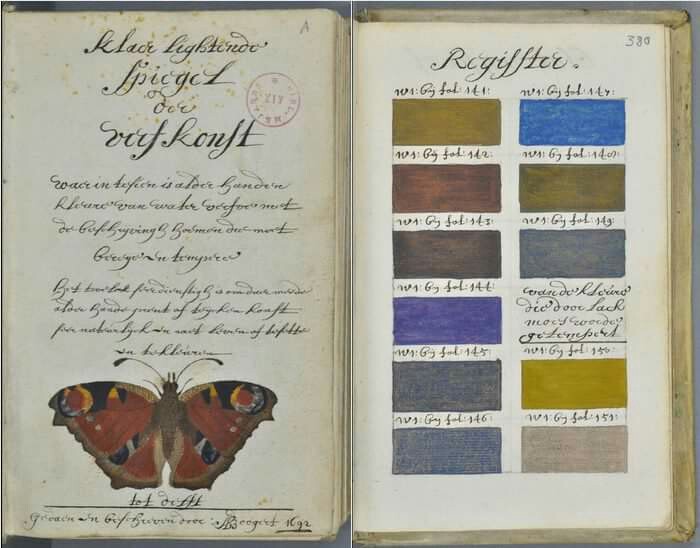
Workers, hell. It’s not hard to imagine Andrei Sokolov, whose paintings were exhibited aboard the Mir station, producing high quality renderings for Mad Men’s Don Draper to show high-rolling Martian clients.
And pop science mag Tekhnika Molodezhi (“Technology for the Youth”) promoted the space race with pages of intriguing four-color images. The dollhouse-like cross section (above) of a communal residence below the moon’s crust is practically screaming Wes Anderson’s name.
Anyone who’s suffered through the hell of growing out a short style or spent a pre-awards show afternoon getting sewn into extensions will appreciate the brisk pace of London-based illustrator Gary Card’s “Prince Hair Chart” slideshow.
It’s only 15 seconds long, but seriously, can you name another Prince with coiffures amorphous enough to merit such prolonged gaze? Certainly, not Charles, or even the compellingly flame-haired Harry.
As this chronological speed-through of 35 years of hairdos attests, musical chameleon Prince (aka Love Symbol #2,Prince Rogers Nelson)has never shied from standing out in a crowd. Thirty-six looks shimmer and writhe atop his lavender pate, as he stares cooly ahead, more mantis than Medusa.
Not all of them worked. If we were playing Who Wore It Better, I’d have to go with Liza Minelli (1985) and Jennifer Aniston (1990), but the slideshow is richer (and a couple of fractions of a second longer) due to such silliness.
Doubtless Prince will have rearranged his locks before the doves can cry again. His latest look, as evidenced by a recent guest cameo opposite Zooey Deschanel on the TV comedy, ‘New Girl’, is a return to roots, a la 1978.
From January 24 through April 27, 2014, The Morgan Library and Museum is staging an exhibition on Antoine de Saint-Exupéry’s The Little Prince, a story that speaks to the hearts and minds of children and adults alike. Though Saint-Exupéry was French, he wrote and published his great tale while living in New York City in 1943. Twenty five years later, in 1968, the Morgan acquired the original manuscript, which is now on display.
If you can’t travel to New York, you can virtually pore over ten original illustrations from Le Petit Prince online. We’d recommend clicking here, and then clicking on the Full Screen icon in the bottom right-hand side of the first illustration you see. Then start flipping through the pages and enjoy. As the Morgan notes, the pages are “replete with crossed-out words, cigarette burns, and coffee stains.” You’ll find one such burn on the illustration immediately above.
Jorge Luis Borges (1899–1986), one of the great writers to come out of Argentina, went blind when he was only 55 years old. As unsettling as it must have been, it wasn’t particularly a surprise. He once told The New York Times, “I knew I would go blind, because my father, my paternal grandmother, my great-grandfather, they had all gone blind.”
Above, you can see a self portrait that Borges drew in the basement of the famous Strand Bookstore in New York City. According to the Times, he did this “using one finger to guide the pen he was holding with his other hand.” After making the sketch, Borges entered the main part of the bookstore and started “listening to the room, the stacks, the books,” and made the remarkable observation “You have as many books as we have in our national library.”
If you’ve ever been to The Strand, you know how many books it holds. Indeed, the store boasts of being “New York City’s legendary home of 18 Miles of new, used and rare books.” My guess is that Argentina’s national library might have a few more volumes than that. But who is really counting?
If you would like to sign up for Open Culture’s free email newsletter, please find it here. It’s a great way to see our new posts, all bundled in one email, each day.
If you would like to support the mission of Open Culture, consider making a donation to our site. It’s hard to rely 100% on ads, and your contributions will help us continue providing the best free cultural and educational materials to learners everywhere. You can contribute through PayPal, Patreon, and Venmo (@openculture). Thanks!
There’s a rapacious, run-amok energy to Italian street artist Blu’s stop motion animation, “BIG BANG BIG BOOM.” However long it took him, assisted by a slew of local artists, to render a host of painted large-scale characters across a primarily industrial landscape in Argentina and Uruguay, it takes less than ten, gloriously gritty minutes for his just-dawned world to destroy itself.
This is evolution at its most apocryphal (and least scientific). Crustaceans and giant lizards who mere decades ago would have terrorized the streets of Tokyo are here no match for man. In fact, man is no match for man, rapidly engineering his own demise as he chases about an appropriately circular, abandoned-looking silo.
The necessary demise of his murals—animation frames, if you like—serves as a nifty reminder of the evolutionary fate of most street art. A Banksy carefully preserved beneath Plexi is the exception, and even that is no guarantee of permanence. Case in point, New York City’s legendary “institute of higher burning,” 5 Pointz, whose 200,000-square-feet were recently whitewashed into nothingness overnight.
We're hoping to rely on loyal readers, rather than erratic ads. Please click the Donate button and support Open Culture. You can use Paypal, Venmo, Patreon, even Crypto! We thank you!
Open Culture scours the web for the best educational media. We find the free courses and audio books you need, the language lessons & educational videos you want, and plenty of enlightenment in between.