The European banking sector may still be on shaky footing. But it’s not stopping European banks from putting together a good flashmob. Last year, the Spanish bank, Banco Sabadell, brought together 100 professional musicians and singers to perform the anthem of the European Union — Beethoven’s “Ode to Joy” from his Symphony No. 9. And movingly so. It all happened in the Plaça de Sant Roc in Sabadell, Spain, a little north of Barcelona.
This year, we travel north to the city of Breda in Holland, where the Dutch multinational bank ING paid performers to recreate Rembrandt’s famous painting, The Night Watch, in a shopping center. The occasion? The re-opening of The Rijksmuseum in Amsterdam on April 13 after a long 10-year renovation.
Pa, the horses got out of the barn again, and danged if they don’t appear to have passed through the Museum of Natural History on their way to Grand Central.
The otherworldly beasts are occupying the famed New York City transit hub’s Vanderbilt Hall this week as Heard NYC, a collaboration between artist Nick Cave and Creative Time, which commissions work for presentation in public spaces. For his latest feat, Cave took his Soundsuits—wearable sculptures with an organic sonic component—in a direction both equine and ethnographic. Sixty dancers from the Ailey School bring the herd of thirty to life, stamping raffia-sheathed legs and tossing black heads augmented with festive Rajasthani embroidery. Their twice daily performances occur during off-peak hours. Chance interactions with midday travelers are one thing, but an unscripted encounter with an exhausted commuter rushing for the Metro North bar car? That’s a horse of a different color, my friend.
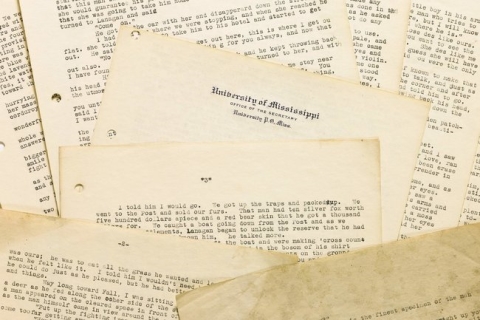
Just when it seemed, after decades of scholarship, criticism, and commentary on the life’s work of William Faulkner, that there was nothing more to say, along comes The New York Timeswith a report of an early unpublished story and a batch of letters to his wife Estelle, recently uncovered in a box found in the barn at the Faulkner family farm in Charlottesville, Virginia. The new work, discovered last year, will go on auction at Sotheby’s this June, along with hand-corrected manuscripts, a hand-bound poetry book, Faulkner’s 1949 Nobel prize medal and diploma, and a handwritten draft of his acceptance speech.
The Times comments that the Nobel items are “likely to be the most sought after” by collectors, but for scholars and us lovers of the writing, it’s the unpublished work that holds the most interest. Says Faulkner scholar Sally Wolff-King: “In literary circles a newly discovered first draft of a famous story or novel can be as significant as an early version of the Gettysburg Address to American historians.”
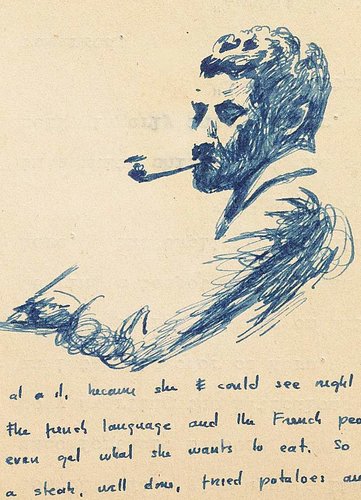
In addition to his Nobel-winning literary skill, Faulkner was quite the illustrator, often including pen-and-ink drawings in his letters and postcards, such as the self-portrait at left, drawn on the back of a draft of a story, with newly-grown beard and pipe. “My beard is getting along quite well,” he writes. Faulkner sent illustrated letters and postcards to his parents from his sojourn in Paris, signing them “Billy.”
The image at the top shows the unpublished story—about a fur trapper’s trip to the city—typed on the back of University of Mississippi letterhead, where Faulkner was a student for three semesters between 1919 and 1920.
The creative team of Tom Wrigglesworth & Matt Robinson went to an art class at The Book Club in London, and there created an animation that breathes life into a series of figure drawings. Every easel in the class captured a nude model from a different angle. The film then gathered them all together, producing one wonderfully animated composite figure. Pretty neat stuff. If you’re in London, you can check out the next Life Drawing class on April 6.
Doctor, what does it mean if you dream of creating a font of Freud’s handwriting?
This is exactly what German typographer Harald Geisler has in mind, and, in the spirit of self-actualization, he’s funding the project on Kickstarter. His charisma is such that he’s already raised over eight times the original $1500 goal that will allow him to travel to Vienna, where he will create the typeface in a borrowed apartment within walking distance from Freud’s former home at Berggasse 19. That address is now home to the Sigmund Freud Museum, where the romantically-minded Geisler plans to visit the hard copies of the eight letters from which his alphabet will be assembled.
Don’t let the project’s fully-in-the-black status keep you from visiting its fundraising page. In addition to being an inadvertent tutorial on the elements of a top-notch Kickstarter campaign, it also provides some interesting information with regard to penmanship, font creation, and the difference between Kurrent, the German-style script Freud learned as a schoolboy, and the Latin-style cursive that was standard among his North American patients.
Geisler says it cracks him up to imagine someone jotting a note to his or her shrink in Freud’s handwriting. Perhaps those of us not currently under the care of a psychiatry professional could use it to write our mothers.
Which best describes your museum-going experience? Inspiration and spiritual refreshment? Or a soul crushing attempt to fight your way past the hoards there for the latest blockbuster exhibit, with a too-heavy bag and a whining, foot sore companion in tow?
Wouldn’t it be wonderful to lose yourself in contemplation of a single work? What about that giant one at the top of the Metropolitan Museum of Art’s Grand Staircase? For every visitor who pauses to take it in, another thousand stream by with hardly a glance.
The above commentary by curator of Italian paintings, Xavier Salomon, may well turn Giovanni Battista Tiepolo’s The Triumph of Marius into one of the Met’s hottest attractions. It’s often difficult for the average museum-goer to understand what the deal is in one of these densely populated, 19th century oils. Salomon supplies the needed historical context—general Gaius Marius parading captive Numidian king Jugurtha through the streets upon his triumphal return to Rome.
Things get even more interesting when he translates the Latin inscription at the top of the canvas: “The Roman people behold Jugurtha laden with chains.” In other words, you can forgo the hero worship of the title and concentrate on the bad guy. This, Salomon speculates, is what the artist had in mind when swathing Jugurtha in that eye-catching red cape. Jugurtha may be the loser, but his refusal to be humbled before the crowd is winsome.
As is 82nd and 5th, an online series that aims to celebrate 100 transformative works of art from the museum’s collection before year’s end. In addition to Salomon’s compelling thoughts on The Triumph of Marius, some pleasures thus far include Melanie Holcomb, Associate Curator of Medieval Art and The Cloisters, geeking out over illustrated manuscript pages and fashion and costume curator Andrew Bolton recalling his first encounter with one of designer Alexander McQueen’s most extreme garments. Each video is supplemented with a tab for further exploration. You can also find the talks collected on YouTube.
Brilliantly conceived and executed, these commentaries provide virtual museum-goers with a highly personal tour, and can only but enrich the experience of anyone lucky enough to visit in the flesh.
The Los Angeles County Museum of Art houses the largest American collection of art west of Chicago. Developed as an “encyclopedic” museum—its collections represent nearly every human civilization since recorded time—LACMA’s eclectic holdings span from art of the ancient world to video installations. Like all great public collections, LACMA sees its mission as providing the greatest possible access to the widest range of art.
Two years ago LACMA made a relatively small number of its image holdings available for free download in an online library. From that beginning of 2,000 images, the museum recently expanded its downloadable collection by ten-fold, making 20,000 images of artwork available for free.
This represents about a quarter of all the art represented on LACMA’s site. They’ve chosen images of artworks the museum believes to be in the public domain and developed a robust digital archive with a richer search function than most museums.
LACMA’s online collection (80,000 images altogether, including restricted use and unrestricted) is sorted by the usual curatorial terms (“American Art,” “Art of the Pacific” and so on) but that’s just one of many filtering options.
A search for works related to the word “roses” can be done as a general search of all objects, turning up, among 268 other items, Toulouse-Lautrec’s Mlle Marcelle Lender. This item happens to be available for free download. (Note the bloom in the Madamoiselle’s cleavage to see why the image turned up in this search.)
But the collection can be searched more narrowly by object type and curatorial area. There’s also a cool option to search by what’s on view now right now. This choice allows users to zero in on a specific building or floor of the museum’s eight buildings. The collection can also be entered according to chronological era, from 10,000 BCE to the present day.
This is important for the public, but even more so for students and educators. Nine years ago Eastman Kodak stopped producing slide projectors. Since then the task of assembling quality images for the study of art history has become hopelessly daunting, with teachers and students searching a myriad websites to create digital “carousels” for class or study.
For whatever reason, in an age over-abundant with high resolution images of nearly everything, pictures of art itself are scattered and expensive.
Institutions like Google Art Projects, the Metropolitan Museum of Art and LACMA are among a few that offer extensive, free art images online.
Of course there are still copyright issues that all institutions must contend with. But it is to LACMA’s credit that they take their mission of public access seriously and put resources into making their wonderful collection available to the international community.
Brian Eno, the well-known music producer, resident intellectual of rock, “non-musician” musician, “drifting clarifier,” and popularizer of ambient records, went to art school. (The Colchester Institute in Essex, specifically.) Anyone familiar with Eno’s career knows that English art school of the sixties must have perfectly suited his interests and inclinations. But read up on his generation of U.K. popular musicians, and you’ll find art school not a wholly unusual rite of passage. That background united several of the members of Roxy Music, the band in which Eno would hone his sonic craft (and build his notoriety) in the early seventies. Though music would offer him his highest peaks of fame and fortune, Eno never quite forgot that he’d originally entered art school with the intention of painting. Attending an exhibition of his 77 Million Paintings a few years back, I delighted in seeing his interest in technology and composition intersect with his penchant for the visual arts.
Rewind, now, to the eighties, where we find another, equally fascinating example of Eno continuing to “paint,” but in a technologically rethought manner. You can now watch his “video paintings” of that era on Youtube. Here you can see Thursday Afternoon, his series on the female form (some of which, despite approaching abstraction, could potentially be considered NSFW, though any mainstream gallery today would show them openly). Just above, you’ll find an excerpt from his series Mistaken Memories of Medieval Manhattan. It may not look like much, and indeed, Eno’s initial process involved little more than accidentally leaving his camcorder recording on the windowsill. But bear in mind that the actual installation involved screening the piece right-side-up on a television itself turned on its side — a simple recontextualization, but as those who saw the original have assured me, a striking one. Rainy-day project: try replicating that setup at home. I think Eno would approve.
Colin Marshall hosts and produces Notebook on Cities and Culture and writes essays on literature, film, cities, Asia, and aesthetics. He’s at work on a book about Los Angeles, A Los Angeles Primer. Follow him on Twitter at @colinmarshall.
We're hoping to rely on loyal readers, rather than erratic ads. Please click the Donate button and support Open Culture. You can use Paypal, Venmo, Patreon, even Crypto! We thank you!
Open Culture scours the web for the best educational media. We find the free courses and audio books you need, the language lessons & educational videos you want, and plenty of enlightenment in between.