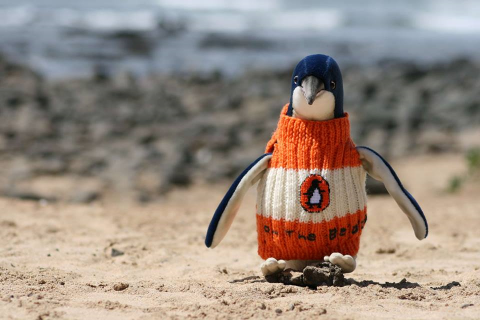
How does 109-year-old Alfred “Alfie” Date keep himself busy? Apparently by knitting sweaters for endangered penguins. The oldest man in Australia, Alfie began knitting these little sweaters at the request of The Penguin Foundation in 2013, after hundreds of Little Penguins were injured by a big oil spill. He makes the sweaters in different styles. But you can’t beat a penguin wearing a Penguin Books logo. We dare you to try.
News of the new, long-awaited but hardly expected Harper Lee novel, Go Set a Watchman—a sequel to the 1960’s To Kill a Mockingbird—has been met with varying degrees of skepticism, surely warranted given her late sister Alice and others’ characterization of Lee’s physical and mental decline. On the other hand, the novelist, it’s been reported, is “extremely hurt” by allegations that she has been pressured to publish. It would be a shame if the controversy over the publication of the novel eclipsed the novel itself. While it had become something of a truism that Harper Lee would only publish the one, great novel and never another, I for one greet this latest news with joy.
For one thing, circumstances aside, the new Harper Lee novel has the mass media doing something it rarely does anymore—talking about literary fiction. And for the thousands of school kids required to read To Kill a Mockingbird and wondering why they should bother, the conversation hopefully communicates that books still matter, and not just dystopian YA sci-fi and mass-market trade books about BDSM fantasies, but books about ordinary people in ordinary times and places. It’s a lesson Lee learned early. In a 2006 letter to Oprah Winfrey, published in O magazine, Lee wrote about her childhood experiences with reading, and being read to. She recalls arriving “in the first grade, literate,” because of her upbringing. She also acknowledges that “books were scarce”; her and her siblings early literacy meant they were “privileged” compared to other children, “mostly from rural areas,” and the “children of our African-American servants.”
While we may dismiss Lee’s contention that in “an abundant society where people have laptops, cell phones” and “iPods” they also have “minds like empty rooms” as the kvetching of a senior citizen, I doubt most people who respect Lee’s wisdom and good humor would do so lightly. Her poetic evocation of the tactile differences between books and gadgets alone should give us pause: “some things should only happen on soft pages, not cold metal.”
Read the full letter below.
May 7, 2006
Dear Oprah,
Do you remember when you learned to read, or like me, can you not even remember a time when you didn’t know how? I must have learned from having been read to by my family. My sisters and brother, much older, read aloud to keep me from pestering them; my mother read me a story every day, usually a children’s classic, and my father read from the four newspapers he got through every evening. Then, of course, it was Uncle Wiggily at bedtime.
So I arrived in the first grade, literate, with a curious cultural assimilation of American history, romance, the Rover Boys, Rapunzel, and The Mobile Press. Early signs of genius? Far from it. Reading was an accomplishment I shared with several local contemporaries. Why this endemic precocity? Because in my hometown, a remote village in the early 1930s, youngsters had little to do but read. A movie? Not often — movies weren’t for small children. A park for games? Not a hope. We’re talking unpaved streets here, and the Depression.
Books were scarce. There was nothing you could call a public library, we were a hundred miles away from a department store’s books section, so we children began to circulate reading material among ourselves until each child had read another’s entire stock. There were long dry spells broken by the new Christmas books, which started the rounds again.
As we grew older, we began to realize what our books were worth: Anne of Green Gables was worth two Bobbsey Twins; two Rover Boys were an even swap for two Tom Swifts. Aesthetic frissons ran a poor second to the thrills of acquisition. The goal, a full set of a series, was attained only once by an individual of exceptional greed — he swapped his sister’s doll buggy.
We were privileged. There were children, mostly from rural areas, who had never looked into a book until they went to school. They had to be taught to read in the first grade, and we were impatient with them for having to catch up. We ignored them.
And it wasn’t until we were grown, some of us, that we discovered what had befallen the children of our African-American servants. In some of their schools, pupils learned to read three-to-one — three children to one book, which was more than likely a cast-off primer from a white grammar school. We seldom saw them until, older, they came to work for us.
Now, 75 years later in an abundant society where people have laptops, cell phones, iPods, and minds like empty rooms, I still plod along with books. Instant information is not for me. I prefer to search library stacks because when I work to learn something, I remember it.
And, Oprah, can you imagine curling up in bed to read a computer? Weeping for Anna Karenina and being terrified by Hannibal Lecter, entering the heart of darkness with Mistah Kurtz, having Holden Caulfield ring you up — some things should happen on soft pages, not cold metal.
The village of my childhood is gone, with it most of the book collectors, including the dodgy one who swapped his complete set of Seckatary Hawkinses for a shotgun and kept it until it was retrieved by an irate parent.
Now we are three in number and live hundreds of miles away from each other. We still keep in touch by telephone conversations of recurrent theme: “What is your name again?” followed by “What are you reading?” We don’t always remember.
Note: It looks like the 92nd St Y took the reading off of its Youtube channel for unknown reasons. However you can stream it here.
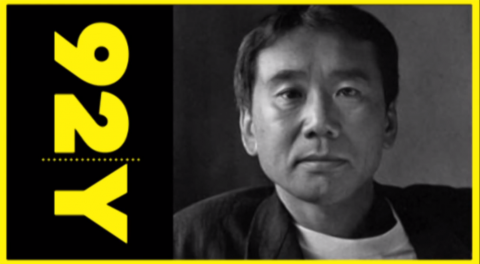
Haruki Murakami doesn’t make many public appearances, but when he does, his fans savor them. This recording of a reading he gave at New York’s 92nd Street Y back in 1998 (stream it here) counts as a treasured piece of material among English-speaking Murakamists, especially those who love his eighth novel, The Wind-Up Bird Chronicle. When asked to read from that book, the author explains here, he usually reads from chapter one, “but I’m tired of reading the same thing over and over, so I’m going to read chapter three today.” And that’s what he does after giving some background on the book, its 29-year-old protagonist Toru Okada, and his own thoughts on how it feels to be 29.
The Wind-Up Bird Chronicle, published in three parts in Japan in 1994 and 1995 and in its entirety in English in 1997, began a new chapter in the writer’s career. You could tell by its size alone: the page count rose to 600 in the English-language edition, whereas none of his previous novels had clocked in above 400. Thematically, too, Murakami’s mission had clearly broadened: where its predecessors concern themselves primarily with Western pop culture, disappearing girls, twentysomething languor, and mysterious animal-men, The Wind-Up Bird Chronicle takes on Japanese history, especially the country’s ill-advised wartime colonial venture in Manchuria.
As a result, the book finally earned Murakami some respect — albeit respect he’d never directly sought — from his homeland’s long-disdainful literary establishment. Despite having held its place since the time of this reading as Murakami’s “important” book, and one many readers name as their favorite, it might not offer the easiest point of entry into his work. When I asked Wang Chung lead singer Jack Hues about a Murakami reference in the band’s song “City of Light,” he told me he put it there after reading The Wind-Up Bird Chronicle on his daughter’s recommendation and not liking it very much. I suggested he try Norwegian Wood instead.
Note: You can download a complete audio version of The Wind-Up Bird Chronicle if you take part in one of the free trials offered by our partners Audible.com and/or Audiobooks.com. Click on the respective links to get more information.
Charlie Watts’s first love has always been jazz. While his Rolling Stones band mates spent their youth listening to the Blues, Watts listened to Miles Davis and John Coltrane. And something about that seems to have stuck. Mick Jagger and Keith Richards defined what a rock star should look like in the late 60s – disheveled and flamboyant. Watts always seemed to carry himself with a jazzman’s sense of cool.
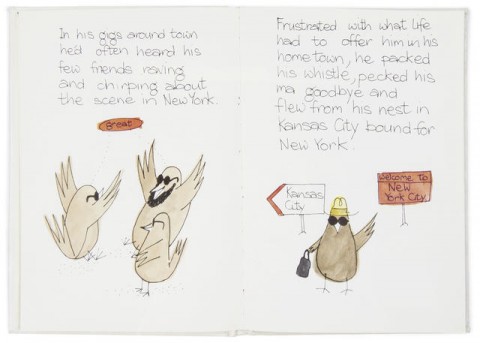
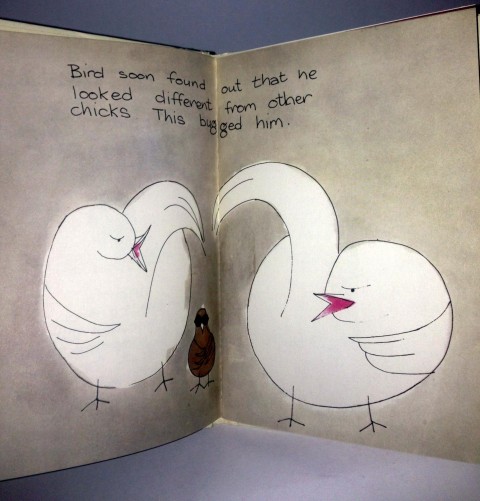
Back in 1960, when he was working as a graphic designer and doing drumming gigs on the side, Watts found another way to show off his love for jazz. He wrote a children’s book. Ode to a Highflying Bird is about alt sax legend Charlie Parker, rendered in doodle-like fashion as a bird in shades. The hand-drawn text details Parker’s life story: “Frustrated with what life had to offer him in his hometown, he packed his whistle, pecked his ma goodbye and flew from his nest in Kansas City bound for New York.”
The book was originally done as a portfolio piece but, in 1964, after Watts became a member of the Stones, the book was published. As Watts recalled, “This guy who published ‘Rolling Stones Monthly’ saw my book and said ‘Ah, there’s a few bob in this!’”
This wasn’t the only ode to Bird that Watts made over his long career. In 1992, his jazz band, The Charlie Watts Quintet, released an album called From One Charlie… which, as the title suggests, pays homage to Parker and his other bee-bop gods. “I don’t really love rock & roll,” as he toldRolling Stone magazine. “I love jazz. But I love playing rock & roll with the Stones.”
A few old copies of Ode to a Highflying Bird can be found on Amazon and on Abe Books.
Jonathan Crow is a Los Angeles-based writer and filmmaker whose work has appeared in Yahoo!, The Hollywood Reporter, and other publications. You can follow him at @jonccrow. And check out his blog Veeptopus, featuring lots of pictures of badgers and even more pictures of vice presidents with octopuses on their heads. The Veeptopus store is here.
One’s never too old to be read a story. There’s no shame in stealing a couple of minutes from your busy, stress-filled day to let actress Susan Sarandon read you one, above.
Goodnight Moonwas never a part of my childhood, but it came into heavy rotation when my own kids were little. It wasn’t a title they clamored for—in my experience, the intended demographic favors the junky and cringe-inducing over classics of children’s literature, but no matter.
All day, I indulged their hankering for tales of preschool-aged dinosaurs who had to be taught how to share, giant silly cookies, and a certain television character who reacted poorly to being passed over as flower girl. In return, I ruled the night.
I treasured Goodnight Moon not so much because it made them fall asleep—there are shelves upon shelves of dependable choices in that department—but rather for its simplicity. There were no moral lessons. Nothing sparkly or magic or forced. Nothing that catered to their supposed whims. Author Margaret Wise Brown’s stated aim with regard to the child reader was “to jog him with the unexpected and comfort him with the familiar.”
I approve. But there’s not a lot of jogging in Goodnight Moon. Just that comb and that brush and that bowlful of mush. What a blessed relief.
As one approaches the end, Goodnight Moon begins to rival Charlotte’s Web as children’s literature’s great meditation on death. The catalogue of all those things we’re saying goodnight to harkens to the final scene in Our Town, when the newly dead Emily, revisiting her childhood home, cries, “All that was going on in life and we never noticed.”
Every time my small crew made it to “goodnight stars, goodnight air, goodnight noises everywhere,” I was croaking. (Not figuratively, though a little research reveals I am not the only one to think this lovely phrase would make a great epitaph.)
This emotional collapse was equal parts cathartic and embarrassing. What can I say? My cup ranneth over. I was glad to learn that E. B. White’s voice betrayed him, too, recording Charlotte’s Web’s most poignant scene.
Narrating the lightly animated story for 1999’sGoodnight Moon & Other Sleepytime Tales, Sarandon exhibits astonishing self control. It’s probably a good thing for children everywhere to see that there’s at least one adult out there with the steel to soldier through. Her youngest child was still little when she went into the recording booth. If she’d wanted, she could’ve milked it for every last drop of pathos, but I’m glad she played it straight, because most of us can’t.
(And few of us can write a book so elegant on a topic so profound. Sarandon’s would-be publishers rejected her children’s book about a “very funny raccoon” who dies.”)
When the young Neil Gaiman was learning Lewis Carroll’s “Jabberwocky” by heart, he surely had no inkling that years later he’d be called upon to recite it for legions of adoring fans…particularly on the Internet, a phenomenon the budding author may well have imagined, if not technically implemented.
Worldbuilders, a fundraising portal that rewards donors not with tote bags or umbrellas, but rather with celebrity challenges of a non-ice bucket variety, scored big when Gaiman agreed to participate.
The videography may be casual, but his off-book performance in an undisclosed tulgey wood is the stuff of high drama.
Callooh!
Callay!
Is that a memory lapse at the one minute mark? Another interpreter might have called for a retake, but Gaiman rides out a four second pause cooly, his eyes the only indicator that something may be amiss. Perhaps he’s just taking precautions, listening for telltale whiffling and burbling.
If you’re on the prowl to make some year end charitable donations, recreational mathemusician Vi Hart and author John Green are among those Worldbuilders has in the pipeline to perform stunts for successfully funded campaigns.
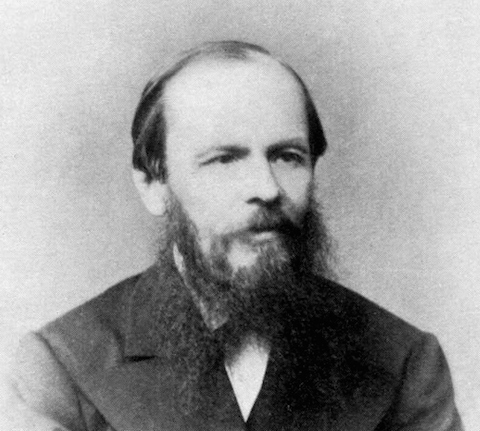
In the pantheon of Great Russian Writers, two heads appear to tower above all others—at least for us English-language readers. Leo Tolstoy, aristocrat-turned-mystic, whose detailed realism feels like a fictionalized documentary of 19th century Russian life; and Fyodor Mikhailovich Dostoevsky, the once-condemned-to-death, epileptic former gambler, whose fever-dream novels read like psychological case studies of people barely clinging to the jagged edges of that same society. Both novelists are read with similar reverence and devotion by their fans, and they are often pitted against each other, writes Kevin Hartnett at The Millions, like “Williams vs. DiMaggio and Bird vs. Magic,” even as people who have these kinds arguments acknowledge them both as “irreducibly great.”
I’ve had the Tolstoy vs. Dostoevsky back and forth a time or two, and I have to say I usually give the edge to Dostoevsky. It’s the high-stakes desperation of his characters, the tragic irony of their un-self-awareness, or the gnawing obsession of those who know a little bit too much, about themselves and everyone else. Dostoyevsky has long been described as a psychological novelist. Nietzsche famously called him “the only psychologist from whom I have anything to learn.” Henry Miller’s praise of the writer of particularly Russian forms of misery and trespass is a little more colorful: “Dostoevsky,” he wrote, “is chaos and fecundity. Humanity, with him, is but a vortex in the bubbling maelstrom.”
Perhaps the most succinct statement on the Russian novelist’s work comes from Scottish poet and novelist Edwin Muir, who said, “Dostoyevsky wrote of the unconscious as if it were conscious; that is in reality the reason why his characters seem ‘pathological,’ while they are only visualized more clearly than any other figures in imaginative literature.” Joseph Conrad may have found him “too Russian,” but even with the cultural gulf that separates him from us, and the well over one hundred years of social, political, and technological change, we still read Dostoevsky and see our own inner darkness reflected back at us—our hypocrisies, neuroses, obsessions, terrors, doubts, and even the paranoia and narcissism we think unique to our internet age.
This kind of thing can be unsettling. Although, like Tolstoy, Dostoevsky embraced a fiercely uncompromising Christianity—one more wracked with painful doubt, perhaps, but no less sincere—his willingness to descend into the lowest depths of the human psyche made him seem to Turgenev like “the nastiest Christian I’ve ever met.” I’m not sure if that was meant as a compliment, but it’s perhaps a fitting description of the creator of such expressly vicious characters as Crime and Punishment’s sociopathic Arkady Svidrigailov, Demons’ cruel rapist Nikolai Stavrogin, and The Brothers Karamazov’s psychopathic creep Pavel Smerdyakov (a character so nasty he inspired a Marvel comics villain).
Next to these devils, Dostoevsky places saints: Crime and Punishment’s Sonya, Karamazov brother Alyosha the monk, and holy fool Prince Myshkin in The Idiot. His characters frequently murder and redeem each other, but they also work out existential crises, have lengthy theological arguments, and illustrate the author’s philosophical ideas about faith and its lack. The genius of Dostoevsky lies in his ability to explore such heady abstractions while rarely becoming didactic or turning his characters into puppets. On the contrary—no figures in modern literature seem so alive and three-dimensional as his anguished collection of unforgettable anarchists, aristocrats, poor folks, criminals, flaneurs, and underground men.
Should you have missed out on the pleasure, if it can so be called, of fully immersing yourself in Dostoevsky’s world of fear, belief, and madness—or should you desire to refresh your knowledge of his dense and multifaceted work—you can find all of his major novels and novellas online in a variety of formats. We’ve done you the favor of compiling them below in ebook format. Where possible, we’ve also included audio books too. (Note: they all permanently reside in our Free eBooks and Free Audio Books collections.)
Find more of Dostoevsky’s work—including his sketches of prison life in Siberia and many of his short stories—at Project Gutenberg. Like his contemporary Charles Dickens, Dostoevsky’s novels were serialized in periodicals, and their plots (and character names) can be winding, convoluted, and difficult to follow. For a comprehensive guide through the life and work of the Russian psychological realist, see Christiaan Stange’s “Dostoevsky Research Station,” an online database with full text of the author’s work and links to artwork, critical essays, bibliographies, quotations, study guides and outlines, and museums and “historically important places.” And for even more resources, see FyodorDostoevsky.com, a huge archive of texts, essays, links, pictures and more. Enjoy!
Gentle reader, if you feel your knee jerking at Thug Notes, may I suggest taking a moment to gaze beyond the gold bling and du-rag favored by its fictitious host, literature lover Sparky Sweets, PhD.
A poor choice of metaphor, given the fictitious Dr. Sweets’ soft spot for baby felines. It’s not something he talks about on the show, but he frequently tweets photos of himself in their oh-so-cuddly company, tagging them #kittentherapy.
He (or perhaps head writer / producer Jared Bauer) also turns to Twitter to disseminate quotes by the likes of Cervantes (“Diligence is the mother of good fortune”) and Orwell (“Either we all live in a decent world, or nobody does”).
Thug Notes’ tagline “classic literature, original gangsta” may be its punchline, but the humor of incongruity is not its sole aim.
Comedian Greg Edwards, who plays Sparky Sweets, told The New York Times that the project is “trivializing academia’s attempt at making literature exclusionary by showing that even highbrow academic concepts can be communicated in a clear and open fashion.”
Amen. As Sparky Sweets observes following Simon’s murder in the Lord of the Flies above, “Whoo, this $hit (is) gettin’ real!”
Is there an equal or greater danger that a reluctant student might be prodded in a positive direction by Sparky’s zesty, insightful take on their assigned reading?
Resoundingly, yes.
Thug Notes’ discussion of racism as portrayed in To Kill a Mockingbird is not the longest I’ve ever heard, but it is the most straightforward and bracing. It got my blood going! I’m inspired to drag my dog eared paperback copy out and give it another read! (Maybe I’ll have a Scotch and play some classical music. Sparky does that too.)
I’m hoping the kids at the high school a couple of blocks away — who, for the record, look and sound far more like Sparky than they do me — will be encouraged to supplement their reading of this book, and others, with Thug Notes.
As an out-of-character Greg Edwards, bearing as much resemblance to Sparky Sweets as Stephen Colbert does to his most famous creation, told interviewer Tavis Smiley:
We don’t want to stop kids from reading the book. We just want to open up doors. Maybe teachers can use it. It’s hard being a teacher nowadays. You’re underpaid, you’re overworked, the classrooms are full, the kids are crazy, so throw this on and maybe it’ll spark one kid’s attention.
As of this writing, Thug Notes has tackled dozens of titles (you can watch them all here, or right below), a heaping helping of banned books, and four of Shakespeare’s plays (above).
New titles will be added every other Tuesday. I can’t wait.
We're hoping to rely on loyal readers, rather than erratic ads. Please click the Donate button and support Open Culture. You can use Paypal, Venmo, Patreon, even Crypto! We thank you!
Open Culture scours the web for the best educational media. We find the free courses and audio books you need, the language lessons & educational videos you want, and plenty of enlightenment in between.