A new study published this week in Scienceconcludes that you may get something unexpected from reading great literary works: more finely-tuned social and emotional skills. Conducted by Emanuele Castano and David Comer Kidd (researchers in the psych department at the New School for Social Research), the study determined that readers of literary fiction (as opposed to popular fiction or non-fiction) find themselves scoring better on tests measuring empathy, social perception and emotional intelligence. In some cases, it took reading literary fiction for only a few minutes for test scores to improve.
The New York Times has a nice overview of the study, where, among other things, it features a quote by Albert Wendland, an English professor at Seton Hall, who puts the relationship between literature and social intelligence into clear terms: “Reading sensitive and lengthy explorations of people’s lives, that kind of fiction is literally putting yourself into another person’s position — lives that could be more difficult, more complex, more than what you might be used to in popular fiction. It makes sense that they will find that, yeah, that can lead to more empathy and understanding of other lives.”
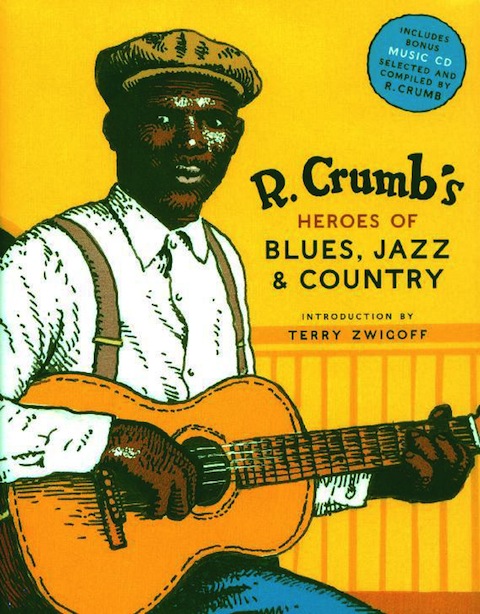
It was one of my favorite gifts of Christmas 2006. No, all apologies to everyone who bought me thoughtful gewgaws, but it was, without a doubt, the favorite. A humble, unassuming package contained a veritable encyclopedia of Americana: over one hundred portraits of jazz, blues, and country artists from the golden eras of American music, all drawn by a foremost antiquarian of pre-WWII music, R. Crumb. Beside each portrait—some made with Crumb’s exaggerated proportions and thick-lined shading, some softer and more realist—was a brief, one-paragraph bio, just enough to situate the singer, player, or band within the pantheon.
Though a fan of this sort of thing may think that it could get no better, glued to the back cover was a slipcase containing a CD with 21 tracks—seven from each genre. A quick scan showed a few familiar names: Skip James, Charlie Patton, Jelly Roll Morton. Then there were such unknown entities as Memphis Jug Band, Crockett’s Kentucky Mountaineers, and East Texas Serenaders, culled from Crumb’s enormous, library-size archive of rare 78s. Joy to the world.
Crumb’s Heroes of Blues, Jazz & Country began in the 80s with a series of illustrated trading cards, as you can see in the video above (which only covers the blues and jazz corners of the triangle). The first cards, “Heroes of the Blues,” came attached to old-time reissues from the Yazoo record company. Eventually expanding the cards to include jazz and country, working in each category from old photos or newsreel footage, Crumb covered quite a lot of musico-historical ground. Archivists and authors Stephen Calt, David Jasen, and Richard Nevins wrote the short blurbs. Finally Yazoo, rather than issuing the cards individually with each record, combined them into boxed sets.
The book—which validates my sense that this music belongs together cheek by jowl, even if some of its partisans can’t stand each other’s company—evolved through a painstaking process in which Crumb redrew and recolored the original illustrations from the printed trading cards (the original artwork having disappeared). You can follow one step of that process in a detailed description of Crumb’s conversion of the blues cards to a silkscreened poster. Crumb’s process is as thorough as his period knowledge. But Crumb fans know that the comic artist’s reverence for Americana goes beyond his collecting and extends to his own version of kitchen-sink bluegrass, blues, and jazz. Listen to Crumb on the banjo above with his Cheap Suit Serenaders. And if anyone feels like getting me a Christmas present this year, I’d like a copy of their record Chasin Rainbows. On vinyl of course.
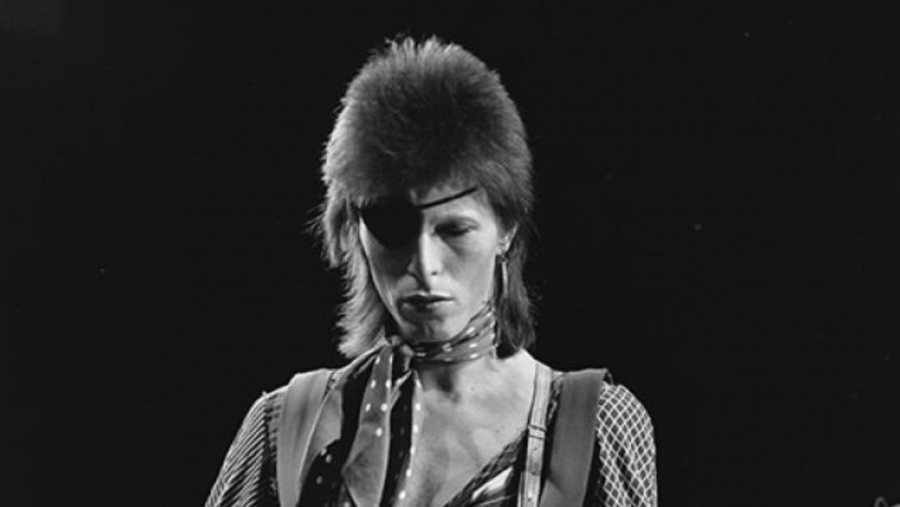
“David Bowie Is,” the extensive retrospective exhibit of the artist and his fabulous costumes, hit Toronto last Friday (see our post from earlier today), and as many people have reported, in addition to those costumes—and photos, instruments, set designs, lyric sheets, etc.—the show includes a list of Bowie’s favorite books. Described as a “voracious reader” by curator Geoffrey Marsh, Bowie’s top 100 book list spans decades, from Richard Wright’s raw 1945 memoir Black Boy to Susan Jacoby’s 2008 analysis of U.S. anti-intellectualism in The Age of American Unreason.
Bowie’s always had a complicated relationship with the U.S., but his list shows a lot of love to American writers, from the aforementioned to Truman Capote, Hubert Selby, Jr., Saul Bellow, Junot Diaz, Jack Kerouac and many more. He’s also very fond of fellow Brits George Orwell, Ian McEwan, and Julian Barnes and loves Mishima and Bulgakov. You can read the full list below or over at Open Book Toronto, who urges you to “grab one of these titles and settle in to read — and just think, somewhere, at some point, David Bowie (or, to be more accurate, the man behind David Bowie, David Jones) was doing the exact same thing.” If that sort of thing inspires you to pick up a good book, go for it. You could also peruse the list, then puzzle over the literate Bowie’s lyrics to “I Can’t Read.” You can also explore a new related book–Bowie’s Bookshelf:The Hundred Books that Changed David Bowie’s Life.
If you would like to support the mission of Open Culture, consider making a donation to our site. It’s hard to rely 100% on ads, and your contributions will help us continue providing the best free cultural and educational materials to learners everywhere. You can contribute through PayPal, Patreon, and Venmo (@openculture). Thanks!
Goodreads, that social network for the bookish, recently posted on its blog the results of a survey taken among its 20 million members with the melancholy title “The Psychology of Abandonment.” Complete with infographic, the survey gives us, among other things, a list of the “Top Five Abandoned Classics.” James Joyce’s Ulysses is third on the list, and I’m not at all surprised to find it there. One must know Ulysses, it seems, to merit consideration as a culturally literate person. But Ulysses, perhaps more than any work of modern literature, can easily discourage. It presents us with a landscape so psychologically complex, so dense with literary and historical allusion and contemporary cultural reference, that I cannot say I would have known what to do with it had I not read it under the auspices of an august Irish Joyce scholar and with Don Gifford’s guidebook Ulysses Annotated ready at hand. I had nowhere near the breadth and depth of reading Joyce seems to assume of his ideal reader. Few people do.
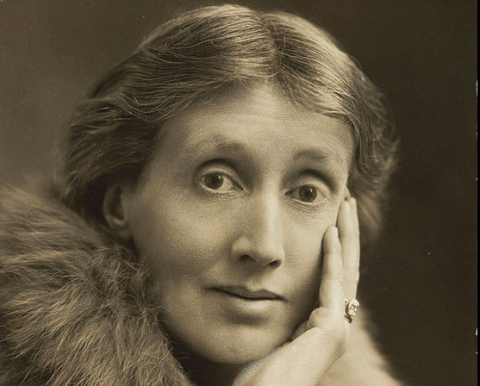
Two of Joyce’s contemporaries, however, had such a grasp of literature and language: T.S. Eliot and Virginia Woolf. And the two had quite a lot to say about the book, much of it to each other. Eliot recommended Joyce’s novel to Woolf, and very soon after its 1922 publication, she purchased her own copy. At the time, Woolf was hard at work on her story “Mrs. Dalloway on Bond Street,” which would eventually grow into her next novel, Mrs. Dalloway. She was also immersed in Proust’s epic Remembrance of Things Past, just beginning the second volume. According to Dartmouth’s James Heffernan, Woolf “chafes at the thought of Ulysses,” writing haughtily:
Oh what a bore about Joyce! Just as I was devoting myself to Proust—Now I must put aside Proust—and what I suspect is that Joyce is one of those undelivered geniuses, whom one can’t neglect, or silence their groans, but must help them out, at considerable pains to oneself.
Heffernan chronicles Woolf’s reading of Ulysses, which she documented in her diary in a “withering assessment” as the work of “a self-taught working man… egotistic, insistent, raw, striking, & ultimately nauseating.” “When one can have cooked flesh,” she writes, “why have the raw?”
This private critical opinion Woolf recorded after reading only 200 pages of the novel. Heffernan makes the case that she read no more thereafter. Though she claimed to have “finished Ulysses,” he takes her to mean she had finished with the book, putting it aside like those bewildered, bored, or exasperated Goodreads members. Nevertheless, Woolf could not shake Joyce. She continued to write about him, to Eliot and herself. “Never did any book so bore me,” she would write, and many more very disparaging remarks about her brilliant contemporary.
Over and again she savaged Joyce in her diaries; so much so that it seems to Heffernan and Woolf scholar Suzette Henke that hers is a case of protesting too much against an author whom, Henke alleges, was her “artistic ‘double,’ a male ally in the modernist battle for psychological realism.” This may indeed be so. In the midst of her characterizations of Joyce as uncouth, boring, “underbred” and worse, she admits in her diary that what she attempted in her fiction was “probably being better done by Mr. Joyce.” While hardly any reader of Ulysses—among those who finish it and those who don’t—can say they are attempting something near what he accomplished, we might all find some solace in knowing that a reader as sharp as Virginia Woolf found his modernist masterpiece either so boring or so intimidating that even she may not have been able to finish it.
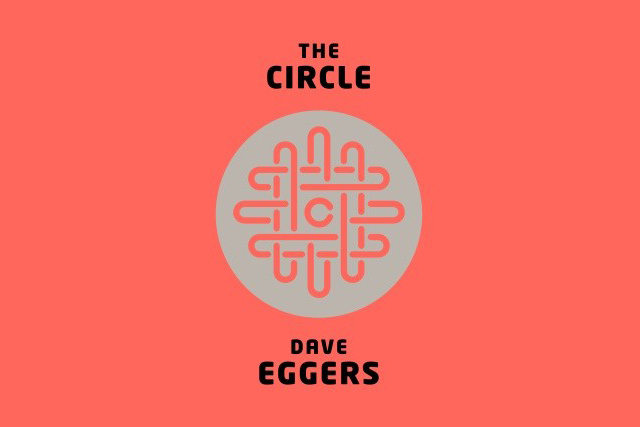
Dave Eggers, author of A Heartbreaking Work of Staggering Genius, has a new book coming out in early October, The Circle, a novel about “a young woman who goes to work at an omnipotent technology company and gets sucked into a corporate culture that knows no distinction between work and life, public and private.” Breaking with tradition, The New York Times has placed the novel’s cover on the cover of its own Sunday Magazine. It has also printed a lengthy excerpt from the book. Read it online here, or listen right below (or on iTunes) to a reading of the excerpt by actor Don Graham. It runs 46 minutes.
Earlier this month, we highlighted The 10 Greatest Films of All Time According to 846 Film Critics. Featuring films by Hitchcock, Kubrick, Welles and Fellini, this master list came together in 2012 when Sight & Sound(the cinema journal of the British Film Institute) asked contemporary critics and directors to name their 12 favorite movies. Nearly 900 cinephiles responded, and, from those submissions, a meta list of 10 was culled.
So how about something similar for books, you ask? For that, we can look back to 2007, when J. Peder Zane, the book editor of the Raleigh News & Observer, asked 125 top writers to name their favorite books — writers like Norman Mailer, Annie Proulx, Stephen King, Jonathan Franzen, Claire Messud, and Michael Chabon. The lists were all compiled in an edited collection, The Top Ten: Writers Pick Their Favorite Books, and then prefaced by one uber list, “The Top Top Ten.”
Zane explained the methodology behind the uber list as follows: “The participants could pick any work, by any writer, by any time period.… After awarding ten points to each first-place pick, nine to second-place picks, and so on, the results were tabulated to create the Top Top Ten List — the very best of the best.”
The short list appears below, along with links to electronic versions of the works (and traditional published editions). There’s one notable exception, Vladimir Nabokov’s Lolita. We couldn’t provide that electronic text, but we do have something special — an audio recording of Nabokov reading a chapter from his controversial 1955 novel.
The texts listed below are permanently housed in our collection of Free eBooks, along with many other classics. In many cases, you’ll find audio versions of the same works in our ever-growing collection of Free Audio Books. If you have questions about how to load files onto your Kindle, please see this related instructional video.
Got an issue with any of the selections? Tell us all about it in the comments section below.
It comes as no surprise that Roald Dahl, author of Charlie and the Chocolate Factory, possessed a sweet tooth. Having dazzled young readers with visions of Cavity-Filling Caramels, Everlasting Gobstoppers, and snozzberry-flavored wallpaper, Dahl’s candy of choice was the more pedestrian Kit-Kat bar. In addition to savoring one daily (a luxury little Charlie Bucket could but dream of, prior to winning that most golden of tickets) he invented a frozen confection called “Kit-Kat Pudding.”
The original recipe is, appropriately, simple enough for a child to make. Stack as many Kit-Kats as you like into a tower, using whipped cream for mortar, then shove the entire thing into the freezer, and leave it there until solid.
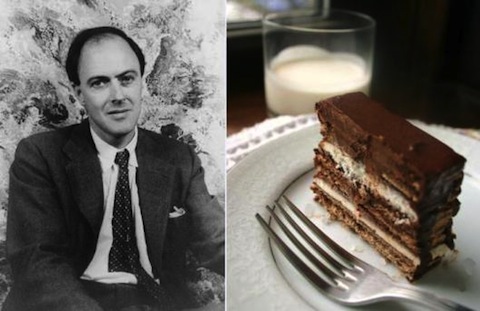
Book publicist and self-described literary fangirl Nicole Villeneuve does him one better on Paper and Salt, a food blog devoted to the recipes of iconic authors. Her re-imagined and renamed Frozen Homemade Kit-Kat Cakeadds bittersweet chocolate ganache, replacing Dahl’s beloved candy bars with high quality wafer cookies. It remains a pretty straight-forward preparation, not quite as decadent as the Marquis de Sade’s Molten Chocolate Espresso Cake with Pomegranate, but surely more to Dahl’s liking than Jane Austen’s Brown Butter Bread Pudding Tarts would have been. (The author once wrote that he preferred his chocolate straight.)
Villeneuve spices her entry with historical context and anecdotes regarding early 20th-century candy marketing, Dahl’s hatred of the Cadbury Crème Egg, and his dog’s hankering for Smarties. Details such as these make Paper and Salt, which features plenty of savories to go with the sweet, a delicious read even for non-cooks.
Novelist Thomas Pynchon does not, as his readers well know, do publicity. But does he need to? When a man has written books like V., The Crying of Lot 49, and Gravity’s Rainbow, doesn’t the appearance of a new one publicize itself, in some sense? Pynchon’s eighth novel Bleeding Edge, a seemingly hard-boiled yet characteristically askew and paranoia-flavored tale of post-tech-bubble but pre‑9/11 New York, comes out on September 17th, and a certain class of fan has no doubt spent hours scrutinizing the excerpt its publisher Penguin has already released. A certain other class of fan, the sort who spent long dorm-room hours with the early books but who somehow never summoned the will for the more recent ones, will at least have felt their curiosity piqued. To another class of fan entirely, those who feel like they could get into Pynchon but can’t quite determine why or how, we offer the documentary above, Fosco and Donatello Dubini’s A Journey into the Mind of P.
“I think of Pynchon as a cryptogram,” says one reader interviewed in the film. “We are almost, in a sense, codebreakers. He presents a puzzle that we are trying to crack.” That, as well as anything, sums up my own findings from talking to Pynchon die-hards about their enthusiasm for their author of choice. A Journey into the Mind of P actually examines two minds at once: the mind of Pynchon the writer, and the mind of the Pynchon fan, which seeks not only to grasp the culturally sweeping, information-dense heightened reality of the novels, but also to construct a coherent image of the man who creates that reality. Thus far, these readers have had to draw this image from only the novels themselves (though, in several cases, large and labyrinthine ones), and for the foreseeable future they must continue to do so. At least Bleeding Edge, whatever its reception, will add almost 500 more pages to their body of available evidence. Best of luck, Pynchon exegetes with copies on pre-order. Perhaps the rest of you would rather start with the book trailer just above. A new Pynchon novel may always make a splash, but Penguin’s publicity department isn’t taking any chances.
We're hoping to rely on loyal readers, rather than erratic ads. Please click the Donate button and support Open Culture. You can use Paypal, Venmo, Patreon, even Crypto! We thank you!
Open Culture scours the web for the best educational media. We find the free courses and audio books you need, the language lessons & educational videos you want, and plenty of enlightenment in between.