How many times have you encountered an otherwise perfect view spoiled by a newly erected high rise, a construction crane, or a CGI brachiosaurus?
Constantly, right?
Video editor William Hirsch makes light work of Jurassic Park’s primary attractions’ first appearance, literally erasing them from the scene.
Hirsch estimated that it took him about a week to get rid of those pesky ‘saurs using nothing fancier than After Effects’s built in tools, which include the motion tracking software Mocha.
It’s equal parts ridiculous and lovely to see humans suddenly thunderstruck by the unspoiled landscape they’ve been driving through.
These days, of course, Laura Dern would have to glance up from her phone, not a paper map.
Though it’s not such a stretch to imagine Jurassic Park’s author’s successor, the late Michael Crichton’s literary heir, hard at work on a dystopian novel titled Park.
At the time of its release, Jurassic Park’s dinosaurs were a special effects game changer. Their numbers were supplemented by some non-computer-generated animatronic models, though no doubt Spielberg was apprehensive given the way his robotic sharks acted up on the set of Jaws. The human players may have had more screen time, but the dinosaurs’ 15 minutes of footage has resulted in a lasting fame, extending decades beyond the expected 15 minutes.
Unexpectedly, Hirsch’s dinosaurs, or rather, lack thereof, have generated the most excitement with regard to his project. But his attention to detail is also laudable. Above, he reveals how he tweaked the access badge dangling from the rear view mirror of the park’s all-terrain vehicle.
Are we wrong to think that John Williams’ swelling original score feels more organic in this dinosaur-free context? Rivers, trees, and vast amounts of skies have been known to spur composers to such heights.
The potentially lethal prehistoric beasts are out of the way, but that line “We’re gonna make a fortune with this place” retains an air of ominous foreshadowing, given the plentiful natural resources on display. Sometimes humans can do more damage than dinosaurs.
If that feels too intense, you can also retreat to the escapist pleasures of the original, below.
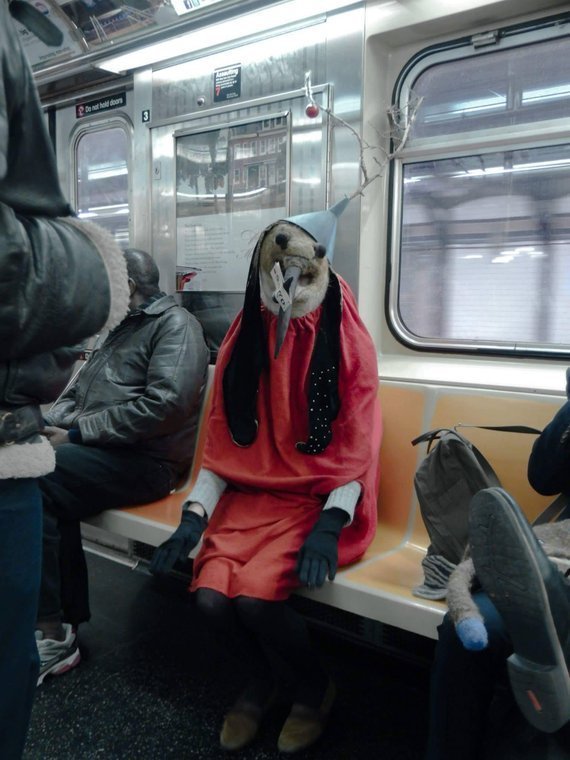
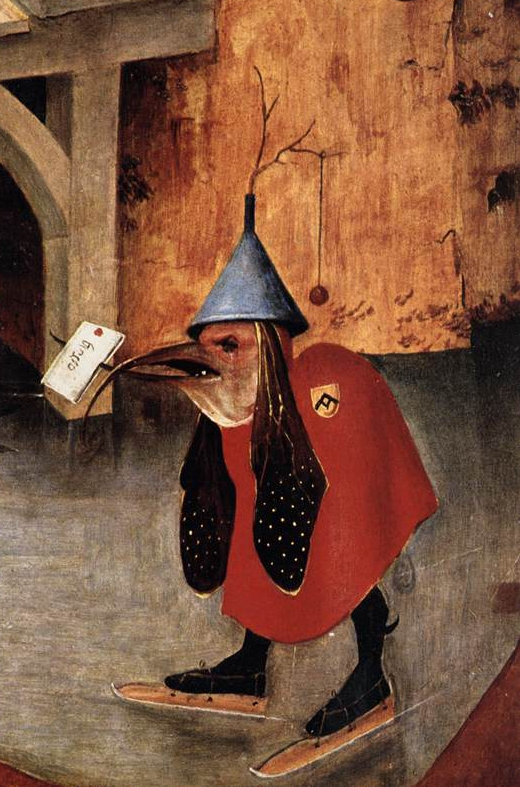
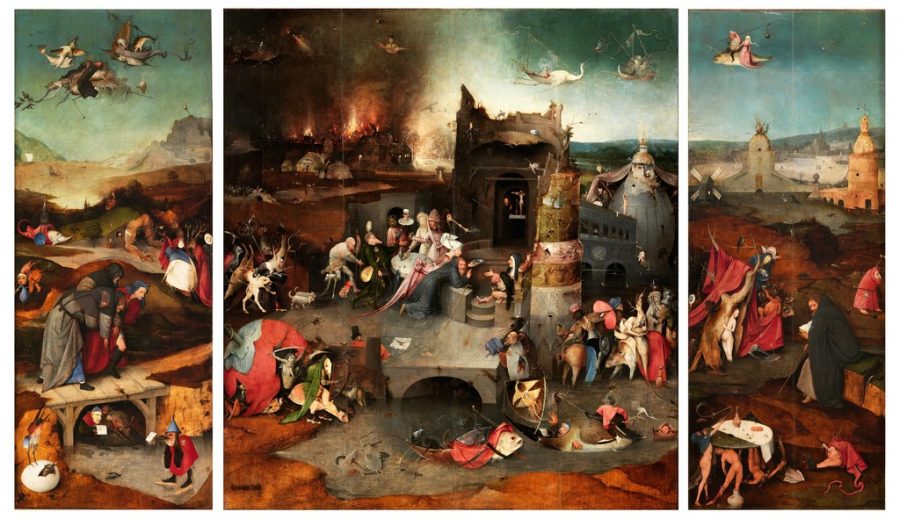
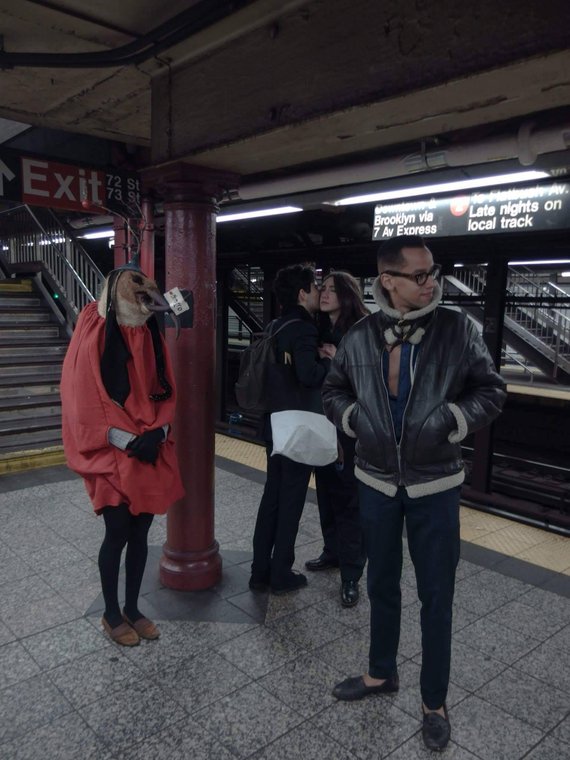
To me, the great promise of homeschooling is that one day your child might, on their own initiative, ride the New York City subways dressed in a homemade, needlefelted costume modeled on the ice-skating bird messenger from Hieronymus Bosch’s The Temptation of St. Anthony.
Rae Stimson, akaRae Swon, a Brooklyn-based artist who did just that a little over a week ago, describes her upbringing thusly:
Growing up I was home schooled in the countryside by my mom who is a sculptor and my dad who is an oil painter, carpenter, and many other things. Most of my days were spent drawing and observing nature rather than doing normal school work. Learning traditional art techniques had always been very important to me so that I can play a role in keeping these beautiful methods alive during this contemporary trend of digital, nonrepresentational, and conceptual art. I make traditional artwork in a wide variety of mediums, including woodcarving, oil painting, etching, needle felting, and alternative process photography.
Not every homeschooler, or, for that matter, Waldorf student, is into needle felting. It only seems that way when you compare the numbers to their counterparts in more traditional school settings…
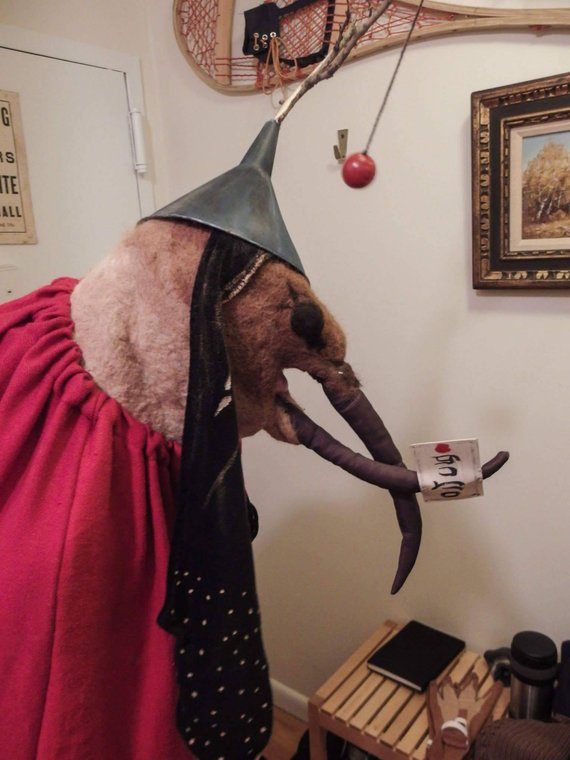
Even the tiniest creature produced by this method is a labor intensive proposition, wherein loose woolen fibers are soaked, soaped, and jabbed with a needle until they come together in a rough mat, suitable for shaping into the whimsical—or demonic—figure of its creator’s choosing.
Stimson matched her full-head bird mask to the one in the painting by equipping it with gloves, a blanket cloak, long velvet ears, and a leafless twig emerging from the spout of its hand-painted funnel hat.
An accomplished milliner, Stimson was drawn to her subject’s unusual headgear, telling HuffPo’s Priscilla Frank how she wished she could ask Bosch about the various elements of his “beautiful demon-bird” and “what, if any, symbolic significance they hold.”
…a monster on ice skates approaches three fiends who are hiding under a bridge across which pious men are helping an unconscious Saint Anthony. The monster, wearing a badge that Bax says can be recognized as the emblem of a messenger, bears a letter that is supposedly a protest of Saint Anthony’s treatment. But the letter, according to (Bosch scholar and author Dirk) Bax, is in mirror writing, a sure sign that the monster and the fiends are mocking the saint. The monster wears a funnel that symbolizes intemperance and wastefulness, sports a dry twig and a ball that signify licentious merrymaking, and has lopping ears that show its foolishness. All this might have been obvious to the artist’s contemporaries when the work was created, but the average modern viewer can only hope to understand the overall intent of a Bosch painting, while regarding the scores of bizarre monsters and demons as a kind of dark and cruel comic relief.
A field guide to Bosch’s bizarre images in the same article gives viewers leave to interpret any and all funnels in his work as a coded reference to deceit and intemperance… perhaps at the hands of a false doctor or alchemist!
Not every subway rider caught the arty reference. Unsurprisingly, some even refused to acknowledge the strange being in their midst. Those folks must not share Stimson’s dedication to examining “that which is unfamiliar, seeking out all that is yet unknown to you in both art and life.”
Within 24 hours of its Metropolitan Transit Authority adventure, the one-of-a-kind demon-bird costume was sold on Etsy.
(Holler if you wish Stimson had kept it around long enough to take a spin on the ice at Rockefeller Center or Bryant Park, where the majority of patrons would no doubt be gliding around in ignorance that, as per Meisler, Bosch equated skates with folly.)
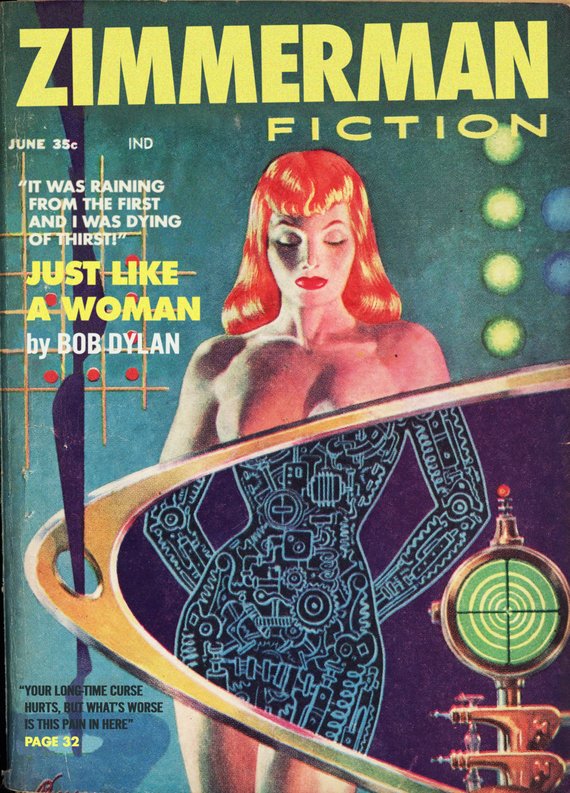
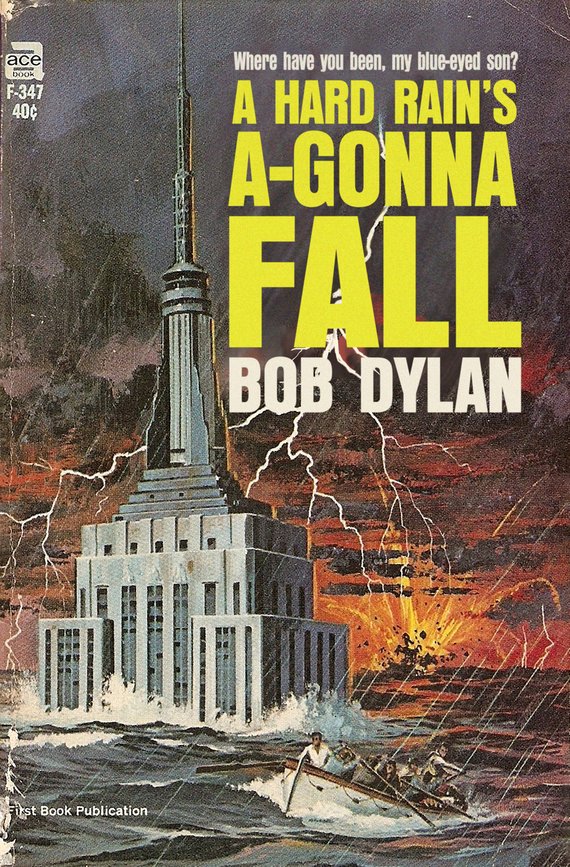
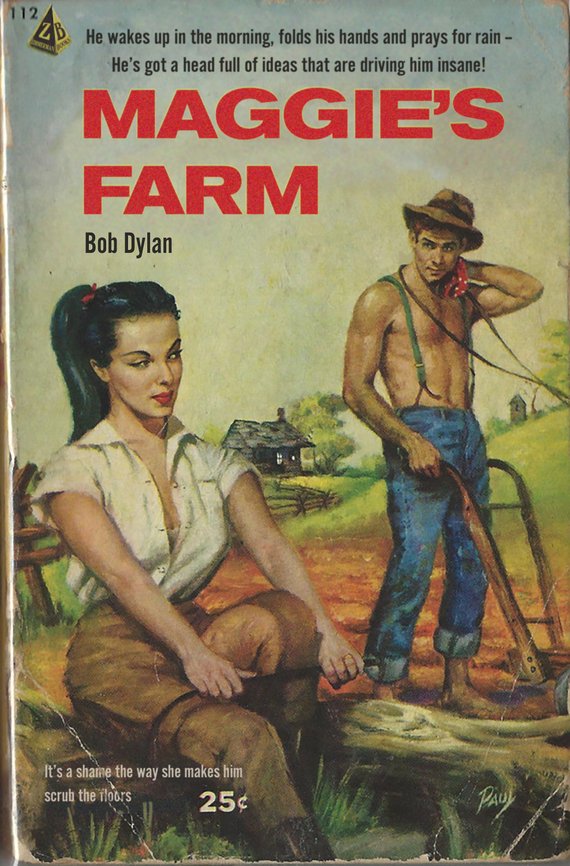
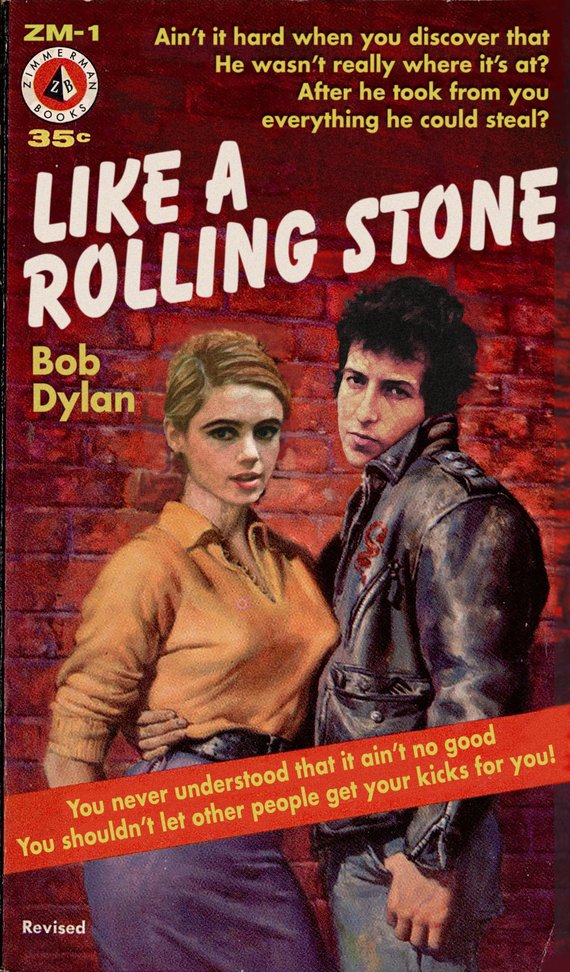
To restate what should be obvious from the second, if not first glance, none of Alcott’s titles are real. His aesthetically convincing mock-ups pay tribute to favorite songs by favorite artists: David Bowie, Talking Heads, Joy Division, Elvis Costello…
The start of the school year finds him in a Dylan mood, rendering some of his best known hits in a variety of pulp genre formats:
Bob Dylan is the perfect subject for this project, because his work has always been all about quotation and repurposing. From the very beginning, he took old songs, changed the lyrics and called them his own…. And it’s not just the melodies, he’s also not shy about lifting phrases and whole lines from other sources. One of the fun things about being a Bob Dylan fan is being able to spot the influences. It’s not just lifting lines from classic blues songs, where we don’t really know who “wrote” the originals, it’s real, identifiable, copyright-protected material. And you never know where it’s going to come from, a book about the Yakuza from Japan, a cookbook, an old Time Magazine article, or 1940s noir pictures.
I was watching a classic Robert Mitchum noir, Out of the Past, and Mitchum is talking to someone, and they mention San Francisco, and Mitchum says “I always liked San Francisco, I was there for a party once.”
And I was like “Wait, what?” Because that’s a line from a really obscure Dylan song, “Maybe Someday,” off his album Knocked-Out Loaded.
I was like “Wait, why did that line stick in Dylan’s mind? Why did he decide to quote that? Is it just the way Mitchum says it? What happened there?” And suddenly a song I hadn’t thought about much became a lot more interesting.
So for my Dylan covers, I try to carry on that tradition of taking quotes and repurposing them. So “Just Like a Woman” becomes a story in a science-fiction pulp, and “Like a Rolling Stone” becomes an expose on juvenile delinquency, and “Rainy Day Women” becomes a post-apocalyptic adventure story.
In a way, it’s what this project is all about, taking discarded pieces of culture and sticking them back together with new references to make them breathe again.
From a design standpoint, it’s a great illustration of the heavy lifting a single well-chosen punctuation change can do.
The magazine’s title is an extra gift to Dylan fans.
The Blonde-on-Blonde Chroniclescontinue with Rainy Day Women #12 & 35. Does it matter that the breast-plated, and for all practical purposes bottomless warriors are raven tressed?
It’s not the fallout rain. It isn’t that at all. The hard rain’s gonna fall is in the last verse…That means all the lies, you know, that people get told on their radios and in newspapers. All you have to think for a minute, you know. Trying to take people’s brains away, you know. Which maybe has been done already. I hate to think it’s been done. All the lies, which I consider poison.
This writer can think of another reason citizens might find themselves fighting for their lives in a rowboat level with the very tippy top of the Empire State Building. So, I suspect, can Alcott.
Or maybe we’re wrong and climate change is nothing but fake news.
Alcott gets some mileage out of another rain-based lyric on Maggie’s Farm, a steamy rural romp whose creased cover is also part and parcel of the genre.
Who’s that young punk on the cover of Like a Rolling Stone? Beats me, but the girl’s a dead ringer for Warhol superstar, Edie Sedgwick, the purported inspiration for the song that shares the novel’s name. Ms. Sedgwick’s real life figure was much less voluptuous, but if the genre covers that sparked this project demonstrate anything, it’s that sex sells.
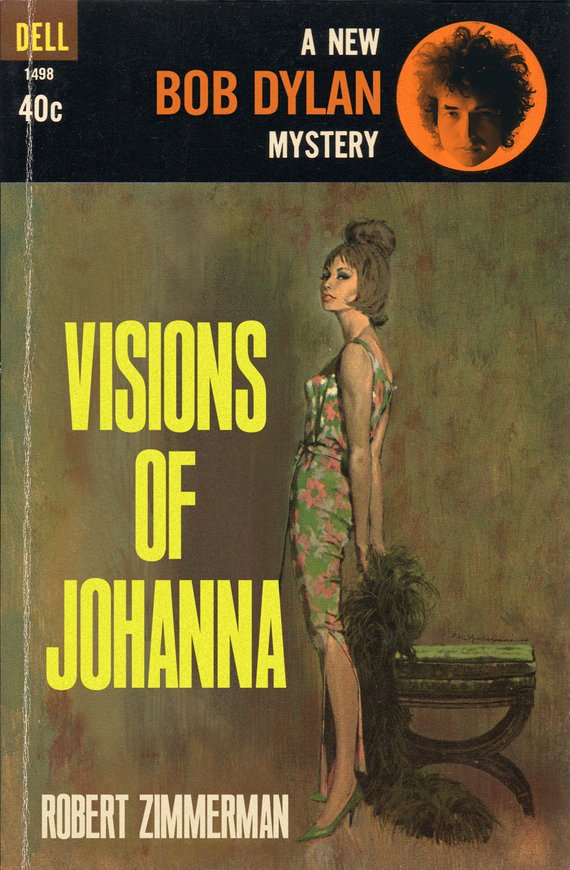
Visions of Johanna is positively understated in comparison. While many pulp authors toiled in obscurity, let us pretend that Nobel Prize winner and (faux) pulp-novelist Dylan wouldn’t have. Especially if he had a series like the pseudonymous Brett Halliday’s popular Mike Shayne mysteries. At that level, the cover wouldn’t really need quotes.
Though what harm would there be? There’s plenty of negative space here. Readers, which line would you splash across the cover if you were this prankster, Alcott?
Ain’t it just like the night to play tricks when you’re tryin’ to be so quiet?
We sit here stranded, though we’re all doin’ our best to deny it
And Louise holds a handful of rain, temptin’ you to defy it
Lights flicker from the opposite loft
In this room the heat pipes just cough
The country music station plays soft
But there’s nothing, really nothing to turn off
Just Louise and her lover so entwined
And these visions of Johanna that conquer my mind
In the empty lot where the ladies play blindman’s bluff with the key chain
And the all-night girls they whisper of escapades out on the “D” train
We can hear the night watchman click his flashlight
Ask himself if it’s him or them that’s really insane
Louise, she’s all right, she’s just near
She’s delicate and seems like the mirror
But she just makes it all too concise and too clear
That Johanna’s not here
The ghost of ’lectricity howls in the bones of her face
Where these visions of Johanna have now taken my place
Now, little boy lost, he takes himself so seriously
He brags of his misery, he likes to live dangerously
And when bringing her name up
He speaks of a farewell kiss to me
He’s sure got a lotta gall to be so useless and all
Muttering small talk at the wall while I’m in the hall
How can I explain?
Oh, it’s so hard to get on
And these visions of Johanna, they kept me up past the dawn
Inside the museums, Infinity goes up on trial
Voices echo this is what salvation must be like after a while
But Mona Lisa musta had the highway blues
You can tell by the way she smiles
See the primitive wallflower freeze
When the jelly-faced women all sneeze
Hear the one with the mustache say, “Jeeze
I can’t find my knees”
Oh, jewels and binoculars hang from the head of the mule
But these visions of Johanna, they make it all seem so cruel
The peddler now speaks to the countess who’s pretending to care for him
Sayin’, “Name me someone that’s not a parasite and I’ll go out and say a prayer for him”
But like Louise always says
“Ya can’t look at much, can ya man?”
As she, herself, prepares for him
And Madonna, she still has not showed
We see this empty cage now corrode
Where her cape of the stage once had flowed
The fiddler, he now steps to the road
He writes ev’rything’s been returned which was owed
On the back of the fish truck that loads
While my conscience explodes
The harmonicas play the skeleton keys and the rain
And these visions of Johanna are now all that remain
You can see more of Todd Alcott’s Mid-Century Pulp Fiction Cover project, and pick up archival quality prints from his Etsy shop.
The late Bob Ross, the almost laughably calm host of PBS’ popular how-to series, the Joy of Painting, was a boss of many things—business, branding, the 16th-century wet-on-wet ”Alla Prima” technique…
Also speed, as thirteen New York City comedians recently discovered firsthand.
Invited to participate in The Bob Ross Challenge, a web series-cum-fundraiser hatched by comedians Micah Sherman and Mark Stetson, they gamely plunged ahead, regardless of artistic talent or familiarity with the master.
Some like, Julia Duffy, are simply too young to have encountered Ross in his public television heyday.
The majority seem to share a latch key kid’s fondness for the gentle Ross, whose show proved a chill pairing with afterschool snacks.
“We spent about $1000 on official Bob Ross supplies,” Sheman reports. From easel to the fan brush, everything was set up for the participating comedians’ success. Like Ross, who typically shot a season’s worth of episodes over a single weekend, the first season’s shoot transpired over a few days.
The ground rules were simple. Armed with an arsenal of officially sanctioned supplies, each comedian entered a studio where a Joy of Painting episode was screening, charged with recreating that canvas in real time. At the end of the episode, it was “brushes down” whether or not the canvas bore passing resemblance to Bob’s.
“Our original title was Bob Ross Fails, but people were actually succeeding,” Sherman confesses.
That said, there’s a definite edge. The participants may be trained in improv, but as performers, there’s an imperative to get over, and, as stated, Ross moves fast. In the time it takes an average mortal to apply a sky wash, he’s likely fan brushed in a couple of happy little trees.
Tough nuts.
The rules of the game decree that the stopwatch abides.
David Carl, above, creator of Trump Lear, declares (in character) that he not only defeated Bob Ross, but that “no one’s ever had a better tree than that” and that his clouds are “beautifully tremendous.”
Sherman and his co-creator Mark Stetson have conceived of The Bob Ross Challenge as a fundraiser for the Leukemia & Lymphoma Society. Like Ross, Stetson’s father was prematurely claimed by lymphoma. Make a donation in their honor here.
“He had admirers but no imitators,” writes Dave Itzkoff in Robin, his new biography of Robin Williams. “No one combined the precise set of talents he had in the same alchemical proportions.” Though Itzkoff’s book has received a great deal of acclaim, many fans may still feel that important elements of Williams’ particular genius remain less than fully understood. Scholars of comedy will surely continue to scrutinize the beloved comic’s persona for decades to come, just as they have over the past four years since his death. The cinema-analyzing video essay series Every Frame a Painting produced one of the first such examinations of Williams’ technique, “Robin Williams — In Motion,” and its insight still holds up today.
“Few actors could express themselves as well through motion,” narrator Tony Zhou says of Williams, “whether that motion was big or small. Even when he was doing the same movement in two different scenes, you could see the subtle variations he brought to the arc of the character.” This goes for Williams’ manic, impression laden performances as well as his low-key, slow-burning ones. “To watch his work,” Zhou says over a montage of entertaining examples, “is to see the subtle thing that an actor can do with his hands, his mouth, his right leg, and his facepalm. Robin Williams’ work is an encyclopedia of ways that an actor can express himself through movement, and he was fortunate to work with filmmakers who used his talents to their fullest.”
Those filmmakers included Barry Levinson (Good Morning Vietnam, Toys, Man of the Year), Peter Weir (Dead Poets Society), Terry Gilliam (The Adventures of Baron Munchausen, The Fisher King), and Gus Van Sant (Good Will Hunting). Zhou credits them and others with letting Williams “play it straight through” rather than adhering to the more common stop-start shooting method that only permits a few seconds of acting at a time; they gave him “something physical to do,” without which his skill with motion couldn’t come through in the first place; they used “blocking,” meaning the arrangement of the actors in the space of the scene, “to tell their story visually”; they “let him listen,” a little-acknowledged but nonetheless important part of a performance, especially a Williams performance.
Finally, these directors “didn’t let perfection get in the way of inspiration.” While the quality of the individual works in Williams’ impressively large filmography may vary, his performances in them are almost all unfailingly compelling. Even during his lifetime Williams was described as a comic genius, and he showed us that comic geniuses have to take risks. And even though every risk he took might not have paid off, his body of work, taken as a whole, teaches us a lesson: “Be open. This was a man who improvised many of his most iconic moments. Maybe he was on to something.” Or as Williams himself put it on an Inside the Actors Studio interview, “When the stuff really hits you, it’s usually something that happened, and it happened then. That’s what film is about: capturing a moment.”
Based in Seoul, Colin Marshall writes and broadcasts on cities and culture. His projects include the book The Stateless City: a Walk through 21st-Century Los Angeles and the video series The City in Cinema. Follow him on Twitter at @colinmarshall or on Facebook.
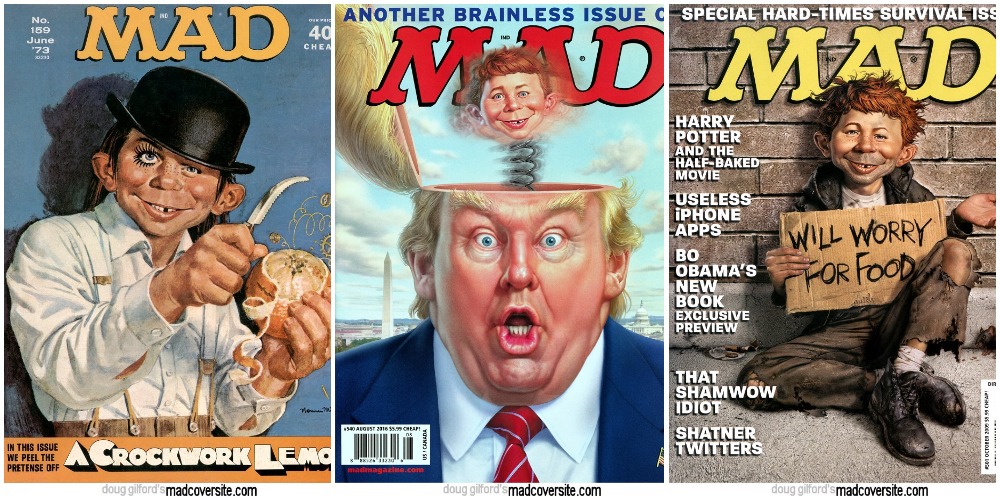
For 65 years and counting, the pages of Mad magazine have entertained readers by satirizing all the cultural items, social fads, news items, and political issues of the moment. Throughout that span of time the covers of Mad magazine have done the same, except that they’ve entertained everyone, even those who’ve never opened an issue, whether they want it or not. Though on one level designed purely as disposable visual gags, Mad’s covers collectively provide a satirical history of America, and one you can easily browse at Doug Gilford’s Mad Cover Site, “a resource for collectors and fans of the world’s most important (ecch!) humor publication.”
Gilford started the site back in 1997, a year that saw Mad’s covers take on such phenomena as The X‑Files, the Spice Girls, the Tamagotchi, and Seinfeld. That last seizes the presumably irresistible opportunity to draw Jerry Seinfeld scowling in irritation at “Neuman” — not his nemesis-neighbor Newman, but Mad’s mascot Alfred E. Neuman, who appears in one form or another on almost all of the magazine’s covers.
These sort of antics had already been going on for quite some time, as evidenced, for instance, by the June 1973 cover above in which Neuman dons a Droog outfit to take the place of Malcolm McDowell in A Clockwork Orange — or, in Mad’s, view, A Crockwork Lemon.
To see the archive’s covers in a large format, you need only scroll to the desired year, click on the issue number, and then click on the image that appears. (Alternatively, those with advanced Mad knowledge can simply pick an issue number from the pull-down “Select-a-Mad” menu at the top of the page.) Gilford keeps the site updated with covers right up to the latest issue: number three, as of this writing, since the magazine “rebooted” this past June as it relocated its offices from New York to California. Recent targets have included Donald Trump, Donald Trump, Donald Trump, and, of course, Donald Trump. Mad’s longevity may be surprising, but it certainly doesn’t look like America will stop providing the ridiculousness on which it has always survived any time soon.
Based in Seoul, Colin Marshall writes and broadcasts on cities and culture. His projects include the book The Stateless City: a Walk through 21st-Century Los Angeles and the video series The City in Cinema. Follow him on Twitter at @colinmarshall or on Facebook.
I usually chafe when director Wes Anderson is labelled “twee,” but as an enthusiastic, sticky-fingered gobbler of bark and ash encrusted campfire s’mores, I did enjoy a rather rowdy laugh at his expense while watching the above video.
Each entry in filmmaker David Ma’s #FoodFilms series starts with a hypothesis that pairs a simple, familiar dish with a director whose visual style is well established.
What if Wes Anderson made S’mores?
Ma’s early marination in the realms of food styling and advertising is a recipe for success here.
The world may know him as an actor and comedian, but Nick Offerman also loves woodworking. And he doesn’t just love it in the evenings-and-weekends, something-to-do-with-my-hands-while-I-listen-to-podcasts way: he’s actually devoted a serious chunk of his life, personal and professional, to making things out of trees. As neatly as it may dovetail with the musky, traditionally (and sometimes buffoonishly) masculine characters he plays, the woodworking aspect of Offerman’s life exists independently of his other craft — not to say, of course, that you’ll find the web site of the Offerman Woodshop completely devoid of humor.
Though pride in physical work well done is its own reward, Offerman believes that his woodworking also made it possible for him to succeed as an entertainer. “People often ask me, how can I get my kid involved in show business?” he says in the Big Think clip above. “And I always say, I would advise that you take up woodworking, because it’s addictive,” a “craft that is so satisfying, that doesn’t require the input of any corporate entities.” This in contrast to the Hollywood auditions where he always found himself performing for “a room full of bankers” and leaving bewildered, thinking, “ ‘I have no idea how I did,’ which gives you a lot of stress and a lot of agita.”
This stress and agita sent him straight to his woodshop, where he would “just start sanding a walnut table.” Before long, “I would see the tangible result of this work that I had done. The thing is, there’s no way to describe the sensation. There’s magic in it, whether you’re working with glass or metals or food or knitting or wood.” He credits that powerful and empowering sensation, which he describes, in a perhaps uncharacteristically Californian manner, as having “an incredible meditative or Zen quality,” with giving him “a mellow demeanor to the point that I no longer cared as much about the TV shows.” And by caring less, he found that he could handle all of the performances show business demanded of him that much better.
You can get a tour of Offerman’s Los Angeles woodshop in the second video from the top, a clip from This Old House. Beginning with his impressive wood stock, it continues on to his even more formidable set of indestructible-looking vintage tools. “The less electricity you can use,” he tells the host, “the more pleasurable your woodworking will be.” He shares more woodworking advice in the video just above, answering questions from the would-be woodworkers of Twitter: Is an apron really necessary? Yes. Does oak require a pre-stain conditioner? Don’t stain oak at all. When one fellow requesting help identifying a joint type addresses Offerman as “Master Crafter Wood,” Offerman corrects him: “I’m a student of the form, but I appreciate your optimism.” That sums up what woodworking offers: a condition of eternal studenthood, and if not optimism then at least a helpful equanimity. “Zen” may be the right word after all.
Based in Seoul, Colin Marshall writes and broadcasts on cities and culture. His projects include the book The Stateless City: a Walk through 21st-Century Los Angeles and the video series The City in Cinema. Follow him on Twitter at @colinmarshall or on Facebook.
We're hoping to rely on loyal readers, rather than erratic ads. Please click the Donate button and support Open Culture. You can use Paypal, Venmo, Patreon, even Crypto! We thank you!
Open Culture scours the web for the best educational media. We find the free courses and audio books you need, the language lessons & educational videos you want, and plenty of enlightenment in between.