A Map of the Disney Entertainment Empire Reveals the Deep Connections Between Its Movies, Its Merchandise, Disneyland & More (1967)

We all remem­ber the first Dis­ney movie we ever saw. In most of our child­hoods, one Dis­ney movie led to anoth­er, which stoked in us the desire for Dis­ney toys, Dis­ney games, Dis­ney comics, Dis­ney music, and so on. If we were lucky, we might also take a trip to Dis­ney­land or one of its descen­dants else­where in the world. Many of us spent the bulk of our youngest years as hap­py res­i­dents of the Dis­ney enter­tain­ment empire; some of us, into adult­hood or even old age, remain there still.

Die-hard Dis­ney fans appre­ci­ate that the world of Dis­ney — com­pris­ing not just films and theme parks but tele­vi­sion shows, print­ed mat­ter, attrac­tions on the inter­net, and mer­chan­dise of near­ly every kind — is too vast ever to com­pre­hend, let alone ful­ly explore.

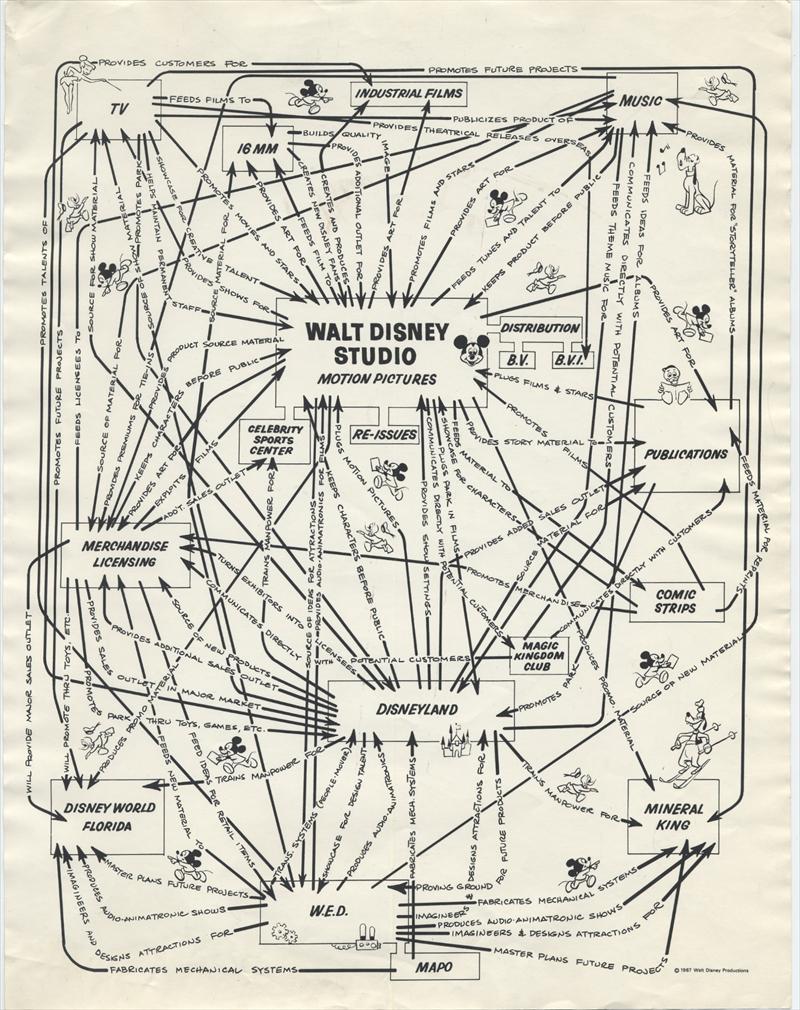
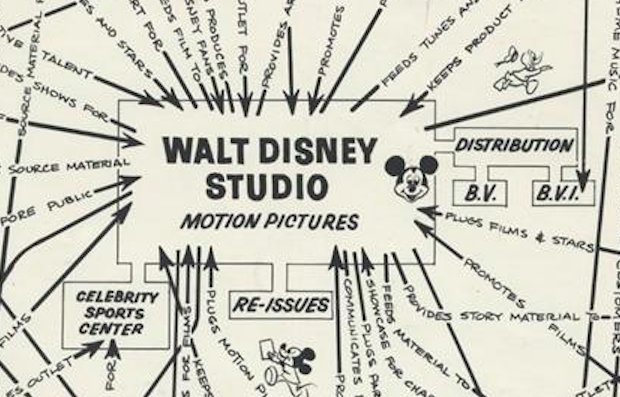
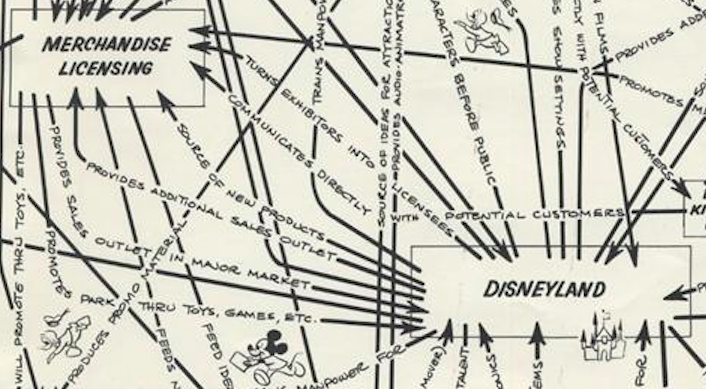
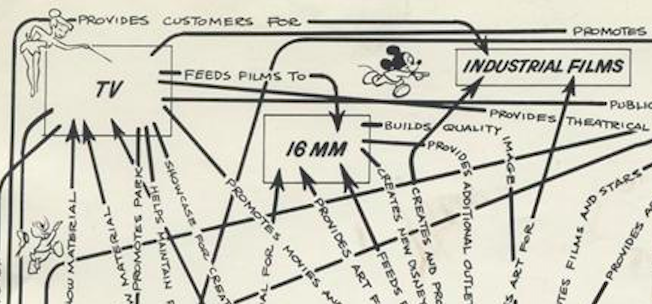
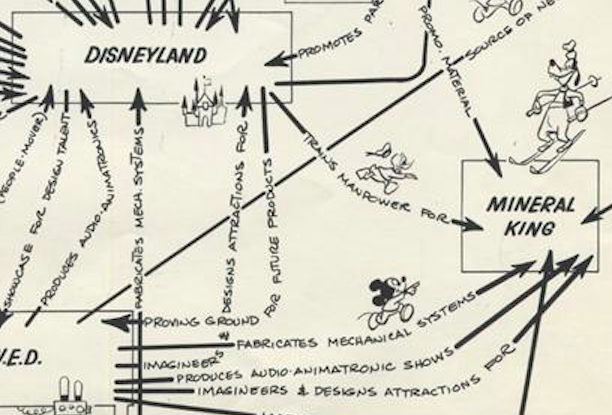
It was already big half a cen­tu­ry ago, but not too big to grasp. You can see the whole of the oper­a­tion laid out in this orga­ni­za­tion­al syn­er­gy dia­gram cre­at­ed by Walt Dis­ney Pro­duc­tions in 1967. Depict­ing “the many and var­ied syn­er­gis­tic rela­tion­ships between the divi­sions of Walt Dis­ney Pro­duc­tions,” the infor­ma­tion graph­ic reveals the links between each divi­sion.

Along the arrow­head­ed lines indi­cat­ing the flows of man­pow­er, mate­r­i­al, and intel­lec­tu­al prop­er­ty, “short tex­tu­al descrip­tions show what each divi­sion sup­plies and con­tributes to the oth­ers.” The motion pic­ture divi­sion “feeds tunes and tal­ent” to the music divi­sion, for exam­ple, which “pro­motes pre­mi­ums for tie-ins” to the mer­chan­dise licens­ing depart­ment, which “feeds ideas for retail items” to WED Enter­pris­es (the hold­ing com­pa­ny found­ed by Walt Dis­ney in 1950), which pro­duces “audio-ani­ma­tron­ics” for Dis­ney­land.

Some of the nexus­es on the dia­gram will be as famil­iar as Mick­ey Mouse, Goofy, Tin­ker­bell, and the char­ac­ters cavort­ing here and there around it. Oth­ers will be less so: the 16-mil­lime­ter films divi­sion, for instance, which would even­tu­al­ly be replaced by a colos­sal home-video divi­sion (itself sure­ly being eat­en into, now, by stream­ing). The Celebri­ty Sports Cen­ter, an indoor enter­tain­ment com­plex out­side Den­ver, closed in 1994. MAPO refers to a theme-park ani­ma­tron­ics unit formed in the 1960s with the prof­its of Mary Pop­pins (hence its name) and dis­solved in 2012. And as for Min­er­al King, a pro­posed ski resort in Cal­i­for­ni­a’s Sequoia Nation­al Park, it was nev­er even built.

“The ski resort was one of sev­er­al ambi­tious projects that Walt Dis­ney spear­head­ed in the years before his death in 1966,” writes Nathan Mas­ters at Giz­mo­do. But as the size of the Min­er­al King plans grew, wilder­ness-activist oppo­si­tion inten­si­fied. After years of oppo­si­tion by the Sier­ra Club, as well as the pas­sage of the Nation­al Envi­ron­men­tal Pol­i­cy Act 1970 and the Nation­al Parks and Recre­ation Act of 1978, cor­po­rate inter­est in the project final­ly fiz­zled out. Though that would no doubt have come as a dis­ap­point­ment to Walt Dis­ney him­self, he might also have known to keep the fail­ure in per­spec­tive. As he once said of the empire bear­ing his name, “I only hope that we nev­er lose sight of one thing — that it was all start­ed by a mouse.”

h/t Eli and via Howard Low­ery

Relat­ed Con­tent:

Dis­ney­land 1957: A Lit­tle Stroll Down Mem­o­ry Lane

How Walt Dis­ney Car­toons Are Made: 1939 Doc­u­men­tary Gives an Inside Look

Walt Dis­ney Presents the Super Car­toon Cam­era

Disney’s 12 Time­less Prin­ci­ples of Ani­ma­tion

Based in Seoul, Col­in Mar­shall writes and broad­casts on cities, lan­guage, and cul­ture. His projects include the book The State­less City: a Walk through 21st-Cen­tu­ry Los Ange­les and the video series The City in Cin­e­ma. Fol­low him on Twit­ter at @colinmarshall or on Face­book.

How Cartoons Saved R. Crumb’s Life, and How R. Crumb Turned Cartoons into an Art Form (NSFW)

Robert Crumb, the icon­ic, found­ing fig­ure of the under­ground and alter­na­tive comix scene, began his career as the ulti­mate out­sider. “I was so alien­at­ed when I was young that draw­ing was like my only con­nec­tion to soci­ety,” he says in the video inter­view above from the Louisiana Chan­nel, “the only thing I could see that was gonna save me from a real­ly dis­mal fate of god knows what.” He had no social skills and no oth­er abil­i­ties to speak of. He was debil­i­tat­ed by self-doubt yet inflat­ed by the buoy­ant ego of the lone artist deter­mined to “make [his] mark on the world.”

What Crumb calls his “two sides” have nev­er been rec­on­ciled, although he has left behind cer­tain racial car­i­ca­tures in more recent work and he claims, in a recent inter­view with Nad­ja Sayej, that he is “no longer a slave to a rag­ing libido.” But his shame­less indul­gence in exag­ger­at­ed stereo­types was always a blunt instru­ment that both pulled read­ers in and pushed them away from the more sub­tle satire and pathos in his comics. As an edi­tor at a Lon­don gallery put it, “there’s some­thing irrec­on­cil­able at the heart of the work that doesn’t resolve towards a sin­gle vision of beau­ty.”

Crumb’s comics are “about seduc­tion and repul­sion. You are drawn into the work and you are judg­ing your­self as you look at it.” We are also judg­ing the artist. Crumb has been called racist, misog­y­nist, a bit­ter, hate­ful lon­er with a nihilis­tic streak five miles wide. These descrip­tions hap­pen to apply to a sig­nif­i­cant num­ber of con­vict­ed and poten­tial ter­ror­ist killers these days, the very peo­ple we seek to mar­gin­al­ize from pub­lic dis­course with hate speech laws and pub­lic sham­ing and shun­ning.

As you might expect, Crumb has no tol­er­ance for such things as fall under the head­ing “polit­i­cal cor­rect­ness.” Sup­press­ing art that offends “can even lead to cen­so­r­i­al poli­cies in the gov­ern­ment,” he says, defend­ing the rights of the artist to say what­ev­er they deem nec­es­sary. His work, he says, even at its most extreme, was nec­es­sary. It saved his life. “The art­work I did that used those images and expressed those kinds of feel­ings, I stand by it…. I still think that’s some­thing that need­ed to be said and need­ed to be done…. It prob­a­bly hurts some people’s feel­ings to see those images, but still, I had to put it out there.”

Some of Crum­b’s imagery is hard to defend, such as his use of black­face imagery from the 1920s and 30s, and his some­times vio­lent objec­ti­fi­ca­tion of women, from the point of view of char­ac­ters near­ly impos­si­ble to sep­a­rate from their cre­ator. But why, if his art is con­fes­sion­al, should he not con­fess? In so doing, he reveals not only his own teem­ing desires. Crumb illus­trat­ed the male hip­pie uncon­scious as well as his own.

After start­ing a rel­a­tive mass move­ment in under­ground comix in the 60s (and becom­ing a reluc­tant leg­end for “Keep on Truckin’”), he says, “I decid­ed I don’t want to be America’s best-loved hip­pie car­toon­ist. I don’t want that role. So I’ll just be hon­est about who I am, and the weird­ness, and take my chances.” Crumb’s can­dor hap­pened to lay bare many of the atti­tudes he observed not only in him­self but in the denizens of the San Fran­cis­co scene, as he told Jacques Hyza­gi in a very reveal­ing Observ­er inter­view (which prompt­ed a very bit­ter feud between the two).

The hip­pie cul­ture of Haight-Ash­bury, where it all start­ed for me, was full of men doing noth­ing all day and expect­ing women to bring them food. The ‘chick’ had to pro­vide a home for them, cook meals for them, even pay the rent. It was still very much ingrained from the ear­li­er patri­ar­chal men­tal­i­ty of our fathers, except that our fathers, gen­er­al­ly, were providers. Free love meant free sex and food for men. Sure, women enjoyed it, too, and had a lot of sex, but then they served men. Even among left-wing polit­i­cal groups, women were always rel­e­gat­ed to sec­re­tar­i­al, menial jobs. We were all on LSD, so it took a few years for the smoke to dis­si­pate and for women to real­ize what a raw deal they were get­ting with the ne’er-do-well hip­pie male. 

Do we see in Crumb’s work, in which burly, huge-calved women dom­i­nate weak-willed men, a cel­e­bra­tion or a con­dem­na­tion of these atti­tudes? We can say, “it’s com­pli­cat­ed,” which sounds like a cop out, or we can go back to the source. Hear Crumb him­self explain his work, as a prod­uct of two war­ring selves and a need to draw him­self into the world with­out hold­ing any­thing back. He showed oth­er artists and writ­ers who were also “born weird,” as he says, that they could tell their sto­ries entire­ly their own way too.

Relat­ed Con­tent:  

R. Crumb Illus­trates Gen­e­sis: A Faith­ful, Idio­syn­crat­ic Illus­tra­tion of All 50 Chap­ters

Under­ground Car­toon­ist Robert Crumb Cre­ates an Illus­trat­ed Intro­duc­tion to Franz Kafka’s Life and Work

The Con­fes­sions of Robert Crumb: A Por­trait Script­ed by the Under­ground Comics Leg­end Him­self (1987)

Josh Jones is a writer and musi­cian based in Durham, NC. Fol­low him at @jdmagness

Meditation for Artists: Learn Moebius’ Meditative Technique Called “Automatic Drawing”

Med­i­ta­tion and art have an ancient, inter­twined his­to­ry in Chi­na, where the begin­nings of Chan Bud­dhism are insep­a­ra­ble from land­scape paint­ing. In Japan, Zen art has con­sti­tut­ed “a prac­tice in appre­ci­at­ing sim­plic­i­ty,” of dis­ap­pear­ing into the cre­ative act, cul­ti­vat­ing degrees of ego­less­ness that allow an artist’s move­ments to become spon­ta­neous and unham­pered by sec­ond guess­es. The “first Japan­ese artists to work in [ink],” notes the Met­ro­pol­i­tan Muse­um of Art, “were Zen monks who paint­ed in a quick and evoca­tive man­ner.” They passed their tech­niques, and their wis­dom, on to their stu­dents.

Per­haps the clos­est ana­logue to this tra­di­tion in the west is com­ic art. Artist Ted Gula has worked with comics leg­ends Frank Frazetta and Moe­bius and drawn for Dis­ney, Mar­vel, and DC. As a child, he watched Jack Kir­by work. “He wouldn’t speak,” says Gula. “He’d be in a trance…. The pen­cil would hit the paper and it wouldn’t stop until the page was com­plete, like it poured out.” How is that pos­si­ble? Gula asked him­self, aston­ished. Kir­by had dis­ap­peared into the work. There were no pre­lim­i­nary sketch­es or rough indi­ca­tors. He would draw an entire book like that, Gula says in the video above from Proko.

Say what you will about the con­tent of Kirby’s work—superhero comics aren’t to everyone’s lik­ing. But no dis­taste for the nature of his sto­ry­telling dimin­ish­es Kirby’s attain­ment of a pure­ly extem­po­ra­ne­ous method he seems nev­er to have explained to Gula in words. Lat­er, how­ev­er, while work­ing with Moe­bius, Gula says, he learned the tech­nique of “auto­mat­ic draw­ing.” Demon­strat­ing it for us above, Gula describes a way of draw­ing that shares much in com­mon with oth­er med­i­ta­tive visu­al art tra­di­tions.

“It’s all doing very organ­ic shapes,” he says, show­ing us how to “draw your mind’s eye. This takes your mind, and your mind’s eye, to a place that nor­mal­ly is unex­plored, and it can’t help but enhance your whole view of your abil­i­ty.” The ego must step aside, exec­u­tive func­tion­ing isn’t need­ed here. “I have no idea,” Gula says, “it’s all just hap­pen­ing on its own.” Moe­bius explained it as “just let­ting my mind relax” and Gula has observed sim­i­lar prac­tices among all the artists he’s worked with.

Gula describes auto­mat­ic draw­ing as a nat­ur­al process for the artist’s mind and hands. The inter­view­er, artist and teacher Sam Prokopenko, also men­tions Kore­an artist Kim Jung Gi in their inter­view, who does “amaz­ing­ly accu­rate draw­ings from his mem­o­ry with­out any con­struc­tion lines,” as Prokopenko says above, in a video from his “12 Days of Proko” series, which inter­views well-known artists about their tech­niques. What’s Kim Jung Gi’s secret? Is he pos­sessed of a super­hu­man, pho­to­graph­ic mem­o­ry? No, he tells Prokopenko.

The secret to becom­ing ful­ly immersed in the work—one that sure­ly goes for so many pur­suits, both cre­ative and athletic—is just to do it: over and over and over and over and over again. (To many people’s dis­ap­point­ment, this also seems to be the secret of med­i­ta­tion.) In Kim Jung Gi’s case, “of course, some part of it is a tal­ent he was born with, but we can’t over­look how much that tal­ent was devel­oped.” We need no expert tal­ent, either innate or devel­oped, to get start­ed. Auto­mat­ic draw­ing seems to require a beginner’s mind.

Relat­ed Con­tent:

Moe­bius Gives 18 Wis­dom-Filled Tips to Aspir­ing Artists

Watch Moe­bius and Miyaza­ki, Two of the Most Imag­i­na­tive Artists, in Con­ver­sa­tion (2004)

In Search of Mœbius: A Doc­u­men­tary Intro­duc­tion to the Inscrutable Imag­i­na­tion of the Late Com­ic Artist Mœbius

Moe­bius’ Sto­ry­boards & Con­cept Art for Jodorowsky’s Dune

Josh Jones is a writer and musi­cian based in Durham, NC. Fol­low him at @jdmagness

Lynda Barry’s New Book Offers a Master Class in Making Comics

In the same way you don’t have to like the way your liv­er looks for it to be able to func­tion, you don’t have to like the way your draw­ings look for them to start to work.  —Lyn­da Bar­ry

Want to feel more alive in the world?

Get back in touch with your inner four-year-old artist, using meth­ods put for­ward by artist, edu­ca­tor, and g*ddamn nation­al trea­sure Lyn­da Bar­ry.

Mak­ing Comics, the lat­est book from the Uni­ver­si­ty of Wis­con­sin asso­ciate pro­fes­sor, MacArthur Genius, and Omega Insti­tute fac­ul­ty mem­ber, bypass­es stan­dard­ized pro­fes­sion­al skills such as ink­ing, sto­ry­board­ing, and let­ter­ing, in order to foment a deep­er emo­tion­al con­nec­tion between car­toon­ist and com­ic.

First things first, you can draw. Stop say­ing you can’t. You can.

Stop say­ing your draw­ings look like they were made by a four-year-old.

In Barry’s expe­ri­ence, the unfet­tered draw­ings of four-year-old artists are some­thing to aim for.

As author and comics his­to­ri­an Chris Gavaler notes in his Pop Mat­ters review:

Mak­ing Comics is a love let­ter to every child who ever picked up a cray­on and start­ed mak­ing marks with unself­con­scious inten­si­ty. Those chil­dren include her col­lege stu­dents. Like her read­ers, some arrive at class with artis­tic train­ing and some arrive with none at all. The lat­ter arrive hav­ing long for­got­ten the unin­hib­it­ed style of image-mak­ing they under­stood instinc­tive­ly as chil­dren. Find­ing each of those chil­dren is Bar­ry’s mis­sion, and she is very very good at it.

Bar­ry, who is child­less, is keen­ly attuned to the sort of play­ful assign­ments that hold imme­di­ate appeal for chil­dren of all ages.

And she doles out instruc­tions on a need to know basis, dis­arm­ing the self-doubt and excuse-mak­ing that plague adult stu­dents who are pre­sent­ed with the big pic­ture too ear­ly in the process.

In Mak­ing Comics, exer­cis­es include draw­ing with eyes closed, draw­ing with the non-dom­i­nant hand, two-hand­ed draw­ing, simul­ta­ne­ous part­ner draw­ing, Exquis­ite Corpse, and trans­form­ing scrib­bles and cof­fee stains by teas­ing out what­ev­er image they may sug­gest.

Bar­ry also con­veys pre­cise instruc­tions with regard to speed and mate­ri­als, know­ing that those can close as many win­dows as they open.

She’s bat­tling the sti­fling impulse toward per­fec­tion, the impos­si­ble stan­dards that cause so many to turn away from mak­ing pic­tures and sto­ries as they mature.

Don’t sweat it! More rock, less talk! Unleash the mon­sters of your id! Invite unfore­seen ghosts into the frame!

As Bar­ry says:

….there are two work­ing lan­guages in human life. One is sort of top of the mind, what we’re con­scious of. The oth­er is this uncon­scious stuff that we might not know about or have access to. The way we access it is usu­al­ly through this thing we call ‘the arts.’ Unfor­tu­nate­ly, that has got­ten removed from the reg­u­lar dai­ly expe­ri­ence of human life. What I’m try­ing to do is to show that there is a way that they can come togeth­er, and that you can make things in a way that makes you actu­al­ly feel alive and present.

Read an excerpt of Lyn­da Barry’s Mak­ing Comics. Or pur­chase your own copy of Mak­ing Comics here.

Video at the top of the page cour­tesy of Art Book Walk-throughs & Reviews.

Relat­ed Con­tent:

Fol­low Car­toon­ist Lyn­da Barry’s 2017 “Mak­ing Comics” Class Online, Pre­sent­ed at UW-Wis­con­sin

Lyn­da Bar­ry on How the Smart­phone Is Endan­ger­ing Three Ingre­di­ents of Cre­ativ­i­ty: Lone­li­ness, Uncer­tain­ty & Bore­dom

Car­toon­ist Lyn­da Bar­ry Teach­es You How to Draw

Ayun Hal­l­i­day is an author, illus­tra­tor, the­ater mak­er and Chief Pri­ma­tol­o­gist of the East Vil­lage Inky zine.  Join her in NYC on Mon­day, Decem­ber 9 when her month­ly book-based vari­ety show, Necro­mancers of the Pub­lic Domain cel­e­brates Dennison’s Christ­mas Book (1921). Fol­low her @AyunHalliday.

The Velvet Underground as Peanuts Characters: Snoopy Morphs Into Lou Reed, Charlie Brown Into Andy Warhol

peanut underground

The fun car­toon above was appar­ent­ly found in a “Guide to the Vel­vet Under­ground and Andy Warhol’s Fac­to­ry” pub­lished by the French mag­a­zine, Les Inrock­upt­ibles in 1990. It came around the same time the Fon­da­tion Carti­er pour l’art con­tem­po­rain (locat­ed in Paris) held an exhi­bi­tion ded­i­cat­ed to Andy Warhol. Of course, Warhol famous­ly took a break from paint­ing in the mid-1960s and, among oth­er things, threw his influ­ence behind the up-and-com­ing NYC band, The Vel­vet Under­ground. Serv­ing as the band’s man­ag­er, he “pro­duced” VU’s first album, which meant design­ing the album cov­er and giv­ing the band mem­bers — Lou Reed, John Cale, Ster­ling Mor­ri­son, Mau­reen Tuck­er and Nico — the free­dom to make what­ev­er album they pleased, up to a cer­tain point. Above, you can see these same musi­cians reimag­ined as Peanuts char­ac­ters.

If you would like to sign up for Open Culture’s free email newslet­ter, please find it here. It’s a great way to see our new posts, all bun­dled in one email, each day.

If you would like to sup­port the mis­sion of Open Cul­ture, con­sid­er mak­ing a dona­tion to our site. It’s hard to rely 100% on ads, and your con­tri­bu­tions will help us con­tin­ue pro­vid­ing the best free cul­tur­al and edu­ca­tion­al mate­ri­als to learn­ers every­where. You can con­tribute through Pay­Pal, Patre­on, and Ven­mo (@openculture). Thanks!

Relat­ed Con­tent:

The Vel­vet Under­ground Cap­tured in Col­or Con­cert Footage by Andy Warhol (1967)

Andy Warhol Explains Why He Decid­ed to Give Up Paint­ing & Man­age the Vel­vet Under­ground Instead (1966)

A Sym­pho­ny of Sound (1966): Vel­vet Under­ground Impro­vis­es, Warhol Films It, Until the Cops Turn Up

by | Permalink | Make a Comment ( 1 ) |

Anne Frank’s Diary: The Graphic Novel Adaptation

The human imag­i­na­tion can be an extra­or­di­nary cop­ing device in times of trou­ble, a tiny win­dow pro­vid­ing men­tal escape from what­ev­er cell fate has con­signed us to.

Diarist and aspir­ing pro­fes­sion­al writer Anne Frank, who died in the Bergen-Belsen con­cen­tra­tion camp at the age of 15, chafed at her now-uni­ver­sal­ly-known con­fine­ment in the Secret Annex. She chafed at her mother’s author­i­ty and the seem­ing­ly effort­less saint­li­ness of her old­er sis­ter. Doc­u­ment­ing her dai­ly phys­i­cal and emo­tion­al real­i­ty offered tem­po­rary respite from it.

The lib­er­at­ing pow­er of the cre­ative mind is one of the aspects writer Ari Fol­man and illus­tra­tor David Polon­sky sought to tease out when adapt­ing Anne Frank: The Diary of a Young Girl as a graph­ic nov­el.

The graph­ic nov­el for­mat decreed that entire pas­sages would be cut or con­densed. Polon­sky can use a sin­gle pan­el to show logis­tics it took Anne para­graphs to describe. The inter­per­son­al con­flicts she dwelt on are now con­veyed by facial expres­sions and body lan­guage.

As with Sid Jacob­son and Ernie Colón’s 2010 Anne Frank: The Anne Frank House Autho­rized Graph­ic Biog­ra­phythe diary’s small stage is expand­ed to give read­ers, par­tic­u­lar­ly those unac­quaint­ed with the orig­i­nal text, a his­tor­i­cal con­text for under­stand­ing the wider social impli­ca­tions of Anne’s tragedy.

But this graph­ic retelling is unique in that it traf­fics in mag­ic real­ist visu­als that should play well with 21st-cen­tu­ry youth, who cut their teeth on CGI, fast-paced edits, and stream­ing teen-focused enter­tain­ments where­in char­ac­ters are apt to break the fourth wall or break into song.

These are the read­ers to whom the project is most inten­tion­al­ly pitched. As Fol­man told Teen Vogue’s Emma Sar­ran Web­ster:

I tru­ly believe that in a few years, when the very last sur­vivors will have died, the angle that will be tak­en from the sto­ry will be that with every year, we are 10 years fur­ther away from the orig­i­nal. […] There is a severe threat that the things we have to learn from it will not be taught and learned if we don’t find a new lan­guage for them. So any new lan­guage in my opin­ion is blessed, as long as it stays with­in the frame­work and reach­es young audi­ences by means of their tools, which are now very visu­al.

Ergo, Kit­ty, Anne’s nick­name for her diary, has been per­son­i­fied, emerg­ing from the lit­tle plaid book’s pages like Peter Pan’s shad­ow, ear atten­tive­ly cocked toward the secrets Anne whis­pers into it.

The melo­dra­mat­ic Mrs. van Daan’s prized fur coat has an anthro­po­mor­phized rab­bit head col­lar, capa­ble of join­ing in the dia­logue.

Polon­sky pays homage to artists Edvard Munch, whose “degen­er­a­tive” work Hitler had removed from Ger­man muse­ums, and Gus­tav Klimt, who paint­ed many works that were con­fis­cat­ed from their Jew­ish own­ers by Nazi decree.

Young read­ers’ mod­ern sen­si­bil­i­ties also guid­ed Folman’s approach to the text. The spir­it of the orig­i­nal is pre­served, but cer­tain phras­ings have been giv­en a 21st cen­tu­ry update.

The snarky Secret Annex menus and diet tips he allows his hero­ine harken to the direct address of var­i­ous meta teen come­dies, as well as the blis­ter­ing par­o­dy of the Sara­je­vo Sur­vival Guide, a pur­port­ed trav­el guide writ­ten dur­ing the Siege.

Noble goal of engag­ing the next gen­er­a­tion aside, there are no doubt some purists who will view these inno­va­tions as impo­si­tion. Rest assured that Anne Frank’s Diary: The Graph­ic Adap­ta­tion is sanc­tioned by Anne Frank Fonds, the char­i­ta­ble foun­da­tion estab­lished by Anne’s father, Otto.

Relat­ed Con­tent:

Watch the Only Known Footage of Anne Frank

Read the Poignant Let­ter Sent to Anne Frank by George Whit­man, Own­er of Paris’ Famed Shake­speare & Co Book­shop (1960): “If I Sent This Let­ter to the Post Office It Would No Longer Reach You”

How Art Spiegel­man Designs Com­ic Books: A Break­down of His Mas­ter­piece, Maus

Ayun Hal­l­i­day is an author, illus­tra­tor, the­ater mak­er and Chief Pri­ma­tol­o­gist of the East Vil­lage Inky zine.  Join her in NYC on Mon­day, Novem­ber 4 when her month­ly book-based vari­ety show, Necro­mancers of the Pub­lic Domain cel­e­brates Louise Jor­dan Miln’s “Woo­ings and Wed­dings in Many Climes (1900). Fol­low her @AyunHalliday.

The Story of Ziggy Stardust Gets Chronicled in a New Graphic Novel, Featuring a Foreword by Neil Gaiman

Film has always been a medi­um that seeks to enter­tain as well as edi­fy, fram­ing thrills and chills for prof­it, and fram­ing com­po­si­tions deserv­ing of the label of “art.” Very often it has done both at the same time. Every casu­al stu­dent of the medi­um will, at least, admit this much. But nev­er have the dif­fer­ences between movie art and enter­tain­ment seemed as mag­ni­fied and polar­ized as they are now, in the midst of debates about com­ic book fran­chis­es and the fine art we call cin­e­ma.

What­ev­er the rea­sons, film has not reached the détente between art and enter­tain­ment achieved by pop­u­lar music—another medi­um depen­dent on late-19th/20th cen­tu­ry record­ing tech­nolo­gies and born of a thor­ough­ly mod­ern com­mer­cial matrix. Of course, not all pop aspires to art. But the idea that music can be huge­ly entertaining—drawing on the “low” gen­res of fan­ta­sy, sci­ence fic­tion, and com­ic books—and also wor­thy of cul­tur­al immor­tal­i­ty has become uncon­tro­ver­sial in large part because of the career of one musi­cian.

David Bowie, rock and roll’s orig­i­nal space alien super­hero, used his bank­able per­son­ae through the decades to give cre­dence to the idea of “art rock,” to real­ize its glam pos­si­bil­i­ties, to turn the rock auteur into an actor. He learned from a host of exper­i­menters, both his direct influ­ences and his spir­i­tu­al pre­de­ces­sors. And he inspired a legion of suc­ces­sors who weren’t afraid to play char­ac­ters in their work, to mix inter­ests in phi­los­o­phy, lit­er­a­ture, and the occult with the flam­boy­ant, campy styles of the comics. (A mix comics them­selves played with in both pop­u­lar and under­ground man­i­fes­ta­tions.)

Bowie embod­ied the future when he appeared on the scene as Zig­gy in 1972, after years of labor­ing in obscu­ri­ty and a few fleet­ing brush­es with fame. “The incar­na­tions of David Bowie were, in them­selves, sci­ence fic­tion­al, “writes Neil Gaiman in the for­ward to a new graph­ic nov­el, BOWIE: Star­dust, Ray­guns, & Moon­age Day­dreams, which tells the sto­ry of Bowie’s rise as Zig­gy. “All I was miss­ing was a Bowie com­ic,” says Gaiman of his own fan­dom. “And, miss­ing it, I would draw bad Bowie comics myself.” Zig­gy Star­dust espe­cial­ly called for such treat­ment.

Bowie wore the glam rock Mar­t­ian mask with such com­mit­ment no one doubt­ed that he meant it—only what, exact­ly, he meant by it. “He defied clas­si­fi­ca­tion,” notes Simon & Schus­ter, “with his psy­che­del­ic aes­thet­ics, his larg­er-than-life image, and his way of hov­er­ing on the bor­der of the sur­re­al.” Fit­ting­ly, the com­ic is drawn by an artist who real­ized a psy­che­del­ic, sur­re­al­ist cre­ative vision of Neil Gaiman’s: Michael Allred, who worked on the Sand­man series.

The sto­ry, “part biog­ra­phy and part imag­i­na­tion,” reports Rolling Stone, is writ­ten by Steve Hor­ton and col­ored by Lau­ra Allred. You can order a copy here.

via Rolling Stone

Relat­ed Con­tent:

96 Draw­ings of David Bowie by the “World’s Best Com­ic Artists”: Michel Gondry, Kate Beat­on & More

David Bowie Songs Reimag­ined as Pulp Fic­tion Book Cov­ers: Space Odd­i­ty, Heroes, Life on Mars & More

Fred­die Mer­cury Reimag­ined as Com­ic Book Heroes

Josh Jones is a writer and musi­cian based in Durham, NC. Fol­low him at @jdmagness

The Best of the Edward Gorey Envelope Art Contest

What a delight it must have been to have been one of Edward Gorey’s cor­re­spon­dents, or even a postal work­er charged with han­dling his out­go­ing mail.

The late author and illus­tra­tor had a pen­chant for embell­ish­ing envelopes with the hairy beasts, pok­er-faced chil­dren, and cats who are the main­stays of his dark­ly humor­ous aes­thet­ic.

(A num­ber of these envelopes and some 60 post­cards and sketch­es are includ­ed in Float­ing Worlds: The Let­ters of Edward Gorey and Peter F. Neumey­erwhich doc­u­ments the cor­re­spon­dence-based friend­ship between Gorey and the author with whom he col­lab­o­rat­ed on three children’s books, includ­ing the delight­ful­ly macabre Don­ald Has a Dif­fi­cul­ty.)

The Edward Gorey House, a beloved Cape Cod res­i­dence turned muse­um, has been keep­ing the tra­di­tion alive with its annu­al Hal­loween Enve­lope Art Con­test.

Com­peti­tors of all ages vie for the oppor­tu­ni­ty to have their win­ning (and run­ners up and “very-close-to-being-run­ners-up”) Gorey-inspired entries dis­played in the Gorey House and its dig­i­tal exten­sions.

2019’s theme is the high­ly evoca­tive “Uncom­fort­able Crea­tures” … and depend­ing on the speed with which you can exe­cute a bril­liant idea and deliv­er it to the post office, you may still have a shot—entries must be post­marked by Mon­day, Octo­ber 21, with win­ners to be announced on Hal­loween.

In addi­tion to Stef Kiihn Aschenbrenner’s win­ning enve­lope from the 2018 contest’s over-18 cat­e­go­ry (top), some of our favorites from past years are repro­duced here. Our inky-black hearts are espe­cial­ly warmed to see the spir­it of the mas­ter kin­dling the imag­i­na­tions of the youngest entrants—special shout out to Daniel Miley, aged 4.

View five years’ worth of notable Hal­loween Enve­lope Con­test entries on the Edward Gorey House web­site (20182017201620152014) or down­load the offi­cial entry form and race to the post office with your bid for 2019 glo­ry.

Entries must be post­marked by Mon­day, Octo­ber 21 and addressed to Edward Gorey House, 8 Straw­ber­ry Lane, Yarmouth Port, MA 02675 USA.

Relat­ed Con­tent:

Lemo­ny Snick­et Reveals His Edward Gorey Obses­sion in an Upcom­ing Ani­mat­ed Doc­u­men­tary

Edward Gorey Talks About His Love Cats & More in the Ani­mat­ed Series, “Goreytelling”

Edward Gorey Illus­trates H.G. Wells’ The War of the Worlds in His Inim­itable Goth­ic Style (1960)

Ayun Hal­l­i­day is an author, illus­tra­tor, the­ater mak­er and Chief Pri­ma­tol­o­gist of the East Vil­lage Inky zine.  Join her in NYC on Mon­day, Novem­ber 4 when her month­ly book-based vari­ety show, Necro­mancers of the Pub­lic Domain cel­e­brates Louise Jor­dan Miln’s “Woo­ings and Wed­dings in Many Climes (1900). Fol­low her @AyunHalliday.

« Go BackMore in this category... »
Quantcast