The Best of the Edward Gorey Envelope Art Contest

What a delight it must have been to have been one of Edward Gorey’s cor­re­spon­dents, or even a postal work­er charged with han­dling his out­go­ing mail.

The late author and illus­tra­tor had a pen­chant for embell­ish­ing envelopes with the hairy beasts, pok­er-faced chil­dren, and cats who are the main­stays of his dark­ly humor­ous aes­thet­ic.

(A num­ber of these envelopes and some 60 post­cards and sketch­es are includ­ed in Float­ing Worlds: The Let­ters of Edward Gorey and Peter F. Neumey­erwhich doc­u­ments the cor­re­spon­dence-based friend­ship between Gorey and the author with whom he col­lab­o­rat­ed on three children’s books, includ­ing the delight­ful­ly macabre Don­ald Has a Dif­fi­cul­ty.)

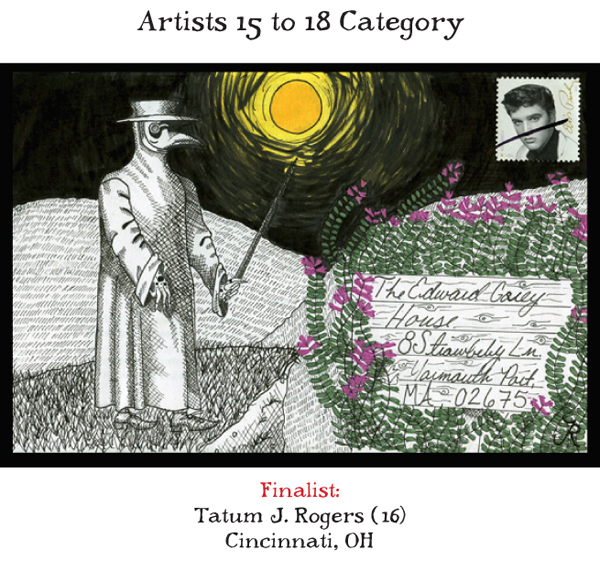
The Edward Gorey House, a beloved Cape Cod res­i­dence turned muse­um, has been keep­ing the tra­di­tion alive with its annu­al Hal­loween Enve­lope Art Con­test.

Com­peti­tors of all ages vie for the oppor­tu­ni­ty to have their win­ning (and run­ners up and “very-close-to-being-run­ners-up”) Gorey-inspired entries dis­played in the Gorey House and its dig­i­tal exten­sions.

2019’s theme is the high­ly evoca­tive “Uncom­fort­able Crea­tures” … and depend­ing on the speed with which you can exe­cute a bril­liant idea and deliv­er it to the post office, you may still have a shot—entries must be post­marked by Mon­day, Octo­ber 21, with win­ners to be announced on Hal­loween.

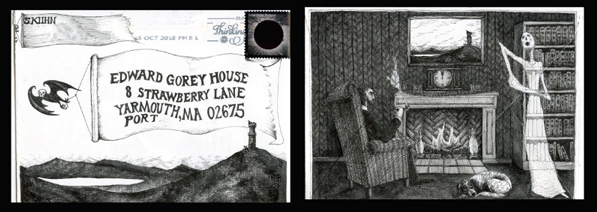
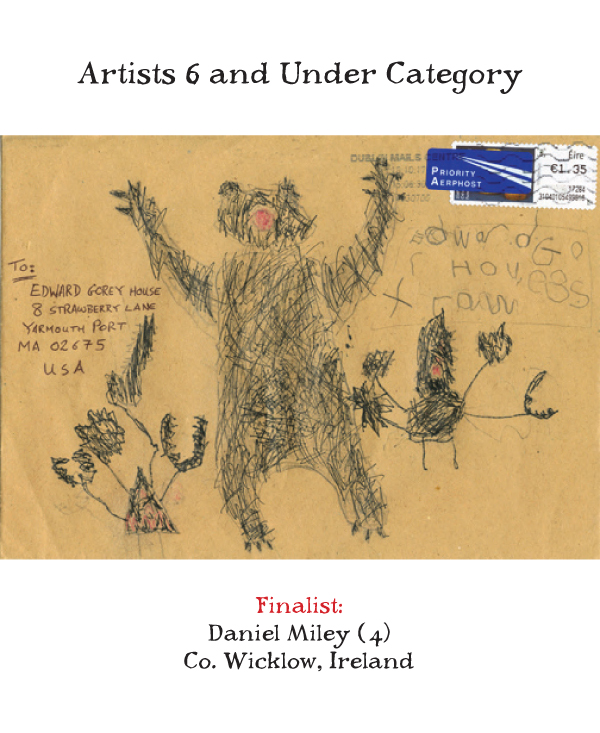
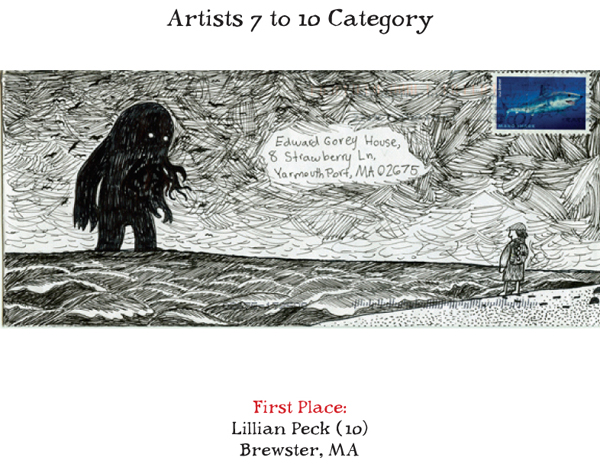
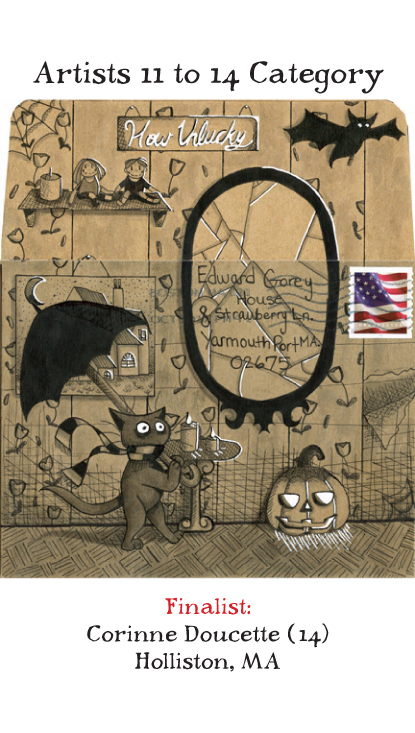
In addi­tion to Stef Kiihn Aschenbrenner’s win­ning enve­lope from the 2018 contest’s over-18 cat­e­go­ry (top), some of our favorites from past years are repro­duced here. Our inky-black hearts are espe­cial­ly warmed to see the spir­it of the mas­ter kin­dling the imag­i­na­tions of the youngest entrants—special shout out to Daniel Miley, aged 4.

View five years’ worth of notable Hal­loween Enve­lope Con­test entries on the Edward Gorey House web­site (20182017201620152014) or down­load the offi­cial entry form and race to the post office with your bid for 2019 glo­ry.

Entries must be post­marked by Mon­day, Octo­ber 21 and addressed to Edward Gorey House, 8 Straw­ber­ry Lane, Yarmouth Port, MA 02675 USA.

Relat­ed Con­tent:

Lemo­ny Snick­et Reveals His Edward Gorey Obses­sion in an Upcom­ing Ani­mat­ed Doc­u­men­tary

Edward Gorey Talks About His Love Cats & More in the Ani­mat­ed Series, “Goreytelling”

Edward Gorey Illus­trates H.G. Wells’ The War of the Worlds in His Inim­itable Goth­ic Style (1960)

Ayun Hal­l­i­day is an author, illus­tra­tor, the­ater mak­er and Chief Pri­ma­tol­o­gist of the East Vil­lage Inky zine.  Join her in NYC on Mon­day, Novem­ber 4 when her month­ly book-based vari­ety show, Necro­mancers of the Pub­lic Domain cel­e­brates Louise Jor­dan Miln’s “Woo­ings and Wed­dings in Many Climes (1900). Fol­low her @AyunHalliday.
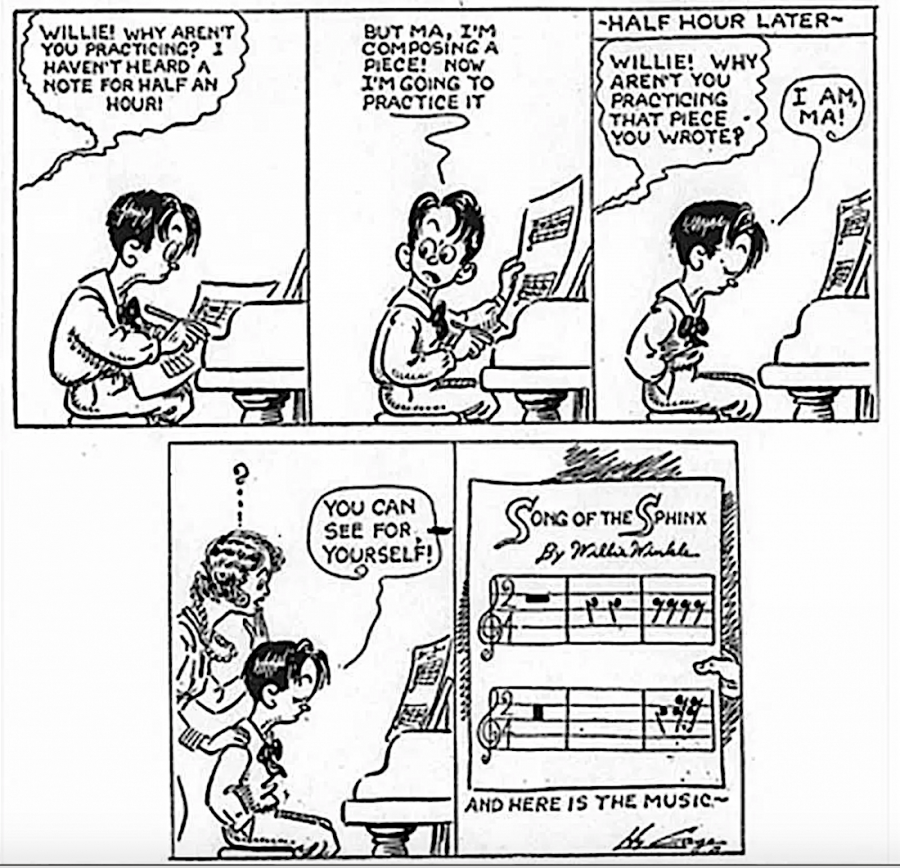
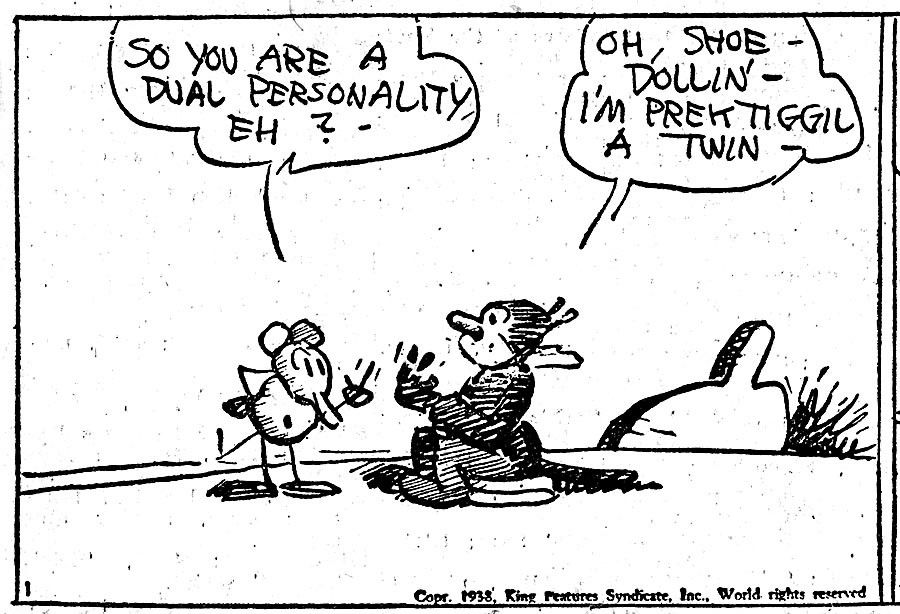
20 Years Before John Cage’s 4′33″, a Man Named Hy Cage Created a Cartoon about a Silent Piano Composition (1932)

Quite a find by Futil­i­ty Clos­et:

In John Cage’s 1952 com­po­si­tion 4’33”, the per­former is instruct­ed not to play his instru­ment.

Amer­i­can music crit­ic Kyle Gann dis­cov­ered this 1932 car­toon in The Etude, a mag­a­zine for pianists.

The cartoonist’s name, remark­ably, is Hy Cage.

Need any back­ground on Cage’s 4′33″? Explore the posts in the Relat­eds below.

via Boing Boing

Relat­ed Con­tent:

John Cage’s Silent, Avant-Garde Piece 4’33” Gets Cov­ered by a Death Met­al Band

John Cage Per­forms His Avant-Garde Piano Piece 4’33” … in 1’22” (Har­vard Square, 1973)

The Curi­ous Score for John Cage’s “Silent” Zen Com­po­si­tion 4’33”

The BBC Sym­pho­ny Orches­tra Per­forms 4′33,″ the Con­tro­ver­sial Com­po­si­tion by John Cage, Born 100 Years Ago Today


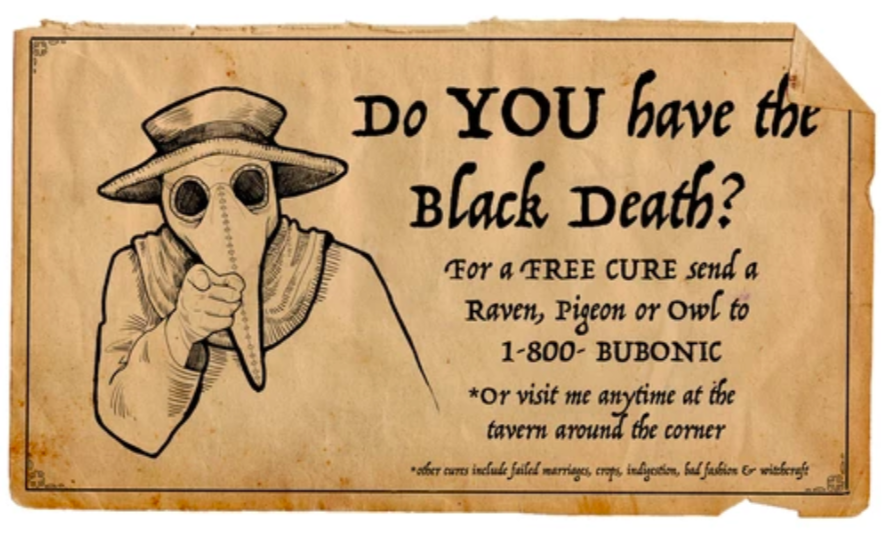
Imagined Medieval Comics Illuminate the Absurdities of Modern Life

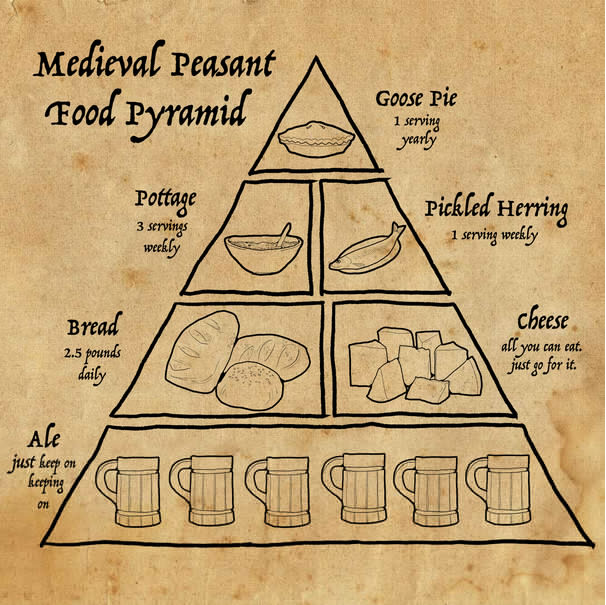
In 2005, the U.S. Depart­ment of Agri­cul­ture revised its famous food pyra­mid, jet­ti­son­ing the famil­iar hier­ar­chi­cal graph­ic in favor of ver­ti­cal rain­bow stripes rep­re­sent­ing the var­i­ous nutri­tion­al groups. A stick fig­ure bound­ed up a stair­case built into one side, to rein­force the idea of adding reg­u­lar phys­i­cal activ­i­ty to all those whole grains and veg­gies.

The dietary infor­ma­tion it pro­mot­ed was an improve­ment on the orig­i­nal, but nutri­tion­al sci­en­tists were skep­ti­cal that the pub­lic would be able to parse the con­fus­ing graph­ic, and by and large this proved to be the case.

Artist Tyler Gun­ther, how­ev­er, was inspired:

I start­ed think­ing about the mes­sag­ing school chil­dren in 1308 were force fed to believe was part of a heart healthy diet, only to have the rug pulled out from under them 15 years lat­er when some monk rearranged the whole thing.

In oth­er words, you’d bet­ter dig into that annu­al goose pie, kids, while you’ve still got 6 glass­es of ale to wash it down.

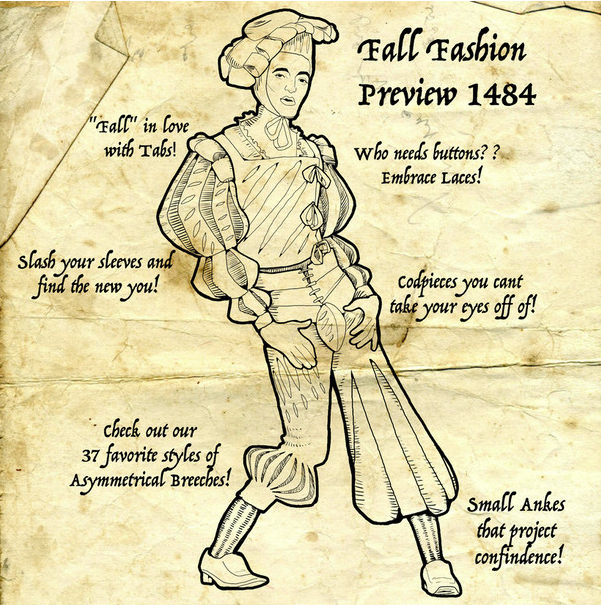
The imag­ined over­lap between the mod­ern and the medieval is a fer­tile vein for Gunter, whose MFA in Cos­tume Design is often put to good use in his hilar­i­ous his­tor­i­cal comics:

Mod­ern men’s fash­ion is so incred­i­bly bor­ing. A guy wears a pat­tered shirt with a suit and he gets laud­ed as though he won the super bowl of fash­ion. But back in the Mid­dle Ages men made bold, brave fash­ion choic­es and I admire them great­ly for this. It’s so excit­ing to me to think of these inven­tive, strange, fan­tas­tic cre­ations being a part of the every­day mas­cu­line aes­thet­ic.

The shapes and struc­tures of women’s head­wear in the dark ages are tru­ly inspir­ing. Where were these milliners draw­ing inspi­ra­tion from? How were they engi­neered? How com­fort­able were they to wear? How did they fit through the major­i­ty of door­ways? What was it like to sit behind a par­tic­u­lar­ly large one in church? I’m still scrolling through many an inter­net his­to­ry blog to find the answers. 

Kathryn Warner’s Edward II blog has proved a help­ful resource, as has Anne H. van Buren’s book Illu­mi­nat­ing Fash­ion: Dress in the Art of Medieval France and the Nether­lands.

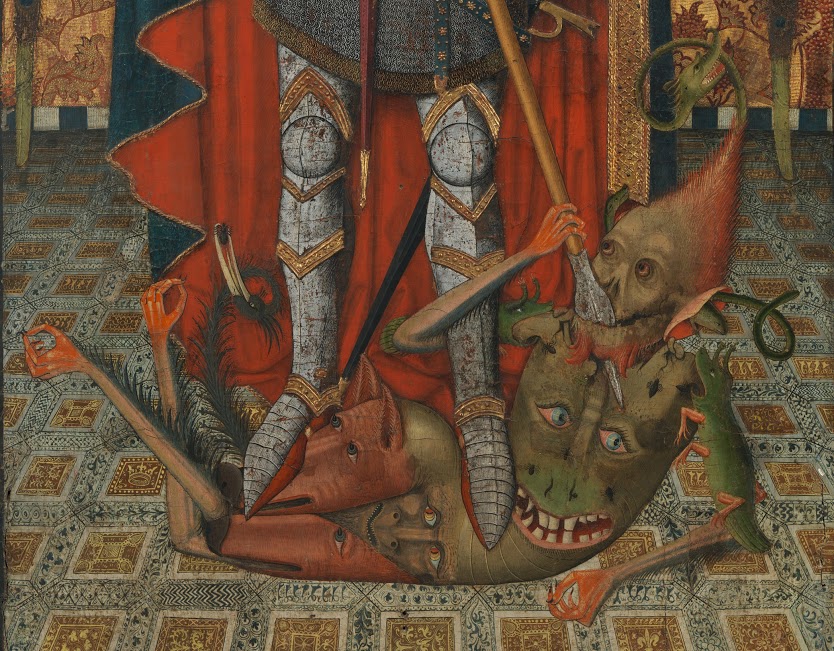
The Brook­lyn-based, Arkansas-born artist also makes peri­od­ic pil­grim­ages to the Clois­ters, where the Met­ro­pol­i­tan Muse­um hous­es a vast num­ber illu­mi­nat­ed man­u­scripts, pan­el paint­ings, altar pieces, and the famed Uni­corn Tapes­tries:

On my first trip to The Clois­ters I saw a paint­ing of St. Michael and the dev­il almost imme­di­ate­ly. I don’t think my life or art has been the same since. None of us know what the dev­il looks like. But you wouldn’t know that based on how con­fi­dent­ly this artist por­trays his like­ness. After gaz­ing at this paint­ing for an extend­ed peri­od of time I want­ed so bad­ly to under­stand the imag­i­na­tion of who­ev­er could imag­ine an alli­ga­tor arms/face crotch/dragon pony­tail com­bo. I don’t think I’ve come close to scratch­ing the sur­face.

Every time I go to that muse­um I think, “Wow it’s like I’m on Game of Thrones” and then I have to remind myself kind­ly that this was real life. Almost every­thing there was an object that peo­ple inter­act­ed with as part of their aver­age dai­ly life and that fas­ci­nates me as some­one who lives in a world filled with mass pro­duced, plas­tic objects. 

Gunther’s draw­ings and comics are cre­at­ed (and aged) on that most mod­ern of conveniences—the iPad.

The British monar­chy and the First Ladies are also sources of fas­ci­na­tion, but the mid­dle ages are his pri­ma­ry pas­sion, to the point where he recent­ly cos­tumed him­self as a page to tell the sto­ry of Piers Gave­ston, 1st Earl of Corn­wall and Edward II’s dar­ling, aid­ed by a gar­ment rack he’d retooled as a medieval pageant cart-cum-pup­pet the­ater.

See the rest of Tyler Gunther’s Medieval Comics on his web­site and don’t for­get to sur­prise your favorite hygien­ist or oral sur­geon with his Medieval Den­tist print this hol­i­day sea­son.

All images used with per­mis­sion of artist Tyler Gun­ther

Relat­ed Con­tent:

How to Make a Medieval Man­u­script: An Intro­duc­tion in 7 Videos

Medieval Monks Com­plained About Con­stant Dis­trac­tions: Learn How They Worked to Over­come Them

Why Knights Fought Snails in Illu­mi­nat­ed Medieval Man­u­scripts

Ayun Hal­l­i­day is an author, illus­tra­tor, the­ater mak­er and Chief Pri­ma­tol­o­gist of the East Vil­lage Inkyzine.  Join her in NYC on Mon­day, Octo­ber 7 when her month­ly book-based vari­ety show, Necro­mancers of the Pub­lic Domaincel­e­brates the art of Aubrey Beard­s­ley, with a spe­cial appear­ance by Tyler Gun­ther. Fol­low her @AyunHalliday.
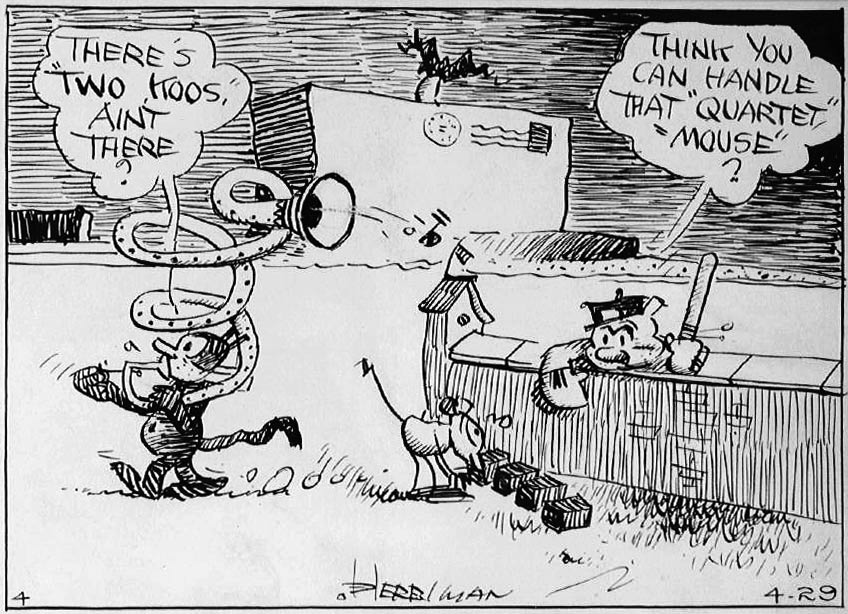
George Herriman’s Krazy Kat, Praised as the Greatest Comic Strip of All Time, Gets Digitized as Early Installments Enter the Public Domain

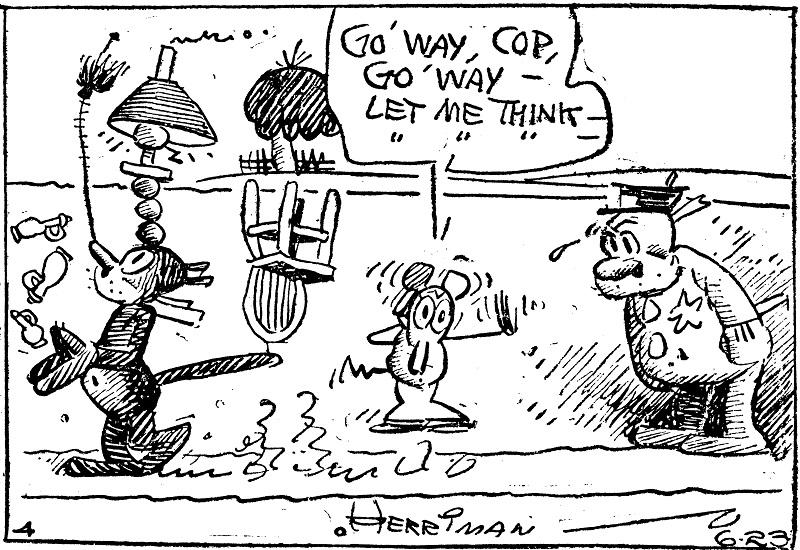
“As a car­toon­ist, I read Krazy Kat with awe and won­der,” writes Calvin and Hobbes cre­ator Bill Wat­ter­son in his intro­duc­tion to The Kom­plete Kolor Krazy Kat. The cre­ator of quite pos­si­bly the most beloved com­ic strip of the past thir­ty years calls Krazy Kat “such a pure and com­plete­ly real­ized per­son­al vision that the strip’s inner mech­a­nism is ulti­mate­ly as unknow­able as George Her­ri­man,” the artist who wrote and drew it for its entire three-decade run from 1913 to 1944. “I mar­vel at how this fan­ci­ful world could be so force­ful­ly imag­ined and brought to paper with such imme­di­a­cy. THIS is how good a com­ic strip can be.”

High praise, espe­cial­ly from the hyper­bole-resis­tant Wat­ter­son, a sharp-eyed crit­ic of his art form and per­ceiv­er of its unre­al­ized poten­tial. “Quirky, indi­vid­ual, and uncom­pro­mised, Krazy Kat is one of the very few com­ic strips that takes full advan­tage of its medi­um. There are some things a com­ic strip can do that no oth­er medi­um, not even ani­ma­tion, can touch, and Krazy Kat is a vir­tu­al essay on com­ic strip essence.”

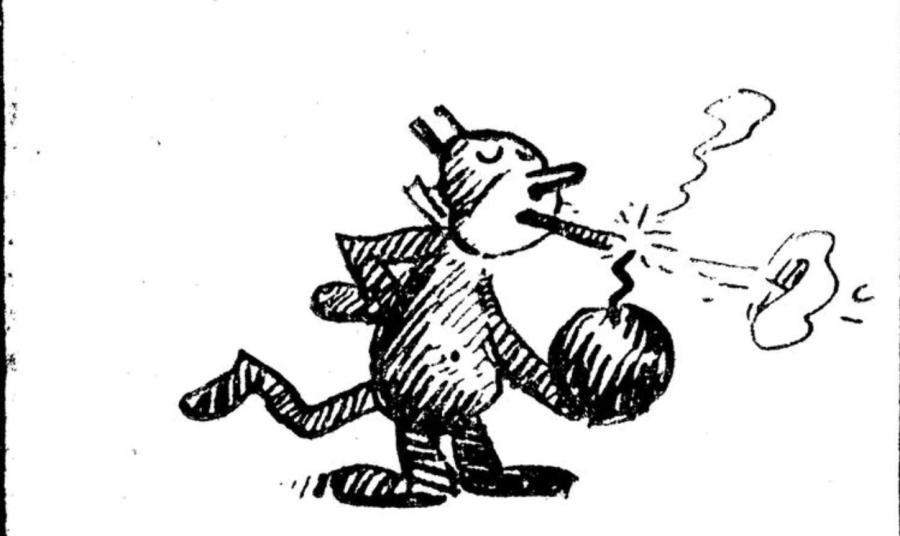
The “self-con­scious­ly baroque nar­ra­tions and mono­logues” show that “words can be fun­ny in them­selves”; “the sky turns from black to white to zigza­gs and plaids sim­ply because, in a com­ic strip, it CAN”; its sur­re­al Ari­zona desert set­ting “is a char­ac­ter in the sto­ry, and the strip is ‘about’ that land­scape as much as it is about the ani­mals who pop­u­late it,” Ignatz Mouse, Off­is­sa Pupp, and the tit­u­lar Krazy Kat.

Ignatz Mouse “demon­strates his con­tempt for Krazy by throw­ing bricks at her” (though their gen­ders, so mod­ern observers note, were nev­er quite sta­ble), “Krazy rein­ter­prets the bricks as signs of love,” and Off­is­sa Pupp, the desert’s lone law­man, is “oblig­ed by duty (and regard for Krazy) to thwart and pun­ish Ignatz’s ‘sin,’ there­by inter­fer­ing with a process that’s sat­is­fy­ing to every­one for all the wrong rea­sons.”

Now read­ers every­where can feel that sat­is­fac­tion for them­selves at the web site of Krazy Kat fan Joel Franu­sic, who has launched a project to find and dig­i­tize (using Machine Learn­ing) all of Her­ri­man’s strips that have so far fall­en into the pub­lic domain. Franu­sic writes of hav­ing got into Krazy Kat in the first place because of the pres­ence of Calvin and Hobbes in his child­hood: “I remem­bered how Bill Wat­ter­son ref­er­enced Krazy Kat as a big rea­son why he insist­ed on get­ting a larg­er full col­or for­mat for his Sun­day com­ic strips.”

I myself first picked up a Krazy Kat col­lec­tion as a Calvin and Hobbes-lov­ing ele­men­tary school­er, and soon found myself cap­ti­vat­ed by the sheer den­si­ty of strange­ness in its pages. But read enough of Her­ri­man’s mas­ter­work, and that strange­ness takes on a strong mean­ing that nev­er­the­less dif­fers from read­er to read­er. “Krazy Kat has been described as a para­ble of love, a metaphor for democ­ra­cy, a ‘sur­re­al­is­tic’ poem, unfold­ing over years and years,” writes Chris Ware, anoth­er of the most respect­ed com­ic-strip artists alive. “It is all of these, but so much more: it is a por­trait of Amer­i­ca, a self-por­trait of Her­ri­man, and, I believe, the first attempt to paint the full range  of human con­scious­ness in the lan­guage of the com­ic strip.” And now, 75 years after its con­clu­sion, much more of human­i­ty can enjoy Krazy Kat than ever. Explore dig­i­tized scans at Franu­sic’s web site. Or pick up a copy of the new edi­tion of The Com­plete Krazy Kat in Col­or, a col­or fac­sim­i­le of the com­plete pages of Krazy Kat 1935–44.

via Boing­Bo­ing

Relat­ed Con­tent:

Umber­to Eco Explains the Poet­ic Pow­er of Charles Schulz’s Peanuts

24,000 Vin­tage Car­toons from the Library of Con­gress Illus­trate the His­to­ry of This Mod­ern Art Form (1780–1977)

Down­load 15,000+ Free Gold­en Age Comics from the Dig­i­tal Com­ic Muse­um

Down­load Over 22,000 Gold­en & Sil­ver Age Com­ic Books from the Com­ic Book Plus Archive

Clas­sic Children’s Books Now Dig­i­tized and Put Online: Revis­it Vin­tage Works from the 19th & 20th Cen­turies

A Dig­i­tal Archive of Heavy Met­al, the Influ­en­tial “Adult Fan­ta­sy Mag­a­zine” That Fea­tured the Art of Moe­bius, H.R. Giger & More

Based in Seoul, Col­in Mar­shall writes and broad­casts on cities, lan­guage, and cul­ture. His projects include the book The State­less City: a Walk through 21st-Cen­tu­ry Los Ange­les and the video series The City in Cin­e­ma. Fol­low him on Twit­ter at @colinmarshall, on Face­book, or on Insta­gram.

An Illustrated Version of The Mueller Report: Read Online an Edition Created by the Author of Black Hawk Down and an Illustrator from Archer

The 448 page Mueller Report does­n’t make for breezy beach read­ing. That’s for sure. But, “buried with­in the Mueller report, there is a nar­ra­tive that reads in parts like a thriller.” Work­ing with that the­o­ry, Insider.com “hired Mark Bow­den, a jour­nal­ist and author known for his bril­liant works of nar­ra­tive non­fic­tion like Black Hawk Down, Killing Pablo, and Hue 1968.” And they gave him an assign­ment: “Use the inter­views and facts laid out in the Mueller Report (plus those from reli­able, fact-checked sources and pub­lished first­hand accounts)” and cre­ate an account that’s “so grip­ping it will hold your atten­tion (and maybe your con­gres­sion­al rep­re­sen­ta­tive’s).” They also hired “Chad Hurd, an illus­tra­tor from the art depart­ment of Archer,” and “asked him to draw out scenes from the report to bring them to life.” Find the result­ing illus­trat­ed edi­tion of The Mueller Report right here.

If you would like to sign up for Open Culture’s free email newslet­ter, please find it here. It’s a great way to see our new posts, all bun­dled in one email, each day.

If you would like to sup­port the mis­sion of Open Cul­ture, con­sid­er mak­ing a dona­tion to our site. It’s hard to rely 100% on ads, and your con­tri­bu­tions will help us con­tin­ue pro­vid­ing the best free cul­tur­al and edu­ca­tion­al mate­ri­als to learn­ers every­where. You can con­tribute through Pay­Pal, Patre­on, and Ven­mo (@openculture). Thanks!

Relat­ed Con­tent:

The Mueller Report Released as a Free Well-For­mat­ted eBook (by The Dig­i­tal Pub­lic Library of Amer­i­ca)

Watch a Star-Stud­ded Cast Read The Mueller Report: John Lith­gow, Kevin Kline, Sigour­ney Weaver, Annette Ben­ing & More

by | Permalink | Make a Comment ( 2 ) |

The End of an Era: MAD Magazine Will Publish Its Last Issue With Original Content This Fall

As a cul­tur­al ref­er­ence, MAD mag­a­zine may have died decades ago. This is a not a dis­par­age­ment, but a state­ment of fact. The kind of satire the august, anar­chic com­ic first unleashed on the world of 1952 debuted in a cul­tur­al milieu that is no more, and a form—the illus­trat­ed, satir­i­cal periodical—that is increas­ing­ly niche. MAD left an indeli­ble impres­sion on Amer­i­can publishing’s past, but as the magazine’s leg­endary car­toon­ist Al Jaf­fee tells The Wash­ing­ton Post, “it’s most­ly nos­tal­gia now.”

Respond­ing to the market’s cues, MAD will more or less dis­ap­pear from news­stands, pub­lish­ing lega­cy con­tent on a sub­scrip­tion-only basis and on the direct mar­ket, “a.k.a. spe­cial­ty and com­ic book stores,” writes Giz­mo­do, “like the vast major­i­ty of DC’s comics out­put is already.” MAD shaped itself in oppo­si­tion to Cold War para­noia and nev­er seemed to find a new edge after favorite tar­gets like Richard Nixon and Ronald Rea­gan left the scene. The mag­a­zine turned almost exclu­sive­ly to pop cul­ture par­o­dy in the 90s. As ABC News reports, MAD “peaked at 2.8 mil­lion sub­scribers in 1973,” then began its decline, with only “140,000 left as of 2017.”

The magazine’s found­ing edi­tor, car­toon­ist Har­vey Kurtz­man, passed away in 1993. His suc­ces­sor Al Feld­stein, who brought the mag­a­zine to inter­na­tion­al promi­nence, died in 2014. MAD’s long­time, tight-knit staff of writ­ers and car­toon­ists are most­ly retired, and most are san­guine about the wind­ing down. “It’s been a log­i­cal devel­op­ment,” com­ments anoth­er MAD car­toon­ing leg­end, Ser­gio Aragonés. To wit, after Issue 10 (MAD re-num­bered last June) comes out this fall, there will be no new con­tent, “except for the end-of-year spe­cials,” notes The Post. “All issues after that will be repub­lished con­tent culled from 67 years of pub­li­ca­tion.”

This still rep­re­sents a great way for new­com­ers to MAD to catch up on its wild­ly skewed view of the last half of the 20th cen­tu­ry, though some imag­i­na­tion is required to appre­ci­ate how sub­ver­sive their humor was for much of its run. MAD inspired count­less off­shoots in the decade after its found­ing, set­ting the tone for rad­i­cal cam­pus pub­li­ca­tions, coun­ter­cul­tur­al car­toon­ists, and com­ic writ­ers, some of whom went on to become Stephen Col­bert and Judd Apa­tow, who both wrote in the pages of MAD about how much the mag­a­zine meant to them dur­ing their appren­tice years.

The list of MAD devo­tees, both famous and not (I count myself among the lat­ter), runs into the mil­lions, but it runs along some obvi­ous demo­graph­ic divides. As the mag­a­zine is poised to become a gift-shop ver­sion of itself, trib­utes have poured in for its edi­tors, writ­ers, and cartoonists—all of them, to a man, well, men. And most of those tributes—those from promi­nent car­toon­ists and writ­ers claim­ing MAD as a for­ma­tive influ­ence, at least—are also from men of a cer­tain gen­er­a­tion, most of them straight and white.

Such mar­ket seg­men­ta­tion, one might say, speaks to the way MAD’s brand of polit­i­cal satire remained embed­ded in its hey­day. As laid-back car­toon­ists Jaf­fee and Aragonés rec­og­nize, you can’t stay young and rel­e­vant forever—though MAD had a remark­ably good run. The Post offers a notable exam­ple of Mad’s pas­sage into his­to­ry. When the cur­rent pres­i­dent “mock­ing­ly referred to Demo­c­ra­t­ic pres­i­den­tial can­di­date Pete Buttigieg as Alfred E. Neuman”—the once-ubiq­ui­tous, gap-toothed sym­bol of take-no-pris­on­ers irreverence—the 37-year-old Buttigieg replied, “I’ll be hon­est. I had to Google that.”

Relat­ed Con­tent:

A Gallery of Mad Magazine’s Rol­lick­ing Fake Adver­tise­ments from the 1960s

Al Jaf­fee, the Longest Work­ing Car­toon­ist in His­to­ry, Shows How He Invent­ed the Icon­ic “Folds-Ins” for Mad Mag­a­zine

Mad Magazine’s Al Jaf­fee & Oth­er Car­toon­ists Cre­ate Ani­ma­tions to End Dis­tract­ed Dri­ving

Josh Jones is a writer and musi­cian based in Durham, NC. Fol­low him at @jdmagness

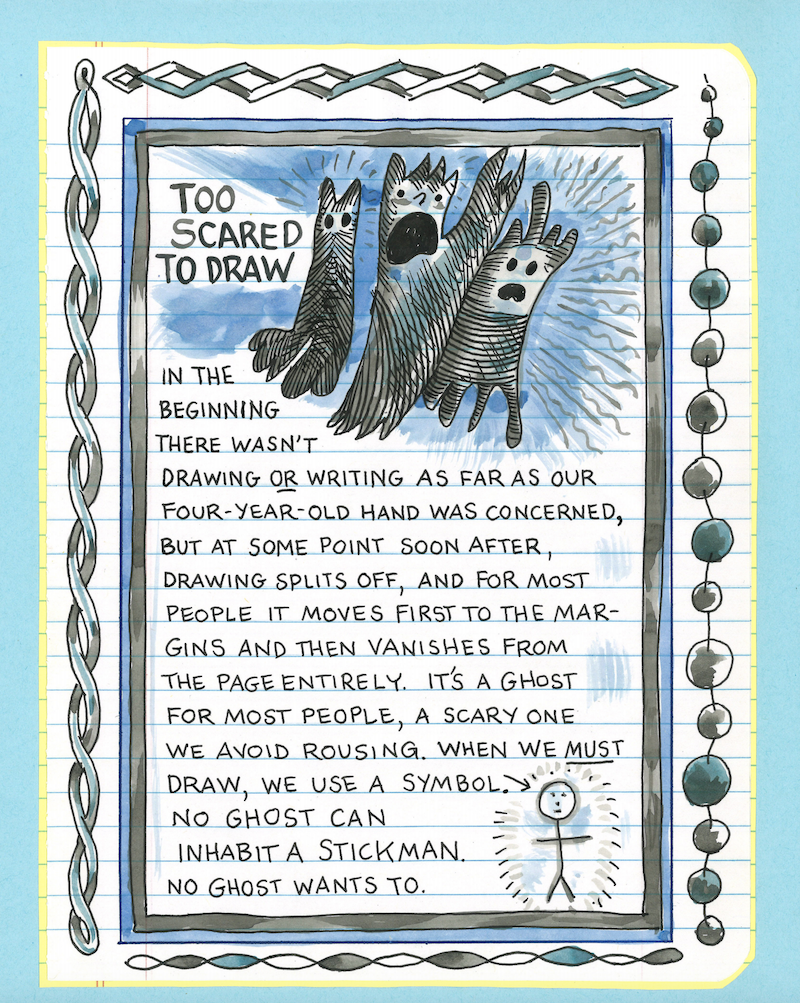
Cartoonist Lynda Barry Teaches You How to Draw

Friend, are you par­a­lyzed by your iron­clad con­vic­tion that you can’t draw?

Pro­fes­sor Chew­bac­ca aka Pro­fes­sor Old Skull aka car­toon­ist Lyn­da Bar­ry has had quite enough of that non­sense!

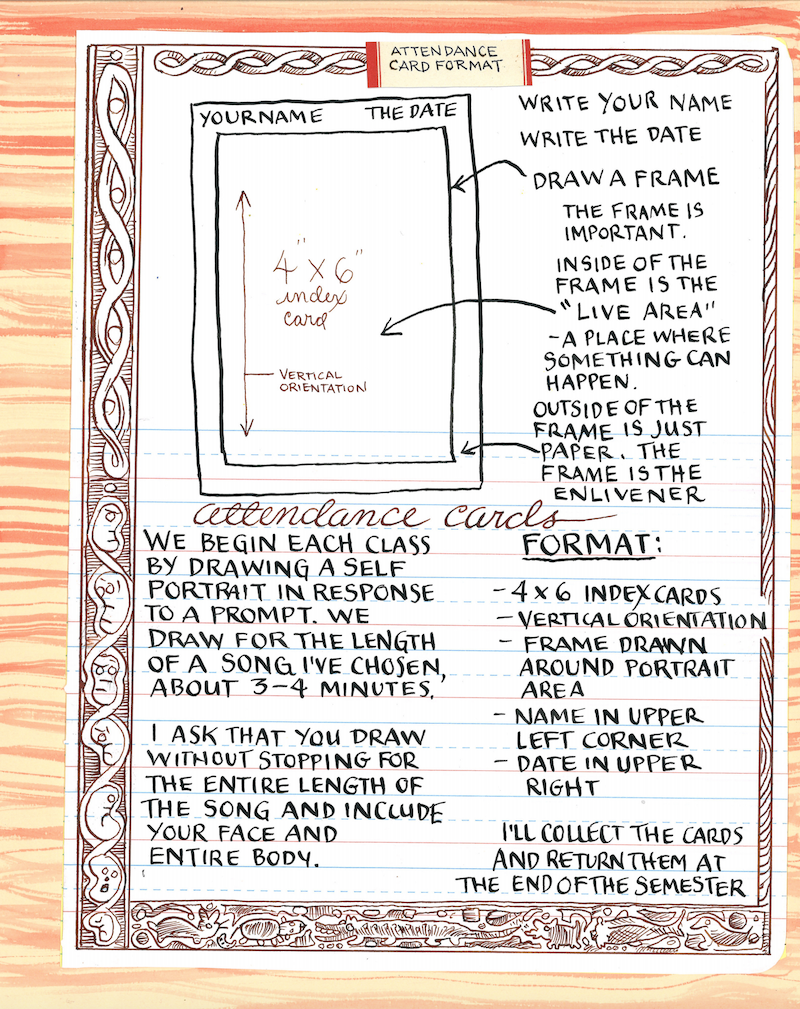
So stop dis­sem­bling, grab a pen and a hand-sized piece of paper, and fol­low her instruc­tions to Anne Strain­champs, host of NPR’s To The Best Of Our Knowl­edge, below.

It’s bet­ter to throw your­self into it with­out know­ing pre­cise­ly what the ten minute exer­cise holds (oth­er than draw­ing, of course).

We know, we know, you can’t, except that you can. Like Strain­champs, you’re prob­a­bly just rusty.

Don’t judge your­self too harsh­ly if things look “ter­ri­ble.”

In Barry’s view, that’s rel­a­tive, par­tic­u­lar­ly if you were draw­ing with your eyes closed.

A neu­rol­o­gy nerd, Bar­ry cites Gir­i­ja Kaimal, Kendra Ray, and Juan Muniz’ study Reduc­tion of Cor­ti­sol Lev­els and Par­tic­i­pants’ Respons­es Fol­low­ing Art Mak­ing. It’s the action, not the sub­jec­tive artis­tic mer­it of what winds up on the page that counts in this regard.

For more of Barry’s exer­cis­es and delight­ful­ly droll pres­ence, check out this playlist on Dr. Michael Green’s Graph­ic Med­i­cine Chan­nel.

Relat­ed Con­tent:

Lyn­da Bar­ry on How the Smart­phone Is Endan­ger­ing Three Ingre­di­ents of Cre­ativ­i­ty: Lone­li­ness, Uncer­tain­ty & Bore­dom

Fol­low Car­toon­ist Lyn­da Barry’s 2017 “Mak­ing Comics” Class Online, Pre­sent­ed at UW-Wis­con­sin

Lyn­da Barry’s Illus­trat­ed Syl­labus & Home­work Assign­ments from Her New UW-Madi­son Course, “Mak­ing Comics”

Join Car­toon­ist Lyn­da Bar­ry for a Uni­ver­si­ty-Lev­el Course on Doo­dling and Neu­ro­science

Ayun Hal­l­i­day is an author, illus­tra­tor, the­ater mak­er and Chief Pri­ma­tol­o­gist of the East Vil­lage Inky zine… Fol­low her @AyunHalliday.
The Story of Jean-Michel Basquiat’s Rise in the 1980s Art World Gets Told in a New Graphic Novel

Jean-Michel Basquiat was keen­ly sen­si­tive to the way the art mar­ket thought about him. He was com­pared to “a preach­er pos­sessed by the spir­it,” his art, wrote crit­ics, indica­tive of his “inner child.” This talk, writes Art­net’s Bruce Gop­nik, “could eas­i­ly veer into ideas of the Noble Sav­age.” The artist thought so; he was dis­gust­ed by his por­tray­al as “a wild man run­ning around,” he said. He want­ed no part of the prim­i­tivist image forced upon him. Yet “to this day, he’s almost always billed as being more in touch with his emo­tions and the pas­sions of urban life than with the order­ly rea­son­ing of post-Enlight­en­ment cul­ture.”

This itself is a false dichotomy—between expres­sion­ist and con­cep­tu­al art, “urban” pas­sions and reason—but if any­one gets caught in-between, it’s Basquiat. Gop­nick leans, maybe too heav­i­ly, on the con­cep­tu­al side of things, push­ing com­par­isons between Jen­ny Holz­er and Hans Haacke, down­play­ing Basquiat’s roots as a street artist and his con­nec­tions to hip hop and new wave. Basquiat had his ear to the street—also an arti­fact of post-Enlight­en­ment culture—and was hard­ly com­fort­able with the order­ly rea­son­ing of the mas­sive­ly prof­itable art mar­ket.

What­ev­er any­one wants to call his work, it makes no sense to sep­a­rate it from its con­text: Basquiat’s Brook­lyn home and Low­er East Side stomp­ing grounds, the down­town scene in which he came of age, his com­pli­cat­ed rela­tion­ships with Kei­th Har­ing, Andy Warhol, and Julian Schn­abel, three of many fig­ures who, along with Basquiat, cre­at­ed the huge 1980s art mar­ket and art gallery cul­ture. A new graph­ic nov­el by Ital­ian illus­tra­tor Pao­lo Parisi promis­es a new take on the now-well-worn biog­ra­phy of Basquiat. It’s a sto­ry writ­ten and drawn by a fel­low con­cep­tu­al artist, albeit one whose work more fits the image.

With eye-pop­ping pri­ma­ry and sec­ondary tones—the com­ic book col­ors favored by Basquiat and his contemporaries—Parisi takes some license, imag­in­ing con­ver­sa­tions that may or may not have occurred. “Basquiat comes off as a bit more naïve and far less con­flict­ed than we now know him to be,” writes Eileen Kin­sel­la at Art­net. The chap­ter excerpt­ed there, “New Art/New Mon­ey,” (see a few pages above and below), has mul­ti­ple per­spec­tives. In a recon­struct­ed din­ner scene between art deal­ers Mary Boone and Lar­ry Gagosian, Basquiat doesn’t even appear.

But the nar­ra­tive also draws direct­ly from Basquiat’s own words. One page is a fac­sim­i­le of a hand­writ­ten note the artist made in April 1984. “I have mon­ey every­where, every­where. I’m paid exor­bi­tant sums for a sin­gle piece,” he writes, not to boast but to mar­vel at the incred­i­ble amount of infla­tion he sees all around him:

A pic­ture I sold to Deb­bie Har­ry for $200 only a cou­ple of years ago is now worth $20,000. That’s the art mar­ket today. Work­ing with gallery own­ers is exhaust­ing.

                                                They always want

                                                            More

                                                            More

                                                            More

Lat­er Parisi adapts the artist’s thoughts in a crit­i­cal mono­logue: The gal­lerists “have this way of doing things I’ve nev­er seen before. They focus a lot on the artist’s image, buy in bulk, decide who to pro­mote and how. They often buy and sell among them­selves, between gal­leries. They nev­er respect agree­ments. I don’t think I’ll be able to trust them.” Basquiat’s frus­tra­tion at “some­thing rot­ten in this scene” made him con­sid­er giv­ing up paint­ing for good. He didn’t get the chance, though Parisi has him tell a girl­friend “Picas­so died at nine­ty… I’m cer­tain­ly not going before then.”

Parisi, who has also writ­ten and illus­trat­ed graph­ic biogra­phies of Bil­lie Hol­i­day and John Coltrane, has an ear for Amer­i­can speech pat­terns and class and race dynam­ics, draw­ing out with more or less sub­tle­ty the asso­ci­a­tions between the art world’s fas­ci­na­tion with “prim­i­tivist” art and the con­tin­u­ing res­o­nances of slav­ery and colo­nial­ism in its hyper-cap­i­tal­ist econ­o­my. Was Basquiat a child­like char­ac­ter who only slow­ly real­ized the greedy machi­na­tions of the deal­ers?

In the 2010 doc­u­men­tary The Radi­ant Child, his for­mer graf­fi­ti part­ner Al Diaz explains his moti­va­tions from the very begin­ning. “We want­ed to do some kind of con­cep­tu­al art project.” Basquiat aimed direct­ly at the art world, writ­ing mes­sages on walls like “4 THE SO-CALLED AVANT-GARDE.” Once in its com­pa­ny, how­ev­er, he found, like many oth­er fierce­ly inde­pen­dent artists who make it big, it wasn’t worth the mon­ey. Read the ful­ly excerpt­ed chap­ter at Art­net and pur­chase Parisi’s graph­ic nov­el Basquiat online.

via Art­net

Relat­ed Con­tent:

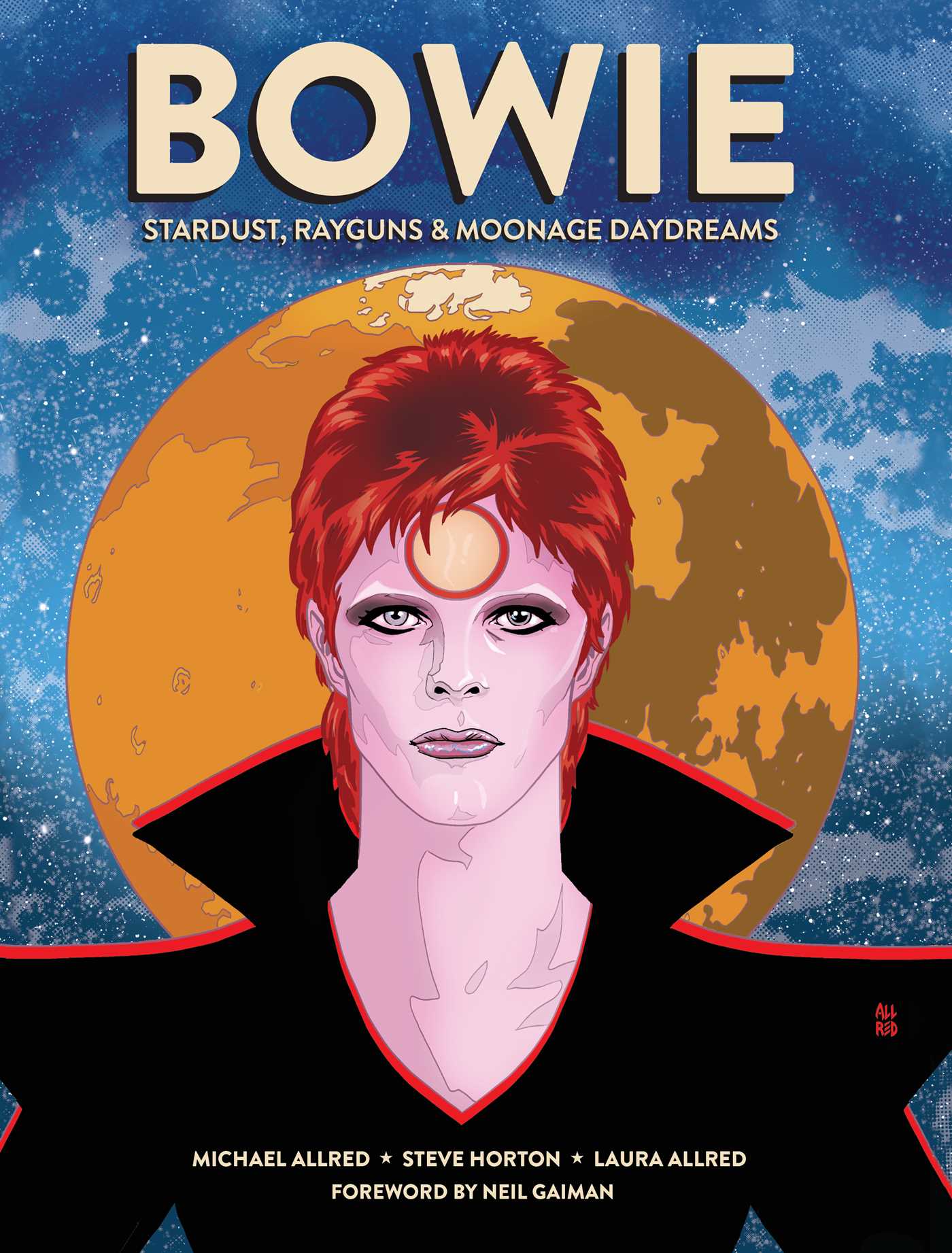
The Sto­ry of How David Jones Became David Bowie Gets Told in a New Graph­ic Nov­el

Take a Close Look at Basquiat’s Rev­o­lu­tion­ary Art in a New 500-Page, 14-Pound, Large For­mat Book by TASCHEN

An Ani­mat­ed Intro­duc­tion to the Chaot­ic Bril­liance of Jean-Michel Basquiat: From Home­less Graf­fi­ti Artist to Inter­na­tion­al­ly Renowned Painter

Sal­vador Dalí & the Marx Broth­ers’ 1930s Film Script Gets Released as a Graph­ic Nov­el

How Art Spiegel­man Designs Com­ic Books: A Break­down of His Mas­ter­piece, Maus

« Go BackMore in this category... »
Quantcast