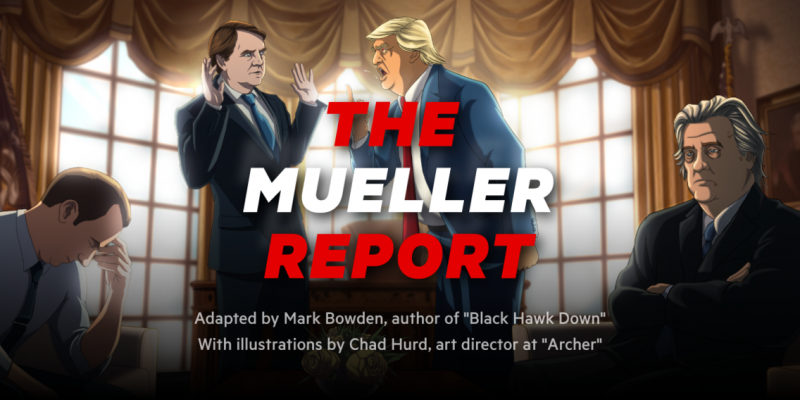
The 448 page Mueller Report doesn’t make for breezy beach reading. That’s for sure. But, “buried within the Mueller report, there is a narrative that reads in parts like a thriller.” Working with that theory, Insider.com “hired Mark Bowden, a journalist and author known for his brilliant works of narrative nonfiction like Black Hawk Down, Killing Pablo, and Hue 1968.” And they gave him an assignment: “Use the interviews and facts laid out in the Mueller Report (plus those from reliable, fact-checked sources and published firsthand accounts)” and create an account that’s “so gripping it will hold your attention (and maybe your congressional representative’s).” They also hired “Chad Hurd, an illustrator from the art department of Archer,” and “asked him to draw out scenes from the report to bring them to life.” Find the resulting illustrated edition of The Mueller Report right here.
If you would like to support the mission of Open Culture, consider making a donation to our site. It’s hard to rely 100% on ads, and your contributions will help us continue providing the best free cultural and educational materials to learners everywhere. You can contribute through PayPal, Patreon, and Venmo (@openculture). Thanks!
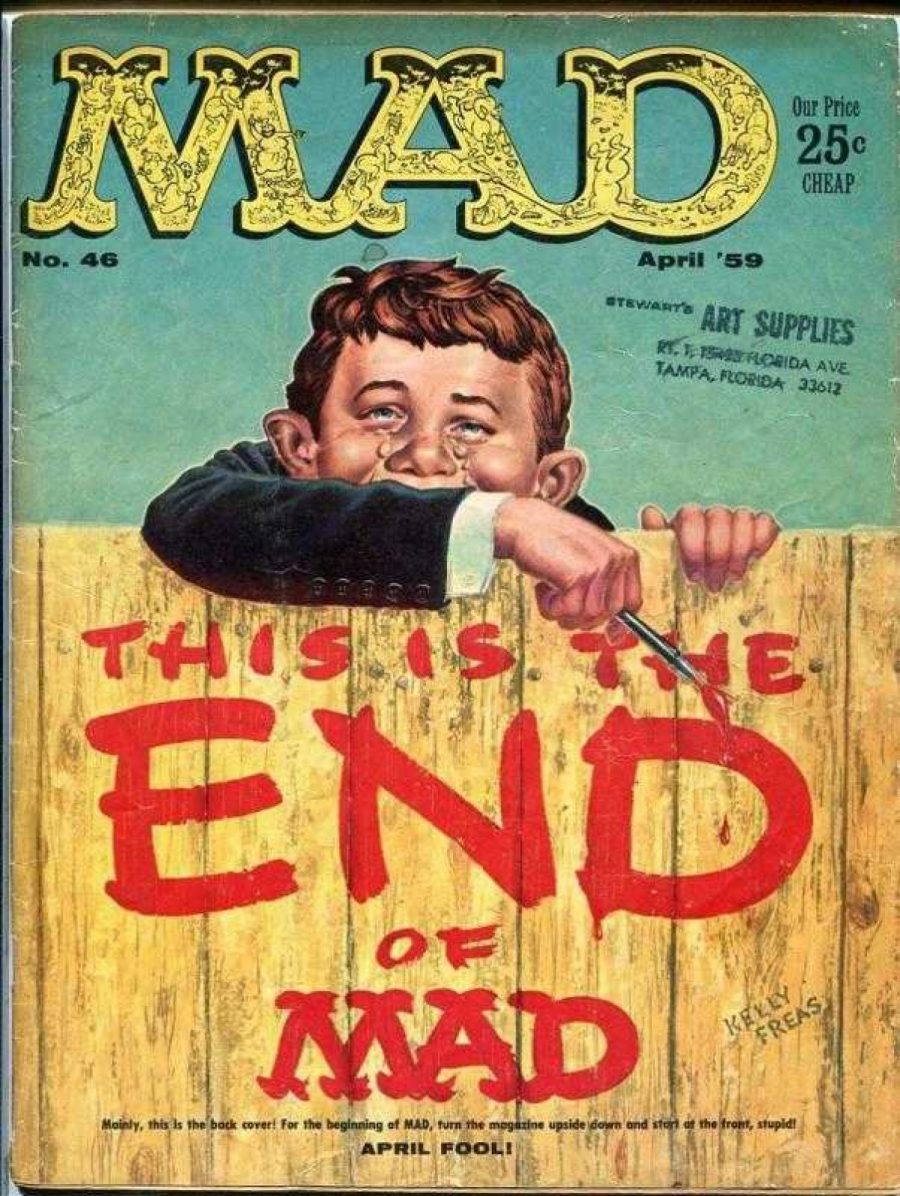
As a cultural reference, MAD magazine may have died decades ago. This is a not a disparagement, but a statement of fact. The kind of satire the august, anarchic comic first unleashed on the world of 1952 debuted in a cultural milieu that is no more, and a form—the illustrated, satirical periodical—that is increasingly niche. MAD left an indelible impression on American publishing’s past, but as the magazine’s legendary cartoonist Al Jaffee tells The Washington Post, “it’s mostly nostalgia now.”
Responding to the market’s cues, MAD will more or less disappear from newsstands, publishing legacy content on a subscription-only basis and on the direct market, “a.k.a. specialty and comic book stores,” writes Gizmodo, “like the vast majority of DC’s comics output is already.” MAD shaped itself in opposition to Cold War paranoia and never seemed to find a new edge after favorite targets like Richard Nixon and Ronald Reagan left the scene. The magazine turned almost exclusively to pop culture parody in the 90s. As ABC News reports, MAD “peaked at 2.8 million subscribers in 1973,” then began its decline, with only “140,000 left as of 2017.”
The magazine’s founding editor, cartoonist Harvey Kurtzman, passed away in 1993. His successor Al Feldstein, who brought the magazine to international prominence, died in 2014. MAD’s longtime, tight-knit staff of writers and cartoonists are mostly retired, and most are sanguine about the winding down. “It’s been a logical development,” comments another MAD cartooning legend, Sergio Aragonés. To wit, after Issue 10 (MAD re-numbered last June) comes out this fall, there will be no new content, “except for the end-of-year specials,” notes The Post. “All issues after that will be republished content culled from 67 years of publication.”
This still represents a great way for newcomers to MAD to catch up on its wildly skewed view of the last half of the 20th century, though some imagination is required to appreciate how subversive their humor was for much of its run. MAD inspired countless offshoots in the decade after its founding, setting the tone for radical campus publications, countercultural cartoonists, and comic writers, some of whom went on to become Stephen Colbert and Judd Apatow, who both wrote in the pages of MAD about how much the magazine meant to them during their apprentice years.
The list of MAD devotees, both famous and not (I count myself among the latter), runs into the millions, but it runs along some obvious demographic divides. As the magazine is poised to become a gift-shop version of itself, tributes have poured in for its editors, writers, and cartoonists—all of them, to a man, well, men. And most of those tributes—those from prominent cartoonists and writers claiming MAD as a formative influence, at least—are also from men of a certain generation, most of them straight and white.
Such market segmentation, one might say, speaks to the way MAD’s brand of political satire remained embedded in its heyday. As laid-back cartoonists Jaffee and Aragonés recognize, you can’t stay young and relevant forever—though MAD had a remarkably good run. The Post offers a notable example of Mad’s passage into history. When the current president “mockingly referred to Democratic presidential candidate Pete Buttigieg as Alfred E. Neuman”—the once-ubiquitous, gap-toothed symbol of take-no-prisoners irreverence—the 37-year-old Buttigieg replied, “I’ll be honest. I had to Google that.”
Jean-Michel Basquiat was keenly sensitive to the way the art market thought about him. He was compared to “a preacher possessed by the spirit,” his art, wrote critics, indicative of his “inner child.” This talk, writes Artnet’s Bruce Gopnik, “could easily veer into ideas of the Noble Savage.” The artist thought so; he was disgusted by his portrayal as “a wild man running around,” he said. He wanted no part of the primitivist image forced upon him. Yet “to this day, he’s almost always billed as being more in touch with his emotions and the passions of urban life than with the orderly reasoning of post-Enlightenment culture.”
This itself is a false dichotomy—between expressionist and conceptual art, “urban” passions and reason—but if anyone gets caught in-between, it’s Basquiat. Gopnick leans, maybe too heavily, on the conceptual side of things, pushing comparisons between Jenny Holzer and Hans Haacke, downplaying Basquiat’s roots as a street artist and his connections to hip hop and new wave. Basquiat had his ear to the street—also an artifact of post-Enlightenment culture—and was hardly comfortable with the orderly reasoning of the massively profitable art market.
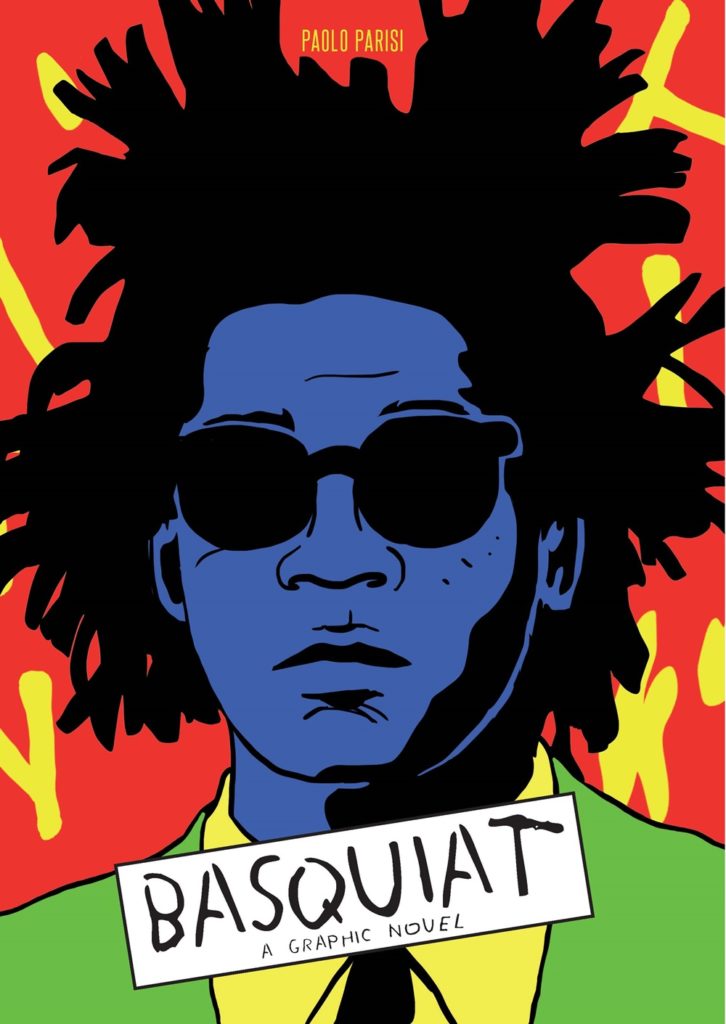
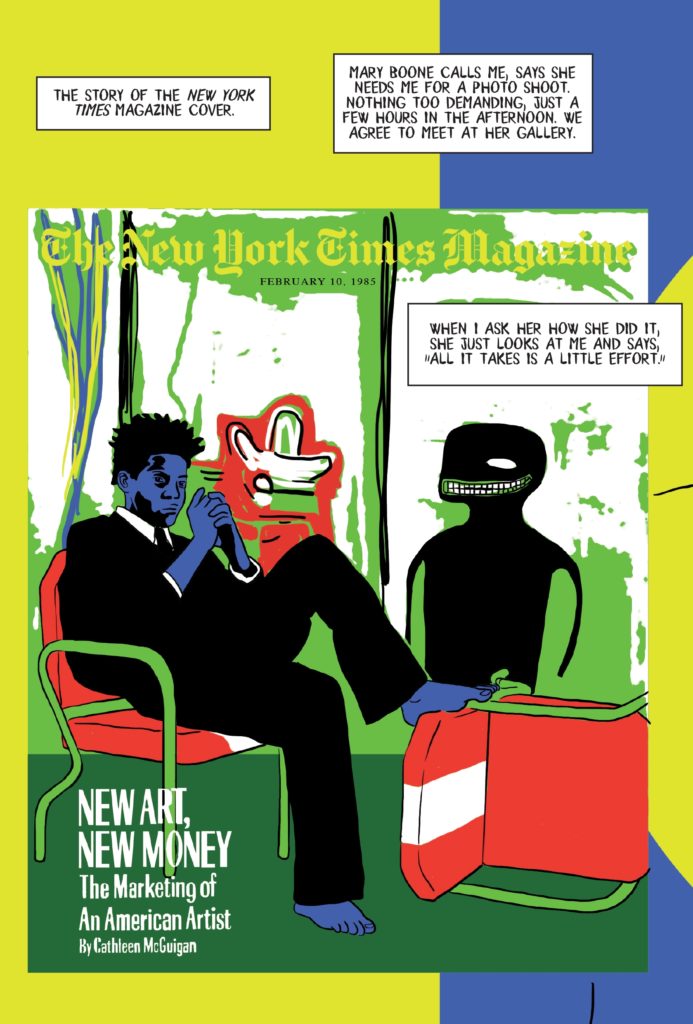
Whatever anyone wants to call his work, it makes no sense to separate it from its context: Basquiat’s Brooklyn home and Lower East Side stomping grounds, the downtown scene in which he came of age, his complicated relationships with Keith Haring, Andy Warhol, and Julian Schnabel, three of many figures who, along with Basquiat, created the huge 1980s art market and art gallery culture. A new graphic novel by Italian illustrator Paolo Parisi promises a new take on the now-well-worn biography of Basquiat. It’s a story written and drawn by a fellow conceptual artist, albeit one whose work more fits the image.
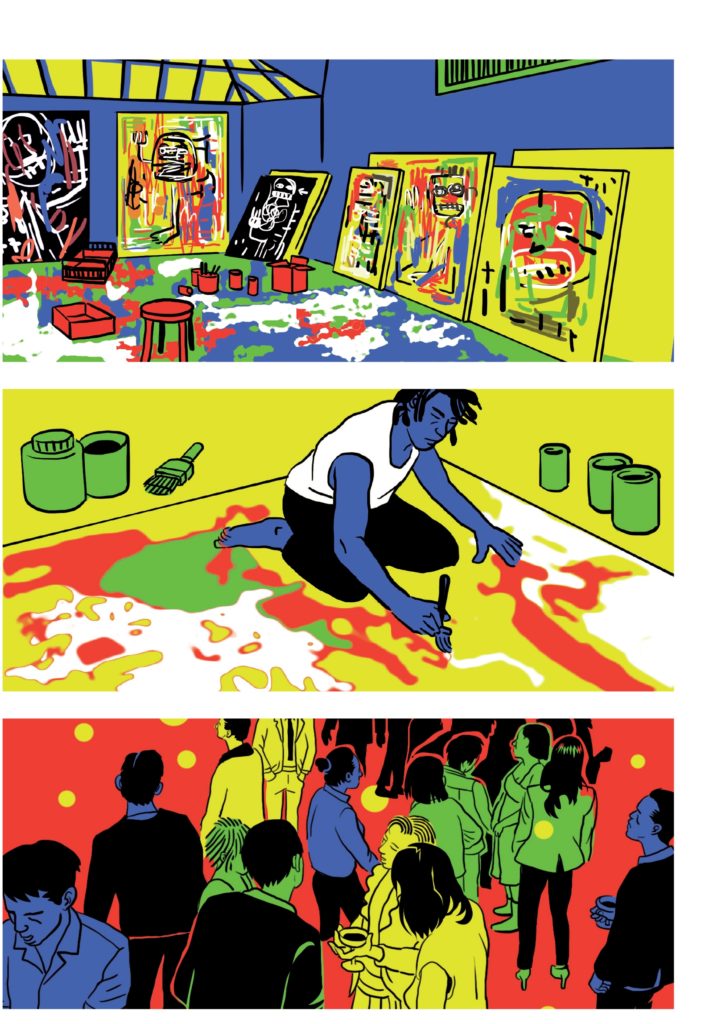
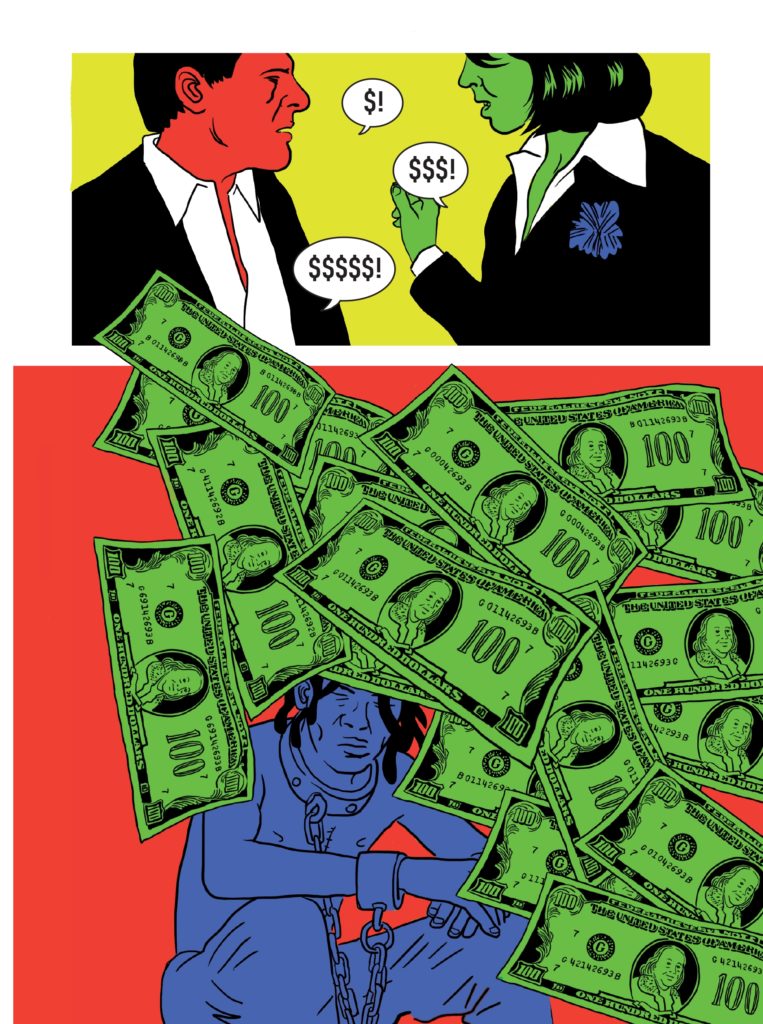
With eye-popping primary and secondary tones—the comic book colors favored by Basquiat and his contemporaries—Parisi takes some license, imagining conversations that may or may not have occurred. “Basquiat comes off as a bit more naïve and far less conflicted than we now know him to be,” writes Eileen Kinsella at Artnet. The chapter excerpted there, “New Art/New Money,” (see a few pages above and below), has multiple perspectives. In a reconstructed dinner scene between art dealers Mary Boone and Larry Gagosian, Basquiat doesn’t even appear.
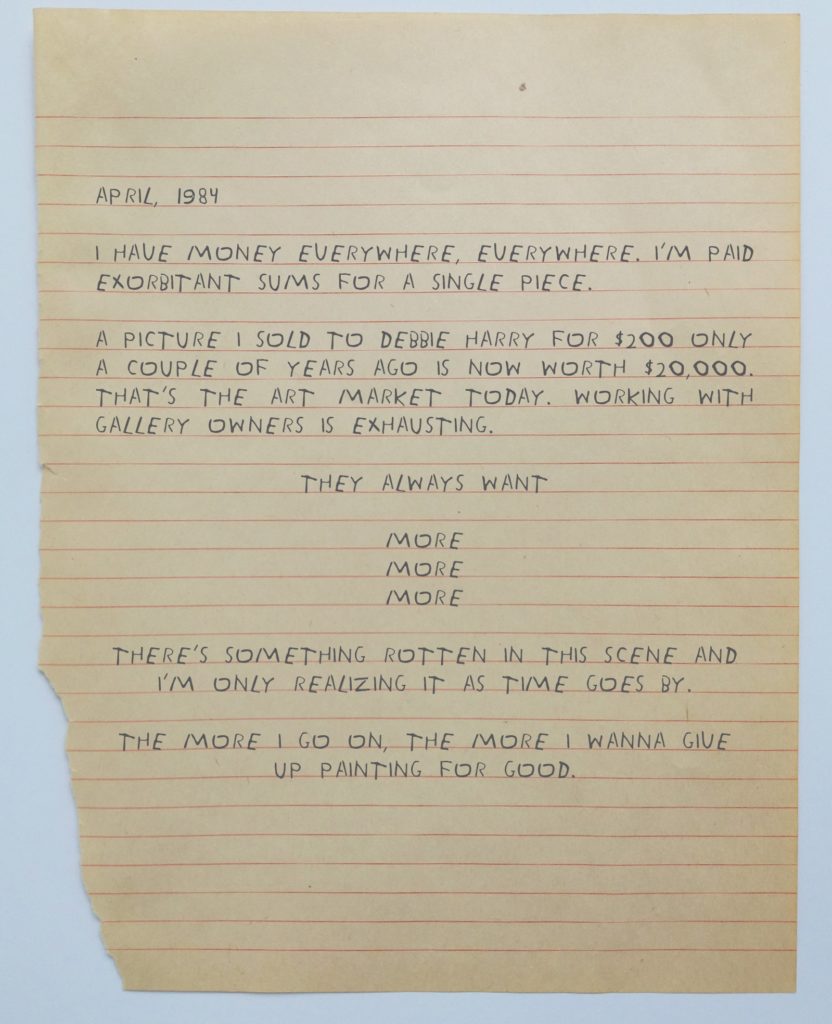
But the narrative also draws directly from Basquiat’s own words. One page is a facsimile of a handwritten note the artist made in April 1984. “I have money everywhere, everywhere. I’m paid exorbitant sums for a single piece,” he writes, not to boast but to marvel at the incredible amount of inflation he sees all around him:
A picture I sold to Debbie Harry for $200 only a couple of years ago is now worth $20,000. That’s the art market today. Working with gallery owners is exhausting.
They always want
More
More
More
Later Parisi adapts the artist’s thoughts in a critical monologue: The gallerists “have this way of doing things I’ve never seen before. They focus a lot on the artist’s image, buy in bulk, decide who to promote and how. They often buy and sell among themselves, between galleries. They never respect agreements. I don’t think I’ll be able to trust them.” Basquiat’s frustration at “something rotten in this scene” made him consider giving up painting for good. He didn’t get the chance, though Parisi has him tell a girlfriend “Picasso died at ninety… I’m certainly not going before then.”
Parisi, who has also written and illustrated graphic biographies of Billie Holiday and John Coltrane, has an ear for American speech patterns and class and race dynamics, drawing out with more or less subtlety the associations between the art world’s fascination with “primitivist” art and the continuing resonances of slavery and colonialism in its hyper-capitalist economy. Was Basquiat a childlike character who only slowly realized the greedy machinations of the dealers?
In the 2010 documentary The Radiant Child, his former graffiti partner Al Diaz explains his motivations from the very beginning. “We wanted to do some kind of conceptual art project.” Basquiat aimed directly at the art world, writing messages on walls like “4 THE SO-CALLED AVANT-GARDE.” Once in its company, however, he found, like many other fiercely independent artists who make it big, it wasn’t worth the money. Read the fully excerpted chapter at Artnet and purchase Parisi’s graphic novel Basquiat online.
Pop culture thrives on superheroes, both fictional and real. This isn’t unique in human history. Read most any collection of ancient myth and literature and you’ll find the same. The demigods and chieftains beating their chests and talking trash in the Iliad, for example, remind me of macho professional wrestlers or characters in the Marvel and DC universes, cultural artifacts indebted in their various ways to classical legends. One thread runs through all of the epic tales of heroes and heroines: a seeming need to immortalize people who embody the qualities we most desire. Heroes may suffer for their tragic flaws, but that’s the price they pay for universal acclaim or an iron throne.
The traits ascribed to late modernity’s fictional heroes haven’t changed overmuch from the distant past—power, wit, agility, persistence, anger issues, spicy, complicated love lives…. But when it comes to the real people we admire—the celebrities who get the superhero treatment—creativity, style, and musical talent top the list. Why not?
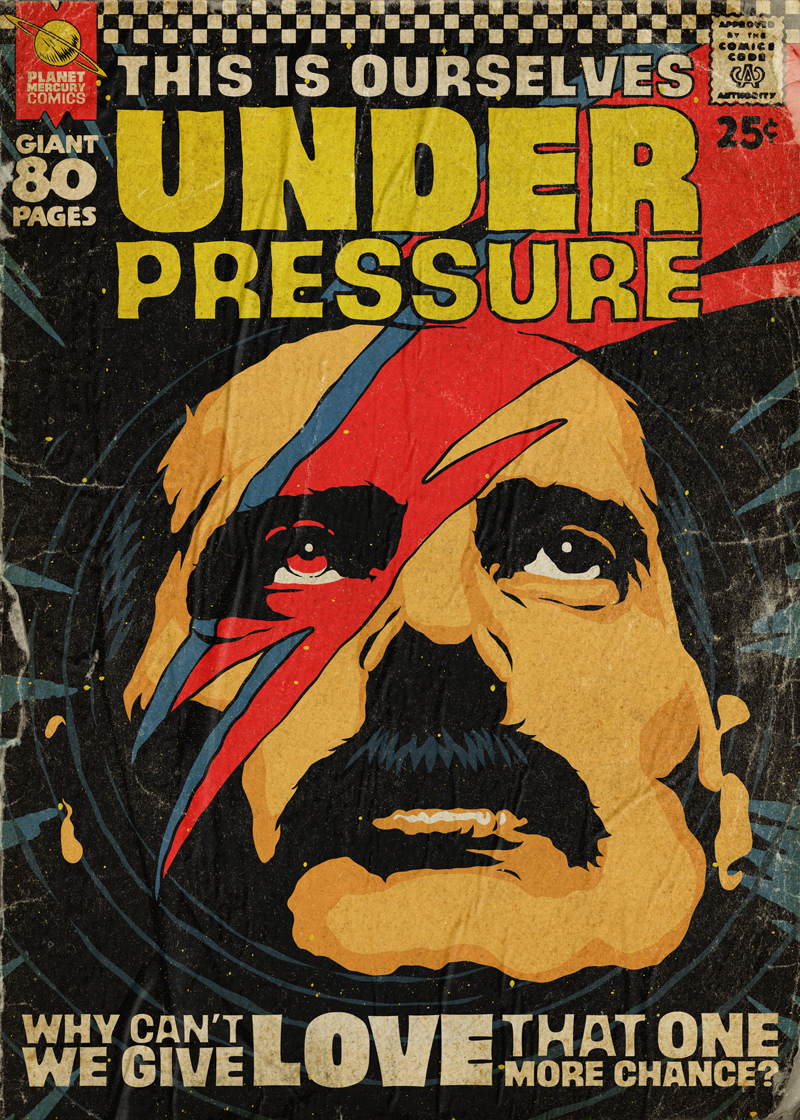
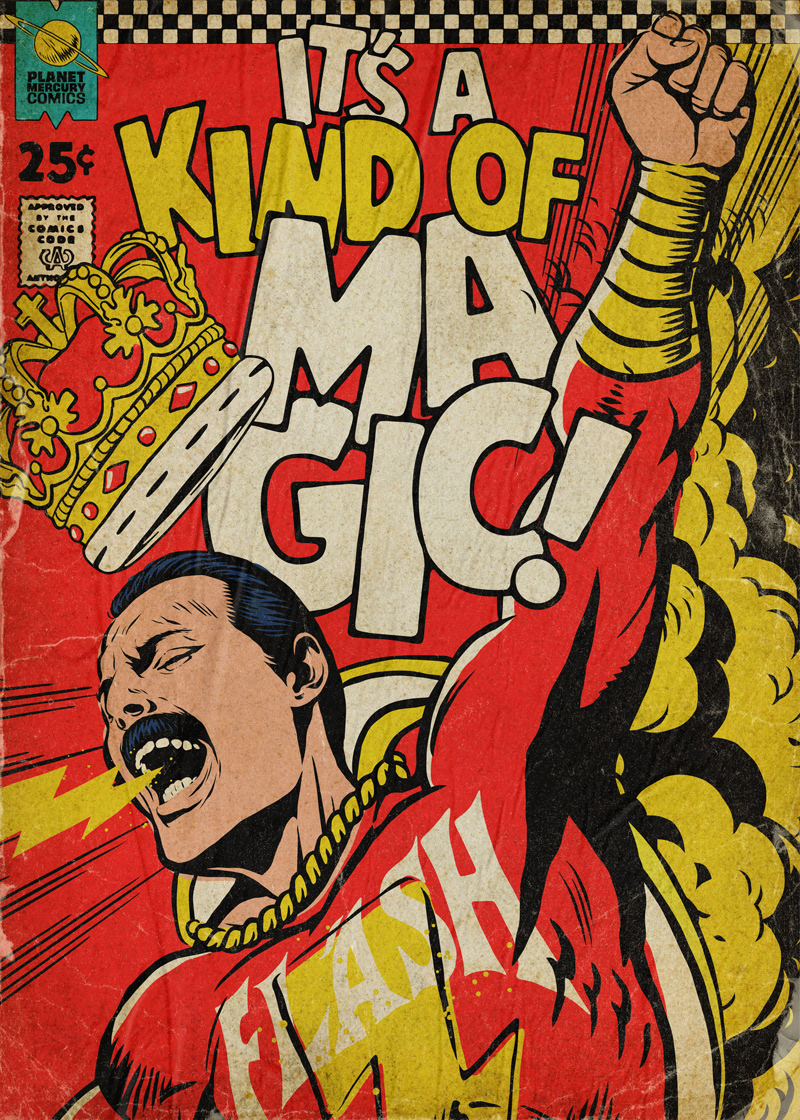
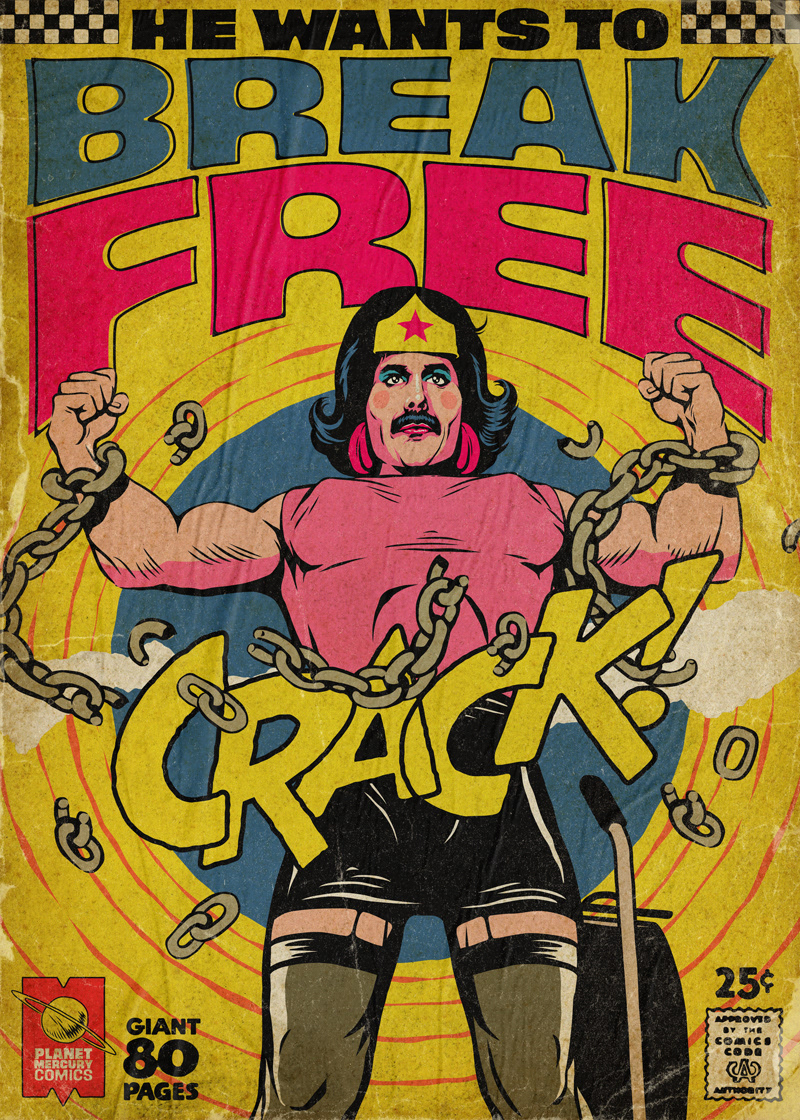
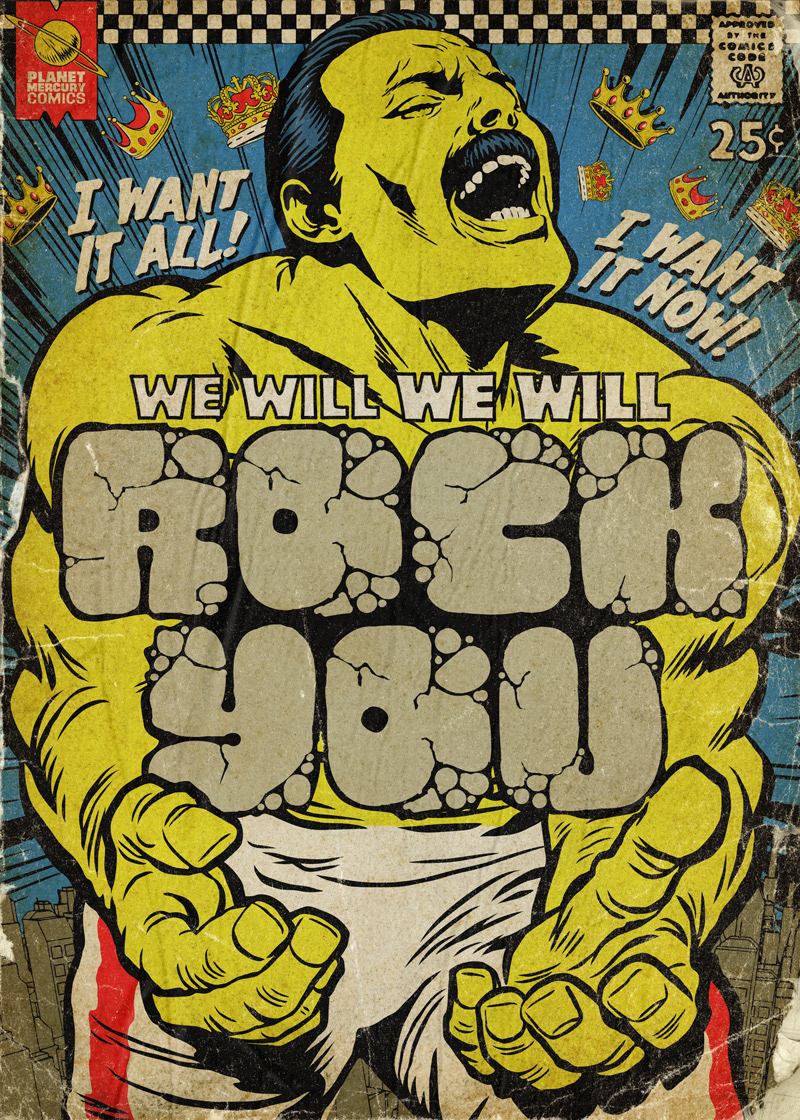
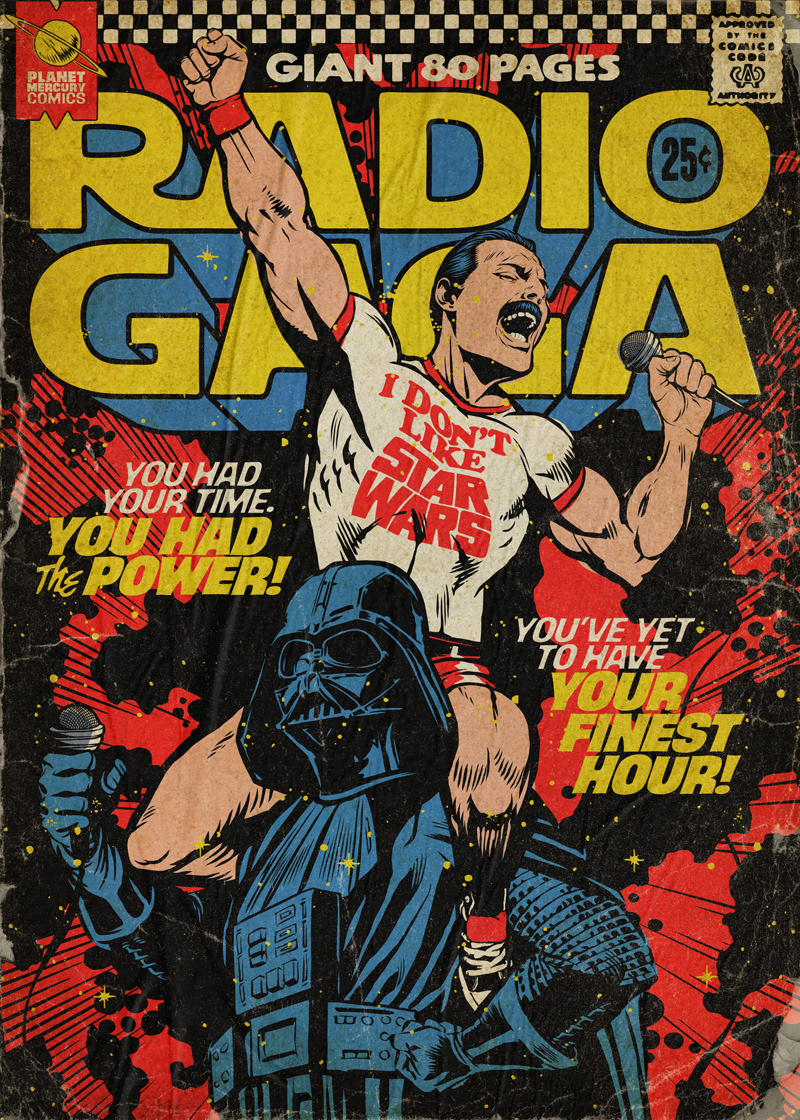
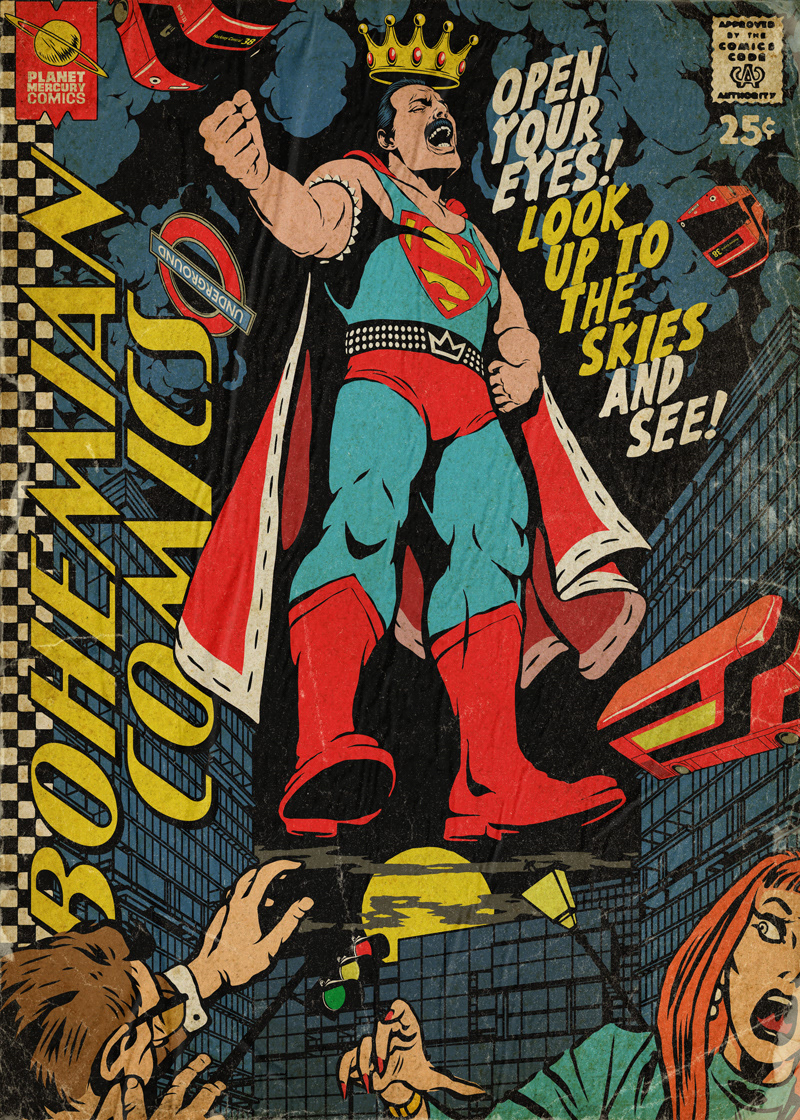
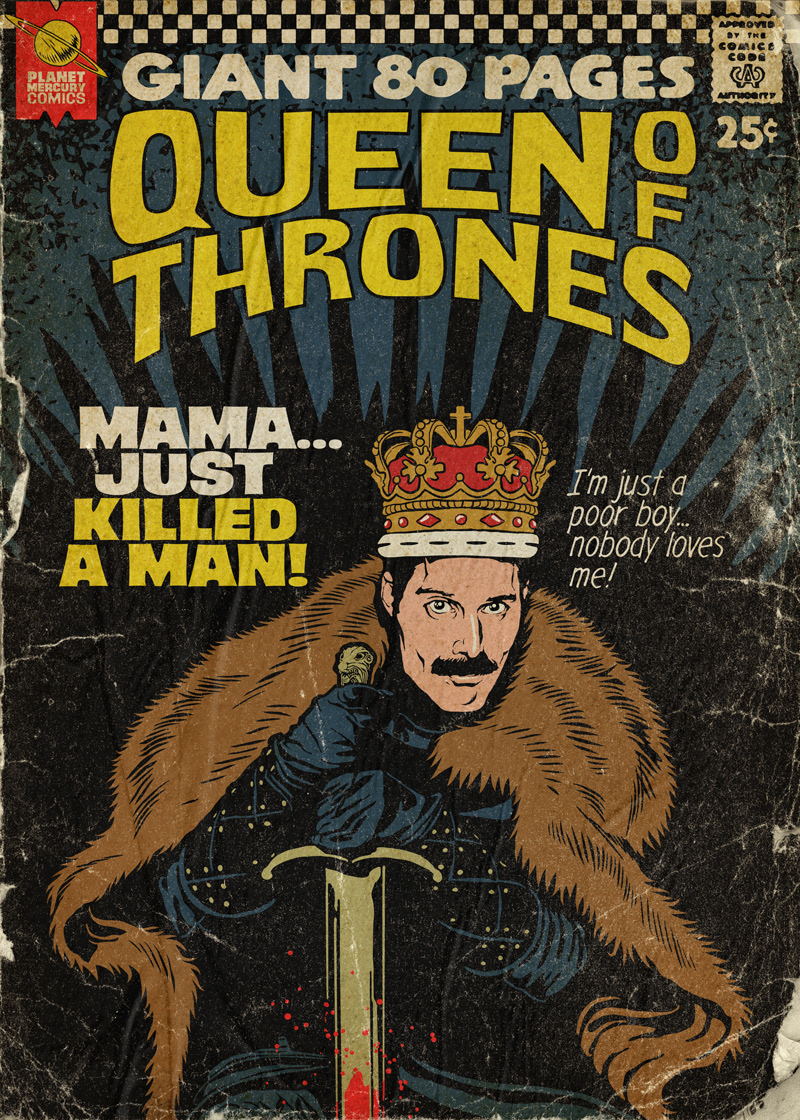
Performing a similar service for Freddie Mercury, Brazilian artist Butcher Billy satisfies the cultural craving for demigods in his immortalization of Freddie Mercury as various heroes like The Hulk, Superman, and Shazam (or “Flash”); a contender for the Iron Throne; and himself: riding on Darth Vader’s shoulders, breaking free in housewife drag, and sporting Bowie’s Aladdin Sane lightning bolt. What are the superpowers of these super-Freddies? The usual smashing, punching, and flying, it seems, but also the essentials of his real-life power—an impossibly big personality, huge stage presence, personal magnetism, and a godlike force of a voice.
Add to these characteristics a unique talent for writing lyrics punchier than your favorite Twitter feed, and we have the makings of a modern epic giant with abilities that seemed to surpass those of mere mortals, with the swagger and ego to match. This tribute to Mercury is unabashed hero worship, turning the singer into an archetype. In the simple, bold, colorful lines of comic cover art we might just see that there’s a Freddie Mercury in all of us, wanting to break free, pump a fist in the air, and belt out our biggest feelings in capital letters and giant exclamation marks.
Comic-book stories of a boy reporter and his dog (later accompanied by a foulmouthed sea captain) featuring rocketships and submarines, booby-traps and buried treasure, gangsters and abominable snowmen, smugglers and super-weapons, all told with bright colors, clear lines, and practically no girls in sight: no wonder The Adventures of Tintin at first looks tailor-made for rambunctious youngsters. But now, eighty years after Tintin’s debut in the children’s supplement of a Belgian Catholic newspaper, his ever-growing fan base surely includes more grown-ups than it does kids, and grown-ups prepared to regard his adventures as serious works of modern art at that.
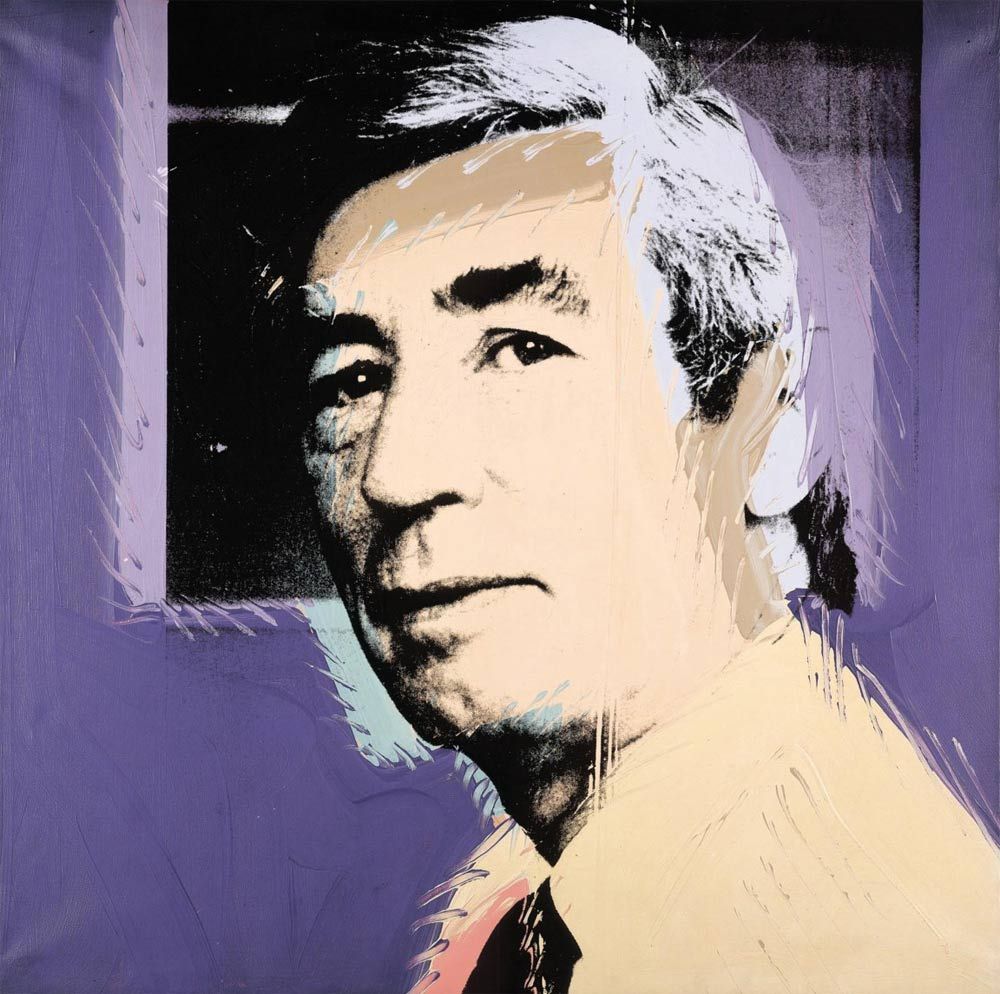
The field of Tintin enthusiasts (in their most dedicated form, “Tintinologists”) includes some of the best-known modern artists in history. Roy Lichtenstein, he of the zoomed-in comic-book aesthetic, once made Tintin his subject, and Tintin’s creator Hergé, who cultivated a love for modern art from the 1960s onward, hung a suite of Lichtenstein prints in his office. As Andy Warhol once put it, “Hergé has influenced my work in the same way as Walt Disney. For me, Hergé was more than a comic strip artist.” And for Hergé, Warhol seems to have been more than a fashionable American painter: in 1979, Hergé commissioned Warhol to paint his portrait, and Warhol came up with a series of four images in a style reminiscent of the one he’d used to paint Jackie Onassis and Marilyn Monroe.
Hergé and Warhol had first met in 1972, when Hergé paid a visit to Warhol’s “Factory” in New York — the kind of setting in which one imagines the straight-laced, sixtysomething Belgian setting foot only with difficulty. But the two had more in common as artists than it may seem: both got their start in commercial illustration, and both soon found their careers defined by particular works that exploded into cultural phenomena. (Warhol may also have felt an affinity with Tintin in their shared recognizability by hairstyle alone.) The Independent’s John Lichfield writes that Hergé, who had by that point learned to paint a few modern abstract pieces of his own, “asked Warhol, modestly, whether the father of Tintin should also consider himself a ‘Pop Artist.’ Warhol, although a great fan of Hergé, simply stared back at him and did not reply.”
Warhol may not have known what to say forty years ago, but in that time Hergé has unquestionably ascended into the institutional pantheon of Western art: Lichfield’s article is a review of a 2006 Hergé retrospective at the Pompidou Centre, and the years since have seen the opening of the Musée Hergé south of Brussels as well as increasingly elaborate exhibitions on Tintin and his creator all around the world. (I myself attended such an exhibition in Seoul, where I live, just last month.) The French artist Jean-Pierre Raynaud expresses a now-common kind of sentiment when he credits Hergé with “a precision of the kind I love in Mondrian” and “the artistic economy that you find in Matisse.” Warhol, who probably wouldn’t have phrased his appreciation in quite that way, makes a more tonally characteristic response in the clip above when Hergé tells him about Tintin’s latter-day switch from his signature plus fours to jeans: “Oh, great!”
Based in Seoul, Colin Marshall writes and broadcasts on cities, language, and culture. His projects include the book The Stateless City: a Walk through 21st-Century Los Angeles and the video series The City in Cinema. Follow him on Twitter at @colinmarshall or on Facebook.
Ancient Greece and Rome have provided fertile hunting grounds for animated subject matter since the very inception of the form.
So what if the results wind up doing little more than frolic in the pastoral setting? Witness 1930’s Playful Pan, above, which can basically be summed up as Silly Symphony in a toga (with a cute bear cub who looks a lot like Mickey Mouse and some flame play that prefigures The Sorcerer’s Apprentice…)
Others are packed with history, mythic narrative, and period details, though be forewarned that not all are as visually appealing as Steve Simons’ Hoplites! Greeks at War, part of the Panoply Vase Animation Project.
Some series, such as the Asterix movies and Aesop and Son—a staple of The Rocky and Bullwinkle Show from 1959 to 1962—have been the gateways through which many history lovers’ curiosity was first roused.
(Russian animator Anatoly Petrov’s erotic shorts for Soyuzmultfilm may rouse other, er, curiosities, and are definitely NSFW.)
And then there are instant classics like 2004’s It’s All Greek to Scooby in which “Shaggy’s purchase of a mysterious amulet only serves to cause a pestering archaeologist and centaur to chase him.” (Ye gods…)
Senior Lecturer of Classical and Mediterranean Studies at Vanderbilt, Chiara Sulprizio, has collected all of these and more on her blog, Animated Antiquity.
Beginning with the 2‑minute fragment that’s all we have left of Winsor McCay’s 1921 The Centaurs, Sulprizio shares some of her favorite cartoon representations of ancient Greece, Rome, and beyond. Her areas of professional specialization—gender and sexuality, Greek comedy, and Roman satire—are well suited to her chosen hobby, and her commentary doubles down on historical context to include the history of animation.
The appearance of cartoon stars like Daffy Duck, Tom and Jerry, and Popeye further demonstrates this antique subject matter’s sturdiness. TED-Ed and the BBC may view the genre as an excellent teaching tool, but there’s nothing stopping the animator from shoehorning some fabrications in amongst the buxom nymphs and buff gladiators.
(Raise your hand if your mother ever sacrificed you on the altar to Spinachia, goddess of spinach, in hopes that she might unleash a mushroom cloud of super-atomic power in your puny bicep.)
What do you do after you’ve helped create one of the “first anti-heroes in Western comics”; pioneered the underground comics industry and heavy metal album covers; won the enduring admiration of Federico Fellini, Stan Lee, and Hayao Miyazaki; and brought your distinctive creative style to the look of sci-fi classics like Blade Runner, Alien, Tron, and The Abyss?
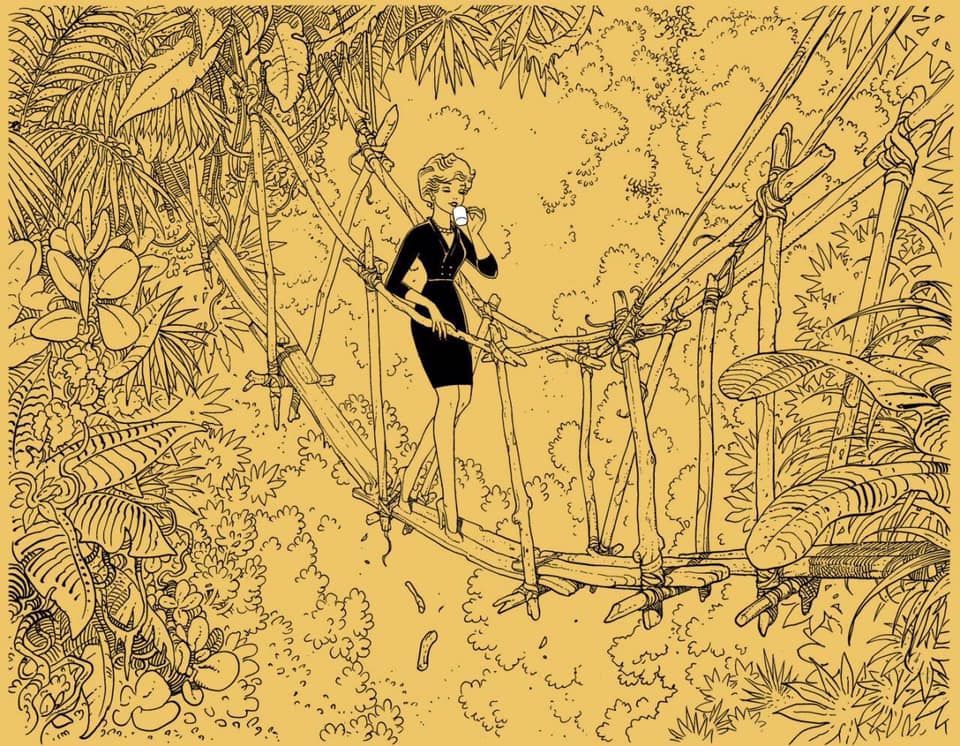
Sit back, have a coffee, and design a series of ads for Maxwell House. Why not? You’re Moebius. You can draw whatever you want. No one’s going to accuse Alejandro Jodorowsky’s partner in the legendary never-made Dune film and The Incal comics of selling out—not when contemporary comic art, science fiction, and fantasy could hardly have existed without him.
“Probably the most important fantasy comic artist of all time,” as Art Futura dubs him, the man originally known by his birth name Jean Giraud began his career as an illustrator for the youth press Fleurus, who were the first in France to publish fellow bande dessinées artist Herge’s Adventures of Tintin. The Maxwell House ads here, drawn in 1989, recall those early days of Franco-Belgian comic art, when adventurers raced around the colonies, braving wild animals and surly natives.
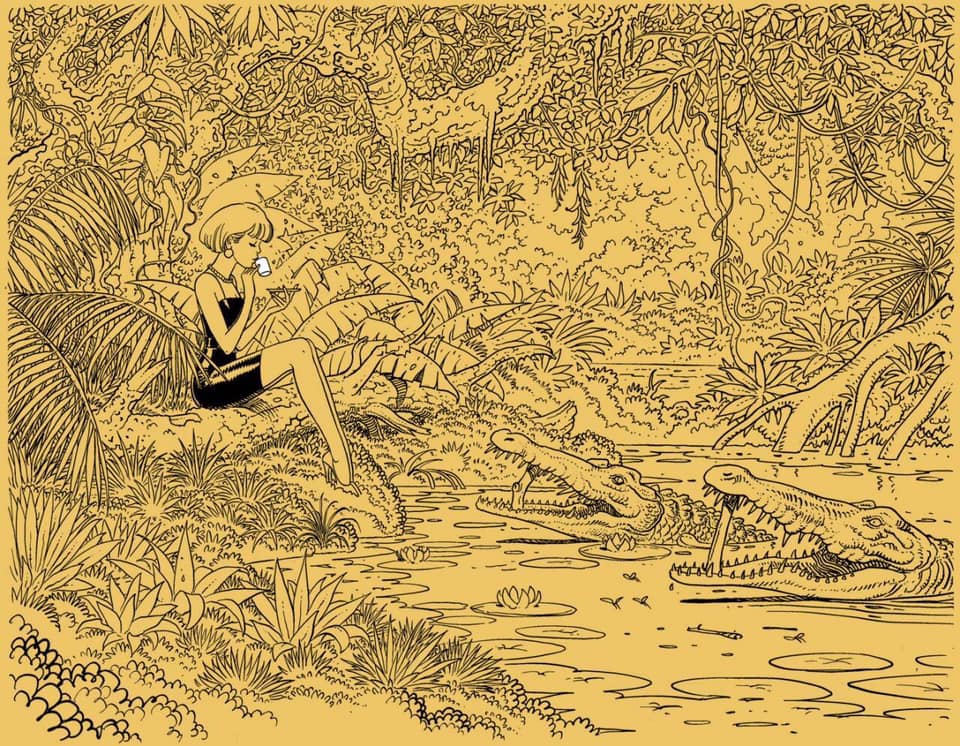
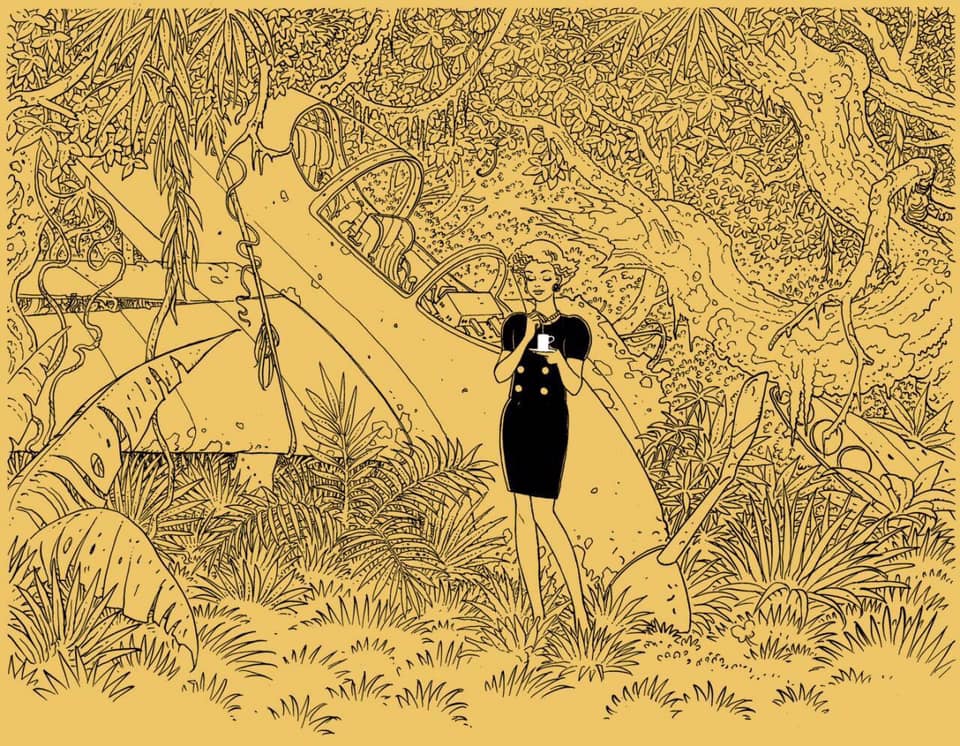
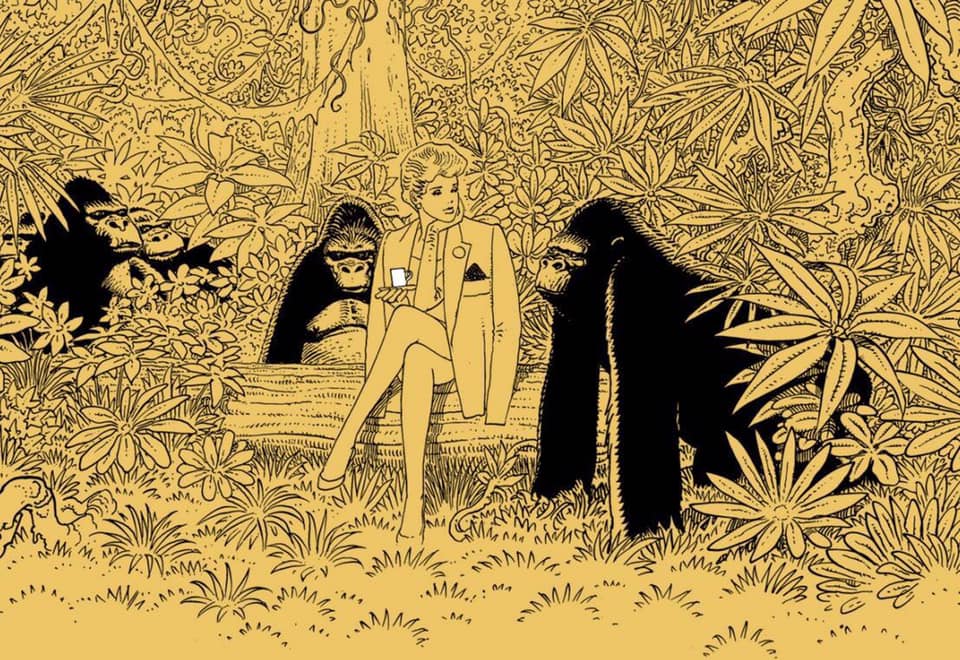
Moebius’ confident hand leaves a signature in the dense patterns of the foliage and slender jawline of the elegant, coffee-sipping damsel, who does not seem remotely in distress, downed plane and curious gorillas notwithstanding. But the settings are just as reminiscent of Tintin’s juvenile conceptions of the Amazon and “darkest Africa,” though Moebius leaves out the swashbucklers and ugly native caricatures.
Giraud’s own travels took him through Mexico—where he joined his mother as a teenager and saw for the first time the magnificent Western landscapes he had always dreamed of—and through Algeria, where he worked as an illustrator for the French army magazine while finishing his military service. Unlike many of his contemporaries, he portrayed non-European nations and people with sympathy and respect.
Though he first took the name Moebius in 1974 in order to pursue more fantasy-oriented work after drawing the Western Blueberry for over a decade, some of Giraud’s ‘70s comic stories under the name drew upon real events, like the murder of a North African immigrant, Wounded Knee, and the famous speech of Chief Seattle.
The Maxwell House panels keep things light and sweet, so to speak, though where the cream and sugar might be hiding is anyone’s guess. The heroine of the series, named Tatiana, is “a self-possessed and fashionable young woman who happens to find herself alone on a desert jungle island or the like,” as Martin Schneider writes at Dangerous Minds. Unperturbed, she takes more interest in her coffee than the wildness around her.
At Dangerous Minds you’ll find alternate unused images and the ad campaign’s droll captions describing Tatiana taking coffee breaks from some mundane errand or chore. The commentary, though amusing, is hardly necessary. We can imagine dozens of stories embedded in each panel. The ability to create such complex and evocative illustrations, every one a world within a world, has always set Moebius ahead of his peers and many imitators.
We're hoping to rely on loyal readers, rather than erratic ads. Please click the Donate button and support Open Culture. You can use Paypal, Venmo, Patreon, even Crypto! We thank you!
Open Culture scours the web for the best educational media. We find the free courses and audio books you need, the language lessons & educational videos you want, and plenty of enlightenment in between.