M.C. Escher’s Perpetual Motion Waterfall Brought to Life: Real or Sleight of Hand?

Since M.C. Esch­er bent minds in the 20th cen­tu­ry with his Möbius strips, meta­mor­phoses, and impos­si­ble objects, oth­er artists have been try­ing to bring his cre­ations to life. And the advent of com­put­er illus­tra­tion, then ani­ma­tion, has made it all the more pos­si­ble.

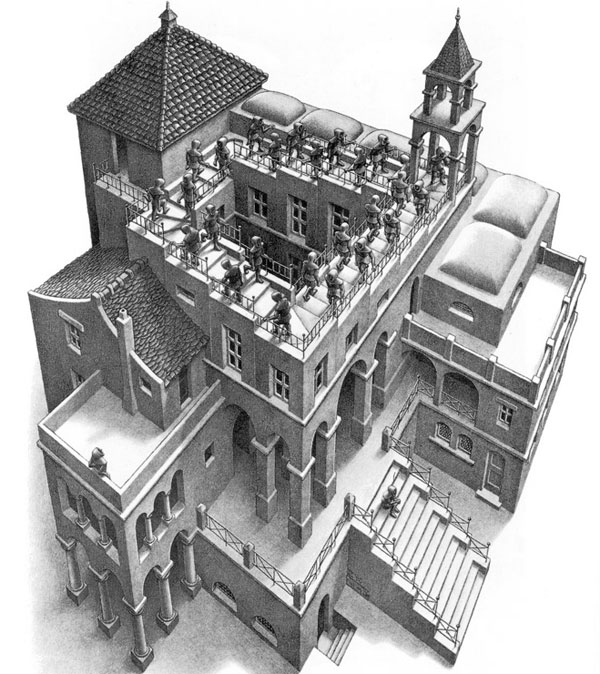
In the real, “meat­space” world of organ­ic things, it’s a lit­tle bit hard­er. In Jan­u­ary 2011, a YouTu­ber by the name of “mcwolles” post­ed the video above. In it, a man pours water in a scale mod­el of Escher’s 1961 Water­fall. The con­trap­tion, using blue water, actu­al­ly seems to work. The water runs uphill through sev­er­al sharp angles and fin­ish­es by tum­bling off the top into the pad­dle­wheel below, where its begins its jour­ney again. “Mcwolles” ends the video star­ing into the cam­era as he tries to find the off switch…but also dares view­ers to fig­ure out how he did it.

Escher, Waterfall 1961

Cre­ative Com­mons image via Wikipedia

The Inter­net had a viral freakout—check out the 9.3 mil­lion views—and prompt­ly set about try­ing to offer solu­tions. “Look how the shad­ows fall!” sev­er­al peo­ple point­ed out. The locked-down cam­era was anoth­er clue.

In May of 2011, “mcwolles” offered a 360 tour of the cre­ation in his garage that offered some sug­ges­tions, and that was all that was need­ed for user “LookingMercury3D” to offer their expla­na­tion of how the trick was done. (Hint: edit­ing).

Since then, “mcwolles” has only post­ed two more videos: one of him los­ing weight and one of a dog hav­ing its way with a stuffed ani­mal. Maybe he’s busy work­ing on his next piece of Esch­er-inspired art.


Relat­ed con­tent:

Meta­mor­phose: 1999 Doc­u­men­tary Reveals the Life and Work of Artist M.C. Esch­er

The Genius of J.S. Bach’s “Crab Canon” Visu­al­ized on a Möbius Strip

Inspi­ra­tions: A Short Film Cel­e­brat­ing the Math­e­mat­i­cal Art of M.C. Esch­er

Ted Mills is a free­lance writer on the arts who cur­rent­ly hosts the FunkZone Pod­cast. You can also fol­low him on Twit­ter at @tedmills, read his oth­er arts writ­ing at tedmills.com and/or watch his films here.

Watch a Luthier Birth a Cello in This Hypnotic Documentary

It’s always inter­est­ing to see how things are made—crayons, Fend­er Stra­to­cast­ers, car­toon eggs…

The doc­u­men­tary above takes you through the cre­ation of a cel­lo in the Barcelona work­shop of mas­ter luthi­er Xavier Vidal i Roca. (To watch with Eng­lish sub­ti­tles, click the closed cap­tion icon — “CC” — in the low­er right cor­ner.)

The open­ing shots of luthi­er Eduard Bosque Miñana tak­ing mea­sure­ments have the jazzy feel of a Mis­ter Rogers’ Neigh­bor­hood seg­ment, but once music schol­ar Ramón Andres gets into the act, things take a turn toward the philo­soph­i­cal.

His thoughts as to the ways the “king of all instru­ments” speaks to the human con­di­tion are com­men­su­rate with the lev­el of crafts­man­ship its con­struc­tion requires.

(Though see­ing Miñana patient­ly fit a steam-shaped curve to the devel­op­ing instrument’s c‑bout leads me to ques­tion Andres’ choice of anthro­po­mor­phiz­ing pro­noun. With a waist­line like that, sure­ly this cel­lo is a deep-voiced queen.)

The mas­ter luthi­er him­self acknowl­edges that there is always a bit of mys­tery as to how any giv­en instru­ment will sound. Most mod­ern cel­los are copies of ancient instru­ments. With the design set, the luthi­er must chan­nel his or her cre­ative expres­sion into the con­struc­tion, work­ing with sim­i­lar­ly ancient tools — chis­els, palette knives, and the like. If pow­er tools come into play, direc­tor Lau­ra Vidal keeps them off­screen.

The effect is med­i­ta­tive, hypnotic…I was glad to have the mys­tery pre­served, even as I agree with cel­list Lito Igle­sias that musi­cians should make an effort to under­stand their instru­ments’ con­struc­tion, and the rea­sons behind the selec­tion of par­tic­u­lar woods and shapes.

Igle­sias also notes that the luthi­er is the unsung part­ner in every pub­lic per­for­mance, the one the audi­ence nev­er thinks to acknowl­edge.

The Sara­bande of Bach’s Suite for Solo Cel­lo no. 1 in G major brings things to an appro­pri­ate­ly emo­tion­al con­clu­sion.

via Devour

Relat­ed Con­tent:

The Recy­cled Orches­tra: Paraguayan Youth Play Mozart with Instru­ments Clev­er­ly Made Out of Trash

Elec­tric Gui­tars Made from the Detri­tus of Detroit

A Song of Our Warm­ing Plan­et: Cel­list Turns 130 Years of Cli­mate Change Data into Music

Ralph Steadman’s Evolving Album Cover Designs: From Miles Davis & The Who, to Frank Zappa & Slash (1956–2010)

steadman02

Ralph Stead­man will always best be known—and for good reason—as the visu­al inter­preter of Hunter S. Thompson’s drug­gy gonzo vision of Amer­i­can excess and hubris. As Col­in Mar­shall wrote in a pre­vi­ous post on Stead­man and Thompson’s pow­er­ful col­lab­o­ra­tive rela­tion­ship, it’s hard to imag­ine a more “suit­able visu­al accom­pa­ni­ment to the simul­ta­ne­ous­ly clear- and wild-eyed sen­si­bil­i­ty of Thomp­son­ian prose.” But the British artist has had a long and dis­tin­guished career, pre- and post-Thomp­son: illus­trat­ing Lewis Carroll’s sur­re­al­ist clas­sic Alice in Won­der­land; cre­at­ing lim­it­ed edi­tion DVD cov­ers for the dark cult hit TV show Break­ing Bad; mak­ing bul­let-rid­dled col­lage art with coun­ter­cul­ture hero William S. Bur­roughs…. To name just a few of his off­beat assign­ments over the years.

happy jack steadman

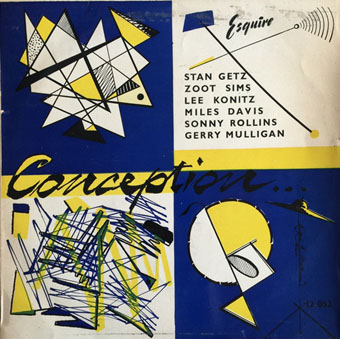
Today we bring you a less­er-known facet of Steadman’s work: design­ing album cov­ers. As artist and illus­tra­tor John Coulthart notes in a post on Steadman’s album designs, he’s been at it since the mid-fifties, when—for example—he illus­trat­ed a release of Con­cep­tion (top), “an under­ap­pre­ci­at­ed mas­ter­piece of cere­bral cool jazz” fea­tur­ing the likes of Miles Davis, Stan Getz, and Son­ny Rollins. Stead­man’s abstract expres­sion­ist-inspired jazz cov­ers soon gave way to more Stead­manesque, though still rel­a­tive­ly tame, cov­ers like that above for The Who’s sin­gle “Hap­py Jack”/“I’ve Been Away” from 1966.

steadman07

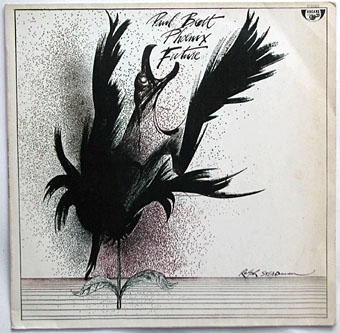
It’s not until the 70s, however—after he’d begun his col­lab­o­ra­tion with Thompson—that his album cov­ers begin to take on the decid­ed­ly crazed look his work is known for, such as in the cov­er for Paul Bret­t’s Phoenix Future, above, from 1975.

steadman26

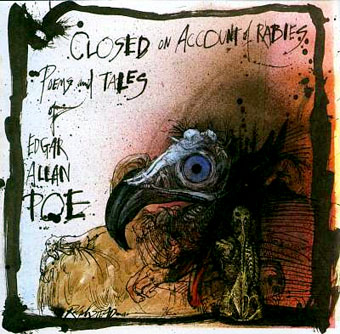
By 1997, Stead­man seems to have per­fect­ed his inim­itable riot of grotesque imagery, wild col­or palette, and unhinged black lines and let­ter­ing, as in the cov­er for Closed On Account Of Rabies: Poems And Tales Of Edgar Allan Poe, a com­pi­la­tion of Poe read­ings by stars like Christo­pher Walken, Iggy Pop, Mar­i­anne Faith­full, Jeff Buck­ley, and Abel Fer­rara, which we’ve fea­tured on OC before. The artists rep­re­sent­ed here are—as in his work with Thomp­son and Burroughs—perfectly fit­ting for Stead­man’s sen­si­bil­i­ty. So, of course, is the clean-liv­ing but oth­er­wise total­ly bonkers Frank Zap­pa, whose 1997 Have I Offend­ed Some­one? received the Stead­man treat­ment, as you can see below.

zappa steadman

In the past few years, Stead­man has mel­lowed a bit, if you could call it that, and his work has tak­en on a slight­ly more refined char­ac­ter. His Break­ing Bad illus­tra­tions seem restrained by the stan­dards of his work with Thomp­son or Zap­pa. And in a 2010 cov­er for Slash’s first offi­cial sin­gle, “By the Sword,” below, he reigns in some of his wilder graph­ic impuls­es while retain­ing all of the styl­ist sig­na­tures he devel­oped over the decades.

slash steadman

Stead­man has always been a one-of-a-kind illus­tra­tor. In his album cov­er design, we can per­haps best watch his work evolve. As Coulthart writes, “the style of the ear­ly sleeves is marked­ly dif­fer­ent to the angry, splat­tery cre­ations that made his name, and with­out a sig­na­ture you’d be unlike­ly to recog­nise the artist.” See many more Stead­man album cov­ers over at Coulthart’s excel­lent blog.

via Feuil­leton

Relat­ed Con­tent: 

Break­ing Bad Illus­trat­ed by Gonzo Artist Ralph Stead­man

See Ralph Steadman’s Twist­ed Illus­tra­tions of Alice’s Adven­tures in Won­der­land on the Story’s 150th Anniver­sary

Gun Nut William S. Bur­roughs & Gonzo Illus­tra­tor Ralph Stead­man Make Polaroid Por­traits Togeth­er

Josh Jones is a writer and musi­cian based in Durham, NC. Fol­low him at @jdmagness

David Bowie Paper Dolls Recreate Some of the Style Icon’s Most Famous Looks

thinwhitepaperdoll

Per­form an inter­net search on the phrase “David Bowie Paper Doll” and what do you get? Hint: it’s not a cov­er of the Mills Broth­ers hitDavid Bowie paper dolls are pro­lif­er­at­ing in aston­ish­ing num­bers.

Sharp­en your scis­sors and behold!

The most com­pre­hen­sive career rep­re­sen­ta­tion is the Thin White Paper Doll Cutout Heather Col­lett designed for the Cana­di­an Broad­cast­ing Cor­po­ra­tion (above). There’s even a print­er friend­ly ver­sion for those who are seri­ous about play­ing with Aladdin Sane, Zig­gy Star­dust, Labyrinth’s Gob­lin King, and oth­er Bowie alter egos.

But wait! There’s more…

DavidBowie70sPaperDollVodkaCaramel.com_

Elu­sive design­er Vod­ka Caramel’s Amaz­ing 70’s Bowie Paper Doll cel­e­brates some of our hero’s most glam­orous looks, but sad­dles him with the crotch of a Ken doll and no few­er than four inter­change­able heads! And we thought the Thin White Paper Doll’s crew socks were an indig­ni­ty.

bowie paper doll

A Span­ish fan observed Bowie’s 65th birth­day by updat­ing the abbre­vi­at­ed tighty whities of a noto­ri­ous 1973 pho­to shoot to a mod­est pair of stan­dard issue Y‑fronts. Inter­est­ing­ly, this paper dol­l’s sus­pendered Hal­loween Jack suit arrives with bulge intact.

bowie_031813

Points to Serge Baeken above for rec­og­niz­ing the paper doll pos­si­bil­i­ties in the Pier­rot cos­tume Bowie sport­ed in the video for 1980’s “Ash­es to Ash­es.” (Fun fact: Bowie made his the­atri­cal debut—and wrote the music for—a bizarre 1968 pan­tomime about Pier­rot.… His char­ac­ter’s name was “Cloud”)

etsybowie2

Artist Clau­dia Varo­sio’s entry in the Bowie paper doll stakes could pass as illus­tra­tions for a 1970’s children’s book. Title? Boys Keep Swing­ing, after a cut from Bowie’s 1979 Lodger album. Chaste young girls would love the t‑shirted, non-threat­en­ing Bowie.

2527937388_31e26dedac_o

The com­par­a­tive­ly con­ser­v­a­tive, full-faced Bowie above comes to us via Swedish fam­i­ly mag­a­zine Ă…ret Runt. I may nev­er learn anoth­er word of Swedish, but thanks to David Bowie, I can now say paper doll (klip­p­dock­or). In appre­ci­a­tion, allow me to share anoth­er exam­ple of David Bowie klip­p­dock­or…

dress-up-paper-doll-pop-star-5

If it all starts seem­ing a bit rote, mix things up by hav­ing artist Mel Elliot’s paper doll Bowie swap  duds with fel­low pop star / style icon paper dolls, Bey­once, Deb­bie Har­ry, and Rihan­na.

David_Bowie_Paper_Doll_by_electricsorbet

(image by Elec­tric Sor­bet)

There is only one David Bowie, but there can nev­er be too many David Bowie paper dolls. Make your own today!

Relat­ed Con­tent:

96 Draw­ings of David Bowie by the “World’s Best Com­ic Artists”: Michel Gondry, Kate Beat­on & More

50 Years of Chang­ing David Bowie Hair Styles in One Ani­mat­ed GIF

The Musi­cal Career of David Bowie in One Minute … and One Con­tin­u­ous Take

Ayun Hal­l­i­day is an author, illus­tra­tor, and Chief Pri­ma­tol­o­gist of the East Vil­lage Inky zine. Fol­low her @AyunHalliday

Discover Japan’s Earthquake Proof Underground Bike Storage System: The Future is Now

Behold, the inge­nious under­ground bicy­cle stor­age of Japan! What a vision of futur­ist effi­cien­cy — the only thing miss­ing is Ray­mond Scott’s Pow­er­house (aka Bugs Bun­ny fac­to­ry music).

Japan­ese cul­tur­al com­men­ta­tor Dan­ny Choo strapped a cam­era to his seat to cap­ture a bike’s eye view of the robot­ic Eco Cycle Anti-Seis­mic Under­ground Bicy­cle Park. It takes an aver­age of 8 sec­onds for two-wheel­ers to make the jour­ney — human involve­ment stops at the street lev­el card read­er.

(One inter­net com­menter won­dered what hap­pens if the sys­tem malfunctions…and all I can say is I once spent what felt like an eter­ni­ty, trapped in Disney’s Haunt­ed Man­sion.)

Giken-Eco-Cycle-Underground-Bike-Park-1-537x424

As futur­is­tic visions go, it’s a finite one. The envi­ron­men­tal­ly-friend­ly design allows for fair­ly easy de-instal­la­tion, should pub­lic demand for safe, sub­ter­ranean bike park­ing wane.

It’s also earth­quake-proof, a fea­ture which gives rise to all sorts of dystopi­an Plan­et of the Apes-style fan­tasies (replace Apes with Bikes).

Cities from Lon­don and Paris to New York and Hangzhou have embraced bike­shar­ing schemes, but the Japan­ese mod­el allows cyclists to keep their own rides. Signs post­ed at street lev­el remind rid­ers to remove per­son­al effects like pets (!) before using the sys­tem.) Unlim­it­ed park­ing and retrieval comes in at under 20 bucks a month.

It’s an idea whose time has come. As of this writ­ing, the cycle-friend­ly Nether­lands is plot­ting the world’s largest bike park — under­der­ground — to be launched in 2018.

Hat tip to Dan­ny Choo.

- Ayun Hal­l­i­day is an author, illus­tra­tor, and Chief Pri­ma­tol­o­gist of the East Vil­lage Inky zine. Fol­low her @AyunHalliday

Relat­ed Con­tent:

Turn Your Bike into an Elec­tric Hybrid with MIT’s “Copen­hagen Wheel”

The Physics of the Bike

How Leo Tol­stoy Learned to Ride a Bike at 67, and Oth­er Tales of Life­long Learn­ing

Watch a Japanese Craftsman Lovingly Bring a Tattered Old Book Back to Near Mint Condition

Remem­ber dis­fig­ur­ing binders with band logos and lyrics, doo­dling in the mar­gins of text­books, idly mark­ing the fore edges with ball point designs?

At most, such pur­suits helped pass a few min­utes in study hall.

How long would it take to undo all this hand­i­work?

Clear­ly much, much longer than it took to cre­ate. In the above episode of the Japan­ese doc­u­men­tary series, The Fas­ci­nat­ing Repair­men, Tokyo-based book con­ser­va­tor Nobuo Okano brings over 30 years of expe­ri­ence to bear on a tat­tered, mid­dle school Eng­lish-to-Japan­ese dic­tio­nary. This is not the sort of job that can be rushed.

Its orig­i­nal own­er must be dri­ven by sen­ti­ment in hir­ing a mas­ter crafts­man to restore the book as a present for his col­lege-bound daugh­ter. Sure­ly it would be just as easy, pos­si­bly even more con­ve­nient, for the young woman in ques­tion to look up vocab­u­lary online. If keep­ing things old school is the goal, I guar­an­tee a recent­ly pub­lished paper­back would prove far cheap­er than con­ser­va­tor Okano’s labo­ri­ous fix.

He spends four hours just turn­ing and press­ing its bat­tered pages—all 1000 of them—with tweez­ers and a tiny pink iron.

He also scrapes the spine free of crum­bling glue, resets tat­tered maps, pre­serves the old cover’s title as a dec­o­ra­tive ele­ment for the new one, and dis­patch­es the ini­tials of a teenage crush with one chop of his blade. (So much for sen­ti­ment…)

One need not speak Japan­ese to admire the painstak­ing crafts­man­ship that will keep this beat-up old book out of the land­fill.

Oth­er episodes fol­low oth­er crafts­peo­ple as they lav­ish atten­tion on a suit­case, grater, and a stuffed toy pen­guin. Watch a com­plete playlist here.

via Colos­sal

Relat­ed Con­tent:

Artist Takes Old Books and Gives Them New Life as Intri­cate Sculp­tures

The Chem­istry Behind the Smell of Old Books: Explained with a Free Info­graph­ic

The Craft and Phi­los­o­phy of Build­ing Wood­en Boats by Hand

Ayun Hal­l­i­day is an author, illus­tra­tor, and Chief Pri­ma­tol­o­gist of the East Vil­lage Inky zine. Fol­low her @AyunHalliday

A Harrowing Test Drive of Buckminster Fuller’s 1933 Dymaxion Car: Art That Is Scary to Ride

In the 1930s, the sys­tems the­o­rist, design­er and inven­tor Buck­min­ster Fuller cre­at­ed the Dymax­ion car — an aero­dy­nam­ic con­cept car that man­aged to get 30 miles per gal­lon while top­ping out at 90 miles per hour, and trans­port­ing 11 pas­sen­gers. Like Fuller’s Dymax­ion house, the three-wheel Dymax­ion car could be dis­as­sem­bled and re-assem­bled with ease. You can see vin­tage videos of both here.

The con­cept car did­n’t get much beyond the con­cept stage. Only three orig­i­nal ver­sions were built, one of which rolled over at the 1933 World’s Fair, leav­ing the dri­ver dead, three pas­sen­gers injured, and investors reluc­tant to bring the car to mar­ket. In 2010, the British archi­tect Sir Nor­man Fos­ter built a repli­ca of the Dymax­ion. You can see Dan Neil, of The Wall Street Jour­nal, take the car on a har­row­ing test dri­ve above. And if you’re intrigued enough to learn more, you can hunt down the 2012 doc­u­men­tary called The Last Dymax­ion (watch a trail­er of the film here).

If you would like to sign up for Open Culture’s free email newslet­ter, please find it here. It’s a great way to see our new posts, all bun­dled in one email, each day.

If you would like to sup­port the mis­sion of Open Cul­ture, con­sid­er mak­ing a dona­tion to our site. It’s hard to rely 100% on ads, and your con­tri­bu­tions will help us con­tin­ue pro­vid­ing the best free cul­tur­al and edu­ca­tion­al mate­ri­als to learn­ers every­where. You can con­tribute through Pay­Pal, Patre­on, and Ven­mo (@openculture). Thanks!

Relat­ed Con­tent:

Every­thing I Know: 42 Hours of Buck­min­ster Fuller’s Vision­ary Lec­tures Free Online (1975)

Bet­ter Liv­ing Through Buck­min­ster Fuller’s Utopi­an Designs: Revis­it the Dymax­ion Car, House, and Map

Watch an Ani­mat­ed Buck­min­ster Fuller Tell Studs Terkel All About “the Geo­des­ic Life”

by | Permalink | Make a Comment ( 7 ) |

Watch Björk’s 6 Favorite TED Talks, From the Mushroom Death Suit to the Virtual Choir

Björk_-_Hurricane_Festival

Image by Zach Klein

Singer-song­writer Björk, cur­rent­ly enjoy­ing a career ret­ro­spec­tive at the Muse­um of Mod­ern Art, cel­e­brat­ed TED’s bil­lionth video view with a playlist of six trea­sured TED Talks. What do her choic­es say about her?

In this talk, artist Jae Rhim Lee mod­els her Mush­room Death Suit, a kicky lit­tle snug­gy designed to decom­pose and reme­di­ate tox­ins from corpses before they leech back into the soil or sky. Despite Björk’s fond­ness for out­rĂ© fash­ion, I’m pret­ty sure this choice goes beyond the mere­ly sar­to­r­i­al.

For more infor­ma­tion, or to get in line for a mush­room suit of your own, see the Infin­i­ty Bur­ial Project.

Con­tin­u­ing with the mush­room / fash­ion theme, Björk next turns to design­er Suzanne Lee, who demon­strates how she grows sus­tain­able tex­tiles from kom­bucha mush­rooms. The result­ing mate­r­i­al may var­i­ous­ly resem­ble paper or flex­i­ble veg­etable leather. It is extreme­ly recep­tive to nat­ur­al dyes, but not water repel­lent, so bring a non-kom­bucha-based change of clothes in case you get caught in the rain.

For more infor­ma­tion on Lee’s home­grown, super green fab­ric, vis­it Bio­Cou­ture.

Björk’s clear­ly got a soft spot for things that grow: mush­rooms, mush­room-based fab­ric, and now…building mate­ri­als? Pro­fes­sor of Exper­i­men­tal Archi­tec­ture Rachel Arm­strong’s plan for self-regen­er­at­ing build­ings involves pro­to­cols, or “lit­tle fat­ty bags” that behave like liv­ing things despite an absence of DNA. I’m still not sure how it works, but as long as the lit­tle fat­ty bags are not added to my own ever-grow­ing edi­fice, I’m down.

For more infor­ma­tion on what Dr. Arm­strong refers to as bot­tom up con­struc­tion (includ­ing a scheme to keep Venice from sink­ing) see Black Sky Think­ing.

Björk’s next choice takes a turn for the seri­ous… with games. Game Design­er Bren­da Romero began explor­ing the heavy duty emo­tion­al pos­si­bil­i­ties of the medi­um when her 9‑year-old daugh­ter returned from school with a less than nuanced under­stand­ing of the Mid­dle Pas­sage. The suc­cess of that exper­i­ment inspired her to cre­ate games that spur play­ers to engage on a deep­er lev­el with thorny his­tor­i­cal sub­jects. (The Trail of Tears required 50,000 indi­vid­ual red­dish-brown pieces).

Learn more about Romero’s ana­log games at The Mechan­ic is the Mes­sage.

Remem­ber those 50,000 indi­vid­ual pieces? As pho­tog­ra­ph­er Aaron Huey doc­u­ment­ed life on Pine Ridge Reser­va­tion, he was hum­bled by hear­ing him­self referred to as “wasichu,” a Lako­ta word that can be trans­lat­ed as “non-Indi­an.” Huey decid­ed not to shy away from its more point­ed trans­la­tion: “the one who takes the best meat for him­self.” His TED Talk is an impas­sioned his­to­ry les­son that begins in 1824 with the cre­ation of the Bureau of Indi­an Affairs and ends in an activist chal­lenge.

Proof that Björk is not entire­ly about the quirk.

See Huey’s pho­tos from the Nation­al Geo­graph­ic cov­er sto­ry, “In the Spir­it of Crazy Horse.”

Björk opts to close things on a musi­cal note with excerpts from com­pos­er Eric Whitacre’s “Lux Aurumque” and “Sleep” per­formed by a crowd­sourced vir­tu­al choir. Its members—they swell to 1999 for â€śSleep”—record their parts alone at home, then upload them to be mixed into some­thing son­i­cal­ly and spir­i­tu­al­ly greater than the sum of its parts.

Lis­ten to “Sleep” in its entire­ty here.

Relat­ed Con­tent:

Hear the Album Björk Record­ed as an 11-Year-Old: Fea­tures Cov­er Art Pro­vid­ed By Her Mom (1977)

A Young Björk Decon­structs (Phys­i­cal­ly & The­o­ret­i­cal­ly) a Tele­vi­sion in a Delight­ful Retro Video

Björk and Sir David Atten­bor­ough Team Up in a New Doc­u­men­tary About Music and Tech­nol­o­gy

Ayun Hal­l­i­day is an author, illus­tra­tor, and Chief Pri­ma­tol­o­gist of the East Vil­lage Inky zine. Fol­low her @AyunHalliday

« Go BackMore in this category... »
Quantcast