“Whatever you do, nobody else can do that better than you. You have to find what you can do better than anyone else, what you have in yourself that nobody else has in them. Don’t do anything that you know, deep in your heart, that somebody else can do better, but do what nobody else can do except for you.” That sounds like fine advice, but when receiving advice we should always consider the source. In this case we could hardly do better: the source is Wim Wenders, director of Alice in the Cities, Paris, Texas, Wings of Desire, and many other films besides, an auteur seldom accused of making movies anyone else could make.
Wenders’ interview clip and the others here come from “Advice to the Young,” a video series created by the Louisiana Museum in Denmark (which has quite an impressive gift shop, incidentally, if you happen to need advice on gift-shopping). Jonathan Franzen, author of novels like The Corrections, Freedom, and Purity, admits to feeling embarrassment about “giving advice to the young writer,” but he still has valuable words for creators in any domain: “The most important advice I have is to have fun, to try to create something that is fun to work on.”
And by fun he means fun like you have on a tennis court, where “you’re not just messing around, you’re not just hitting the ball wherever you want — you are focused on having a game, and once you are in it you are having fun. That’s the kind of focused fun I’m talking about, and if you are having that kind of focused fun, there’s a good chance that the reader will too.”
The range of writers from which Louisiana Museum has sought advice also includes Lydia Davis, whose sensibility may differ from Franzen’s but who has garnered an equal (or even greater) degree of respect from her readership. “You learn from models and you analyze them, you study them, you analyze them very closely, one thing at a time,” she says, beginning her more expansive advice based on her own method. “You don’t just sort of read the paragraph and say, ‘Oh, that really flows, you know? That’s good.’ You say, ‘What kind of adjectives? How many? What kind of nouns? How long are the sentences? What’s the rhythm?’ You know, you pick it apart, and that’s very helpful.” Her other suggestions include to “be very patient, even patient with chaos” and to keep a notebook (“it takes some of the tension and the worry away, because if you write it down, it may just be a note. It doesn’t have to be the beginning of anything”).
“Do what you want to do,” Davis concludes, “and don’t worry if it’s a little odd or doesn’t fit the market.” That bit of guidance seems to have worked for her, and in the great variety of forms it can take seems to have worked for seemingly every other artist. Take Ed Ruscha, for instance, whose canvasses of gas stations, corporate signage, and other icons of American blankness must hardly have seemed geared toward any particular “market” when first he painted them. For the young he has only one piece of advice, received second-hand and briefly delivered: “No one could ever beat this thing that Max Ernst said. They asked him what a young artist should do, and he said, ‘cut off an ear.’ That’s good advice to follow. You can’t beat that.”
Other artists featured in the video playlist include Laurie Anderson, David Byrne, Umberto Eco, Patti Smith & more.
Based in Seoul, Colin Marshall writes and broadcasts on cities, language, and culture. His projects include the book The Stateless City: a Walk through 21st-Century Los Angeles and the video series The City in Cinema. Follow him on Twitter at @colinmarshall or on Facebook.
After the fire that totally destroyed Brazil’s Museu Nacional in Rio, many people lamented that the museum had not digitally backed up its collection and pointed to the event as a tragic example of why such digitization is so necessary. Just a couple decades ago, storing and displaying this much information was impossible, so it may seem like a strange demand to make. And in any case, two-dimensional images stored on servers—or even 3D printed copies—cannot replace or substitute for original, priceless artifacts or works of art.
But museums around the world that have digitized most–or all–of their collections don’t claim to have replicated or replaced the experience of an in-person visit, or to have rendered physical media obsolete.
Digital collections provide access to millions of people who cannot, or will not, ever travel to the major cities in which fine art resides, and they give millions of scholars, teachers, and students resources once available only to a select few.
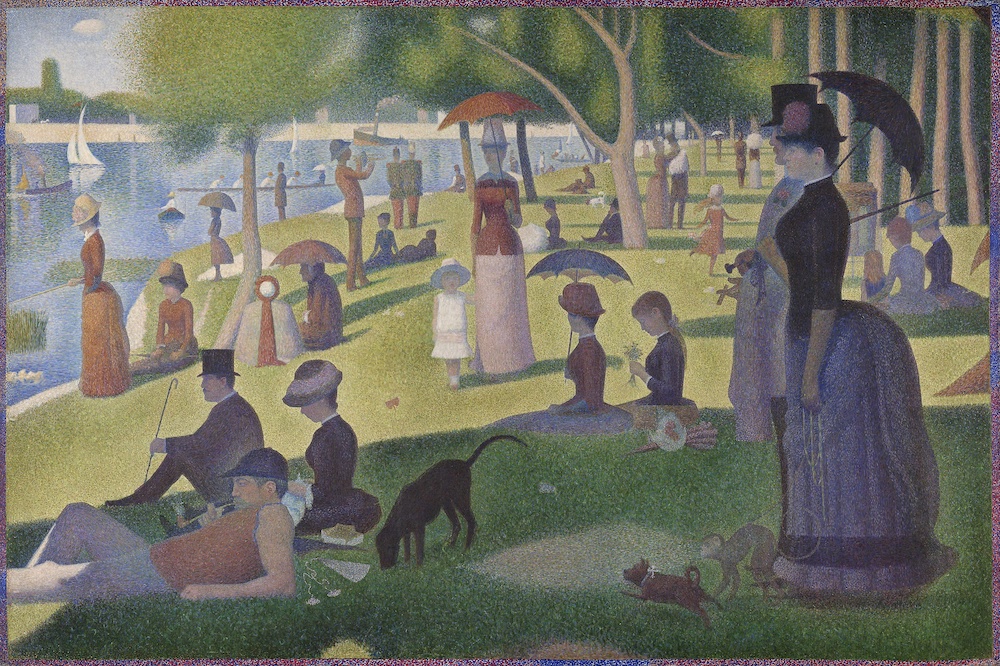
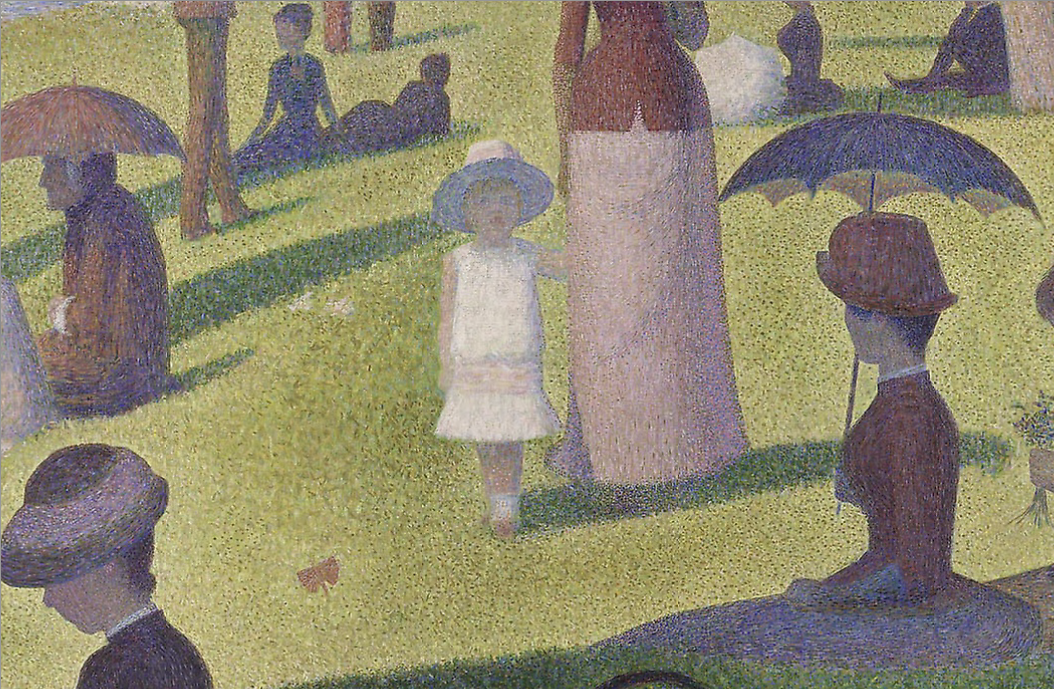
We can’t all take the day off like Ferris Bueller and stand in front of Georges Seurat’s Sunday Afternoon on the Island of La Grande Jatte. But thanks to the Art Institute of Chicago, we can all view and download the 1884 pointillist painting in high resolution, zoom in closely like the troubled Cameron to specific details, share the digital image under a Creative Commons Zero license, and similarly interact with an oil sketch for the final painting and several conté crayon studies.
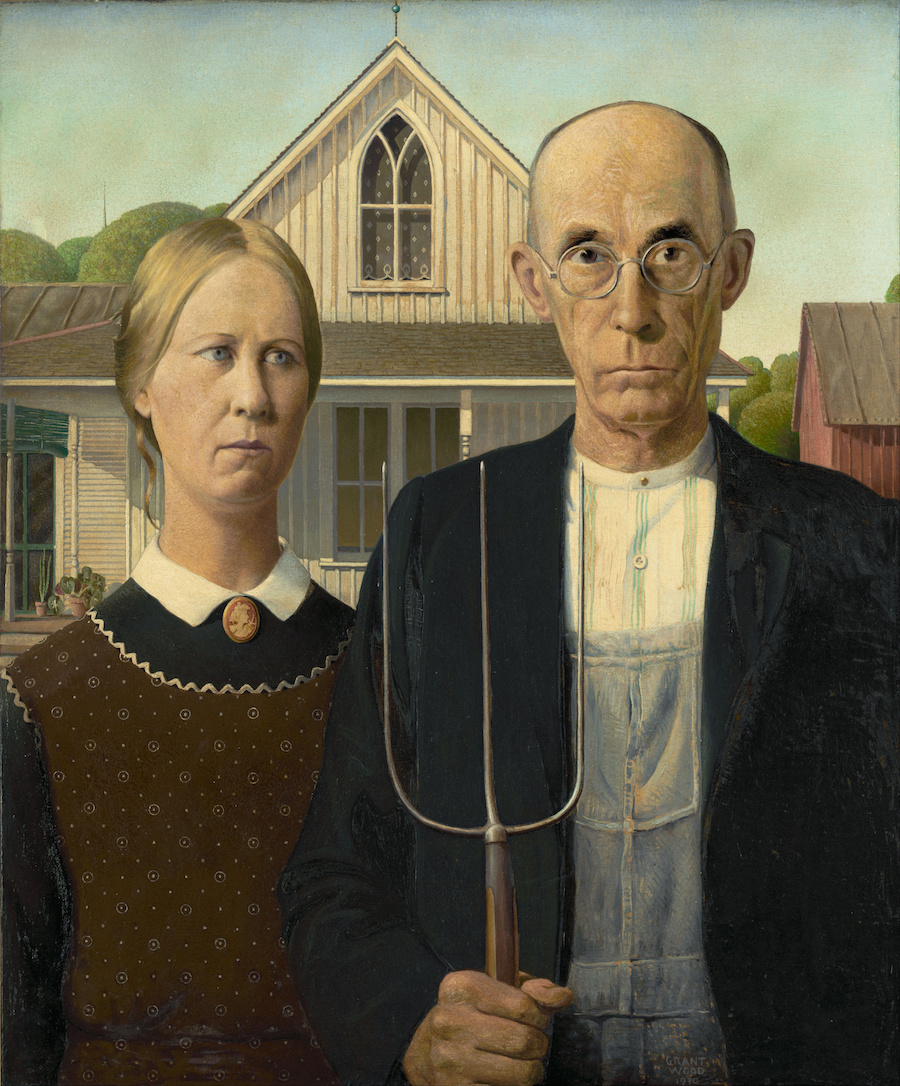
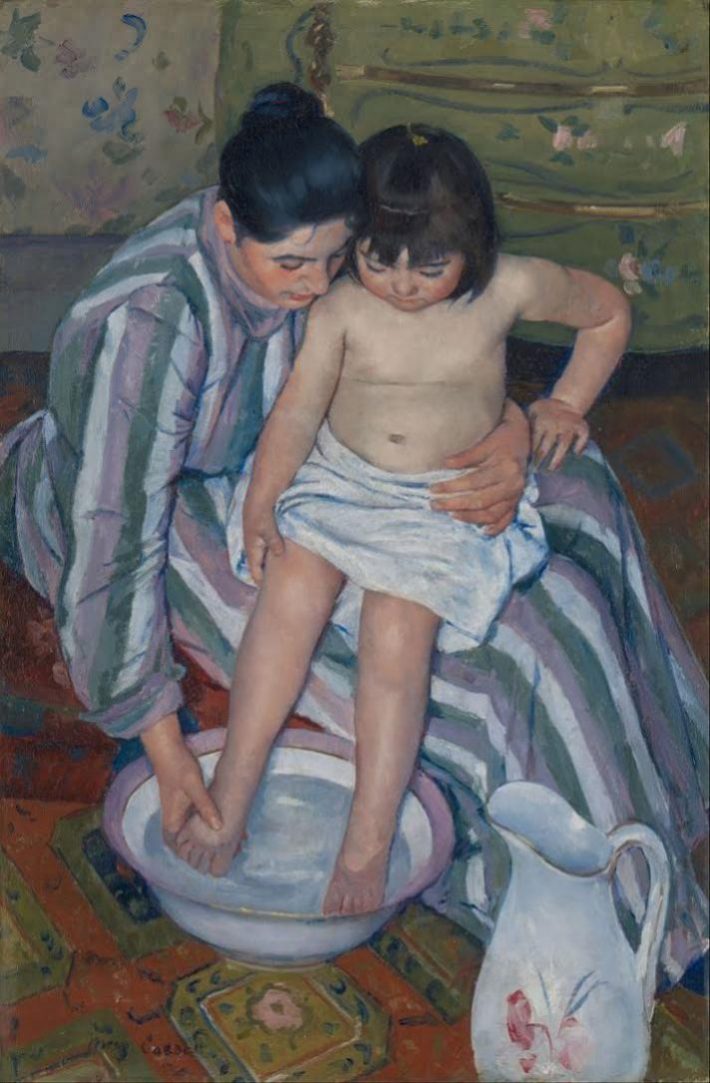
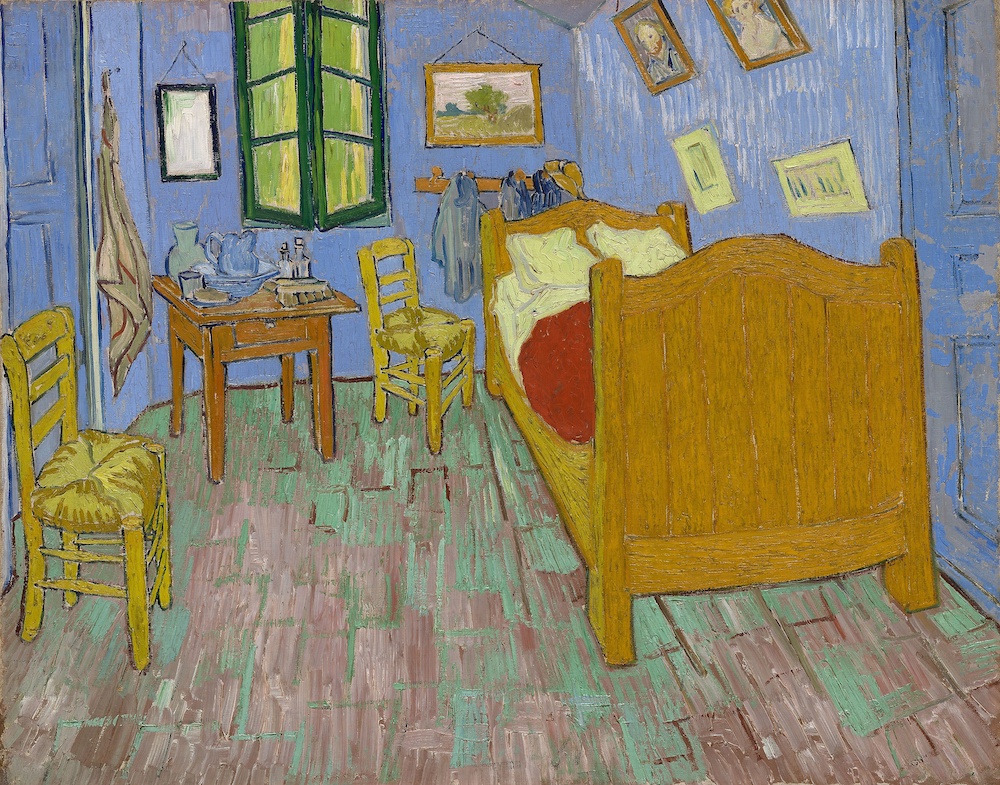
And if that weren’t enough, the museum also includes a bibliography, exhibition history, notes on provenance, audio and video histories and descriptions, and educational resources like teacher manuals, lesson plans, and exams. This goes for many of the 44,312—with more to come—digital images online, including such famous works of art as Vincent van Gogh’s 1889 The Bedroom, Grant Wood’s 1930 American Gothic, Pablo Picasso’s 1903–4 blue period painting The Old Guitarist, Edward Hopper’s 1942 Nighthawks, Mary Cassatt’s 1893 The Child’s Bath, and so many more that it boggles the mind.
Browse Impressionism, Pop Art, works from the African Diaspora, Cityscapes, Fashion, Mythological Works, and other genres and categories. Search artists, dates, styles, media, departments, places, and more.
A personal visit to the Art Institute is an awe-inspiring, and somewhat overwhelming experience, if you can get the day to go. You can visit the website, with full unrestricted access, and gather information, study, marvel, and casually browse, at any time of day—every day if you like. No, it’s not the same, but as a learning experience, in some ways, it’s even better. And if, by some awful chance, anything should happen to this art, we won’t have to rely on user-submitted photos to reconstruct the cultural memory.
The launch of this collection comes as part of the museum’s website redesign, and it is an extensive, and expensive, endeavor. The Art Institute, which charges for entry, can afford to make its collections free online. Some other museums charge image fees to support their online work. Ideally, as art historian Bendor Grosvenor writes at Art History News, museums should offer free and open access to both physical and online collections, and some institutions, like Sweden’s Nationalmuseum, have shown that this is possible.
And, as Grosvenor shows, the success of open access online collections has yielded another benefit, for both viewers and museums alike. The more people are exposed to art online, the more likely they are to visit museums in person. Chicago awaits you. Until then, virtually immerse yourself in the Art Institute’s many thousands of treasures here.
“The looming student loan default crisis is worse than we thought,” writes Professor of Economics Judith Scott-Clayton at Brookings. I’ll leave it to you to parse the report, but to sum up… it looks bad. Subprime mortgage crisis bad. Maybe… there’s another way? Working models of fully subsidized higher ed systems in other countries—like fully subsidized healthcare systems—strongly suggest as much. Some high-end programs in the U.S., like NYU’s newly free medical school, have taken an early lead, hoping to solve the problem of doctor shortages.
But there’s an earlier, humbler, more progressive model of free college in the States, Kentucky’s little-known Berea College, founded in 1855 by an abolitionist Presbyterian minister John Gregg Fee as the first integrated, co-educational college in the American South. “It has not charged students tuition since 1892,” Adam Harris reports at The Atlantic. “Every student on campus works, and its labor program is like work-study on steroids. The work includes everyday tasks such as janitorial services, but older students are often assigned jobs aligned to their volunteer programs.”
Rather than working to pay off tuition, “students receive a physical check for their labor that can go toward housing and living expenses.” Nearly half of the school’s graduates leave with no debt, with the remaining carrying an average of less than $7,000 from room and board expenses. Compare that to a national average of $37,172 in loan debt per student for the class of 2016. How does Berea do it? It funds tuition with its large endowment of 1.2 billion dollars.
Through a perverse historical irony, as Harris describes, the same racist hatred that ran Berea’s founder out of town in 1859, and forced the school to segregate in 1904, made certain that its funding model would sustain it far into its (re)integrated future. After Kentucky’s passage of the so-called “Day Law,” barring black students from attending, money began to pour in.
The prospect of educating poor white people from Appalachia for no tuition was something that the community could get behind. And nearly 100 years ago, on October 20, 1920, the board made sure that the college would be able to do so for a long time. According to Jeff Amburgey, the school’s chief financial officer, “The board essentially said, for Berea to sustain its funding model,” any unrestricted bequests—essentially money that someone leaves the institution after they have passed away, that is not tagged for a specific purpose—could not be spent right away. Instead, he says, the money was expected to be treated as part of the endowment, and only the return on that investment could be spent.
Berea could not, as some other schools do, spend millions on football stadiums instead of investing in its students. In the 50s, the school reintegrated, but the process was very slow, as it was everywhere in the country. “The community was gone,” says Berea history professor Alicestyne Turley, referring to the Reconstruction-era community that had a student body mix of 50–50 black and white students.
The school had to relearn its founding principles, as expressed in its founder’s chosen motto, from the Book of Acts: “God has made of one blood all peoples of the earth.” Now most of the enrollees, low-income white and black students mostly from Appalachia, qualify for Pell grants. 10 percent of the budget comes from charitable gifts. But the school pays the bulk of the tuition, $39,400 per student, from its endowment.
Is this sustainable? Time will tell. Though a 1937 promotional film, above, from the college’s segregated past decries “the false glitter of easy prosperity,” its current president tells Harris “we’re not the kind of institution that holds the world of finance in disdain. We are dependent on it.” A stock market crash could bankrupt Berea, and no bailouts would be forthcoming. But for now, the college thrives, with very impressive ranking numbers in the U.S. News Best Colleges report (it comes in a #4 in Best Undergraduate Teaching and #3 in Most Innovative Schools).
The school hosts bell hooks as a professor in residence and boasts as an alumnus Carter G. Woodson, the “father of black history,” with a center named for him whose mission is “to assert the kinship of all people and provide interracial education with a particular emphasis on understanding and equality among blacks and whites as a foundation for building community among all peoples of the earth.”
Maybe if there were a way to, say, fund Berea, and colleges and universities nationwide, through some kind of, say, taxation on, say, the most profitable companies on the planet, or some such… just imagine.…
We should be suspicious when researchers assume their conclusion; when the results of an academic study merely confirm the author’s pre-existing biases. Humans are wired to seek confirmation, a cognitive deficit so deeply engrained that it can be exploited among laypeople and specialists alike. Art historians have been fooled by forgeries, historians by fake manuscripts, and paleontologists by phony fossils. Physicist Steven Weinberg referenced such high-level hoaxes in a 1996 essay in The New York Review of Books, and he placed that year’s academic scandal—known as the “Sokal Hoax”—among them.
The gist of the Sokal affair runs as follows: NYU mathematical physicist Alan Sokal suspected that post-structuralist-influenced cultural studies was jargon-laden, obfuscating BS, and he set out to prove it by authoring his own “postmodernist” text, an article full of misused terminology from quantum physics. He sent it off to the journal Social Text, who published it in their Spring/Summer issue. Sokal then revealed in another journal, Lingua Franca, that the article had been a fraud, “liberally salted with nonsense,” and had only been accepted because “(a) it sounded good and (b) it flattered the editor’s ideological preconceptions.”
Sokal’s hoax, it was roundly claimed, demonstrated that certain fashionable quarters of the academic humanities had deteriorated into babble, signifying nothing more than rigid ideological commitments and a general disregard for the actual meanings of words and concepts. Weinberg wasn’t so sure. At most, perhaps, it showed the editorial failings of Social Text. And while humanists may abuse scientific ideas, Weinberg points out that scientists of the stature of Werner Heisenberg have also been prone to slipshod, quasi-mystical thinking.
But the Sokal hoax did expose to the wider public a tendency among a coterie of academics to indulge in mystifying language, including the misuse of jargon from other fields of study, usually in imitation of French theorists like Jacques Lacan, Julia Kristeva, or Jacques Derrida—whom, it must be said, all wrote in a very different intellectual culture (one that expects, Michel Foucault once admitted, at least “ten percent incomprehensible”). For a good many people in the academic humanities, this wasn’t much of a revelation. (Sokal has since published a more thoroughly critical book with the apt title Beyond the Hoax.)
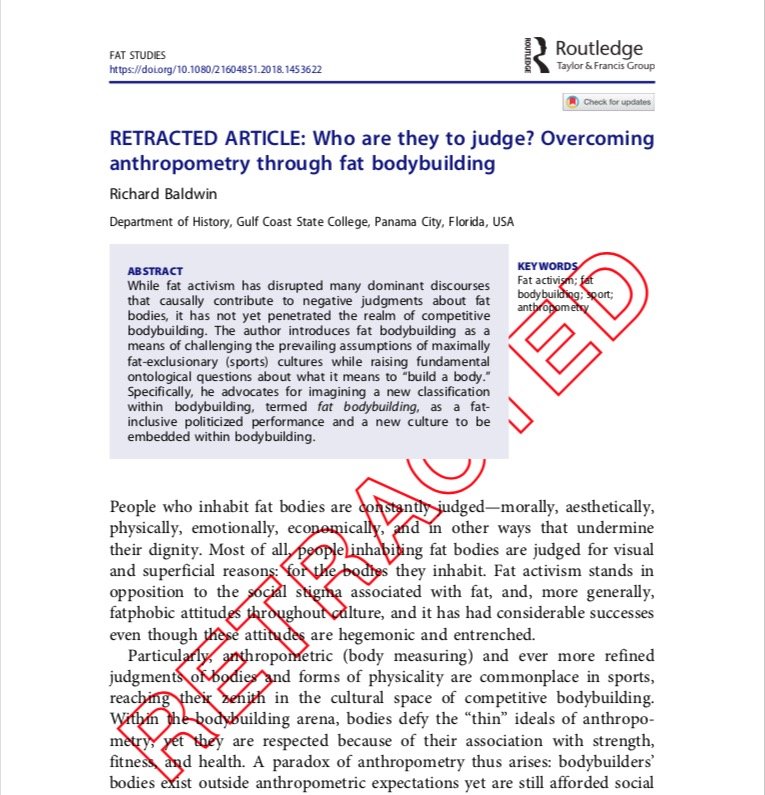
Part of the problem with his hoax as a serious critique is that it began with its conclusion. Cultural studies are rife with crap arguments, ideology, and incomprehensible nonsense, Sokal believed. And so, when his paper was accepted, he simply rested his case, making no effort to engage charitably with good scholarship while he ridiculed the bad. Which brings us to the current state of the academic humanities, and to a contemporary, Sokal-like attack on them by a trio of writers who rest their case on a slightly broader base of evidence—20 fraudulent articles sent out to various niche cultural studies journals over a year: four published (since retracted), three accepted but not published, seven under review, and six rejected.
The authors—academic philosopher Peter Boghossian and writers Helen Pluckrose and James A. Lindsay—revealed the hoax this week in an article published at the Pluckrose-edited Areo magazine. One needn’t read past the title to understand the authors’ take on cultural studies in general: “Academic Grievance Studies and the Corruption of Scholarship.” While all three hoaxers identify as left-leaning liberals, the broad-brush characterization of whole fields as “grievance studies” reveals a prejudicial degree of contempt that seems unwarranted. In the article, they reveal their motivations and methods, outline the successes of the project, and post the comments of the articles’ referees, along with a video of themselves having a good laugh at the whole thing.
This last bit is unnecessary and obnoxious, but does the new hoax—“Sokal Squared” as it’s been called—genuinely undermine the credibility of cultural studies as a whole? Is it “’hilarious and delightful,’” asks Alexander C. Kafka at The Chronicle of Higher Education, or “an ugly example of dishonesty and bad faith?” Harvard political scientist Yascha Mounk tactfully finds in it a serious case for concern: “Some academic emperors—the ones who supposedly have the most to say about these crucial topics [discrimination, racism, sexism]—have no clothes.”
This is a point worth pursuing, and certain recent scandals should give everyone pause to consider how bullying and groupthink manifest on the academic left at the highest level of prestige. But the great majority of academics are not “emperors” and have very little social or economic power. And Mounk is careful not to overstate the case. He points out how the hoax has unfortunately given welcome “ammunition” to right-wing conservative axe-grinders:
Many conservatives who are deeply hostile to the science of climate change, and who dismiss out of hand the studies that attest to deep injustices in our society, are using Sokal Squared to smear all academics as biased culture warriors. The Federalist, a right-wing news and commentary site, went so far as to spread the apparent ideological bias of a few journals in one particular corner of academia to most professors, the mainstream media, and Democrats on the Senate Judiciary Committee.
The Federalist specializes in irresponsible conspiracy-mongering, the kind of thing that sells ads and wins elections but doesn’t belong in academic debate. The question Mounk doesn’t ask is whether the hoaxers’ own attitudes encourage and share in such hostility, an issue raised by several of their critics. As physicist Sean Carroll wrote on Twitter, “What strikes me about stunts like this is their fundamental meanness. No attempt to intellectually engage with ideas you disagree with; just trolling for the lulz.” McGill University political theorist Jacob T. Levy expressed similar reservations in an interview, notes The New York Times, saying
even some colleagues who are not fans of identity-oriented scholarship are looking at the hoax and saying ‘this is potentially unethical and doesn’t show what they think it is showing.’ Besides, he added, “We all recognized that this kind of thing could also be done in our disciplines if people were willing to dedicate a year to do it.”
Therein lies another problem with Sokal Squared. Hoaxes have been perpetuated by smart, dedicated forgers, con-artists, and pranksters in nearly every field, showing up all sorts of experts as potential dupes. The singling out of cultural studies for particular ridicule—the characterization of studies of race, gender, disability, etc. as “grievance studies”—reveals an aggrieved agenda all its own, one that ignores the serious problems corrupting other disciplines (e.g. industry funding in academic sciences, or the gross overuse of undergraduate students as the main subjects of studies—groups that hardly represent the general population.)
Some, but not all, of the successfully-published hoax papers sound ludicrous and terrible. Some, in fact, do not, as Justin Weinberg shows at Daily Nous, and should not shame the editors who published them. Some of the journals have much higher editorial standards than others. (An early hoax attempt by Boghossian targeted an ill-reputed, pay-to-play publication.) The whole affair may speak to broader failures in academic publishing that go beyond a tiny corner of the humanities. In part, those failures may stem from a general trend toward overworked, underpaid, increasingly precarious scholars whose disciplines, and funding, have been under relentless political attack since at least the 1990s and who must keep grinding out publications, sometimes of dubious merit, as part of the overall drive toward sheer productivity as the sole measure of success.
How should you take notes in class? Like so many students who came before me and would come after, I had little idea in college and even less in high school. The inherently ambiguous nature of the note-taking task has inspired a variety of methods and systems, few of them as respected as Cornell Notes. Invented in the 1940s by Cornell University education professor Walter Pauk, author of How to Study in College, Cornell Notes involves dividing each page up into three sections: one to paraphrase the lecture’s main ideas, one to summarize those ideas, and one to write questions. After writing down those main ideas during class, immediately summarize and add questions about the content. Then, while studying later, try to answer those questions without looking at the main body of notes.
You’ll find a complete and concise explanation of how to take Cornell Notes at Cornell’s web site, which includes information on the “Reflect” stage (in which you ask yourself broader questions like “What’s the significance of these facts?” and “What principle are they based on?”) and the “Review” stage (in which you “spend at least ten minutes every week reviewing all your previous notes” to aid retention).
For a more detailed visual explanation, have a look at teacher Jennifer DesRochers’ instructions for how to take Cornell Notes in the video above, which now approaches one million views on Youtube. Her own version encourages taking down main-idea summaries in drawings as well as text, and including things like “key points” and “important people or ideas” in the question column.
That DesRochers’ video now approaches one million views suggests students still find the Cornell Notes system effective, as much as or even more so than they did when Pauk first published it. Over time, of course, its users have also augmented it: take Doug Neill’s video “Improving Cornell Notes With Sketchnoting Techniques” above, which combines standard Cornell Notes with his system of “sketchnoting,” also known as “visual note-taking and graphic recording.”
He provides examples of what such Cornell-formatted sketchnoting might look like, explaining that “having the option of doing something more visual in your mind triggers a different type of processing power, so that you’re more active in the way that you’re responding to the ideas. You’re not just passively taking in information.” The nature of school, as students in every era have known, can often induce a state of passivity; systems like Cornell Notes and its many variations remind us of how much more we can learn if we have a way to break out of it.
If you would like to support the mission of Open Culture, consider making a donation to our site. It’s hard to rely 100% on ads, and your contributions will help us continue providing the best free cultural and educational materials to learners everywhere. You can contribute through PayPal, Patreon, and Venmo (@openculture). Thanks!
Based in Seoul, Colin Marshall writes and broadcasts on cities, language, and culture. His projects include the book The Stateless City: a Walk through 21st-Century Los Angeles and the video series The City in Cinema. Follow him on Twitter at @colinmarshall or on Facebook.
Perhaps one of the most criminally overlooked voices from World War I, Siegfried Sassoon, was, in his time, enormously popular with the British reading public. His war poems, as Margaret B. McDowell writes in the Dictionary of Literary Biography, are “harshly realistic laments or satires” that detail the grisly horrors of trench warfare with unsparingly vivid images and commentary. In lieu of the mass medium of television, and with film still emerging from its infancy, poets like Sassoon and Wilfred Owen served an important function not only as artists but as moving, firsthand documentarians of the war’s physical and emotional ravages.
It is unfortunate that poetry no longer serves this public function. These days, video threatens to eclipse even journalistic writing as a primary means of communication, a development made especially troubling by how easily digital video can be faked or manipulated by the same technologies used to produce blockbuster Hollywood spectacles and video games. But a fascinating new use of that technology, Peter Jackson shows us above, will also soon bring the grainy, indistinct film of the past into new life, giving footage of WWI the kind of startling immediacy still conveyed by Sassoon’s poetry.
Jackson is currently at work on what he describes as “not the usual film that you would expect on the First World War,” and as part of that documentary work, he has digitally enhanced footage from the period, “incredible footage of which the faces of the men just jump out at you. It’s the faces, it’s the people that come to life in this film. It’s the human beings that were actually there, that were thrust into this extraordinary situation that defined their lives in many cases.” In addition to restoring old film, Jackson and his team have combed through about 600 hours of audio interviews with WWI veterans, in order to further communicate “the experience of what it was like to fight in this war” from the point of view of the people who fought it.
The project, commissioned by the Imperial War Museums, “will debut at the BFI London Film Festival later this year,” reports The Independent, “later airing on BBC One. A copy of the film will also be given to every secondary school in the country for the 2018 autumn term.” No word yet on where the film can be seen outside the UK, but you can check the site 1418now.org.uk for release details. In the meanwhile, consider picking up some of the work of Siegfried Sassoon, whom critic Peter Levi once described as “one of the few poets of his generation we are really unable to do without.”
Learn more about the war at the free course offerings below.
FYI: If you sign up for a MasterClass course by clicking on the affiliate links in this post, Open Culture will receive a small fee that helps support our operation.
The problem of dystopian fiction is this: quite often the worst future creative writers can imagine is exactly the kind of present that has already been inflicted on others—by colonialism, dictatorship, genocidal war, slavery, theocracy, abject poverty, environmental degradation, etc. Millions all over the world have suffered under these conditions, but many readers fail to recognize dystopian novels as depicting existing evils because they happen, or have happened, to people far away in space and time. Of course, Margaret Atwood understands this principle. The nightmares she has written about in novels like The Handmaid’s Talehave all already come to pass, she tells us.
In the promo video above for her Masterclass on Creative Writing starting this fall (it’s now open), Atwood says, “when I wrote The Handmaid’s Tale, nothing went into it that had not happened in real life somewhere at some time. The reason I made that rule is that I didn’t want anybody saying, ‘You certainly have an evil imagination, you made up all these bad things.’” And yet, she says, “I didn’t make them up.” In a Swiftian way, she implies, we did—“we” being humanity writ large, or, perhaps more accurately, the destructive, greedy, power-mad individuals who wreak havoc on the lives of those they deem inferiors or rightful property.
“As a writer,” she says above, “your goal is to keep your reader believing, even though both of you know it’s fiction.” Atwood’s trick to achieving this is a devious one in what we might call sci-fi or dark fantasy (though she spurns these designations): she writes not only what she knows to be true, in some sense, but also what we know to be true, though we would rather it not be, as in Virginia Woolf’s characterization of fiction as “as spider’s web, attached ever so lightly perhaps, but still attached to life at all four corners.”
Atwood says that writers turn away from the blank page because they fear something. She has made it her business, instead, to turn toward fear, to see dark visions like those of her MaddAddam Trilogy, an extrapolation of horrors already happening, in some form, somewhere in the world (and soon to be a fun-filled TV series). What she feared in 1984, the year she began writing The Handmaid’s Tale, seems just as chillingly prescient to many readers—and viewers of the TV adaptation—thirty-four years later, a testament to Atwood’s speculative realism, and to the awful, stubborn resistance reality puts up to improvement.
As she put it in an essay about the novel’s origins, “Nations never build apparently radical forms of government on foundations that aren’t there already.” The same, perhaps, might be said of novelists. Do you have some truths to tell in fictional form? Maybe Atwood is the perfect guide to help you write them.
You can take this class by signing up for a MasterClass’ All Access Pass. The AllAccessPass will give you instant access to this course and 85 others for a 12-month period.
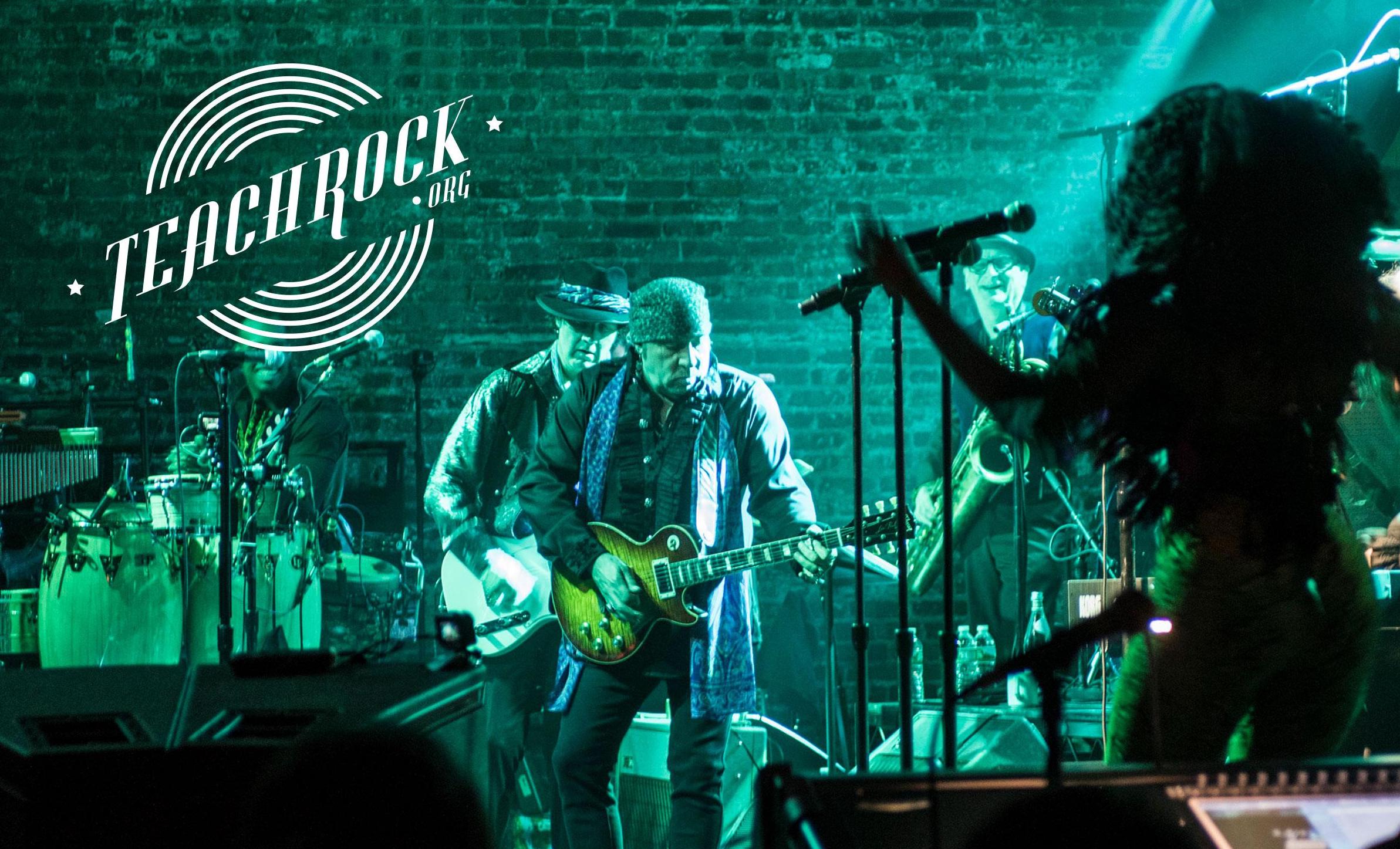
When I think of rock ‘n’ roll high school, I think of the Ramones, but in the 1979 Roger Corman film no one really learns much. In reality, however, another legendary musician, still going strong after five decades in the business, has put his cred to serious use, leveraging stardom as a musician and actor to create a music curriculum teachers can use for free, with lessons on rock history, Native American politics, Bob Dylan’s poetry, immigration and the blues, civil disobedience, the fight to end Apartheid, and much more. That man is Steven Van Zandt—aka Little Steven of the E Street Band, or Silvio Dante of The Sopranos, or Frank Tagliano of Lilyhammer, or a few other aliases and fictional characters.
“For the past decade,” writes John Seabrook at The New Yorker, the bandana-clad guitarist has been “working on a way to recreate” a “dynamic, out-of-school learning experience inside classrooms, through his Rock and Roll Forever Foundation.” Working, that is, to recreate his own experience as a disaffected youth who “had no interest in school whatsoever,” he recalls. What interested him was music: the Beatles, at first, but as he learned more about them, he picked up “bits of information” about Eastern religion and orchestration. He learned about literature from Dylan.
“You didn’t get into it to learn things,” he says, “but you learn things anyway.” At least if you’re as curious and open-minded as Van Zandt, who came to value education through his non-traditional course. Over ten years ago, when the National Association for Music Education told him that “No Child Left Behind legislation was really devastating art classes,” he confronted Ted Kennedy and Mitch McConnell, telling them, “did you ever hear that every kid who takes music class does better in math and science?” They apologized,” he says, “but they said they weren’t going to fix it.”
So Van Zandt decided to do it himself with a program called TeachRock. Working with two ethnomusicologists, he built the curriculum to connect with kids through music. “Instead of telling the kid, ‘Take the iPod out of your ears,’” he told a crowd of teachers gathered at Times Square’s Playstation Theater in May, “we ask them, ‘What are you listening to?’” Van Zandt calls his curriculum “teaching in the present tense,” and while his own back catalog may not necessarily be streaming on kids’ current playlists, he incorporates not only his music and the fifties and sixties rock ‘n’ roll he loves, but also hip-hop, pop, punk, and the “Latin rhythms of ‘Despacito.’” He even uses Beyoncé’s “Single Ladies” video to prompt a discussion on the slave trade.
The focus on popular music as a force for change is fully in keeping with Van Zandt’s own path. His self-education led him into activism in the 80s when he wrote and recorded “Sun City” with 50 other artists to protest South African Apartheid. Unlike some other benefit songs of the time (like the cringe-inducing “Do They Know It’s Christmas”), “Sun City,” with its accompanying video (above), took effective political action—a blanket boycott of the Sun City resort—and didn’t sugar-coat the issues one bit (“relocation to phony homelands/separation of families, I can’t understand”). The Sun City boycott gets its own module.
As Van Zandt told Fast Company in 2015, “I had been researching American foreign policy post-World War II just to educate myself, which I had never done, being obsessed with rock ‘n’ roll my whole life. I was quite shocked to find that we were not always the good guys.” His discoveries compelled him to visit South Africa and to “dedicate my five-record solo career to that learning process, and also combine a bit of journalism with the rock art form.” That same passion for justice informs all of the TeachRock lessons, which you can browse and download for free at the TeachRock site. The multi-media units incorporate video, audio, images, activities, informative handouts, and other resources.
Each lesson also explains how its objectives meet Common Core State Standards (or the state standards of New Jersey and Texas). “TeachRock is rooted in a teaching philosophy that believes students learn best when they truly connect with the material to which they’re introduced,” notes the site’s “Welcome Teachers” page. “Obviously, popular music is one such point of connection.” Perhaps not every kid who learns through music as Van Zandt did will go out and try to change the world, but they’re more than likely to stay engaged and stay in school. And that’s exactly what he hopes to accomplish.
“Teaching kids something they’re not interested in,” he told the teachers in New York, “it didn’t work then, and it’s even worse now. We have an epidemic dropout rate.” Then, in his refreshingly honest way, he concluded, “Where are we going to be in twenty years? How are we going to get smarter looking at this Administration? You know, we’re just getting stupider.” Not if Little Steven has anything to say about it. He’s currently on tour with his Disciples of Soul, and offering free tickets to teachers, provided they show up early for a TeachRock workshop. Sign up here!
We're hoping to rely on loyal readers, rather than erratic ads. Please click the Donate button and support Open Culture. You can use Paypal, Venmo, Patreon, even Crypto! We thank you!
Open Culture scours the web for the best educational media. We find the free courses and audio books you need, the language lessons & educational videos you want, and plenty of enlightenment in between.