Werner Herzog is the wild man of cinema. His movies are stark and elemental and ecstatic and are usually about a crazed dreamer who struggles to achieve an impossible task in the face of a chaotic, indifferent universe. Think Aguirre, Wrath of God, about a conquistador who goes crazy while adrift along an Amazonian river. Think Stroszek, about a German grifter who goes mental in the forbidding landscape of Wisconsin while struggling to find the American dream. That film famously, inexplicably, ends with shots of a dancing chicken.
The ecstatic truths seen in his movies are reflected in the man himself. At the age of 14, Herzog struck out from his native Germany for Albania and then Sudan. In 1972, he once walked from Munich to Paris to visit an ailing friend. In 1977, he shot footage at the lip of a volcano at the brink of eruption. He’s a filmmaker who seems to go out of his way to choose locations that are remote and difficult — Antarctica, the Sahara and the Amazonian rain forest — and his shoots always seem to be bedeviled by intrigue and catastrophe. His first feature was nearly derailed because of a coup d’état. While shooting Fata Morgana in Cameroon, he was mistaken for a wanted criminal and thrown in jail. Once during a TV interview in the hills of Los Angeles, he was shot by a random crazy person. Watch it here.
“A BBC television crew came to see me in Laurel Canyon,” as he recounted for The New Yorker. “They wanted to interview me for the British première of ‘Grizzly Man.’ I didn’t want them to film right outside my house, so we went up to Skyline Drive. In the middle of the interview, I was shot with a rifle by someone standing on his balcony. I seem to attract the clinically insane.”
Instead of stopping the interview, running for protection and perhaps going to the hospital, Herzog just continued with the interview saying simply, “It was not a significant bullet. I am not afraid.”
Herzog’s improbable penchant for disaster, his collaboration with the brilliant, but batshit crazy, Klaus Kinski, and of course, his singular, uncompromising work have turned him into almost a mythic figure in some circles. But it’s these mad, macho declarations like those above that have really fed the cult of Herzog.
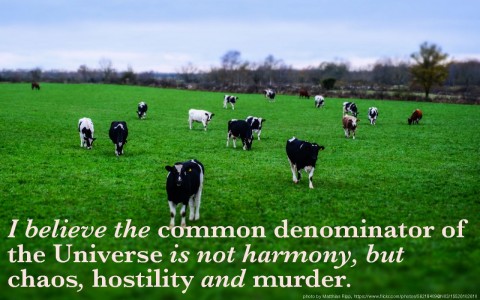
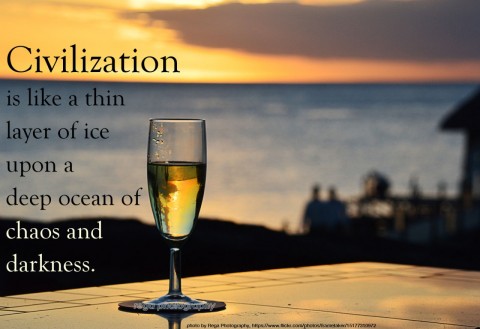
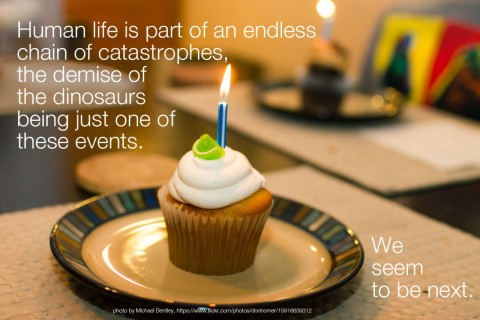
Recently, some unknown genius turned some of Herzog’s more extreme quotations into inspirational posters. Lines like “Civilization is like a thin layer of ice upon a deep ocean of chaos and darkness” are placed along side a shot of a glass of white wine and a sunset.
So gaze upon them. Absorb the pearls of wisdom. Find cold comfort in their bleak, nihilist pronouncements. They make fine additions to any cubicle.
Jonathan Crow is a Los Angeles-based writer and filmmaker whose work has appeared in Yahoo!, The Hollywood Reporter, and other publications. You can follow him at @jonccrow. And check out his blog Veeptopus, featuring lots of pictures of badgers and even more pictures of vice presidents with octopuses on their heads. The Veeptopus store is here.
When we get deep enough into our enthusiasm for film, cinephiles start speculating in ways that might strike non-cinephiles as, well, unusual. The video essayist koganada, for example, states in the video above his desire to “build a time machine and travel to Italy circa 1952” and “ask Vittorio de Sica to make a film using Hollywood actors like Montgomery Clift and Jennifer Jones, and then team de Sica up with a Hollywood producer, the kind that likes to impose his will and sensibility onto a film — someone like David O. Selznick. In bringing these two worlds of cinema together, I’d hope for a clash in cinema so great that it would result in two cuts of the same film, one by de Sica and the other by Selznick.”
This may sound like the speculation of a fanboy, albeit a highbrow fanboy, but you can hardly call it idle speculation. This video essay, as you can see, actually manages to screen, side-by-side, scenes from what really do look like two different versions of the same early-1950s film, one cut in the classic Hollywood style, and one cut in the Italian neorealist style. This “experiment” in cinema illuminates the rhythms, emphases, and values of both kinds of filmmaking, adding nuance to the conception of one as clear-eyed, methodical, and uncompromising, and the other as idealized, flamboyant, and crowd-pleasing.
So has kogonada actually built this time machine and commissioned two cuts of the same picture from the director of Bicycle Thieves and the producer of Gone with the Wind? Not quite, but film history has provided him with the next best thing: 1954’s Terminal Station and The Indiscretion of an American Wife. De Sica “was one of the world’s most celebrated filmmakers when David O. Selznick commissioned TerminalStation from him and his screenwriting partner, Cesare Zavattini,” writes critic Dave Kehr in a Criterion Collection essay. But the production soon hit some serious snags. Criterion goes on to add:
The troubled collaboration between director Vittorio De Sica and producer David O. Selznick resulted in two cuts of the same film. De Sica’s version, Terminal Station, was screened at a length of one-and-a-half hours, but after disappointing previews, Selznick severely re-edited it and changed the title to Indiscretion of an American Wife without De Sica’s permission.
Though Kehr finds de Sica’s take on the material “immeasurably superior” to Selznick’s, he adds that “both have quite distinct emotional and dramatic qualities, and it is fascinating to see how identical material can be pushed and pulled, wholly through the postproduction process, in two radically different directions.” Even casual cinephiles stand to learn a lot from a back-to-back viewing of Terminal Station and The Indiscretion of an American Wife, but only in this video essay’s five minutes can we see them so carefully compared and contrasted side-by-side. Briefly but densely, it reveals to us the nature of both classic Hollywood and Italian neorealism — no time travel required.
It’s not my favorite Marlene Dietrich gem on the internet. No, that would be her temperamental screen test for The Blue Angel (1930). But it’s still a precious find. Above, we have an audio clip featuring Dietrich, one of the towering movie stars of early cinema, playing the musical saw. Andrea James writes over at BoingBoing: “Dietrich always wanted to be a classical musician. Since her cabaret act and film career left little time for her to do the required practice, she played the musical saw instead. Throughout World War II she wowed USO audiences with the novelty.” And that’s what we get a taste of here. In other clips available on Youtube, you can find Dietrich playing her “singing saw,” and again playing the musical saw on the radio, circa 1945.
Last month, we featured Every Frame a Painting, Tony Zhou’s series of video essays examining the filmmaking techniques of directors like Martin Scorsese, Edgar Wright, Steven Spielberg, and David Fincher. His newest piece looks at just one element of just one scene, but one directed by one of the highest figures, if not the highest figure, in the cinematic pantheon: Akira Kurosawa. Zhou, as any cinephile might expect, has a full-length examination of “the Emperor” of Japanese film in the works, but for now he’s put out a short video essay on the geometry of a couple minutes from The Bad Sleep Well (1960).
That 1960 release, a non-period piece not quite as well known as Kurosawa films like Seven Samurai, Rashomon, and Kagemusha, tells a Hamlet-like tale against the cultural backdrop of postwar Japanese corporate corruption.
Despite its non-epic nature, it has drawn my own attention again and again over the years, just as it seems to have drawn Zhou’s. Here, he uses it to illustrate Kurosawa’s penchant for constructing scenes not out of, as Hitchcock once put it, “photographs of people talking” — a dull practice that more than persists on screens today — but out of geometrical shapes.
You might like to compare this brief study of Kurosawa’s geometry with video essayist Kogonada’s look at the geometry of Wes Anderson’s movies. Just as you can’t watch the Every Frame a Painting mini-episode on The Bad Sleep Well without looking for shapes in the next Kurosawa pictures you watch, you can’t watch “Centered” without drawing a mental line down the center of your next screening of Bottle Rocket, Rushmore, The Royal Tenenbaums, or their Andersonian successors. Zhou says he feels bored when subjected to the undisciplined visual composition in most major films, but here we have two filmmakers one can always rely on for the antidote.
It was 1967, and David Lynch, a student at the Pennsylvania Academy of the Fine Arts, was up late in his studio when he had a vision. The plants in the painting he was working on seemed to be moving. “I’m looking at this and hearing this,” he recalled, “and I say, ‘Oh, a moving painting.’ And that was it.”
That thunderbolt of an idea put him on the road towards creating some of the most unsettling and surreal images in cinema from the dancing dream dwarf in Twin Peaks to those freaky little people in Mulholland Drive. His first step was the multimedia work “Six Men Getting Sick” – a large-scale work consisting of painting, sculpture and a one-minute film loop, Lynch’s first foray into film. His subsequent early film work, from The Grandmother to Eraserhead, feels like an extension of his fine art work. “As a painter, you do everything yourself, and I thought cinema was that way,” Lynch said, “like a painting, but you have people helping you.” Of course, by the time he made his big budget dud Dune, he was thoroughly disabused of that notion.
Yet while becoming one of Hollywood’s most influential directors, he continued to paint. Last year his alma mater unveiled a retrospective of his artwork from 1965 to the present called “David Lynch: The Unified Field.” Much of the work is from the late-90s on, a time when Lynch found himself detaching more and more from Hollywood. His last feature film, Inland Empire, came out in 2006. Apparently, he was spending much of his free time in the studio.
David Lynch
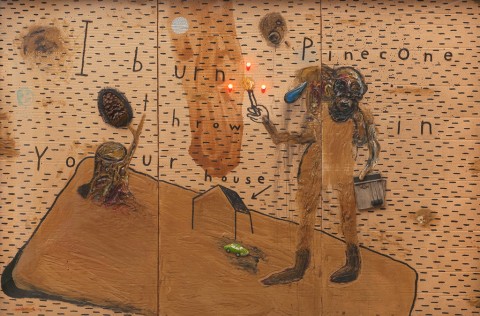
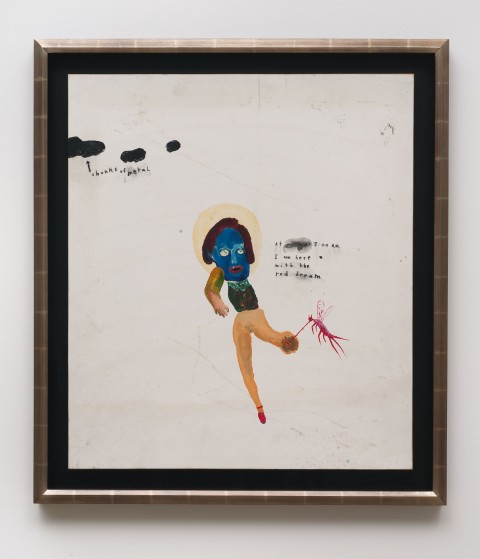
His work during this period is intentionally crude and childlike, combining cartoonish images with pregnant, semi-intelligible text. Sure, his paintings don’t have the primal, psychosexual power of his movies, but there is still something compelling about them. Take, for insistence, the multimedia work “I Burn Pinecone and throw it in your house” (top). It looks like a demented children’s book narrated by a crazed mountain man.
“At 3 A.M. I Am Here With The Red Dream” (middle) looks like the product of a mental patient, complete with smudged out text and Henry Darger-esque girl legs.
David Lynch
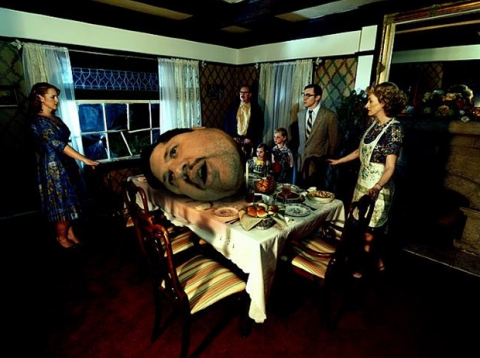
Of course, Lynch didn’t restrict himself to painting. He has also worked in digital photography. In his 2009 work, Untitled (Grim Augury #1), (bottom) Lynch depicts a Sunday dinner gone horribly, inexplicably, wrong.
Jonathan Crow is a Los Angeles-based writer and filmmaker whose work has appeared in Yahoo!, The Hollywood Reporter, and other publications. You can follow him at @jonccrow. And check out his blog Veeptopus, featuring lots of pictures of badgers and even more pictures of vice presidents with octopuses on their heads. The Veeptopus store is here.
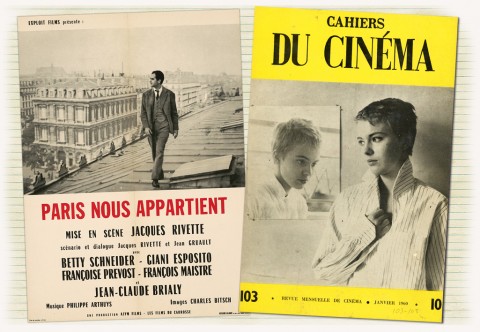
It’s hard to overstate the impact of Cahiers du cinéma on film history.
In the early ‘50s, the great critic André Bazin led a small coterie of film fanatics – guys with names like Jean-Luc Godard, François Truffaut, Eric Rohmer and Jacques Rivette — who hung out at the Cinémathèque française. Theaters were flooded with Hollywood movies, really for the first time since the beginning of World War II, and this group took the opportunity to watch anything they could get their hands on, from high brow art films to cut rate Westerns. They would watch anything.
In 1951, Bazin founded Cahiers and this band of cinematic outsiders became famously brutal and uncompromising iconoclasts. They praised lowly genre films – film noir especially – as masterpieces while slamming the middlebrow flicks the French film industry was cranking out at the time. Truffaut was famous for being particularly harsh, earning the moniker “The Gravedigger of French Cinema.” His reviews were so acerbic that he was the only French film critic not invited to cover the 1958 Cannes Film Festival. (The fact that he then turned around and won the fest’s top prize the next year for his masterpiece 400 Blows might be one of the greatest feats of badassery in cinema history.)
Perhaps the Cahiers’ greatest contribution was an article, written by Truffaut in 1954, called “A Certain Tendency of the French Cinema,” which was a manifesto for what would later be called auteur theory – an idea that certain directors have such a command of the medium that they impress their individual vision on a film, in the same way an author does to a book. This idea has been so completely absorbed into popular consciousness that it’s hard to see just how revolutionary it was at the time. Before Cahiers, people generally thought about movies in terms of the stars, not the director. Most would refer to Rear Window, say, as a Jimmy Stewart movie, not an Alfred Hitchcock film. The concept resulted in a basic reordering in the way filmmakers thought about their art.
Truffaut and company obsessed with filmmakers they considered auteurs. Their top 10 list for 1955, the year after “A Certain Tendency” was published, shows who in particular they considered auteurs – art house icons (Carl Dreyer and Roberto Rossellini), Hollywood renegades (Robert Aldrich and Nicholas Ray) and, of course, Hitchcock.
1955 1. Voyage To Italy (Roberto Rossellini) 2. Ordet (Carl Dreyer) 3. The Big Knife (Robert Aldrich) 4. Lola Montes (Max Ophuls) 5. Rear Window (Alfred Hitchcock) 6. Les Mauvais Recontres (Alexandre Astruc) 7. La Strada (Federico Fellini) 8. The Barefoot Contessa (Joseph L. Mankiewicz) 9. Johnny Guitar (Nicholas Ray) 10. Kiss Me Deadly (Robert Aldrich)
1960 was the year that seemingly the entire editorial staff at Cahiers du cinéma took camera in hand and became filmmakers, launching the French New Wave. Truffaut’s 400 Blows in 1959 was followed up by Chabrol’s Les Bonnes Femmes and Godard’s groundbreaking assault on cinematic form, Breathless. Yet for their top 10 list, Cahiers put Japanese master Kenji Mizoguchi’s Sansho the Bailiff at the top. Hitchcock also makes the list, number 9, with a little film called Psycho.
1960 1. Sansho The Bailiff (Kenji Mizoguchi) 2. L’avventura (Michaelangelo Antonioni) 3. Breathless (Jean-Luc Godard) 4. Shoot The Piano Player (François Truffaut) 5. Poem Of The Sea (Alexander Dovzhenko/Julia Solntesva) 6. Les Bonnes Femmes (Claude Chabrol) 7. Nazarin (Luis Buñuel) 8. Moonfleet (Fritz Lang) 9. Psycho (Alfred Hitchcock) 10. Le Trou (Jacques Becker)
Starting from 1968 until the late-70s, the journal became a Maoist collective and renounced bourgeois concepts like “best of” lists, narrative cinema and, y’know, fun. But in the early ‘80s, Cahiers shifted its editorial focus back to the world of commercial film. They lauded movies by Nouvelle Vague veterans like Godard and Rohmer, film festival darlings like Hou Hsiao Hsien and, to a perverse degree, Clint Eastwood. You can see all of Cahiers du cinéma’s top 10 lists here, including the most recent list for 2014 here.
Jonathan Crow is a Los Angeles-based writer and filmmaker whose work has appeared in Yahoo!, The Hollywood Reporter, and other publications. You can follow him at @jonccrow. And check out his blog Veeptopus, featuring lots of pictures of badgers and even more pictures of vice presidents with octopuses on their heads. The Veeptopus store is here.
Ah, the joys of dining at a new friend’s home, knowing sooner or later, one’s hostess’ bladder or some bit of last minute meal preparation will dictate that one will be left alone to rifle the titles on her bookshelf with abandon. No medicine cabinet can compete with this peek into the psyche.
Pity that some of the people whose bookshelves I’d be most curious to see are the least likely to open their homes to me. That’s why I’d like to thank The Strand bookstore for providing a virtual peek at the shelves of filmmakers-cum-authors Miranda July and Lena Dunham. (Previous participants in the Authors Bookshelf series include just-plain-regular authors George Saunders, Edwidge Danticat and the late David Foster Wallace whose contributions were selected by biographer D.T. Max.)
I wish Dunham and July had offered up some personal commentary to explain their hand-picked titles. (Surely their homes are lined with books. Surely each list is but a representative sampling, one shelf from hundreds. Hmm. Interesting. Did they run back and forth between various rooms, curating with a vengeance, or is this a case of whatever happened to be in the case closest at hand when deadline loomed?)
Which book’s a longtime favorite?
Which the literary equivalent of comfort food?
Are there things that only made the cut because the author is a friend?
Both women are celebrated storytellers. Surely, there are stories here beyond the ones contained between two covers.
But no matter. The lack of accompanying anecdotes means we now have the fun of inventing imaginary dinner parties:
ME: (flustered) Oh, ha ha, yes! Alex! … I sent him a Facebook request and he accepted.
LENA DUNHAM: (mutters under her breath)
ME: Design Sponge? Really? What’s someone in your shoes doing with a bunch of DIY decorating books?
LENA DUNHAM: (coldly) Research.
Actually, maybe it is better to admire one’s idols’ bookshelves from afar.
I’m chagrined that I don’t recognize more of their modern fiction picks. That wasn’t such a problem when I was measuring myself against the 430 books on Marilyn Monroe’s reading list.
Thank heaven for old standbys like Madame Bovary.
In all sincerity, I was glad that Dunham didn’t try to mask her love of home decor blog books.
One’s shelves, after all, are a matter of taste. So, celebrate the similarities, take their recommendations under advisement, see below and read what you like!
The Girls’ Guide to Hunting and Fishing — Melissa Bank
A Little History of the World — E. H. Gombrich
Anne of Green Gables — L.M. Montgomery
Apartment Therapy Presents: Real Homes, Real People, Hundreds of Real Design Solutions — Maxwell Gillingham-Ryan
Ariel: The Restored Edition — Sylvia Plath
Bad Feminist: Essays — Roxane Gay
Bastard Out of Carolina (20th Anniversary Edition) — Dorothy Allison
Blue is the Warmest Color — Julie Maroh
Brighton Rock — Graham Greene
Cavedweller - Dorothy Allison
Country Girl: A Memoir — Edna O’Brien
Crazy Salad and Scribble Scribble: Some Things About Women and Notes on Media — Nora Ephron
Design Sponge at Home — Grace Bonney
Dinner: A Love Story: It All Begins at the Family Table — Jenny Rosenstrach
Eleanor & Park — Rainbow Rowell
Eloise — Kay Thompson
Eloise In Moscow — Kay Thompson
Eloise In Paris — Kay Thompson
Fanny At Chez Panisse — Alice Waters
Goodbye, Columbus and Five Short Stories — Philip Roth
Holidays on Ice — David Sedaris
Important Artifacts and Personal Property from the Collection of Lenore Doolan and Harold Morris, Including Books, Street Fashion, and Jewelry — Leanne Shapton
Lentil — Robert McCloskey
Love Poems — Nikki Giovanni
Love, an Index (McSweeney’s Poetry Series) — Rebecca Lindenberg
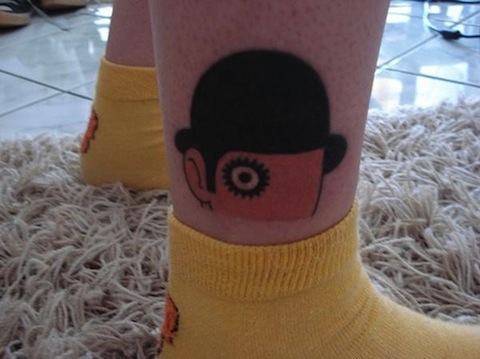
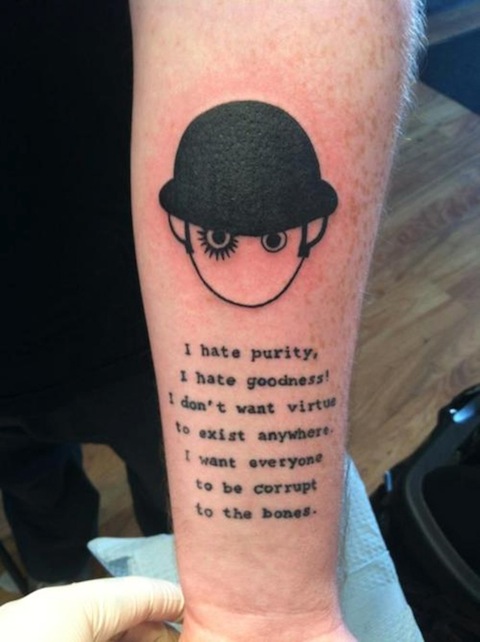
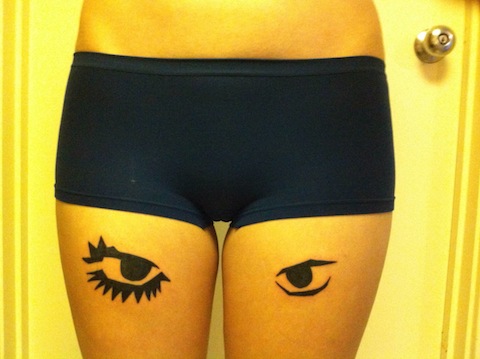
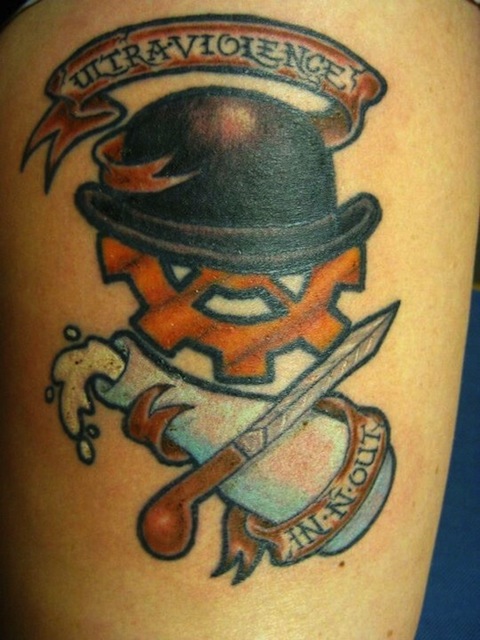
Alex, the protagonist of Anthony Burgess’ A Clockwork Orange takes teenage rebellion to psychotic extremes, but one act he and hisdroogs never indulge in is getting tattooed. It doesn’t even seem to be on their radar. How different things were in 1962, when the book was published!
It’s also just one of many Clockwork Orange-inspired images that decorates fans’ hides now that tattooing has hit the mainstream. What would Alex think?
The little monster’s ego would’ve have relished the notoriety, but I bet he’d have had a snicker, too, at the lengths to which eager chellovecks and devotchkas will go. It’s the kind of thing his dim droogie Dim would do—mark himself up permanent when he could’ve just as well have bought a totebag.
Whether or not you personally would consider making a salute to A Clockwork Orange a lifelong feature of your birthday suit, it’s hard not to admire the commitment of the passionate literature and film lovers who do.
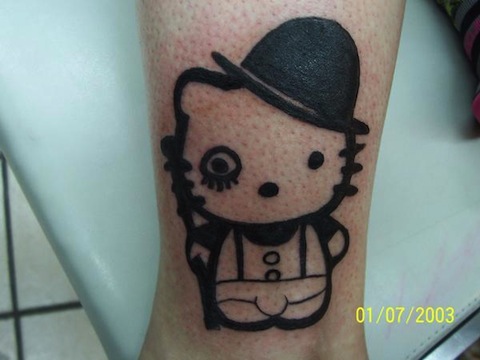
In assembling the gallery below, we’ve opted to forgo the photorealistic portraits of McDowell—particularly the ones that recreate the aversion therapy scene—in favor of the graphic, the creative, the jaw dropping, the sly… and the unavoidable Hello Kitty mash up, which we’re kind of hoping washes off.
We're hoping to rely on loyal readers, rather than erratic ads. Please click the Donate button and support Open Culture. You can use Paypal, Venmo, Patreon, even Crypto! We thank you!
Open Culture scours the web for the best educational media. We find the free courses and audio books you need, the language lessons & educational videos you want, and plenty of enlightenment in between.