We don’t often think of the Beats as family men, and that’s because the most prominent of them weren’t, except William Burroughs for a time (a tragic story or two for another day). But friends of Ginsberg and Kerouac like Lucien and Francesca Carr and Robert and Mary Frank brought children into the poets’ lives, and you can see them all above, relaxing at the Harmony Bar & Restaurant in New York’s East Village in 1959.
This rare silent footage unites the three Carr and two Frank children in a rare appearance of the Beats together on film. The mustachioed Lucien Carr —a character with his own dark story—can be seen seated next to Kerouac. The Franks, père and mère, were both artists in their own right—London-born Mary a trained dancer, sculptor, and painter, and Robert an important American photographer and documentary filmmaker.
Dangerous Minds speculates that it’s Robert Frank behind the camera, both because we don’t see him in front of it and because Frank would that same year direct the short film Pull My Daisy (above), featuring both Ginsberg and Kerouac and adapted from Kerouac’s play Beat Generation. (Frank apparently denies he shot the footage at the top). Pull My Daisy also includes famous Beats like Gregory Corso, musician David Amram, and Ginsberg’s partner, poet Peter Orlovsky. In a previous post on that film, Open Culture’s Colin Marshall described it as crafted with “great deliberateness, albeit the kind of deliberateness meant to create the impression of thrown-together, ramshackle spontaneity.”
To learn more about the Beats’ appearances on film—as themselves, in character, and through their adapted work, see this excellent filmography. And just above, watch a mash-up of most of those various cinematic appearances in a trailer produced by Cinefamily for the IFC and Sundance series “Beats on Film.”
If Peter Shukoff and Lloyd Ahlquist, the makers of Epic Rap Battles of History refuse to say, I will: neither of them.
Instead, it is action director Michael Bay (as embodied by a bewigged Shukoff), who emerges victorious, dropping into the proceedings via helicopter, to spit that moviemaking is all about the “motherfuc&in’ money”! Artistically, he may not have much currency, but there’s no arguing that the Transformers franchise has indeed endowed him with the “socks made of silk money.”
It’s vulgar, and NSFW sans headphones, but as legions of adolescent boys will passionately attest, it has its moments. Watching the behind the scenes, below, reminded me of all the planning that went into this episode, from special effects make up to research and green screen. If the end result is not quite to your taste, at least you can rest assured that it’s by design.
The common conception of New Year’s resolutions frames them as disposable ideals, not to be taken too seriously or followed through past the first few months of winter; by spring, we all assume, we’ll be right back to our slothful, gluttonous ways. Perhaps the problem lies in the way we approach this yearly ritual. Lists of the most common resolutions tend towards the almost shockingly banal, such that most people’s desires for change are interchangeable with their friends and neighbors and might as well be scripted by greeting card companies. I’d hazard it’s impossible to be passionate about half-thoughts and boilerplate ambition.
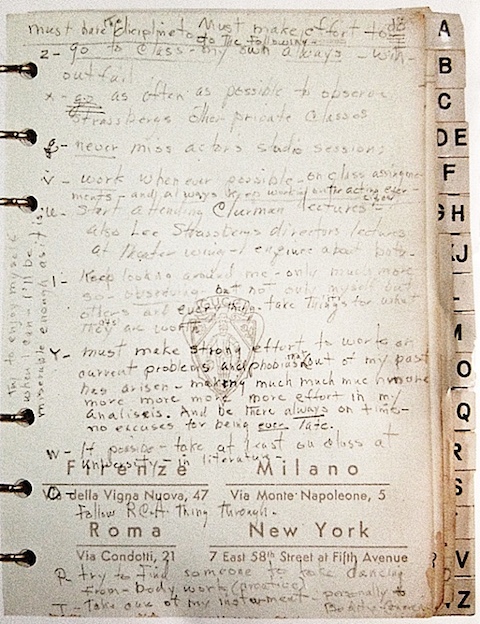
But there are those few people who really pour their hearts into it, creating lists so individualized and authentic that the documents expose their inner lives, their hopes, fears, loves, struggles, and deep, personal yearnings and aspirations. One such list that circulates often, and which we featured last year, is this gem from Woody Guthrie circa 1943. It’s so completely him, so much in his voice, that no one else could have written it, even in parody. This year, we direct your attention to the list above, from Marilyn Monroe, written at the end of 1955 when the star was 29.
Already well-known for her acting in such fine films as All About Eve, Gentlemen Prefer Blondes, and The Seven Year Itch, Monroe had recently been accepted to Lee Strasberg’s Actors Studio. As Lists of Note puts it, “judging by this list, she was determined to make the most of her opportunities.” I’m not sure what to make of the odd use of random letters at the beginning of each resolution, but what the list does offer us is a glimpse into Monroe’s deep commitment—despite her feeling that her life was “miserable”—to growing and developing as an actor and a person.
See a full transcript of her list of resolutions below.
Must make effort to do
Must have the dicipline to do the following –
z – go to class – my own always – without fail
x – go as often as possible to observe Strassberg’s other private classes
g – never miss actor’s studio sessions
v – work whenever possible – on class assignments – and always keep working on the acting exercises
u – start attending Clurman lectures – also Lee Strassberg’s directors lectures at theater wing – enquire about both
l – keep looking around me – only much more so – observing – but not only myself but others and everything – take things (it) for what they (it’s) are worth
y – must make strong effort to work on current problems and phobias that out of my past has arisen – making much much much more more more more more effort in my analisis. And be there always on time – no excuses for being ever late.
w – if possible – take at least one class at university – in literature –
o – follow RCA thing through.
p – try to find someone to take dancing from – body work (creative)
t – take care of my instrument – personally & bodily (exercise)
try to enjoy myself when I can – I’ll be miserable enough as it is.
What do movies like Blade Runner, Her, Drive, and Repo Man, separated by the years and even more so by their sensibilities, have in common? All come from auteur directors, all have accumulated considerable fan followings, and all have styles all their own. But to my mind, one important quality unites them more than any other: all take place in Los Angeles. What’s more, all take place in a distinctive vision of Los Angeles, that most photographed but least understood city in the world. Every feature film that uses Los Angeles as something more than a backdrop, whether it tries to represent or reimagine it, also acts as an accidental documentary of the city: of its built environment, of its people, of the ever-shifting ideas we have of it.
?si=K9lV4aUGTMqE94YA
On that premise, I created Los Angeles, the City in Cinema, a series of video essays meant to examine the variety of Los Angeleses revealed in the films set there, both those new and old, mainstream and obscure, respectable and schlocky, appealing and unappealing — just like the contradictory characteristics of the city itself. At the top of the post, you can watch my episode on Blade Runner, Ridley Scott’s 1982 proto-cyberpunk future noir that remains, to this day, the popular idea of the Los Angeles of the future (as evidenced by the pejorative currency of the term “Blade Runner-ization” among NIMBYs): denser, darker, thoroughly Asianized, and taken back to a third-world industrial phase it never really passed through in the first place.
?si=esjTBpRSqjHa81eC
But more recently, a competing vision of Los Angeles’ future emerged in the form of Her, Spike Jonze’s tale of a mustachioed, ukulele-playing milquetoast who falls in love with a sentient computer operating system. He does so in the high-rises and high-speed trains of, by comparison to Blade Runner, a glossier, gentler, future Los Angeles not only free of killer android replicants but — even more surprisingly to many an Angeleno — free of cars. My video essay on Her compares and contrasts Scott and Jonze’s ideas of what lies ahead for the city: would you rather live in the former’s Los Angeles, hybridized with a grittier, less orderly Tokyo, or the latter’s, hybridized with a sanitized Shanghai?
Nicolas Winding Refn’s Drive gave us a new take on the old tradition of European filmmakers examining Los Angeles with a kind of perplexed fascination, as previously exemplified by John Boorman’s Point Blank, Jacques Deray’s The Outside Man, and Jacques Demy’s Model Shop. English cult director Alex Cox added his own rough-edged volume to that shelf with1984’s sci-fi punk favorite Repo Man. In 2000, Cox’s countryman Mike Figgis pulled off his real-time, four-screen experiment Timecode on the Sunset Strip, not far from the strip club where John Cassavetes set much of The Killing of a Chinese Bookie more than twenty years earlier. You can find video essays on these movies and others on the list of those I’ve produced so far:
New videos, including episodes on this year’s solid Los Angeles pictures, Nightcrawler and the Thomas Pynchon adaptation Inherent Vice, will appear regularly. If you live anywhere near Portland, Oregon, note that I’ll give a talk and screening there entitled “Los Angeles and Portland: The Cities in Cinema” at the Hollywood Theatre, featuring never-before-seen video essays on both Los Angeles and Portland films, on January 25, 2015. Keep an eye on their site for details.
They’ve even become friends, ones close enough that Lynch just calls Moby “Mo,” and Moby once gave Lynch a slide guitar as a present. They’ve got such a rapport, in fact, that Moby can ask Lynch, leadingly and admittedly so, if Lynch considers that slide guitar the best present he ever received. He asks it, in fact, right up there onstage at the IMS, along with such other questions, pre-written on a sheet, as “Have you ever grown maggots?,” “Is Inland Empire my favorite movie of the last ten years?,” “What would your favorite birthday meal be, keeping in mind this is a conference about electronic music?,” “Do we fear death?,” and “Would you like to grow quinoa in your backyard?”
Though both Moby and Lynch love their quinoa, they make even more of a connection over their city of residence, Los Angeles. The former points out that three of the latter’s pictures — Lost Highway, Mulholland Drive, and Inland Empire — star not any particular human actor, but Los Angeles itself. “Anything goes,” Lynch explains about the city that inspires him (sometimes, no doubt, during the meditation sessions he also discusses here) with its light and its jasmine-scented air. “You’re free to think and do things” — two pursuits that both of these guys have engaged in, unceasingly and fruitfully, over their entire careers.
Santa left a new Kindle, iPad, Kindle Fire or other media player under your tree. He did his job. Now we’ll do ours. We’ll tell you how to fill those devices with free intelligent media — great books, movies, courses, and all of the rest. And if you didn’t get a new gadget, fear not. You can access all of these materials on the good old fashioned computer. Here we go:
Free eBooks: You have always wanted to read the great works. And now is your chance. When you dive into our Free eBooks collection you will find 700 great works by some classic writers (Dickens, Dostoevsky, Shakespeare and Tolstoy) and contemporary writers (F. Scott Fitzgerald, Philip K. Dick, Isaac Asimov, and Kurt Vonnegut). The collection also gives you access to the 51-volume Harvard Classics.
If you’re an iPad/iPhone user, the download process is super easy. Just click the “iPad/iPhone” links and you’re good to go. Kindle and Nook users will generally want to click the “Kindle + Other Formats links” to download ebook files, but we’d suggest watching these instructional videos (Kindle – Nook) beforehand.
Free Audio Books: What better way to spend your free time than listening to some of the greatest books ever written? This page contains a vast number of free audio books — 630 works in total — including texts by Arthur Conan Doyle, James Joyce, Jane Austen, Edgar Allan Poe, George Orwell and more recent writers — Italo Calvino, Vladimir Nabokov, Raymond Carver, etc. You can download these classic books straight to your gadgets, then listen as you go.
[Note: If you’re looking for a contemporary book, you can download one free audio book from Audible.com. Find details on Audible’s no-strings-attached deal here.]
Free Online Courses: This list brings together over 1100 free online courses from leading universities, including Stanford, Yale, MIT, UC Berkeley, Oxford and beyond.
These full-fledged courses range across all disciplines — history, physics, philosophy, psychology, business, and beyond. Most all of these courses are available in audio, and roughly 75% are available in video. You can’t receive credits or certificates for these courses (click here for courses that do offer certificates). But the amount of personal enrichment you will derive is immeasurable.
Free Movies: With a click of a mouse, or a tap of your touch screen, you will have access to 700 great movies. The collection hosts many classics, westerns, indies, documentaries, silent films and film noir favorites. It features work by some of our great directors (Alfred Hitchcock, Orson Welles, Andrei Tarkovsky, Stanley Kubrick, Jean-Luc Godard and David Lynch) and performances by cinema legends: John Wayne, Jack Nicholson, Audrey Hepburn, Charlie Chaplin, and beyond. On this one page, you will find thousands of hours of cinema bliss.
Free Language Lessons: Perhaps learning a new language is high on your list of New Year’s resolutions. Well, here is a great way to do it. Take your pick of 46 languages, including Spanish, French, Italian, Mandarin, English, Russian, Dutch, even Finnish, Yiddish and Esperanto. These lessons are all free and ready to download.
Free Textbooks: And one last item for the lifelong learners among you. We have scoured the web and pulled together a list of 200 Free Textbooks. It’s a great resource particularly if you’re looking to learn math, computer science or physics on your own. There might be a diamond in the rough here for you.
Thank Santa, maybe thank us, and enjoy that new device.…
If you would like to support the mission of Open Culture, consider making a donation to our site. It’s hard to rely 100% on ads, and your contributions will help us continue providing the best free cultural and educational materials to learners everywhere. You can contribute through PayPal, Patreon, and Venmo (@openculture). Thanks!
If you wanted to know what life was really like in the Cold War Soviet Union, you might take the word of an émigré Russian writer. You might even take the word of Ayn Rand, as the House Un-American Activities Committee (HUAC) did during the Red Scare, though Rand had not lived in her native country since 1926. Nonetheless, as you can see above, she testified with confidence about the daily lives of post-war Soviet citizens. Rand also testified, with equal confidence, about the nefarious influence of Communist writers and directors in her adopted home of Hollywood, where she had more recent experience working in the film industry.
The 1947 HUAC hearings, writes the blog Aphelis, led to “the systematic blacklisting of Hollywood artists.” Among the witnesses deemed “friendly” to capitalism were Gary Cooper, Walt Disney, and Ayn Rand. Prior to her testimony, the FBI had consulted Rand for an enormous, 13,533-page report entitled “Communist Infiltration of the Motion Picture Industry” (find it online here), which quoted from a pamphlet published by her group:
The purpose of the Communists in Hollywood is not the production of political movies openly advocating Communism. Their purpose is to corrupt non-political movies — by introducing small, casual bits of propaganda into innocent stories and to make people absorb the basic principles of Collectivism by indirection and implication. Few people would take Communism straight, but a constant stream of hints, lines, touches and suggestions battering the public from the screen will act like drops of water that split a rock if continued long enough. The rock that they are trying to split is Americanism.
Rand and her associates helped design a “film regime” that dissected other post-war movies like William Wyler’s The Best Years of Our Lives and George Cukor’s Keeper of the Flame. These McCarthy-era film critics sought to root out “ideological termites” in the industry; they were especially distrustful of movies that elevated what Rand called, with contempt, “the little man.” One of the films identified as particularly pernicious to the “rock” of Americanism was Frank Capra’s classic It’s a Wonderful Life, a movie that today seems built on bedrock U.S. nationalist values—commitment to family, redemption through faith, contentment with modest small-town living….
Listening to Capra’s motivation for the film—as quoted in The Los Angeles Times—makes it hard to believe he had anything like promoting a worker’s paradise in mind: “There are just two things that are important,” he said, “One is to strengthen the individual’s belief in himself, and the other, even more important right now, is to combat a modern trend toward atheism.”
But in the FBI’s analysis—and possibly Rand’s, though it’s not clear how much, if any, of the report she authored directly—the tale of George Bailey manifested several subversive tendencies. Flavorwire sums up the charges succinctly: “Written by Communist sympathizers,” “Attempting to instigate class warfare,” and “Demonizing bankers.”
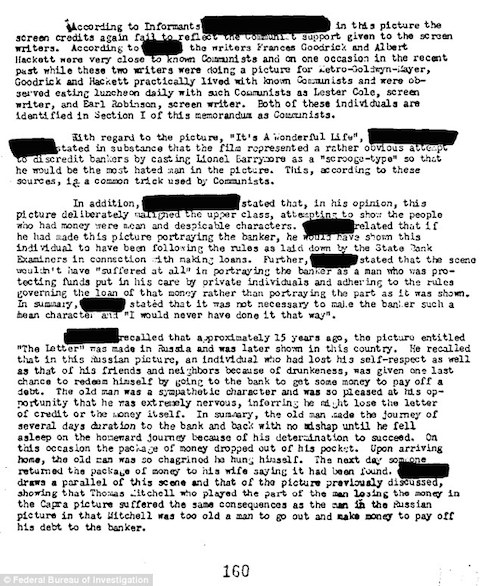
We live in odd times, such that this rhetoric—which seemed so quaint just a couple short decades or so ago—sounds jarringly contemporary again as the politics of the mid-20th century reappear everywhere. The charges against the seemingly innocuous Capra film hinged in part on the alleged Communist ties of its principle screenwriters, Francis Goodrich and Albert Hackett. In their report, part of which you can see above, the FBI wrote that the screen writers “practically lived with known Communists and were observed eating luncheon daily with such Communists as Lester Cole, screen writer, and Earl Robinson.” Palling around, as it were.
In addition to naming the writers’ acquaintances and lunch buddies, the report quotes a redacted individual who “stated that, in his opinion, this picture deliberately maligned the upper class.” Another blacked-out source “stated in substance that the film represented a rather obvious attempt to discredit bankers by casting Lionel Barrymore as a ‘scrooge-type’ so that he would be the most hated man in the picture. This, according to these sources, is a common trick used by Communists.” Finally, a third redacted source compares the plot of Capra’s movie with that of a Russian film called The Letter, screened in the U.S. fifteen years earlier.
We cannot say for certain, but it’s reasonable to assume that many of these hidden FBI sources were associates of Rand. In any case, Rand—in vogue after the success of her novel The Fountainhead—appeared before HUAC and re-iterated many of the general claims made in the report. During her testimony, she focused on a 1944 film called Song of Russia (you can hear her mention it briefly in the short clip at the top). She chiefly critiques the film for its idealized portrait of life in the Soviet Union, hence her enumeration of the many evils of actual life there.
Curiously, many critical treatments of It’s A Wonderful Life have said more or less the same thing of that work, calling the film “sentimental hogwash,” for example, and a representative of “American capitalist ideology.” These readings seem persuasive to me, but for those like Rand and her followers, as well as J. Edgar Hoover and his paranoid underlings, no film it seems—no matter how celebratory of U.S. nationalist mythology—could go far enough in glorifying heroic capitalists, ignoring class conflict, and minimizing the struggles of “the little man.”
As Raw Story notes, testimony from others at the HUAC hearings brought “redemption of an odd sort” for Capra’s movie, which “has been more than redeemed as it slowly became a sentimental and beloved holiday perennial.” But even if It’s A Wonderful Life may now look like apple pie on celluloid, Flavorwire points out that it’s still liable to raise suspicions among certain aggressive pundits and culture warriors who push a “war on Christmas” narrative and see socialist subversion even in acts of charity, like those displayed so extravagantly in the film’s mushy ending (above).
It’s A Wonderful Life “is a holiday movie that doesn’t mention Christmas until the 99-minute mark…. It takes a mostly secular reading of the holiday as a time to take stock of your life, of the true blessings of family and friends. To those obsessed with the preferred holiday greeting or the color of Santa’s skin… this must sound like quite the Communist subversion indeed.”
Read much more about the HUAC investigation of Hollywood at Aphelis, who include links to a redacted version of the FBI “Communist Infiltration” report and many other fascinating documents.
Like films by the Marx brothers, Airplane! creates a feeling of giddy, exuberant anarchy by hurling a non-stop barrage of jokes at you. It is the sort of movie that viewers risk hyperventilating from laughing so much. Yet among the all gags and one-liners — “I picked the wrong week to stop sniffing glue.”– possibly the most memorable is the famous jive talking bit. You can watch it above.
The gag features two African American guys speaking with each other in an impenetrable patois of jive. Later, one of the guys — the characters are simply credited as First Jive Dude and Second Jive Dude — is suffering from a stomach ailment. When the stewardess can’t understand what they are saying, Barbara Billingsley – A.K.A. June Clever, A.K.A the whitest lady on the planet – stands up and starts to talk to the guys in fluent jive. It’s a jarring and hilarious moment. Jim Abrahams and David and Jerry Zucker, the writers and directors of the movie talk, about that scene below.
“The whole notion for jive dialogue originated from when we saw Shaft,” said Abraham. “We went and saw it and didn’t understand what they were saying. So we did our best as three nice Jewish boys from Milwaukee to write jive talk for the script.”
During the audition, Norman Alexander Gibbs and Al White, old high school friends, delivered a spot on exchange in jive. They were immediately cast as First Jive Dude and Second Jive Dude respectively. “We had to apologize for what we had written,” said David Zucker.
“We came up with the individual dialogue in the movie,” said White. “They wanted jive as a language, which it is not. Jive is only a word here or a phrase there.”
“We actually created a language,” said Gibbs.
“I was sent the script and I thought it was the craziest script I’ve ever read,” recalled Billingsley in an interview you can see below. “My part wasn’t written. It just said I talked jive. I met the producer and I said I would do it. I met the two black fellows that taught me jive. … It wasn’t hard for me to learn.”
Thanks to Erik R. for sending this our way.
Jonathan Crow is a Los Angeles-based writer and filmmaker whose work has appeared in Yahoo!, The Hollywood Reporter, and other publications. You can follow him at @jonccrow. And check out his blog Veeptopus, featuring lots of pictures of badgers and even more pictures of vice presidents with octopuses on their heads. The Veeptopus store is here.
We're hoping to rely on loyal readers, rather than erratic ads. Please click the Donate button and support Open Culture. You can use Paypal, Venmo, Patreon, even Crypto! We thank you!
Open Culture scours the web for the best educational media. We find the free courses and audio books you need, the language lessons & educational videos you want, and plenty of enlightenment in between.