In his 1997 book of drawings and verse, The Melancholy Death of Oyster Boy & Other Stories, Tim Burton imagines a bizarre menagerie of misfits with names like Toxic Boy, Junk Girl, the Pin Cushion Queen and the Boy with Nails in his Eyes.
“Inspired by such childhood heroes as Dr. Seuss and Roald Dahl,” writes James Ryan in the New York Times, “Mr. Burton’s slim volume exquisitely conveys the pain of an adolescent outsider. Like his movies, the work manages to be both childlike and sophisticated, blending the innocent with the macabre.”
One of those adolescent outsiders is Stain Boy, a strange kind of superhero:
He can’t fly around tall buildings,
or outrun a speeding train,
the only talent he seems to have
is to leave a nasty stain.
Sometimes I know it bothers him,
that he can’t run or swim or fly,
and because of this one ability,
his dry cleaning bill is sky-high.
In 2000, Burton extended Stain Boy’s adventures (and compressed his name into one word) with The World of Stainboy, a series of short animations commissioned for the Internet by Shockwave.com. “For some stories you have to wait for the right medium,” Burton said at the time. “I think (the Internet’s) the perfect forum to tell a sad little story like this one. Stainboy is a character that doesn’t do much. He’s just perfect for four-minute animations.”
Burton created a series of sketches, watercolors and pastel-accented gray-on-gray washes and brought them, along with a script and storyboards, to Flinch Studio for translation into Macromedia Flash animation. Twenty-six episodes were planned, but only six were completed. “Stainboy was an experiment in developing revenue streams for the Web,” writes Alison McMahan in The Films of Tim Burton: Animating Live Action in Contemporary Hollywood, “but it did not succeed, at least not financially.”
The Stainboy character was resurrected briefly in late 2010, when Burton invited fans to compose a new Stainboy adventure in brief installments via Twitter. Burton pieced together a story using the best tweets. (You can read the final result here.) Meanwhile, the original Web animations have continued to attract a following. You can watch the complete six-part series below in HD. As you will see, some episodes introduce new characters — Stare Girl, Toxic Boy, Bowling Ball Head and the rest:
Earlier this week, we brought you Audrey Hepburn’s Screen Test for Roman Holiday (1953). Next up, we have Katharine Hepburn appearing on the very 70s set of The Dick Cavett Show. In case you’re wondering, the two Hepburns were only distantly related. According to Salon, they shared one common ancestor, James Hepburn, Earl of Bothwell, the third husband of Mary, Queen of Scots.
Anyway, here’s the backstory on the Cavett interview that aired on September 14, 1973:
Hepburn rarely granted interviews, and when she did, she wanted them under her terms. When she agreed to appear on the Dick Cavett Show they went in the studio a day early so she could get the feel of things. They ended up doing the interview right then and there, without an audience.
Brilliant but unmotivated, Stephen Hawking was a 21-year-old PhD student at Cambridge when he first noticed something was wrong. He was falling down a lot, and dropping things. He went into the hospital for tests, and learned he had amyotrophic lateral sclerosis, or ALS. The doctors told him he would gradually lose control of every muscle in his body.
“My dreams at that time were rather disturbed,” Hawking said. “Before my condition had been diagnosed, I had been very bored with life. There had not seemed to be anything worth doing. But shortly after I came out of hospital, I dreamt that I was going to be executed. I suddenly realized that there were a lot of worthwhile things I could do if I were reprieved.”
The doctors gave the young man two and a half years to live. That was in early 1963. Over the next half century, Hawking defied all odds and went on to become one of the most celebrated scientists of the era, making major contributions to quantum cosmology and the understanding of black holes. Along the way, the wheelchair-bound Hawking became a cultural icon, a symbol of disembodied intellect and indomitable spirit.
This coming Sunday, 49 years after his grim diagnosis, Hawking will turn 70. A scientific conference in his honor got underway today at the University of Cambridge’s Centre for Theoretical Cosmology, and will culminate on Sunday with a public symposium, “The State of the Universe,” featuring some of the world’s greatest astronomers and physicists, including Martin Rees, Kip Thorne and Saul Perlmutter. You can watch live streaming video of the events at the official website.
To help celebrate, we present Errol Morris’s 1992 film of A Brief History of Time (above), Hawking’s bestselling book. Morris weaves biography in with the science, interviewing members of Hawking’s family–his mother, sister and aunt–along with friends and colleagues, including Roger Penrose, Dennis Sciama and John Archibald Wheeler.
A Brief History of Time was Morris’s first film as a director-for-hire (he was recruited by Steven Spielberg for Amblin Entertainment), which created some difficulties, but Morris was pleased with the outcome. He later said, “It’s actually one of the most beautiful films I ever shot.” The film won the Grand Jury Prize for Documentary Filmmaking and the Documentary Filmmaker’s Trophy at the Sundance Film Festival.
In 1992 Morris told the New York Times Magazine that A Brief History of Time was “less cerebral and more moving” than anything he had worked on before. “This feeling of time, of aging, of mortality combined with this search for the most basic and deep questions about the world around us and ourselves,” Morris said, “is pretty persuasive stuff.” Find it listed in our Free Movies Online collection, within the Documentary section.
Shortly after finishing film school, the young Belgian director Vincent Bal shot The Bloody Olive (1996), a 10 minute film based on a comic book by the French artist Lewis Trondheim. It was an instant hit, winning over 20 awards at film festivals worldwide. Wanting to keep things spoiler-free around here, let us just say this: the short film pays a fun little tribute to the film noir tradition — its aesthetic, conventions and all of the rest.
For more film noir fun, don’t miss Key Lime Pie, a 2007 animated film in the noir tradition, or our collection of 31 Free Noir Films. The noir collection features classics by John Huston, Elia Kazan, Fritz Lang, Ida Lupino, Otto Preminger, Orson Welles and others. You can find great classics from other genres within our list of Free Movies Online.
Before we rush headlong into a new year, it’s worth pausing, ever so briefly, to consider the ground we covered in 2011. What topics resonated with you … and jazzed us? Today, we’re highlighting 10 thematic areas (and 46 posts) that captured the imagination. Chances are you missed a few gems here. So please join us on our brief journey back into time. Tomorrow, we start looking forward again.
1) Universities Offer More Free Courses, Then Start Pushing Toward Certificates: The year started well enough. Yale released another 10 stellar open courses. (Find them on our list of 400 Free Courses). Then other universities started pushing the envelope on the open course format. This fall, Stanford launched a series of free courses that combined video lectures with more dynamic resources — short quizzes; the ability to pose questions to Stanford instructors; feedback on your overall performance; a statement of accomplishment from the instructor, etc. A new round of free courses will start in January and February. (Get the full list and enroll here.) Finally, keep your eyes peeled for this: In 2012, MIT will offer similar courses, but with one big difference. Students will get an official certificate at the end of the course, all at a very minimal charge. More details here.
3) Books Intelligent People Should Read: Neil deGrasse Tyson’s list “8 (Free) Books Every Intelligent Person Should Read” ended up generating far more conversation and controversy than we would have expected. (Users have left 83 comments at last count.) No matter what you think of his rationale for choosing these texts, the books make for essential reading, and they’re freely available online.
4) Christopher Hitchens and Stephen Fry: Christopher Hitchens left us this past month. And, until his last day, Hitchens was the same old Hitch — prolific, incisive, surly and defiant, especially when asked about whether he’d change his position on religion, spirituality and the afterlife. All of this was on display when he spoke at the American Jewish University in Los Angeles last February. We covered his comments in a post called, No Deathbed Conversion for Me, Thanks, But it was Good of You to Ask. And even from the grave, Hitchens did more of the same, forcing us to question the whole modern meaning of Christmas.
In this video created by the Guardian, writer and award-winning documentary filmmaker Errol Morris talks about the nature of truth, art, and propaganda in photography. He draws examples from the photographs of Abu Ghraib and the Crimean War, both cited in his book Believing is Seeing, and he asks the viewer to consider a most fundamental question: how does a photograph relate to the physical world? Unlike a verbal or written statement, a photograph cannot be true or false. It simply is.
Then comes another argument worth considering — the idea that all photographs are posed. By way of example, Morris cites an instance where a photographer (in this case Roger Fenton) omits an elephant standing outside the frame. And it leads Morris to suggest that we shouldn’t take photos at face value. Rather we should do our due diligence to find out whether there isn’t always a metaphorical elephant looming beyond the frame. As Morris states, a photograph decontextualizes everything. It reveals to us a two dimensional reality that’s “been torn out of the fabric of the world.”
This video is part of the Guardian’s “Comment is Free” series, in which the world’s top thinkers, newsmakers, and people with stories to tell are interviewed. For more meditations on photography, give some time to Errol Morris’ speech at the Harvard Bookstore. Find the transcript here.
Eugene Buchko is a blogger and photographer living in Atlanta, GA. He maintains a photoblog, Erudite Expressions, and writes about what he reads on his reading blog.
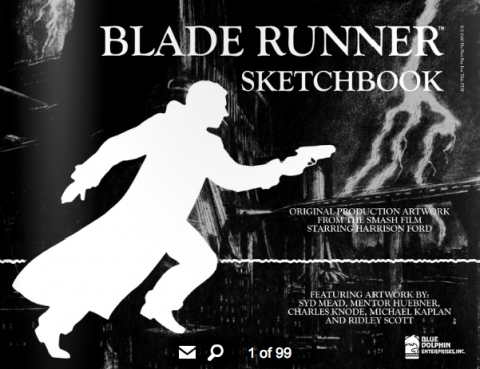
Coinciding with the release of Blade Runner in 1982, David Scroggy published the Blade Runner Sketchbook, a book with 100+ production drawings and artwork for Ridley Scott’s classic sci-fi film. The sketchbook features visual work by Scott himself, artist Mentor Huebner, and costume designer Charles Knode, but most notably a slew of drawings by artist, futurist, and illustrator Syd Mead.
As Comics Alliance notes, this sketchbook has been out of print for years and scant few paper copies remain available for purchase. So digital versions have filled the void online, and now comes this: a version that lets you revel in the Blade Runner artwork in full-screen mode. Enter the sketchbook by clicking the image above or below. (The book itself is hosted at Isuu.com). Once you get there, click the images and they’ll fill your screen.
Enjoy, and while you’re at it, don’t miss some related items:
Orson Welles. A brilliant director. A talented actor. And not a bad narrator of animated films. We know one thing. The whole is often greater than the sum of the parts. So, today, we’re serving up three animated films narrated by Welles, plus some classic radio broadcasts.
We start with an animated version of Plato’s Cave Allegory from 1973. The allegory is the most well known part of The Republic (Download – Kindle), and Welles reads the famous lines delivered by Socrates. Perfect casting. This is hardly the first animation of the cave allegory. Partially Examined Life has a roundup of 20 animations, but we’re always partial to this brilliant version done with claymation.
In 1962, Orson Welles directed The Trial, a film based on Franz Kafka’s last and arguably best-known novel. The film begins auspiciously with Welles narrating an animated version of “Before the Law,” a parable from The Trial. And then the dramatic film unfolds. Later in his life, Welles told the BBC, “Say what you will, but The Trial is the best film I have ever made. I have never been so happy as when I made that film.”
The backstory behind this short animated film, Freedom River, deserves a little mention. According to Joseph Cavella, a writer for the film:
For several years, Bosustow Productions had asked Orson Welles, then living in Paris, to narrate one of their films. He never responded. When I finished the Freedom River script, we sent it to him together with a portable reel to reel tape recorder and a sizable check and crossed our fingers. He was either desperate for money or (I would rather believe) something in it touched him because two weeks later we got the reel back with the narration word for word and we were on our way.
Filmed 40 years ago, Freedom River offers some strong commentary on America, some of which will still resonate today.
Finally, if you can’t get enough of Orson’s voice, don’t miss The Mercury Theatre on the Air, Welles’ radio program that brought theatrical productions to the American airwaves from 1938 to 1941. You can still find the broadcasts online, including the legendary War of the Worlds program from 1938 (listen), and dramatized versions of Dickens’ A Christmas Carol (listen) and Around the World in 80 Days (click the first item in playlist).
The short films mentioned above appear in our collection of Free Movies Online, where you will also find some longer films by Welles.
We're hoping to rely on loyal readers, rather than erratic ads. Please click the Donate button and support Open Culture. You can use Paypal, Venmo, Patreon, even Crypto! We thank you!
Open Culture scours the web for the best educational media. We find the free courses and audio books you need, the language lessons & educational videos you want, and plenty of enlightenment in between.