Let’s now head 600 miles south, to the Riviera city of Nice, where some café owners opted for another way to keep bad behavior in check. At the Petite Syrah, they’ve implemented a simple pricing scheme that works like this:
If you ask for “a coffee” (it’s most likely an espresso), it will run you 7 euros, or $9.50.
If you ask for a “coffee please,” the charge drops to €4.25/$5.80.
But if you start your order by saying “Hello, may I have a coffee, please,” the bill becomes a manageable €1.40.
Now, truth be told, the pricing scheme is more carrot than stick. The café’s manager readily admits that he has never actually charged any of the punitive higher prices. But that’s not to say that the scheme doesn’t work. According to manager/owner Fabrice Pepino, regular customers quickly took note of the sign and began to “say, ‘Hello, your highness, will you serve me one of your beautiful coffees.” Eh voilà, no more coffee jerks.
Here’s a quick scenario for you. You’ve poured yourself a fresh cup of black coffee, and you want to keep it hot until you’re ready to drink it. Are you making a mistake by adding cream to that coffee? Does coffee with cream cool faster than black coffee left alone? Intuition says yes. The laws of physics lead to a different conclusion.
1) Black coffee is darker, and dark colors emit heat faster than light colors. As such, “by lightening the color of your coffee, you slow the rate at which it cools,” if only slightly.
2) The Stefan-Boltzmann Law (apparently) says that hotter surfaces radiate heat faster than cooler ones. So if you add cream to a cup of black coffee, it might lower the temperature of that cup of coffee. However that cup could still cool at a slower rate than a cup of hot black coffee.
3) Finally, and perhaps most importantly, “adding cream thickens the coffee (adds viscosity), so it evaporates slower.” And, in turn, less heat gets carried away by the evaporation.
To top things off, Modernist Cuisine also produced a video showing cream being poured into coffee in super slow motion. Even if you don’t care to consider the physics of coffee & cream, it’s pretty cool to watch an average cup of joe getting turned into a roiling sea.
Bonaverde is “a small, dedicated team of young, sleepless Berliner entrepreneurs that [have] made it their goal to revolutionize the coffee world.” How? By building the world’s first “Roast-Grind-Brew Coffee Machine.” Other machines might grind and brew the coffee. This one will roast the beans too, which is no trivial innovation. It promises to significantly decrease the number of steps, and the amount of time, it takes to turn a harvested coffee bean into your morning cup of joe, which means a much fresher cup of coffee. And perhaps a cheaper one too.
Bonaverde has already developed a prototype. (See how it works below.) Now the venture needs to bring the machine into production. Through a Kickstarter campaign ending on December 8th, the venture initially hoped to raise $135,000. But it has already blown past that figure, raising $582,693 thus far. Anyone who contributes $250 (or more) to the campaign will get one of the very first Roast-Grind-Brew Coffee Machines, plus 6.6 lbs. (3kg) of green coffee. Theoretically all you need to brew one very fresh cup of coffee. Find more information on the next-generation coffee machine over on Bonaverde’s Kickstarter page.
The once-surrealist (and, in a sense, always surrealist) Spanish filmmaker Luis Buñuel made such classically bleak, humorous, and bleakly humorous pictures like Viridiana, The Exterminating Angel, The Discreet Charm of the Bourgeoisie, and That Obscure Object of Desire. He also made personal connections with an international range of idiosyncratic creative luminaries including Federico García Lorca, Sergei Eisenstein, Charlie Chaplin, Aldous Huxley, Pablo Picasso, Bertolt Brecht, Octavio Paz, Alexander Calder, and Salvador Dalí (his collaborator on the notorious short Un Chien Andalou and L’Age d’Or). Having lived a life like that, Buñuel surely couldn’t help but write one of the most fascinating autobiographies in print. To become such a human cultural nexus, one needs not make motion pictures as enduringly striking as Buñuel’s, but one must certainly make a dry martini on the level of his own. Fortunately for the aspiring Buñuels of the world, My Last Sigh, that formidably intriguing life story, includes his personal recipe.
Dangerous Minds has posted the relevant excerpt. “To provoke, or sustain, a reverie in a bar, you have to drink English gin, especially in the form of the dry martini,” writes Buñuel. “To be frank, given the primordial role in my life played by the dry martini, I think I really ought to give it at least a page.” He recommends that “the ice be so cold and hard that it won’t melt, since nothing’s worse than a watery martini,” then offers up his procedure, “the fruit of long experimentation and guaranteed to produce perfect results. The day before your guests arrive, put all the ingredients—glasses, gin, and shaker—in the refrigerator. Use a thermometer to make sure the ice is about twenty degrees below zero (centigrade). Don’t take anything out until your friends arrive; then pour a few drops of Noilly Prat and half a demitasse spoon of Angostura bitters over the ice. Stir it, then pour it out, keeping only the ice, which retains a faint taste of both. Then pour straight gin over the ice, stir it again, and serve.” In the clip above, you can witness the man himself in action, a sight that gets me wondering whether Buñuel ever crossed paths with John Updike. Imagining such a meeting sets the mind reeling, but few quotes seem as apropos here as the New England novelist’s observation that “excellence in the great things is built upon excellence in the small.”
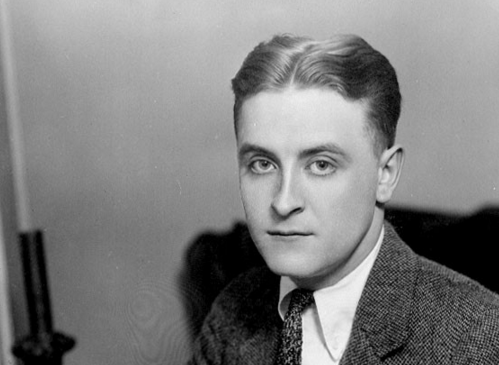
“At this post holiday season, the refrigerators of the nation are overstuffed with large masses of turkey, the sight of which is calculated to give an adult an attack of dizziness. It seems, therefore, an appropriate time to give the owners the benefit of my experience as an old gourmet, in using this surplus material.” There writes no less a legend of American letters than F. Scott Fitzgerald, author of The Great Gatsby and Tender is the Night (both available in our Free eBooks collection). His words quoted here, from “Turkey Remains and How to Inter Them with Numerous Scarce Recipes,” a column found in the Fitzgerald miscellany collection The Crack-Up, hold just as true this day-after-Thanksgiving as they did during those his lifetime. Lists of Note offers the full piece, which itself offers thirteen potential uses for your leftover bird, some of which, Fitzgerald writes, “have been in my family for generations”:
1. Turkey Cocktail: To one large turkey add one gallon of vermouth and a demijohn of angostura bitters. Shake.
2. Turkey à la Francais: Take a large ripe turkey, prepare as for basting and stuff with old watches and chains and monkey meat. Proceed as with cottage pudding.
3. Turkey and Water: Take one turkey and one pan of water. Heat the latter to the boiling point and then put in the refrigerator. When it has jelled, drown the turkey in it. Eat. In preparing this recipe it is best to have a few ham sandwiches around in case things go wrong.
4. Turkey Mongole: Take three butts of salami and a large turkey skeleton, from which the feathers and natural stuffing have been removed. Lay them out on the table and call up some Mongole in the neighborhood to tell you how to proceed from there.
5. Turkey Mousse: Seed a large prone turkey, being careful to remove the bones, flesh, fins, gravy, etc. Blow up with a bicycle pump. Mount in becoming style and hang in the front hall.
6. Stolen Turkey: Walk quickly from the market, and, if accosted, remark with a laugh that it had just flown into your arms and you hadn’t noticed it. Then drop the turkey with the white of one egg—well, anyhow, beat it.
7. Turkey à la Crême: Prepare the crême a day in advance. Deluge the turkey with it and cook for six days over a blast furnace. Wrap in fly paper and serve.
8. Turkey Hash: This is the delight of all connoisseurs of the holiday beast, but few understand how really to prepare it. Like a lobster, it must be plunged alive into boiling water, until it becomes bright red or purple or something, and then before the color fades, placed quickly in a washing machine and allowed to stew in its own gore as it is whirled around. Only then is it ready for hash. To hash, take a large sharp tool like a nail-file or, if none is handy, a bayonet will serve the purpose—and then get at it! Hash it well! Bind the remains with dental floss and serve.
9. Feathered Turkey: To prepare this, a turkey is necessary and a one pounder cannon to compel anyone to eat it. Broil the feathers and stuff with sage-brush, old clothes, almost anything you can dig up. Then sit down and simmer. The feathers are to be eaten like artichokes (and this is not to be confused with the old Roman custom of tickling the throat.)
10. Turkey à la Maryland: Take a plump turkey to a barber’s and have him shaved, or if a female bird, given a facial and a water wave. Then, before killing him, stuff with old newspapers and put him to roost. He can then be served hot or raw, usually with a thick gravy of mineral oil and rubbing alcohol. (Note: This recipe was given me by an old black mammy.)
11. Turkey Remnant: This is one of the most useful recipes for, though not, “chic,” it tells what to do with the turkey after the holiday, and how to extract the most value from it. Take the remants, or, if they have been consumed, take the various plates on which the turkey or its parts have rested and stew them for two hours in milk of magnesia. Stuff with moth-balls.
12. Turkey with Whiskey Sauce: This recipe is for a party of four. Obtain a gallon of whiskey, and allow it to age for several hours. Then serve, allowing one quart for each guest. The next day the turkey should be added, little by little, constantly stirring and basting.
13. For Weddings or Funerals: Obtain a gross of small white boxes such as are used for bride’s cake. Cut the turkey into small squares, roast, stuff, kill, boil, bake and allow to skewer. Now we are ready to begin. Fill each box with a quantity of soup stock and pile in a handy place. As the liquid elapses, the prepared turkey is added until the guests arrive. The boxes delicately tied with white ribbons are then placed in the handbags of the ladies, or in the men’s side pockets.
What, you expected recipes more… followable than these? And perhaps recipes with less alcohol involved? These all make much more sense if you bear in mind Fitzgerald’s formidable creativity, his even more formidable penchant for the drink, and his mordant sense of humor about it all. “I guess that’s enough turkey talk,” concludes this literary icon of my Thanksgiving-celebrating nation. “I hope I’ll never see or hear of another until—well, until next year.” If you haven’t had enough, and indeed feel like getting the jump on next year, see also the Airship’s list of twelve Thanksgiving recipes from favorite authors, including Jonathan Franzen’s pasta with kale, Alice Munro’s rosemary bread pudding, and Ralph Ellison’s sweet yams.
Like many others on Thanksgiving, William Shatner sought a “moister, tastier” turkey experience. The former Star Trek star had purchased a sizable fryer and, turned brash by pangs of hunger, threw caution to the wind; despite knowing Archimedes’ principle full well, Shatner boldly went where no cook should go and deposited the turkey into a vat brimming with oil. Oh, woeful day! The oil, displaced by the turkey, ran over the fryer’s sides and onto the open flame. Flames then shot up, burning Shatner’s arms.
In 2011, Shatner joined forces with the insurance company State Farm to create a cautionary video warning would-be Thanksgiving turkey fryers about the perils of engaging in such a gastronomic enterprise. According to State Farm, insurance claims related to Thanksgiving grease & cooking-accidents dropped by half after this public service announcement came out.
In what can only be interpreted as an attempt to tamper with perfection, in 2012, State Farm decided to have YouTube’s melodysheep remix Shatner’s original video, giving it a glistening new coat of Internet virality. We are pleased to say that the endeavor proved to be a resounding success. Please enjoy the video, above, and remember the following frying tips:
1: Avoid oil spillover–don’t overfill the pot.
2: Turn off the flame when lowering the turkey into oil.
3: Fry outside, away from the house.
4: Properly thaw the turkey before frying.
5: Keep a grease-fire-approved extinguisher nearby.
Ilia Blinderman is a Montreal-based culture and science writer. Follow him at @iliablinderman.
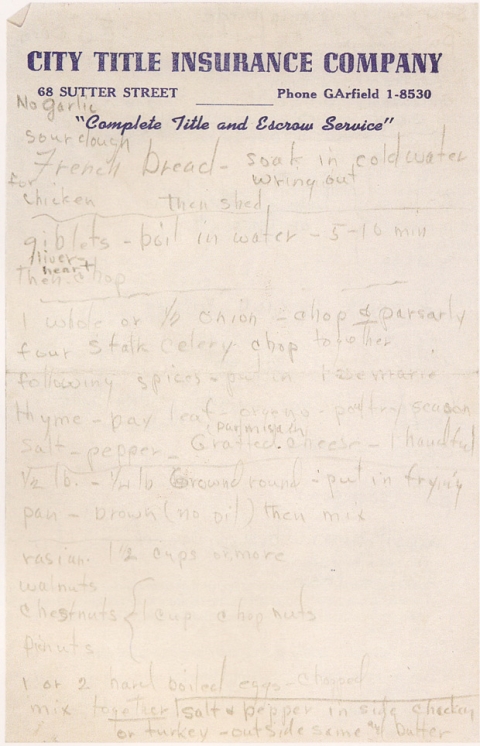
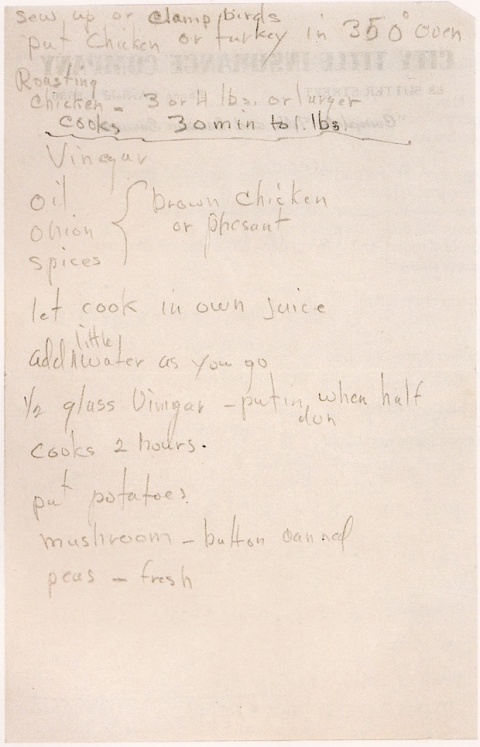
Entire industries seem to have sprung up around the mission of demonstrating that Marilyn Monroe did more in her short life than become an icon — the icon — of midcentury American starlethood. We here at Open Culture have previously featured not just her famously photographed reading of James Joyce’s Ulysses, but the contents of her personal library as well. The new book Fragments provides a great deal of rich ephemera to those scholars of Monroe’s pursuits off the screen, including, as Matt Lee and Ted Lee in the New York Timesdescribe it, “assorted letters, poems and back-of-the-envelope scribblings that span the time from Monroe’s first marriage in 1943 to her death in 1962.” The article appears in the paper’s Dining & Wine section thanks to one Monrovian fragment of particular interest this time of year: her personal recipe for turkey and stuffing.
“Scrawled on stationery with a letterhead from a title insurance company,” write Lee and Lee, “the recipe describes in some detail how to prepare a stuffing for chicken or turkey. The formula is extensive in the number of ingredients (11, not including the 5 herbs and spices, or salt and pepper), and in their diversity (3 kinds of nuts and 3 animal proteins). It is unorthodox for an American stuffing in its use of a bread loaf soaked in water, wrung dry and shredded, and in its lack of added fat, broth, raw egg or any other binder.” You can find a transcript of the steps right below. And if you give a whirl on Thanksgiving, let us know how it turns out.
For the Stuffing
No garlic
Sourdough
French bread — soak in cold water, wring out, then shred
For chicken giblets — boil in water 5–10 mins
Liver — heart then chop
1 whole or ½ onion, chop & parsley / four stalk celery, chop together following spices — put in rosemary
Thyme, bay leaf, oregano, poultry seasoning, salt, pepper,
Grated Parmesan cheese, 1 handful
1/2lb – 1/4lb ground round — put in frying pan — brown (no oil) then mix raisin 1 ½ cuops or more
1 cup chop nuts (walnuts, chestnuts, peanuts)
1 or 2 hard boiled eggs — chopped mix together
To Prep the Bird
Salt & pepper inside chicken or turkey — outside same and butter
Sew up clamp birds put chicken or turkey in 350 oven
Roasting chicken — 3or 4lbs or larger
Cooks 30 min to 1lbs
Brown chicken or pheasant (vinegar, oil, onion, spices) — let cook in own juice
In 2006, a profile of Christopher Hitchens in The New Yorker noted how its subject had the tendency to drink “like a Hemingway character: continually and to no apparent effect.” Although Ernest Hemingway’s approach to alcohol informed the habits of his literary personages, it differed significantly from that of the late journalist. Hemingway, counter to his image, stood firmly against mixing writing and drinking, and when asked about combining the two exclaimed:
“Jeezus Christ! Have you ever heard of anyone who drank while he worked? You’re thinking of Faulkner. He does sometimes—and I can tell right in the middle of a page when he’s had his first one. Besides, who in hell would mix more than one martini at a time, anyway?”
Whereas Hemingway’s approach to writing and imbibing was often marked by a cautious and professional wall of separation, Hitchens had no such compunctions. The contrarian willingly admitted to drinking a fortifying mixture of wine and spirit throughout the day:
“I work at home, where there is indeed a bar-room, and can suit myself.… At about half past midday, a decent slug of Mr. Walker’s amber restorative, cut with Perrier water (an ideal delivery system) and no ice. At luncheon, perhaps half a bottle of red wine: not always more but never less. Then back to the desk, and ready to repeat the treatment at the evening meal. No “after dinner drinks”—most especially nothing sweet and never, ever any brandy. “Nightcaps” depend on how well the day went, but always the mixture as before. No mixing: no messing around with a gin here and a vodka there.”
Despite this hale and hearty routine, Hitchens claimed to be invigorated rather than impaired by his consumption:
“… on average I produce at least a thousand words of printable copy every day, and sometimes more. I have never missed a deadline. I give a class or a lecture or a seminar perhaps four times a month and have never been late for an engagement or shown up the worse for wear. My boyish visage and my mellifluous tones are fairly regularly to be seen and heard on TV and radio, and nothing will amplify the slightest slur more than the studio microphone.”
As with fishing and amorous exploits, so with drinking—one should be skeptical of bold claims. Nevertheless, Graydon Carter, the longstanding editor of Vanity Fair magazine, corroborated the robustness of Hitchens’ constitution in a fond and respectful obituary following the journalist’s death in 2011.
“He was a man of insatiable appetites—for cigarettes, for scotch, for company, for great writing, and, above all, for conversation… Pre-lunch canisters of scotch were followed by a couple of glasses of wine during the meal and a similar quantity of post-meal cognac. That was just his intake. After stumbling back to the office, we set him up at a rickety table and with an old Olivetti, and in a symphony of clacking he produced a 1,000-word column of near perfection in under half an hour.”
In the clip above, Hitchens makes his well-researched pronouncements on the world’s best Scotch whisky. Below, the former Asylum.com producer Anthony Layser sits down with Hitchens for a drink following the release of his memoir, Hitch-22. Over Hitchens’ beloved spirit, the duo discusses everything from writing, to Brazilian waxes, to waterboarding. The conversation, lasting some 14 minutes, is part of an Asylum.com series titled Drinks with Writers, which includes Layser’s interviews with Gary Shteyngart, Simon Rich, and Nick Hornby.
We're hoping to rely on loyal readers, rather than erratic ads. Please click the Donate button and support Open Culture. You can use Paypal, Venmo, Patreon, even Crypto! We thank you!
Open Culture scours the web for the best educational media. We find the free courses and audio books you need, the language lessons & educational videos you want, and plenty of enlightenment in between.