Michael Pollan, the bestselling author who describes himself jokingly as a “liberal foodie intellectual,” published Food Rulesin 2009, a handbook that offers “straightforward, memorable rules for eating wisely.” The one I remember best is Rule #2. “Don’t eat anything your great-grandmother wouldn’t recognize as food.” That’s because it’s likely processed and “designed to get us to buy and eat more by pushing our evolutionary buttons, our inborn preferences for sweetness and fat and salt.” A few other noteworthy suggestions and assertions include:
Rule #6: “Avoid foods that contain more than five ingredients.”
Rule #20: “It’s not food if it arrived through the window of your car.”
Rule #37: “The whiter the bread, the sooner you’ll be dead.”
Rule #17: “Eat only foods that have been cooked by humans.”
Last year, we brought you a description of Hunter S. Thompson’s daily drug and alcohol regimen, consisting of frightening amounts of cocaine and liquor, supplanted by the occasional cup of coffee or acid tab. While the story may be apocryphal, Thompson was no dilettante when it came to psychoactive substances. The father of gonzo journalism burnished his image as a formidable substance user in the opening lines of Fear and Loathing in Las Vegas(1971):
The trunk of the car looked like a mobile police narcotics lab. We had two bags of grass, seventy—five pellets of mescaline, five sheets of high—powered blotter acid, a salt shaker half full of cocaine, and a whole galaxy of multi—colored uppers, downers, screamers, laughers and also a quart of tequila, a quart of rum, a case of Budweiser, a pint of raw ether and two dozen amyls. All this had been rounded up the night before, in a frenzy of high—speed driving all over Los Angeles County—from Topanga to Watts, we picked up everything we could get our hands on. Not that we needed all that for the trip, but once you get locked into a serious drug collection, the tendency is to push it as far as you can.
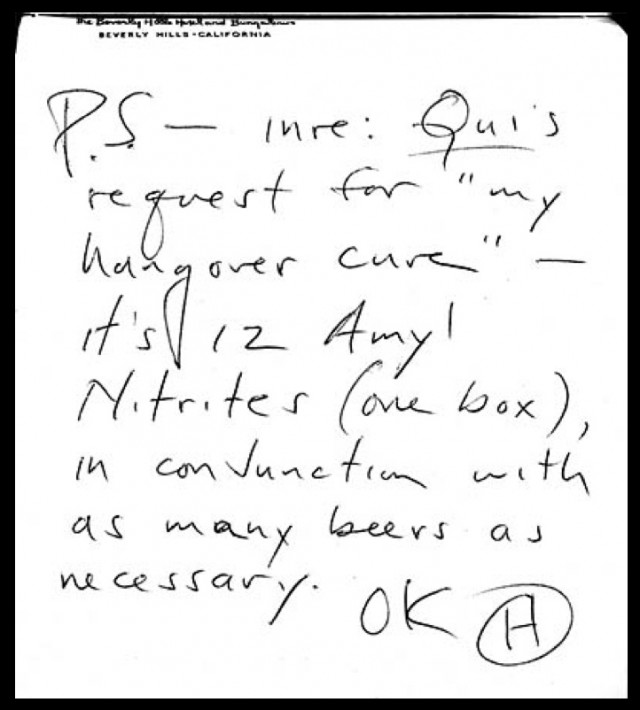
It’s safe to say that if you were to consult anyone about a hangover fix, Thompson would be a good candidate for counsel. Luckily, the author left us with a guide. In 2011, Playboy released a compendium of its 1960s and 1970s correspondences with Thompson. Most were disappointingly prosaic, but among the dross was a hurriedly scribbled note on the topic of hangover cures:
P.S. — inre: Oui’s request for “my hangover cure” — it’s 12 amyl nitrites (one box), in conjunction with as many beers as necessary.
OK H
If a hair of the dog approach doesn’t quite suit you, or if Thompson’s recipe exceeds your initial consumption, I suggest a bottle of sports drink at the tail end of a big night to replenish electrolytes. Still, according YouTube’s SciShow, which does a fantastic job of elucidating the chemical processes behind all the headaches and room spins, there’s only one foolproof method:
As a PSA to stave off angry comments, a spoiler alert: SciShow’s recommendation is on par with the abstinence model of birth control: just don’t do it, and you’ll be fine.
Ilia Blinderman is a Montreal-based culture and science writer. Follow him at @iliablinderman.
The morning cup of coffee sweeps the cobwebs off of your brain. Almost magically. Just like that. If you care to get analytical about what’s going on in your caffeinated brain, we give you a short video from PHD comics — short, of course, for Piled Higher and Deeper. For more of their videos see:
In his 1621 opusThe Anatomy of Melancholy, Robert Burton wrote, “The Turks have a drink called coffa (for they use no wine), so named of a berry as black as soot, and as bitter … which they sip still of, and sup as warm as they can suffer; they spend much time in those coffa-houses, which are somewhat like our alehouses or taverns…”
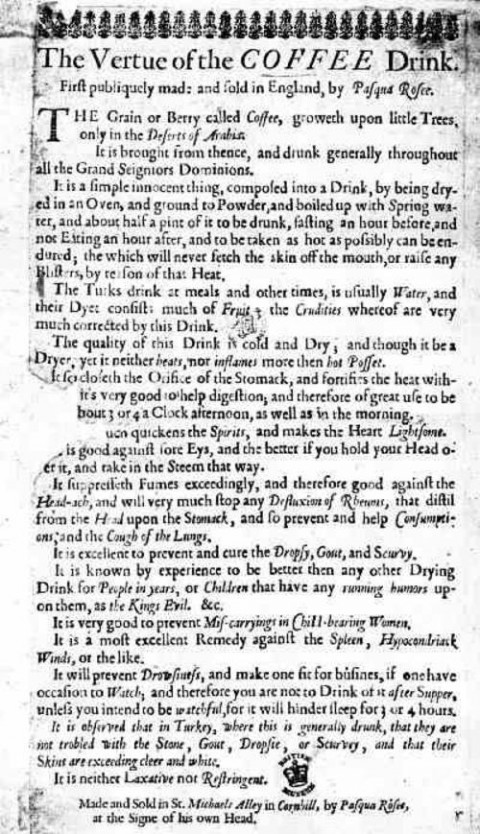
Prior to 1652, when Pasqua Rosée established a small coffeehouse in St. Michael’s Alley in London, coffee was virtually unknown in England. Rosée, a servant of a coffee-loving trader to the Levant, found tremendous success with his venture and, according to Green, was soon selling over 600 servings a day. Above, readers can view Rosée’s original handbill, where the entrepreneur advertised both the therapeutic and prophylactic effects of his wares on digestion, headaches, rheumatism, consumption, cough, dropsy, gout, scurvy, and miscarriages. It’s a wonder anyone ever drinking the stuff got sick.
Coffeehouses quickly became popular places for men to converse and congregate, and Green notes that women soon grew tired of their absence. This exasperation mounted until the 1674 Women’s Petition Against Coffee, which claimed that “Excessive use of that Newfangled, Abominable, Heathenish Liquor called COFFEE” led to England’s falling birthrate, making men “as unfruitful as the sandy deserts, from where that unhappy berry is said to be brought.” Men, as they are wont to do, expressed their disagreement, and stated in Men’s Answer to the Women’s Petition Against Coffeethat coffee made “the erection more vigorous, the ejaculation more full, add[ing] a spiritual ascendency to the sperm.”
A year later, coffeehouses found more formidable opposition in the form of King Charles II, who issued the “Proclamation for the suppression of Coffee Houses” in 1675. Charles, however, was more interested in their political effects than the spiritual ascendency of his subjects’ sperm. Coffeehouses provided an opportunity for more mindful and serious conversations than did alehouses, and allowed anyone who paid the single penny entrance charge to participate in discussions — to Charles, these were the ideal circumstances for plotting sedition and treason among the populace. Despite the King’s proclamation, the coffeehouses, buoyed by a supportive public, prevailed.
In one time-lapse minute, you can watch Bigfoot Barleywine Style Ale, made by Sierra Nevada, turbulently sloshing around, rising and falling, over the course of six days. The clip is set to the music of Edvard Grieg’s Peer Gynt Suite No. 1, Op. 46. Now if you want to put this visual display into a bit of a larger educational context, then we recommend you spend another two minutes watching a short animated video explaining the beer-making process, from start to finish. For the impatient, the fermenting comes at the 1:20 mark.
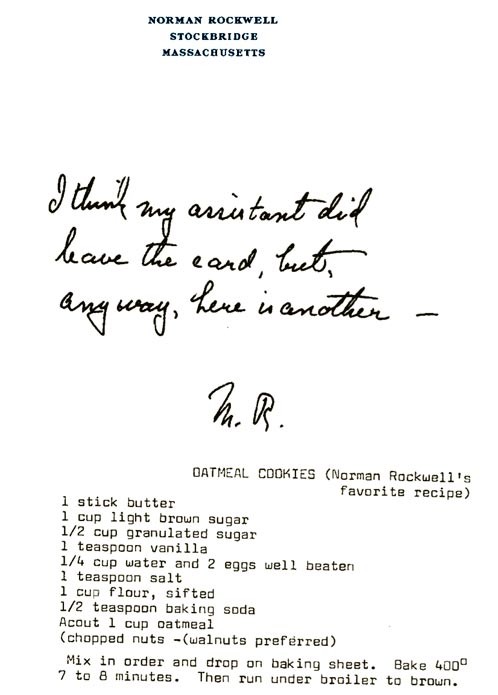
Norman Rockwell, prolific painter and illustrator of 20th century Americana, often worked so single-mindedly that he missed his meals. In 1943, Rockwell exhausted himself to such a degree that, while completing the Franklin Delano Roosevelt-inspired series of paintings entitled Four Freedoms, he lost 15 pounds over the course of seven months. This drop in weight is, perhaps, all the more shocking when given some context: Rockwell was far from being a corpulent man. In fact, when the then 23-year-old artist attempted to enlist as a serviceman in the U. S. Navy during World War I, he was judged to be eight pounds underweight, standing at six feet and tipping the scales at 140 pounds. Rockwell, however, was not to be deterred by something so trivial as his bodily composition. He gorged himself on bananas and doughnuts when he came home that evening. The next day, Navy recruiters dully welcomed the sufficiently bloated Rockwell to the fold.
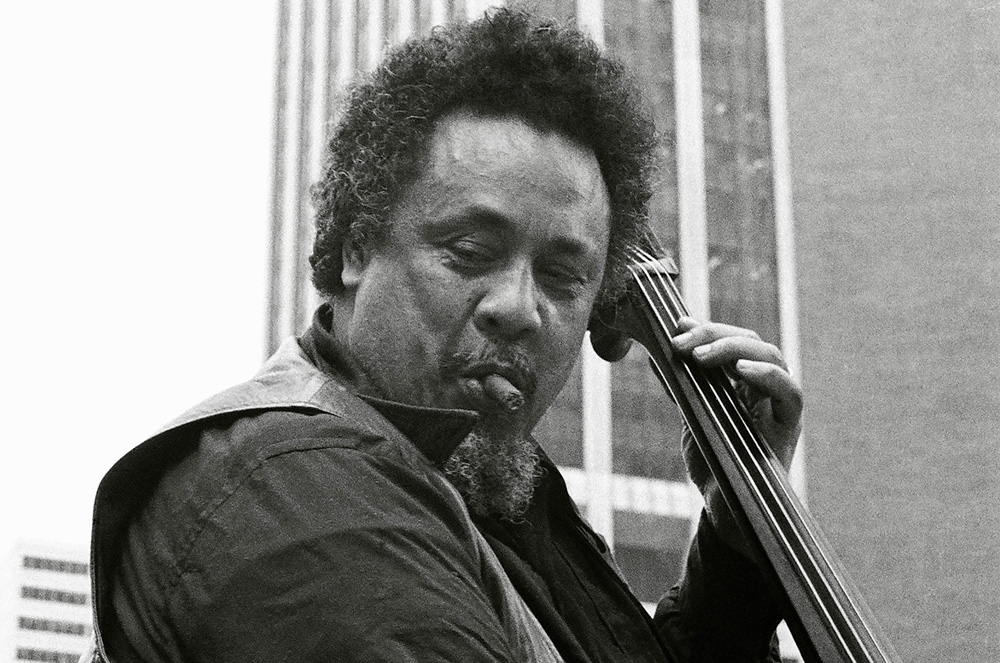
Just in time for a hard-drinking Christmas, the Village Voice brings us the “top secret” eggnog recipe from “Angry Man of Jazz” Charles Mingus. Despite his generally irascible temperament, Mingus had a legendary “zeal for parties and drink” and “felt the yuletide spirit—or spirits, if you will—according to biographer Janet Coleman.” Mingus passed his recipe to Coleman over the phone, and she published it in Mingus/Mingus: Two Memoirs. The ‘nog, the Voice tells us, “calls for enough alcohol to put down an elephant,” so if you happen to be hosting one, this might just come in handy. Humans seem to dig it too. Coleman called it “a concoction so delicious and mind-blowing, you would do anything to make sure you saw him at Christmas.”
Charles Mingus’ “Top Secret” Eggnog
* Separate one egg for one person. Each person gets an egg. * Two sugars for each egg, each person. * One shot of rum, one shot of brandy per person. * Put all the yolks into one big pan, with some milk. * That’s where the 151 proof rum goes. Put it in gradually or it’ll burn the eggs, * OK. The whites are separate and the cream is separate. * In another pot- depending on how many people- put in one shot of each, rum and brandy. (This is after you whip your whites and your cream.) * Pour it over the top of the milk and yolks. * One teaspoon of sugar. Brandy and rum. * Actually you mix it all together. * Yes, a lot of nutmeg. Fresh nutmeg. And stir it up. * You don’t need ice cream unless you’ve got people coming and you need to keep it cold. Vanilla ice cream. You can use eggnog. I use vanilla ice cream. * Right, taste for flavor. Bourbon? I use Jamaica Rum in there. Jamaican Rums. Or I’ll put rye in it. Scotch. It depends. See, it depends on how drunk I get while I’m tasting it.
If you’re drinking tonight, make sure you drink responsibly!
British cooking has been the butt of many jokes, and serious thought-pieces have been devoted to “why British food was so bad for so long.” While that article blames WWI for the decline of English Cuisine, the stigma long precedes the 20th century. In his unpublished essay “British Cookery,” for example, George Orwell opens with a quote from Voltaire, who wrote that Britain has “a hundred religions and only one sauce.” This, Orwell writes, “was untrue” and “is equally untrue today.” His “today” was 1945, before the best British cuisine was Indian. And though he does defend his country’s cooking, and did so in another essay published that year in the Evening Standard, Orwell also makes some critical comments that confirm some of the stereotypes, calling the British diet “a simple, rather heavy, perhaps slightly barbarous diet” and writing: “Cheap restaurants in Britain are almost invariably bad, while in expensive restaurants the cookery is almost always French, or imitation French.”
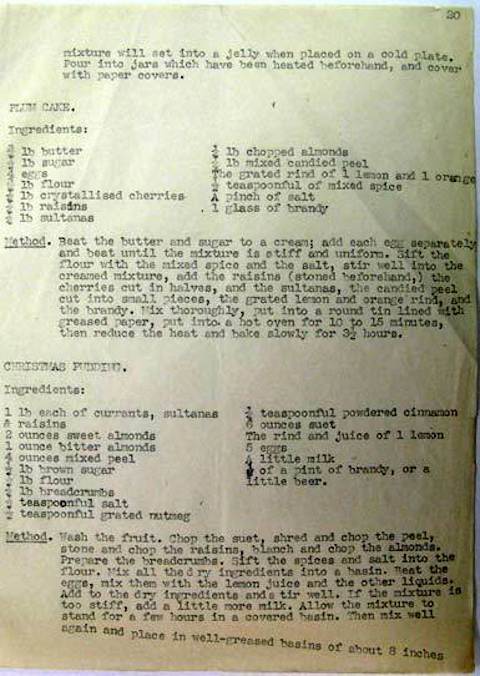
The essay is an exhaustive survey of the British palate of the time, and it concludes with some of Orwell’s own recipes for sweets, including treacle tart, orange marmalade, plum cake, and, lastly, Christmas pudding. You can see the stained typescript of the last two recipes above, and read the full transcript of Orwell’s “British Cookery” here (the recipes are at the end). Having no experience with the strange world of British sweets and pies, I’ll have to take The Guardian’s Alex Renton’s word when he tells us that “the Orwell Christmas pudding is nothing radical.” Nonetheless, I’m tempted to try this recipe more than any of the others Renton mentions, even if I may not get my hands on real suet or sultanas. Read a transcript of Orwell’s Christmas pudding recipe below.
CHRISTMAS PUDDING.
Ingredients:
1 lb each of currants, sultanas & raisins
2 ounces sweet almonds
1 ounces sweet almonds
1 ounces bitter almonds
4 ounces mixed peel
½ lb brown sugar
½ lb flour
¼ lb breadcrumbs
½ teaspoonful salt
½ teaspoonful grated nutmeg
¼ teaspoonful powdered cinnamon
6 ounces suet
The rind and juice of 1 lemon
5 eggs
A little milk
1/8 of a pint of brandy, or a little beer
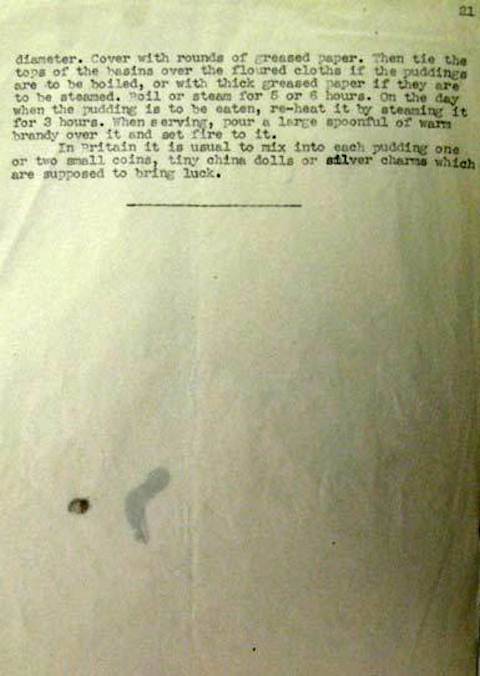
Method. Wash the fruit. Chop the suet, shred and chop the peel, stone and chop the raisins, blanch and chop the almonds. Prepare the breadcrumbs. Sift the spices and salt into the flour. Mix all the dry ingredients into a basin. Heat the eggs, mix them with the lemon juice and the other liquids. Add to the dry ingredients and stir well. If the mixture is too stiff, add a little more milk. Allow the mixture to stand for a few hours in a covered basin. Then mix well again and place in well-greased basins of about 8 inches diameter. Cover with rounds of greased paper. Then tie the tops of the basins over the floured cloths if the puddings are to be boiled, or with thick greased paper if they are to be steamed. Boil or steam for 5 or 6 hours. On the day when the pudding is to be eaten, re-heat it by steaming it for 3 hours. When serving, pour a large spoonful of warm brandy over it and set fire to it.
In Britain it is unusual to mix into each pudding one or two small coins, tiny china dolls or silver charms which are supposed to bring luck.
We're hoping to rely on loyal readers, rather than erratic ads. Please click the Donate button and support Open Culture. You can use Paypal, Venmo, Patreon, even Crypto! We thank you!
Open Culture scours the web for the best educational media. We find the free courses and audio books you need, the language lessons & educational videos you want, and plenty of enlightenment in between.