Since the release of An Inconvenient Truth, Al Gore has had quite a run. He first won himself an Emmy, then an Oscar, and now the Nobel Peace Prize. Although the film represents Gore’s most well known work on the environment, it’s hardly where his environmental efforts began. His campaign goes back to the late 1970s, when he held congressional hearings on climate change and greenhouse gases. And it moves through the 1980s and then the 1990s, when he occupied the Vice Presidency. In 1992, while other political leaders quibbled over the pros and cons of NAFTA, Gore put the environment on the national agenda, really for the first time, when he published Earth in the Balance: Ecology and the Human Spirit. (The Bush administration then took it off the agenda, regrettably.) Gore’s book became a national bestseller, and it has since gone through several new editions, the latest having been issued just last year. You could buy the book, but the good news is that Google serves up large portions of the book online for free. It’s at a price you can’t beat, and it goes easy on the pulp. Have a good look. And also see below Gore’s comments upon learning about the Nobel Prize.

Goethe (and Shakespeare) on Google
Marking the start of the Frankfurt Book Fair, Google Book Search has launched a “microsite” dedicated to Germany’s most celebrated writer — Johann Wolfgang von Goethe. There, you can learn about his life and travels and, even better, get access to free digital versions of his writings. That’s right, you get to read Faust online for free. The potential rub is that you’ll need to speak German to generally avail yourself of this site, although there are some materials in English. To get more information on the new Goethe site, check out the Google Book Search blog.
Also be sure to see Google’s other microsite dedicated to Shakespeare.

YouTube Gets Smart: The Launch of New University Channels
Updated: See full collection of University Video Collections on YouTube.
I heard rumors something like this was coming, and now it’s here. YouTube has struck deals with major universities, creating dedicated channels from which schools can distribute their media content. Not surprisingly UC Berkeley, always at the digital forefront, has taken the lead and launched an ambitious channel with over 300 hours of videotaped courses and events. You can check out their channel here. The other major university to sign on is USC (University of Southern California).
Back in March, we lamented the sheer dearth of cultural content on YouTube. (Listen to our radio interview here and also see our related blog post.) Since its inception, the now Google-owned video service has been awash with home-brewed videos of guitar riffs, dormroom lip sync sessions, and pet tricks. Meanwhile, videos of greater cultural substance have been harder to come by (and that’s why we’ve tried to flag the good ones for you. See here, here & here.) YouTube’s new university initiative begins to remedy that problem. It shows a perhaps burgeoning commitment to higher-minded media. But let’s not get too carried away. When you go to YouTube, it’s not clear how users will find/navigate to these channels. If you look under Categories, “education” is not an option (although I think it used to be). Perhaps YouTube has plans to tweak its navigation. Or is this just a case of letting a tree fall in the woods? Let’s stay optimistic and we’ll check back soon.
Please visit our collection of 250 Free Online Courses

Classic Films on Google Video
Here’s a little something for the film buffs out there: TheListUniverse has posted a collection of ten classic films from the 1920s, 30s and 40s that you can watch on Google Video. Just click and watch. On the list, you’ll find Fritz Lang’s M, the 1922 German silent film Nosferatu, The Gold Rush with Charlie Chaplin, The General with Buster Keaton, and three films by the great Frank Capra — It Happened One Night (with Clark Gable), It’s a Wonderful Life and Mr. Smith Goes to Washington (both with Jimmy Stewart). Being one of our favorites, we have posted “Mr. Smith” below.
Note: For more great films, please see our collection of Free Movies Online, which features more than 120 films, many of them classics.
Life-Changing Books Now on Google’s “My Library”
A few weeks ago, our readers contributed to creating a list of books that left an indelible mark on their lives. You can review the original post here. But we figured why not add them to our “My Library” page on Google, a new product that we briefly mentioned yesterday. You can access the collection here (or get it by rss feed). And, as you’ll see, we also imported to the list all of our users’ comments on the individual books. Explore the list, find a great read, and pass it along to a worthy friend.
Related Content:
Download over 100 classic audiobooks as free podcasts, or learn over 25 foreign languages with, yes, more free podcasts.

Google’s “My Library” (and Other Bookish Social Networks)
As part of Google’s push into the digital book market (see Friday’s post), the company launched last week My Library, which lets you create lists of your own books, search the content of your book inventory by keyword, and then share your book lists with friends. (You can see examples of these book lists here and here, and also get Google’s official spiel on the project here.) It’s a nice idea for students and scholars, but will it have much take-up with the broader reading public? I’m skeptical, but you tell me? We’ve got many bona fide readers here. Will you be sinking time into building your Google Library? Or are you instead ever-refining your Facebook profile and sharing booklists there? Yeah, that’s what I thought.
Check out the Visual Bookshelf app on Facebook, which offers an effective way of sharing your books with your social network. Also be sure to scan Deeplinking’s compilation, The Big List of Bookish Social Networks. Finally, if you create a booklist on Google Library (start making one here), send the urls our way and we’ll post them.
 Subscribe to our feed in a reader.
New eBook Initiatives from Amazon and Google
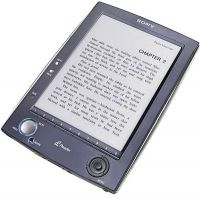 In case you missed it, The New York Times published a piece yesterday previewing two new efforts to bring electronic books to the mass market. In October, Amazon.com will roll out the Kindle (check out leaked pictures here), an ebook reader, priced somewhere between $400 to $500, that will wirelessly connect to an e‑book store on Amazon’s site, from which readers can download books in electronic format. (Think iTunes for ebooks.) Meanwhile, Google will start “charging users for full online access to the digital copies of some books in its database” and share revenue with publishers. The whole idea here is to disrupt the $35 billion book market in much the same way that the Apple has dislocated the music market with the iPod. But whether consumers will see digital books as having comparable advantages to the iPod remains TBD, and the doubters are certainly out there. Read more here. And, in the meantime, if you want a lot of free audiobooks, check out our Audiobook Podcast Collection.
 Subscribe to our feed in a reader
Google GeoMaps the Book World: A Little More “Gee Whiz” Than Utility
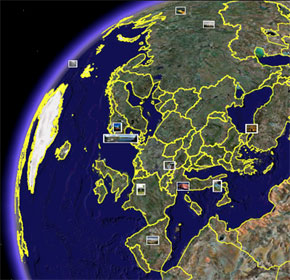 Google Earth added new functionality this week that lets you search the world by geographical location and find books that reference that location. So, for example, if you open Google Earth and type “London,” you will be presented with numerous yellow book icons. Click on any one of them, and Google will show you instances where books specifically reference “London.” (In this case, I found works by Thomas Hobbes and John Locke, two of England’s most important political thinkers.) All of the books presented here are in the public domain, which means that you can continue to explore the complete text, courtesy of Google, should you want to. A nice touch.
There is a certain “gee whiz” factor to this new application, no doubt. But how widely it will be used is another story. Search for “Boston” and you will get more book icons than you can handle. And will you want to mouse over each one to find a potentially useful text? Doubtful. And the problem will only get worse as Google Book Search, a partner in the project, digitizes more texts. A more effective solution, it seems, is simply to head over to Google Book Search and conduct a good, old fashioned search, then read through the more legibly-presented and ranked search results. That’s so 1990s, I know.
Please note that to use this new functionality, you should download a recent version of Google Earth, and check off “Google Book Search” in the “Featured Content” section under “Layers.” You can get more information from Google here and here.
If I am missing something important about this new feature — that is, if I’m wrong about its utility — feel free to say so. The Google folks are smart, and I wouldn’t be surprised if they’re seeing something that I’m not. The jury on GeoMapping books remains out for now.
Support Us
We're hoping to rely on loyal readers, rather than erratic ads. Please click the Donate button and support Open Culture. You can use Paypal, Venmo, Patreon, even Crypto! We thank you!

About Us

Open Culture scours the web for the best educational media. We find the free courses and audio books you need, the language lessons & educational videos you want, and plenty of enlightenment in between.
Advertise With Us

