Read J. R. R. Tolkien’s “Letter From Father Christmas” To His Young Children (1925)

J.R.R. Tolkien is best known for the sweep­ing fan­ta­sy land­scapes of Lord of The Rings and The Hob­bit. Apart from being a cel­e­brat­ed author, the Oxford Uni­ver­si­ty pro­fes­sor of Anglo-Sax­on was also a devot­ed father who dot­ed on his chil­dren.

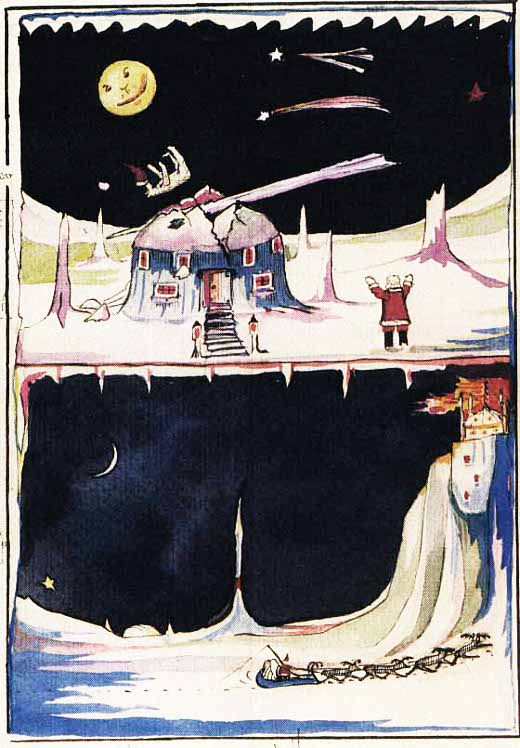
In 1920, a few short years after Tolkien returned from World War I, he began an endear­ing fam­i­ly Christ­mas tra­di­tion that would con­tin­ue for the next 23 years. After the birth of his first­born son, John, Tolkien began to write his four chil­dren let­ters from Father Christ­mas. These North Pole tales chiefly con­cern Father Christ­mas’ strug­gles against the north’s bat-rid­ing gob­lins, as well as the mis­chie­vous hijinks of his helper, North Polar Bear. An adept illus­tra­tor whose orig­i­nal draw­ings accom­pa­nied many of his writ­ings (see his book cov­er designs for Lord of the Rings), Tolkien includ­ed with many of his Christ­mas let­ters a set of charm­ing pic­tures.

The many let­ters were even­tu­al­ly col­lect­ed in a beau­ti­ful vol­ume called Let­ters From Father Christ­mas. Thanks to the good work of Let­ters of Note, we bring to you a sam­ple let­ter from 1925:

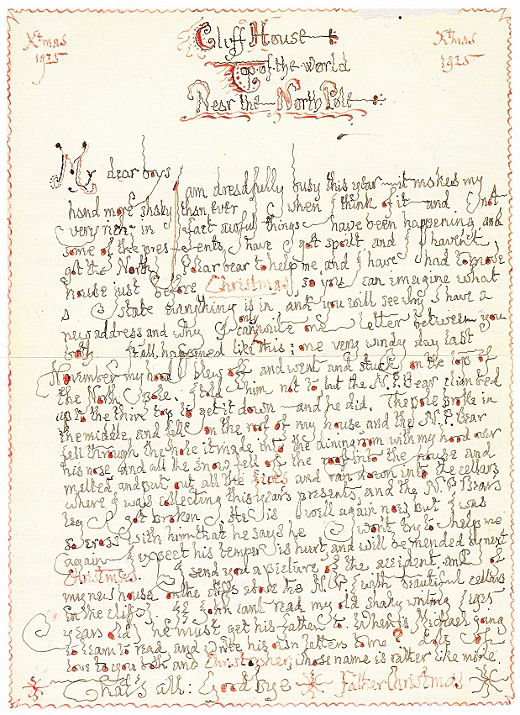
Cliff House

Top of the World

Near the North Pole

Xmas 1925

My dear boys,

I am dread­ful­ly busy this year — it makes my hand more shaky than ever when I think of it — and not very rich. In fact, awful things have been hap­pen­ing, and some of the presents have got spoilt and I haven’t got the North Polar Bear to help me and I have had to move house just before Christ­mas, so you can imag­ine what a state every­thing is in, and you will see why I have a new address, and why I can only write one let­ter between you both. It all hap­pened like this: one very windy day last Novem­ber my hood blew off and went and stuck on the top of the North Pole. I told him not to, but the N.P.Bear climbed up to the thin top to get it down — and he did. The pole broke in the mid­dle and fell on the roof of my house, and the N.P.Bear fell through the hole it made into the din­ing room with my hood over his nose, and all the snow fell off the roof into the house and melt­ed and put out all the fires and ran down into the cel­lars where I was col­lect­ing this year’s presents, and the N.P.Bear’s leg got bro­ken. He is well again now, but I was so cross with him that he says he won’t try to help me again. I expect his tem­per is hurt, and will be mend­ed by next Christ­mas. I send you a pic­ture of the acci­dent, and of my new house on the cliffs above the N.P. (with beau­ti­ful cel­lars in the cliffs). If John can’t read my old shaky writ­ing (1925 years old) he must get his father to. When is Michael going to learn to read, and write his own let­ters to me? Lots of love to you both and Christo­pher, whose name is rather like mine.

That’s all. Good­bye.

Father Christ­mas

via The Paris Review

Relat­ed Con­tent:

110 Draw­ings and Paint­ings by J.R.R. Tolkien: Of Mid­dle-Earth and Beyond

Explore Rarely-Seen Art by J. R. R. Tolkien in a New Web Site Cre­at­ed by the Tolkien Estate

Dis­cov­er J.R.R. Tolkien’s Per­son­al Book Cov­er Designs for The Lord of the Rings Tril­o­gy

Sovi­et-Era Illus­tra­tions Of J. R. R. Tolkien’s The Hob­bit (1976)

Map of Mid­dle-Earth Anno­tat­ed by Tolkien Found in a Copy of Lord of the Rings

Ilia Blin­d­er­man is a Mon­tre­al-based cul­ture and sci­ence writer. Fol­low him at @iliablinderman.

Watch James Earl Jones Read Kurt Vonnegut’s Letter Urging High-School Students to Create Art & “Make Your Soul Grow”

As cul­tur­al fig­ures, the late James Earl Jones and Kurt Von­negut would seem to have had lit­tle in com­mon, but each could eas­i­ly be rec­og­nized by his voice. Jones’ will come to mind as soon as you think of Darth Vad­er, Sim­ba’s father, or “This is CNN.” Von­negut’s dis­tinc­tion was the voice evi­dent on any giv­en page of nov­els like Cat’s Cra­dle, Break­fast of Cham­pi­ons, and of course Slaugh­ter­house-Five — a voice many of us have known since ado­les­cence. They come togeth­er in the Let­ters Live video above with Jones read­ing a Von­negut let­ter to the stu­dents of Ms. Lock­wood’s Eng­lish class at New York’s Xavier High School in 2006.

Von­negut was writ­ing in response to five such stu­dents, who’d cho­sen him when assigned to write to their favorite author. We’ve pre­vi­ous­ly fea­tured his let­ter here on Open Cul­ture as read aloud by Sir Ian McK­ellen, but its mes­sage bears repeat­ing by any­one who will speak it, beloved actor or oth­er­wise. “Prac­tice any art, music, singing, danc­ing, act­ing, draw­ing, paint­ing, sculpt­ing, poet­ry, fic­tion, essays, reportage, no mat­ter how well or bad­ly,” he writes. The idea is “not to get mon­ey and fame, but to expe­ri­ence becom­ing, to find out what’s inside you, to make your soul grow.”

The cel­e­brat­ed nov­el­ist even hands down an assign­ment to his teenage fans: “Write a six line poem, about any­thing, but rhymed. No fair ten­nis with­out a net. Make it as good as you pos­si­bly can. But don’t tell any­body what you’re doing. Don’t show it or recite it to any­body, not even your girl­friend or par­ents or what­ev­er, or Ms. Lock­wood.” After thor­ough­ly dis­pos­ing of this entire­ly pri­vate piece of art, know that “you have expe­ri­enced becom­ing, learned a lot more about what’s inside you, and you have made your soul grow.”

None of this con­flicts with the stan­dard advice about writ­ing, which tends to empha­size just get­ting start­ed, work­ing under restric­tions, and not mak­ing an undue rush to pub­li­ca­tion. But they make a dif­fer­ent kind of impact when rec­om­mend­ed by Von­negut in what would turn out to be the last year of life, and with his char­ac­ter­is­tic ten­den­cy to reach for the heav­ens while nev­er depart­ing from the mun­dane, even sil­ly things of this earth. “Dance home after school, and sing in the show­er and on and on,” he sug­gests. “Make a face in your mashed pota­toes. Pre­tend you’re Count Drac­u­la.” There writes a grand old man of Amer­i­can let­ters who knew how com­mu­ni­cate across a dis­tance of gen­er­a­tions.

Relat­ed con­tent:

James Earl Jones (RIP) Reads Edgar Allan Poe’s “The Raven” and Walt Whitman’s “Song of Myself”

James Earl Jones Reads Oth­el­lo at White House Poet­ry Jam

Fred­er­ick Douglass’s Fiery 1852 Speech, “The Mean­ing of July 4th for the Negro,” Read by James Earl Jones

Darth Vader’s Voice: The Orig­i­nal Voice Ver­sus the Vocals of James Earl Jones

Kurt Von­negut Urges Young Peo­ple to Make Art and “Make Your Soul Grow”

Sir Ian McK­ellen Reads Kurt Vonnegut’s Let­ter to High School Stu­dents: Make Art and “Make Your Soul Grow”

Based in Seoul, Col­in Marshall writes and broad­casts on cities, lan­guage, and cul­ture. His projects include the Sub­stack newslet­ter Books on Cities and the book The State­less City: a Walk through 21st-Cen­tu­ry Los Ange­les. Fol­low him on Twit­ter at @colinmarshall or on Face­book.

Gertrude Stein Gets a Snarky Rejection Letter from a Publisher (1912)

stein-rejection-letter

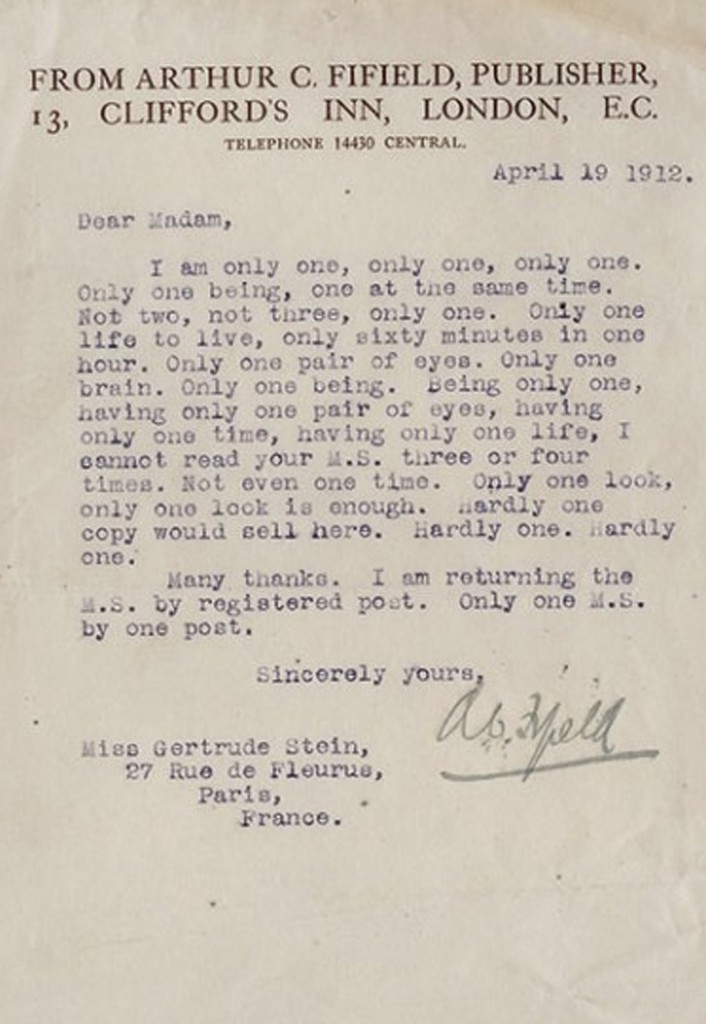
Gertrude Stein con­sid­ered her­self an exper­i­men­tal writer and wrote what The Poet­ry Foun­da­tion calls “dense poems and fic­tions, often devoid of plot or dia­logue,” with the result being that “com­mer­cial pub­lish­ers slight­ed her exper­i­men­tal writ­ings and crit­ics dis­missed them as incom­pre­hen­si­ble.” Take, for exam­ple, what hap­pened when Stein sent a man­u­script to Alfred C. Fifield, a Lon­don-based pub­lish­er, and received a rejec­tion let­ter mock­ing her prose in return. Accord­ing to Let­ters of Note, the man­u­script in ques­tion was pub­lished many years lat­er as her mod­ernist nov­el, The Mak­ing of Amer­i­cans: Being a His­to­ry of a Fam­i­ly’s Progress (1925). You can hear Stein read­ing a selec­tion from the nov­el below.

If you would like to sup­port the mis­sion of Open Cul­ture, con­sid­er mak­ing a dona­tion to our site. It’s hard to rely 100% on ads, and your con­tri­bu­tions will help us con­tin­ue pro­vid­ing the best free cul­tur­al and edu­ca­tion­al mate­ri­als to learn­ers every­where. You can con­tribute through Pay­Pal, Patre­on, and Ven­mo (@openculture). Thanks!

Relat­ed Con­tent:

Gertrude Stein Sends a “Review” of The Great Gats­by to F. Scott Fitzger­ald (1925)

No Women Need Apply: A Dis­heart­en­ing 1938 Rejec­tion Let­ter from Dis­ney Ani­ma­tion

Alice B. Tok­las Reads Her Famous Recipe for Hashish Fudge (1963)

by | Permalink | Make a Comment ( 5 ) |

Laurence Fishburne Reads a Former Slave’s Incredible Letter to His Old Master (1865)

Lawrence Fish­burne brings a degree of grav­i­ty to his roles offered by few oth­er liv­ing actors. That has secured his place in pop cul­ture as Mor­pheus from The Matrix, for exam­ple. But he could even mar­shal it ear­ly in his career, as evi­denced by his role as Apoc­a­lypse Now’s “Mr. Clean,” which he took on at just four­teen years old. But it was a much more recent per­for­mance he gave for Let­ters Live, which you can see in the video above, that clear­ly brings out the qual­i­ties that have made him a beloved and endur­ing fig­ure onscreen: not just his moral seri­ous­ness, but this sense of humor as well.

“To my old mas­ter,” Fish­burne begins, get­ting a laugh right away. The let­ter in ques­tion, pre­vi­ous­ly fea­tured here on Open Cul­ture, was orig­i­nal­ly writ­ten in 1865 by a man named Jour­don Ander­son, who had escaped a life of slav­ery in Ten­nessee with his wife the pre­vi­ous year. Hav­ing since fall­en on hard times, that for­mer mas­ter had writ­ten to Ander­son and asked him to come back to work on the plan­ta­tion. “I have often felt uneasy about you,” Ander­son writes. “I thought the Yan­kees would’ve hung you before this for har­bor­ing Rebs that they found at your house,” among oth­er crimes he recalls.

Hav­ing set him­self and his fam­i­ly up in Ohio, Ander­son could hard­ly have felt tempt­ed to go down South again. “I want to know par­tic­u­lar­ly what the good chance is you pro­pose to give me,” he writes. “I am doing tol­er­a­bly well here. I get $25 a month, with vict­uals and cloth­ing, have a com­fort­able home for Mandy — the folks call her Mrs. Ander­son — and the chil­dren, Mil­lie, Jane, and Grundy, go to school and are learn­ing well.” But “if you will write and say what wages you will give me, I will bet­ter be able to decide whether it will be to my advan­tage to move back again.”

Fish­burne deliv­ers these lines with a thick lay­er of irony, as Ander­son no doubt intend­ed. “Mandy says she would be afraid to go back with­out some proof that you were dis­posed to treat us kind­ly and just­ly, and we have con­clud­ed to test your sin­cer­i­ty by ask­ing you to send us our wages for the time that we served you.” When Fish­burne says that, he prac­ti­cal­ly gets a stand­ing ova­tion, and indeed, the let­ter met with a favor­able recep­tion in its day as well — not from Colonel P. H. Ander­son him­self, but from the read­ers of the news­pa­pers in which it was reprint­ed. In the end, Jour­don Ander­son kept his free­dom, and got fame last­ing more than a cen­tu­ry after his death to go with it.

Relat­ed con­tent:

Hear the Voic­es of Amer­i­cans Born in Slav­ery: The Library of Con­gress Fea­tures 23 Audio Inter­views with For­mer­ly Enslaved Peo­ple (1932–75)

What the Text­books Don’t Tell Us About The Atlantic Slave Trade: An Ani­mat­ed Video Fills In His­tor­i­cal Gaps

The Names of 1.8 Mil­lion Eman­ci­pat­ed Slaves Are Now Search­able in the World’s Largest Genealog­i­cal Data­base, Help­ing African Amer­i­cans Find Lost Ances­tors

A New Data­base Will Doc­u­ment Every Slave House in the U.S.: Dis­cov­er the “Sav­ing Slave Hous­es Project”

The Atlantic Slave Trade Visu­al­ized in Two Min­utes: 10 Mil­lion Lives, 20,000 Voy­ages, Over 315 Years

“Ask a Slave” by Azie Dungey Sets the His­tor­i­cal Record Straight in a New Web Series

Based in Seoul, Col­in Marshall writes and broad­casts on cities, lan­guage, and cul­ture. His projects include the Sub­stack newslet­ter Books on Cities, the book The State­less City: a Walk through 21st-Cen­tu­ry Los Ange­les and the video series The City in Cin­e­ma. Fol­low him on Twit­ter at @colinmarshall or on Face­book.


The Roman Author Pliny the Younger Gets Ghosted by a Friend, and Goes on a Rant: Hear It Read by Actor Rob Delaney

Pliny the Younger may be best remem­bered for writ­ing the only eye-wit­ness account of the destruc­tion of Pom­peii in 79 AD. It’s a mem­o­rable let­ter still found in mod­ern col­lec­tions of Pliny the Younger’s cor­re­spon­dence. There, you can also find a sim­ple let­ter authored by Pliny, one that reflects not on a shat­ter­ing his­tor­i­cal event, but rather some­thing we can all relate to: the anger the author felt upon get­ting ghost­ed by a friend. To set the scene, Pliny had invit­ed Sep­ti­cius Clarus to join him for some food, wine, and con­ver­sa­tion. But his friend nev­er showed up, and so Pliny fired off a snub let­ter, which actor and come­di­an Rob Delaney reads above at a Let­ters Live event. You can fol­low along with the text below:

Shame on you! You promised to come to din­ner, and you nev­er came!

I’ll take you to court, and you will pay to the last pen­ny for my loss­es, and quite a sum! Ready for each of us were a let­tuce, three snails, and two eggs, bar­ley water with hon­ey wine cooled with snow (you must add the cost of snow as well, in fact the snow in par­tic­u­lar, as it melts in the dish). There were olives, beet­root, gourds, onions, and count­less oth­er del­i­ca­cies no less ele­gant. You would have heard per­form­ers of com­e­dy, or a read­er, or a lyre-play­er, or even all three, such is my gen­eros­i­ty!

But you pre­ferred to dine at some nobody’s house, enjoy­ing oys­ters, sow’s tripe, sea urchins, and per­form­ing-girls from Cadiz. You’ll be pun­ished for this, I won’t say how. What boor­ish­ness was this! You begrudged per­haps your­self, and cer­tain­ly me – but yes, your­self as well. What jok­ing and laugh­ter and learn­ing we would have enjoyed!

You can dine in many hous­es on more elab­o­rate fare, but nowhere more genial­ly, inno­cent­ly, and unguard­ed­ly. Farewell!

In the end, Pliny for­gave his friend. For Pliny ded­i­cat­ed the first of his let­ter to Sep­ti­cius, stat­ing: “You have con­stant­ly urged me to col­lect and pub­lish the more high­ly fin­ished of the let­ters that I may have writ­ten. I have made such a col­lec­tion… I can only hope that you will not have cause to regret the advice you gave, and that I shall not repent hav­ing fol­lowed it.” You can read the col­lec­tion online here.

Relat­ed Con­tent

The Only Writ­ten Eye-Wit­ness Account of Pompeii’s Destruc­tion: Hear Pliny the Younger’s Let­ters on the Mount Vesu­vius Erup­tion

The Lit­tle-Known Bomb­ing of Pom­peii Dur­ing World War II

What the Romans Saw When They Reached New Parts of the World: Hear First-Hand Accounts by Appi­an, Pliny, Tac­i­tus & Oth­er Ancient His­to­ri­ans

Stephen Fry Reads Nick Cave’s Stirring Letter About ChatGPT and Human Creativity: “We Are Fighting for the Very Soul of the World”

Observers have expressed a vari­ety of reac­tions to the orga­ni­za­tion­al dra­ma unfold­ing even now at Ope­nAI, the non-prof­it behind the enor­mous­ly pop­u­lar Chat­G­PT. Some have already writ­ten spec­u­la­tive laments in case of Ope­nAI’s total dis­so­lu­tion, mourn­ing the great strides in arti­fi­cial intel­li­gence that would thus be for­sak­en. It’s safe to say that Nick Cave will not do the same: hav­ing used his newslet­ter The Red Hand Files to cast doubt on AI’s abil­i­ty to write a great song — and to con­demn a set of Chat­G­PT-gen­er­at­ed lyrics in his own style — he more recent­ly told a fan exact­ly “what’s wrong with mak­ing things faster and eas­i­er” through AI.

“Chat­G­PT rejects any notions of cre­ative strug­gle, that our endeav­ors ani­mate and nur­ture our lives giv­ing them depth and mean­ing,” Cave writes. “It rejects that there is a col­lec­tive, essen­tial and uncon­scious human spir­it under­pin­ning our exis­tence, con­nect­ing us all through our mutu­al striv­ing.”

In “fast-track­ing the com­mod­i­fi­ca­tion of the human spir­it by mech­a­niz­ing the imag­i­na­tion,” it works toward elim­i­nat­ing “the process of cre­ation and its atten­dant chal­lenges, view­ing it as noth­ing more than a time-wast­ing incon­ve­nience that stands in the way of the com­mod­i­ty itself.” But the cre­ative impulse “must be defend­ed at all costs, and just as we would fight any exis­ten­tial evil,” we should fight the forces set against it “tooth and nail, for we are fight­ing for the very soul of the world.”

These are strong words, and they sound even stronger when read aloud in the Let­ters Live video above by Stephen Fry. One may sense a cer­tain irony here, giv­en Fry’s well-known technophil­ia, but he and Cave have made com­mon cause before, whether call­ing for gov­ern­ment sup­port of the arts or turn­ing up for the coro­na­tion of King Charles III. “Fry refers to Cave’s Mur­der Bal­lads album in his book The Ode Less Trav­elled,” adds one Youtube com­menter, “while Fry is rumored to be the per­son with ‘an enor­mous and ency­clo­pe­dic brain’ in Cave’s song ‘We Call Upon the Author.’ ” Chat­G­PT could well be described as ency­clo­pe­dic, but in no ordi­nary sense does it have a brain — the very thing of which authors are now called upon to make the fullest pos­si­ble use.

Relat­ed Con­tent:

Nick Cave Answers the Hot­ly Debat­ed Ques­tion: Will Arti­fi­cial Intel­li­gence Ever Be Able to Write a Great Song?

A New Course Teach­es You How to Tap the Pow­ers of Chat­G­PT and Put It to Work for You

Chat­G­PT Writes a Song in the Style of Nick Cave–and Nick Cave Calls it “a Grotesque Mock­ery of What It Is to Be Human”

Noam Chom­sky on Chat­G­PT: It’s “Basi­cal­ly High-Tech Pla­gia­rism” and “a Way of Avoid­ing Learn­ing”

Demys­ti­fy­ing Nick Cave and the Bad Seeds’ “Red Right Hand,” and How It Was Inspired by Milton’s Par­adise Lost

Bene­dict Cum­ber­batch, Mar­garet Atwood, Stephen Fry & Oth­ers Read Let­ters of Hope, Love & Sup­port Dur­ing COVID-19

Based in Seoul, Col­in Marshall writes and broad­casts on cities, lan­guage, and cul­ture. His projects include the Sub­stack newslet­ter Books on Cities, the book The State­less City: a Walk through 21st-Cen­tu­ry Los Ange­les and the video series The City in Cin­e­ma. Fol­low him on Twit­ter at @colinmarshall or on Face­book.

Benedict Cumberbatch Reads a Letter to People Who Don’t Lock Bathroom Doors

In April 2018, author Andrew For­rester wrote an open let­ter to “Peo­ple Who Don’t Make Every Con­ceiv­able Effort to Ensure that the Bath­room Door is Locked.” And now Bene­dict Cum­ber­batch has read it, and read it well. This read­ing took place at Let­ters Live, an event cel­e­brat­ing the pow­er of lit­er­ary cor­re­spon­dence, held at Lon­don’s Roy­al Albert Hall. You can find oth­er Cum­ber­batch read­ings in the Relat­eds below.

If you would like to sup­port the mis­sion of Open Cul­ture, con­sid­er mak­ing a dona­tion to our site. It’s hard to rely 100% on ads, and your con­tri­bu­tions will help us con­tin­ue pro­vid­ing the best free cul­tur­al and edu­ca­tion­al mate­ri­als to learn­ers every­where. You can con­tribute through Pay­Pal, Patre­on, and Ven­mo (@openculture). Thanks!

Relat­ed Con­tent 

Bene­dict Cum­ber­batch & Ian McK­ellen Read Epic Let­ters Writ­ten by Kurt Von­negut

Bene­dict Cum­ber­batch Reads “the Best Cov­er Let­ter Ever Writ­ten”

Hear Bene­dict Cum­ber­batch Read­ing Let­ters by Kurt Von­negut, Alan Tur­ing, Sol LeWitt, and Oth­ers

A Student Writes a Rejection Letter Rejecting Harvard’s Rejection Letter (1981): Hear It Read by Actor Himesh Patel

The doc­u­men­tary film­mak­er and sports edi­tor Paul Devlin has won five Emmy awards, but he may well be bet­ter known for not get­ting into Har­vard — or rather, for not get­ting into Har­vard, then reject­ing Har­vard’s rejec­tion. “I noticed that the rejec­tion let­ter I received from Har­vard had a gram­mat­i­cal error,” Devlin writes. “So, I wrote a let­ter back, reject­ing their rejec­tion let­ter.” His moth­er then “sent a copy of this let­ter to the New York Times and it was pub­lished in the New Jer­sey sec­tion on May 31, 1981.” In 1996, when the New York Times Mag­a­zine pub­lished a cov­er sto­ry “about the trau­ma stu­dents were expe­ri­enc­ing get­ting reject­ed from col­leges,” she seized the oppor­tu­ni­ty to send her son’s rejec­tion-rejec­tion let­ter to the Paper of Record.

It turned out that Devlin’s let­ter had already run there, hav­ing long since gone the pre-social-media equiv­a­lent of viral. “The New York Times accused me of pla­gia­rism. When they dis­cov­ered that I was the orig­i­nal author and they had unwit­ting­ly re-print­ed them­selves, they were none too hap­py. But my mom insists that it was impor­tant to reprint the arti­cle because the issue was clear­ly still rel­e­vant.”

Indeed, its after­life con­tin­ues even today, as evi­denced by the new video from Let­ters Live at the top of the post. In it actor Himesh Patel, well-known from series like Eas­t­En­ders, Sta­tion Eleven, and Avenue 5, reads aloud Devlin’s let­ter, which runs as fol­lows:

Hav­ing reviewed the many rejec­tion let­ters I have received in the last few weeks, it is with great regret that I must inform you I am unable to accept your rejec­tion at this time.

This year, after apply­ing to a great many col­leges and uni­ver­si­ties, I received an espe­cial­ly fine crop of rejec­tion let­ters. Unfor­tu­nate­ly, the num­ber of rejec­tions that I can accept is lim­it­ed.

Each of my rejec­tions was reviewed care­ful­ly and on an indi­vid­ual basis. Many fac­tors were tak­en into account – the size of the insti­tu­tion, stu­dent-fac­ul­ty ratio, loca­tion, rep­u­ta­tion, costs and social atmos­phere.

I am cer­tain that most col­leges I applied to are more than qual­i­fied to reject me. I am also sure that some mis­takes were made in turn­ing away some of these rejec­tions. I can only hope they were few in num­ber.

I am aware of the keen dis­ap­point­ment my deci­sion may bring. Through­out my delib­er­a­tions, I have kept in mind the time and effort it may have tak­en for you to reach your deci­sion to reject me.

Keep in mind that at times it was nec­es­sary for me to reject even those let­ters of rejec­tion that would nor­mal­ly have met my tra­di­tion­al­ly high stan­dards.

I appre­ci­ate your hav­ing enough inter­est in me to reject my appli­ca­tion. Let me take the oppor­tu­ni­ty to wish you well in what I am sure will be a suc­cess­ful aca­d­e­m­ic year.

SEE YOU IN THE FALL!

Sin­cere­ly,
Paul Devlin
Appli­cant at Large

How­ev­er con­sid­er­able the mox­ie (to use a whol­ly Amer­i­can term) shown by the young Devlin in his let­ter, his rea­son­ing seems not to have swayed Har­vard’s admis­sions depart­ment. Whether it would prove any more effec­tive in the twen­ty-twen­ties than it did in the nine­teen-eight­ies seems doubt­ful, but it must remain a sat­is­fy­ing read for high-school stu­dents dispir­it­ed by the sup­pli­cat­ing pos­ture the col­lege-appli­ca­tion process all but forces them to take. It sure­ly does them good to remem­ber that they, too, pos­sess the agency to declare accep­tance or rejec­tion of that which is pre­sent­ed to them sim­ply as neces­si­ty, as oblig­a­tion, as a giv­en. And for Devlin, at least, there was always the Uni­ver­si­ty of Michi­gan.

Relat­ed con­tent:

Read Rejec­tion Let­ters Sent to Three Famous Artists: Sylvia Plath, Kurt Von­negut & Andy Warhol

T. S. Eliot, as Faber & Faber Edi­tor, Rejects George Orwell’s “Trot­skyite” Nov­el Ani­mal Farm (1944)

Gertrude Stein Gets a Snarky Rejec­tion Let­ter from Pub­lish­er (1912)

Meet the “Gram­mar Vig­i­lante,” Hell-Bent on Fix­ing Gram­mat­i­cal Mis­takes on England’s Store­front Signs

Steven Pinker Iden­ti­fies 10 Break­able Gram­mat­i­cal Rules: “Who” Vs. “Whom,” Dan­gling Mod­i­fiers & More

Based in Seoul, Col­in Marshall writes and broad­casts on cities, lan­guage, and cul­ture. His projects include the Sub­stack newslet­ter Books on Cities, the book The State­less City: a Walk through 21st-Cen­tu­ry Los Ange­les and the video series The City in Cin­e­ma. Fol­low him on Twit­ter at @colinmarshall or on Face­book.

« Go BackMore in this category... »
Quantcast