Imagine, if you will, an evening’s entertainment consisting of an episode of Portlandia, a spin of Nirvana’s In Utero, and a screening of Koyaanisqatsi. Perhaps these works would, at first glance, seem to have little in common. But if you end the night by watching the above episode of Big Think’s series Dispatches from the Well with Kmele Foster, their common spirit may well come into view. In it, Foster travels America in order to visit with Godfrey Reggio, Steve Albini, and Fred Armisen, widely known, respectively, as the director of Koyaanisqatsi, the producer of In Utero, and the co-creator of Portlandia. All of them have also made a great deal of other work, and none of them are about to stop now.
“When you have a mania, you can scream and go nuts, or you can write everything down,” says Reggio. “I write everything down.” The same concept arises in Foster’s conversation with Albini, who believes that “the best music is made in service of the mania of the people doing it at the moment.” As for “the people who are trying to be popular, who are trying to, like, entertain — a lot of that music is trivial.”
Foster credibly describes Albini as “a man with a code,” not least that which dictates his rejection of digital media. “I’m not making an aesthetic case for analog recording,” he says. “Analog recordings are a durable archive of our culture, and in the distant future, I want people to be able to hear what our music sounded like.”
To create as persistently as these three have demands a willingness to play the long game — and to “re-perceive the normal,” as Reggio puts it while articulating the purpose of his unconventional documentary films. To his mind, it’s what we perceive least that affects us most, and if “what we do every day, without question, is who we are,” we can enrich our experience of reality by asking questions in our life and our work like, “Is it the content of your mind that determines your behavior, or is it your behavior that determines the content of your mind?” This line of inquiry will send each of us in different intellectual and aesthetic directions, impossible though it is to arrive at a final answer. And in the face of the fact that we all end up at the same place in the end, Armisen has a creative strategy: “I really celebrate death,” he explains. “I have my funeral all planned out and everything.”
Based in Seoul, Colin Marshall writes and broadcasts on cities, language, and culture. His projects include the Substack newsletterBooks on Cities, the book The Stateless City: a Walk through 21st-Century Los Angeles and the video series The City in Cinema. Follow him on Twitter at @colinmarshall or on Facebook.
In 1966, Paul McCartney famously sang of “all the lonely people,” wondering aloud where they come from. Nearly six decades later, their numbers seem only to have increased; as for their origin, psychiatrist, psychoanalyst, and Zen priest Robert Waldinger has made it a longtime professional concern. “Starting in the nineteen fifties, and going all the way through to today, we know that people have been less and less invested in other people,” he says in the Big Think video above. “In some studies, as many as 60 percent of people will say that they feel lonely much of the time,” a feeling “pervasive across the world, across all age groups, all income groups, all demographics.”
“Having an extensive network of friends is no guarantee against loneliness,” writes the late sociologist Ray Oldenburg in The Great Good Place. “Nor does membership in voluntary associations, the ‘instant communities’ of our mobile society, ensure against social isolation and attendant feelings of boredom and alienation. The network of friends has no unity and no home base.” He names as a key factor the disappearance, especially in American life since World War II, of “convenient and open-ended socializing — places where individuals can go without aim or arrangement and be greeted by people who know them and know how to enjoy a little time off.”
Oldenburg’s elegy for and defense of “cafés, coffee shops, community centers, general stores, bars,” and other engines of community life, was published in 1989, well before the rise of social media — which Waldinger frames as the latest stage in a process that began with television. As more American homes acquired sets of their own, “there was a decline in investing in our communities. People went out less, they joined clubs less often. They went to houses of worship less often. They invited people over less often.” Then, “the digital revolution gave us more and more screens to look at, and software that was designed specifically to grab our attention, hold our attention, and therefore keep it away from the people we care about.”
We also know, he continues, that “people with strong social bonds are much less likely to die in any given year than people without strong social bonds.” This is a credible claim, given that he happens to direct the now 85-year-long Harvard Study of Adult Development. In 2016, we featured Waldinger’s TED Talk on some of its findings here on Open Culture. Before that, we posted a PBS BrainCraft video that considers the Harvard Study of Adult Development along with other research on the contributing factors to happiness, a body of work that, taken together, points to the importance of love — which, even if it isn’t all you need, is certainly something you need. And thus one more Beatles lyric continues to resonate.
Based in Seoul, Colin Marshall writes and broadcasts on cities, language, and culture. His projects include the Substack newsletterBooks on Cities, the book The Stateless City: a Walk through 21st-Century Los Angeles and the video series The City in Cinema. Follow him on Twitter at @colinmarshall or on Facebook.
Six months before his assassination, Martin Luther King Jr. spoke to students at Barratt Junior High School in Philadelphia, and asked What Is Your Life’s Blueprint?
Addressing the students, he observed: “This is the most important and crucial period of your lives. For what you do now and what you decide now at this age may well determine which way your life shall go. Whenever a building is constructed, you usually have an architect who draws a blueprint. And that blueprint serves as the pattern, as the guide, as the model, for those who are to build the building. And a building is not well erected without a good, sound, and solid blueprint.”
So what makes for a sound blueprint? The civil rights leader had some suggestions:
Number one in your life’s blueprint should be: a deep belief in your own dignity, your own worth and your own somebodiness. Don’t allow anybody to make you feel that you are nobody. Always feel that you count. Always feel that you have worth, and always feel that your life has ultimate significance.
Now that means you should not be ashamed of your color. You know, it’s very unfortunate that in so many instances, our society has placed a stigma on the Negro’s color. You know there are some Negros who are ashamed of themselves? Don’t be ashamed of your color. Don’t be ashamed of your biological features…
Secondly, in your life’s blueprint you must have as the basic principle the determination to achieve excellence in your various fields of endeavor. You’re going to be deciding as the days and the years unfold, what you will do in life — what your life’s work will be.
And once you discover what it will be, set out to do it, and to do it well.
You can read a transcript of the speech here. As a postscript, it’s worth highlighting a remarkable comment left on YouTube, from the student who apparently recorded the speech on October 26, 1967. It reads:
I cannot believe that I found this footage. I am the student cameraman that recorded this speech. I remember this like it was yesterday. I have been telling my boys for years about this and now I can show them. I thought this was lost years ago and am so happy that it survived the years. I was 12 or 13 years old when he can to Barrett and was mesmerized by what he was saying. I can’t wait to share this with my family. Wow I am elated that I found this.
Why must we all work long hours to earn the right to live? Why must only the wealthy have access to leisure, aesthetic pleasure, self-actualization…? Everyone seems to have an answer, according to their political or theological bent. One economic bogeyman, so-called “trickle-down” economics, or “Reaganomics,” actually predates our 40th president by a few hundred years at least. The notion that we must better ourselves—or simply survive—by toiling to increase the wealth and property of already wealthy men was perhaps first comprehensively articulated in the 18th-century doctrine of “improvement.” In order to justify privatizing common land and forcing the peasantry into jobbing for them, English landlords attempted to show in treatise after treatise that 1) the peasants were lazy, immoral, and unproductive, and 2) they were better off working for others. As a corollary, most argued that landowners should be given the utmost social and political privilege so that their largesse could benefit everyone.
This scheme necessitated a complete redefinition of what it meant to work. In his study, The English Village Community and the Enclosure Movements, historian W.E. Tate quotes from several of the “improvement” treatises, many written by Puritans who argued that “the poor are of two classes, the industrious poor who are content to work for their betters, and the idle poor who prefer to work for themselves.” Tate’s summation perfectly articulates the early modern redefinition of “work” as the creation of profit for owners. Such work is virtuous, “industrious,” and leads to contentment. Other kinds of work, leisurely, domestic, pleasurable, subsistence, or otherwise, qualifies—in an Orwellian turn of phrase—as “idleness.” (We hear echoes of this rhetoric in the language of “deserving” and “undeserving” poor.) It was this language, and its legal and social repercussions, that Max Weber later documented in The Protestant Ethic and the Spirit of Capitalism, Karl Marx reacted to in Das Capital, and feminists have shown to be a consolidation of patriarchal power and further exclusion of women from economic participation.
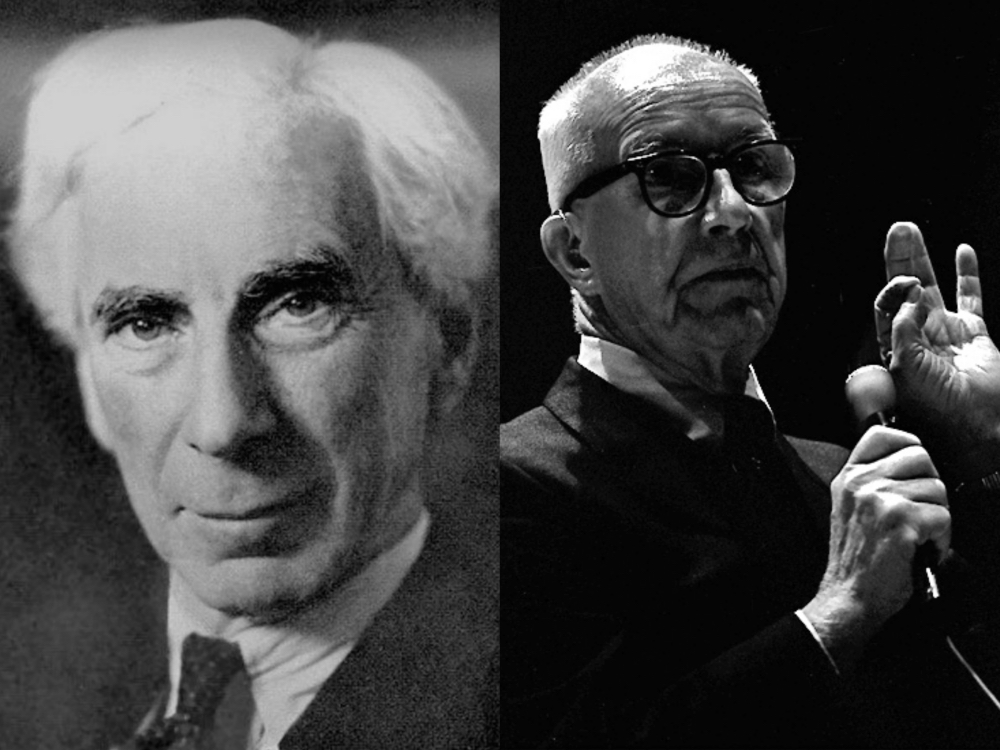
Along with Marx, various others have raised significant objections to Protestant, capitalist definitions of work, including Thomas Paine, the Fabians, agrarians, and anarchists. In the twentieth century, we can add two significant names to an already distinguished list of dissenters: Buckminster Fuller and Bertrand Russell. Both challenged the notion that we must have wage-earning jobs in order to live, and that we are not entitled to indulge our passions and interests unless we do so for monetary profit or have independent wealth. In a New York Times column on Russell’s 1932 essay “In Praise of Idleness,” Gary Gutting writes, “For most of us, a paying job is still utterly essential — as masses of unemployed people know all too well. But in our economic system, most of us inevitably see our work as a means to something else: it makes a living, but it doesn’t make a life.”
In far too many cases in fact, the work we must do to survive robs us of the ability to live by ruining our health, consuming all our precious time, and degrading our environment. In his essay, Russell argued that “there is far too much work done in the world, that immense harm is caused by the belief that work is virtuous, and that what needs to be preached in modern industrial countries is quite different from what has always been preached.” His “arguments for laziness,” as he called them, begin with definitions of what we mean by “work,” which might be characterized as the difference between labor and management:
What is work? Work is of two kinds: first, altering the position of matter at or near the earth’s surface relatively to other such matter; second, telling other people to do so. The first kind is unpleasant and ill paid; the second is pleasant and highly paid.
Russell further divides the second category into “those who give orders” and “those who give advice as to what orders should be given.” This latter kind of work, he says, “is called politics,” and requires no real “knowledge of the subjects as to which advice is given,” but only the ability to manipulate: “the art of persuasive speaking and writing, i.e. of advertising.” Russell then discusses a “third class of men” at the top, “more respected than either of the classes of the workers”—the landowners, who “are able to make others pay for the privilege of being allowed to exist and to work.” The idleness of landowners, he writes, “is only rendered possible by the industry of others. Indeed their desire for comfortable idleness is historically the source of the whole gospel of work. The last thing they have ever wished is that others should follow their example.”
The “gospel of work” Russell outlines is, he writes, “the morality of the Slave State,” and the kinds of murderous toil that developed under its rule—actual chattel slavery, fifteen hour workdays in abominable conditions, child labor—has been “disastrous.” Work looks very different today than it did even in Russell’s time, but even in modernity, when labor movements have managed to gather some increasingly precarious amount of social security and leisure time for working people, the amount of work forced upon the majority of us is unnecessary for human thriving and in fact counter to it—the result of a still-successful capitalist propaganda campaign: if we aren’t laboring for wages to increase the profits of others, the logic still dictates, we will fall to sloth and vice and fail to earn our keep. “Satan finds some mischief for idle hands to do,” goes the Protestant proverb Russell quotes at the beginning of his essay. On the contrary, he concludes,
…in a world where no one is compelled to work more than four hours a day, every person possessed of scientific curiosity will be able to indulge it, and every painter will be able to paint without starving, however excellent his pictures may be. Young writers will not be obliged to draw attention to themselves by sensational pot-boilers, with a view to acquiring the economic independence for monumental works, for which, when the time at last comes, they will have lost the taste and capacity.
The less we are forced to labor, the more we can do good work in our idleness, and we can all labor less, Russell argues, because “modern methods of production have given us the possibility of ease and security for all” instead of “overwork for some and starvation for others.”
A few decades later, visionary architect, inventor, and theorist Buckminster Fuller would make exactly the same argument, in similar terms, against the “specious notion that everybody has to earn a living.” Fuller articulated his ideas on work and non-work throughout his long career. He put them most succinctly in a 1970 New York magazine “Environmental Teach-In”:
It is a fact today that one in ten thousand of us can make a technological breakthrough capable of supporting all the rest…. We keep inventing jobs because of this false idea that everybody has to be employed at some kind of drudgery because, according to Malthusian-Darwinian theory, he must justify his right to exist.
Many people are paid very little to do backbreaking labor; many others paid quite a lot to do very little. The creation of surplus jobs leads to redundancy, inefficiency, and the bureaucratic waste we hear so many politicians rail against: “we have inspectors and people making instruments for inspectors to inspect inspectors”—all to satisfy a dubious moral imperative and to make a small number of rich people even richer.
What should we do instead? We should continue our education, and do what we please, Fuller argues: “The true business of people should be to go back to school and think about whatever it was they were thinking about before somebody came along and told them they had to earn a living.” We should all, in other words, work for ourselves, performing the kind of labor we deem necessary for our quality of life and our social arrangements, rather than the kinds of labor dictated to us by governments, landowners, and corporate executives. And we can all do so, Fuller thought, and all flourish similarly. Fuller called the technological and evolutionary advancement that enables us to do more with less “euphemeralization.” InCritical Path, a visionary work on human development, he claimed “It is now possible to give every man, woman and child on Earth a standard of living comparable to that of a modern-day billionaire.”
Sound utopian? Perhaps. But Fuller’s far-reaching path out of reliance on fossil fuels and into a sustainable future has never been tried, for some depressingly obvious reasons and some less obvious. Neither Russell nor Fuller argued for the abolition—or inevitable self-destruction—of capitalism and the rise of a workers’ paradise. (Russell gave up his early enthusiasm for communism.) Neither does Gary Gutting, a philosophy professor at the University of Notre Dame, who in his New York Times commentary on Russell asserts that “Capitalism, with its devotion to profit, is not in itself evil.” Most Marxists on the other hand would argue that devotion to profit can never be benign. But there are many middle ways between state communism and our current religious devotion to supply-side capitalism, such as robust democratic socialism or a basic income guarantee. In any case, what most dissenters against modern notions of work share in common is the conviction that education should produce critical thinkers and self-directed individuals, and not, as Gutting puts it, “be primarily for training workers or consumers”—and that doing work we love for the sake of our own personal fulfillment should not be the exclusive preserve of a propertied leisure class.
Note: An earlier version of this post appeared on our site in 2015.
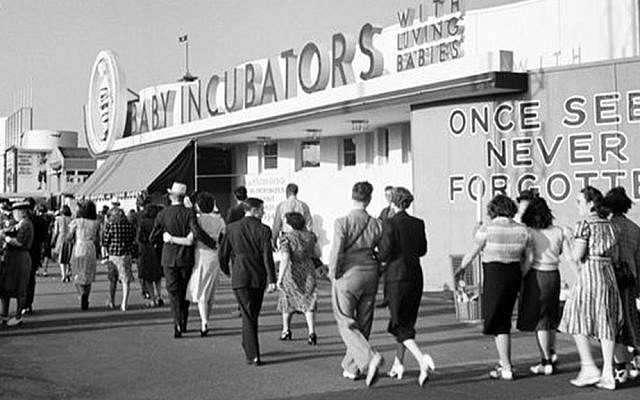
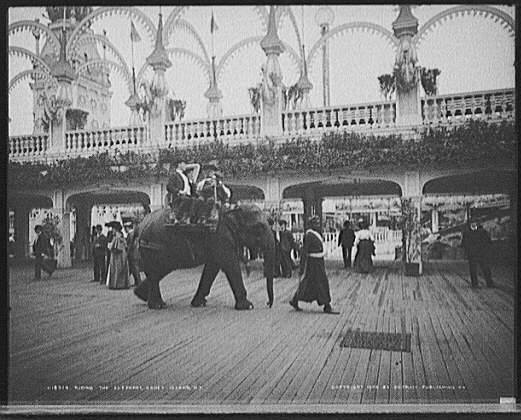
Early in the 20th century, crowds flocked to New York City’s Coney Island, where wonders awaited at every turn.
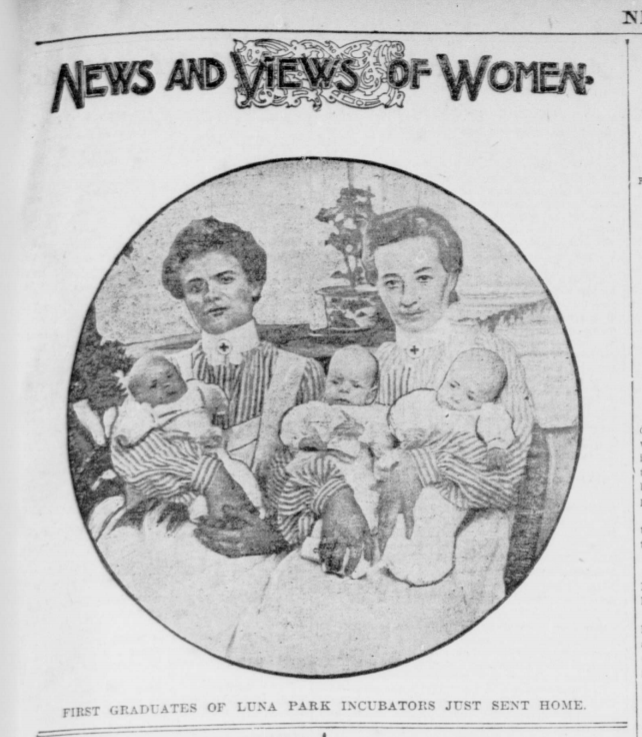
In 1902, the Brooklyn Daily Eagle published a few of the highlights in store for visitors at Coney Island’s soon-to-open “electric Eden,” Luna Park:
…the most important will be an illustration of Jules Verne’s ‘Twenty Thousand Leagues Under the Sea’, which will cover 55,000 square feet of ground, and a naval spectatorium, which will have a water area of 60,000 square feet. Beside these we will have many novelties, including the River Styx, the Whirl of the Town, Shooting the White Horse Rapids, the Grand Canyon, the ’49 Mining Camp, Dragon Rouge, overland and incline railways, Japanese, Philippine, Irish, Eskimo and German villages, the infant incubator, water show and carnival, circus and hippodrome, Yellowstone Park, zoological gardens, performing wild beasts, sea lions and seals, caves of Capri, the Florida Everglades and Mont Pelee, an electric representation of the volcanic destruction of St. Pierre.
Hold up a sec…what’s this about an infant incubator? What kind of name is that for a roller coaster!?
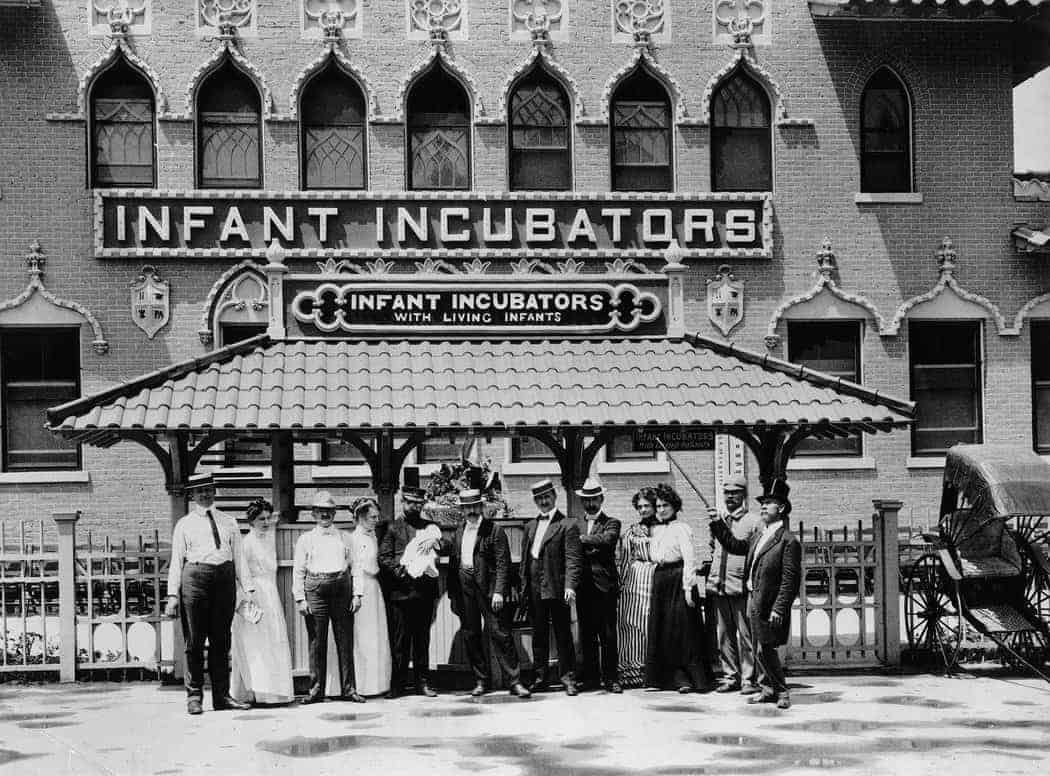
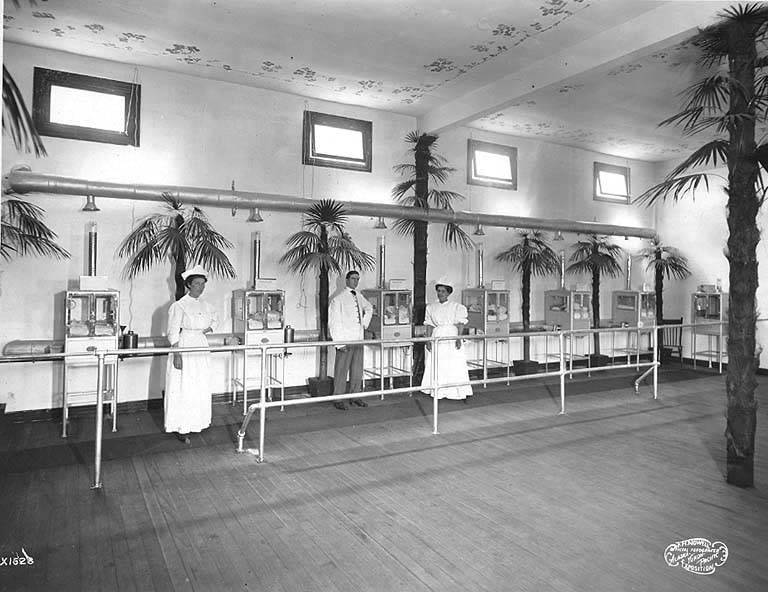
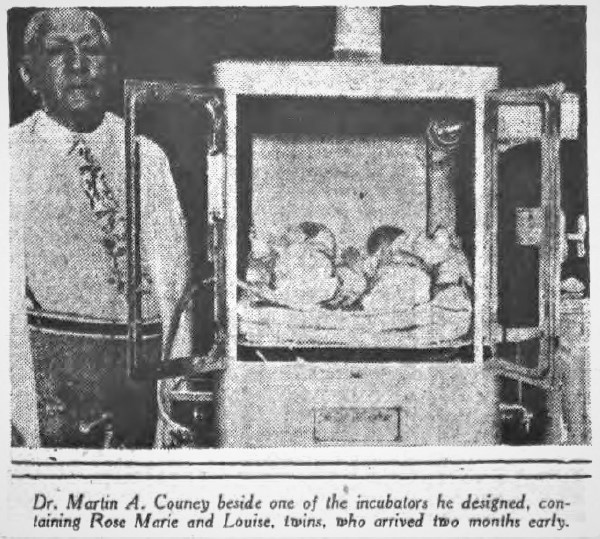
As it turns out, amid all the exotica and bedazzlements, a building furnished with steel and glass cribs, heated from below by temperature-controlled hot water pipes, was one of the boardwalk’s leading attractions.
Antiseptic-soaked wool acted as a rudimentary air filter, while an exhaust fan kept things properly ventilated.
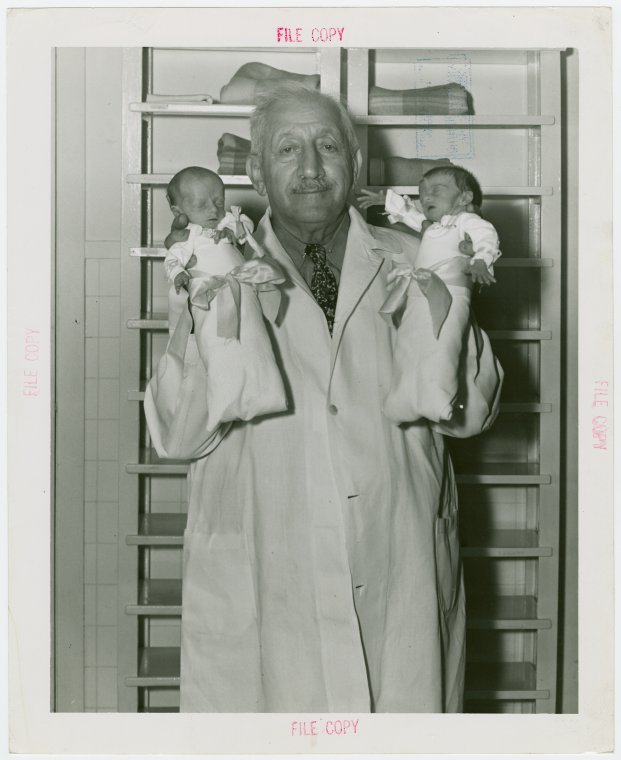
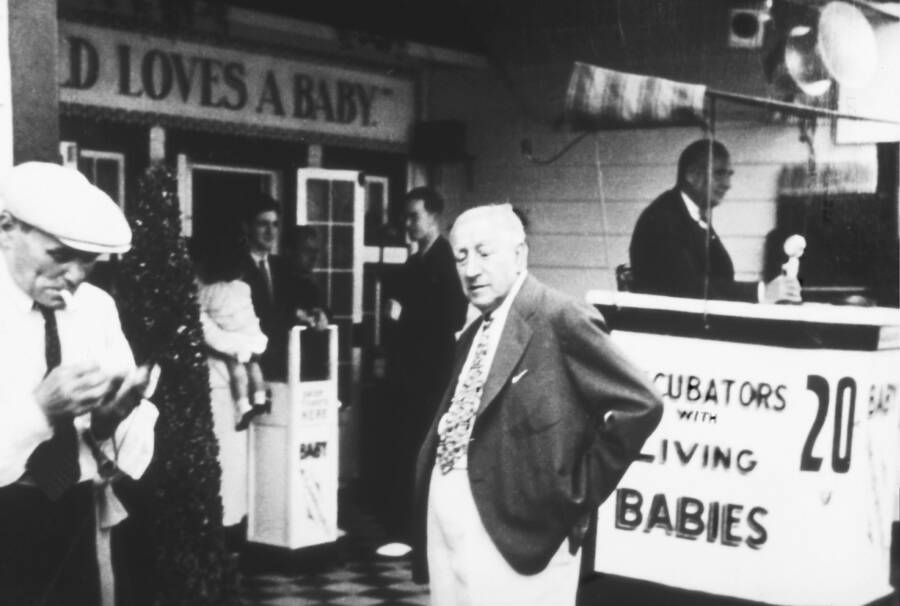
The real draw were the premature babies who inhabited these cribs every summer, tended to round the clock by a capable staff of white clad nurses, wet nurses and Dr. Martin Couney, the man who had the ideas to put these tiny newborns on display…and in so doing, saved thousands of lives.
Couney, a breast feeding advocate who once apprenticed under the founder of modern perinatal medicine, obstetrician Pierre-Constant Budin, had no license to practice.
Initially painted as a child-exploiting charlatan by many in the medical community, he was as vague about his background as he was passionate about his advocacy for preemies whose survival depended on robust intervention.
Having presented Budin’s Kinderbrutanstalt — child hatchery — to spectators at 1896’s Great Industrial Exposition of Berlin, and another infant incubator show as part of Queen Victoria Diamond Jubilee Celebration, he knew firsthand the public’s capacity to become invested in the preemies’ welfare, despite a general lack of interest on the part of the American medical establishment.
Thusly was the idea for the boardwalk Infantoriums hatched.
As word of Couney’s Infantorium spread, parents brought their premature newborns to Coney Island, knowing that their chances of finding a lifesaving incubator there was far greater than it would be in the hospital. And the care there would be both highly skilled and free, underwritten by paying spectators who observed the operation through a glass window. Prentice notes that “Couney took in babies from all backgrounds, regardless of race or social class:”
… a remarkably progressive policy, especially when he started out. He did not take a penny from the parents of the babies. In 1903 it cost around $15 (equivalent to around $405 today) a day to care for each baby; Couney covered all the costs through the entrance fees.
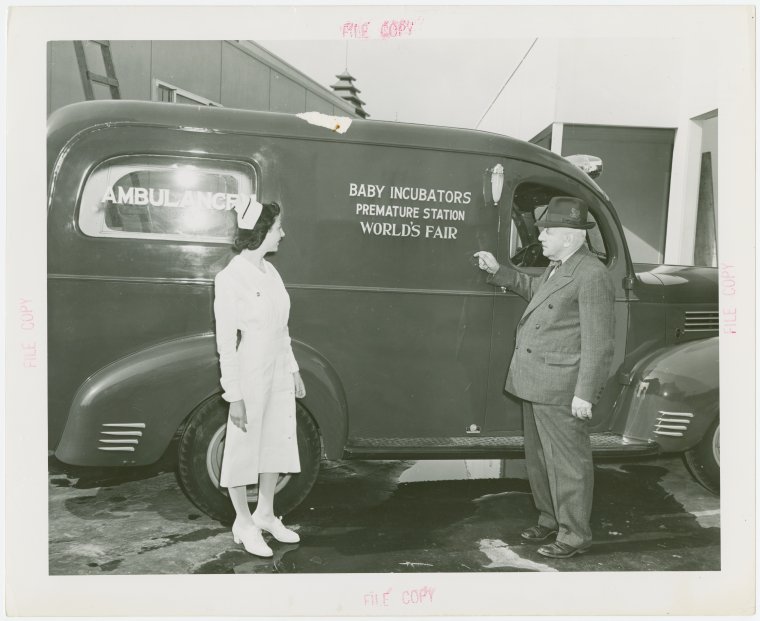
The New Yorker’s A. J. Lieblingobserved Couney at the 1939 World’s Fair in Flushing, Queens, where he had set up in a pink-and-blue building that beckoned visitors with a sign declaring “All the World Loves a Baby:”
The backbone of Dr. Couney’s business is supplied by the repeaters. A repeater becomes interested in one baby and returns at intervals of a week or less to note its growth. Repeaters attend more assiduously than most of the patients’ parents, even though the parents get in on passes. After a preemie graduates, a chronic repeater picks out another one and starts watching it. Dr. Couney’s prize repeater, a Coney Island woman named Cassatt, visited his exhibit there once a week for thirty-six seasons. Repeaters, as one might expect, are often childless married people, but just as often they are interested in babies because they have so many children of their own. “It works both ways,” says Dr. Couney, with quiet pleasure.
It’s estimated that Couney’s incubators spared the lives of more than 6,500 premature babies in the United States, London, Paris, Mexico and Brazil.
Despite his lack of bonafides, a number of pediatricians who toured Couney’s infantoriums were impressed by what they saw, and began referring patients whose families could not afford to pay for medical care. Many, as Liebling reported in 1939, wished his boardwalk attraction could stay open year round, “for the benefit of winter preemies:”
In the early years of the century no American hospital had good facilities for handling prematures, and there is no doubt that every winter many babies whom Dr. Couney could have saved died. Even today it is difficult to get adequate care for premature infants in a clinic. Few New York hospitals have set up special departments for their benefit, because they do not get enough premature babies to warrant it; there are not enough doctors and nurses experienced in this field to go around. Care of prematures as private patients is hideously expensive. One item it involves is six dollars a day for mother’s milk, and others are rental of an incubator and hospital room, oxygen, several visits a day by a physician, and fifteen dollars a day for three shifts of nurses. The New York hospitals are making plans now to centralize their work with prematures at Cornell Medical Center, and probably will have things organized within a year. When they do, Dr. Couney says, he will retire. He will feel he has “made enough propaganda for preemies.”
Listen to a StoryCorps interview with Lucille Horn, a 1920 graduate of Couney’s Coney Island incubators below.
From 2006 to 2009, Bob Dylan hosted the Theme Time Radio Hour on Sirius Satellite Radio. Each show featured “an eclectic mix of songs, from a wide variety of musical genres, … along with Dylan’s on-air thoughts and commentary interspersed with phone calls, email readings, contributions from special guests and an array of classic radio IDs, jingles and promos from the past.” That eclectic mix also gave us this: Dylan reading, in his distinctive, quirky way, a list of the most oft-cited New Year’s Resolutions, ones that we annually make and sometimes break. Sound familiar? Welcome to 2024!
If you would like to support the mission of Open Culture, consider making a donation to our site. It’s hard to rely 100% on ads, and your contributions will help us continue providing the best free cultural and educational materials to learners everywhere. You can contribute through PayPal, Patreon, and Venmo (@openculture). Thanks!
However detailed they may be in other respects, many accounts of daily life centuries and centuries ago pass over the use of the toilet in silence. Even if they didn’t, they wouldn’t involve the kind of toilets we would recognize today, but rather chamber pots, outhouses, and other kinds of specialized rooms with chutes emptying straight out into rivers and onto back gardens. And that was just the residences. What would public facilities have been like? We have one answer in the Told in Stone video above, which describes “public latrines in ancient Rome,” the facilities constructed in almost every Roman town “where citizens could relieve themselves en masse.”
These usually had at least a dozen seats, Told in Stone creator Garrett Ryan explains, though some were grander in scale than others: the Roman agora of Athens, for example, boasted a 68-seater. A facility in Timgad, the “African Pompeii” previously featured here on Open Culture, had “fancy armrests in the shape of leaping dolphins.”
Judged by their ruins, these public “restrooms” may seem unexpectedly impressive in their engineering and elegant in their design. But we may feel somewhat less inclined toward time-travel fantasies when Ryan gets into such details as “the sponge on a stick that served as toilet paper” that remains “one of the more notorious aspects of daily life in ancient Rome.”
These weren’t technically latrines, as Lina Zeldovich notes at Smithsonian.com. “The word ‘latrine,’ or latrina in Latin, was used to describe a private toilet in someone’s home, usually constructed over a cesspit. Public toilets were called foricae,” and their construction tended to rely on deep-pocketed organizations or individuals. “Upper-class Romans, who sometimes paid for the foricae to be erected, generally wouldn’t set foot in these places. They constructed them for the poor and the enslaved — but not because they took pity on the lower classes. They built these public toilets so they wouldn’t have to walk knee-deep in excrement on the streets.”
The problem of large-scale human waste disposal is as old as urban civilization, and Rome hardly solved it once and for all. The Absolute History short above shows how the castles of medieval England handled it, using lavatories with holes over the moat (and piles of “moss, grass, or hay” in lieu of yet-to-be-invented toilet paper). At Medievalists.net, Lucie Laumonier writes that the urban equivalent of Roman foricae were “often built over bridges and on quays to facilitate the evacuation of human waste that went directly into running water.” Innovative as this was, it must have posed difficulties for boaters passing below, to say nothing of the users unfortunate enough to sit on a wooden seat just rotten enough to give out — the prospect of which, for all the deficiencies of Modern Western civilization’s public restrooms, at least no longer worries us quite so much today.
Based in Seoul, Colin Marshall writes and broadcasts on cities, language, and culture. His projects include the Substack newsletterBooks on Cities, the book The Stateless City: a Walk through 21st-Century Los Angeles and the video series The City in Cinema. Follow him on Twitter at @colinmarshall or on Facebook.
From 1967 to 1969, Tom and Dick Smothers hosted The Smothers Brothers Comedy Hour, a politely edgy comedy show that tested the boundaries of mainstream television and the patience of CBS executives. Playing to a younger demographic, the show took positions against the Vietnam War and for the Civil Rights Movement, while featuring musical acts that challenged the norms of the era–everyone from Joan Baez and Pete Seeger, to the Doors and Jefferson Airplane, to Buffalo Springfield and Simon and Garfunkel.
Then came The Who in September 1967. Making its American network TV debut, the band picked up where they left off a few months ago at the Monterey Pop Festival. They performed “My Generation” and went into auto-destruction mode, smashing their guitars, toppling their drums, and creating general mayhem, before bringing the song to a close. But for The Smothers Brothers Comedy Hour, The Who added a special twist, packing Keith Moon’s drum kit with explosives, a few too many, it turns out.
Here’s how Allan Blye, a producer-writer for the show, remembers it:
The Who wanted to do a big explosion at the end of their performance. In dress rehearsal, it was a powder puff. So, I say to the special effects guy, “We have to make a bigger boom.” Unbeknownst to us, The Who had told their own guy the same thing. When the explosion went off, it affected Pete Townshend’s hearing permanently. Keith Moon got blown off his drumstand, but was too out of it to know.
Stunned yet poised, Tom Smothers walked onto the stage, only to find his acoustic guitar snatched from his hands and smashed to smithereens too. He later recalled: “Everyone was so shocked.” “When Townshend came over and grabbed my guitar, I was busy just seeing where the bodies were, seeing if anyone was injured. He picked the guitar up, and people kept saying, ‘Did he really ruin your guitar? It looked so real!’ And I’d say. ‘Well it was real! I was confused as hell!’ ”
The suits at CBS abruptly canceled The Smothers Brothers Comedy Hour in 1969, leading the brothers to file a breach of contract lawsuit, which they eventually won. (They discuss the sting of that whole experience with David Letterman here.)
Tom Smothers died yesterday at age 86, “following a recent battle with cancer.” His brother Dick announced his passing, stating: “Tom was not only the loving older brother that everyone would want in their life, he was a one-of-a-kind creative partner. I am forever grateful to have spent a lifetime together with him, on and off stage, for over 60 years. Our relationship was like a good marriage – the longer we were together, the more we loved and respected one another. We were truly blessed.” And so were the rest of us.
We're hoping to rely on loyal readers, rather than erratic ads. Please click the Donate button and support Open Culture. You can use Paypal, Venmo, Patreon, even Crypto! We thank you!
Open Culture scours the web for the best educational media. We find the free courses and audio books you need, the language lessons & educational videos you want, and plenty of enlightenment in between.