Several weeks ago, we watched NASA scientists explode with applause when they landed their rugged rover, Curiosity, on Mars. Imagine how an earlier generation of scientists must have felt when, on July 20, 1969, Neil Armstrong took his first steps on the moon and then uttered his immortal words: “That’s one small step for man, one giant leap for mankind.” You can get goosebumps thinking about it.
Today, America lost a great one. Neil Armstrong has died at 82, after undergoing heart-bypass surgery earlier this month. Above, we bring you legendary footage from the Apollo 11 Mission. And here you can view high resolution images from that historic space flight. Below, we present an hour-long BBC documentary on the life and times of the pioneering astronaut.
By the 1980s, Frank Zappa was entering the third decade of his musical career. An icon of the avant-garde music scene, Zappa had cultural capital to spend. And spend he did. On one occasion in 1986, Zappa appeared on CNN’s Crossfire, where he sparred with conservatives looking to censor rock lyrics. On other occasions, he recorded public service announcements (PSAs) that encouraged a younger generation to make better life decisions. The PSAs dealt with the mundane and the deadly serious, and things that fell somewhere in between. But they were always presented in Zappa’s own distinctive way.
Above we start you off with Zappa’s “Register to Vote” PSAs from 1984. It’s worth recalling that the ’84 presidential election pitted the incumbent Ronald Reagan against Walter Mondale. That’s followed by Zappa (now reborn as “The Dental Floss Tycoon”) recording PSAs for the American Dental Association in 1981. And finally we head back to the late 1960s, when Zappa cut announcements for The Do It Now Foundation, an organization dedicated to highlighting the dangers of amphetamine abuse. At its height, the campaign aired on 1,500 radio stations across the US and beyond.
Brush Your Teeth
Don’t Do Speed
If you would like to support the mission of Open Culture, consider making a donation to our site. It’s hard to rely 100% on ads, and your contributions will help us continue providing the best free cultural and educational materials to learners everywhere. You can contribute through PayPal, Patreon, and Venmo (@openculture). Thanks!
Henry Rollins had dropped out of college and was working at a Haagen-Dazs in Washington, DC when he joined the seminal L.A. hardcore punk band Black Flag in 1981, a career move that would shape the rest of the singer/author/actor/activist’s life. And although he left higher education for a more individualized path, Rollins has a very high regard for the potential of a good education to change people’s lives.
We’ve previously featured Rollins’ motivational Big Think talk to young people on the dangers of resentment. In the short, but equally inspiring, talk above–from the same set of interviews–Rollins describes education as the engine of a democratic society, “the great equalizer.” For Rollins, education is the key to a “more vigorous democracy.” And although he makes some arguable claims about the possibility of educational reform to substantially diminish the effects of institutionalized racism and poverty, his view of what an education should be corresponds to what educational reformers have stressed for decades—that moving to a focus on critical thinking, rather than “teaching to the test,” is a shift that needs to happen in order for students to become curious, intentional, and independent learners and, ultimately, free and independent citizens.
Rollins speculates that certain political actors and vested interests deliberately block educational reform to maintain the status quo. Whether or not you accept his analysis, there’s no denying that the state of primary, secondary, and higher education in the U.S. is dire, and the functional efficacy of our democratic process seems constantly in jeopardy. Alluding to the dictum attributed to Thomas Jefferson (who may not have actually written this) that “An educated citizenry is a vital requisite for our survival as a free people,” Rollins believes that educational reforms offer “the way out” of our current political gridlock and of the despairing situations underprivileged people are born into. I think he makes a pretty compelling case in just under four minutes.
Josh Jones is a doctoral candidate in English at Fordham University and a co-founder and former managing editor of Guernica / A Magazine of Arts and Politics.
In an interview aired on San Francisco radio last week, Francis Ford Coppola acknowledged that he could no longer compete with himself — that he couldn’t make the kind of films that made him famous during the 1970s. The Godfather (1972), The Godfather II (1974), and Apocalypse Now (1979) — they were big, sprawling, masterful films. And they sometimes pushed a young Coppola to the physical and financial brink.
The making of Apocalypse Now is a legendary tale. Shot in the Philippines in 1976, the production ran into immediate problems. After only two weeks, Coppola fired Harvey Keitel, the lead actor, and replaced him with Martin Sheen, who stumbled into chaos upon his arrival. As biographer Robert Sellers noted in The Independent, “Coppola was writing the movie as he went along and firing personnel, people were coming down with varioustropical diseases and the helicopters used in the combat sequences were constantly recalled by President Marcos to fight his own war against anti-government rebels.” And things only got worse from there. Marlon Brando showed up enormously overweight and not knowing his lines. Then, during the difficult filming, Sheen suffered a heart attack, and Coppola himself had a seizure and eventually a nervous breakdown, apparently threatening to commit suicide on several occasions. Speaking about the whole experience years later, Coppola’s wife, Eleanor, said:
It was a journey for him up the river I always felt. He went deeper and deeper into himself and deeper and deeper and deeper into the production. It just got out of control.… The script was evolving and the scenes were changing — it just got larger and more complex. And little by little he got out there as far as his characters. That wasn’t the intention at all at the beginning.
Yes, it’s no wonder that Coppola, now 73 years old, might not have another epic film in him.
Apocalypse Now hit theaters exactly 33 years ago this week. And to commemorate that occasion, we’re serving up a short remix film, Heart of Coppola, that weaves together scenes from the film, footage from behind the scenes, and audio of the great Orson Welles reading from Heart of Darkness, the Joseph Conrad novella upon which Apocalypse Now was loosely based. (Find it in our collection of Free Audio Books and Free eBooks.)
By now, you know that David Rakoff, a prizewinning humorist championed by David Sedaris, died Thursday night after two public battles with cancer. Rakoff cultivated a following among listeners of This American Life, the beloved radio show hosted by Ira Glass. In May, he made one of his last appearances on the show when TAL presented “The Invisible Made Visible,” a live stage performance beamed to movie theaters nationwide. Here, Rakoff reads the story, “Stiff as a Board, Light as a Feather,” about “the invisible processes that can happen inside our bodies…and the visible effects they eventually have.” You won’t want to his miss his poignant last dance. It’s yet another reminder of why he’ll be sorely missed. We’d also recommend spending time with his appearances on NPR’s Fresh Air.
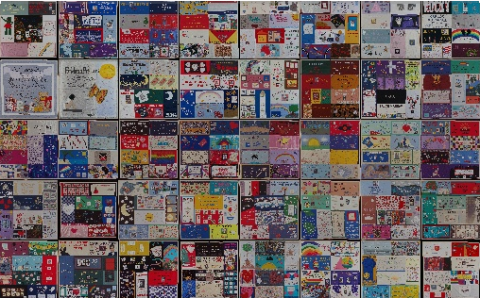
Twenty-five years ago a group of friends gathered in a San Francisco apartment to memorialize companions who had died of AIDS. They used one of the oldest techniques around to honor their loved ones: they made a quilt, the now-famous AIDS Memorial Quilt, with unique panels for each person felled by the disease. Now including some 48,000 panels, the quilt has grown into a massive, public expression of grief. Its panels come from around the world. It was even nominated for the Nobel Peace Prize in 1989. (Find more on the history of the quilt here.)
Like any good archive—and the quilt is an archive of life and loss—the AIDS Memorial Quilt serves as a historical repository, a storehouse of sentimental information for scores of people. But beyond that the quilt is a piece of political folk art. AIDS, after all, is a uniquely political disease, at least in the United States. The idea for the quilt was conceived during a candlelight march for assassinated San Francisco Mayor George Moscone and Supervisor Harvey Milk. Efforts to lift the stigma of AIDS are closely linked to gay rights activism.
While the quilt is on view in Washington, D.C. this summer, Microsoft offers the world up close and personal access. Even if the Mall is too small to hold the entire quilt, the Internet isn’t. All 48,000 panels are newly digitized through a collaboration between Microsoft and the University of Iowa, the University of Southern California and the Names Quilt Foundation.
You can fly like a bird over the whole, beautiful piece. You can zoom in to read the thousands of names—some in block letters, others stitched in cursive. You can count the rainbows, too.
You can also search the quilt by name or, if you know it, by the block number of a particular panel through the AIDS Quilt Touch interface. The site allows unique searches for each time the quilt has been displayed. This is important because the quilt is so massive that the Mall in Washington can’t hold it all. It’s always displayed in sections, so if you want to know where a special panel has been on view, recently, it’s now possible to find out.
Kate Rix is a freelance writer based in Oakland. See more of her work at .
Back in 1975, Tom Davis and Al Franken, two Minnesota-born comedians, joined the writing staff of Saturday Night Live, a new late-night comedy show. Together, Franken & Davis sketched out some unforgettable SNL characters — The Coneheads played by Dan Aykroyd, Jane Curtin and Laraine Newman. Nick The Lounge Singer, a character inhabited wonderfully by Bill Murray. Julia Child brought to life by Aykroyd again. 37 years later, Saturday Night Live is still going strong.
The Franken & Davis comedy team broke up in 1990. Time passed. And, in 2009, their lives went in very different directions. Al Franken was elected to the U.S. Senate. Tom Davis was diagnosed with throat and neck cancer — the disease that finally took his life yesterday. In recent months, Davis wrote openly about his journey with cancer. In a blog post called The Dark Side of Death, he joked about indulging in medical marijuana (“These days I get my marijuana through airport security by hiding it in the morphine”) and the day he’d “de-animate.” But he also talked movingly about the perspective the disease gave him, writing:
I wake up in the morning, delighted to be waking up, read, write, feed the birds, watch sports on TV, accepting the fact that in the foreseeable future I will be a dead person. I want to remind you that dead people are people too. There are good dead people and bad dead people. Some of my best friends are dead people. Dead people have fought in every war. We’re all going to try it sometime. Fortunately for me, I have always enjoyed mystery and solitude.
Many people in my situation say, “It’s been my worst and best year.” If that sounds like a cliché, you don’t have cancer. On the plus side, I am grateful to have gained real, not just intellectual empathy. I was prepared to go through life without having suffered, and I was doing a good job of it. Now I know what it’s like to starve. And to accept “that over which I have no control,” I had to turn inward. People from all over my life are reconnecting with me, and I’ve tried to take responsibility for my deeds, good and bad. As my friend Timothy Leary said in his book, Death by Design, “Even if you’ve been a complete slob your whole life, if you can end the last act with panache, that’s what they’ll remember.”
I think I’ve finally grown up.
When Davis said that “some of my best friends are dead people,” he was probably thinking of Timothy Leary and Jerry Garcia too. Here, you can watch Davis and the Grateful Dead frontman cook a meal together, and above we bring you Franken & Davis conducting a Grateful Dead trivia contest in 1980. Thanks to Tom for the memories and laughs.
Metafilter recently featured this Big Think clip of Henry Rollins telling the story of his most life-changing decision. This choice, of course, was the one that brought him to the front of punk rock band Black Flag. Before he made it, he could call himself only a college dropout assistant-managing a Washington, D.C. Häagen-Dazs. In 1981, after catching one of Black Flag’s New York shows — during which he happened to climb onstage and sing a song with them — he decided to try out to become the group’s actual singer. When Rollins ditched the ice cream game for the day (a forfeit, he recalls, of no more than $21) to audition, Black Flag went from his favorite band to his band. Thinking back, he realizes he had little to lose: if he didn’t give it a shot, he’d find himself looking down the barrel of a long, hard existence on his feet, answering to customers all day, every day. If he gave it a shot and didn’t make it, he’d at worst feel humiliated, but, as he puts it, “humiliation and young people kind of go together.”
“I don’t have talent,” Rollins insists. “I have tenacity. I have discipline. There was no choice for me but to work really hard.” You may recall him making a similar point in his previous Big Think video we featured, in which he recommended going at one’s pursuits with a “monastic obsession.” But this time, he adds a note of fear. He talks about coming to understand that, without relying on his four pillars of “application, discipline, focus, repetition,” an entity he calls “the America” would have gotten the better of him. This term seems to refer to the constant threat of crushing mediocrity he feels in the United States. “Every moment I am alive is because I have not been murdered by the America,” he says in another interview. “The tasks I set out for myself are what I do to beat the perfect pointlessness of life.” Even if you don’t conceive of your own situation quite so grimly, Rollins offers a perspective worth considering. Perhaps his recruitment into Black Flag strikes you as a lucky break; he certainly considers it one. But as Brian Eno, another cultural figure as well known for his point of view as his music, once said, “Luck is being ready.”
We're hoping to rely on loyal readers, rather than erratic ads. Please click the Donate button and support Open Culture. You can use Paypal, Venmo, Patreon, even Crypto! We thank you!
Open Culture scours the web for the best educational media. We find the free courses and audio books you need, the language lessons & educational videos you want, and plenty of enlightenment in between.