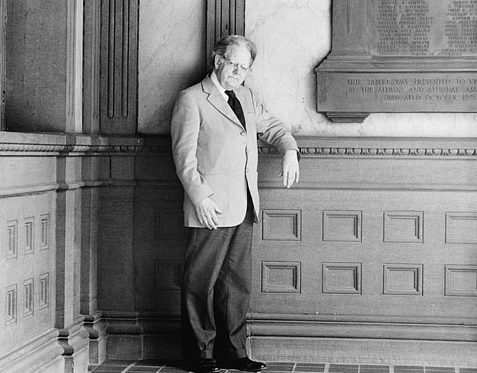
Where other authors might limit themselves to the strictly professional, Chabon spices things up with details on his bar mitzvah, his failed first marriage, and the births of his children.
Where others’ timelines grow weighty with evidence of increasing fame, his reads more like a diary, written in the third person.
Breaking of Hank Aaron’s pure record of 755 home runs amid the now-commonplace American congeries of hypocrisy, excess, bad faith, racism and lies finally proves too much, and the wrong kind, of baseball sadness; turns his back on the game (8/07)
Penetrates to the secret nighttime heart of Disneyland (9/11)
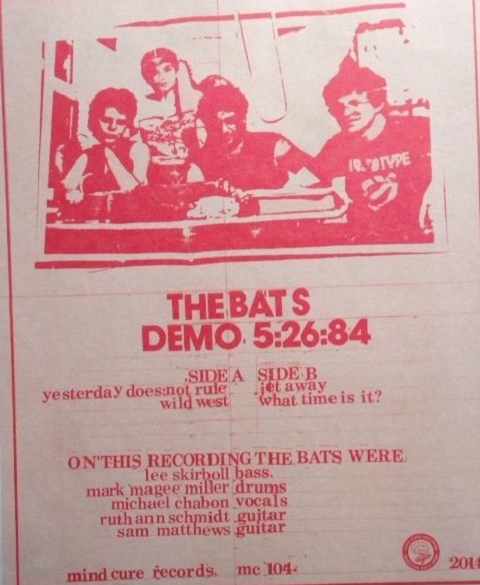
Given his zest for personal milestones, it’s surprising he didn’t see fit to share that he was once the lead singer in a Pittsburgh punk band. It would have fit nicely between the photo in which he and novelist Jon Armstrong are garbed as strolling Renaissance Festival players and the moment he enters an Oakland crawlspace to begin work on The Mysteries of Pittsburgh.
He might rethink this omission, now that Mindcure Records has released the four-track demo that is his band, the Bats’ only studio recording. Also preserved on vinyl is the author’s sole live outing with the band, a 21st birthday gig at the Electric Banana, shortly before he graduated from the University of Pittsburgh and disappeared into that crawlspace. The label describes his vocals as “snotty.” It’s a compliment in context.
Meanwhile in the Pittsburgh Post Gazette, Chabon recalled the Bats as “a fine little band, a unique assemblage of diverse strengths and quirks, anchored by one of the most rock-solid drummers ever to grace the Pittsburgh scene, and hampered only by the weakness of their goofball frontman.”
One reason I’m glad for having had a childhood religious education: it has made me conversant in even some of the most obscure stories and ideas in the Christian Bible, which is everywhere in English literature. Not only was the King James translation formative for early modern English, but stories like that of King David and his son Absalom have furnished material for great works from John Dryden’s dense political allegory “Absalom and Achitophel” to William Faulkner’s dense modernist fable Absalom, Absalom! Then, of course, there’s so much of the work of Blake, Shakespeare, and Milton to account for. Without a fairly solid grounding in Biblical literature, it can be doubly difficult to make headway in a study of the secular variety.
The students of highly regarded Canadian literary critic Northrop Frye found this to be true. As a junior instructor, Frye had difficulty getting his class to understand what was going on in John Milton’s Paradise Lost because so many of the Biblical allusions were lost on them. (It’s a hard enough poem to grasp when you get the references.) “How do you expect to teach Paradise Lost,” said the chair of Frye’s department, “to people who don’t know the difference between a Philistine and a Pharisee?” Responding to this gap in cultural literacy, Frye designed and taught “The Bible and English Literature.” The entire, videotaped course from a 1981 session at the University of Toronto is available online in 25 lectures.
It’s very much a treat to sit in on these lectures. Frye’s work on myth and folktale in English literature is still nearly definitive; his 1957 Anatomy of Criticism, though picked apart many times over through the decades, retains an authoritative place in studies of literary archetypes and rhetoric. Frye’s lectures on the Bible focus on what he sees as its “narrative unity,” due in part to “a number of recurring images: mountain, sheep, river, hill, pasture, bride, bread, wine and so on.” He also spends a good deal of time, at least in his first lecture above, discussing church history, theological and critical conflicts, and the history of various translations. The UToronto site includes full transcripts of each lecture, and the entire course promises to be enlightening for students of literature, of the Bible and church history, or both.
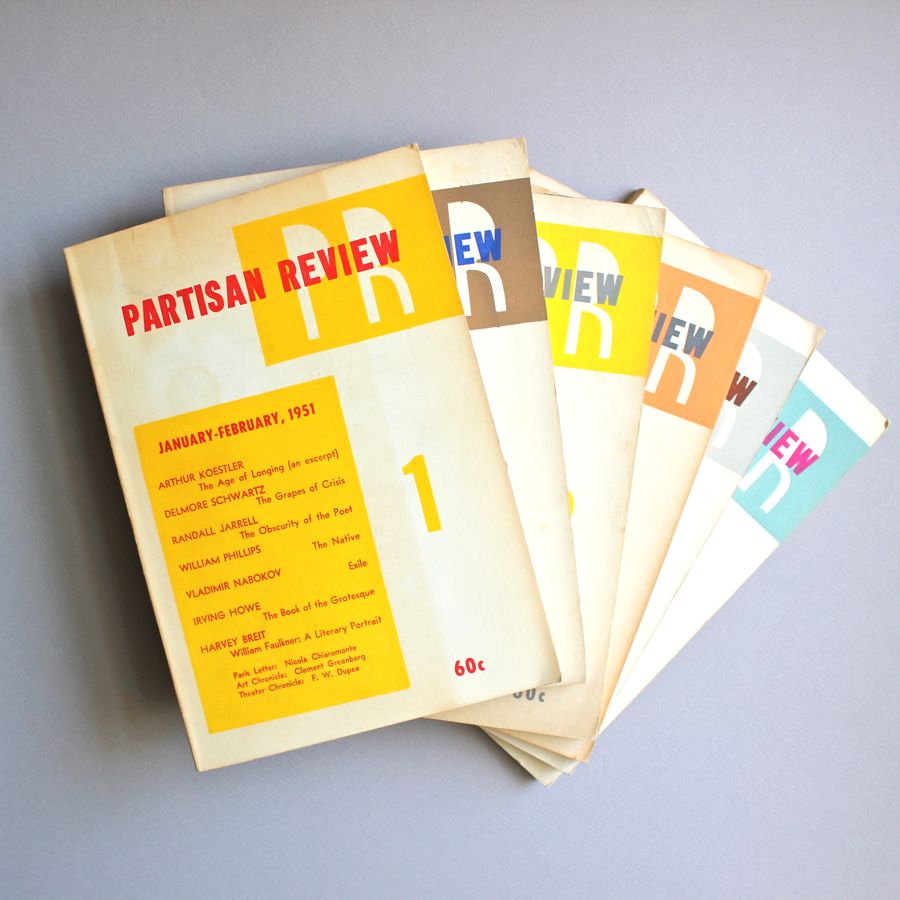
Founded by William Phillips and Philip Rahv in February of 1934, leftist arts and politics magazine Partisan Review came about initially as an alternative to the American Communist Party’s publication, New Masses. While Partisan Review (PR) published many a Marxist writer, its politics diverged sharply from communism with the rise of Stalin. Perhaps this turn ensured the magazine’s almost 70-year run from ’34 to 2003, while New Masses folded in 1948. Partisan Review nonetheless remained a venue for some very heated political conversations (see more on which below), yet it has equally, if not more so, been known as one of the foremost literary journals of the 20th century.
PR first published James Baldwin’s “Sonny’s Blues” in Summer 1957 and two of T.S. Eliot’s Four Quartets in 1940, for example, as well as Delmore Schwartz’s brilliant story “In Dreams Begin Responsibilities” in a 1937 issue that also featured Wallace Stevens, Edmund Wilson, Pablo Picasso (writing on Franco), James Agee, and Mary McCarthy. “More a literary event,” writes Robin Hemley at The Believer, “than a literary magazine,” even issues sixty or more years old can still carry “the punch of revelation.”
Now you can assess the impact of that punch by accessing all 70-years’ worth of issues online at Boston University’s Howard Gotlieb Archival Research Center. BU began hosting the magazine in 1978 after it moved from Rutgers, where founding editor William Phillips taught. Now the university has finished digitizing the entire collection, in handsome scans of vintage copies that readers can page through like an actual magazine. The collection is searchable, though this function is a little clunky (all links here direct you to the front cover of the issue. You’ll have to navigate to the actual pages yourself.)
In a post on the Gotlieb Center project, Hyperallergic points us toward a few more highlights:
In art, Partisan Review is perhaps best known as the publisher of Clement Greenberg, who contributed over 30 articles from 1939 to 1981, most notably his Summer 1939 essay entitled “Avant-Garde and Kitsch.” (Greenberg even made a posthumous appearance in the Spring 1999 issue.) Beyond Greenberg’s voluble legacy we encounter such landmark texts as Dwight Macdonald’s “Masscult and Midcult,” from the Spring 1960 issue, and Susan Sontag’s “Notes on ‘Camp’” from Winter 1964, as well as the seminal popular-culture criticism of Robert Warshow (his essay on the Krazy Kat comic strip in the November-December 1946 issue is especially great) and the work of Hilton Kramer, the conservative iconoclast who went on to found The New Criterion.
Partisan Review also served as an outlet for George Orwell, who lambasted leftist pacifists—calling them, more or less, fascist sympathizers—in his series of articles between January 1941 and the summer of 1946, which he called “London Letters.” Orwell did not hesitate to name names; he also reported in 1945 of the “most enormous crimes and disasters” committed by the Soviets, including “purges, deportations, massacres, famines, imprisonment without trial, aggressive wars, broken treaties….” These things, Orwell remarked “not only fail to excite the big public, but can actually escape notice altogether.”
Partisan Review, however, was not aimed at “the big public.” Its “rarified principles,” writes Sam Tanenhaus of Slate—who calls PR “Trotskyist” for its interventionist boosterism—“attracted only 15,000 subscribers at its peak.”PR began in the age of the “little magazine,” a “term of honor” for the small journals that nurtured the high culture of their day, and which seem now so antiquated even as beleaguered publishers keep pushing them out to preciously small cliques of devoted readers. But charges of elitism can ring hollow, and given all we have to thank “little magazines” like Partisan Review for, it would probably behoove to pay attention to their successors. Enter the archive here.
My first exposure to the writing of David Sedaris came fifteen years ago, at a reading he gave in Seattle. I couldn’t remember laughing at anything before quite so hard as I laughed at the stories of the author and his fellow French-learners struggling for a grasp on the language. I fought hardest for oxygen when he got to the part about his classmates, a veritable United Nations of a group, straining in this non-native language of theirs to discuss various holidays. One particular line has always stuck with me, after a Moroccan student demands an explanation of Easter:
The Poles led the charge to the best of their ability. “It is,” said one, “a party for the little boy of God who call his self Jesus and… oh, shit.”
She faltered, and her fellow countryman came to her aid.
“He call his self Jesus, and then he be die one day on two… morsels of… lumber.”
The scene eventually ended up in print in “Jesus Shaves,” a story in Sedaris’ third collection, Me Talk Pretty One Day. You can read it free online in a selection of three of his pieces rounded up by Esquire. Sedaris’ observational humor does tend to come out in full force on holidays (see also his reading of the Saint Nicholas-themed story “Six to Eight Black Men” on Dutch television above), and indeed the holidays provided him the material that first launched him into the mainstream.
When Ira Glass, the soon-to-be mastermind of This American Life, happened to hear him reading his diary aloud at a Chicago club, Glass knew he simply had to put this man on the radio. This led up to the big break of a National Public Radio broadcast of “The Santaland Diaries,” Sedaris’ rich account of a season spent as a Macy’s elf. You can still hear This American Life’s full broadcast of it on the show’s site.
True Sedarians, of course, know him for not just his inimitably askew perspective on the holidays, but for his accounts of life in New York, Paris (the reason he enrolled in those French classes in the first place), Normandy, London, the English countryside, and growing up amid his large Greek-American family. Many of Sedaris’ stories — 20 in fact — have been collected at the web site, The Electric Typewriter, giving you an overview of Sedaris’ world: his time in the elfin trenches, his rare moments of ease among siblings and parents, his futile father-mandated guitar lessons, his less futile language lessons, his relinquishment of his signature smoking habit (the easy indulgence of which took him, so he’d said at that Seattle reading, to France in the first place). Among the collected stories, you will find:
Yesterday, of course, marked the 13th anniversary of the horrible attacks on the Twin Towers and the Pentagon. Today marks the 6th anniversary of David Foster Wallace’s death by suicide. The two events are related not only by proximity, and not because they are comparable tragedies, but because Wallace’s work, in particular his 1993 essay “E Unibus Pluram: Television and U.S. Fiction,” has become such a touchstone for the discourse of “post-irony” or “the new sincerity” since 9/11, when Vanity Fair editor Graydon Carter and others proclaimed the “end of irony.” But the cultural consciousness has shifted measurably since those heady days of fervent affirmation. In a reconsideration of Wallace on irony, Bradley Warshauer writes, “he wasn’t wrong—but he is obsolete.” Our national discourse—as much as it can be defined in broad terms—may have, some argue, swung further toward sincerity and sentimental reverence than Wallace would have liked. And he may have been much more an ironist than he liked to believe.
Wallace, writes Warshauer, was “a wannabe sentimentalist who was too absurdly talented and probably too obsessed with the artificiality of fiction to be the sort of ‘anti-rebel’ that he himself talked about.” While he may have romanticized the high-minded figure who “stands for” things in uncomplicated ways, Wallace himself was complicated, prickly, and just too hyper-aware—of himself and others—to be seduced by easy sentiment, what Somerset Maugham called “unearned emotion.” While his work pulls us still toward deeper levels of analysis, toward contemplation and critique, toward serious considerations of value, it does not do so by eschewing irony. In the descriptive force of his prose are the evasions, parries, asides, circumlocutions, and jarringly odd juxtapositions of the ironist, the satirist, and—what might be the same thing—the moralist. “The inherent contradiction”—the irony, if you will—of Wallace’s stance, Washauer argues, citing 1999’s Brief Interviews With Hideous Men, is that he himself “was addicted to ironic detachment.” But, of course, it’s not so simple as that.
Today we bring you several readings by David Foster Wallace of his own work. We begin at the top with “Death is Not the End” from Brief Interviews, that collection of “weird metafiction” that couches raw and painful confessions in layers of irony. Below it, from that same collection, we have “Suicide as a Sort of Present,” a piece that, in hindsight, offers its own potential morbidly ironic readings. Just above, hear Wallace read the short story “Incarnations of Burned Children” from the 2005 collection Oblivion, full of stories Wyatt Mason described as “tightly withhold[ing]… hiding on high shelves the keys that unlock their treasures.” Replete with tiny mechanisms that can take many careful readings to parse, these stories are fine-art studies in ironic language and situations.
One may class David Foster Wallace as a master ironist, despite his critical stance against its overuse, but this reduces the full range of his mastery to one mode among so many. His work embraced the voice of irony and the voice of sincerity as equally valid rhetorical means, alternating between the two in what A.O. Scott once called a “feedback loop.” “The View From Mrs. Thompson’s,” the essay Wallace reads above from 2005’s essay collection Consider the Lobster, is a piece he wrote just days after 9/11. Written quickly as a commission from Rolling Stone, the essay records his trenchant observations of the reactions in Bloomington, Illinois between September 11–13. It’s a piece that showcases the tension between Wallace’s sincere desire for immediacy and his almost uncontrollable impulse to amused detachment. And hearing Wallace commemorate the tragic events we remembered yesterday highlights the sad irony of memorializing his own death today.
George Bernard Shaw once called Mark Twain “the American Voltaire,” and like the inspired French satirist, Twain seems to have something to say to every age, from his own to ours. But if Twain is Voltaire, to whom do we compare Bill Murray? Only posterity can properly assess Murray’s considerable impact on our culture, but his current role as everyone’s favorite pleasant surprise will surely figure largely in his historical portrait. Of Murray’s many random acts of kindness—which include “popping in on random karaoke nights, or doing dishes at other people’s house parties, or crashing wedding photo shoots”—he has also taken to surprising us with readings from American literary greats: from Cole Porter, to Wallace Stevens, to Emily Dickinson.
Just above see Murray read an excerpt from American great Mark Twain’s The Adventures ofHuckleberry Finn. Murray’s appearance at the 1996 Barnes & Noble event apparently came as a surprise to the audience—and to himself. The excerpt he reads might also surprise many readers of Twain’s classic, who probably won’t find it in their copies of the novel. These passages were originally published in Life on the Mississippi but reinserted—“correctly, I guess,” Murray shrugs—into Huck Finn in Random House’s 1996 republication of the novel, marketed as “the only comprehensive edition.” (Read a publication history and summary of the changes in this brief, unsympathetic review of the re-edited text.)
1996 was an interesting year for Twain’s novel. Long at the center of debates over racial sensitivity in public education, and banned many times over, the book figured prominently that year in a tense but fruitful meeting between parents and teachers in Cherry Hill, New Jersey. These discussions produced a new curricular approach that PBS outlines in its teaching guide “Huck Finn in Context,” which offers a variety of responses to the thorny pedagogy of “the ‘n’ word,” racial stereotyping, and reading satire. Beyond the issue of derogatory language, there also arose that year a pugnacious challenge to the book’s place in the American literary canon from novelist Jane Smiley. Smiley’s polemic prompted a lengthy rebuttal in The New York Times from Twain scholar Justin Kaplan.
Revisiting these debates reminds us of just how much we can take for granted a literary work’s social and cultural value. Smiley reminds us of the breadth of American literature by women writers that was pushed aside by critics to give male writers like Twain, Melville, and Poe pride of place. The various controversies surrounding the novel’s place in the classroom should remind us—as Toni Morrison has explained in depth—that racialized language does not strike all readers equally, and that this is a problem to be discussed openly, not ignored or banned out of sight. And Murray’s excellent dramatic reading of these re-inserted passages should remind us, over all, of the first reason we care about Huck Finn—not because of its political correctness or incorrectness, but because of its richness of character and dialogue.
After Murray’s reading above, New York Times writer Brent Staples introduces a distinguished panel of Shelby Foote, William Styron, Roy Blount, Jr., and Justin Kaplan. The five go on to discuss the “literary and historical significance” of the novel, confronting the controversies head-on. I think it’s a shame Jane Smiley wasn’t invited, or chose not to appear. In any case, you might be tempted to bolt after Bill Murray, but stick around for the writers. You won’t be disappointed.
Charles Baudelaire’s decadent visions pushed the Victorian cult of beauty toward modernism, Henry Miller’s lurid epics pushed a then staid modernism toward anarchic beat writing, and Georges Bataille and the surrealists of his arts journal Documents gave us much of the culture we have today, call it what you will if postmodern is too passé. Obsessed with torture, pornography, horror, and bodily fluids, Bataille “wanted to bring art down to the base level of other physical phenomena,” says surrealist scholar Dawn Ades. Where other transgressive figures of the past have mostly been tamed, Bataille, I submit, is still quite dangerous. The Bataille quote that opens the film above, A perte de vue (“As far as the eye can see”), won’t go down easily with almost anyone: “The world,” reads narrator Jean-Claude Dauphin, “is only inhabitable on the condition that nothing in it is respected.” This, the documentary suggests, is Bataille’s philosophy, one he defines as “a need for sensibility to call up disturbance.”
Bataille, a failed priest and sometime librarian, founded surrealist flagship Documents in 1929, published 15 issues, then went on to write novels, poems, and essays for the next thirty years. But his most famous work has remained his first, The Story of the Eye, originally published under the pseudonym Lord Auch in 1928. It’s a book that even today can seem like “social anthrax,” as novelist John Wray put it, in a way that other once taboo-breaking works like Joyce’s Ulysses, for example, certainly do not. It’s an apt comparison, not on literary grounds, but given that both writers were haunted by once fervent Catholicism turned to fervent rejection. Writes Mark Hudson in The Guardian, “he did believe in his own transgressive philosophies in a quasi-religious sense.” Like Joyce, “there’s a powerful dualism in his thought, a profound religious impulse.” Unlike Joyce—or Bataille’s fellow surrealists for that matter, who “excommunicated” him from the movement—“there is still much in his work that is difficult to redeem and far from being accommodated by the mainstream—if indeed it ever can be.”
You can read four of Bataille’s challenging pieces at Supervert’s elibrary: The Story of the Eye and three essays, “The Use Value of D.A.F. de Sade,” “The Big Toe,” and “The Cruel Practice of Art.” Bataille’s philosophy, writes Supervert, “apparently lay in personal experience—in particular his childhood with a suicidal mother and a blind, syphilitic father.” This kind of psychologizing may seem superfluous, yet Bataille introduces himself to us, in his own words—through audio interviews in the first few minutes of A pert de vue—as the product of “a sad place to be.” Personal origins aside, Bataille’s philosophy has resonated widely and “helped pave the way to contemporary critical theory.” By embracing everything rejected, feared, or held in contempt, Bataille reclaimed everyday parts of human existence—those we euphemize or seek to contain—for literature, philosophy… and well, the internet. If some of Bataille’s preoccupations are irredeemable for mainstream tastes, you may find as you watch the film above and read Bataille’s writing that this is for good reason.
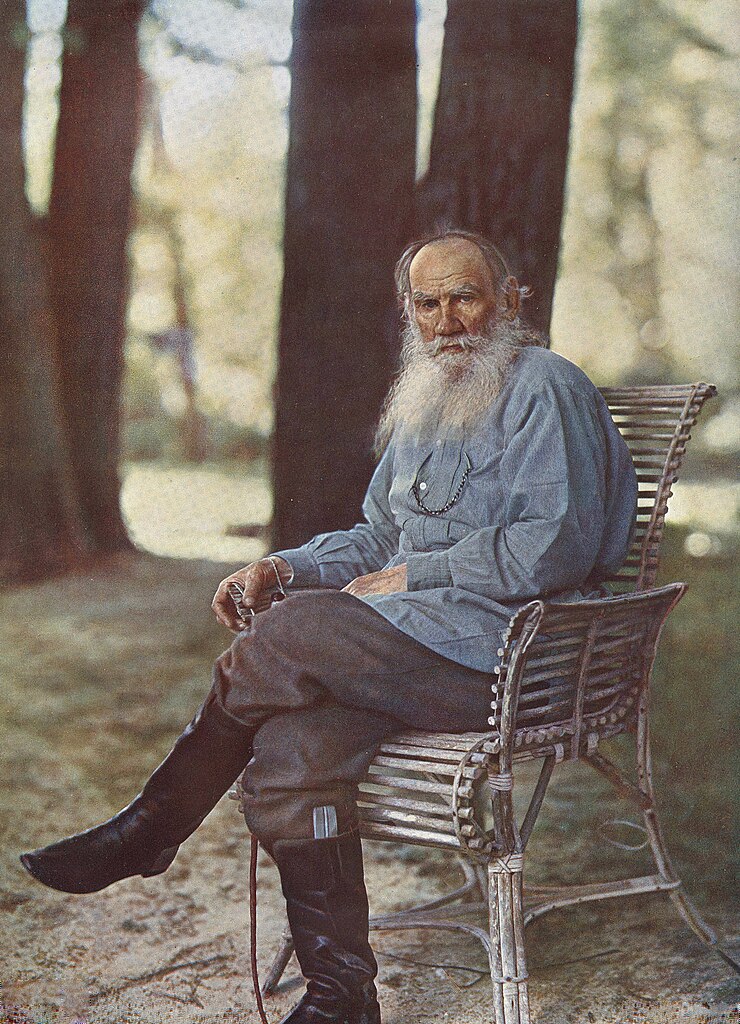
A good few people objected to a recent project that colorized old photos of Walt Whitman, Charlie Chaplin, Helen Keller, Mark Twain, and other historical characters. Leave them alone! they grumped. The past, they wanted left in black and white. But this is not so easily done when some photos—whether of august personages like Leo Tolstoy above, or of ordinary anonymous peasants below—were always processed in color. The Tolstoy image dates from 1908, two years before his death, but the process is much older, and successful color photographs, not simply hand-painted colorizations, go back at least to the Lumiere Brothers’ Autochromes from the late 19th century.
The method that gave us Tolstoy in color involved taking three photographs—with a red, a green, and a blue filter—then projecting the resulting prints through filters of the same color. It’s a procedure that dates to Scottish scientist James Clerk Maxwell’s 1861 experiments, which put to the test several earlier theories. The photographs you see here are the work of scientist and inventor Sergei Prokudin-Gorsky, who had perfected the projection method to such a degree that—as he wrote in a letter to Tolstoy asking him to pose—he only needed “from 1 to 3 seconds to take the photograph.” Thus it would not be “overly tiresome” for the soon-to-be eighty-year-old novelist.
Tolstoy, of course, was a national institution, and had warranted an earlier attempt at a color portrait by an anonymous amateur to whom Prokudin-Gorsky refers in his letter of request. The first attempt, the inventor implies, was a botched job. Billing himself as a specialist in “photography ‘in natural colors,’” the self-confident entrepreneur assured the writer he could produce “excellent results” with “accurate colors.” “My colored projections,” he wrote, “are known in both Europe and in Russia.” Prokudin-Gorsky was received and given two days to take several color photographs, though whether the others have survived, I do not know. We do know that the portrait appeared in the August, 1908 issue of The Proceedings of the Russian Technical Society as “the first Russian color photoportrait.” The journal offered the image in tribute to Tolstoy’s upcoming 80th birthday celebration, writing:
Our periodical, as a purely technical one, cannot honor this venerable representative of Russian thought and word with special articles. Desiring, however, to take part in the general festivities, the editorial staff […] decided to publish in this, its August issue, the newest portrait of Tolstoy, which is the dernier mot in photographic technology. The portrait was taken on location and in natural colors, achieved through technical methods alone, without any use of the artist’s brush or tool.
Prokudin-Gorsky expressed his gratitude to the novelist by mailing him a photographic periodical containing “many pictures produced in my workshops from my photographs.” Perhaps the other photos we see here were contained in that journal. Prokudin-Gorsky had every reason to be proud of his work, and the Russian Technical Society every reason to endorse it. The pictures are stunning.
Some of the photographs, like the Tolstoy portrait, have a painterly, almost impressionistic quality. Others, like the 1911 village scene with the Nikolaevskii Cathedral in the distance, have almost the depth of field and fine-grained clarity of 35mm film. And some, like that of the already cartoonish structure below, have an almost hallucinatory CGI quality. The method wasn’t perfect—even with such short exposures, subjects had to remain absolutely still. If they moved, the result was an eerie double exposure effect you see in the middle distance of the field workers photographed above. But overall, these photographs simply astonish in their crispness and fidelity.
You can see many more of Prokudin-Gorsky’s images at this online gallery, which includes over a dozen early-twentieth century photos of Russian laborers, landscapes, and self portraits. Prokudin-Gorsky’s work also preserves images of various Eastern European peoples in traditional dress—like the final Emir of Bukhara, now Uzbekistan, below in 1910. Many of these groups were on the verge of cultural extinction in the coming years of Soviet imperialism. Unwittingly, Prokudin-Gorsky managed to beautifully capture the very end of tsarist Russia, most poignantly symbolized for so many Russians by their aged literary hero, whose birthday we celebrate again today. Google decided to do so in full color as well, with fancy doodles of his major works. You may accuse them of tampering with the past, but those who find these color photographs too modern may need to expand their definition of modernity.
We're hoping to rely on loyal readers, rather than erratic ads. Please click the Donate button and support Open Culture. You can use Paypal, Venmo, Patreon, even Crypto! We thank you!
Open Culture scours the web for the best educational media. We find the free courses and audio books you need, the language lessons & educational videos you want, and plenty of enlightenment in between.