On Friday, we featured Nikolai Gogol’s “The Nose,” adapted in 1963 through the work-intensive but aesthetically stunning means of “pinscreen animation” by Alexander Alexeieff and Claire Parker. But they hadn’t labored over it in total obscurity; the year before, no less solid a pillar of American film than Orson Welles had commissioned their work for use in his adaptation of Franz Kafka’s The Trial, another work of literature deeply concerned with the absurd. Critical opinion varies about the film, which some consider Welles’ best work, others consider his worst, and others still consider a mixture of the two.
It certainly remains one of his least-seen works, and yet it contains the most mainstream thing Alexeieff and Parker ever did. Very few deny the effectiveness of the film’s prologue, which combines images straight from the husband-and-wife team’s pinscreen with Welles’ unmistakable voice reading “Before the Law,” a parable from Kafka’s novel. Alexeieff and Parker’s images are still, rather than animated, which must have cut way down on the production time.
“Before the law, there stands a guard,” Welles intones. “A man comes from the country, begging admittance to the law. But the guard cannot admit him. May he hope to enter at a later time? That is possible, said the guard. The man tries to peer through the entrance. He’d been taught that the law was to be accessible to every man. ‘Do not attempt to enter without my permission,’ says the guard. I am very powerful. Yet I am the least of all the guards. From hall to hall, door after door, each guard is more powerful than the last. By the guard’s permission, the man sits by the side of the door, and there he waits.” These words establish the basis for not just The Trial, but seemingly Kafka’s own legal sensibility, and indeed worldview. The man waits for years, staring at the guard and lavishing him with bribes. He grows old and enfeebled. Finally, he asks why, despite the fact that “every man strives to attain the law,” nobody else but him has ever come to attempt passage through its doors. “Nobody else but you could ever have obtained admittance,” the guard replies. “This door was intended only for you! And now, I’m going to close it.” Welles then comments that “the logic of this story is the logic of a dream… a nightmare.” One understands why the director, who endured so many futile and absurd experiences in the entertainment industry, would feel drawn to such a fable. As for how he chose such appropriate imagery for it — well, maybe just good luck.
A mild-looking barber slices into his morning loaf of bread to find a human nose embedded within. You might imagine this image opening the next David Lynch movie, but it actually sets up a more lighthearted, much older, and much more Russian story: Nikolai Gogol’s “The Nose.” (Find it in our Free eBooks and Free Audio Books collections.) The story soon introduces us to the man to whom the nose belongs, a government official who wakes to find nothing but a smooth patch of flesh in the middle of his face. The quest to reclaim his nose takes him to the architecturally imposing, column-intensive hall in which he works, where he finds that the organ through which he once breathed has not only grown a body of its own, but already risen above him in the ranks of the civil service. To find out how this increasingly bizarre, dreamlike scenario resolves itself, you can either read Gogol’s story in the English translation free in Project Gutenberg’s copy of the Gogol Collection The Mantle and Other Stories, or you can watch Alexander Alexeieff and Claire Parker’s 1963 short above, which adapts “The Nose” by means of something called pinscreen animation.
Ian Lumsden at Animation Blog describes Alexeieff and Parker’s particular method as a form of “shadow animation in effect whereby Alexander works on the positive side of a large black canvas full of pins and Claire on the negative side; the more the flat headed pins are pushed in the lighter is the effect, creating the look of mezzotint with its textured shades of grey.” Lumsden adds that he “can scarcely conceive of a more labour intensive form of animation particularly given that pins numbered in their hundreds of thousands are used.” Just try to pay close attention to some of the effects The Nose achieves and try not to wince at how demanding and painstaking an effort the animators, pushing these tiny pins in and out to adjust the visual textures just so, must have put forth to achieve them. Russian literary historian D.S. Mirsky calls the original story “a piece of sheer play, almost sheer nonsense,” where “more than anywhere else Gogol displays his extraordinary magic power of making great comic art out of nothing.” In these funny and dazzling but no doubt hard-won eleven minutes Alexeieff and Parker express that sheer play with the most intensive animating work possible.
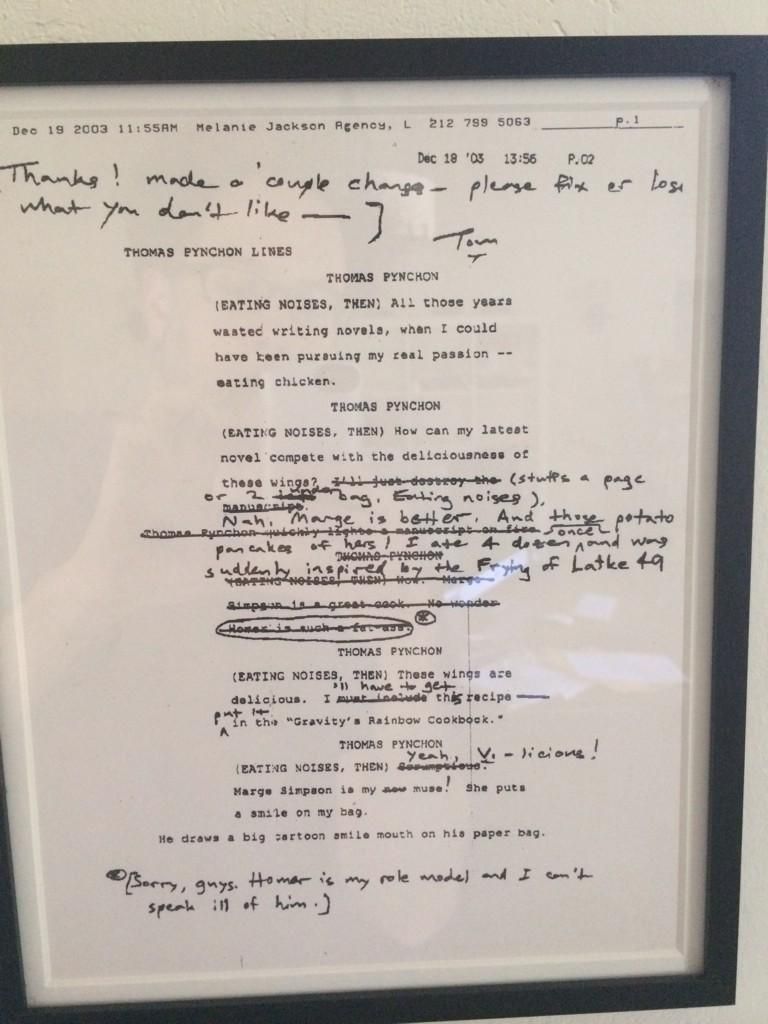
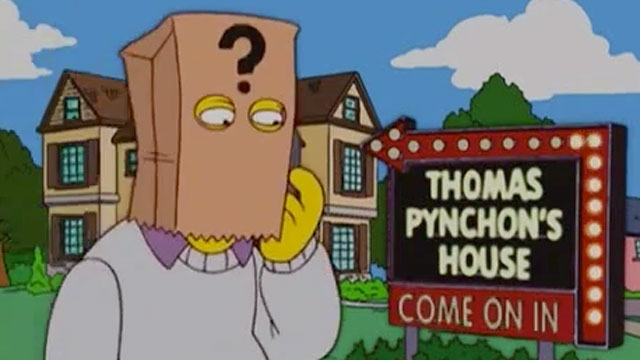
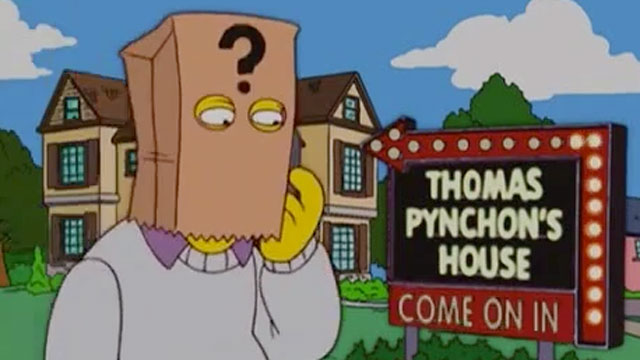
In 2002, the elusive novelist Thomas Pynchon made two cameo appearances on The Simpsons. Of course, we didn’t actually get to see Pynchon. His cartoon depiction wore, rather humorously, a bag over his head. But, we did get to hear Pynchon’s voice. And apparently that, alone, was a first.
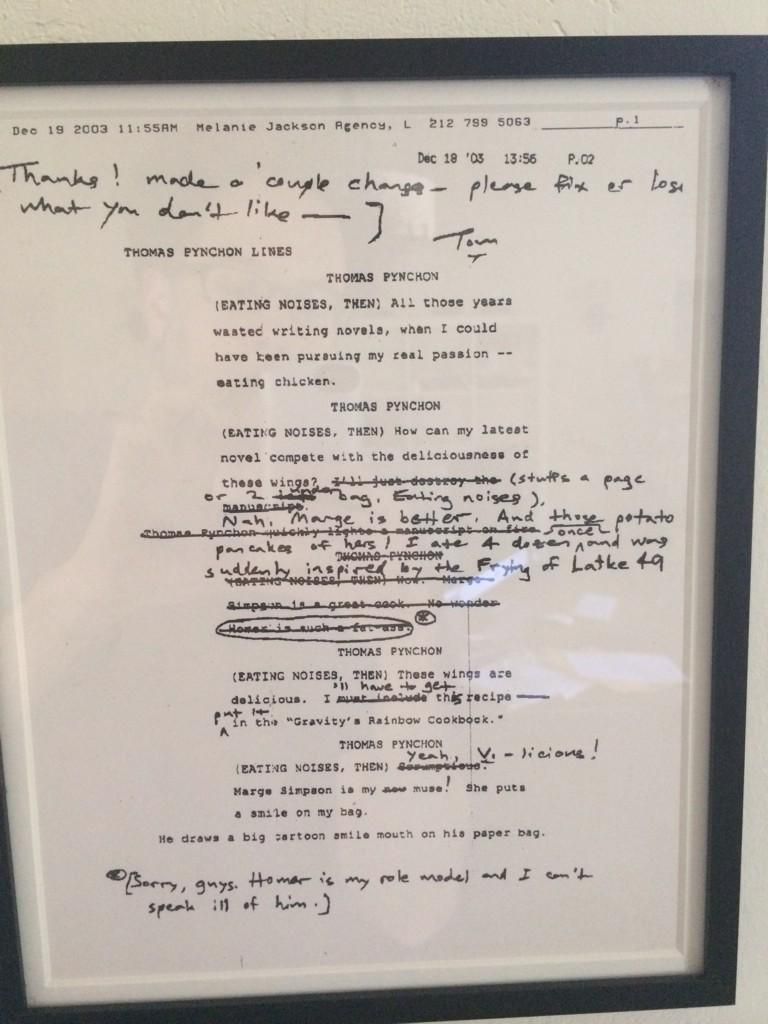
This past week, Matt Selman, an executive producer for The Simpsons, shed some more light on those playful cameos. On Twitter, he posted a copy of the script Pynchon edited and faxed back to the show’s writers. (Click on the image above to see it in a larger format.) In some cases, Pynchon, always the writer, tweaked the language to make it flow as he liked. In other cases, he added his own material to the script — new sound effects, jokes, and puns. (The word “Scrumptious” gets turned into Vi-licious.) And, in one case, he removed a joke. Deleting the words “No wonder Homer is such a fat ass,” Pynchon scrawled the comment: “Sorry, guys. Homer is my role model and I can’t speak ill of him.” Finally, Homer gets some respect.
Having once been involved in the founding of an arts magazine, I have experienced intimately the ways in which such an endeavor can depend upon a community of equals pooling a diversity of skills. The process can be painful: egos compete, certain elements seek to dominate, but the successful product of such a collaborative effort will represent a living community of artists, writers, editors, and other masters of technique who subordinate their individual wills, temporarily, to the will of a collective, creating new gestalt identities from conceptual atoms. As Monoskop—“a wiki for collaborative studies of art, media and the humanities”—points out, “the whole” of an arts magazine, “could become greater than the sum of its parts.” Often when this happens, a publication can serve as the platform or nucleus of an entirely new movement.
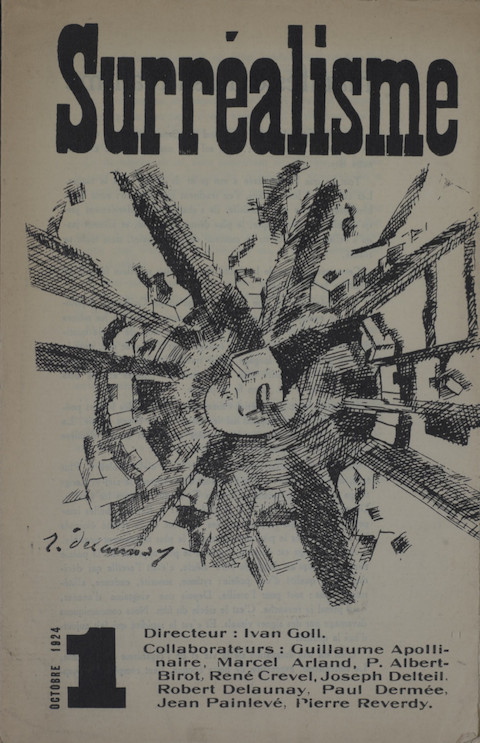
Monoskop maintains a digital archive of printed avant-garde and modernist magazines dating from the late-19th century to the late 1930s, published in locales from Arad to Bucharest, Copenhagen to Warsaw, in addition to the expected New York and Paris. From the latter city comes the 1924 first issue of Surrealisme at the top of the post.
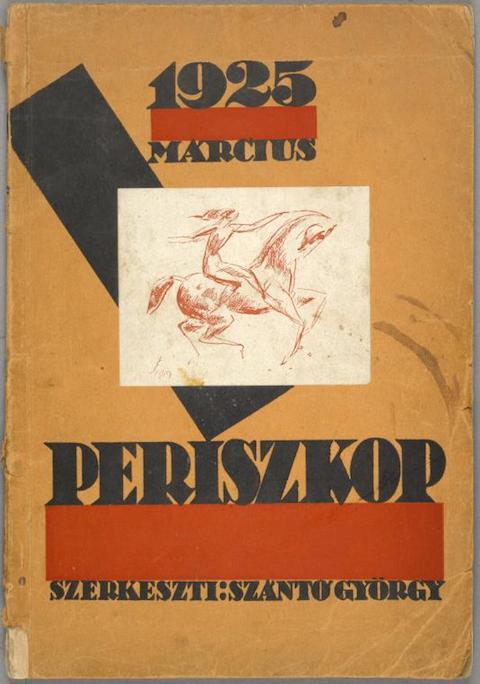
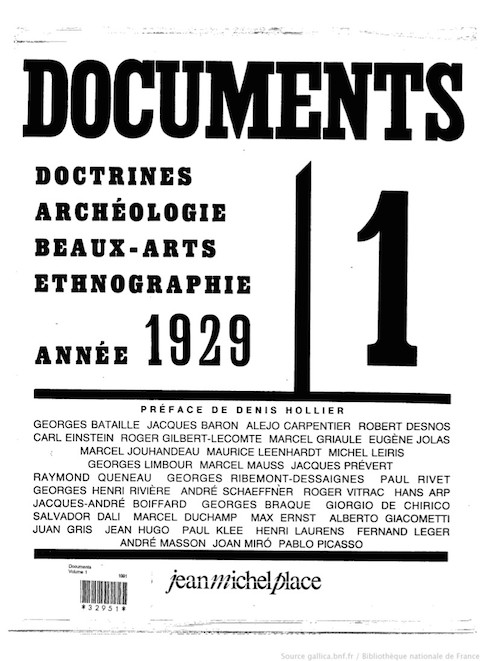
From the much smaller city of Arad in Romania comes the March, 1925 issue 1 of Periszkóp above, published in Hungarian and featuring works by Picasso, Marc Chagall, and many lesser-known Eastern European artists. Just below, see another Paris publication: the first, 1929 issue of Documents, a surrealist journal edited by Georges Bataille and featuring such luminaries as Cuban novelist Alejo Carpentier and artists Georges Braque, Giorgio De Chirico, Salvador Dali, Marcel Duchamp, Paul Klee, Joan Miro, and Pablo Picasso. Further down, see the first, 1926, issue of the Bauhaus journal, vehicle of the famous arts movement founded by Walter Gropius in 1919.
The variety of modernist and avant garde publications archived at Monoskop “provide us with a historical record of several generations of artists and writers.” They also “remind us that our lenses matter.” In an age of “the relentless linearity of digital bits and the UX of the glowing screen” we tend to lose sight of such critically important matters as design, typography, layout, writing, and the “techniques of printing and mechanical reproduction.” Anyone can build a website, fill it with “content,” and propagate it globally, giving little or no thought to aesthetic choices and editorial framing. But the magazines represented in Monoskop’s archive are specialized creations, the products of very deliberate choices made by groups of highly skilled individuals with very specific aesthetic agendas.
A majority of the publications represented come from the explosive period of modernist experimentation between the wars, but several, like the journal Rhythm: Art Music Literature—first published in 1911—offer glimpses of the early stirrings of modernist innovation in the Anglophone world. Others like the 1890–93 Parisian Entretiens politiques et littéraires showcase the work of pioneering early French modernist forebears like Jules Laforgue (a great influence upon T.S. Eliot) and also André Gide and Stéphane Mallarmé. Some of the publications here are already famous, like The Little Review, many much lesser-known. Most published only a handful of issues.
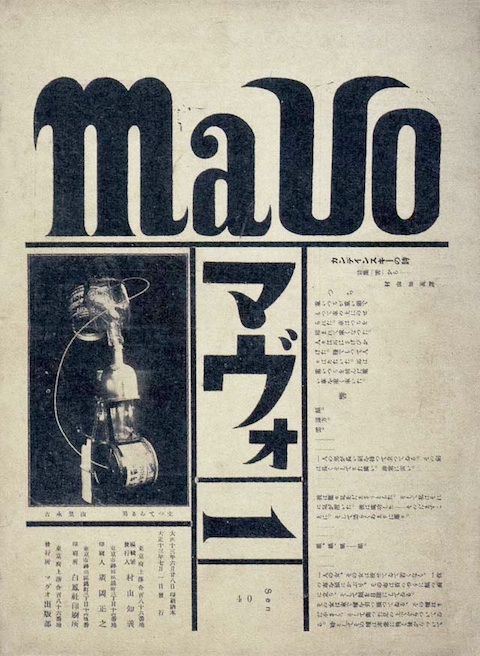
With a few exceptions—such as the 1923 Japanese publication MAVO shown above—almost all of the journals represented at Monoskop’s archive hail from Eastern and Western Europe and the U.S.. While “only a few journals had any significant impact outside the avant-garde circles in their time,” the ripples of that impact have spread outward to encompass the art and design worlds that surround us today. These examples of the literary and design culture of early 20th century modernist magazines, like those of late 20th century postmodern ‘zines, provide us with a distillation of minor movements that came to have major significance in decades hence.
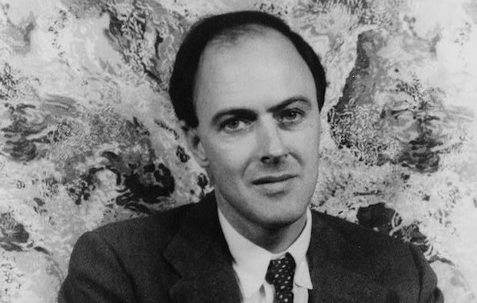
Generations of us know Roald Dahl as, first and foremost, the author of popular children’s novels like The BFG, The Witches, Charlie and the Chocolate Factory (that book of the “subversive” lost chapter), and James and the Giant Peach. We remember reading those with great delight, and some of us even made it into the rumored literary territory of his “stories for grown-ups.” But few of us, at least if we grew up in the past few decades, will have familiarized ourselves with all the purposes to which Dahl put his pen. Like many fine writers, Dahl always drew something from his personal experience, and few personal experiences could have had as much impact as the sudden death of his measles-stricken seven-year-old daughter Olivia in 1962. A chapter of Donald Sturrock’s biography Storyteller: The Life of Roald Dahl, excerpted at The Telegraph, tells of both the event itself and Dahl’s stoic, writerly (according to some, perhaps too stoic and too writerly) way of handling it.
But good did come out of Dahl’s response to the tragedy. In 1986, he wrote a leaflet for the Sandwell Health Authority entitled Measles: A Dangerous Illness, which tells Olivia’s story and provides a swift and well-supported argument for universal vaccination against the disease:
Olivia, my eldest daughter, caught measles when she was seven years old. As the illness took its usual course I can remember reading to her often in bed and not feeling particularly alarmed about it. Then one morning, when she was well on the road to recovery, I was sitting on her bed showing her how to fashion little animals out of coloured pipe-cleaners, and when it came to her turn to make one herself, I noticed that her fingers and her mind were not working together and she couldn’t do anything.
“Are you feeling all right?” I asked her.
“I feel all sleepy,” she said.
In an hour, she was unconscious. In twelve hours she was dead.
The measles had turned into a terrible thing called measles encephalitis and there was nothing the doctors could do to save her. That was twenty-four years ago in 1962, but even now, if a child with measles happens to develop the same deadly reaction from measles as Olivia did, there would still be nothing the doctors could do to help her.
On the other hand, there is today something that parents can do to make sure that this sort of tragedy does not happen to a child of theirs. They can insist that their child is immunised against measles. I was unable to do that for Olivia in 1962 because in those days a reliable measles vaccine had not been discovered. Today a good and safe vaccine is available to every family and all you have to do is to ask your doctor to administer it.
It is not yet generally accepted that measles can be a dangerous illness. Believe me, it is. In my opinion parents who now refuse to have their children immunised are putting the lives of those children at risk. In America, where measles immunisation is compulsory, measles like smallpox, has been virtually wiped out.
Here in Britain, because so many parents refuse, either out of obstinacy or ignorance or fear, to allow their children to be immunised, we still have a hundred thousand cases of measles every year. Out of those, more than 10,000 will suffer side effects of one kind or another. At least 10,000 will develop ear or chest infections. About 20 will die.
LET THAT SINK IN.
Every year around 20 children will die in Britain from measles.
So what about the risks that your children will run from being immunised?
They are almost non-existent. Listen to this. In a district of around 300,000 people, there will be only one child every 250 years who will develop serious side effects from measles immunisation! That is about a million to one chance. I should think there would be more chance of your child choking to death on a chocolate bar than of becoming seriously ill from a measles immunisation.
So what on earth are you worrying about? It really is almost a crime to allow your child to go unimmunised.
The ideal time to have it done is at 13 months, but it is never too late. All school-children who have not yet had a measles immunisation should beg their parents to arrange for them to have one as soon as possible.
Incidentally, I dedicated two of my books to Olivia, the first was ‘James and the Giant Peach’. That was when she was still alive. The second was ‘The BFG’, dedicated to her memory after she had died from measles. You will see her name at the beginning of each of these books. And I know how happy she would be if only she could know that her death had helped to save a good deal of illness and death among other children.
Alas, this message hasn’t quite fallen into irrelevance. What with anti-vaccination movements having somehow picked up a bit of steam in recent years (and with the number of cases of measles cases now climbing again), it might make sense to send Dahl’s leaflet back into print — or, better yet, to keep it circulating far and wide around the internet. Not that others haven’t made cogent pro-vaccination arguments of their own, in different media, with different illustrations of the data, and with different levels of profanity. Take, for instance, Penn and Teller’s segmentbelow, which, finding the perfect target given its mandate against non-evidence-based beliefs, takes aim at the proposition that vaccinations cause autism:
Last month we featured the particulars of novelist Haruki Murakami’s passion for jazz, including a big Youtube playlist of songs selected from Portrait in Jazz, his book of essays on the music. But we also alluded to Murakami’s admission of running to a soundtrack provided by The Lovin’ Spoonful, which suggests listening habits not enslaved to purism. His books — one of the very best known of which takes its name straight from a Beatles song (“Norwegian Wood”) —tend to come pre-loaded with references to several varieties of music, almost always Western and usually American. “The Fierce Imagination of Haruki Murakami,” Sam Anderson’s profile of the writer on the occasion of the release of his previous novel 1Q84, name-checks not just Stan Getz but Janáček’s Sinfonietta, The Rolling Stones’ Sympathy for the Devil, Eric Clapton’s Reptile, Bruce Springsteen’s version of “Old Dan Tucker,” and The Many Sides of Gene Pitney. The title of Murakami’s newColorless Tsukuru Tazaki and His Years of Pilgrimage,writes The Week’s Scott Meslow, references Franz Liszt’s ‘Years of Pilgrimage’ suite, “which plays a central role in the novel’s narrative. The pointed reference isn’t exactly a major detour from Murakami.”
Given the writer’s increasing reliance on music and the notion of “songs that literally have the power to change the world,” to say nothing of his “ability to single-handedly drive musical trends,” it can prove an illuminating exercise to assemble Murakami playlists. Selecting 96 tracks, Meslow has created his own playlist (above) that emphasizes the breadth of genre in the music incorporated into Murakami’s fiction: from Ray Charles to Brenda Lee, Duke Ellington to Bobby Darin, Glenn Gould to the Beach Boys. Each song appears in one of Murakami’s novels, and Meslow even includes citations for each track: “I had some coffee while listening to Maynard Ferguson’s ‘Star Wars.’ ” “Her milk was on the house if she would play the Beatles’ ‘Here Comes the Sun,’ said the girl.” “Imagine The Greatest Hits of Bobby Darin minus ‘Mack the Knife.’ That’s what my life would be like without you.” “The room begins to darken. In the deepening darkness, ‘I Can’t Go For That’ continues to play.” It all coheres in something to listen to while exploring Murakami’s world: in your imagination, in real life, or in his trademark realms between.
To listen to the playlist above, you will first need to download Spotify. Please note that once you mouse over the playlist, you can scroll through all 96 songs. Look for the vertical scrollbar along the right side of the playlist.
Photo above is attributed to “wakarimasita of Flickr”
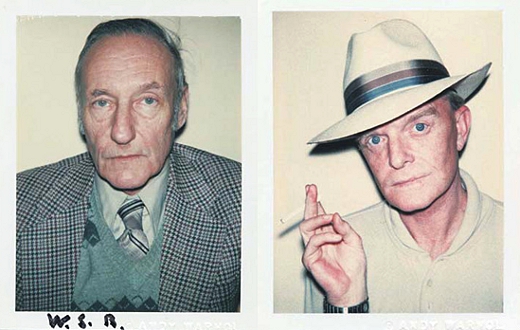
On July 23, 1970, William S. Burroughs wrote Truman Capote a letter. “This is not a fan letter in the usual sense — unless you refer to ceiling fans in Panama.” Instead, Burroughs’s missive is a poison pen letter, blistering even by the high standards of New York literary circles. Of course, Capote, author of Breakfast at Tiffany’s and In Cold Blood, was no stranger to feuds. He often traded witty, venomous barbs with the likes of Gore Vidal and Norman Mailer. Yet Burroughs’s letter comes off as much darker and, with the benefit of hindsight, much more unnerving.
As Thom Robinson thoroughly details in his article for RealityStudio, the two had a long and complicated past filled with professional jealousy and personal disdain. They first met when Burroughs was a struggling writer and Capote was working as a copy boy at The New Yorker in the early 1940s. Burroughs was no doubt rankled by Capote’s meteoric rise to literary stardom just after the war, thanks to some highly-praised short stories that appeared in Harper’s Bazaar and other publications. Burroughs and his fellow Beat writers ridiculed Capote in their private letters. In a letter to Allen Ginsberg, Jack Kerouac described Capote’s work as “full of bull on every page.” When Kerouac’s On the Road was published, Capote dismissed the book by saying, “[it] isn’t writing at all — it’s typing.”
When Naked Lunch was finally released in America in 1962, three years after its publication in France, William S. Burroughs became a literary icon. (Hear Burroughs read Naked Lunch here.) At the same time, Capote was starting to develop a genre he called creative non-fiction, which would eventually culminate with In Cold Blood. When talking about his book in a 1968 interview with Playboy, Capote compared Burroughs’s writing with his own. In Cold Blood “is really the most avant-garde form of writing existent today […] creative fiction writing has gone as far as it can experimentally. […] Of course we have writers like William Burroughs, whose brand of verbal surface trivia is amusing and occasionally fascinating, but there’s no base for moving forward in that area.” At another point, Capote quipped, “Norman Mailer thinks [he] is a genius, which I think is ludicrous beyond words. I don’t think William Burroughs has an ounce of talent.”
So when Burroughs put pen to paper in 1970, he already had plenty of reasons to dislike Capote. In the letter, though, Burroughs’s ire was specifically directed at Capote’s dubious ethics in writing In Cold Blood, a book that Burroughs described as “a dull unreadable book which could have been written by any staff writer on The New Yorker.” (Note: You can read an early version of In Cold Blood in The New Yorker itself.)
The spine of In Cold Blood is the first-hand account of convicted killers Dick Hickock and Perry Smith. Capote spent hours interviewing them and in the process grew close to them, especially Smith. In spite of this, Capote did little to help their defense. (This is the subject of not one but two movies, by the way, Capote and Infamous.) Critic Kenneth Tynan, in a scathing review for The Observer, cried foul. “For the first time an influential writer of the front rank has been placed in a position of privileged intimacy with criminals about to die, and–in my view–done less than he might have to save them,” he wrote. “An attempt to help (by supplying new psychiatric testimony) might easily have failed: what one misses is any sign that it was ever contemplated.” The fact of the matter was that the book worked better if they died. Though Capote’s biographer Gerald Clarke argued that there was little that the writer could have done to save the two, he conceded that “Tynan was right when he suggested that Truman did not want to save them.”
Seemingly repulsed by Capote’s entire project, Burroughs took the Tynan’s critique one step further. He argued that Capote not only sold out his subjects but served as a mouthpiece for those in power.
I feel that [Tynan] was much too lenient. Your recent appearance before a senatorial committee on which occasion you spoke in favor of continuing the present police practice of extracting confessions by denying the accused the right of consulting consul prior to making a statement also came to my attention. In effect you were speaking in approval of standard police procedure: obtaining statements through brutality and duress, whereas an intelligent police force would rely on evidence rather than enforced confessions. […] You have placed your services at the disposal of interests who are turning America into a police state by the simple device of deliberately fostering the conditions that give rise to criminality and then demanding increased police powers and the retention of capital punishment to deal with the situation they have created.
For someone who had frequently been on the wrong end of the law and for someone who spent his life giving voice to the marginalized, this was an anathema. Burroughs then delivered a chilling, voodoo-style curse:
You have betrayed and sold out the talent that was granted you by this department. That talent is now officially withdrawn. Enjoy your dirty money. You will never have anything else. You will never write another sentence above the level of In Cold Blood. As a writer you are finished. Over and out.
Burroughs’ curse seemed to have worked. 1970 was the high-water mark of Capote’s career. He never wrote another novel after In Cold Blood, though he labored for years on a never completed book called Answered Prayers. He spent the rest of his life on a downward alcoholic spiral until his death in 1984.
July 23, 1970
My Dear Mr. Truman Capote
This is not a fan letter in the usual sense — unless you refer to ceiling fans in Panama. Rather call this a letter from “the reader” — vital statistics are not in capital letters — a selection from marginal notes on material submitted as all “writing” is submitted to this department. I have followed your literary development from its inception, conducting on behalf of the department I represent a series of inquiries as exhaustive as your own recent investigations in the sun flower state. I have interviewed all your characters beginning with Miriam — in her case withholding sugar over a period of several days proved sufficient inducement to render her quite communicative — I prefer to have all the facts at my disposal before taking action. Needless to say, I have read the recent exchange of genialities between Mr. Kenneth Tynan and yourself. I feel that he was much too lenient. Your recent appearance before a senatorial committee on which occasion you spoke in favor of continuing the present police practice of extracting confessions by denying the accused the right of consulting consul prior to making a statement also came to my attention. In effect you were speaking in approval of standard police procedure: obtaining statements through brutality and duress, whereas an intelligent police force would rely on evidence rather than enforced confessions. You further cheapened yourself by reiterating the banal argument that echoes through letters to the editor whenever the issue of capital punishment is raised: “Why all this sympathy for the murderer and none for his innocent victims?” I have in line of duty read all your published work. The early work was in some respects promising — I refer particularly to the short stories. You were granted an area for psychic development. It seemed for a while as if you would make good use of this grant. You choose instead to sell out a talent that is not yours to sell. You have written a dull unreadable book which could have been written by any staff writer on the New Yorker — (an undercover reactionary periodical dedicated to the interests of vested American wealth). You have placed your services at the disposal of interests who are turning America into a police state by the simple device of deliberately fostering the conditions that give rise to criminality and then demanding increased police powers and the retention of capital punishment to deal with the situation they have created. You have betrayed and sold out the talent that was granted you by this department. That talent is now officially withdrawn. Enjoy your dirty money. You will never have anything else. You will never write another sentence above the level of In Cold Blood. As a writer you are finished. Over and out. Are you tracking me? Know who I am? You know me, Truman. You have known me for a long time. This is my last visit.
Jonathan Crow is a Los Angeles-based writer and filmmaker whose work has appeared in Yahoo!, The Hollywood Reporter, and other publications. You can follow him at @jonccrow. And check out his blog Veeptopus, featuring one new drawing of a vice president with an octopus on his head daily.
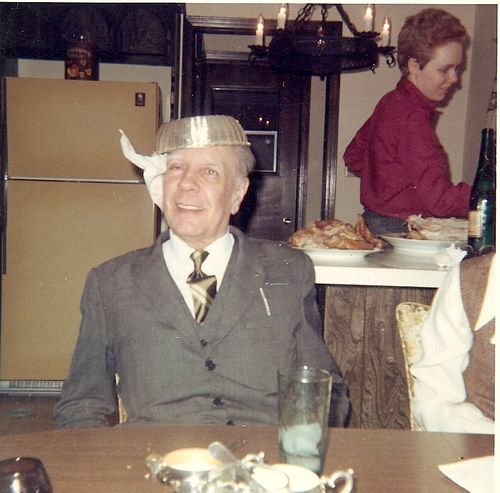
Let’s give three cheers and quickly celebrate the birthday of the Argentine writer Jorge Luis Borges, born on this day in 1899. Above, we have a photo of Borges taken during a seemingly festive moment. According to the blog Me and My Big Mouth, the photo comes from the collection of Norman Thomas di Giovanni, whose biography Georgie and Elsa — Jorge Luis Borges and His Wife: The Untold Story will hit bookstores on September 2 (though it can be pre-ordered now). Paul Theroux calls the bio “a long, satisfying and penetrating gaze into the private life of an acknowledged genius, his work, his evasions, and his peculiar heartaches.”
If you care to turn this celebration into a full-day affair, we’d recommend listening to Borges’ 1967–8 Norton Lectures on Poetry, recorded at Harvard. The 9 lectures provide hours of intellectual stimulation. Or watch the free documentary, Jorge Luis Borges: The Mirror Man, which one reviewer called a “bit of everything – part biography, part literary criticism, part hero-worship, part book reading, and part psychology.”
You can find a few more Borges favorites from our archive right below.
We're hoping to rely on loyal readers, rather than erratic ads. Please click the Donate button and support Open Culture. You can use Paypal, Venmo, Patreon, even Crypto! We thank you!
Open Culture scours the web for the best educational media. We find the free courses and audio books you need, the language lessons & educational videos you want, and plenty of enlightenment in between.






.jpg)