Nadine Gordimer, whose novels of South Africa portray the conflicts and contradictions of a racist society, was named winner of the 1991 Nobel Prize in Literature today as her country finally begins to dismantle the system her works have poignantly explored for more than 40 years.
In a brief citation, the Swedish Academy, which confers the awards, referred to her as “Nadine Gordimer, who through her magnificent epic writing has — in the words of Alfred Nobel — been of very great benefit to humanity.”
The academy also added that “her continual involvement on behalf of literature and free speech in a police state where censorship and persecution of books and people exist have made her ‘the doyenne of South African letters.’ ”
Yesterday, The New Yorker commented that, although she wrote 15 novels, it was “through her short fiction Gordimer made her presence felt the most.” Gordimer published her very first short story, “Come Again Tomorrow,” in a Johannesburg magazine in 1938, when she was just 15 years old. Thirteen years later, there came another first — the first of many stories she published in The New Yorker (“A Watcher of the Dead”). Although many of Gordimer’s New Yorker stories remain locked up, available only to the magazine’s subscribers, we’ve managed to dig up several open ones. Above, you can watch Gordimer read her 1999 story called “Loot” while visiting Harvard University in 2005. The text has since been re-published on the Nobel Prize web site. Below, you can also listen to author Tessa Hadley read “City Lovers,” first published in The New Yorker in 1975. The story “focusses on a love affair between a white man and a ‘colored’ woman in Apartheid South Africa. It’s deeply political in its details—the man is a geologist at a mining company, the couple’s affair is illegal, and they cover it up by pretending that she is his servant. ”
Other Gordimer stories available online include “The First Sense” and “A Beneficiary”, published respectively in The New Yorker in 2006 and 2007. “The Second Sense” came out in The Virginia Quarterly, also in 2007. If you, dear Open Culture readers, happen to know of any other Gordimer stories published online, please let us know in the comments sections below, and we’ll add them to the roundup.
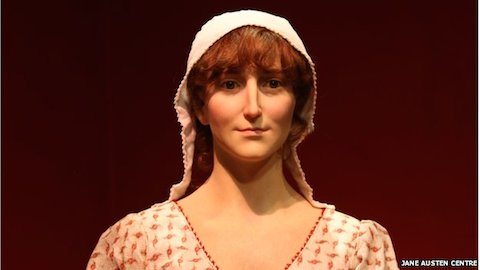
Last Wednesday, the Jane Austen Centre in Bath, England unveiled the wax sculpture above, which they say is the closest “anyone has come to the real Jane Austen in 200 years.” The figure, The Guardianreports, is the creation of forensic artist Melissa Dring, a “specialist team using forensic techniques which draw on contemporary eye-witness accounts,” and Emmy-winning costume designer Andrea Galer.
Austen often introduced her characters with broad descriptions—Emma Woodhouse is “handsome, clever, and rich,” Pride and Prejudice’s Mr. Bingley simply “a single man in possession of a good fortune.” But her talent consisted in undermining such stock descriptions, and the societal assumptions they entail. Instead of types, she gave readers complicated individuals squirming uncomfortably inside the bonds of propriety and decorum. But what of Austen herself? Readers initially knew nothing of the author, as her novels were first published anonymously.
Since her death in 1817, biographers have told and retold her personal history, and she has become an almost cult-like figure for fans of her work. Some of the author’s first biographers were family members, including her nephew James Edward Austen-Leigh, who published A Memoir of Jane Austen in 1872 (above). In it, Austen-Leigh describes his aunt as “very attractive”: “Her figure was rather tall and slender, her step light and firm, and her whole appearance expressive of health and animation. In complexion she was a clear brunette with a rich colour; she had full round cheeks, with mouth and nose small and well-formed, bright hazel eyes, and brown hair forming natural curls round her face.”
Based partly on that description and others from niece Caroline, the wax figure, Dring told the BBC, is “pretty much like her.” Austen “came from a large… family and they all seemed to share the long nose, the bright sparkly eyes and curly brown hair. And these characteristics come through the generations.” Dring used Austen’s sister Cassandra’s famous portrait as a starting point, but noted that the sketch “does make it look like she’s been sucking lemons […] We know from all accounts of her, she was very lively, very great fun to be with and a mischievous and witty person.” All descriptions with which her devoted readers would doubtless agree. See more photos of the Austen wax sculpture here.
Sci-fi author B.C. Kowalski recently posted a short essay on why the advice to write every day is, for lack of a suitable euphemism, “bullshit.” Not that there’s anything wrong with it, Kowalski maintains. Only that it’s not the only way. It’s said Thackeray wrote every morning at dawn. Jack Kerouac wrote (and drank) in binges. Every writer finds some method in-between. The point is to “do what works for you” and to “experiment.” Kowalski might have added a third term: diversify. It’s worked for so many famous writers after all. James Joyce had his music, Sylvia Plath her art, Hemingway his machismo. Faulkner drew cartoons, as did his fellow Southern writer Flannery O’Connor, his equal, I’d say, in the art of the American grotesque. Through both writers ran a deep vein of pessimistic humor, oblique, but detectable, even in scenes of highest pathos.
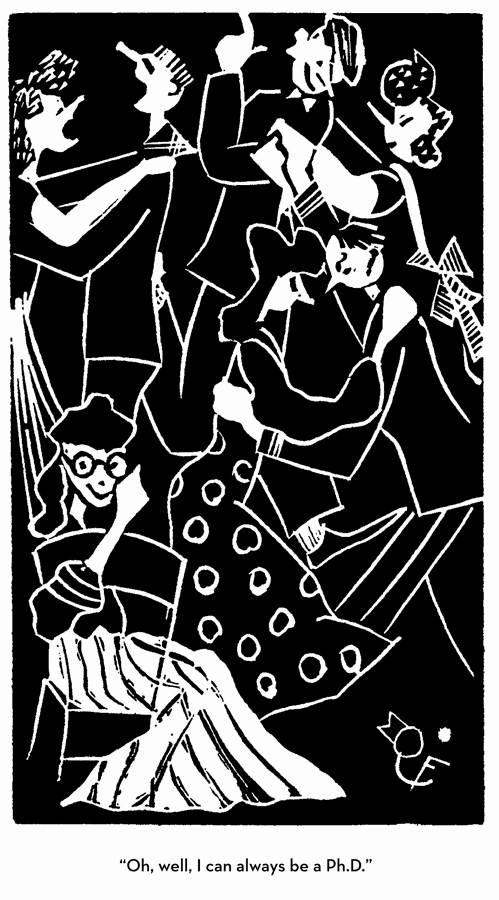
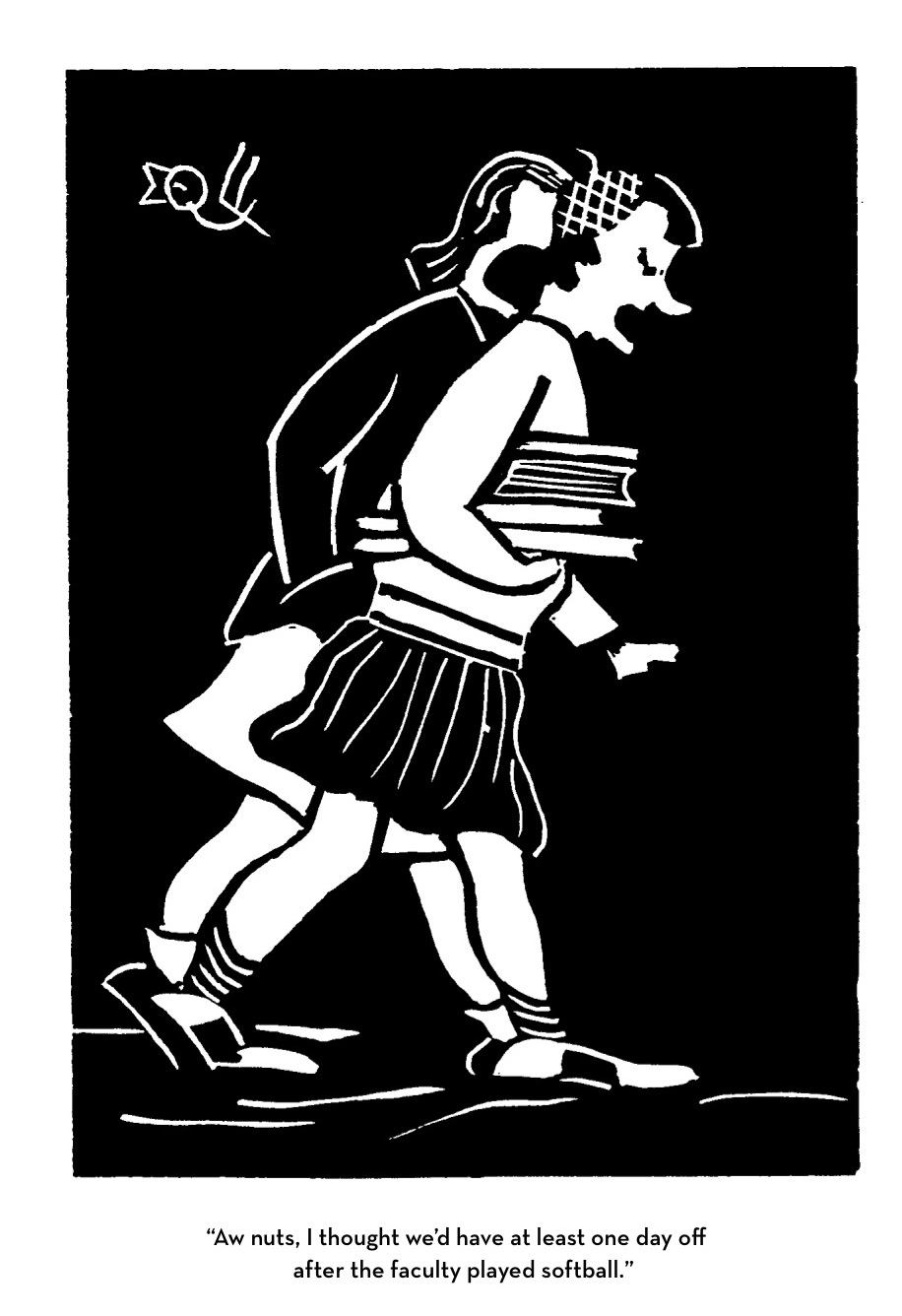
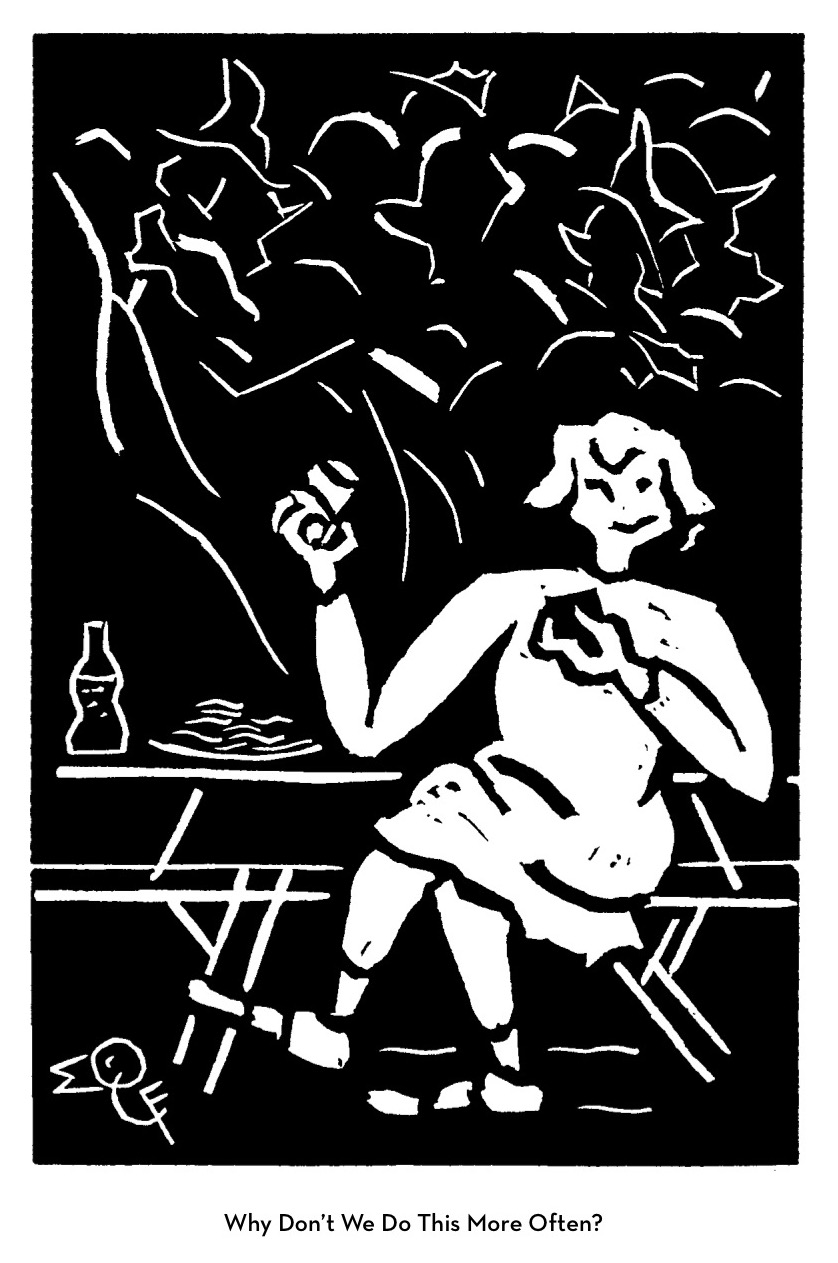
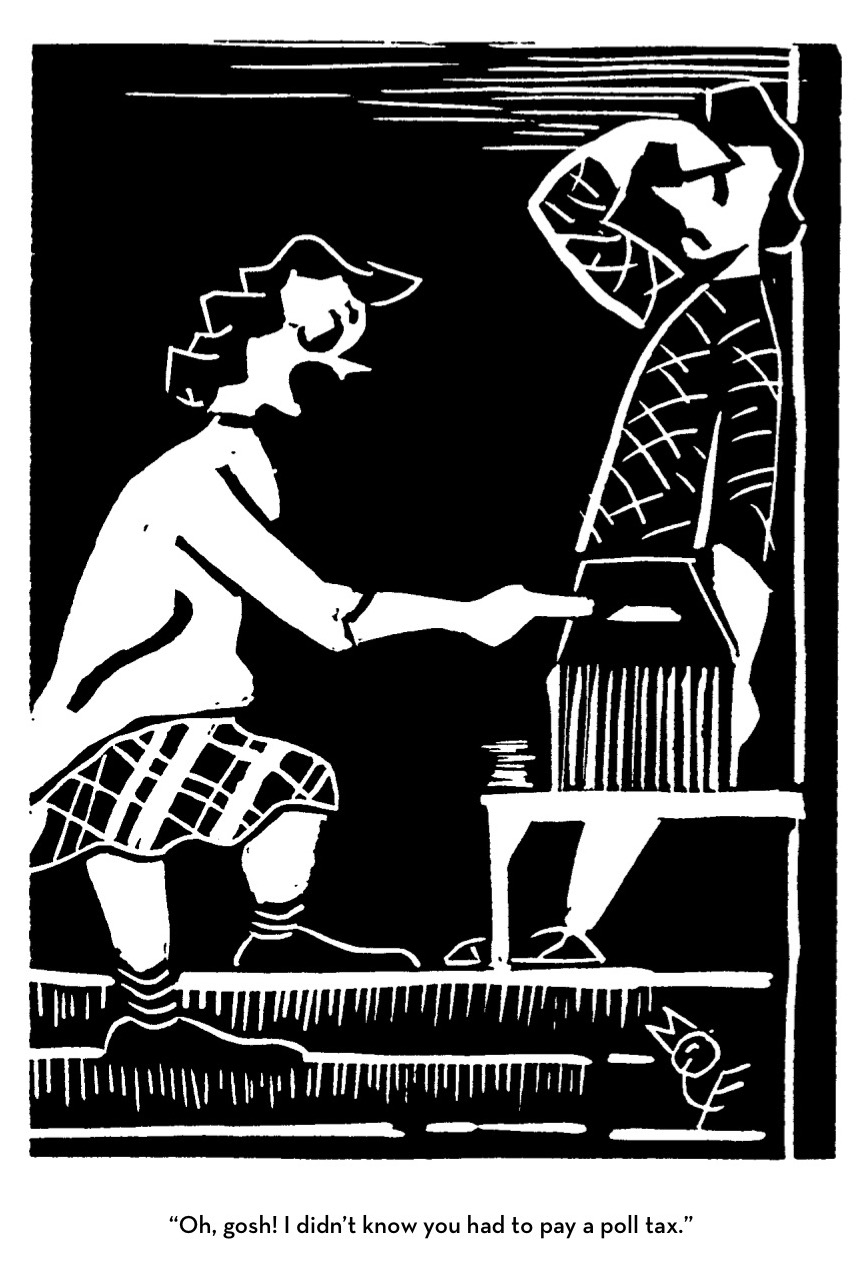
O’Connor’s visual work, writes Kelly Gerald in The Paris Review, was a “way of seeing she described as part of the ‘habit of art’”—a way to train her fiction writer’s eye. Her cartoons hew closely to her authorial voice: a lone sardonic observer, supremely confident in her assessments of human weakness. Perhaps a better comparison than Faulkner is with British poet and doodler Stevie Smith, whose bleak vision and razor-sharp wit similarly cut through mountains of… shall we say, bullshit. In both pen & ink and linoleum cuts, O’Connor set deadpan one-liners against images of pretension, conformity, and the banality of college life. In the cartoon at the top, she seems to mock the pursuit of credentials as a refuge for the socially disaffected. Above, a campaigner for a low-level office deploys bombastic pseudo-Leninist rhetoric, and in the cartoon below, a cranky character escapes a horde of identical WAVES.
O’Connor was an intensely visual writer with, Gerald writes, a “natural proclivity for capturing the humorous character of real people and concrete situations,” fully credible even at their most extreme (as in the increasingly horrific self-lacerations of Wise Blood’s Hazel Motes). She began drawing at five and produced small books and sketches as a child, eventually publishing cartoons in almost every issue of her high-school and college’s newspapers and yearbooks. Her alma mater Georgia College, then known as Georgia State College for Women, has published a book featuring her cartoons from her undergraduate years, 1942–45.
More recently, Gerald edited a collection called Flannery O’Connor: The Cartoons for Fantagraphics. In his introduction, artist Barry Moser describes in detail the technique of her linoleum cuts, calling them “coarse in technical terms.” And yet, “her rudimentary handling of the medium notwithstanding, O’Connor’s prints offer glimpses into the work of the writer she would become” with their “little O’Connor petards aimed at the walls of pretentiousness, academics, student politics, and student committees.” Had O’Connor continued making cartoons into her publishing years, she might have, like B.C. Kowalski, aimed one of those petards at those who dispense dogmatic, cookie-cutter writing advice as well.
Quick note: Earlier this year, J. K. Rowling began writing new stories about the 2014 Quidditch World Cup Finals for Pottermore, the website for all things Harry Potter. Today, she followed up with a story that takes the form of an article published in The Daily Prophet: “Dumbledore’s Army Reunites at Quidditch World Cup Final” by Rita Skeeter. Here, Rowling gives us the first glimpse of the adult Harry Potter.
About to turn 34, there are a couple of threads of silver in the famous Auror’s black hair, but he continues to wear the distinctive round glasses that some might say are better suited to a style-deficient twelve-year-old. The famous lightning scar has company: Potter is sporting a nasty cut over his right cheekbone. Requests for information as to its provenance merely produced the usual response from the Ministry of Magic: ‘We do not comment on the top secret work of the Auror department, as we have told you no less than 514 times, Ms. Skeeter.’ So what are they hiding? Is the Chosen One embroiled in fresh mysteries that will one day explode upon us all, plunging us into a new age of terror and mayhem?
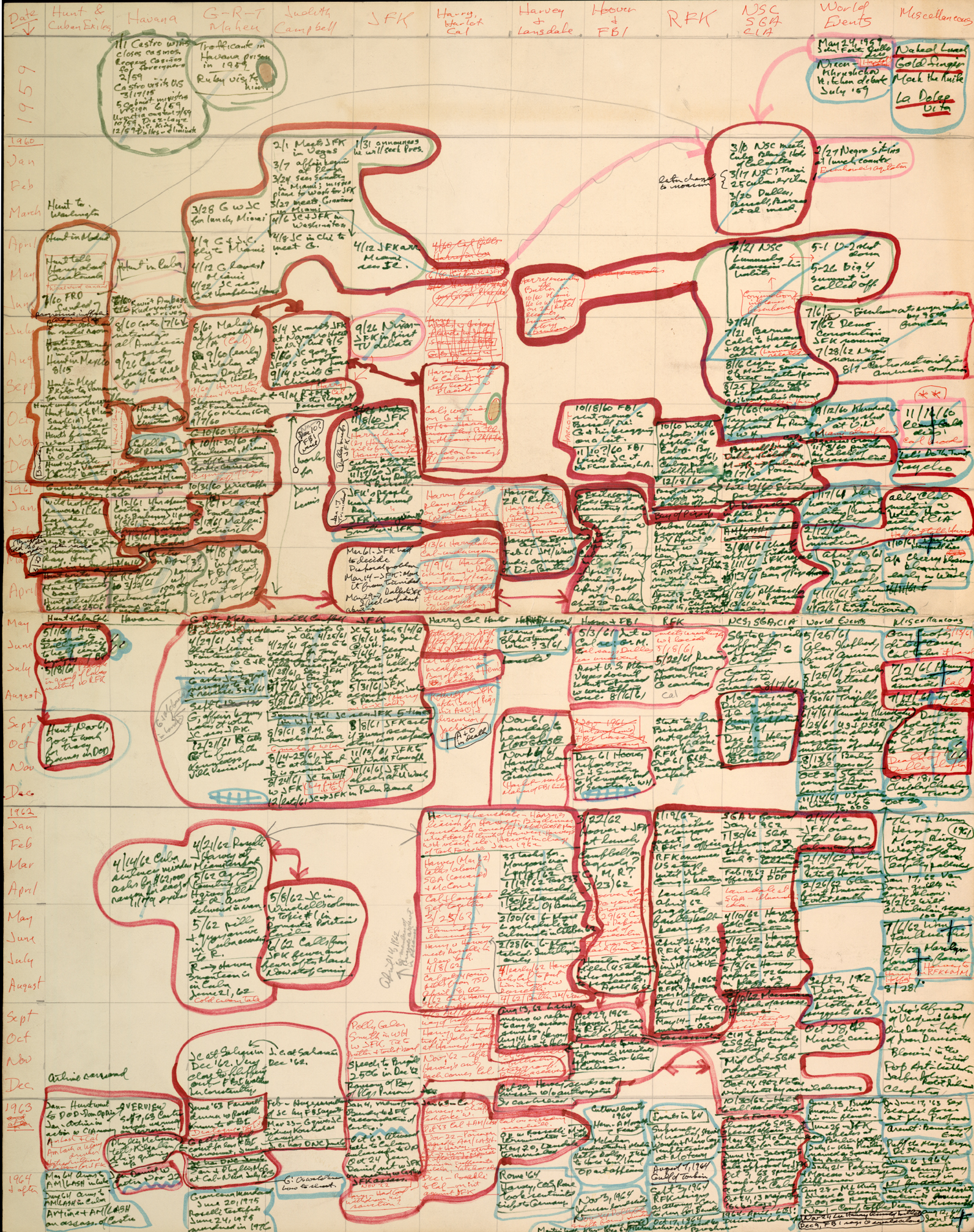
Norman Mailer wrote prolifically, but that didn’t mean cranking out insubstantial volumes. The books whose names we all remember always feel, when we take them down off the shelf, somewhat weightier than we remember: Advertisements for Myself at 532 pages, The Naked and the Dead at 731, The Executioner’s Song at 1072. But the ones with titles which don’t come to mind quite so readily can feel even more physically monumental, and deliberately crafted that way. “Mailer liked to think of his books as his children,” wrote Louis Menand in the author’s 2007 New Yorker obituary, “and, when asked which were his favorites, to name the least critically appreciated” — he answered, “Ancient Evenings and Harlot’s Ghost, great literary pyramids that no one visits any longer.” Ancient Evenings takes place in Egypt, among the actual pyramids, but if you want to visit the much more labyrinthine landmark of Harlot’s Ghost, you’d best take a map. Conveniently, Mailer drew one up himself, in the form of the outline above.
It would never before have seemed possible to me to reduce Mailer’s 1191-page novel of the CIA in the 1960s — a tale of the Mafia, the Cold War, the Cuban Revolution and Missile Crisis, the JFK assassination, and all those events’ attendant complications both real and imagined — to a single sheet, but here we have it. You can click on the image at the top of the post to enlarge it, and then click on the section you’d like to read in detail. Read Harlot’s Ghost with this outline handy, and perhaps you’ll find yourself not on the side of those (Menand included) who dismissed the book upon its publication in 1991, but of those who consider it Mailer’s masterpiece. Christopher Hitchens took the latter position in his own obituary for Mailer, calling the novel “a historic fictionalizing of the national-security state that came very near to realizing the Balzacian ambition that he had conceived for it. What a shame that it was so dismally received by the critics and that he never delivered the second volume of it that he had promised.” And imagine the size and complexity to which Mailer would have grown that book.
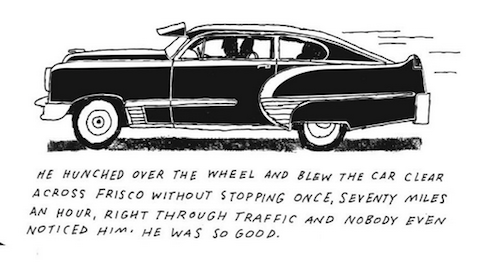
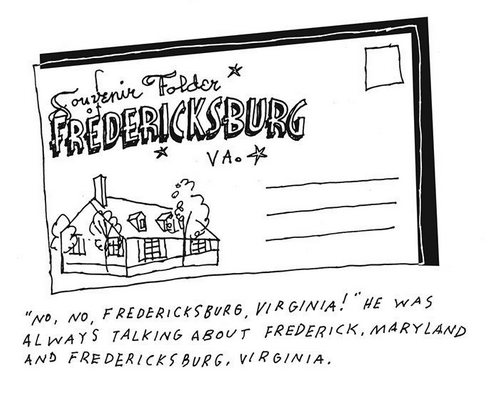
A great deal of mythology has built up around the life of Jack Kerouac, and especially around the experiences that went into his best-known work, the 1957 novel On the Road. Even the very act of its composition — perhaps especially the act of its composition — has, in the imaginations of many of Kerouac’s readers, turned into an image of the man “writing the book on a long scroll of teletype paper in three coffee-soaked-benzedrine-fueled days.” With this image in mind, illustrator Paul Rogers of Pasadena’s Art Center College of Design created On the Road, the illustrated scroll, featuring “a drawing for every page” of the novel, and depicting the historically researched “cars, buses, roadside architecture, and old signs” from Kerouac’s America of the late 1940s and early 50s, one that “looked awfully different than it does now.” You can scroll, as it were, through this work in progress at Rogers’ site.
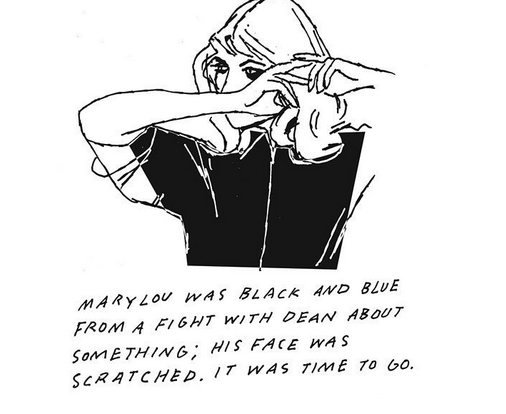
We’ve here included only four of the over 100 drawings Rogers has so far made, but these examples capture the novel’s multigenerationally intoxicating mix of Americana and pure momentum. You’ll also notice that, underneath each image, Rogers excerpts a passage of Kerouac’s. “Adding Kerouac’s words as captions to the drawings makes the series feel like a journal and not a carefully planned out illustrated book,” he writes, “and it seems to capture some of the spirit of Kerouac’s ‘this-happened-then-this-then-this’ writing style.”
You can read the scroll part-by-part on these pages: one through three, four, five, six, seven. Though I never took quite the lifestyle inspiration from On the Road some have, I can’t wait to see what visual inspiration Rogers draws from the bit about fabulous yellow roman candles exploding like spiders across the stars.
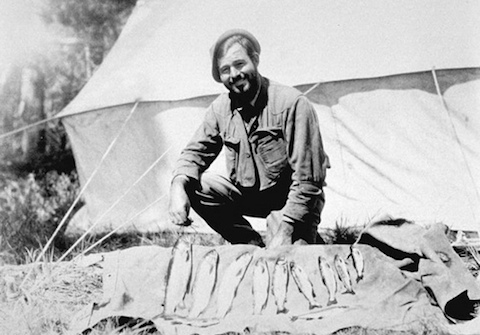
Don’t mistake that metaphor for real life, however. Judging by his 1920 Toronto Star how-to on maximizing comfort on camping vacations, he would not have stood for charred weenies and marshmallows on a stick. Rather, a little cookery know-how was something for a man to be proud of:
“…a frying pan is a most necessary thing to any trip, but you also need the old stew kettle and the folding reflector baker.”
Clearly, the man did not trust readers to independently seek out such sources as The Perry Ladies’ Cookbook of 1920 for instructions. Instead, he painstakingly details his method for successful preparation of Trout Wrapped in Bacon, including his preferred brands of vegetable shortening.
Would your mouth water less if I tell you that literary food blog Paper and Salt has updated Hem’s trout recipe à laEmeril Lagasse, omitting the Crisco and tossing in a few fresh herbs? No campfire required. You can get ‘er done in the broiler:
Bacon-Wrapped Trout: (adapted from Emeril Lagasse)
2 (10-ounce) whole trout, cleaned and gutted
1/2 cup cornmeal
Salt and ground pepper, to taste
8 sprigs fresh thyme
1 lemon, sliced
6 slices bacon
Fresh parsley, for garnish
1. Preheat broiler and set oven rack 4 to 6 inches from heat. With a paper towel, pat trout dry inside and out. Dredge outside of each fish in cornmeal, then season cavity with salt and pepper. Place 4 sprigs of thyme and 2 lemon slices inside each fish.
2. Wrap 3 bacon slices around the middle of each fish, so that the edges overlap slightly. Line a roasting pan with aluminum foil, and place fish on pan. Broil until bacon is crisp, about 5 minutes. With a spatula, carefully flip fish over and cook another 5 minutes, until flesh is firm.
Like any thoughtful hostess (simile!), Hemingway didn’t leave his guests to starve whilst waiting for the main event. His choice of hors d’oeuvres was little pancakes made from a mix, and again, he leaves nothing to chance, or Aunt Jemima’s instructions…
With the prepared pancake flours you take a cupful of pancake flour and add a cup of water. Mix the water and flour and as soon as the lumps are out it is ready for cooking. Have the skillet hot and keep it well greased. Drop the batter in and as soon as it is done on one side loosen it in the skillet and flip it over. Apple butter, syrup or cinnamon and sugar go well with the cakes.
Corn Cakes:
1 1/2 cups corn kernels (either fresh off the cob or thawed)
2 green onions, white parts only, coarsely chopped
2/3 cup flour
1/3 cup stone-ground yellow cornmeal
1 teaspoon baking powder
1/2 teaspoon red chile flakes
1/2 teaspoon salt
1 teaspoon sugar
1 egg, lightly beaten
2/3 cup buttermilk
2 tablespoons butter, melted and cooled
Canola oil, for frying
1. In a food processor, add corn and green onions and pulse 4 to 5 times, until finely chopped. In a large bowl, stir together corn mixture, flour, cornmeal, baking powder, red chile flakes, salt, and sugar.
2. In a small bowl, combine egg, buttermilk, and butter. Add to corn mixture, stirring until just combined.
3. Coat a large skillet or pancake griddle with oil. Over medium heat, spoon batter onto pan in 1/4 cups and fry until cakes are golden on both sides, 1 to 2 minutes per side.
Villeneuve opts out of recreating Hemingway’s dessert, an al fresco fruit pie so good “your pals … will kiss you” (provided, of course, that they’re Frenchmen). Because I, too, aim higher than weenies and marshmallows, here are his lengthy, rather self-congratulatory instructions:
In the baker, mere man comes into his own, for he can make a pie that to his bush appetite will have it all over the product that mother used to make, like a tent. Men have always believed that there was something mysterious and difficult about making a pie. Here is a great secret. There is nothing to it. We’ve been kidded for years. Any man of average office intelligence can make at least as good a pie as his wife.
All there is to a pie is a cup and a half of flour, one-half teaspoonful of salt, one-half cup of lard and cold water. That will make pie crust that will bring tears of joy into your camping partner’s eyes.
Mix the salt with the flour, work the lard into the flour, make it up into a good workmanlike dough with cold water. Spread some flour on the back of a box or something flat, and pat the dough around a while. Then roll it out with whatever kind of round bottle you prefer. Put a little more lard on the surface of the sheet of dough and then slosh a little flour on and roll it up and then roll it out again with the bottle.
Cut out a piece of the rolled out dough big enough to line a pie tin. I like the kind with holes in the bottom. Then put in your dried apples that have soaked all night and been sweetened, or your apricots, or your blueberries, and then take another sheet of the dough and drape it gracefully over the top, soldering it down at the edges with your fingers. Cut a couple of slits in the top dough sheet and prick it a few times with a fork in an artistic manner.
Put it in the baker with a good slow fire for forty-five minutes and then take it out.
Remember, campers: The real woodsman is the man who can be really comfortable in the bush. — Ernest Hemingway
Read nearly any critical commentary on James Joyce’s Dubliners, his 1914 collection of short stories that chronicle the lives of ordinary Irish residents of the title city, and you’re sure to come across the word “epiphany.” This is not some academic jargon, but the word Joyce himself used to describe the way that each story builds to a shock of recognition—often in the form of painful self-awareness—for key characters. Short-circuiting the typical climax-resolution-dénouement of conventional narrative, Joyce’s epiphanies give his stories a verisimilitude that can still feel very unsettling, given our typical expectations that realist fiction still obey the rules of fiction. Dramatic moments in our lives rarely have neat and tidy endings. But in stories like “Eveline,” “Araby,” “A Little Cloud,” and the collection’s capstone piece, “The Dead,” the often feckless characters find themselves paralyzed in states of existential dread by sudden flashes of self-knowledge, unable to assimilate new and painful insights into their limited perspectives.
That final story (adapted into John Huston’s final film) “elevates the book to the level of the supreme artworks of the 20th century,” writes Mark O’Connell in Slate. O’Connell’s essay commemorates the centenary of Dubliner’s publication this month. Dubliners remains, he writes, a book that “writers of the short story form seem basically resigned to never surpassing.” Written in the author’s early 20s, the stories, as Ulysses would eight years later, “reveal something profound and essential and unrealized about the city and its people”: “Dublin can feel less like a place that James Joyce wrote about than a place that is about James Joyce’s writing.” All of us non-Dubliners can enter the city through Joyce’s exquisite stories, and in an increasing variety of ways, thanks to digital technology. At the top of the post, find a digitized first edition of Dubliners. Just above, we have a reading of “Eveline” by “velvet-voiced” Dubliner Tadhg Hynes, and below, hear Irish actor Jim Norton read “The Sisters.”
You’ll find many more readings of Dubliners’ stories online, such as this deadpan reading of “Araby” from one of our favorites, Tom O’Bedlam, a Bloomsday reading of “Eveline” by award-winning Irish playwright Miriam Gallagher, and this Librivox collection of readings from various voices. I think Joyce would have very much appreciated the use of technology to keep his work alive into the 21st century. Part of his literary mission—certainly in many of Dubliners’ stories—was to illustrate the stultifying effects of clinging to the past. An eager adopter of new technologies, Joyce in fact brought the first cinema, The Volta, to Dublin in 1909. So it seems fitting that 100 years after the publication of Dubliners, his book receive the multimedia app treatment in the form of Digital Dubliners, a free, “engaging and authoritative edition” of the book designed by Boston College students and featuring “three hundred-odd images, seven hundred or so notes and explanations, two dozen videos, critical essays and hyperlinks, interactive maps sourced from contemporary newspaper, sound, film and photographic archives, with essays, film, recordings, background and expert discussion.” Watch a short promo video for Digital Dubliners below, and download the book on iTunes here.
Finally, you may wish to read the text in a more late-20th-century, and more open, format with this fully searchable “hypertextual, self-referential edition” prepared for Project Gutenberg. Whichever way you read Joyce’s Dubliners, you should, I presume to suggest, read Joyce’s Dubliners. And if you have read these stories before, even “somewhere in the double figures,” as Mark O’Connell has, then you’ll know how richly they reward re-reading, or hearing, or studying along with other readers and lovers of Joyce and a well-worn map of Dublin, or its shimmering touch-screen digital equivalent.
We're hoping to rely on loyal readers, rather than erratic ads. Please click the Donate button and support Open Culture. You can use Paypal, Venmo, Patreon, even Crypto! We thank you!
Open Culture scours the web for the best educational media. We find the free courses and audio books you need, the language lessons & educational videos you want, and plenty of enlightenment in between.