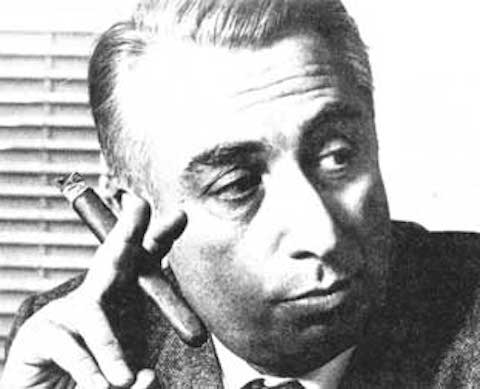
A key figure in such academic areas as semiology, structuralism, and post-structuralism, and author of such theoretical classics as Mythologies, The Pleasure of the Text, and S/Z, Roland Barthes is familiar to students across the humanities. His prolific output encompassed books on literary theory, philosophy, linguistics, anthropology, and theoretical essays on photography, music, fashion, sports, and love. In addition to his wide-ranging writings, Barthes lectured in the U.S., Switzerland, and at the Collège de France, where he was elected Chair of Semiology in 1977.
Barthes’ 1978–1980 lecture course at the Collège de France—titled The Preparation of the Novel—has been preserved in an English translation by Kate Briggs. Speakers of French, however, can hear Barthes himself deliver the lecture series in audio archived at Ubuweb. Listen to the first session from December, 1978 at the top of the post, and hear the fifth, with some musical accompaniment, above.
Delivered shortly after publication of the seminal texts mentioned above, these lectures, writes editor Nathalie Léger in her introduction, “form a diptych—the two parts can be accessed independently of each other, yet each one is indispensable to the other.” The last two lecture courses Barthes taught at the Collège de France, both, Léger writes, represent not a systematic theory, but “the peregrination of a quest,” exploring “one question and one question only: that of literary utopia.” Such probing investigations propelled Barthes’ entire career, and opened up new critical paths for a great many thinkers who dared to trace his winding intellectual steps and often intensely personal explorations.
My “In Ulysses” project is another way of experiencing the book — this time, using the virtual format. It will be a virtual reality videogame that will allow a user to inhabit the characters of Ulysses and experience the density of Joyce’s language in a fun and accessible way.…
As a user of “In Ulysses” walks along a virtual Sandymount Strand, the book will be read to them — they will hear Stephen’s thoughts as they are written — but these thoughts will then be illustrated around the user in real-time using textual annotations, images and links. A user can stop walking (therefore stopping Stephen walking) and explore these illustrations, gaining insight into the book and adding to the enjoyment of it.
“In Ulysses” has already raised €4000, enough to fund its prototype. No target date for its release has been announced. And, from what I can tell, the consumer version of the Oculus Rift won’t be released until next year. So, like any good reader of Ulysses, you’ll need to have a little patience.
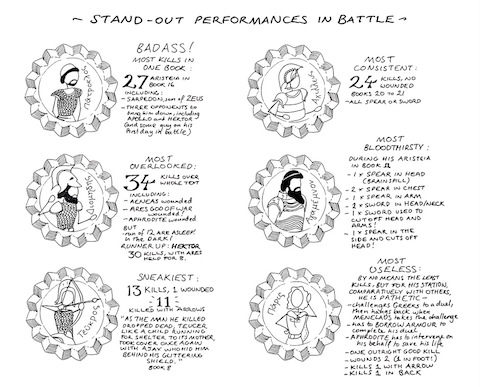
The next time some know-it-all moralist blames any number of social ills on violent video games or action films, ask them if they’d rather kids stick to the classics. When they invariably reply in the affirmative, you can smugly direct their attention to Greek Myth Comix’s astonishing infographic detailing the multitude of gruesome killings in the Iliad. Homer’s epic unflinchingly describes, for example, in graphic detail, the death of Lycon, who in Book 16 has a sword thrust through his neck: “nothing held but a piece of skin, and from that, Lycon’s head dangled down.” And if you’ve held on to your lunch, you may be interested to know the grisly circumstances of the other two candidates for “grimmest death.” Just below, see a section of the comic celebrating “stand out performances in battle.” Can Zack Snyder’s King Leonidas match kills with Homer’s Achilles? Only one way to find out….
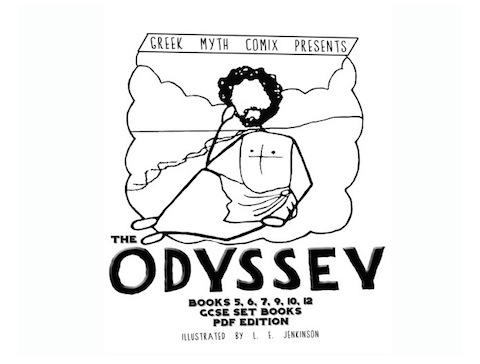
The Iliad graphic is great fun—as well as a succinct way to render modern scolds speechless—but Greek Myth Comix doesn’t stop there… Oh no! Fans of Homer’s Odyssey will not be disappointed; Books 5–7, and much of 9, 10, and 12 also get the “comix” treatment. The artwork is admittedly crude, but the text comes from a much more authoritative source than 300, no disrespect to Frank Miller. Lauren Jenkinson is a “Classical Civilisation and Literature teacher, writer and, apparently, artist,” and her online adaptations are intended primarily to help students pass their GCSE (OCR), the British secondary exams whose nearest equivalent in the States might perhaps be the SATs.
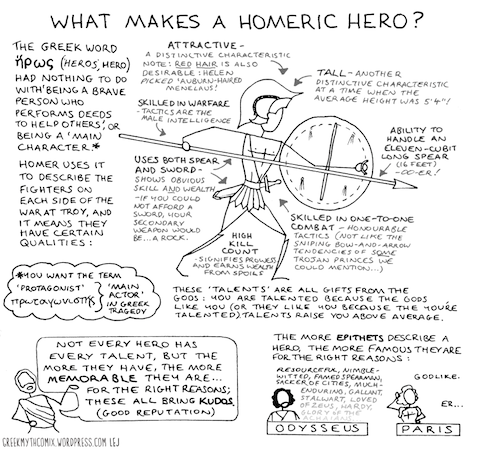
But Greek Myth Comix won’t only appeal to struggling students in the British Isles. Educators will find much to love here, as will lovers of mythology in general. Online access to the site is free, and you can purchase copies of the comix in PDF—either individually, in bulk, or in poster-size resolution. The site’s full archive has other goodies like the above, “What Makes a Homeric Hero?” And with such recent updates, no doubt Greek Myth Comix has much more in store for those struggling to enjoy or understand Homer’s bloody-minded epics, and those who simply love their myths in comic form as well as ancient lyric.
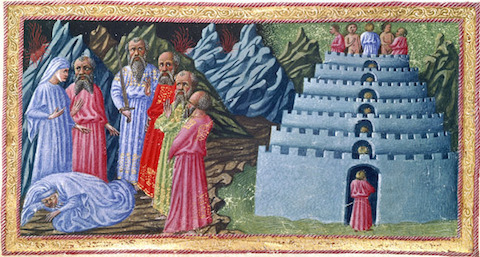
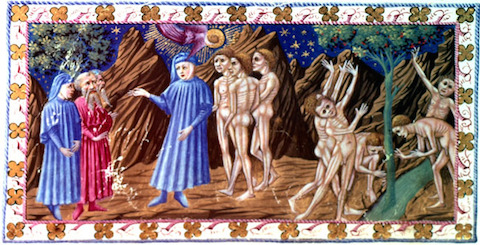
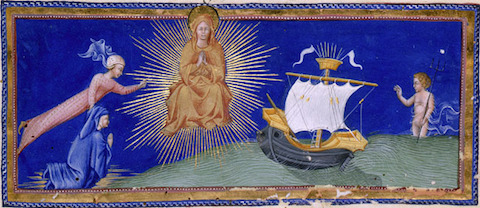
Few writers have inspired so many artists, so deeply and for so long, as Dante Alighieri. His epic poem the Divine Comedy (find in our collection of Free eBooks)has received striking illuminations at the hands of Gustave Doré, Sandro Botticelli, Alberto Martini, and Salvador Dalí — to name only those we’ve featured before here on Open Culture. The names Priamo della Quercia and Giovanni di Paolo may mean relatively little to you right now, but they’ll mean much more once you’ve taken a look at the illustrations featured here and at The World of Dante, which come from an illuminated manuscript of the Divine Comedy at the British Library known as Yates Thompson 36. Produced in Siena around 1450 for an unknown original patron, “the codex belonged to Alfonso V, king of Aragon, Naples, and Sicily,” and includes “110 large miniatures and three historiated initials.” (See all here.) Della Quercia illustrated the Inferno and Purgatorio and all three historiated initials; di Paolo illustrated Paradiso.
“This makes for two distinctly different styles,” continues The World of Dante’s page. “Priamo’s work reflects the more realistic style of late fifteenth-century Florentine painting, an influence which is particularly noticeable in his use of contours and outlines in the depiction of nudes. Giovanni di Paolo’s style is closer to that of late fourteenth-century Sienese artists,” producing results “greatly admired for their visual interpretation of the poem: the artist doesn’t just transcribe Dante’s words but seeks to render their meaning.”
The British Library’s medieval manuscripts blog describes it as “certainly a lavish production” that “must have been an expensive undertaking,” given the status of the men doing the illuminating as “two of the preeminent artists of the day.” But when it came to visualizing Dante’s journey, quite literally, to hell and back in 15th-century Italy, no artist ranked too highly. Even today, I can’t imagine any artist reading the Divine Comedy, illuminated or no, without getting a few vivid ideas of their own.
You know you’re doing something right in your life if the Nobel Prize-winning author of 100 Years of Solitude talks to you like a giddy fan boy.
Back in October 1990, Gabriel García Márquez sat down with Akira Kurosawa in Tokyo as the Japanese master director was shooting his penultimate movie Rhapsody in August — the only Kurosawa movie I can think of that features Richard Gere. The six hour interview, which was published in The Los Angeles Times in 1991, spanned a range of topics but the author’s love of the director’s movies was evident all the way through. At one point, while discussing Kurosawa’s 1965 film Red Beard, García Márquez said this: “I have seen it six times in 20 years and I talked about it to my children almost every day until they were able to see it. So not only is it the one among your films best liked by my family and me, but also one of my favorites in the whole history of cinema.”
One natural topic discussed was adapting literature to film. The history of cinema is littered with some truly dreadful adaptations and even more that are simply inert and lifeless. One of the Kurosawa’s true gifts as a filmmaker was turning the written word into a vital, memorable image. In movies like Throne of Blood and Ran, he has proved himself to be arguably the finest adapter of Shakespeare in the history of cinema.
García Márquez: Has your method also been that intuitive when you have adapted Shakespeare or Gorky or Dostoevsky?
Kurosawa: Directors who make films halfway may not realize that it is very difficult to convey literary images to the audience through cinematic images. For instance, in adapting a detective novel in which a body was found next to the railroad tracks, a young director insisted that a certain spot corresponded perfectly with the one in the book. “You are wrong,” I said. “The problem is that you have already read the novel and you know that a body was found next to the tracks. But for the people who have not read it there is nothing special about the place.” That young director was captivated by the magical power of literature without realizing that cinematic images must be expressed in a different way.
García Márquez: Can you remember any image from real life that you consider impossible to express on film?
Kurosawa: Yes. That of a mining town named Ilidachi [sic], where I worked as an assistant director when I was very young. The director had declared at first glance that the atmosphere was magnificent and strange, and that’s the reason we filmed it. But the images showed only a run-of-the-mill town, for they were missing something that was known to us: that the working conditions in (the town) are very dangerous, and that the women and children of the miners live in eternal fear for their safety. When one looks at the village one confuses the landscape with that feeling, and one perceives it as stranger than it actually is. But the camera does not see it with the same eyes.
When Kurosawa and García Márquez talked about Rhapsody in August, the mood of the interview darkened. The film is about one old woman struggling with the horrors of surviving the atomic attack on Nagasaki. When it came out, American critics bristled at the movie because it had the audacity to point out that many Japanese weren’t all that pleased with getting nuked. This is especially the case with Nagasaki. While Hiroshima had numerous factories and therefore could be considered a military target, Nagasaki had none. In fact, on August 9, 1945, the original target for the world’s second nuclear attack was the industrial town of Kita Kyushu. But that town was covered in clouds. So the pilots cast about looking for some place, any place, to bomb. That place proved to Nagasaki.
Below, Kurosawa talks passionately about the legacy of the bombing. Interestingly, García Márquez, who had often been a vociferous critic of American foreign policy, sort of defends America’s actions at the end of the war.
Kurosawa: The full death toll for Hiroshima and Nagasaki has been officially published at 230,000. But in actual fact there were over half a million dead. And even now there are still 2,700 patients at the Atomic Bomb Hospital waiting to die from the after-effects of the radiation after 45 years of agony. In other words, the atomic bomb is still killing Japanese.
García Márquez: The most rational explanation seems to be that the U.S. rushed in to end it with the bomb for fear that the Soviets would take Japan before they did.
Kurosawa: Yes, but why did they do it in a city inhabited only by civilians who had nothing to do with the war? There were military concentrations that were in fact waging war.
García Márquez: Nor did they drop it on the Imperial Palace, which must have been a very vulnerable spot in the heart of Tokyo. And I think that this is all explained by the fact that they wanted to leave the political power and the military power intact in order to carry out a speedy negotiation without having to share the booty with their allies. It’s something no other country has ever experienced in all of human history. Now then: Had Japan surrendered without the atomic bomb, would it be the same Japan it is today?
Kurosawa: It’s hard to say. The people who survived Nagasaki don’t want to remember their experience because the majority of them, in order to survive, had to abandon their parents, their children, their brothers and sisters. They still can’t stop feeling guilty. Afterwards, the U.S. forces that occupied the country for six years influenced by various means the acceleration of forgetfulness, and the Japanese government collaborated with them. I would even be willing to understand all this as part of the inevitable tragedy generated by war. But I think that, at the very least, the country that dropped the bomb should apologize to the Japanese people. Until that happens this drama will not be over.
The whole interview is fascinating. They continue to talk about historical memory, nuclear power and the difficulty of filming rose-eating ants. You can read the entire thing here. It’s well worth you time.
Jonathan Crow is a Los Angeles-based writer and filmmaker whose work has appeared in Yahoo!, The Hollywood Reporter, and other publications. You can follow him at @jonccrow.
Charles Bukowski—or “Hank” to his friends—assiduously cultivated a literary persona as a perennial drunken deadbeat. He mostly lived it too, but for a few odd jobs and a period of time, just over a decade, that he spent working for the United States Post Office, beginning in the early fifties as a fill-in letter carrier, then later for over a decade as a filing clerk. He found the work mind-numbing, soul-crushing, and any number of other adjectives one uses to describe repetitive and deeply unfulfilling labor. Actually, one needn’t supply a description—Bukowski has splendidly done so for us, both in his fiction and in the epistle below unearthed by Letters of Note.
In Bukowski’s first novel Post Office (1971), the writer of lowlife comedy and pathos builds in plenty of wish-fulfillment for his literary alter ego Henry Chinaski. Kyle Ryan at The Onion’s A.V. Club sums it up succinctly: “In Bukowski’s world, Chinaski is practically irresistible to women, despite his alcoholism, misogyny, and general crankiness.” In reality, to say that Bukowski found little solace in his work would be a gross understatement. But unlike most of his equally miserable co-workers, Bukowski got to retire early, at age 49, when, in 1969, Black Sparrow Press publisher John Martin offered him $100 a month for life on the condition that he quit his job and write full time.
Needless to say, he was thrilled, so much so that he penned the letter below fifteen years later, expressing his gratitude to Martin and describing, with characteristic brutal honesty, the life of the average wage slave. And though comparisons to slavery usually come as close to the level of absurd exaggeration as comparisons to Nazism, Bukowski’s portrait of the 9 to 5 life makes a very convincing case for what we might call the thesis of his letter: “Slavery was never abolished, it was only extended to include all the colors.”
After reading his letter below, you may feel a great deal more sympathy, if you did not already, with Bukowski’s life choices. You may find yourself, in fact, re-evaluating your own.
8–12-86
Hello John:
Thanks for the good letter. I don’t think it hurts, sometimes, to remember where you came from. You know the places where I came from. Even the people who try to write about that or make films about it, they don’t get it right. They call it “9 to 5.” It’s never 9 to 5, there’s no free lunch break at those places, in fact, at many of them in order to keep your job you don’t take lunch. Then there’s OVERTIME and the books never seem to get the overtime right and if you complain about that, there’s another sucker to take your place.
You know my old saying, “Slavery was never abolished, it was only extended to include all the colors.”
And what hurts is the steadily diminishing humanity of those fighting to hold jobs they don’t want but fear the alternative worse. People simply empty out. They are bodies with fearful and obedient minds. The color leaves the eye. The voice becomes ugly. And the body. The hair. The fingernails. The shoes. Everything does.
As a young man I could not believe that people could give their lives over to those conditions. As an old man, I still can’t believe it. What do they do it for? Sex? TV? An automobile on monthly payments? Or children? Children who are just going to do the same things that they did?
Early on, when I was quite young and going from job to job I was foolish enough to sometimes speak to my fellow workers: “Hey, the boss can come in here at any moment and lay all of us off, just like that, don’t you realize that?”
They would just look at me. I was posing something that they didn’t want to enter their minds.
Now in industry, there are vast layoffs (steel mills dead, technical changes in other factors of the work place). They are layed off by the hundreds of thousands and their faces are stunned:
“I put in 35 years…”
“It ain’t right…”
“I don’t know what to do…”
They never pay the slaves enough so they can get free, just enough so they can stay alive and come back to work. I could see all this. Why couldn’t they? I figured the park bench was just as good or being a barfly was just as good. Why not get there first before they put me there? Why wait?
I just wrote in disgust against it all, it was a relief to get the shit out of my system. And now that I’m here, a so-called professional writer, after giving the first 50 years away, I’ve found out that there are other disgusts beyond the system.
I remember once, working as a packer in this lighting fixture company, one of the packers suddenly said: “I’ll never be free!”
One of the bosses was walking by (his name was Morrie) and he let out this delicious cackle of a laugh, enjoying the fact that this fellow was trapped for life.
So, the luck I finally had in getting out of those places, no matter how long it took, has given me a kind of joy, the jolly joy of the miracle. I now write from an old mind and an old body, long beyond the time when most men would ever think of continuing such a thing, but since I started so late I owe it to myself to continue, and when the words begin to falter and I must be helped up stairways and I can no longer tell a bluebird from a paperclip, I still feel that something in me is going to remember (no matter how far I’m gone) how I’ve come through the murder and the mess and the moil, to at least a generous way to die.
To not to have entirely wasted one’s life seems to be a worthy accomplishment, if only for myself.
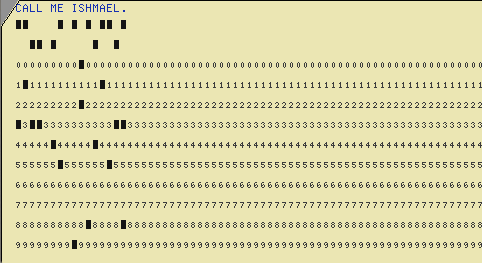
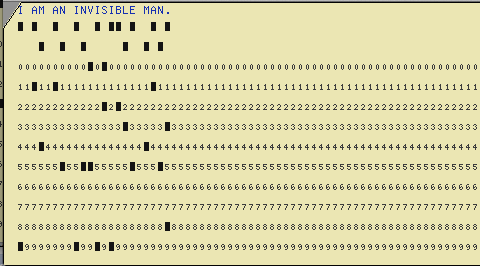
Looking to kill some time during the dog days of summer? Here’s one option that John Ptak came up with. On his intriguing blog, The History of Ideas, he writes: “Isn’t this great? I bumped into a wonderful site called kloth.net that provides a free-to-all and unrestricted use of their punch card emulator. It was found while looking for dating ideas for an IBM 5081 card that I have that has programming information for the BINAC computer (ca. late 1940’s), and kloth.net had info on the history of IBM cards as well as the emulator–plus other stuff. Completely distracted from the BINAC quest, I created some cards using some great first lines of literature. You can play too!” I created two of my own, using The American Book Review’s list of 100 great opening lines.
What exactly is a punch card, our younger readers might rightly ask? An IBM web site tells us:
Perhaps the earliest icon of the Information Age was a simple punched card produced by IBM, commonly known as the “IBM card.” Measuring just 7- 3/8 inches by 3- 1/4 inches, the piece of smooth stock paper was unassuming, to be sure. But taken collectively, the IBM card [like the floppy disks that came later] held nearly all of the world’s known information for just under half a century—an impressive feat even by today’s measures. It rose to popularity during the Great Depression and quickly became a ubiquitous installment in the worlds of data processing and popular culture. What’s more, the punched card [see examples from Columbia University here] provided such a significant profit stream that it was instrumental to IBM’s rapid growth in the mid-twentieth century.
Despite its occasional use in spoken monologue, the Very Long Literary Sentence properly exists in the mind (hence “stream-of-consciousness”), since the most wordy of literary exhalations would exhaust the lungs’ capacity. Molly Bloom’s 36-page, two-sentence run-on soliloquy at the close of Joyce’s Ulysses takes place entirely in her thoughts. Faulkner’s longest sentence—smack in the middle of Absalom, Absalom! —unspools in Quentin Compson’s tortured, silent ruminations. According to a 1983 Guinness Book of Records, this monster once qualified as literature’s longest at 1,288 words, but that record has long been surpassed, in English at least, by Jonathan Coe’s The Rotter’s Club, which ends with a 33-page-long, 13,955 word sentence. Czech and Polish novelists have written book-length sentences since the sixties, and French writer Mathias Énard puts them all to shame with a one-sentence novel 517 pages long, though its status is “compromised by 23 chapter breaks that alleviate eye strain,” writes Ed Park in the New York Times. Like Faulkner’s glorious run-ons, Jacob Silverman describes Énard’s one-sentence Zone as transmuting “the horrific into something sublime.”
Are these literary stunts kin to Philippe Petit’s highwire challenges—undertaken for the thrill and just to show they can be done? Park sees the “The Very Long Sentence” in more philosophical terms, as “a futile hedge against separation, an unwillingness to part from loved ones, the world, life itself.” Perhaps this is why the very long sentence seems most expressive of life at its fullest and most expansive. Below, we bring you five long literary sentences culled from various sources on the subject. These are, of course, not the “5 longest,” nor the “5 best,” nor any other superlative. They are simply five fine examples of The Very Long Sentence in literature. Enjoy reading and re-reading them, and please leave your favorite Very Long Sentence in the comments.
At The New Yorker’s “Book Club,” Jon Michaud points us toward this long sentence, from Samuel Beckett’s Watt. We find the title character, “an obsessively rational servant,” attempting to “see a pattern in how his master, Mr. Knott, rearranges the furniture.”
Thus it was not rare to find, on the Sunday, the tallboy on its feet by the fire, and the dressing table on its head by the bed, and the night-stool on its face by the door, and the washand-stand on its back by the window; and, on the Monday, the tallboy on its back by the bed, and the dressing table on its face by the door, and the night-stool on its back by the window and the washand-stand on its feet by the fire; and on the Tuesday…
Here, writes Michaud, the long sentence conveys “a desperate attempt to nail down all the possibilities in a given situation, to keep the world under control by enumerating it.”
The next example, from Poynter, achieves a very different effect. Instead of listing concrete objects, the sentence below from F. Scott Fitzgerald’s The Great Gatsby opens up into a series of abstract phrases.
Its vanished trees, the trees that had made way for Gatsby’s house, had once pandered in whispers to the last and greatest of all human dreams; for a transitory enchanted moment man must have held his breath in the presence of this continent, compelled into an aesthetic contemplation he neither understood nor desired, face to face for the last time in history with something commensurate to his capacity for wonder.
Chosen by The American Scholar editors as one of the “ten best sentences,” the passage, writes Roy Peter Clark, achieves quite a feat: “Long sentences don’t usually hold together under the weight of abstractions, but this one sets a clear path to the most important phrase, planted firmly at the end, ‘his capacity for wonder.’”
Jane Wong at Tin House’s blog “The Open Bar” quotes the hypnotic sentence below from Jamaica Kincaid’s “The Letter from Home.”
I milked the cows, I churned the butter, I stored the cheese, I baked the bread, I brewed the tea, I washed the clothes, I dressed the children; the cat meowed, the dog barked, the horse neighed, the mouse squeaked, the fly buzzed, the goldfish living in a bowl stretched its jaws; the door banged shut, the stairs creaked, the fridge hummed, the curtains billowed up, the pot boiled, the gas hissed through the stove, the tree branches heavy with snow crashed against the roof; my heart beat loudly thud! thud!, tiny beads of water grew folds, I shed my skin…
Kincaid’s sentences, Wong writes, “have the ability to simultaneously suspend and propel the reader. We trust her semi-colons and follow until we are surprised to find the period. We stand on that rock of a period—with water all around us, and ask: how did we get here?”
The blog Paperback Writer brings us the “puzzle” below from notorious long-sentence-writer Virginia Woolf’s essay “On Being Ill”:
Considering how common illness is, how tremendous the spiritual change that it brings, how astonishing, when the lights of health go down, the undiscovered countries that are then disclosed, what wastes and deserts of the soul a slight attack of influenza brings to view, what precipices and lawns sprinkled with bright flowers a little rise of temperature reveals, what ancient and obdurate oaks are uprooted in us by the act of sickness, how we go down into the pit of death and feel the water of annihilation close above our heads and wake thinking to find ourselves in the presence of the angels and harpers when we have a tooth out and come to the surface in the dentist’s arm-chair and confuse his “Rinse the Mouth —- rinse the mouth” with the greeting of the Deity stooping from the floor of Heaven to welcome us – when we think of this, as we are frequently forced to think of it, it becomes strange indeed that illness has not taken its place with love and battle and jealousy among the prime themes of literature.
Blogger Rebecca quotes Woolf as a challenge to her readers to become better writers. “This sentence is not something to be feared,” she writes, “it is something to be embraced.”
But then they were married (she felt awful about being pregnant before but Harry had been talking about marriage for a while and anyway laughed when she told him in early February about missing her period and said Great she was terribly frightened and he said Great and lifted her put his arms around under her bottom and lifted her like you would a child he could be so wonderful when you didn’t expect it in a way it seemed important that you didn’t expect it there was so much nice in him she couldn’t explain to anybody she had been so frightened about being pregnant and he made her be proud) they were married after her missing her second period in March and she was still little clumsy dark-complected Janice Springer and her husband was a conceited lunk who wasn’t good for anything in the world Daddy said and the feeling of being alone would melt a little with a little drink.
Sentences like these, writes Barnes & Noble blogger Hanna McGrath, “demand something from the reader: patience.” That may be so, but they reward that patience with delight for those who love language too rich for the pinched limitations of workaday grammar and syntax.
We're hoping to rely on loyal readers, rather than erratic ads. Please click the Donate button and support Open Culture. You can use Paypal, Venmo, Patreon, even Crypto! We thank you!
Open Culture scours the web for the best educational media. We find the free courses and audio books you need, the language lessons & educational videos you want, and plenty of enlightenment in between.