“Wishing to get a better view than I had yet had of the ocean, which, we are told, covers more than two thirds of the globe, but of which a man who lives a few miles inland may never see any trace…I have spent, in all, about three weeks on the Cape; walked from Eastham to Provincetown twice on the Atlantic side, and once on the Bay side also…but having come so fresh to the sea, I have got but little salted.”
You can click the image above to see it in a larger format. For many other maps made by Thoreau, visit the “Thoreau Lands and Property Survey” collection at the Concord Free Public Library. Also find works by Thoreau in our collection of Free eBooksand Free Audio Books.
If you would like to support the mission of Open Culture, consider making a donation to our site. It’s hard to rely 100% on ads, and your contributions will help us continue providing the best free cultural and educational materials to learners everywhere. You can contribute through PayPal, Patreon, and Venmo (@openculture). Thanks!
Despite some of the stranger circumstances of Philip K. Dick’s life, his reputation as a paranoid guru is far better deserved by other science fiction writers who lost touch with reality. Dick was a serious thinker and writer before pop culture made him a prophet. Jonathan Letham wrote of him, “Dick wasn’t a legend and he wasn’t mad. He lived among us and was a genius.” It’s a fashionable opinion these days, but his genius went mostly unrecognized in his lifetime—at least in his home country—except among a subset of sci-fi readers. But Dick considered himself a literary writer. He left the University of California after less than a semester, but the “consummate autodidact” read widely and deeply, favoring the giants of European philosophy, theology, and literature. For this reason, Dick suspected that his tepid reception in the U.S., by comparison with the warm regard of the French, showed a “flawed” anti-intellectualism in Americans that prevented them from appreciating his work. In the 1977 edited interview above with Dick in France, you can hear him lay out his theory in detail, offering insights along the way into his literary education and influences.
Dick identifies two strains of anti-intellectualism in the U.S. The first, he says, prevents American readers from appreciating “novels of ideas.” Science fiction, he says, “is essentially the field of ideas. And the anti-intellectualism of Americans prohibits their interest in imaginative ideas and interesting concepts.”
I don’t find Dick particularly persuasive here, but I live in a time when he has been fully embraced, if only in adaptation. Dick’s more specific take on what may be a root cause for Americans’ lack of curiosity has to do with the reading habits of Americans.
There’s another facet as regards my particular work say compared to other science fiction writers. I grew up in Berkeley and my education was not limited at all to reading other science fiction novels preceding my own, such as van Vogt, or Heinlein, or people of that kind… Padgett, and so on…. Bradbury. What I read, because it’s a university city, was Flaubert, Stendhal, Balzac… Proust, and the Russian novelists influenced by the French. Turgenev. And I even read Japanese novels, modern Japanese novels, novelists who were influenced by the French realistic writers.
Dick says his “slice of life” novels were well received in France because he based them on 19th French realist novels. His favorite, he tells the interviewer, were Madame Bovary and The Red and the Black, as well as Turgenev’s Fathers and Sons — all found in our collection of Free eBooks and Free Audio Books. Perhaps a little self-importantly, in his particular conception of himself as a literary writer, Dick distances himself from other American science fiction authors, whom he alleges share the American reader’s anti-intellectual propensities. “I think this applies to me more than other American science fiction writers,” says Dick, “In fact, I think that it’s a great flaw in American science fiction writers, and their readers, that they are insulated from the great literature of the world.”
Jack Kerouac wants you to turn writing into “free deviation (association) of mind into limitless blow-on-subject seas of thought, swimming in sea of English with no discipline, other than rhythms of rhetorical exhalation and expostulated statement….” Think you can do that? Find out by following Kerouac’s “Essentials of Spontaneous Prose.” He published this document in Black Mountain Review in 1957 and wrote it in response to a request from Allen Ginsberg and William S. Burroughs that he explain his method for writing The Subterraneansin three days time.
And for a theory of Kerouac’s not quite theory, visit the site of Marissa M. Juarez, professor of Rhetoric, Composition, and the Teaching of English at the University of Arizona. Juarez raises some salient points about why Kerouac’s “Essentials” bemuse the English teacher: His method “discourages revision… chastises grammatical correctness, and encourages writerly flexibility.” Read Kerouac’s full “Essentials of Spontaneous Prose” here or below. [Note: If you see what looks like typos, they are not errors. They are part of Kerouac’s original, spontaneous text.]
SET-UP: The object is set before the mind, either in reality. as in sketching (before a landscape or teacup or old face) or is set in the memory wherein it becomes the sketching from memory of a definite image-object.
PROCEDURE: Time being of the essence in the purity of speech, sketching language is undisturbed flow from the mind of personal secret idea-words, blowing (as per jazz musician) on subject of image.
METHOD: No periods separating sentence-structures already arbitrarily riddled by false colons and timid usually needless commas-but the vigorous space dash separating rhetorical breathing (as jazz musician drawing breath between outblown phrases)– “measured pauses which are the essentials of
our speech”– “divisions of the sounds we hear”- “time and how to note it down.” (William Carlos Williams)
SCOPING: Not “selectivity” of expression but following free deviation (association) of mind into limitless blow-on-subject seas of thought,
swimming in sea of English with no discipline other than rhythms of rhetorical exhalation and expostulated statement, like a fist coming down on a table with each complete utterance, bang! (the space dash)- Blow as deep as you want-write as deeply, fish as far down as you want, satisfy yourself first, then reader cannot fail to receive telepathic shock and meaning-excitement by same laws operating in his own human mind.
LAG IN PROCEDURE: No pause to think of proper word but the infantile pileup of scatological buildup words till satisfaction is gained, which will turn out to be a great appending rhythm to a thought and be in accordance with Great Law of timing.
TIMING: Nothing is muddy that runs in time and to laws of time-Shakespearian stress of dramatic need to speak now in own unalterable way or forever hold tongue-no revisions (except obvious rational mistakes, such as names or calculated insertions in act of not writing but inserting).
CENTER OF INTEREST: Begin not from preconceived idea of what to say about image but from jewel center of interest in subject of image at moment of writing, and write outwards swimming in sea of language to peripheral release and exhaustion-Do not afterthink except for poetic or P. S. reasons. Never afterthink to “improve” or defray impressions, as, the best writing is always the most painful personal wrung-out tossed from cradle warm protective mind-tap from yourself the song of yourself, blow!-now!-your way is your only way- “good”-or “bad”-always honest (“ludi- crous”), spontaneous, “confessionals’ interesting, because not “crafted.” Craft is craft.
STRUCTURE OF WORK: Modern bizarre structures (science fiction, etc.) arise from language being dead, “different” themes give illusion of “new” life. Follow roughly outlines in outfanning movement over subject, as river rock, so mindflow over jewel-center need (run your mind over it, once) arriving at pivot, where what was dim-formed “beginning” becomes sharp-necessitating “ending” and language shortens in race to wire of time-race of work, following laws of Deep Form, to conclusion, last words, last trickle-Night is The End.
MENTAL STATE: If possible write “without consciousness” in semi-trance (as Yeats’ later “trance writing”) allowing subconscious to admit in own uninhibited interesting necessary and so “modern” language what conscious art would censor, and write excitedly, swiftly, with writing-or-typingcramps, in accordance (as from center to periphery) with laws of orgasm, Reich’s “beclouding of consciousness.” Come from within, out-to relaxed and said.
Oh, and for authenticity’s sake, you should try Kerouac’s “Essentials” on a typewriter. It’s all he had when he wrote The Subterraneans. No grammar robots to distract him.
As a preteen, I steered clear of “young adult” fiction, a form I resentfully suspected would try too hard to teach me lessons. Then again, if I’d had a young adult novelist like John Green — not far out of adolescence himself when I entered the YA demographic — perhaps I’d have actively hoped for a lesson or two. While Green has earned a large part of his fame writing novels like Looking for Alaska, An Abundance of Katherines, and The Fault in Our Stars, a sizable chunk of his renown comes from his prolific way with internet videos, especially of the educational variety, which also demonstrate his possession of serious teaching acumen. Last year we featured his 40-week Crash Course in World History, and today we offer you his collection of crash courses in English literature. At the top, you’ll find its first lesson, the seven-minute “How and Why We Read.” Green, in the same jokey, enthusiastic onscreen persona as before, follows up his world history course by reminding us of the importance of writing as a marker of civilization, and then reveals his personal perspective as a writer: “I don’t want to get all liberal artsy on you, but I do want to make this clear: for me, stories are about communication. We didn’t invent grammar so that your life would be miserable in grade school as you attempted to learn what the Márquez a preposition is. By the way, on this program I will be inserting names of my favorite writers when I would otherwise insert curse words.”
Those lines give you a sense of Green’s tone, as well as his objective. If you felt miserable not just studying grammar in grade school but studying actual literature in high school, these lessons may well revitalize a few of the classics with which you couldn’t engage in the classroom. Just above, we have Green’s crash course on F. Scott Fitzgerald’s The Great Gatsby (part one, part two) which, early on, gets interrupted by a familiar-looking young objector: “Mr. Green, I hate everything about this stupid collection of first-world problems passing for a novel, but my hatred of that Willa Cather-ing loser Daisy Buchanan burns with the fire of a thousand suns.” This draws a groan from our host: “Ugh, me from the past. Here’s the thing: you’re not supposed to like Daisy Buchanan, at least not in the uncomplicated way you like, say, cupcakes. I don’t know where you got the idea the quality of a novel should be judged by the likability of its characters, but let me submit to you that Daisy Buchanan doesn’t have to be likable to be interesting. Furthermore, most of what makes her unlikable — her sense of entitlement, her limited empathy, her inability to make difficult choices — are the very things that make you unlikable.” Green knows that many of us, no matter how literate, still fall back into the disadvantageous reading strategies for which we settled in high school. He does his entertaining utmost to correct them while exploring the deeper themes of not just Gatsby, but other such oft-assigned (and oft-ruined-for-kids) works as Romeo and Juliet (part one, part two), the poetry of Emily Dickinson, and, below, The Catcher in the Rye (part one, part two):
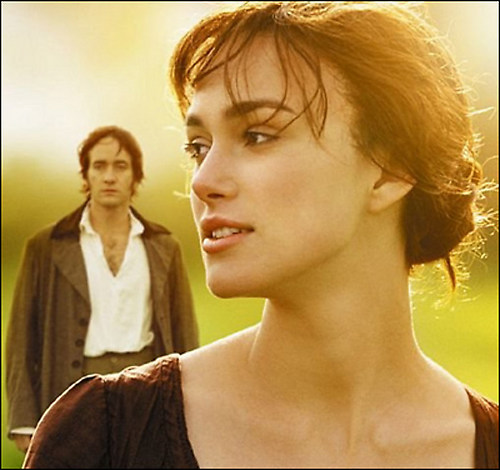
“It is a truth universally acknowledged, that a single man in possession of a good fortune, must be in want of a wife.”
Translation:
The heterogeneity of assumed intentions may incur a conclusory stereotype regarding gender selections in marriage-based societies, especially in those where the masculine hegemony of capital resources presupposes the feminization of property and uxorial acquisition.
Amanda Palmer and Neil Gaiman strike me as a very happily married couple, an impression their live cover of Makin’ Whoopee supports.
What’s their secret? As anyone with an interest in romance or Earth Science will tell you, opposites attract. On the surface of things, the exhibitionistic, highly theatrical, always controversial Palmer is quite different from her unfailingly discreet husband of the last two-and-a-half years. (Watch him mine his reticence to great comic effect at the 2.52 mark.)
That’s not to say they don’t have things in common.
And while he has three children from a previous marriage, the Gaiman-Palmer union has yet to produce any little Neil or Amandas. Which brings us back to Makin’ Whoopee. Whether or not the lyrics jibe with one’s personal outlook, the song’s enduring popularity (85 years and counting) might suggest its central dilemma is evergreen. Its biological observations are certainly above reproach: sex often leads to babies, who lead to the sort of responsibilities that signal the end of the honeymoon, if not the marriage.
Perhaps an open relationship in the whoopee department will continue to keep things playful between the Gaiman-Palmers, regardless of what their future holds. It’s really none of our business, is it?
Ayun Halliday must tender her regrets as she is directing a cast of 15 home schooled teens in her husband’s musical, Yeast Nation, that night. Follow her @AyunHalliday
“Is there anything sadder than an Esperantist?” a friend once jokingly asked me. “Two Esperantists” might seem the natural response, but hey, at least they could talk to each other. Speakers of Esperanto, the best-known constructed language, have wound up as the butt of more than a few jokes since the tongue’s inventor Ludwig Lazarus Zamenhof first made his utopian linguistic creation public in 1887, intending it as a tool to unite a fractious, nationalistic mankind. (A noble origin, balanced by such less-noble uses such as that William Shatner horror movie.) Yet Esperanto has actually enjoyed singular success, by the standards of constructed languages. In the five-minute TED Ed lesson above (and the expanded one at TED Ed’s own site), linguist John McWhorter tells us about the invention of other, lesser-known “conlangs,” including Elvish, Klingon, Dothraki, and Na’vi. If you’ve never heard any of those spoken, don’t feel unworthy; maybe you just haven’t sufficiently explored constructed worlds like those in which Game of Thrones, Avatar, Star Trek, and The Lord of the Ringstake place.
McWhorter makes a special point of Elvish since, in constructing it for use in The Lord of theRings’ Middle-Earth, J.R.R. Tolkien made a linguistic effort with little precedent in modern literature. He took the pains, in fact, to construct not just a plausible Elvish language but a plausible set of Elvish languages. “Tolkien charted out ancient and newer versions of Elvish. When the first Elves awoke at Cuiviénen, in their new language the word for people was kwendi, but in the language of one of the groups that moved away, Teleri, over time kwendi became pendi. Just like real languages, conlangs like Elvish split off into many. When the Romans transplanted Latin across Europe, French, Spanish, and Italian were born.” Hence, in our reality, a variety of words for hand like main, manus, and mano, and in Tolkien’s reality, a variety of words for people like kwendi, pendi, and kindi. But Elvish now finds itself surpassed in grammatical complexity and breadth of vocabulary by the likes of Klingon, Dothraki, and Na’vi, whose fans have put as much energy into expanding them as their creators. And those interested in similarly robust “real” conlangs — i.e., those not built for a fictional realm, but for ours — might take a look at Ithkuil, whose creator John Quijada was recently profiled in the New Yorker by Joshua Foer. You’ll also not want to miss this past post on Open Culture where Tolkien Reads Poems from The Fellowship of the Ring, in Elvish and English (1952). Or just listen to the reading below.
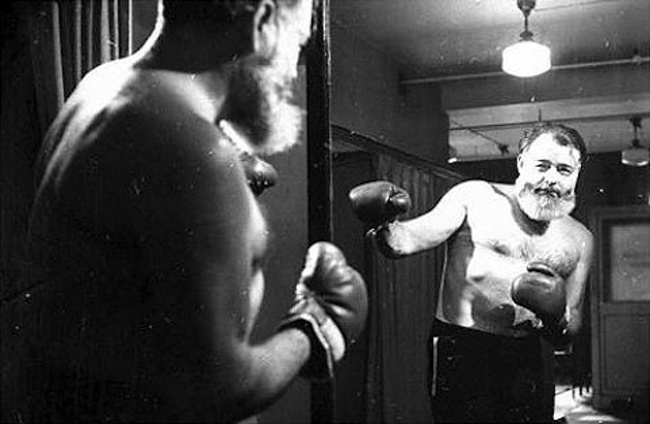
In a 1954 interview in the Paris Review, Ralph Ellison said of one of his literary heroes: “When [Ernest Hemingway] describes something in print, believe him; believe him even when he describes the process of art in terms of baseball or boxing; he’s been there.” I read this thinking that Ellison might be a bit too credulous. Hemingway, after all, has provoked no end of eye-rolling for his legendary machismo, bravado, and maybe several dozen other Latin descriptors for masculine foolhardiness and bluster. As for his “boxing,” we would be wise not to believe him. He may have “been there,” but the real boxers he encountered, and tried to spar with, would never testify he knew what he was doing
Ernest Hemingway wasn’t a boxer so much as he was a “boxer”… a legend in his own mind, a romantic. Hemingway’s friend and sometime sparring partner, novelist Morley Callaghan tells it this way: “we were two amateur boxers. The difference between us was that he had given time and imagination to boxing; I had actually worked out a lot with good fast college boxers.” Or, as the author of an article on the Fine Books & Collections site has it, “Hemingway was lost in the romance of a sport that has no romance to those seriously pursuing it; the romance strictly belongs to spectators.”
As a spectator with pretentions to greatness in the sport, Papa was prone to overestimating his abilities, at the expense of his actual skill as a writer. As he would tell Josephine Herbst, without a hint of irony, “my writing is nothing, my boxing is everything.”
Click for larger image
How did the pros evaluate his self-professed ability? Jack Dempsey, who spent time in Paris in the ‘20s being feted and fawned over, had this to say of Hemingway’s aspirations:
There were a lot of Americans in Paris and I sparred with a couple, just to be obliging…. But there was one fellow I wouldn’t mix it with. That was Ernest Hemingway. He was about twenty-five or so and in good shape, and I was getting so I could read people, or anyway men, pretty well. I had this sense that Hemingway, who really thought he could box, would come out of the corner like a madman. To stop him, I would have to hurt him badly, I didn’t want to do that to Hemingway. That’s why I never sparred with him.
Given Hemingway’s penchant for self-delusion in this matter, he may have interpreted this as Dempsey’s capitulation to his obvious prowess. An even more scathing critique of Hemingway’s bullying… I mean boxing skill … comes to us via Booktryst’s Stephen J. Gertz, who proffers an amusing dissection of the letter above, an unpublished correspondence Hemingway sent in 1943 to George Brown, the writer’s “trainer, coach, friend, and factotum.” Brown, it seems, was kindly, or prudent, enough to encourage his employer in his delusions. However, Gertz writes, “the reality was that anyone who had even the slightest idea of what they were doing in the ring could take Hemingway, who was notorious for foolishly trying to actually fight trained boxers.” He’s lucky, then, that Dempsey practiced such judicious restraint. If not, we may never have seen any fiction from Hemingway after he tried to go a round or two with the champ.
We're hoping to rely on loyal readers, rather than erratic ads. Please click the Donate button and support Open Culture. You can use Paypal, Venmo, Patreon, even Crypto! We thank you!
Open Culture scours the web for the best educational media. We find the free courses and audio books you need, the language lessons & educational videos you want, and plenty of enlightenment in between.