A new study published this week in Scienceconcludes that you may get something unexpected from reading great literary works: more finely-tuned social and emotional skills. Conducted by Emanuele Castano and David Comer Kidd (researchers in the psych department at the New School for Social Research), the study determined that readers of literary fiction (as opposed to popular fiction or non-fiction) find themselves scoring better on tests measuring empathy, social perception and emotional intelligence. In some cases, it took reading literary fiction for only a few minutes for test scores to improve.
The New York Times has a nice overview of the study, where, among other things, it features a quote by Albert Wendland, an English professor at Seton Hall, who puts the relationship between literature and social intelligence into clear terms: “Reading sensitive and lengthy explorations of people’s lives, that kind of fiction is literally putting yourself into another person’s position — lives that could be more difficult, more complex, more than what you might be used to in popular fiction. It makes sense that they will find that, yeah, that can lead to more empathy and understanding of other lives.”
If subtitles don’t automatically appear, please click the “CC” button at the bottom of the video.
“I like being an outcast,” the French writer Jean Genet once said, “just as, with all due respect, Lucifer liked being cast out by God.”
Genet was a kind of poet laureate of outcasts. He was a champion of the socially alienated and a subverter of traditional morality. His poetic and highly original first novel,Our Lady of the Flowers, was written in prison. It deals frankly with his life as a petty criminal and homosexual. Jean Cocteau recognized Genet’s genius and helped get him published. Jean-Paul Sartre canonized him in Saint Genet, Actor and Martyr. Simone de Beauvoir called him a “thug of genius.”
The son of a prostitute and an unknown father, Genet was abandoned as an infant by his mother and raised in foster homes in a village in central France, where he was made to feel like an outsider. As a young boy he developed the habit of stealing things and running away from home. At the age of 15 he was sent to the Mettray Penal Colony, a reformatory for boys. When he got out, he joined the Foreign Legion, from which he eventually deserted. He spent years as a wandering prostitute and thief before finding fame as a poet, novelist and playwright.
In 1981, Genet agreed to collaborate with actress and film producer Danièle Delorme on a “cinematic poem” based on his writings. Delorme enlisted Genet’s friend Antoine Bourseiller, a prominent theatrical director who had staged Genet’s The Balcony. They filmed a series of sequences meant to evoke the atmosphere of Genet’s novels, but were unhappy with the results. They felt the only way to make the film work was to have Genet speak. The 70-year-old writer, who was suffering from throat cancer and finding it difficult to speak, reluctantly agreed. “I will respond,” Genet said, “to one question only: why am I not in prison?”
In the resulting film, Jean Genet: An Interview with Antoine Bourseiller, Genet explains that by the time he reached a certain age, prisons had lost their erotic appeal. He goes on to explain, somewhat cryptically, of his love of darkness and his special fondness for Greece, where “the darkness mixed with light.” In his notes for the film, Genet writes:
When I spoke of the mixture of shadows and light in Greece, I was of course not thinking of the light from the sun, and not even the milky stream of the Turkish baths. Evoking ancient Greece (which is still present), I was thinking not only of Dionysos in opposition to the shining brilliance and the harmony of Apollo, but of something even more distant than they: the Python snake who had her sanctuary at Delphi, and who never stopped rotting there, stinking up Dionysos, Apollo, the Turkish wali, King Constantine, the colonels, and the suns that followed them.
The first of two interviews for the film was recorded at Delphi in the early summer of 1981. The second was recorded a short time later in France, at the producer’s family home near Rambouillet. Genet talks revealingly about his childhood, his sexual awakening and his rejection of Christianity. He touches briefly on a wide range of subjects, from Arthur Rimbaud to the Black Panthers. Excerpts from his books are read by Roger Blin, Gérard Desarthes and J.Q. Chatelain. Genet supervised the editing of the film, which was first exhibited in the fall of 1982. Jean Genet: An Interview with Antoine Bourseiller will be added to our collection of over 500 free movies online.
Even readers not particularly well versed in science fiction know Philip K. Dick as the author of the stories that would become such cinematic visions of a troubled future as Blade Runner, Total Recall, Minority Report, and A Scanner Darkly. Dick’s fans know him better through his 44 novels, 121 short stories, and other writings not quite categorizable as one thing or the other. All came as the products of a creatively hyperactive mind, and one subject to more than its fair share of disturbances from amphetamines, hallucinogens, unconventional beliefs, and what those who write about Dick’s work tend to call paranoia (either justified or unjustified, depending on whom you ask). But Dick, who passed in 1982, channeled this constant churn of visions, theories, convictions, and fears into books like The Man in the High Castle, Do Androids Dream of Electric Sheep?, Ubik, and VALIS, some of the most unusual works of literature ever to carry the label of science fiction — works that, indeed, transcend the whole genre.
But what must it have felt like to live with the guy? The Penultimate Truth About Philip K. Dick (named after his 1964 novel of humanity tricked into living in underground warrens) seeks out the writer’s friends, colleagues, collaborators, stepdaughter, therapist, and wives (three of them, anyway), assembling a portrait of the man who could create so many textual worlds at once so off-kilter and so tapped into our real worries and obsessions. Each of these interviewees regards differently Dick’s dedication to the pursuits of both literary achievement and psychonautical adventure, his complicated conception of the true nature of reality, his at times unpredictable behavior, and his penchant for encounters with the divine. Director Emeliano Larre and writer Patricio Vega’s 2007 documentary reveals one of the most fascinating personalities in late 20th-century letters, though, as any professor of literature will tell you, we ultimately have to return to the work itself. Fortunately, Dick’s personality ensured that we have a great deal of it, all of it unsettling but greatly entertaining. Readers taken note. You can Download 14 Great Sci-Fi Stories by Philip K. Dick as Free Audio Books and Free eBooks.
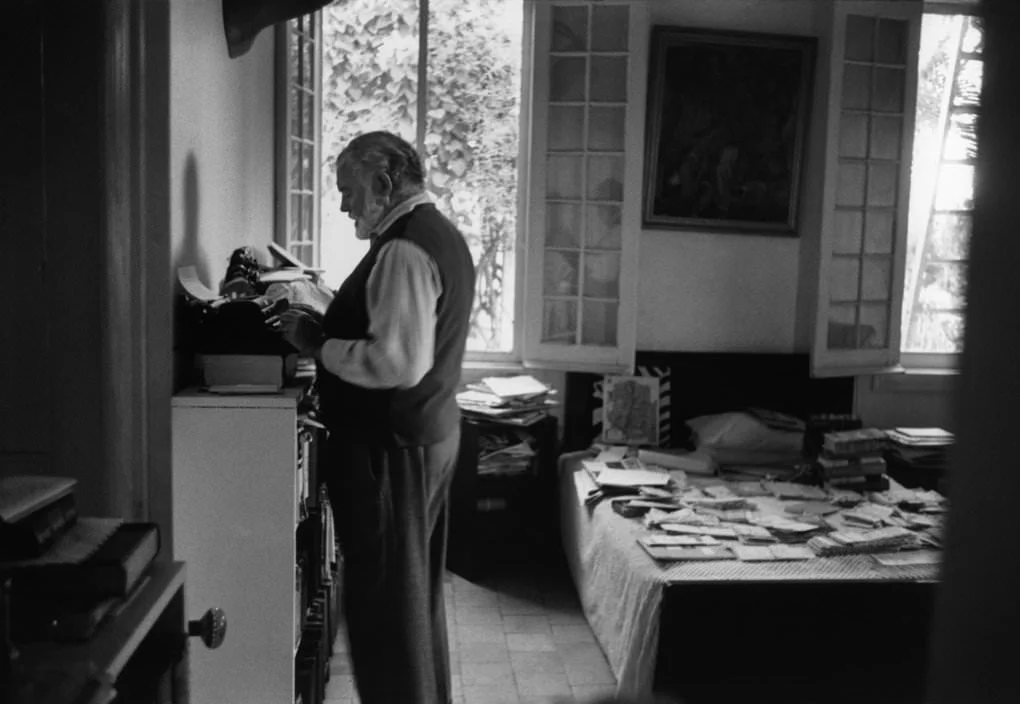
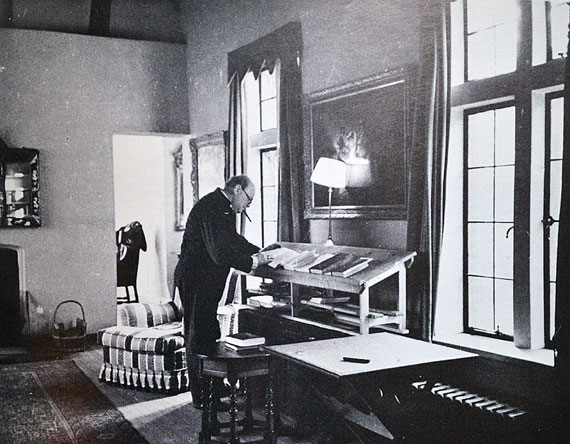
Kierkegaard apparently did his best writing standing up, as did Charles Dickens, Winston Churchill, Vladimir Nabokov and Virginia Woolf. Also put Ernest Hemingway in the standing desk club too.
In 1954, George Plimpton interviewed Hemingway for the literary journal he co-founded the year before, The Paris Review. The interview came prefaced with a description of the novelist’s writing studio in Cuba:
Ernest Hemingway writes in the bedroom of his house in the Havana suburb of San Francisco de Paula. He has a special workroom prepared for him in a square tower at the southwest corner of the house, but prefers to work in his bedroom, climbing to the tower room only when “characters” drive him up there…
The room is divided into two alcoves by a pair of chest-high bookcases that stand out into the room at right angles from opposite walls.…
It is on the top of one of these cluttered bookcases—the one against the wall by the east window and three feet or so from his bed—that Hemingway has his “work desk”—a square foot of cramped area hemmed in by books on one side and on the other by a newspaper-covered heap of papers, manuscripts, and pamphlets. There is just enough space left on top of the bookcase for a typewriter, surmounted by a wooden reading board, five or six pencils, and a chunk of copper ore to weight down papers when the wind blows in from the east window.
A working habit he has had from the beginning, Hemingway stands when he writes. He stands in a pair of his oversized loafers on the worn skin of a lesser kudu—the typewriter and the reading board chest-high opposite him.
Popular Science, a magazine with roots much older than the Paris Review, first began writing about the virtues of standing desks for writers back in 1883. By 1967, they were explaining how to fashion a desk with simple supplies instead of forking over $800 for a commercial model — a hefty sum in the 60s, let alone now. Plywood, saw, hammer, nails, glue, varnish — that’s all you need to build a DIY stand-up desk. Or, as Papa Hemingway did, you could simply throw your writing machine on the nearest bookcase and get going. As for how to write the great American novel, I’m not sure that Popular Science offers much help. But maybe some advice from Hemingway himself will steer you in the right direction. See Seven Tips From Ernest Hemingway on How to Write Fiction.
If you would like to support the mission of Open Culture, consider making a donation to our site. It’s hard to rely 100% on ads, and your contributions will help us continue providing the best free cultural and educational materials to learners everywhere. You can contribute through PayPal, Patreon, and Venmo (@openculture). Thanks!
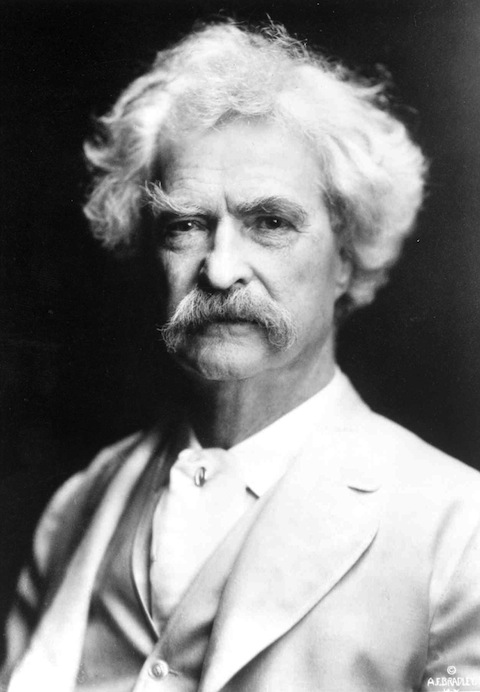
Every American has appreciated at least a little bit of the oeuvre of late-19th- and early-20th-century humorist Samuel Clemens, better known as Mark Twain. Some only manage to get through the chapters of The Adventures of Huckleberry Finn their English classes test them on, but even those give them the inkling that they hold before them the work of a writer worth reading. Others go as far as to become enthusiasts of all things Twain, but perhaps stop just short of reading his “Advice to Little Girls,” a brief piece that offers the following points of counsel to the young ladies of 1865:
Good little girls ought not to make mouths at their teachers for every trifling offense. This retaliation should only be resorted to under peculiarly aggravated circumstances.
If you have nothing but a rag-doll stuffed with sawdust, while one of your more fortunate little playmates has a costly China one, you should treat her with a show of kindness nevertheless. And you ought not to attempt to make a forcible swap with her unless your conscience would justify you in it, and you know you are able to do it.
You ought never to take your little brother’s “chewing-gum” away from him by main force; it is better to rope him in with the promise of the first two dollars and a half you find floating down the river on a grindstone. In the artless simplicity natural to this time of life, he will regard it as a perfectly fair transaction. In all ages of the world this eminently plausible fiction has lured the obtuse infant to financial ruin and disaster.
If at any time you find it necessary to correct your brother, do not correct him with mud—never, on any account, throw mud at him, because it will spoil his clothes. It is better to scald him a little, for then you obtain desirable results. You secure his immediate attention to the lessons you are inculcating, and at the same time your hot water will have a tendency to move impurities from his person, and possibly the skin, in spots.
If your mother tells you to do a thing, it is wrong to reply that you won’t. It is better and more becoming to intimate that you will do as she bids you, and then afterward act quietly in the matter according to the dictates of your best judgment.
You should ever bear in mind that it is to your kind parents that you are indebted for your food, and for the privilege of staying home from school when you let on that you are sick. Therefore you ought to respect their little prejudices, and humor their little whims, and put up with their little foibles until they get to crowding you too much.
Good little girls always show marked deference for the aged. You ought never to “sass” old people unless they “sass” you first.
“American children’s literature in those days was mostly didactic,” writes children’s-book author and illustrator Vladimir Radunsky in a post at the New York Review of Books. It was often addressed to some imaginary reader, an ideal girl or boy, who, “upon reading the story, would immediately adopt its heroes as role models. Twain did not squat down to be heard and understood by children, but asked them to stand on their tiptoes — to absorb the kind of language and humor suitable for adults.” And Twain also understood that, humor, at the height of the craft, limits itself to no one audience in particular. Just as anyone, even today, can enjoy Huckleberry Finn — anyone, that is, without a teacher looking over their shoulder — “Advice to Little Girls” plays, like everything Twain wrote, to both girls and boys, to both the little and the big, at once irresistibly entertaining and viciously satirizing the whole of what he called “the damned human race.”
Then again, Twain also knew, as any master humorist does, that nothing funny ever benefited from too much explanation. We’ll thus leave you with a link to Project Gutenberg’s collection of 216 free e‑books of his work, among which a bit of time spent should turn any one of us into enthusiasts of all things Twain.
Goodreads, that social network for the bookish, recently posted on its blog the results of a survey taken among its 20 million members with the melancholy title “The Psychology of Abandonment.” Complete with infographic, the survey gives us, among other things, a list of the “Top Five Abandoned Classics.” James Joyce’s Ulysses is third on the list, and I’m not at all surprised to find it there. One must know Ulysses, it seems, to merit consideration as a culturally literate person. But Ulysses, perhaps more than any work of modern literature, can easily discourage. It presents us with a landscape so psychologically complex, so dense with literary and historical allusion and contemporary cultural reference, that I cannot say I would have known what to do with it had I not read it under the auspices of an august Irish Joyce scholar and with Don Gifford’s guidebook Ulysses Annotated ready at hand. I had nowhere near the breadth and depth of reading Joyce seems to assume of his ideal reader. Few people do.
Two of Joyce’s contemporaries, however, had such a grasp of literature and language: T.S. Eliot and Virginia Woolf. And the two had quite a lot to say about the book, much of it to each other. Eliot recommended Joyce’s novel to Woolf, and very soon after its 1922 publication, she purchased her own copy. At the time, Woolf was hard at work on her story “Mrs. Dalloway on Bond Street,” which would eventually grow into her next novel, Mrs. Dalloway. She was also immersed in Proust’s epic Remembrance of Things Past, just beginning the second volume. According to Dartmouth’s James Heffernan, Woolf “chafes at the thought of Ulysses,” writing haughtily:
Oh what a bore about Joyce! Just as I was devoting myself to Proust—Now I must put aside Proust—and what I suspect is that Joyce is one of those undelivered geniuses, whom one can’t neglect, or silence their groans, but must help them out, at considerable pains to oneself.
Heffernan chronicles Woolf’s reading of Ulysses, which she documented in her diary in a “withering assessment” as the work of “a self-taught working man… egotistic, insistent, raw, striking, & ultimately nauseating.” “When one can have cooked flesh,” she writes, “why have the raw?”
This private critical opinion Woolf recorded after reading only 200 pages of the novel. Heffernan makes the case that she read no more thereafter. Though she claimed to have “finished Ulysses,” he takes her to mean she had finished with the book, putting it aside like those bewildered, bored, or exasperated Goodreads members. Nevertheless, Woolf could not shake Joyce. She continued to write about him, to Eliot and herself. “Never did any book so bore me,” she would write, and many more very disparaging remarks about her brilliant contemporary.
Over and again she savaged Joyce in her diaries; so much so that it seems to Heffernan and Woolf scholar Suzette Henke that hers is a case of protesting too much against an author whom, Henke alleges, was her “artistic ‘double,’ a male ally in the modernist battle for psychological realism.” This may indeed be so. In the midst of her characterizations of Joyce as uncouth, boring, “underbred” and worse, she admits in her diary that what she attempted in her fiction was “probably being better done by Mr. Joyce.” While hardly any reader of Ulysses—among those who finish it and those who don’t—can say they are attempting something near what he accomplished, we might all find some solace in knowing that a reader as sharp as Virginia Woolf found his modernist masterpiece either so boring or so intimidating that even she may not have been able to finish it.
Dave Eggers, author of A Heartbreaking Work of Staggering Genius, has a new book coming out in early October, The Circle, a novel about “a young woman who goes to work at an omnipotent technology company and gets sucked into a corporate culture that knows no distinction between work and life, public and private.” Breaking with tradition, The New York Times has placed the novel’s cover on the cover of its own Sunday Magazine. It has also printed a lengthy excerpt from the book. Read it online here, or listen right below (or on iTunes) to a reading of the excerpt by actor Don Graham. It runs 46 minutes.
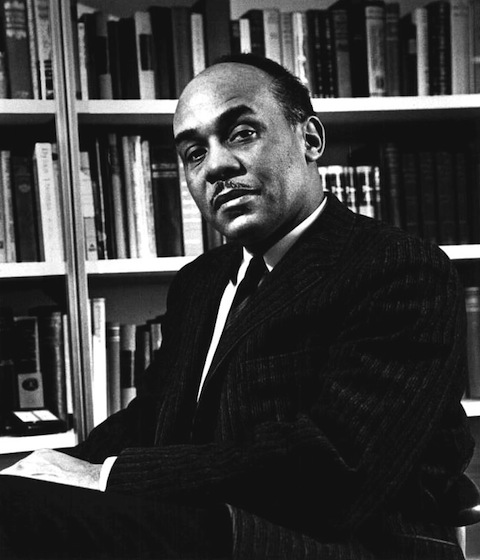
We’re smack in the middle of Banned Books Week, and one particular case of book-banning has received a lot of attention lately, that of Ralph Ellison’s classic 1952 novel Invisible Man, which was censored by the Randolph County, NC school board last week. In response to one parent’s complaint, the board assessed the book, found it a “hard read,” and voted 5–2 to remove it from the high school libraries (prompting the novel’s publisher to give copies away for free to students). One board member stated that he “didn’t find any literary value” in Ellison’s novel, a judgment that may have raised the eyebrows of the National Book Award judges who awarded Ellison the honor in 1953, not to mention the 200 authors and critics who in 1965 voted the novel “the most distinguished single work published in the last twenty years.”
After widespread public outcry, the Randolph County reversed the decision in a special session yesterday. In light of the book’s newfound notoriety after this story, we thought we’d revisit a Paris Review interview Ellison gave in 1954. The interviewers press Ellison on what they see as some of the novel’s weaknesses, but describe Ellison’s masterwork as “crackling, brilliant, sometimes wild, but always controlled.” Below are some highlights from this rich conversation. This interview would not likely sway those shamefully unlettered school board members, but fans of Ellison and those just discovering his work will find much here of merit. Ellison, also an insightful literary critic and essayist, discusses at length his intentions, influences, and theories of literature.
On his literary influences:
Ellison, who says he “became interested in writing through incessant reading,” cites a number of high modernist writers as direct influences on his work. T.S. Eliot’s The Waste Land piqued his interest in 1935, and in the midst of the Depression, while he and his brother “hunted and sold game for a living” in Dayton OH, Ellison “practiced writing and studied Joyce, Dostoyevsky, Stein, and Hemingway.” He especially liked Hemingway for the latter’s authenticity.
I read him to learn his sentence structure and how to organize a story. I guess many young writers were doing this, but I also used his description of hunting when I went into the fields the next day. I had been hunting since I was eleven, but no one had broken down the process of wing-shooting for me, and it was from reading Hemingway that I learned to lead a bird. When he describes something in print, believe him; believe him even when he describes the process of art in terms of baseball or boxing; he’s been there.
On literature as protest
Ellison began Invisible Man in 1945, before the Civil Rights movement got going. He drew much of his sense of the novel as a form of social protest from literary sources, claiming that he recognized “no dichotomy between art and protest.”
Dostoyevsky’s Notes from Underground is, among other things, a protest against the limitations of nineteenth-century rationalism; Don Quixote, Man’s Fate, Oedipus Rex, The Trial—all these embody protest, even against the limitation of human life itself. If social protest is antithetical to art, what then shall we make of Goya, Dickens, and Twain?
All novels are about certain minorities: the individual is a minority. The universal in the novel—and isn’t that what we’re all clamoring for these days?—is reached only through the depiction of the specific man in a specific circumstance.
On the role of myth and folklore in literature:
Ellison adapts a tremendous amount of black American folklore in Invisible Man, from folk tales to the blues, to give the novel much of its voice and structure. His use of folk forms springs from his sense that “Negro folklore, evolving within a larger culture which regarded it as inferior, was an especially courageous expression” as well as his reading of ritual in the modernist masters he admired. Of the use of folklore and myth, Ellison says,
The use of ritual is equally a vital part of the creative process. I learned a few things from Eliot, Joyce and Hemingway, but not how to adapt them. When I started writing, I knew that in both “The Waste Land” and Ulysses, ancient myth and ritual were used to give form and significance to the material; but it took me a few years to realize that the myths and rites which we find functioning in our everyday lives could be used in the same way. … People rationalize what they shun or are incapable of dealing with; these superstitions and their rationalizations become ritual as they govern behavior. The rituals become social forms, and it is one of the functions of the artist to recognize them and raise them to the level of art.
On the moral and social function of literature:
Ellison has quite a lot to say in the interview about what he sees as the moral duty of the novelist to address social problems, which he relates to a nineteenth century tradition (referencing another famously banned book, Huckleberry Finn). Ellison faults the contemporary literature of his day for abandoning this moral dimension, and he makes it clear that his intention is to see the social problems he depicts as great moral questions that American literature should address.
One function of serious literature is to deal with the moral core of a given society. Well, in the United States the Negro and his status have always stood for that moral concern. He symbolizes among other things the human and social possibility of equality. This is the moral question raised in our two great nineteenth-century novels, Moby-Dick and Huckleberry Finn. The very center of Twain’s book revolves finally around the boy’s relations with Nigger Jim and the question of what Huck should do about getting Jim free after the two scoundrels had sold him. There is a magic here worth conjuring, and that reaches to the very nerve of the American consciousness—so why should I abandon it? …Perhaps the discomfort about protest in books by Negro authors comes because since the nineteenth century, American literature has avoided profound moral searching. It was too painful and besides there were specific problems of language and form to which the writers could address themselves. They did wonderful things, but perhaps they left the real problems untouched.
We're hoping to rely on loyal readers, rather than erratic ads. Please click the Donate button and support Open Culture. You can use Paypal, Venmo, Patreon, even Crypto! We thank you!
Open Culture scours the web for the best educational media. We find the free courses and audio books you need, the language lessons & educational videos you want, and plenty of enlightenment in between.