According to The Telegraph, experts rummaging through a dusty box recently uncovered a letter penned by Oscar Wilde in 1890 (or thereabouts). Addressed to a “Mr. Morgan,” the letter runs 13 pages, and it offers what amounts to practical advice for an aspiring writer. Details on the letter’s contents remain scarce, although we will probably know more when the document gets auctioned off in two weeks time. But, so far, we know that Wilde offered Mr. Morgan two points to consider:
“Make some sacrifice for your art, and you will be repaid, but ask of art to sacrifice herself for you and a bitter disappointment may come to you,”
“The best work in literature is always done by those who do not depend on it for their daily bread and the highest form of literature, Poetry, brings no wealth to the singer.”
It’s essentially the nineteenth century version of what Charles Bukowski later said in much more simple terms: “if you’re doing it for money or fame, don’t do it.”
Ernest Hemingway took a dim view of Hollywood. He once said that the best way for a writer to deal with the movie business was to arrange a quick meeting at the California state line. “You throw them your book, they throw you the money,” he said.“Then you jump into your car and drive like hell back the way you came.”
But Hemingway became a little more involved when it was time to film his 1940 novel For Whom the Bell Tolls, as this 1971 CBC interview with Ingrid Bergman reveals. Hemingway sold the film rights to Paramount Pictures in part because he wanted his good friend Gary Cooper, who had starred in A Farewell to Arms (which you canfind in our collection of 500 Free Movies Online), to play the lead role of Robert Jordan, an American volunteer in the Spanish Civil War who is given a dangerous mission to blow up a bridge. Cooper was under contract with Paramount.
Bergman first came to Hemingway’s attention when he saw the young Swedish actress in the 1939 Hollywood remake of Intermezzo. Despite her Nordic appearance, Hemingway thought Bergman would be perfect for the role of the young Spanish woman Maria in For Whom the Bell Tolls. As Bergman explains in the interview, Hemingway sent her a copy of the book with the inscription, “You are the Maria in this book.”
The problem was that Bergman was under contract with another studio, Selznick International Pictures. But studios occasionally made arrangements with one another to share actors, and David O. Selznick became convinced that the high-profile Hemingway project would be great for his young protégé’s career. So in typical fashion, Selznick pulled out all the stops. On January 31, 1941 Selznick sent a note to Kay Brown, his talent scout who had discovered Bergman in Sweden, describing his efforts to win Bergman the part. In a passage quoted by Donald Spoto in Notorious: The Life of Ingrid Bergman, Selznick writes:
I pinned Hemingway down today and he told me clearly and frankly that he would like to see her play the part. He also said this to the press today. However, he tells me also that at Paramount he was told she was wooden, untalented, and various other things. Needless to say, I answered these various charges.… I am also personally supervising a publicity campaign to try to jockey Paramount into a position where they will almost have to use her. You will be seeing these items from time to time. Incidentally, Ingrid wasn’t in town today, or I could have brought her together with Hemingway. However, we are arranging for her to fly today to see Hemingway in San Francisco before he sails for China. If he likes her, I am asking him to go to town with Paramount on it. If she doesn’t get the part, it won’t be because there hasn’t been a systematic campaign to get it for her!
As part of Selznick’s systematic campaign, he invited Life magazine to photograph Bergman’s lunch with Hemingway and his wife, Martha Gellhorn, at Jack’s Restaurant in San Francisco. The magazine published a series of photos along with a caption quoting Hemingway as saying, “If you don’t act in the picture, Ingrid, I won’t work on it.”
Despite Selznick’s machinations, Paramount gave the part to one of its own contract actresses, the ballet dancer Vera Zorina. Bergman had to content herself with the female lead in a little black-and-white film called Casablanca. But after several weeks of shooting the Hemingway film in the Sierra Nevada, Paramount became unhappy with Zorina’s performance. Just as Bergman was wrapping up Casablanca, her wish came through and she was given the role of Maria. For Whom the Bell Tolls became the blockbuster hit of 1943, and Bergman received an Oscar nomination for her performance. Ironically, though, it was her role in the low-profile Casablanca that sealed Bergman’s fate as a film icon.
Beloved of 80s MFA students and New Yorker fiction editors, Raymond Carver belonged to neither world. He suffered and drank his way from working-class obscurity to literary fame like another underdog poet and writer, Charles Bukowski (though Bukowski never had, and maybe never wanted, Carver’s cachet). Carver published his first collection of gritty realist stories—Will You Please Be Quiet, Please?—in 1976, when short fiction was largely dominated by the baroque experimentalism of writers like Donald Barthelme and John Barth.
But while Carver perhaps lacked the imaginative exuberance, and early educational opportunities, of a Barthelme, his fiction gave readers something they craved, maybe without even knowing it. A Publisher’s Weekly reviewer of the first collection noted that Carver voiced the “inarticulate worlds of Americans,” the dim ache in the nondescript lives of aspiring students, down-and-outers, diner waitresses, salesmen, and unhappily hitched blue-collar couples. Carver’s approach to quiet desperation is poetic, eschewing flashy postmodernist contraptions for powerfully direct and evocative images. As writer and critic Brian A. Oard puts it:
The Carveresque image allows the reader to glimpse the terrible waste of his characters’ lives (something the characters themselves can sometimes feel but rarely see) and forces the reader to reconsider the entire story in the image’s dark light.
In the audio at the top, you can hear Carver’s friend, writer Richard Ford, read “The Student’s Wife,” from Will You Please Be Quiet Please?, as part of The Guardian’s short story podcast. Ford describes the story as “spare, direct, rarely polysyllabic, restrained, intense, never melodramatic, and real-sounding while being obviously literary in intent.”
“Fat,” another of Carver’s stories from his first collection, conflates two archetypical images of disquiet in the American psyche: obesity and bad marital sex. In a story about excess and longing, Carver’s minimalist restraint lends these commonplaces near-totemic status. Above, listen to the story read by Irish author and memoirist Anne Enright.
Carver, a man of self-destructive appetites, understood the craving of characters like Rita, the waitress in “Fat.” His own desires drove an alcoholism that nearly killed him. Several of his characters share this flaw, including Wes in Carver’s story “Chef’s House,” read above by celebrated short story-ist David Means. Published in The New Yorker in 1981, “Chef’s House” marks the beginning of Carver’s long relationship with the tony magazine.
In 2007, The New Yorker also broke open the myth of the hyper-minimalist Carver, inspiration to thousands of creative writing students, by showing how his streamlined prose was perhaps as much the product of Alfred A. Knopf editor Gordon Lish as of the author. The magazine published Lish’s edit of Carver’s “Beginners,” which became in Lish’s hands the signature story “What We Talk About When We Talk About Love.”
I do not think lovers of Carver need be too dismayed by these revelations. Several well-known works of literature are close collaborative efforts between editor and author. See, for example, T.S. Eliot’s The Waste Land, which we’d never know by that name without Ezra Pound (the famous footnotes were not Eliot’s idea either). And the glittering sentences of Fitzgerald would not shine so brightly without editor Malcolm Cowley. But as The New Yorker alleges, Carver felt forced to accept Lish’s edits. Once he had gained more confidence and success, his prose took on much more expansive qualities, as you can see in the 1983 story “Cathedral.”
The readings above can be otherwise found in our collection of Free Audio Books.
Perhaps you haven’t given Ralph Ellison any thought since reading Invisible Man in high school. Watch the interview above, and you’ll have no choice but to consider his work and opinions again. Just past twenty minutes into this short documentary called USA: The Novel, he reads an excerpt from a work of his that you may not have read: Juneteenth, the book that would follow up Invisible Man — 47 years later. It saw publication only in 1999, 33 years after this film on Ellison’s “work in progress,” and five years after his death. He’d written over 2000 pages, and even then claimed to have lost portions of the manuscript in a fire. One of Ellison’s biographers, John F. Callahan, cut down and organized the remaining material. Another of his biographers, Arnold Rampersad, doubts that the fire destroyed much of the troubled novel at all.
Though Ellison’s work remains readily available — even Juneteenth reappeared in 2012 in the 1101-page expansion Three Days Before the Shooting…— the writer left behind fewer direct reflections than his fans and scholars might like. That makes footage like this all the more valuable, and, in it, he even addresses his tendency to not to speak publicly: “I’m fascinated by how the interviewer’s mind works, and I’m also aware that, for all my shunning of a public role which is divorced from my identity as a writer, any kind of statement I make, any time my face appears, there are a lot of people who are going to be interpreting my face, my statements in terms of my racial identity rather than in terms of the quality of what I have to say. Power for the writer, it seems to me, lies in his ability to reveal only a little bit more about the complexity of humanity.”
While it did come as a shock to some of Philip Roth’s friends when the novelist announced his retirement from writing last year, one might imagine that after 31 novels, two National Book Awards, a Pulitzer, three PEN/Faulkner Awards and a host of other accolades, the man deserves a break. Roth celebrated his 80th birthday on Tuesday. New Yorker editor David Remnick writes in his account of Roth’s Newark birthday party that the writer “sensed that better books were not ahead” and quit rather than experience his powers failing. This is in character, writes Remnick, for a writer whose books “rage against the indignities and inevitabilities, the inescapability, the horrific cosmic joke of age, of death.”
Remnick’s observation reminds me of the two Roth characters who loom large in my memory of his work—both oversexed mama’s boys, driven by grim humor and narcissistic self-regard. First I think of grotesque old lecher Mickey Sabbath in Sabbath’s Theater, who ekes out his later years on tiny bits of sympathy, lascivious remembrances, and suicidal fantasies. At one point in the novel, he observes, “we are immoderate because grief is immoderate, all the hundreds and thousands of kinds of grief.”
If Sabbath is a projection of Roth’s fear of aging, he is an effectively terrifying portrait of dissolution and decay; for all his gallows humor, he can’t hide the fact that he just doesn’t know when to let go of former glories. If he’s an elderly Alexander Portnoy (perhaps), he’s a Portnoy gone to pot with a few hundred kinds of grief. Of course Portnoy— 33-year-old neurotic chronic masturbator and “lust-ridden, mother addicted young Jewish bachelor”— narrates the novel that made Roth a household name. You can see Roth read from Portnoy’s Complaintin the video above from PBS.
Since Portnoy’s 1969 publication, Roth has endured question after question about the autobiographical content in his novels. Surely he invested Portnoy and Sabbath with some measure of his raging Id, but his body of work takes in concerns far beyond sexually obsessive Jewish mother’s boys. To get a glimpse of the early, pre-Portnoy Roth, take a look at the 1958 and ‘59 short stories “Epstein” and “The Conversion of the Jews” at the Paris Review. Both stories appeared in Roth’s first book Goodbye, Columbus, for which he won his first National Book Award in 1960. And for a look at the aging writer wrestling with the brave new world of open source collaborative authorship, read his fascinating “An Open Letter to Wikipedia” from September of last year, a month before he announced his retirement.
For writers and serious readers, George Saunders is anything but a newcomer. Saunders published his first short story with The New Yorker back in 1992, and his new stories have regularly debuted in the magazine’s Fiction section ever since. Over the years, he has gained the reputation of being a “writer’s writer,” with authors like Tobias Wolff saying about Saunders: “He’s been one of the luminous spots of our literature for the past 20 years.” But despite his literary accomplishments, and despite winning the prestigious MacArthur award in 2006, George Saunders never quite became a household name until January 6 of this year. On that day, The New York Times published an article with the title, “George Saunders Has Written the Best Book You’ll Read This Year,” a pretty bold declaration given that 2013 still had 359 days to go. Since then, Saunders has found himself in the limelight talking about Tenth of December, his newly-published collection of short stories. You can watch him give a reading at Google above, or make appearances on the PBS News Hour and The Colbert Report.
If you’re not familiar with Saunders’ writing, then we have you covered. Below we’ve collected 10 stories by the author, all free to read online. Even better, the list features three stories from Tenth of December, including the story after which the book takes its name. All stories from the new collection have an asterisk next to the title.
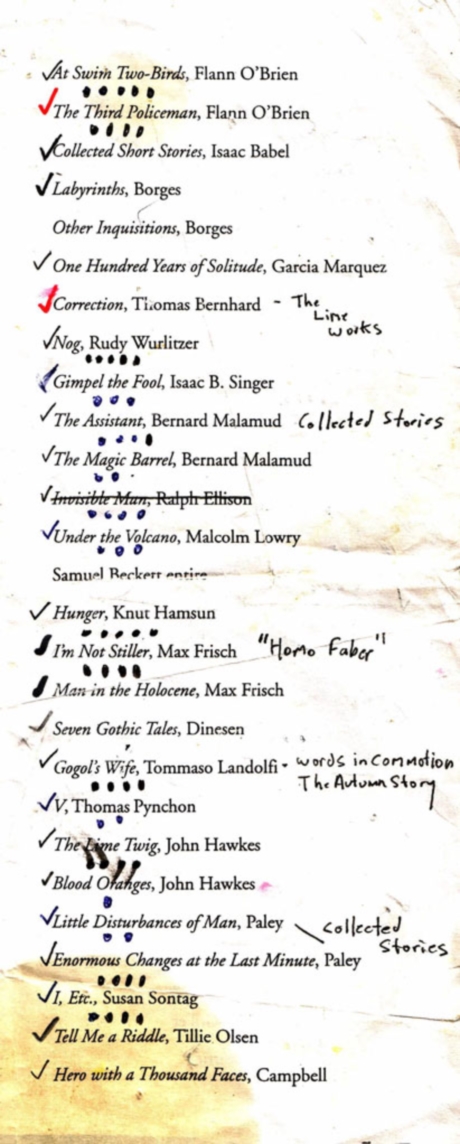
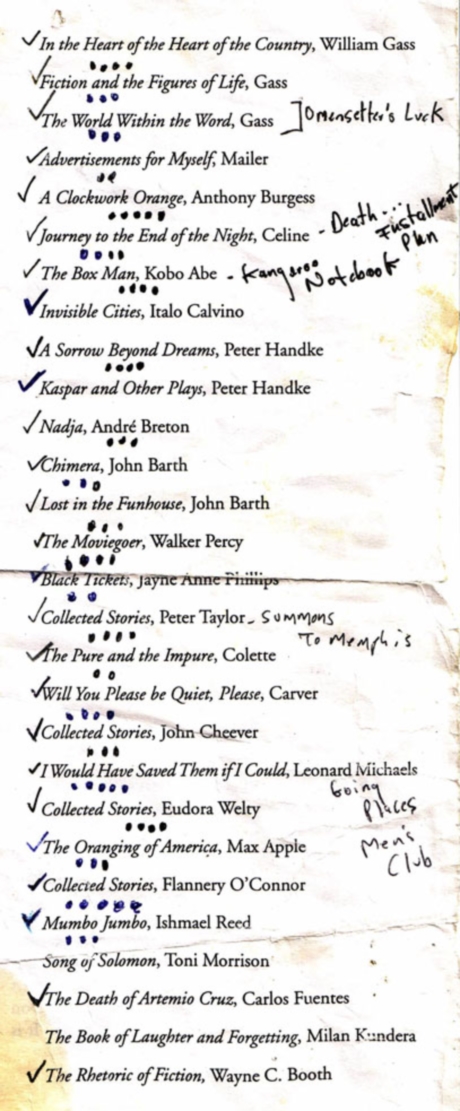
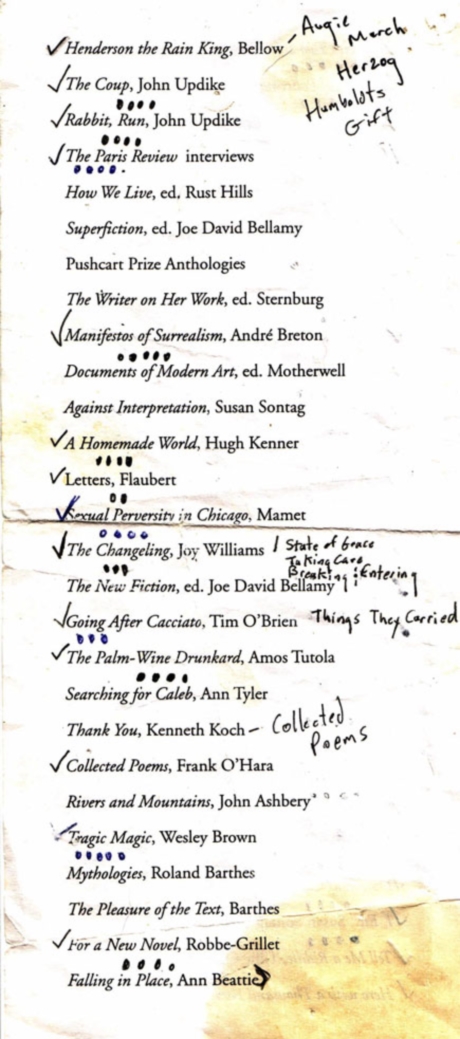
We’ve had a lot of fun—and some debate—lately with reading lists from people like Carl Sagan, Neil DeGrasse Tyson, and even Marilyn Monroe (via her library). And we’ve featured undergraduate syllabi from the teaching days of David Foster Wallace and W.H. Auden. Now for something more-or-less formal than those. This one comes via a 2003 piece by Kevin Moffett in McSweeney’s spin-off The Believer (10 years old this month—I know, right?). The list (first page above and full list below) has a somewhat illustrious heritage. Compiled by postmodernist writer Donald Barthelme for his students at the University of Houston, it then made its way to Barthelme’s student, Southern writer Padgett Powell. The list then came to Moffett when he was a student of Powell’s at the University of Florida.
Consisting of 81 books, mostly novels and short story collections (and the work of Samuel Beckett—“entire”), and mostly twentieth-century modernist fiction, the list came to Powell with Barthelme’s instruction to attack the books, “in no particular order, just read them.”
This Moffett did, and his story of how he sought the books—in the used bookshops, warehouse sales, and libraries of north Florida—lends to his experience the air of a suburban knight’s quest tale, with Moffett as underdog hero. The list spans a range of difficulty, from the academic obscurantism of Roland Barthes to the general accessibility of Updike (Barthelme modestly exempts himself). But the text that turns Moffett from diffident to avid reader, Flannery O’Connor’s “A Late Encounter With the Enemy,” also turns his “resolution into a vow.” It’s almost as though his engagement with Barthelme’s list initiates him into a mystical order of language.
The list itself, as you can see from the scans, shows the wear of several pairs of hands—hands holding late-night coffees in college-town cafes and felt-tip pens with which to make tiny checkmarks of accomplishment. We do not know from Moffett’s piece whose hands did the coffee-spilling, checkmarking, and annotating, whether Powell’s, Moffett’s, or some student or private reader unmentioned. Some of the books left unchecked are those with which I have had readerly epiphanies: Borges’ Other Inquisitions, Barthes’ Mythologies, Beckett (“entire”), Toni Morrison’s Song of Solomon. And what strikes me, as with all such lists, are the number of books I haven’t read but have wished to, meant to, promised that I would. Perhaps it’s not too late to turn a resolution to a vow and hit the stacks.
In an article originally published in book collector’s journal Firsts Magazine, bookseller James M. Dourgarian includes a set of records called “The Columbia Literary Series” (1953) as an essential part of the “completist’s Steinbeck collection.” Dourgarian describes the set, valued at $1,500 in 2007 thus:
The Columbia Literary Series is a great item, a set of 12 12-inch records with a variety of authors reading selections from their works. It was issued in an educational edition with a double sliding case, and a deluxe edition housed in a black leather attaché case with snaps. Both issues included a booklet about the making of the series, which was edited by Goddard Lieberson. The Steinbeck record has the author himself reading two of his most famous short stories, “The Snake” and “Johnny Bear.” Other authors in the series are William Saroyan, the three Sitwells, John Collier, Edna Ferber, Truman Capote, W. Somerset Maugham, Christopher Isherwood, Katherine Anne Porter and Aldous Huxley.
You can hear Steinbeck’s A‑side contribution to this illustrious series below, where he reads “The Snake,” a story he says “isn’t a story at all. It’s just something that happened.” Also in his brief introduction, the author describes his favorite piece of fan mail ever, from a small-town librarian who wrote that “The Snake” was “the worst story she had ever read anywhere. She was quite upset at its badness.”
On the B‑side, above, Steinbeck reads “Johnny Bear,” a story about “a monster,” who “really lived in central California.”
Looking for free, professionally-read audio books from Audible.com? Here’s a great, no-strings-attached deal. If you start a 30 day free trial with Audible.com, you can download two free audio books of your choice. Get more details on the offer here.
We're hoping to rely on loyal readers, rather than erratic ads. Please click the Donate button and support Open Culture. You can use Paypal, Venmo, Patreon, even Crypto! We thank you!
Open Culture scours the web for the best educational media. We find the free courses and audio books you need, the language lessons & educational videos you want, and plenty of enlightenment in between.
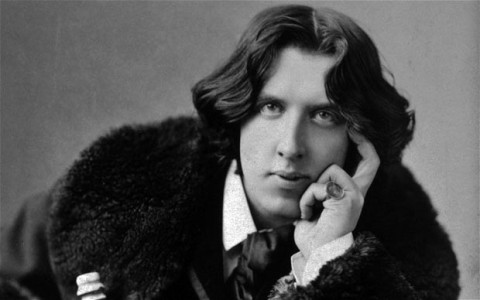 According to The Telegraph, experts rummaging through a dusty box recently uncovered a letter penned by Oscar Wilde in 1890 (or thereabouts). Addressed to a “Mr. Morgan,” the letter runs 13 pages, and it offers what amounts to practical advice for an aspiring writer. Details on the letter’s contents remain scarce, although we will probably know more when the document gets auctioned off in two weeks time. But, so far, we know that Wilde offered Mr. Morgan two points to consider: