It can’t have been easy being Franz Kafka. But then, it can’t have been much easier being Franz Kafka’s fiancée, as evidenced by the correspondence read aloud by Richard Ayoade in the new Letters Live video above. “It is now 10:30 on Monday morning,” he wrote to Felice Bauer on November 4, 1912. “I have been waiting for a letter since 10:30 on Saturday morning, but again nothing has come. I have written every day but don’t I deserve even a word? One single word? Even if it were only to say ‘I never want to hear from you again.’ ” This anxious, hectoring tone was not a one-off indulgence. “Dearest, what have I done that makes you torment me so?” he pleaded just over two weeks later.
Kafka and Bauer had been introduced three months before. She was a relative of Max Brod, Kafka’s friend and eventual literary executor, and according to Kafka’s diaries, made a fairly unprepossessing first impression: “Bony, empty face that wore its emptiness openly. Bare throat. A blouse thrown on. Looked very domestic in her dress although, as it turned out, she by no means was.”
Yet during their ensuing five-year correspondence, he was moved to write her more than 500 letters, some of them sent one day after the other — and more than a few berating her for not writing back quickly enough.
This relationship twice led to engagement, but perhaps unsurprisingly, never culminated in marriage. Nevertheless, Bauer’s relationship with Kafka remained important enough to her that she saved everything he wrote to her, which was collected and published in book form as Briefe an Felice (and later, in translation, as Letters to Felice) in 1967. Perhaps, as burdensome as they could no doubt be, Kafka’s letters suggested to Bauer a certain literary skill. (This was, after all, the same period in which he wrote The Metamorphosisand “In the Penal Colony,” as well as early versions of The Trial). They also hint at his since-celebrated sense of humor, not least in a concluding line like “Damn the mail!” — words that, in Ayoade’s delivery, draw a round of applause.
Based in Seoul, Colin Marshall writes and broadcasts on cities, language, and culture. His projects include the Substack newsletterBooks on Cities and the book The Stateless City: a Walk through 21st-Century Los Angeles. Follow him on the social network formerly known as Twitter at @colinmarshall.
The story of the Globe Theatre, the ancestral home of Shakespeare’s plays, is itself very Shakespearean, in all of the ways we use that adjective: it has deep roots in English history, a tragic backstory, and represents all of the hodgepodge of London, in the early 17th century and today, with the city’s colorful street life, mingling of international cultures, high and low, and its delight in the play and interplay of languages.
“The first public playhouses,” notes the British Library, “were built in London in the late 1500s. Theatres were not permitted within the boundaries of the City itself”—theater not being considered a respectable art—”but were tolerated in the outer districts of London, such as Southwark, where the Globe was located. Southwark was notorious for its noisy, chaotic entertainments and for its sleazy low-life: its theatres, brothels, bear baiting pits, pickpockets and the like.”
The Globe began its life in 1599, in a story that “might be worthy,” writes the Shakespeare Resource Center, “of a Shakespearean play of its own.” Built from the timbers of the city’s first permanent theater, the Burbage, which opened in 1576, the Globe burned down in 1613 “when a cannon shot during a performance of Henry VIII ignited the thatched roof in the gallery.” Within the year, it was rebuilt on the same foundations (with a tiled roof) and operated until the Puritans shut it down in 1642, demolishing the famed open-air theater two years later.
In a twist to this so far very English tale, it took the tireless efforts of an expatriate American, actor-director Sam Wanamaker, to bring the Globe back to London. After more than two decades of advocacy, Wanamaker’s Globe Playhouse Trust succeeded in recreating the Globe, just a short distance from the original location. Opening in 1997, three-hundred and fifty-five years after the first Globe closed, the new Globe Theatre recreated all of the original’s architectural elements.
The stage projects into the circular courtyard, designed for standing spectators and surrounded by three tiers of seats. While the stage itself has an elaborate painted roof, and the seating is protected from the weather by the only thatched roof in London since the 1666 Great Fire, the theater’s courtyard is open to the sky. However, where the original Globe held about 2,000 standing and 1,000 seated playgoers, the recreation, notes Time Out London, holds only about half that number.
Still, theater-goers can “get a rich feel for what it was like to be a ‘groundling’ (the standing rabble at the front of the stage) in the circular, open-air theatre.” Short of that, we can tour the Globe in the virtual recreation at the top of the post. Move around in any direction and look up at the sky. As you do, click on the tiny circles to reveal facts such as “Probably the first Shakespeare play to be performed at the Globe was Julius Caesar, in 1599.”
If you don’t have the luxury of visiting the new Globe, taking a tour, or seeing a performance lovingly-recreated with all of the costuming (and even pronunciation) from Jacobean England, you can get the flavor of this wondrous achievement in bringing cultural history into the present with the virtual tour, also available as an app for iPhone and iPad users. This interactive tour supersedes a previous version we featured a few years back.
If you would like to support the mission of Open Culture, consider making a donation to our site. It’s hard to rely 100% on ads, and your contributions will help us continue providing the best free cultural and educational materials to learners everywhere. You can contribute through PayPal, Patreon, and Venmo (@openculture). Thanks!
Note: An earlier version of this post appeared on our site in 2018.
Many artists have attempted to illustrate Dante Alighieri’s epic poem the Divine Comedy, but none have made such an indelible stamp on our collective imagination as the Frenchman Gustave Doré.
Doré was 23 years old in 1855, when he first decided to create a series of engravings for a deluxe edition of Dante’s classic. He was already the highest-paid illustrator in France, with popular editions of Rabelais and Balzac under his belt, but Doré was unable to convince his publisher, Louis Hachette, to finance such an ambitious and expensive project. The young artist decided to pay the publishing costs for the first book himself. When the illustrated Inferno came out in 1861, it sold out fast. Hachette summoned Doré back to his office with a telegram: “Success! Come quickly! I am an ass!”
Hachette published Purgatorio and Paradiso as a single volume in 1868. Since then, Doré’s Divine Comedy has appeared in hundreds of editions. Although he went on to illustrate a great many other literary works, from the Bible to Edgar Allan Poe’s “The Raven,” Doré is perhaps best remembered for his depictions of Dante. At The World of Dante, art historian Aida Audeh writes:
Characterized by an eclectic mix of Michelangelesque nudes, northern traditions of sublime landscape, and elements of popular culture, Doré’s Dante illustrations were considered among his crowning achievements — a perfect match of the artist’s skill and the poet’s vivid visual imagination. As one critic wrote in 1861 upon publication of the illustrated Inferno: “we are inclined to believe that the conception and the interpretation come from the same source, that Dante and Gustave Doré are communicating by occult and solemn conversations the secret of this Hell plowed by their souls, traveled, explored by them in every sense.”
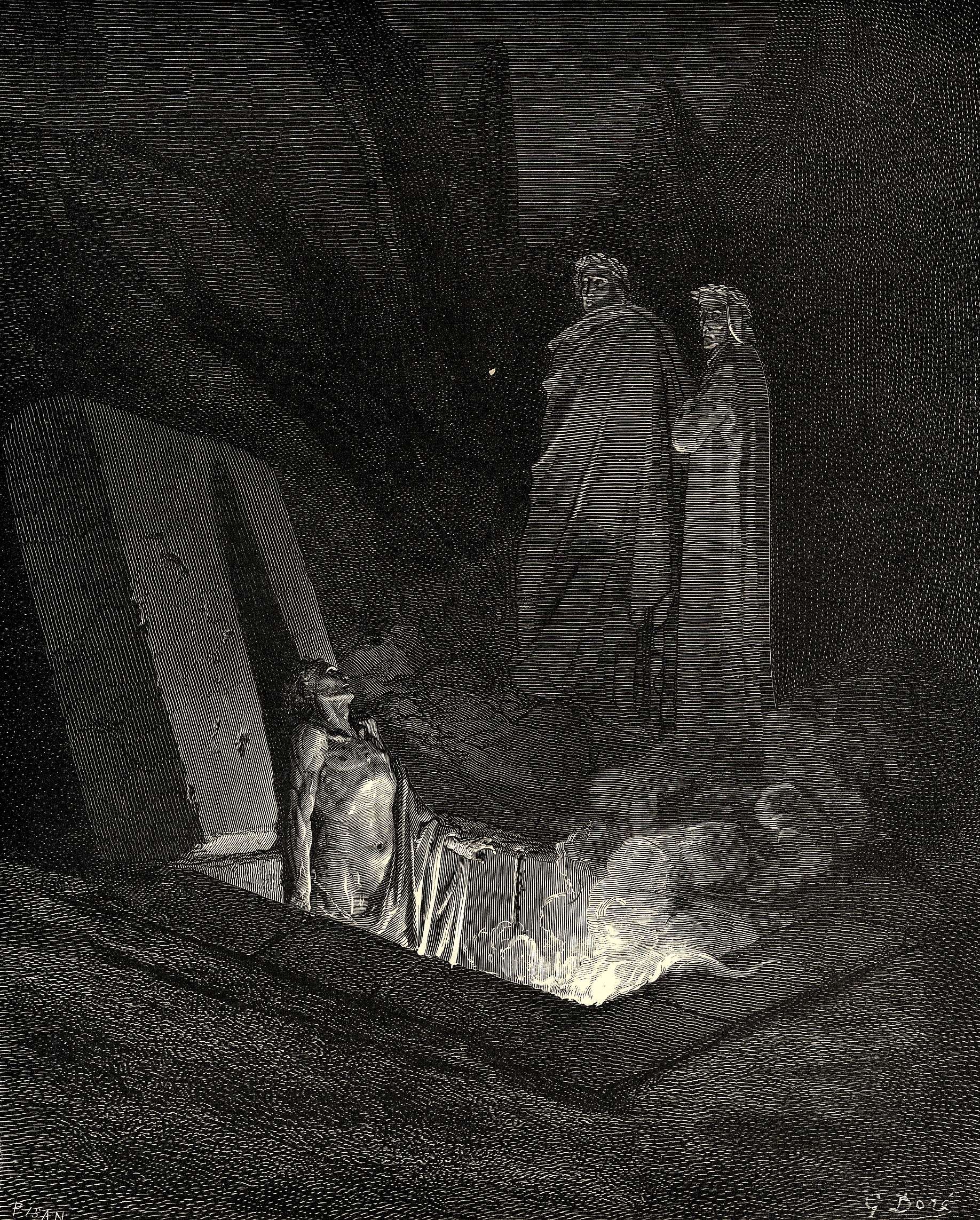
The scene above is from Canto X of the Inferno. Dante and his guide, Virgil, are passing through the Sixth Circle of Hell, in a place reserved for the souls of heretics, when they look down and see the imposing figure of Farinata degli Uberti, a Tuscan nobleman who had agreed with Epicurus that the soul dies with the body, rising up from an open grave. In the translation by John Ciardi, Dante writes:
My eyes were fixed on him already. Erect, he rose above the flame, great chest, great brow; he seemed to hold all Hell in disrespect
Inferno, Canto XVI:
As Dante and Virgil prepare to leave Circle Seven, they are met by the fearsome figure of Geryon, Monster of Fraud.Virgil arranges for Geryon to fly them down to Circle Eight. He climbs onto the monster’s back and instructs Dante to do the same.
Then he called out: “Now, Geryon, we are ready: bear well in mind that his is living weight and make your circles wide and your flight steady.”
As a small ship slides from a beaching or its pier, backward, backward — so that monster slipped back from the rim. And when he had drawn clear
he swung about, and stretching out his tail he worked it like an eel, and with his paws he gathered in the air, while I turned pale.
Inferno, Canto XXXIV:
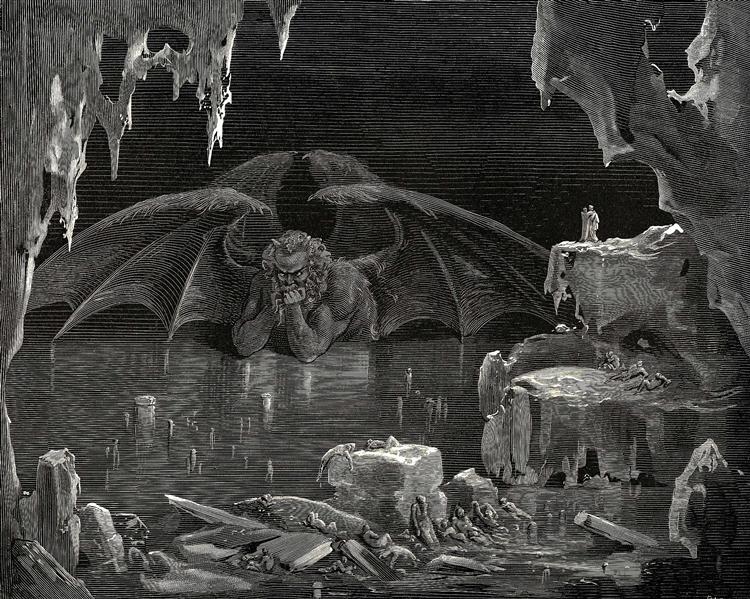
In the Ninth Circle of Hell, at the very center of the Earth, Dante and Virgil encounter the gigantic figure of Satan. As Ciardi writes in his commentary:
He is fixed into the ice at the center to which flow all the rivers of guilt; and as he beats his great wings as if to escape, their icy wind only freezes him more surely into the polluted ice. In a grotesque parody of the Trinity, he has three faces, each a different color, and in each mouth he clamps a sinner whom he rips eternally with his teeth. Judas Iscariot is in the central mouth: Brutus and Cassius in the mouths on either side.
Purgatorio, Canto II:
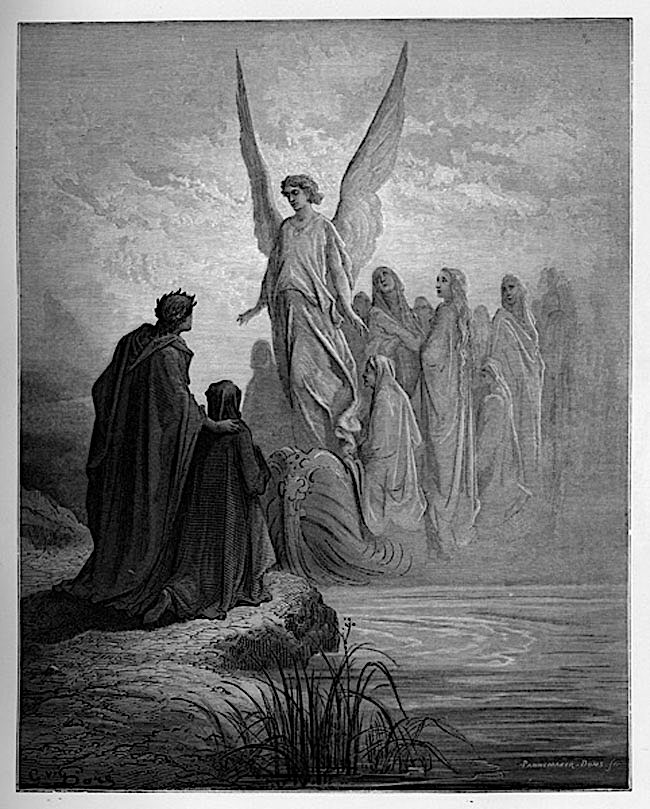
At dawn on Easter Sunday, Dante and Virgil have just emerged from Hell when they witness The Angel Boatman speeding a new group of souls to the shore of Purgatory.
Then as that bird of heaven closed the distance between us, he grew brighter and yet brighter until I could no longer bear the radiance,
and bowed my head. He steered straight for the shore, his ship so light and swift it drew no water; it did not seem to sail so much as soar.
Astern stood the great pilot of the Lord, so fair his blessedness seemed written on him; and more than a hundred souls were seated forward,
singing as if they raised a single voice
in exitu Israel de Aegypto. Verse after verse they made the air rejoice.
The angel made the sign of the cross, and they cast themselves, at his signal, to the shore. Then, swiftly as he had come, he went away.
Purgatorio, Canto IV:
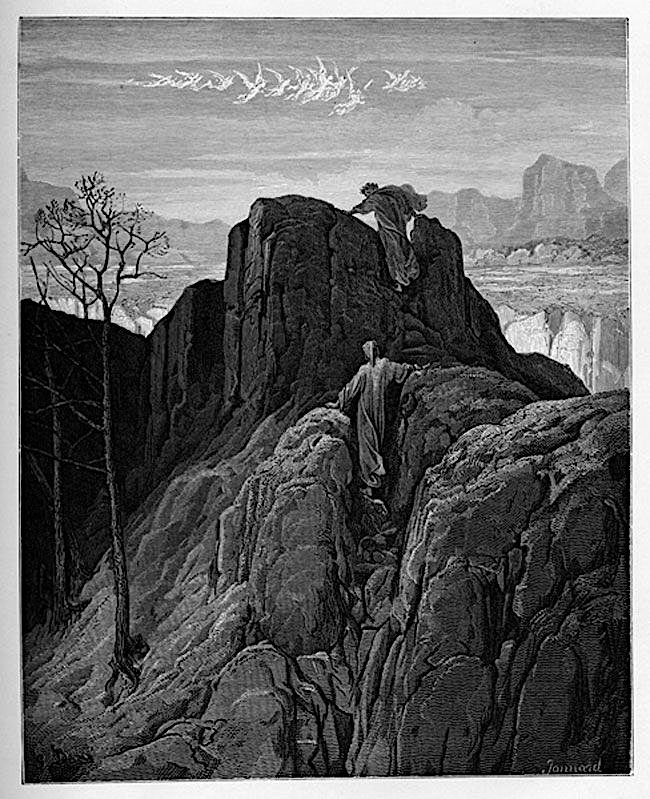
The poets begin their laborious climb up the Mount of Purgatory. Partway up the steep path, Dante cries out to Virgil that he needs to rest.
The climb had sapped my last strength when I cried: “Sweet Father, turn to me: unless you pause I shall be left here on the mountainside!”
He pointed to a ledge a little ahead that wound around the whole face of the slope. “Pull yourself that much higher, my son,” he said.
His words so spurred me that I forced myself to push on after him on hands and knees until at last my feet were on that shelf.
Purgatorio, Canto XXXI:
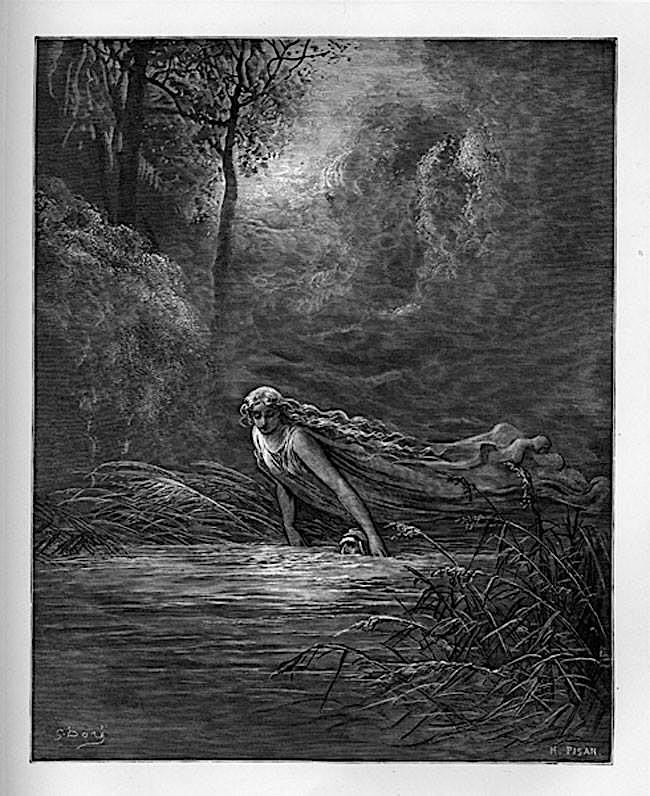
Having ascended at last to the Garden of Eden, Dante is immersed in the waters of the Lethe, the river of forgetfulness, and helped across by the maiden Matilda. He drinks from the water, which wipes away all memory of sin.
She had drawn me into the stream up to my throat, and pulling me behind her, she sped on over the water, light as any boat.
Nearing the sacred bank, I heard her say in tones so sweet I cannot call them back, much less describe them here: “Asperges me.”
Then the sweet lady took my head between her open arms, and embracing me, she dipped me and made me drink the waters that make clean.
Paradiso, Canto V:
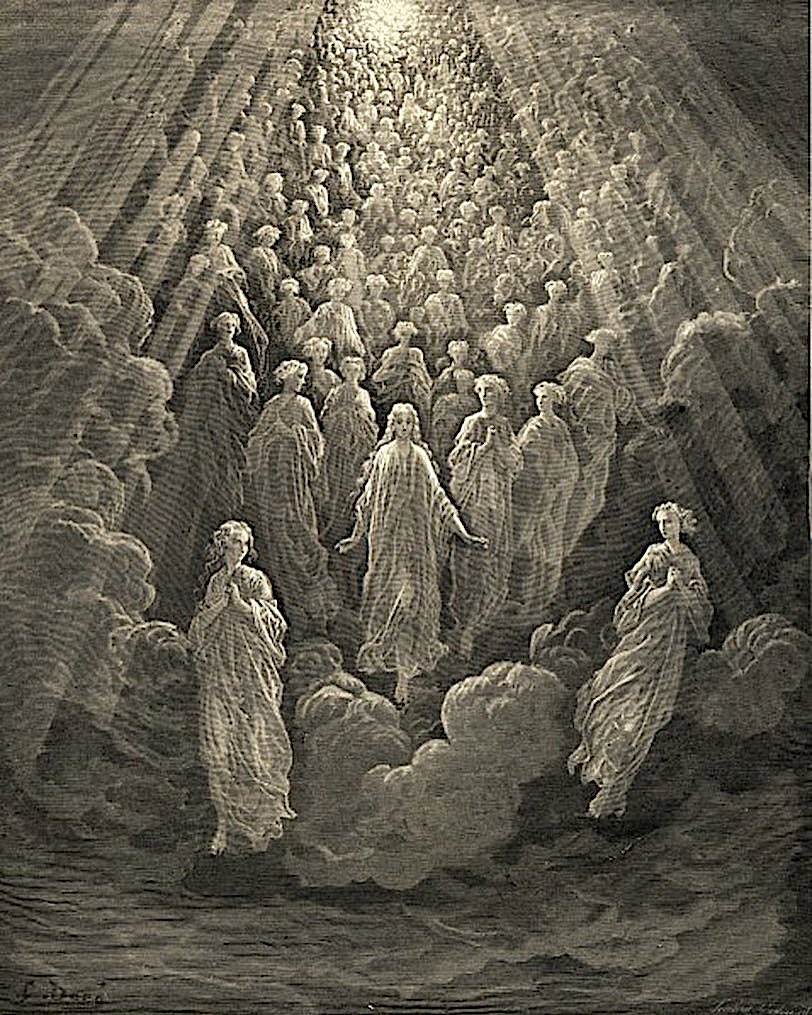
In the Second Heaven, the Sphere of Mercury, Dante sees a multitude of glowing souls. In the translation by Allen Mandelbaum, he writes:
As in a fish pool that is calm and clear, the fish draw close to anything that nears from outside, it seems to be their fare, such were the far more than a thousand splendors I saw approaching us, and each declared: “Here now is one who will increase our loves.” And even as each shade approached, one saw, because of the bright radiance it set forth, the joyousness with which that shade was filled.
Paradiso, Canto XXVIII:
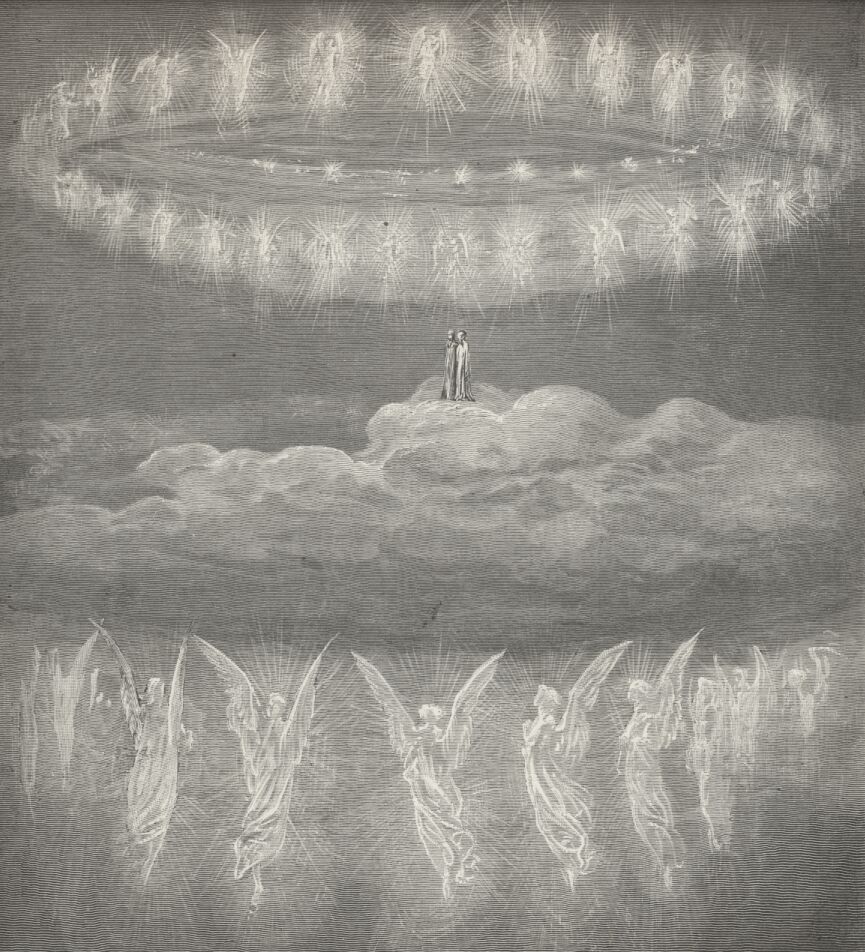
Upon reaching the Ninth Heaven, the Primum Mobile, Dante and his guide Beatrice look upon the sparkling circles of the heavenly host. (The Christian Beatrice, who personifies Divine Love, took over for the pagan Virgil, who personifies Reason, as Dante’s guide when he reached the summit of Purgatory.)
And when I turned and my own eyes were met By what appears within that sphere whenever one looks intently at its revolution, I saw a point that sent forth so acute a light, that anyone who faced the force with which it blazed would have to shut his eyes, and any star that, seen from the earth, would seem to be the smallest, set beside that point, as star conjoined with star, would seem a moon. Around that point a ring of fire wheeled, a ring perhaps as far from that point as a halo from the star that colors it when mist that forms the halo is most thick. It wheeled so quickly that it would outstrip the motion that most swiftly girds the world.
Paradiso, Canto XXXI:
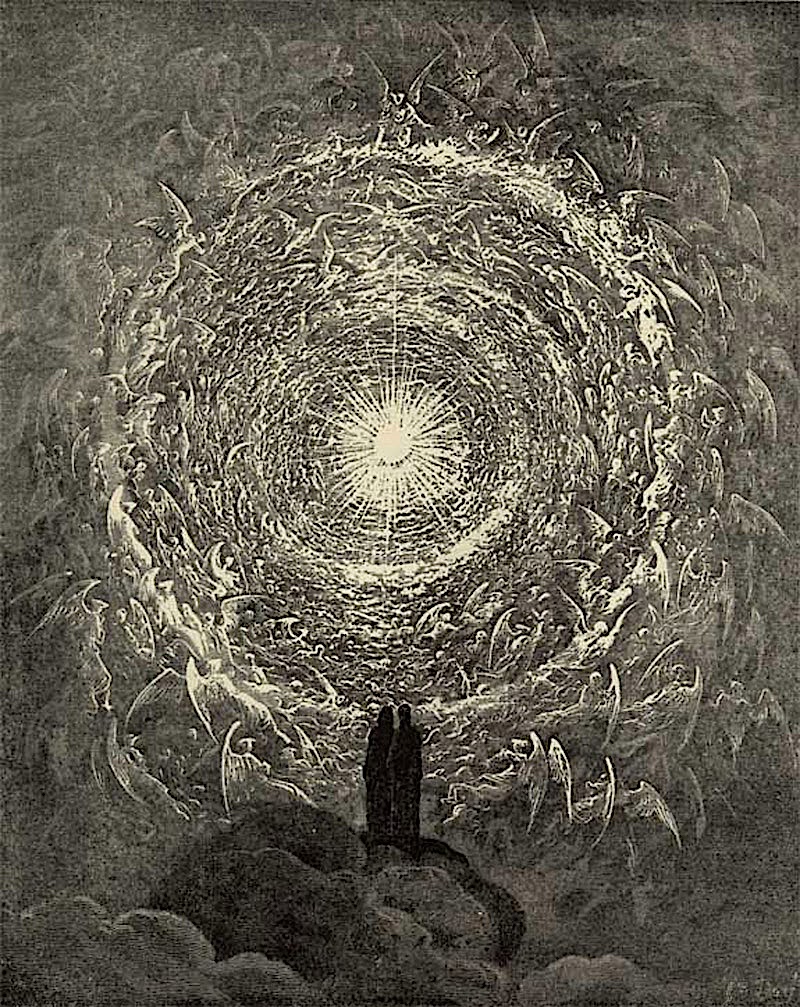
In the Empyrean, the highest heaven, Dante is shown the dwelling place of God. It appears in the form of an enormous rose, the petals of which house the souls of the faithful. Around the center, angels fly like bees carrying the nectar of divine love.
So, in the shape of that white Rose, the holy legion has shown to me — the host that Christ, with His own blood, had taken as His bride. The other host, which, flying, sees and sings the glory of the One who draws its love, and that goodness which granted it such glory, just like a swarm of bees that, at one moment, enters the flowers and, at another, turns back to that labor which yields such sweet savor, descended into that vast flower graced with many petals, then again rose up to the eternal dwelling of its love.
If you would like to support the mission of Open Culture, consider making a donation to our site. It’s hard to rely 100% on ads, and your contributions will help us continue providing the best free cultural and educational materials to learners everywhere. You can contribute through PayPal, Patreon, and Venmo (@openculture). Thanks!
Note: An earlier version of this post appeared on our site in October 2013.
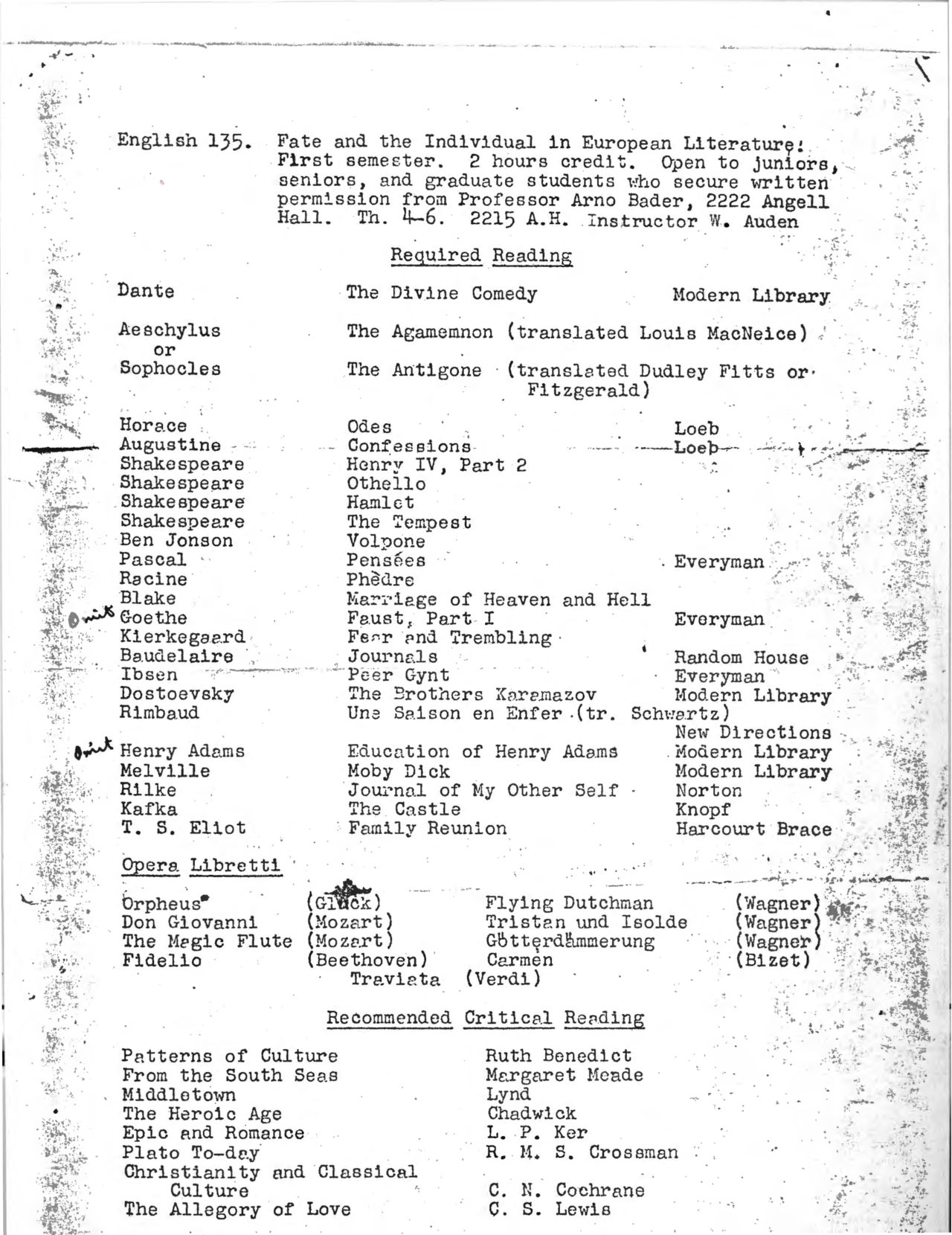
Whether willed, involuntary, or a mix of both, the declining literacy of college students is by now so often lamented that reports of it should no longer come as a surprise. And yet, on some level, they still do: English majors in regional Kansas universities find the opening to Bleak House virtually unintelligible; even students at “highly selective, elite colleges” struggle to read, let alone comprehend, books in their entirety. Things were different in 1941, and very different indeed if you happened to be taking English 135 at the University of Michigan, a class titled “Fate and the Individual in European Literature.” The instructor: a certain W. H. Auden.
In his capacity as an educator, the poet threw down the gauntlet of an “infamously difficult” syllabus, as literary academic and YouTuber Adam Walker explains in his new video above, that “asked undergraduates to read about 6,000 pages of classic literature.”
Not that the course was out of touch with current events: in its historical moment, “Nazi Germany had invaded the Soviet Union and expanded into Eastern Europe. Systematic extermination begins with mass shootings, and the machinery of genocide is accelerating. It’s no accident that Auden takes an interest in fate and the individual in European literature” — a theme that, as he frames it, begins with Dante. After the entirety of The Divine Comedy, Auden’s students had their free choice between Aeschylus’ Agamemnon or Sophocles’ Antigone.
From there, the required reading plunged into Horace’s Odes and Augustine’s Confessions, four Shakespeare plays, Pascal’s Pensées, Goethe’s Faust (but only Part I), and Dostoevsky’s The Brothers Karamazov, to name just a few texts. Not everyone would consider Dostoevsky European, of course, but then, nobody would consider Herman Melville European, which for Auden was hardly a reason to leave Moby-Dick off the syllabus. Walker describes that novel as relevant to the course’s themes of “obsession and cosmic struggle,” evident in all these works and their treatments of “passion and historical forces, and how individuals navigate those forces”: ideas that transcend national and cultural boundaries by definition. Whether they would come across to the kind of twenty-first-century students who’d balk at being assigned even a full-length Auden poem is another question entirely.
Based in Seoul, Colin Marshall writes and broadcasts on cities, language, and culture. His projects include the Substack newsletterBooks on Cities and the book The Stateless City: a Walk through 21st-Century Los Angeles. Follow him on the social network formerly known as Twitter at @colinmarshall.
Like the rock and roll revolution of the 1950s, which shocked staid white audiences with translations of black rhythm and blues, the popularity of jazz caused all kinds of racial panic and social anxiety in the early part of the twentieth century. Long before the rise of European fascism, many American groups expressed extreme fear and agitation over the rise of minority cultural forms. But by World War II, jazz was intrinsically woven into the fabric of American majority culture, albeit often in versions scrubbed of blues undertones. This was not, of course, the case in Nazi occupied Europe, where jazz was suppressed; like most forms of modern art, it bore the stigma of impurity, innovation, passion… all qualities totalitarians frown on (even anti-fascist theorist Theodor Adorno had a serious beef with jazz).
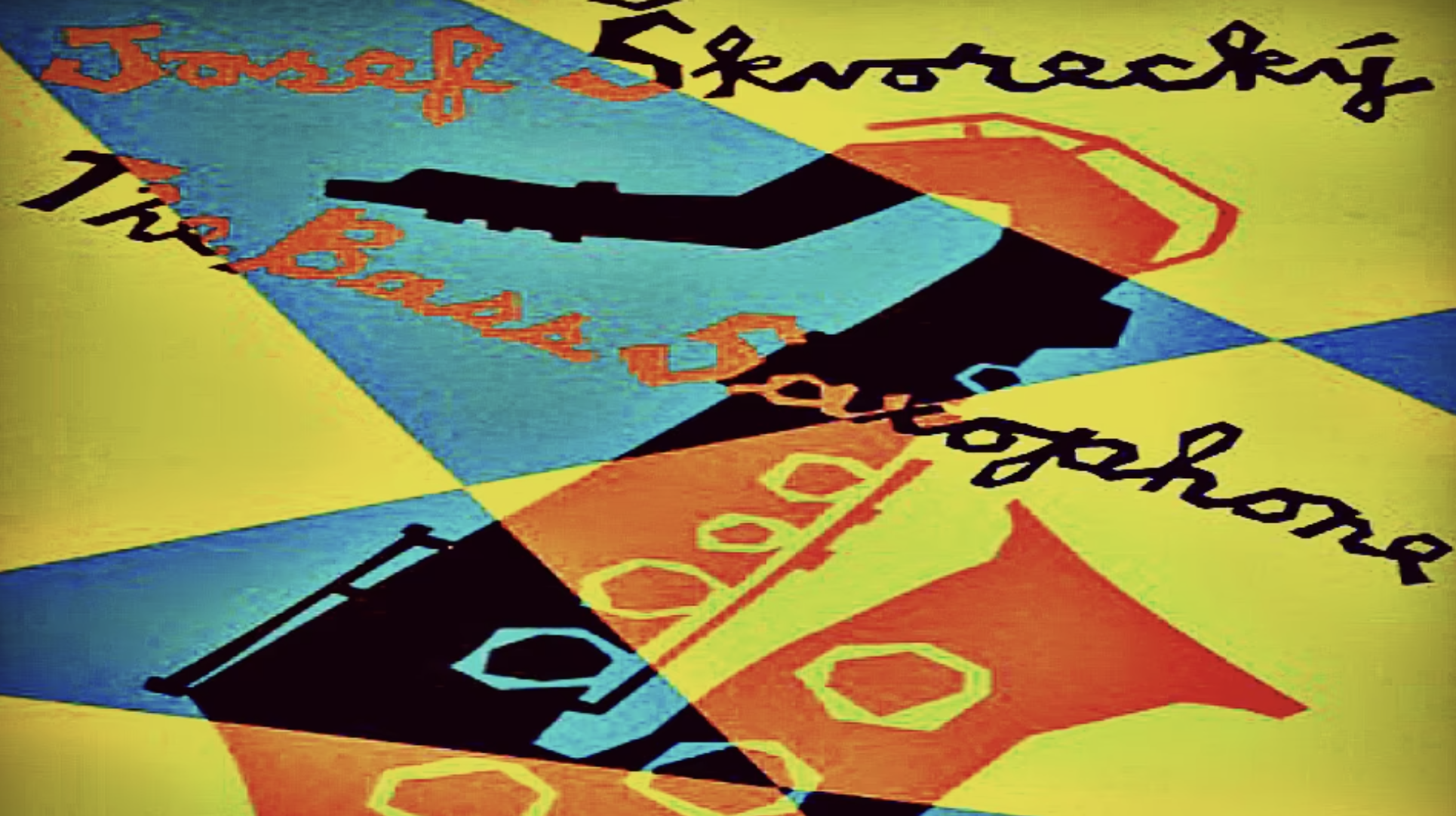
And while it’s no great surprise that Nazis hated jazz, it seems they expressed their disapproval in a very oddly specific way, at least in the recollection of Czech writer and dissident Josef Skvorecky.
On the occasion of Skvorecky’s death, J.J. Gould pointed out in The Atlantic that the writer was himself one of the characters that so interested Kubrick. An aspiring tenor saxophone player living in Third Reich-occupied Czechoslovakia, Skvorecky had ample opportunity to experience the Nazis’ “control-freak hatred of jazz.” In the intro to his short novel The Bass Saxophone, he recounts from memory a set of ten bizarre regulations issued by a Gauleiter, a regional Nazi official, that bound local dance orchestras during the Czech occupation.
Pieces in foxtrot rhythm (so-called swing) are not to exceed 20% of the repertoires of light orchestras and dance bands;
In this so-called jazz type repertoire, preference is to be given to compositions in a major key and to lyrics expressing joy in life rather than Jewishly gloomy lyrics;
As to tempo, preference is also to be given to brisk compositions over slow ones (so-called blues); however, the pace must not exceed a certain degree of allegro, commensurate with the Aryan sense of discipline and moderation. On no account will Negroid excesses in tempo (so-called hot jazz) or in solo performances (so-called breaks) be tolerated;
So-called jazz compositions may contain at most 10% syncopation; the remainder must consist of a natural legato movement devoid of the hysterical rhythmic reverses characteristic of the barbarian races and conducive to dark instincts alien to the German people (so-called riffs);
Strictly prohibited is the use of instruments alien to the German spirit (so-called cowbells, flexatone, brushes, etc.) as well as all mutes which turn the noble sound of wind and brass instruments into a Jewish-Freemasonic yowl (so-called wa-wa, hat, etc.);
Also prohibited are so-called drum breaks longer than half a bar in four-quarter beat (except in stylized military marches);
The double bass must be played solely with the bow in so-called jazz compositions;
Plucking of the strings is prohibited, since it is damaging to the instrument and detrimental to Aryan musicality; if a so-called pizzicato effect is absolutely desirable for the character of the composition, strict care must be taken lest the string be allowed to patter on the sordine, which is henceforth forbidden;
Musicians are likewise forbidden to make vocal improvisations (so-called scat);
All light orchestras and dance bands are advised to restrict the use of saxophones of all keys and to substitute for them the violin-cello, the viola or possibly a suitable folk instrument.
As The Atlantic notes, “being a Nazi, this public servant obviously didn’t miss an opportunity to couch as many of these regulations as he could in racist or anti-Semitic terms.” This racialized fear and hatred was the source, after all, of the objection. It’s almost impossible for me to imagine what kind of music this set of restrictions could possibly produce, but it most certainly would not be anything people would want to dance to. And that was probably the point.
With the Halloween season mere months away, the time has come to start thinking about what frightening reads to line up for ourselves this year. Some of us may reach for Mary Shelley’s Frankenstein; or, The Modern Prometheus, a story we all think we know. But a look into its context reveals that what’s now regarded as a timeless classic was, in its day, quite a topical novel. Introducing the 1931 James Whale film adaptation, the regular horror-movie player Edward Van Sloan describes Frankenstein as dealing with “the two great mysteries of creation: life and death” — which, when Shelley’s novel was published more than a century earlier, were yet more mysterious still.
“Worried by the potential inability to distinguish between the states of life and death, two doctors, William Hawes and Thomas Cogan, set up the Royal Humane Society in London in 1774,” writes Sharon Ruston at The Public Domain Review. At the time, it was actually called the Society for the Recovery of Persons Apparently Drowned, a name that would’ve doubled neatly as a mission statement. Falling into the rivers and canals of London was, it seems, a common occurrence in those days, and few members of the public possessed the swimming skills to save themselves. Thus the Society’s members took it upon themselves to devise methods of reviving those “persons apparently drowned,” whether their plunges were accidentally or deliberately taken.
One such attempted suicide, writes Ruston, “seems to have been Mary Shelley’s mother, the feminist, Mary Wollstonecraft,” who later complained about how, after leaping into the Thames, she was “inhumanly brought back to life and misery.” That incident could well have done its part to inspire Frankenstein, though notions of reviving the dead were very much in the air at the time, not least due to the attention being paid to the practice of “Galvanism,” which involved stimulating the muscles of dead animals and human bodies to movement using the then-novel phenomenon of electricity. In the England of that historical moment, it wasn’t entirely far-fetched to believe that the dead really could be brought back to life.
You can learn more about the scientific developments, social changes, and human anxieties (including about the possibility of being buried alive) that formed Frankenstein’s cultural background from the Vox History Club video above. In a way, it seems inevitable that someone in the early nineteenth century would write about a scientist avant la lettre who dares to create life from death. It just happened to be the teenage Shelley, to whom the idea came while engaged in a competition with Lord Byron, the writer-physician John Polidori, and her soon-to-be husband Percy Bysshe Shelley to see who could write the scariest story. Two centuries later, the story of Frankenstein may no longer scare us, but as told by Shelley, it still has a way of sounding strangely plausible.
Based in Seoul, Colin Marshall writes and broadcasts on cities, language, and culture. His projects include the Substack newsletterBooks on Cities and the book The Stateless City: a Walk through 21st-Century Los Angeles. Follow him on the social network formerly known as Twitter at @colinmarshall.
King, it seems, prefers books that explore basic defects in the human character to spooky tales of fantasy. In other words, he’s interested in stories that are actually terrifying. Orwell’s portrait of a man breaking under the pressure of totalitarianism or William Golding’s parable about a group of boys devolving into beasts are downright troubling. Frank Norris’s saga about the mendacious McTeague isn’t exactly comforting either. And McCarthy’s grim and spectacularly violent masterpiece Blood Meridian might make you crawl into a fetal position and weep for humanity. (That was my reaction, anyway.)
If you would like to support the mission of Open Culture, consider making a donation to our site. It’s hard to rely 100% on ads, and your contributions will help us continue providing the best free cultural and educational materials to learners everywhere. You can contribute through PayPal, Patreon, and Venmo (@openculture). Thanks!
Note: An earlier version of this post appeared on our site in 2014.
Jonathan Crow is a Los Angeles-based writer and filmmaker whose work has appeared in Yahoo!, The Hollywood Reporter, and other publications. You can follow him at @jonccrow. And check out his blog Veeptopus, featuring lots of pictures of vice presidents with octopuses on their heads. The Veeptopus store is here.
“Paradise Lost is one of the books which the reader admires and lays down, and forgets to take up again,” Samuel Johnson wrote in the late eighteenth century. “None ever wished it longer than it is. Its perusal is a duty rather than a pleasure. We read Milton for instruction, retire harassed and overburdened, and look elsewhere for recreation; we desert our master, and seek for companions.” These nearly two and a half centuries later, how many of us attempt to seek out the instruction of Milton in the first place? What was a literary hit in 1667 has become a work read mostly by specialist scholars — but will, perhaps, become a favorite among viewers of the YouTube channel Hochelaga thanks to its new video above.
The first thing to know about Milton’s epic poem, says Hochelaga host Tommie Trelawny, is that it “tells the story of the Biblical fall of man — but, curiously, from Satan’s perspective.” Even if it’s never occurred to you to set eyes on Paradise Lost, you’ve almost certainly heard one of Satan’s most memorable declarations: “Better to reign in Hell, then serve in Heav’n.”
There’s a decent chance you’ve also run across another, “The mind is its own place, and in it self. Can make a Heav’n of Hell, a Hell of Heav’n,” perhaps without knowing which character speaks it. But if you hear enough of his quotable quotes, you might start to think that this Satan fellow makes some good points after all.
Paradise Lost had a similar effect on some of its God-fearing early readers, who suspiciously started to wonder whose side Milton was really on. What the poem seems to glorify, when read today, isn’t Satan, and it’s not even so much God or man as language itself. Now as then, Milton’s baroque grammar and heavily Latinate vocabulary constituted a good portion of both the work’s challenge and its appeal. Equally notable is his obvious conviction that language is up to the task of addressing the most fundamental truths, questions, and contradictions of existence. Satan may not emerge victorious — and certainly doesn’t at the end of the sequel, Paradise Regained — but if he happens to have the best lines, that just reflects our greater, and thoroughly human, fascination with the bad guys more than the good ones.
Based in Seoul, Colin Marshall writes and broadcasts on cities, language, and culture. His projects include the Substack newsletterBooks on Cities and the book The Stateless City: a Walk through 21st-Century Los Angeles. Follow him on the social network formerly known as Twitter at @colinmarshall.
We're hoping to rely on loyal readers, rather than erratic ads. Please click the Donate button and support Open Culture. You can use Paypal, Venmo, Patreon, even Crypto! We thank you!
Open Culture scours the web for the best educational media. We find the free courses and audio books you need, the language lessons & educational videos you want, and plenty of enlightenment in between.