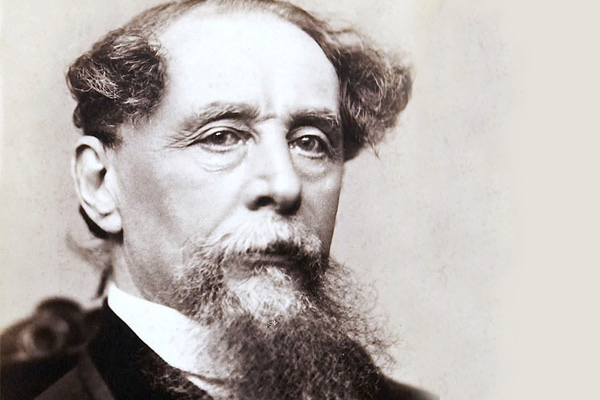
Still true half a century later? Immaterial. Olivier’s use of “I think” and “almost” leaves room enough for a sort of genial, general agreement.
Some of the introductions give unintentionally hilarious added value, such as host Frank Craven’s attempt to contextualize a Lux Radio Theater presentation starring Orson Welles as Sydney Carton in A Tale of Two Cities excerpt. The author’s work was often published in serial form, he tells listeners:
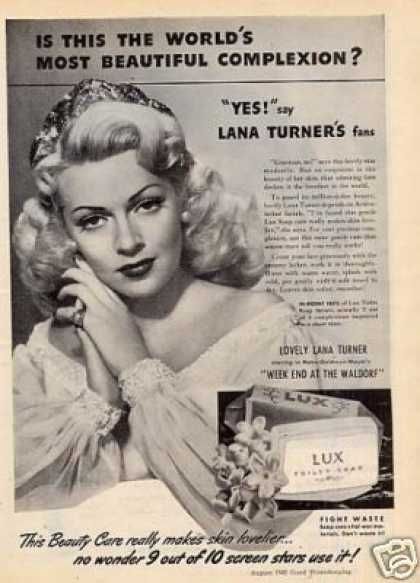
Records tell us of how crowds thronged the wards of New York City to receive news of their favorite heroine or hero. For already, the names of Dickens’ characters were household words, as much, I imagine, as Lux Toilet Soap is a household word throughout America today, and for very much the same reason–the ability to find approval among people of all kinds of ages and every walk of life, not only among women who are anxious to preserve their loveliness but with every member of the family, young and old. Lux Toilet Soap is quick to make friends and to keep them.
How disappointed the sponsors must’ve been that in the whole of A Tale of Two Cities, there’s not a single reference to soap. (For the record, Oliver Twist has one and David Copperfield has two…)
The 24-hour playlist (the first one above) will be added to our list of Free Audio Books. If you need to download Spotify’s free software, grab it here.
In 1856, novelist George Eliot—real name Mary Anne Evans—issued a vicious critique of other women English writers in language we would expect from the most self-satisfied of misogynists, a group of people with an unqualified monopoly on the culture, but who had very little new to say on the subject. But Eliot certainly did, in “Silly Novels by Lady Novelists.” Though she couches many of her critical observations in the condescending vocabulary of a male antagonist, the language only serves to make her argument more effective. The essay, writes Kathryn Schulz, “does a remarkable number of things deftly and all at once.”
Although she is an uncommonly compassionate writer, Eliot has knife skills when she needs them, and the most obvious thing she does here is chiffonade the chick lit of her day. Yet even while castigating some women, she manages to champion women as a whole. Her chief objection to silly novels is that they misrepresent women’s real intellectual capacity; and the chief blame for them, she argues, lies not with their authors but with the culture that produced them—through inadequate education, low expectations, patronizing critics, and fear of the real deal.
The fault, she asserted, lies with the gatekeepers, the tastemakers, the lazy thinkers. Though an accomplished essayist and translator, Eliot would only publish her first novel in 1859, at the age of 37. But “Silly Novels by Lady Novelists,” writes Schulz, “traces out in negative space, the contours of a truly great novel”—one that wouldn’t arrive until fourteen years later: Middlemarch: a study of provincial life. (Read online or download in various formats here.)
The book’s first chapter introduces Dorothea Brooke, a well-off 19-year old orphan—who, writes Pamela Erens, “has dreams of doing some great work in the world” but gives her life instead to “dry humorless pedant” Casaubon—with an ironic quote from the licentious Jacobean play The Maid’s Tragedy: “Since I can do no good because a woman, / Reach constantly at something that is near it.”
As with the pen name she adopted, Eliot appropriated the armor of a male-dominated culture to bring into being some of the most staggeringly insightful writing of the time, and a beacon to other great women writers. “What do I think of Middlemarch?,” wrote Emily Dickinson, “What do I think of glory?—except that in a few instances ‘this mortal has already put on immortality.’” Virginia Woolf pronounced the book “one of the few English novels written for grown-up people.” Number twenty-one on The Guardian’s list of “The 100 Best Novels,” Middlemarch, writes Robert McCrum, exerts “an almost hypnotic power over its readers…. Today it stands as perhaps the greatest of many great Victorian novels.”
Do we have the time or the attention to read Eliot’s sprawling 900-page realist epic in the 21st century? Given that Karl Ove Knausgaard’s 3,600 page, six-part autobiographical novel, My Struggle, is one of the most lauded literary works of the past few years, perhaps we do. More specifically, in the language of many a condescending critic of today, do “Millennials” have the time and attention to read Middlemarch? At least a certain contingent of young readers has not only read the novel, but has adapted it into a seventy-episode web drama, Middlemarch: The Series—an “attempt worth watching,” writes Rebecca Mead at The New Yorker, “for its ambition as well as its charm.”
Written and directed by Yale undergraduate film student Rebecca Shoptaw, the series stars several of Shoptaw’s peers “as students at Lowick College, in the fictional town of Middlemarch, Connecticut,” and it transcribes the novel’s form into that most 21st century of mediums, the vlog. You can see the official teaser at the top of the post; watch the first episode just above, introducing Yale student Mia Fowler as Dot Brooke; and see the full series, thus far, down below. (The show has already won awards and recognition from several film festivals. See “air dates” and more on its busy Tumblr page.)
Up to now, notes Mead,Eliot’s fiction has resisted the kind of treatment given to Charlotte Brontë and Jane Austen in adaptations like “a chapter book for tweens called Jane Airhead” and the Austen-inspired Bridget Jones’s Diary and Clueless (not to mention Pride and Prejudice and Zombies). And yet, despite the daunting size, scope, and seriousness of Eliot’s novel, Middlemarch: the Series continues in this tradition of light-hearted, pop-cultural modernizations, using the same device as the award-winning Austen vlog adaptation The Lizzie Bennet Diaries and Brontë vlog adaptation “The Autobiography of Jane Eyre.”
Though it is “an impossibly tall order,” writes Mead, “to expect a Web series to approach the nuance of a nineteenth-century novel—of the nineteenth-century novel,” adaptations like Shoptaw’s don’t even attempt to do this. They express “a winning affection” for their source material, and a sense of how it still informs the very different gender identities and sexual relationships of the present. In that sense, it may be useful to think of them as, in part, working in a similar vein as another very 21st century medium: fan fiction. Would the knives-out critic Eliot approve? Impossible to say. But I dare say she might admire the ambition, creative impulses, and narrative ingenuity of Shoptaw and her cast perhaps as much as they admire her greatest work.
In a 1904 letter, Franz Kafka famously wrote, “a book must be the axe for the frozen sea inside us,” a line immortalized in pop culture by David Bowie’s “Ashes to Ashes.” Where Bowie referred to the frozen emotions of addiction, the arctic waste inside Kafka may have had much more to do with the agony of writing itself. In the year that he composed his best-known work, The Metamorphosis, Kafka kept a tortured journal in which he confessed to feeling “virtually useless” and suffering “unending torments.” Not only did he need to break the ice, but “you have to dive down,” he wrote on January 30th, “and sink more rapidly than that which sinks in advance of you.”
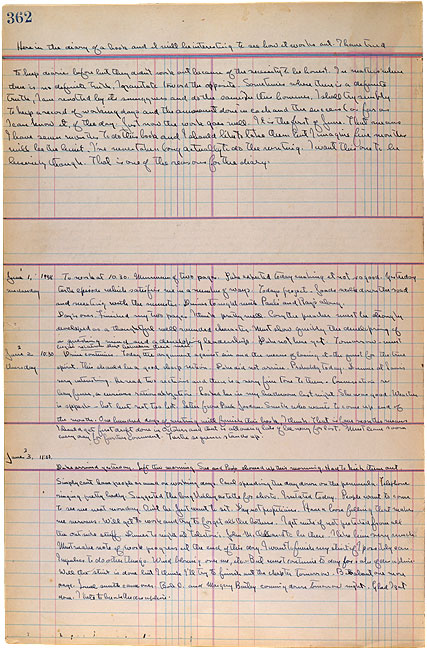
Whether as writers we find the evidence of Kafka’s crippling self-doubt to be a comfort I cannot say. For many people, no matter how successful, or prolific, some degree of pain inevitably attends every act of writing. And many, like Kafka, have left personal accounts of their most productive periods. John Steinbeck struggled mightily during the composition of his masterpiece, The Grapes of Wrath. His journal entries from the period tell the story of a frayed and anxious man overwhelmed by the seeming enormity of his task. But his example is instructive as well: despite his fragile mental state and lack of confidence, he continued to write, telling himself on June 11th, 1938, “this must be a good book. It simply must.” (See some of Steinbeck’s handwritten entries in the image above, courtesy of Austin Kleon.)
In setting the bar so high—“For the first time I am working on a real book,” he wrote—Steinbeck often felt crushed at the end of a day. “My whole nervous system in battered,” he wrote on June 5th. “I hope I’m not headed for a nervous breakdown.” He finds himself a few days later “assailed with my own ignorance and inability.” He continues in this vein. “Where has my discipline gone?” he asks in August, “Have I lost control?” By September he’s seeking perspective: “If only I wouldn’t take this book so seriously. It is just a book after all, and a book is very dead in a very short time. And I’ll be dead in a very short time too. So to hell with it.” The weight of expectation comes and goes, but he keeps writing.
The “private fruit” of Steinbeck’s diary entries, writes Maria Popova, “is in many ways at least as important and morally instructive” as the novel itself. At least that may be so for writers who are also beset by devastating neuroses. For Steinbeck, the diary (published here) was “a tool of discipline” and “hedge against self-doubt.” This may sound counterintuitive, but keeping a diary, even when the novel stalls, is itself a discipline, and an acknowledgement of the importance of being honest with oneself, allowing turbulence and doldrums to be a conscious part of the experience.
Steinbeck “feels his feelings of doubt fully, lets them run through him,” writes Popova, “and yet maintains a higher awareness that they are just that: feelings, not Truth.” His confrontations with negative capability can sound like “Buddhist scripture,” anticipating Ray Bradbury’s Zen in the Art of Writing. We needn’t attribute any religious significance to Steinbeck’s journals, but they do begin to sound like confessions of the kind many mystics have recorded over the centuries, including the imposter syndrome many a saint and bodhisattva has admitted to feeling. “I’m not a writer,” he laments in one entry. “I’ve been fooling myself and other people.” Nonetheless, no matter how excruciating, lonely, and confusing the effort, he resolved to develop a “quality of fierceness until the habit pattern of a certain number of words is established.” A ritual act, of a sort, which “must be a much stronger force than either willpower or inspiration.”
I well remember learning that Dr. Seuss’s real name was Theodor Geisel, mostly because I found Theodor Geisel was just as much fun to say as “Dr. Seuss.” Both names rolled around in the mouth, did somersaults and backflips off the tongue like the author’s multitude of strangely rubbery characters. With his Rube Goldberg machines, miniscule Whos, enormous Hortons, and mountains of comic absurdity, Seuss is like Swift for kids, his stories full of fantastic satire alongside much good clean common sense. Books like Horton Hears a Who and The Grinch Who Stole Christmas are chock full of “positive messages,” writes Amy Chyao at the Harvard Political Review, as well as trenchant social critique for five-year-olds.
Among the many lessons, “embracing diversity is perhaps the single most salient one embedded in many of Dr. Seuss’s books.” Geisel did not always espouse this value. There are those who read Horton’s refrain, “a person’s a person no matter how small,” as penance for work he did as a political cartoonist during World War II, when he drew what Jonathan Crow described in a previous post as “breathtakingly racist” depictions of the Japanese, promoting the bigotry that led to violence and the internment of Japanese Americans, an action he vigorously supported.
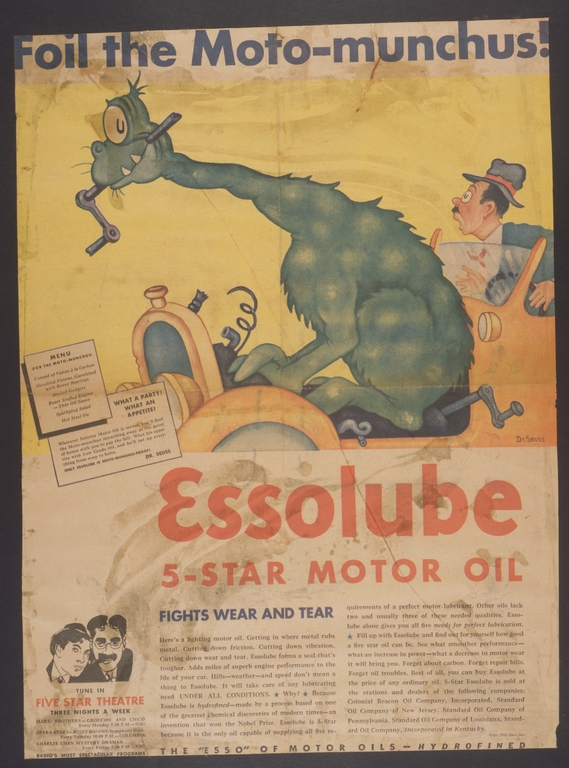
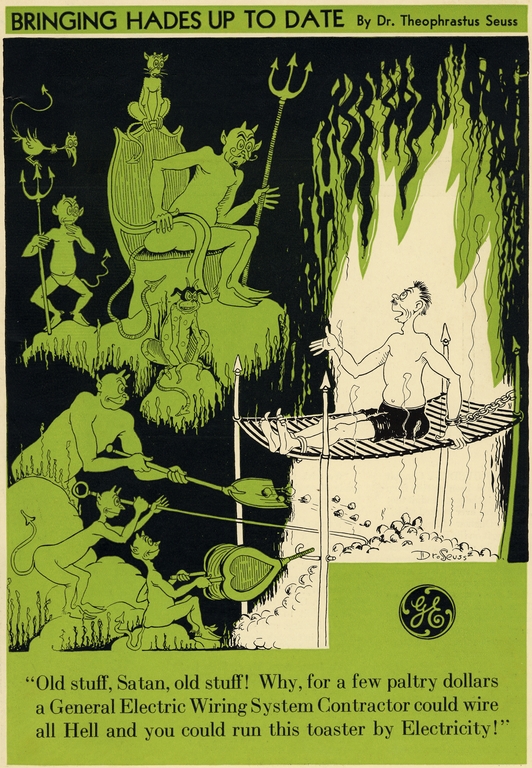
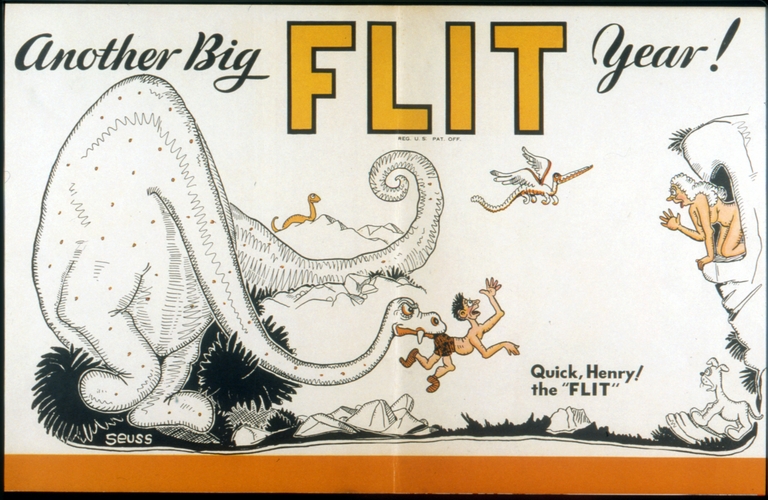
You can see many of his political cartoons at UC San Diego’s digital library, “Dr. Seuss Went to War.” UCSD also hosts an online archive of Geisel’s advertising work, which sustained him throughout much of the 30s and 40s, and not all of which has aged well either.
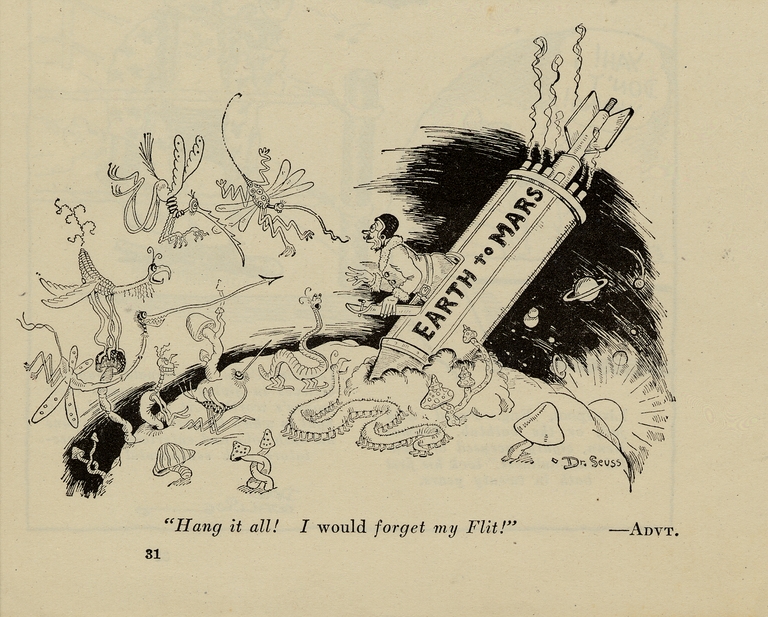
You will find some of these ads in the USCD archive; Geisel did truck in some blatantly inflammatory images. But he mostly drew innocuous, yet visually exciting, cartoons like the one at the top, one of the dozens of ads he drew during a 17-year campaign for Flit, an insect repellant made by Standard Oil.
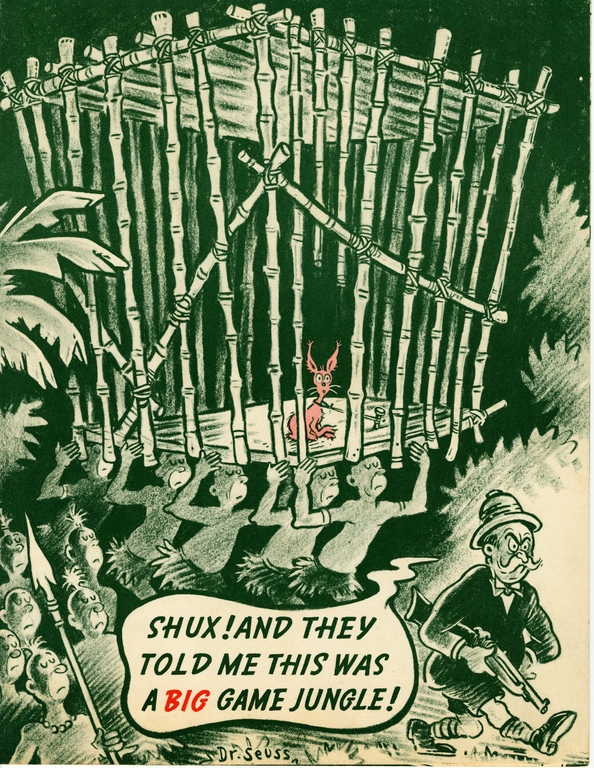
Geisel did ads for Standard Oil’s main product, promoting Essolube motor oil, further up, with the kind of creature that would later inhabit his children’s books. He got irreverently high concept with a GE ad set in hell, published explicitly under the pen name Dr. Theophrastus Seuss. And just above, in a brochure for the National Broadcasting Company, he introduces the visual aesthetic of Horton’s jungle, with a troupe of stereotypical grass-skirted Africans that might have come from one of Hergé’s offensive colonialist Tintin comics. (Both Seuss’s and Hergé’s early work are testaments to the common co-existence of progressive politics with often contemptuous or condescending treatment of nonwhite people in the early twentieth century.)
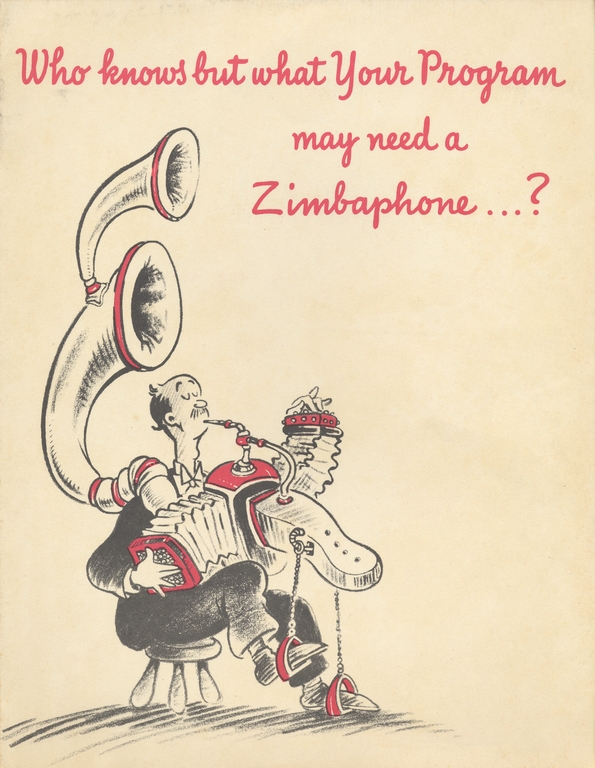
The Seuss advertisements archive shows us the artist’s development from visual puns and quirks to the fully-fledged mechanical surrealism of his mature style, as in the National Broadcasting Company brochure above, with its musical contraption the “Zimbaphone,” a precursor to the many cacophonous, overcomplicated instruments to come. It is when he is at his most inventive that Geisel is at his best. When he abandoned lazy, mean-spirited stereotypes, his work embraced a world of joyous possibility and weirdness.
It’s unlikely that reclusive poet Emily Dickinson would have wanted much fuss made over her birthday while still alive to celebrate it.
But with the lady safely ensconced in Amherst’s West Cemetery’s plot 53 for more than a century, fans can observe the day in the manner they see fit.
Poet Eleanor Heginbotham cited Dickinson’s letter to her editor, abolitionist Thomas Wentworth Higginson–“Are you too deeply occupied to say if my verse is alive?”–before priming the breakfast crowd on what they should expect from the 8 hour marathon:
We’re just going to have a day with no discussion beyond… And it will be frustrating that we can’t ask questions, we can’t stop and say, “Oh, my goodness. Let’s do that one over again.” We’re just going to read and read and read. And from this moment on, the voice of Emily Dickinson, through those of you in this room, that’s the only voice we’re going to hear, and won’t that be fun?
Yes, though you may want to pack a nutritious snack to keep your energy up. The reading slots were secured by means of an online sign up sheet, and while such egalitarianism is laudable, it does not necessarily confer performance chops on the inexperienced.
Naturally, there are stand outs.
Marianne Noble, Associate Professor of Literature at American University, is a highlight with Poem 75, (2:36:40, above). Her Emily Rocks t‑shirt is pretty rad too.
Christopher Lee, whose nearly 70-year acting career spanned most of the 20th century and nearly all of the 21st century so far, saw numerous technological, cinematic, and cultural trends come and go but remained an institution all the while. He first grew famous, as his many fans know, in the vivid, campy Hammer Horror films of the 1950s, 60s, and 70s like The Curse of Frankenstein, Corridor of Blood, and Dracula. His starring role in that last gave him his signature onscreen persona — he would go on to play the blood-sucking Count a total of ten times — but though he specialized in dark, villainous roles, his understanding of their essence meant his hundreds of performances transcended their eras, and often their material as well.
Lee knew, in other words, what it meant to be frightening, ominous, or simply unsettling in a rich and intriguing way, and that knowledge can hardly have come without an appreciation for the enduring work of Edgar Allan Poe.
We’ve previously featured several of Lee’s readings of the 19th-century American master of the macabre, including Poe’s most famous works like “The Raven” and “The Fall of the House of Usher,” but only dedicated collectors will have run across the long out-of-print release we submit for your enjoyment today: Christopher Lee Reads Edgar Allan Poe Tales of Horror, originally released in 1979, on cassette only, by the discount label Music for Pleasure, Ltd.
Spanning two tapes, this recording includes not only “The Fall of the House of Usher” but “The Black Cat,” “The Pit and the Pendulum,” and “The Cask of Amontillado,” all of which demonstrate not just Lee’s ability to conjure up a spooky atmosphere with his voice alone, but his perfect suitability to the kind of language Poe used to tell his stories, always highly mannered even while hinting at the unspeakable depths below. The question of what makes Poe’s writing so of its time yet so timeless may never be fully answered, but then, nor, probably, will the question of what makes Lee’s elegant performances stand out from even the most schlocky or dated productions. Whatever the reasons, the union of the two always guarantees captivating listening, even from a simple 1970s bargain-bin package like this one. You can find old cassettes of Christopher Lee Reads Edgar Allan Poe Tales of Horror floating around on Amazon.
When readers talk about the “music” of On the Road, they usually mean the distinctive qualities of its prose, all typed out by Jack Kerouac, so literary legend has it, on a three-week writing bender in April of 1951. “Time being of the essence in the purity of speech, sketching language is undisturbed flow from the mind of personal secret idea-words, blowing (as per jazz musician) on subject of image,” he wrote, spontaneously, in his “Essentials of Spontaneous Prose.” He also insisted on “no periods separating sentence-structures already arbitrarily riddled by false colons and timid usually needless commas-but the vigorous space dash separating rhetorical breathing (as jazz musician drawing breath between outblown phrases).”
But actual music, and especially jazz music, also forms an integral part of the background — or rather, an integral part of the ever-shifting backgrounds — of the story of Sal Paradise and Dean Moriarty’s automotive criscrossing of America. “Kerouac often made it clear that the sound of jazz in the 1940s had a lot to do with the kind of tone, intensity and unpremeditated drive he was trying to capture in the rhythms of his book,” writes the Guardian’s John Fordham. “In Los Angeles, Kerouac describes ‘the wild humming night of Central Avenue — the night of Hamp’s (that’s swing-band leader Lionel Hampton’s) ‘Central Avenue Breakdown’ — howled and boomed … they were singing in the halls, singing from their windows, just hell and be damned and look out.’ ”
An evocative passage, to be sure, and one drawn from just one of many jazz-infused sections of the novel. After enough of them, though, readers will want to hear some of this music, with its power to bring the cops “swarming from the nearest precinct,” for themselves. The 25-track Youtube playlist at the top of the post comes packed with selections drawn straight from the text, such as Miles Davis and the Charlie Parker Septet’s “Ornithology,” which Kerouac uses to establish the period of bop in which the novel opens, and Dexter Gordon and Wardell Gray’s The Hunt, so invigorating a live recording that Neal and Sal put it on the turntable in two separate chapters. The playlist even includes Red Norvo’s Congo Blues, the record that a girl at one point breaks over Dean’s head — and at Sal’s suggestion, no less — a memorable moment that shows that, however much Kerouac loved and drew inspiration from jazz, he certainly didn’t feel the need to keep reverent about it.
We know George Orwell’s 1984 and Aldous Huxley’s Brave New World, at least by reputation, and we’ve heard both references tossed around with alarming frequency this past year. Before these watershed dystopian novels, published over a decade apart (1949 and 1932, respectively), came an earlier book, one truly “most relevant to our time,” writes Michael Brendan Dougherty: Yevgeny Zamyatin’s We, written in 1923 and set “1,000 years after a revolution that brought the One State into power.” The novel had a significant influence on Orwell’s more famous political dystopia. And we have a good sense of Orwell’s indebtedness to the Russian writer.
Three years before the publication of 1984, Orwell published a review of Zamyatin’s book, having “at last got my hands on a copy… several years after hearing of its existence.” Orwell describes the novel as “one of the literary curiosities of this book-burning age” and spends a good part of his brief commentary comparing We to Huxley’s novel. “[T]he resemblance with Brave New World is striking,” he writes. “But though Zamyatin’s book is less well put together—it has a rather weak and episodic plot which is too complex to summarise—it has a political point which the other lacks.” The earlier Russian novel, writes Orwell, in 1946, “is on the whole more relevant to our own situation.”
Part of what Orwell found convincing in Zamyatin’s “less well put together” book was the fact that underneath the technocratic totalitarian state he depicts, “many of the ancient human instincts are still there” rather than having been eradicated by eugenics and medication. (Although citizens in We are lobotomized, more or less, if they rebel.) “It may well be,” Orwell goes on to say, “that Zamyatin did not intend the Soviet regime to be the special target of his satire.” He did write the book many years before the Stalinist dictatorship that inspired Orwell’s dystopias. “What Zamyatin seems to be aiming at is not any particular country but the implied aims of industrial civilization.”
In the interview at the top of the post (with clumsy subtitles), Noam Chomsky makes some similar observations, and declares We the superior book to both Brave New World and 1984 (which he pronounces “obvious and wooden”). Zamyatin was “more perceptive” than Orwell or Huxley, says Chomsky. He “was talking about the real world…. I think he sensed what a totalitarian system is like,” projecting an overwhelmingly controlling surveillance state in We before such a thing existed in the form it would in Orwell’s time. The novel will remind us of the many dystopian scenarios that have populated fiction and film in the almost 100 years since its publication. As Dougherty concisely summarizes it, in We:
Citizens are known only by their number, and the story’s protagonist is D‑503, an engineer working on a spaceship that aims to bring the glorious principles of the Revolution to space. This world is ruled by the Benefactor, and presided over by the Guardians. They spy on citizens, who all live in apartments made of glass so that they can be perfectly observed. Trust in the system is absolute.
Equality is enforced, to the point of disfiguring the physically beautiful. Beauty — as well as its companion, art — are a kind of heresy in the One State, because “to be original means to distinguish yourself from others. It follows that to be original is to violate the principle of equality.”
Zamyatin surely drew from earlier dystopias, as well as the classical utopia of Plato’s Republic. But an even more immediate influence, curiously, was his time spent in England just before the Revolution. Like his main character, Zamyatin began his career as an engineer—a shipbuilder, in fact, the craft he studied at St. Petersburg Polytechnical University. He was sent to Newcastle in 1916, writes Yolanda Delgado, “to supervise the construction of icebreakers for the Russian government. However, by the time the ships actually reached Russia, they belonged to the new authorities—the Bolsheviks…. [I]n an ironic twist, Zamyatin, one of the most outspoken early critics of the Soviet regime, actually designed the first Soviet icebreakers.”
While Zamyatin wrote We in response to the Soviet takeover, his style and sci-fi setting was greatly inspired by his immersion in English culture. His two years abroad “greatly influenced him,” from his dress to his speech, earning him the nickname “the Englishman.” He became so fluent in English that he found work as an “editor and translator of foreign authors such as H.G. Wells, Jack London, and Sheridan.” (During his sojourn in England, writes Orwell, Zamyatin “had written some blistering satires on English life.”) Upon returning to Russia, Zamyatin quickly became one of the “very first dissidents.” We was banned by the Soviet censors in 1921, and that year the author published an essay called “I Fear,” in which he described the struggles of Russian artists under the new regime, writing, “the conditions under which we live are tearing us to pieces.”
Eventually smuggling the manuscript of We to New York, Zamyatin was able to get the novel published in 1923, incurring the wrath of the Soviet authorities. He was “ostracized… demonized in the press, blacklisted from publishing and kicked out of the Union of Soviet Writers.” Zamyatin was unapologetic, writing Stalin to ask that he be allowed to leave the country. Stalin not only granted the request, allowing Zamyatin to settle in Paris, but allowed him back into the Union of Soviet Writers in 1934, an unusual turn of events indeed. Just above, you can see a German film adaptation of We (turn on closed captions to watch it with English subtitles). And you can read Orwell’s full review of We here.
We're hoping to rely on loyal readers, rather than erratic ads. Please click the Donate button and support Open Culture. You can use Paypal, Venmo, Patreon, even Crypto! We thank you!
Open Culture scours the web for the best educational media. We find the free courses and audio books you need, the language lessons & educational videos you want, and plenty of enlightenment in between.