William S. Burroughs, like Christopher Walken, has one of those voices that casts anything he reads in a new light. No matter who the author, if Burroughs reads it, the text sounds like one more missive from the Interzone. In 1995, Burroughs took on the master of the macabre, Edgar Allan Poe, reading “The Masque of the Red Death” and the poem Annabel Lee for a little known PC game called The Dark Eye.
Ignored during its release, the game has since gained cult status, and playthroughs can be found on YouTube (see below). Similar in style to Myst, players point and clicked their way through three narratives based on Poe stories, with little interaction. In the end it was more about mood and design, and the creep of Burroughs’ drawl. (He also voiced the old man character in the game.)
Accompanying Burroughs’ reading was a slideshow that popped up in the middle of the game, with art directed (and possibly drawn) by Bruce Heavin, best known these days as the co-founder of Lynda.com. Thomas Dolby composed the gloomy soundtrack. The Dark Eye was the second game from Inscape, which debuted with the equally ambitious Bad Day on the Midway, a game featuring weird music giants The Residents. Two years after The Dark Eye, the sort of CD-ROM games the company made fell behind due to advances in technology, and the fall of the house of Inscape came inevitably in 1997.
The Internet continues to excavate what’s left of these boundary pushing games, and for those who want an audio version of “Masque”, an mp3 can be enjoyed here.
Ted Mills is a freelance writer on the arts who currently hosts the FunkZone Podcast. You can also follow him on Twitter at @tedmills, read his other arts writing at tedmills.com and/or watch his films here.
Some of the U.S.‘s greatest secular sages also happen to be some of its greatest cranks, contrarians, and critics. I refer to a category that includes Ambrose Bierce, H.L. Mencken, and Hunter S. Thompson. The many differences between these characters don’t eclipse a fundamental similarity: not a one embraced any of the usual pieties about the inherent, infallible greatness of Western Civilization, though each one in his own way made a significant contribution to the Western canon. We would be greatly remiss if we did not include among them perhaps the greatest American satirist of all, Mark Twain.
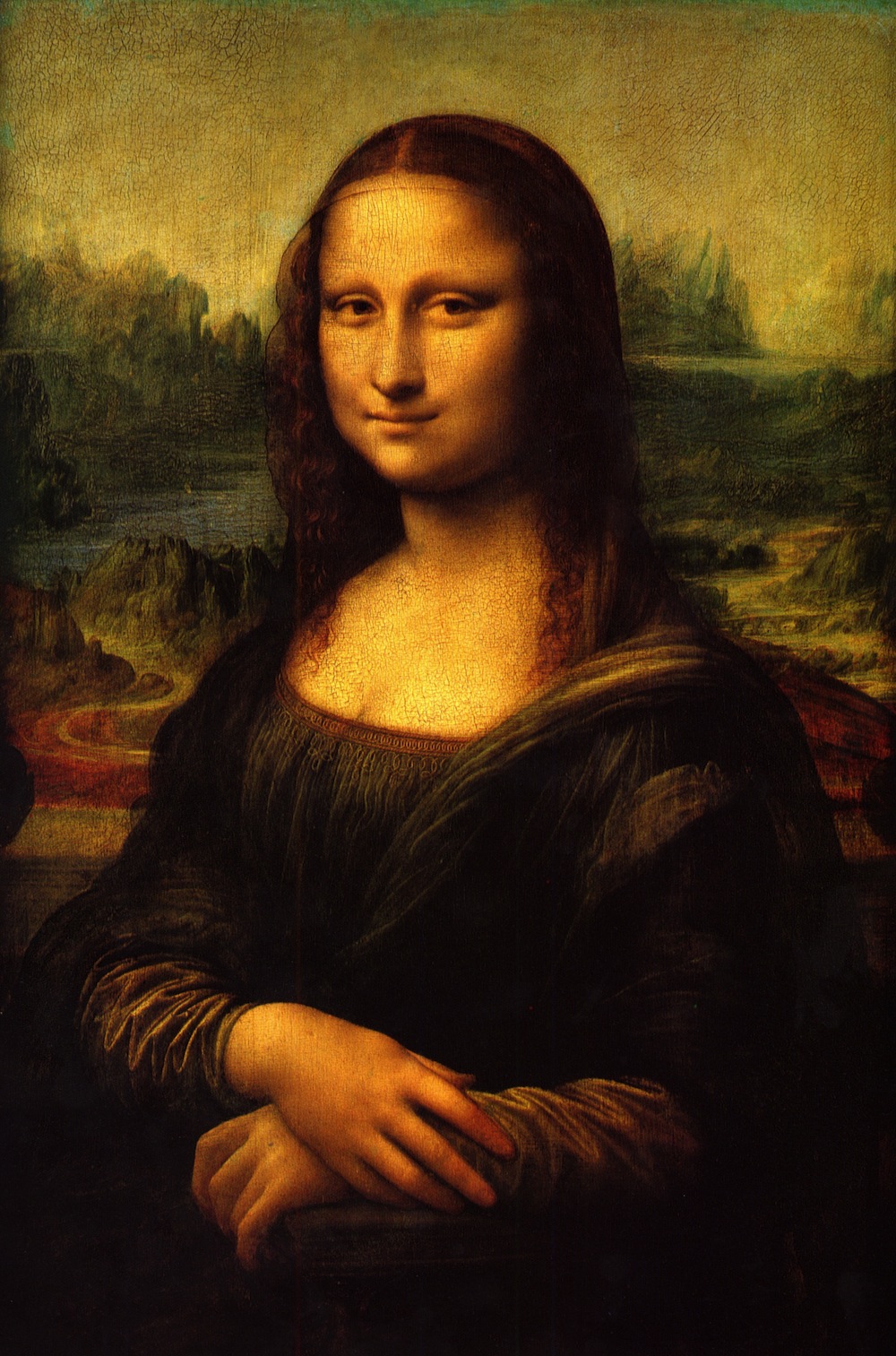
Twain skewered all comers, usually with such wit and invention that we smile and nod even when we feel the sting ourselves. Such was his talent, to deflate puffery in Western literature, politics, religion, and… as we will see, in art. “Throughout his career”—writes UC Berkeley’s Bancroft Library—“Twain expressed his strong reactions to Western painting and sculpture, particularly the Old Masters, both in his published works and in private.” He offered up some hilariously irreverent takes on some of the most revered works of art in history: “his opinions are often passionate, sometimes eccentric, and always lively.” Take for example Twain’s tepid assessment of that most recognizable of Renaissance masterpieces, the Mona Lisa. In an unpublished draft called “The Innocents Adrift,” an account of an 1891 boat trip down the Rhone River, Twain “admitted to being puzzled by the adulation accorded” the painting.
To Twain, the Mona Lisa seemed “merely a good representation of a serene & subdued face… The complexion was bad; in fact it was not even human; there are no people of that color.” The painting’s greenish hue prompted one of Twain’s companions, possibly an invention of the author’s, to exclaim in response, “that smoked haddock!” “After some discussion,” write the UC Berkeley librarians, “the travelers concede that it requires a ‘trained eye’ to appreciate certain aspects of art.” Such training in art appreciation seemed to Twain as much genuine education as instruction in studied, insincere poses.
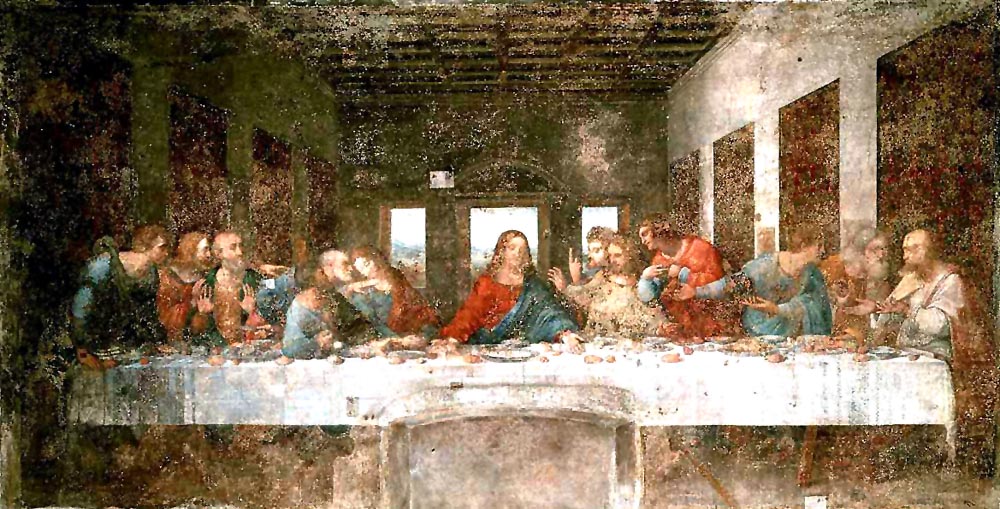
The author took his first “grand tour” in 1867—travelling through Europe and the Levant on the cruise ship Quaker City in the company of many “prosperous—and very proper—passengers.” Unlike these bourgeois travelling companions’ “conventional appreciation for all that they saw,” Twain—writing as a correspondent for the San Francisco Alta California—confessed himself underwhelmed. In particular, he described another Da Vinci, The Last Supper—“the most celebrated painting in the world”—as a “mournful wreck.” (The work was then unrestored; see it above as it looked 100 years later in the 1970s.) Twain later revised his observations for his first full-length book, 1869’s Innocents Abroad, a caricature of ugly American tourists filled with what William Dean Howells called “delicious impudence.” While the others marveled at Da Vinci’s crumbling fresco, Twain, in the current parlance, expressed a great big “meh.”
The world seems to have become settled in the belief, long ago, that it is not possible for human genius to outdo this creation of Da Vinci’s.… The colors are dimmed with age; the countenances are scaled and marred, and nearly all expression is gone from them; the hair is a dead blur upon the wall, and there is no life in the eyes.… I am satisfied that the Last Supper was a very miracle of art once. But it was three hundred years ago.
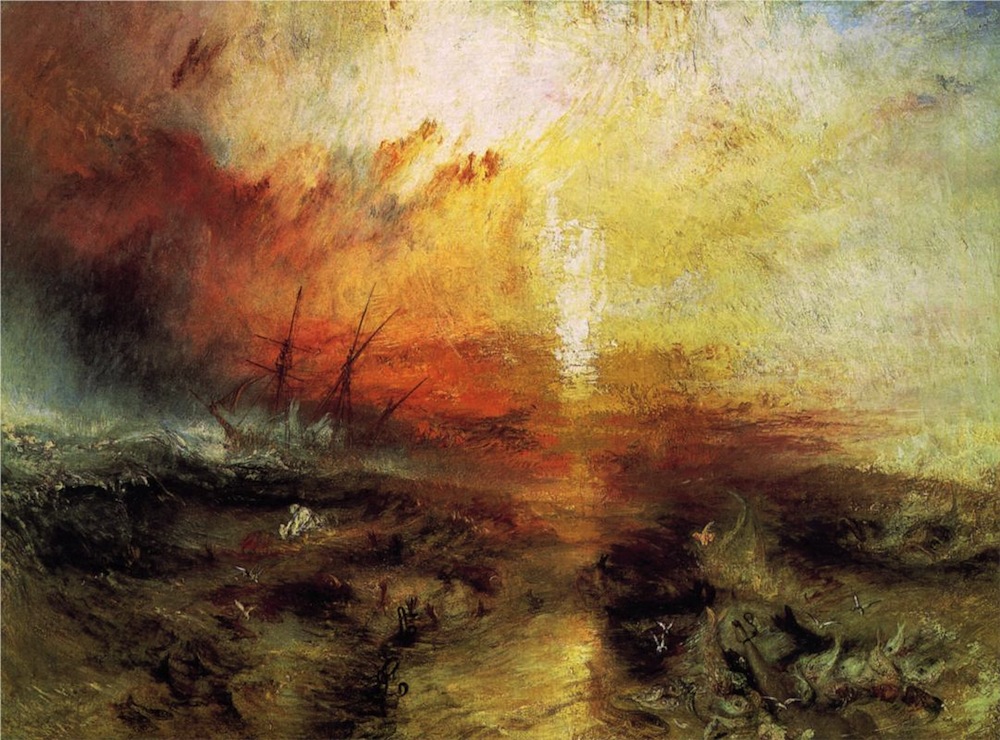
Twain and the professional critics did not always disagree. Take J.M.W. Turner’s famously riotous canvas Slave Ship (or Slavers Overthrowing the Dead and Dying: Typhoon Coming On), above. John Ruskin may have praised the work as the “noblest sea… ever painted by man” and it has come down to us as a violent representation of the horrors of the slave trade, occasioned in part, writes Stephen J. May, by Turner’s sense of “shared guilt about his own role and England’s role in condoning and perpetuating slavery’s malevolent legacy.” The anti-slavery, anti-imperialist Twain would surely have appreciated the sentiment; the painting, however, not so much. Other critics felt similarly, one calling Slave Ship a “gross outrage on nature.” Twain’s summation in an 1878 notebook is much more colorful, a piece of vintage Samuel Clemens undercutting: “Slave Ship—Cat having a fit in a platter of tomatoes.”
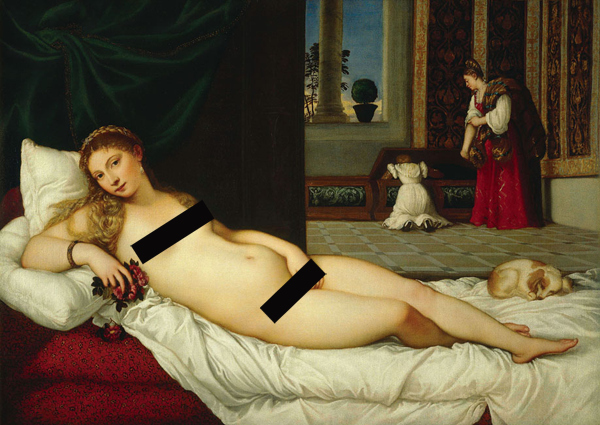
For all his snide portraits of conventional middle-class attitudes toward art, Twain could also be a bit of a prig, as we see in his response to Titian’s Venus of Urbino. In this, he was not so far removed from our own cultural attitudes (or Facebook and Google’s attitudes) about nudity. The censored version of the painting above (see the original here) comes to us via Buzzfeed, who write “Remember kids, blood and gore are fine but boobs will make you blind.” Twain seemed to have unironically agreed, railing in his 1880 travel book A Tramp Abroad against the “indecent license” afforded artists and calling Titian’s suggestive reclining nude “the foulest, the vilest, the obscenest picture the world possesses.” (Ah, if only he had lived to see the internet’s foulest depths.)
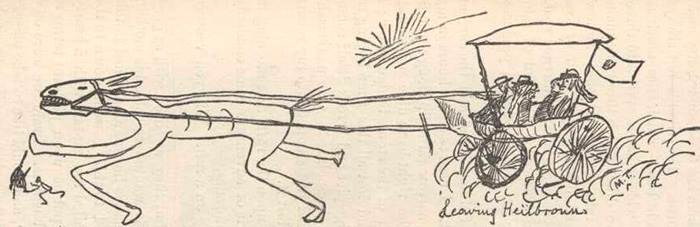
Twain’s own meager contributions to the visual arts—consisting of a dozen sketches, like that above, made for A Tramp Abroad—fall somewhat short of the standards he set for other artists. Nevertheless, he recalled in The Innocents Abroad his dismay at the “acres of very bad drawing, very bad perspective, and very incorrect proportions” in the museums and churches across Europe. What, we might wonder, could possibly move such a harsh, unsparing critic? In art, it seems, Twain valued “strict realism, grandeur of theme and scale, and propriety”—all on display in abundance in American artist Frederic Edwin Church’s The Heart of the Andes, below.
After viewing this idealized South American landscape in St. Louis, Twain called the enormous (over five feet high by ten feet wide) canvas a “most wonderfully beautiful painting.” “We took the opera glasses,” he wrote to his brother, “and examined its beauties minutely…. There is no slurring of perspective about it.” He recommended multiple viewings: “Your third visit will find your brain gasping and straining with futile efforts to take all the wonder in… and understand how such a miracle could have been conceived and executed by human brain and human hands.”
Twain, won over by this sublime spectacle, seems to have temporarily surrendered his critical faculties. In reading his response, I found myself wanting to egg him on: C’mon, what about this soft, gauzy lighting, those lumpy mountains, and the kitschy, overly-sentimental look of the whole thing? But there was room enough in Twain’s critical arsenal for genuine awe as for amused contempt at what he saw as phony expressions of the same. And that breadth of character is what made Mark Twain, well, Mark Twain.
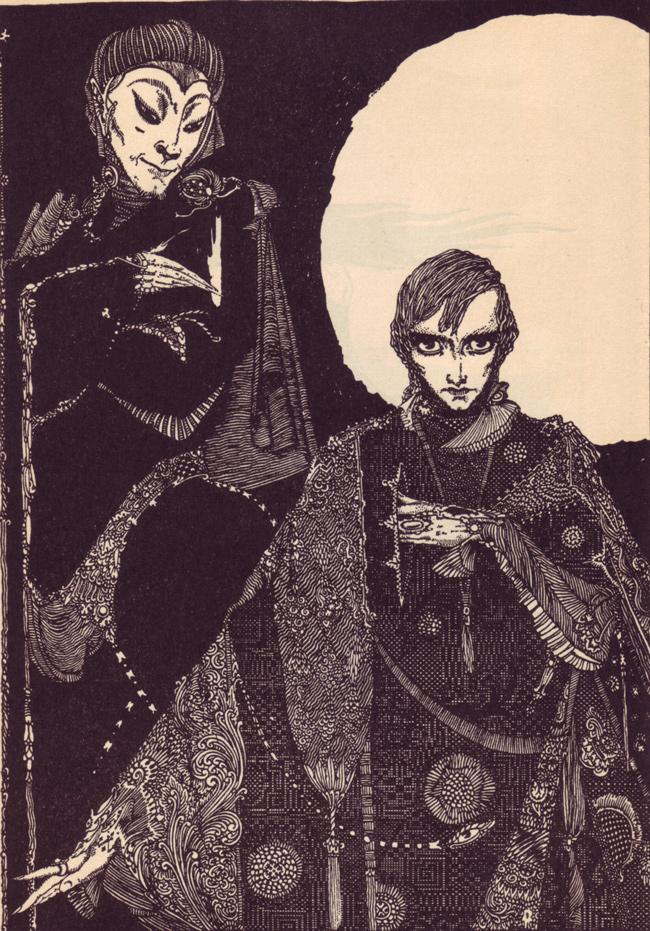
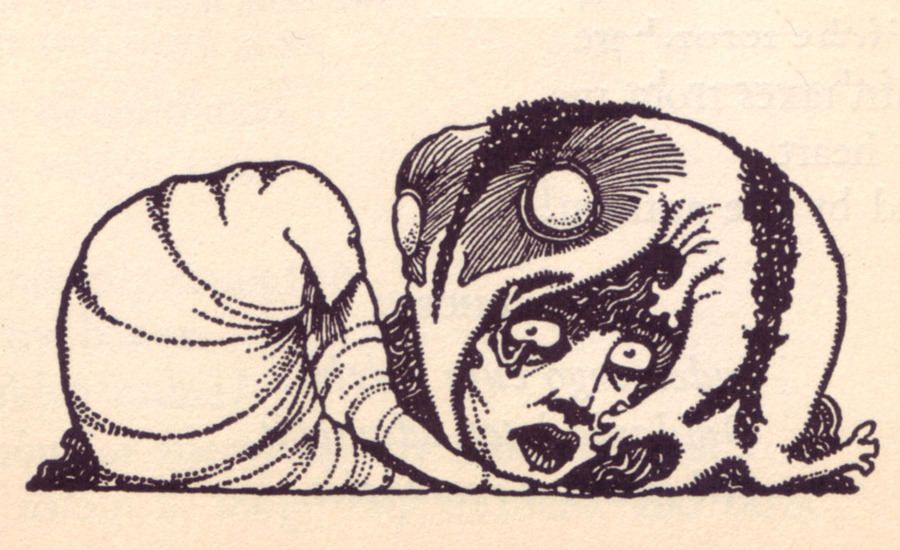
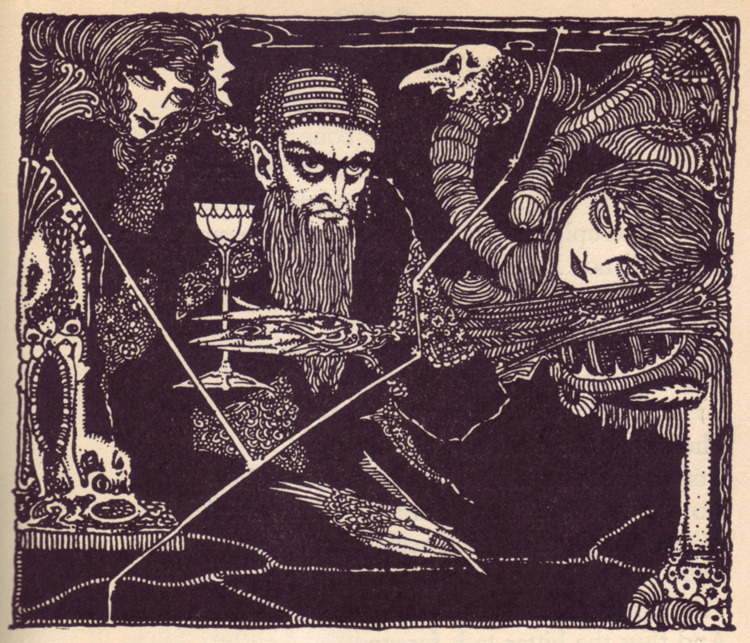
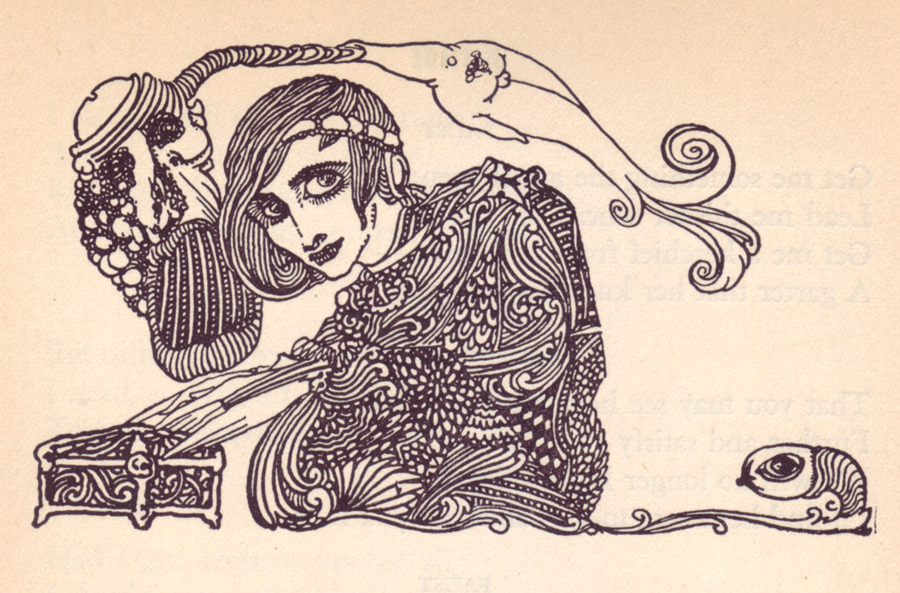
Evoking the playful grotesques of Shel Silverstein, the gothic gloom of Neil Gaiman’s Sandman comics, the occult beauty of the Rider-Waite tarot deck, and the hidden horrors of H.P. Lovecraft, Harry Clarke’s illustrations for a 1926 edition of Goethe’s Faustare said to have inspired the psychedelic imagery of the 60s. And one can easily see why Clarke’s disturbing yet elegant images would appeal to people seeking altered states of consciousness. Clarke, born in Dublin in 1889, came to prominence as an illustrator of imaginative literature—by Hans Christian Andersen, Edgar Allan Poe, and others—though he worked primarily as a designer, with his brother, of stained glass windows. Faust was the last book he illustrated, and the most fantastic.
Clarke (1889 — 1931) drew his inspiration from the Art Nouveau movement that began in the previous century with artists like Aubrey Beardsley and Gustav Klimt. We see the influence of both in Clarke’s gaunt, elongated figures and his interest in unusual, organic patterns and ornamentation. We can also see—mentions an online Tulane University exhibit of his work—the influence of his own stained glass work, “through use of heavy lines in his black and white illustrations.” The blog Garden of Unearthly Delights notes that “initially Harraps, the publisher, did not like the drawings (Clarke recalled that they thought the work was ‘full of steaming horrors’), and many of the illustrations were finished under pressure.”
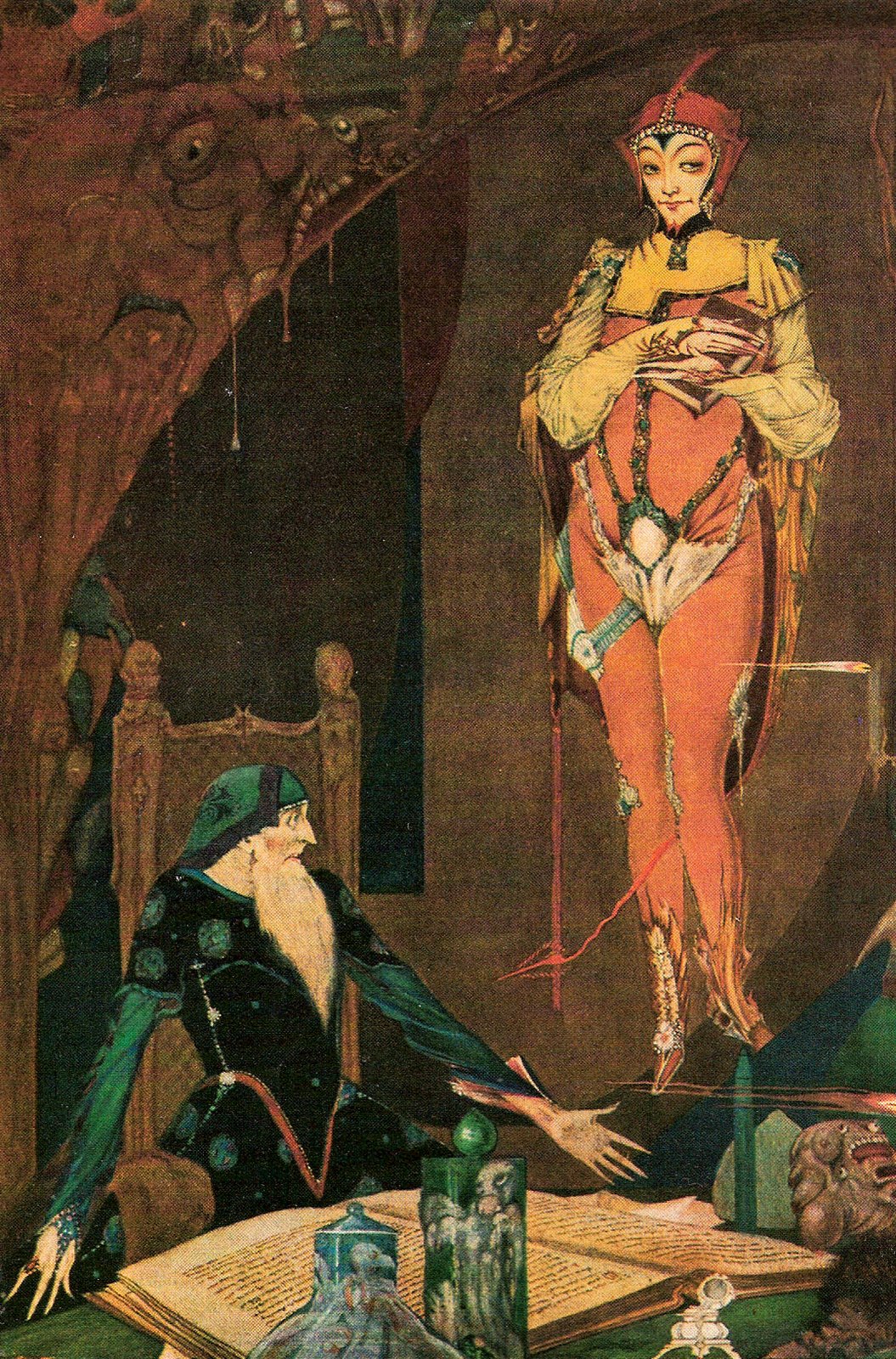
Despite the publisher’s reservations, reviews of the 2,000-copy limited edition were largely positive. Reviewers praised the drawings for their “distinctive charms” and “wealth of fantastic invention.” One critic for the Irish Statesman wrote, “Clarke’s fertility of invention is endless. It is shown in the multitude of designs less elaborate than the page plates, but no less intense.” The “page plates” referred to eight full-color, full-page illustrations like the painting of Faust and Mephistopheles above. Additionally, the book contains eight full-page ink wash illustrations, six full-page illustrations in black and white, and sixty-four smaller black and white vignettes.
You can read the Clarke-illustrated poem online here, with the illustrations reproduced, albeit badly. (Also download the text in various formats at Project Gutenberg.) To see many more higher-quality digital scans like the ones featured here, visit 50 Watts and The Garden of Unearthly Delights, which also brings us more quotations from reviewers, including “a negative review of the drawings” that sums up what we might—and what those 60s revivalists surely did—find most appealing about Clarke’s illustrations. They present, wrote a critic in the magazine Artwork,
A dream world of half-created fantasies; the powerless fancies of senile visions; misshapen bodies with wormlike heads; staring eyes of octopuses and reptiles gaze like ponderous saurian of the lost world, while half-finished homunculi change like “plasma” in forms unbound by reason.
That last phrase, “unbound by reason,” could also apply to the weird, nightmarish pilgrimage of Goethe’s hero, and to the shaking off of old strictures that artists like Clarke, his fin de siècle predecessors, and his psychedelic successors strove to achieve.
By the time she got the all clear, both of us had large portions of it committed to memory.
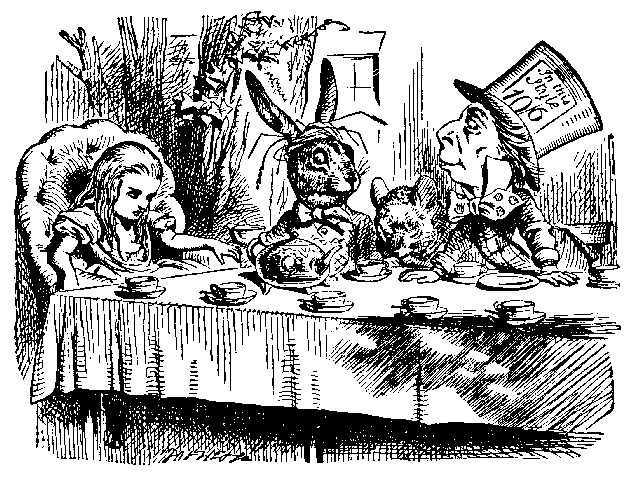
Christopher, I treasure the memories of those long hours spent together on cassette, but I’m afraid I’ll be spending the 150th anniversary of Alicewith Sir John Gielgud, below.
The celebrated dry wit that served him so well throughout his illustrious career keeps this 1989 Alice very easy on the ears. He takes the opposite approach from Plummer, underplaying the character voices. It’s rare to find a gentleman of 85 who can play a 7‑year-old girl so convincingly, and with so little fuss.
Some enthusiasts of 19th-century American psychological horror master (or, in a very real sense, 19th-century American psychological horror inventor) Edgar Allan Poe find his work best read aloud. Thus we’ve previously featured Poe delivered in the gravitas-filled voices of such noted thespians as Vincent Price, Basil Rathbone, Christopher Walken, Christopher Lee, and James Mason. Mason did the reading (above) as a narration for a 1953 animated short The Tell-Tale Heart, adapting Poe’s 1843 story of the same name, which drew both an Academy Award nomination for Best Animated Short Film and — perhaps more in line with the Poe sensibility — a rating of “X” from the British Board of Film Censors.
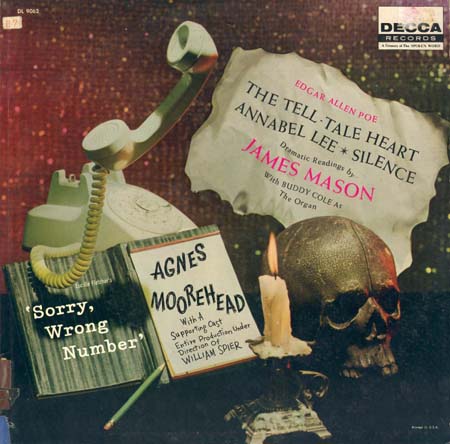
WFMU managed to dig up even more Poe as read by Mason, three tracks of which they posted to their blog one Halloween, all with “creepy and dramatic organ stylings by Buddy Cole, who no doubt wore an Inverness cape for the occasion.” They come from a 1958 release from Decca Records, featuring Mason’s readings of not just “The Tell-Tale Heart” [MP3] but Poe’s cryptic fable “Silence” [MP3—below] and haunting final poem “Annabel Lee” [MP3—bottom]. (The flip side of the album offers something completely different, in the form of Agnes Moorehead “and a supporting cast” performing Lucille Fletcher’s radio play “Sorry, Wrong Number.”)
Opinions on who reads Poe most effectively will differ from listener to listener, but if you’d like to make a partial but direct comparison for yourself, simply line up Mason’s rendition of “The Tell-Tale Heart” on a playlist with the ones we’ve previously posted by Christopher Lee, Basil Rathbone — and of course, Iggy Pop. It may have become Poe’s best-known story in the first place by having retained its impact over all these 172 years, but having such a range of performative personalities interpret it can’t hurt in keeping it as eerie as ever.
Back in 1985, Douglas Adams teamed up with Infocom’s Steve Meretzky to create an interactive fiction video game based on The Hitchhiker’s Guide to the Galaxy. Designed before graphic-intensive video games really hit their stride, the original Hitchhiker’s Guide game (watch an unboxing above) was played with text commands on the Apple II, Macintosh, Commodore 64, CP/M, DOS, Amiga, Atari 8‑bit and Atari ST platforms. And it found instant success. The adventure game sold 400,000 copies, making it one of the best-selling games of its time, and it was named the “Game Of The Year” by various magazines.
The game remains essentially unchanged and the original writing by Douglas Adams remains untouched. It is still played by entering commands and pressing return. Then read the text, follow your judgement and you will probably be killed an inordinate number of times.
Note: The game will kill you frequently. If in doubt, before you make a move please save your game by typing “Save” then enter. You can then restore your game by typing “Restore” then enter. This should make it slightly less annoying getting killed as you can go back to where you were before it happened. You’ll need to be signed in for this to work. You can sign in or register by clicking the BBCiD icon next to the BBC logo in the top navigation bar.
If you would like to support the mission of Open Culture, consider making a donation to our site. It’s hard to rely 100% on ads, and your contributions will help us continue providing the best free cultural and educational materials to learners everywhere. You can contribute through PayPal, Patreon, and Venmo (@openculture). Thanks!
The tale of an ailing New York-based playwright’s unwilling return to his ancestral home is a natural fit for Colbert, raised in Charleston, South Carolina by Northern parents. Recorded at the behest of Selected Shorts, a public radio program wherein well known performers interpret contemporary and classic short fiction, the story—hand picked by Colbert—is a risky choice for 2015.
Like all of O’Connor’s work, it’s darkly comedic, and rife with rich characterizations. It also makes repeated reference to “Negroes,” two of whom the reader—in Colbert’s case, a white man—is tasked with bringing to life. In this current climate, I suspect most white comedians would’ve played it safe with O’Connor’s lurid crowd pleaser, “A Good Man is Hard to Find,” a staple of high school reading lists, which you can hear O’Connor, herself, read here.
Colbert sails through by bringing his Northwestern University theater training to bear. (O’Connor was a favorite of the Performance Studies department during his time there.)
Having spent years embodying a right wing windbag on his satirical Colbert Report, the comedian clearly relishes the opportunity to tackle a variety of roles, including the main character’s willfully superficial mother, his sour sister, and the aforementioned pre-Civil Rights-era African-American men, workers in the hero’s mother’s dairy barn. The Catholic Colbert also has fun with an unexpectedly less-than-erudite Jesuit priest.
As for O’Connor, she gets in a not-so-subtle jab at Gone with the Wind, as well as the sort of reader who, trying to be helpful, counsels an aspirant Southern writer to “put the War in there.”
Something tells me these two would have hit it off…I would’ve loved to hear him interview her along with George Clooney, Amy Schumer, and other first week guests.
I want their minds to be blown the way mine was at 15, when I picked up Slapstick, his 8th novel, for reasons I no longer remember. It wasn’t on recommendation of some beloved teacher, nor was there any Vonnegut on our home shelves, despite the fact that he was a local author. Whatever drew me to that book, thank god it did. It was the beginning of a lifelong romance.
What grabbed me so? His genius idea for bestowing an artificial extended family on every citizen, via the assignment of middle names:
I told him, ‘your new middle name would consist of a noun, the name of a flower or fruit or nut or vegetable or legume, or a bird or a reptile or a fish, or a mollusk, or a gem or a mineral or a chemical element — connected by a hyphen to a number between one and twenty.’ I asked him what his name was at the present time.
‘Elmer Glenville Grasso,’ he said.
‘Well,’ I said, ‘you might become Elmer Uranium‑3 Grasso, say. Everybody with Uranium as a part of their middle name would be your cousin.’
This held enormous appeal for me as the only child of an only child. Lonesome No More!
It also contained the most wonderful profanity I had ever heard:
You ask him his middle name, and when he tells you “Oyster-19” or “Chickadee‑1” or “Hollyhock-13” you say to him: Buster — I happen to be a Uranium‑3. You have one hundred and ninety thousand cousins and ten thousand brothers and sisters. You’re not exactly alone in this world. I have relatives of my own to look after. So why don’t you take a flying fuck at a rolling doughnut? Why don’t you take a flying fuck at the moooooooooooon?
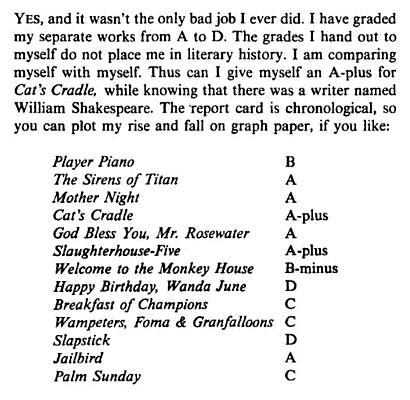
Imagine my dismay when just two books later, Vonnegut gave Slapstick the lowest possible mark in a literary self evaluation published in Palm Sunday, below.
He wasn’t describing the difference between a B and a B+. In Vonnegut’s mind, Slapstick was a D. In other words, a minimally acceptable, deeply below average performance.
He later reflected to journalist Charlie Rose that he’d been overly hard on the title. But the critics had trashed it when it first appeared, and presumably critics knew best. So much for Vonnegut the rebel and class clown. This was a clear case of give the teacher the answer you think she wants.
I give it an A+, and so would you, if you’d discovered it when I did.
How about you? Any marks you’d change on Vonnegut’s report card?
We're hoping to rely on loyal readers, rather than erratic ads. Please click the Donate button and support Open Culture. You can use Paypal, Venmo, Patreon, even Crypto! We thank you!
Open Culture scours the web for the best educational media. We find the free courses and audio books you need, the language lessons & educational videos you want, and plenty of enlightenment in between.