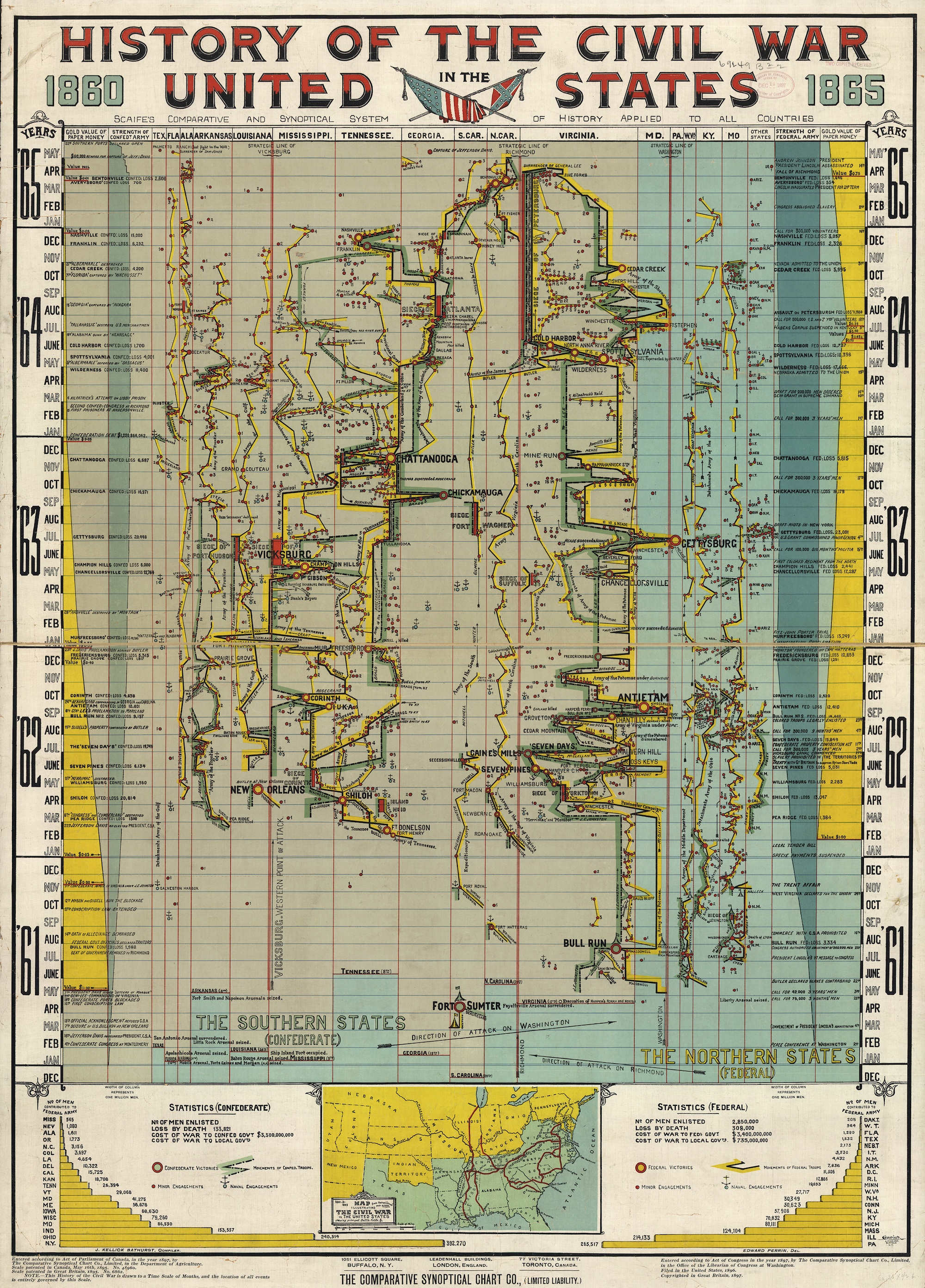
The History of the U.S. Civil War Visualized Month by Month and State by State, in an Infographic from 1897

There’s been a lot of hand­wring­ing over the i‑Generation’s lack of map read­ing skills.

While we’re at it, let’s take a cold, hard look at the Gild­ed Age info­graph­ic, above.…

… and con­clude that peo­ple who live in glass hous­es should stop reach­ing for stones.

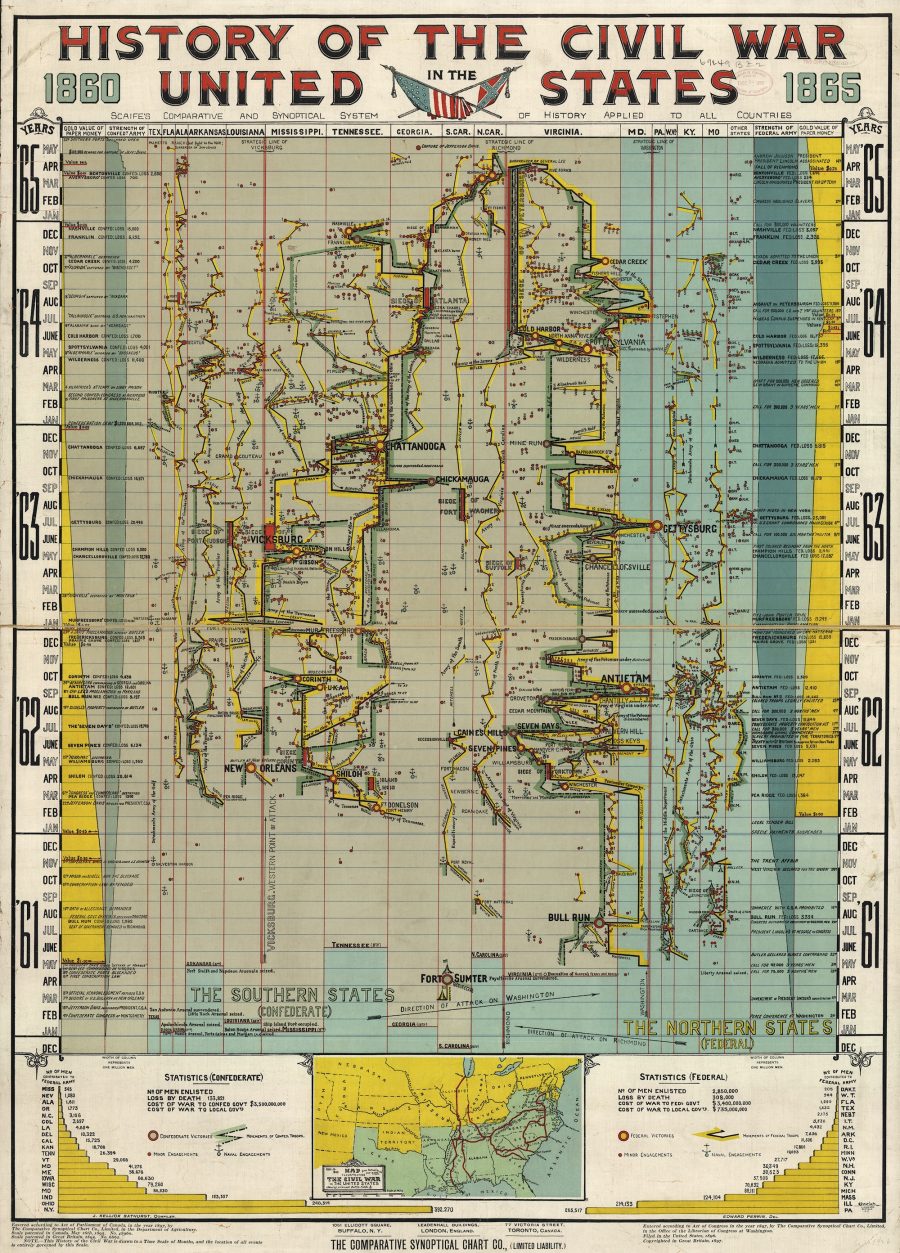
Pub­lished in 1897 by the Com­par­a­tive Syn­op­ti­cal Chart Com­pa­ny, this now unfath­omable doc­u­ment–His­to­ry of the Civ­il War in the Unit­ed States: 1860–1865–achieved its goal of squeez­ing the max­i­mum amount of con­tent onto a sin­gle sheet.

This is in direct oppo­si­tion to today’s gen­er­al­ly accept­ed rules for cre­at­ing suc­cess­ful info­graph­ics, one of which is to sim­pli­fy.

Anoth­er holds that text should be used spar­ing­ly, lest it clut­ter up strong visu­als. Con­sumers have a lim­it­ed atten­tion span, and for con­tent to be con­sid­ered share­able, they should be able to take it in at a glance.

Mod­ern eyes may be for­giv­en for mis­tak­ing this chart for the world’s most con­vo­lut­ed sub­way map. But those aren’t stops, friend. They’re minor engage­ments. Blood­i­er and bet­ter-known bat­tles are delin­eat­ed with larg­er circles—yellow cen­ters for a Union vic­to­ry, pale green for Con­fed­er­ate.

The fastest way to begin mak­ing heads or tails of the chart is to note that each col­umn is assigned to a dif­fer­ent state.

The ver­ti­cal axis is divid­ed into months. Notice all the neg­a­tive space around Fort Sumter.

And the con­stant entries in Vir­gini­a’s col­umn.

The pub­lish­er not­ed that the loca­tion of events was “entire­ly gov­erned” by this time scale.

You’ll have to look hard for Lincoln’s assas­si­na­tion.

Con­sumers who pur­chased the His­to­ry of the Civ­il War in the Unit­ed States 1860–1865 pre­sum­ably pored over it by can­dle­light, sup­ple­ment­ing it with maps and books.

It would still make a superb addi­tion to any his­to­ry teacher’s class­room, both as dec­o­ra­tion and the tin­der that could ignite dis­cus­sion as to how we receive infor­ma­tion, and how much infor­ma­tion is in fact received.

Explore a larg­er, zoomable ver­sion of the map here.

via Slate

Relat­ed Con­tent:

A Free Course from Yale on the U.S. Civ­il War

Watch Vet­er­ans of The US Civ­il War Demon­strate the Dread­ed Rebel Yell (1930)

Visu­al­iz­ing Slav­ery: The Map Abra­ham Lin­coln Spent Hours Study­ing Dur­ing the Civ­il War

Ayun Hal­l­i­day is an author, illus­tra­tor, the­ater mak­er and Chief Pri­ma­tol­o­gist of the East Vil­lage Inky zine. Fol­low her @AyunHalliday.

The History of Cartography, the “Most Ambitious Overview of Map Making Ever,” Is Now Free Online

Worth a quick men­tion: The Uni­ver­si­ty of Chica­go Press has made avail­able online — at no cost — the first three vol­umes of The His­to­ry of Car­tog­ra­phy. Or what Edward Roth­stein, of The New York Times, called “the most ambi­tious overview of map mak­ing ever under­tak­en.” He con­tin­ues:

Peo­ple come to know the world the way they come to map it—through their per­cep­tions of how its ele­ments are con­nect­ed and of how they should move among them. This is pre­cise­ly what the series is attempt­ing by sit­u­at­ing the map at the heart of cul­tur­al life and reveal­ing its rela­tion­ship to soci­ety, sci­ence, and reli­gion…. It is try­ing to define a new set of rela­tion­ships between maps and the phys­i­cal world that involve more than geo­met­ric cor­re­spon­dence. It is in essence a new map of human attempts to chart the world.

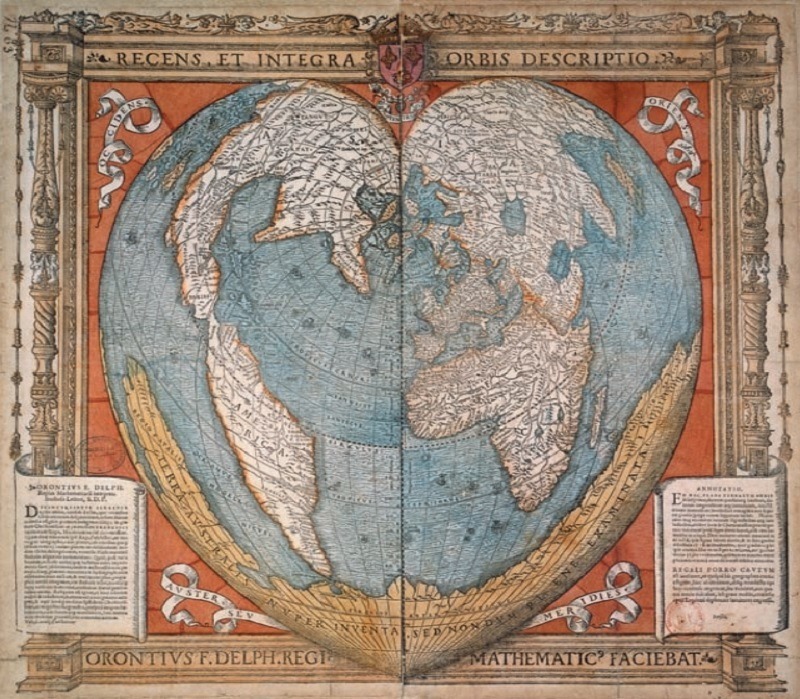
If you head over to this page, then look in the upper left, you will see links to three vol­umes (avail­able in a free PDF for­mat). My sug­ges­tion would be to look at the gallery of col­or illus­tra­tions for each book, links to which you’ll find below. The image above, appear­ing in Vol. 2, dates back to 1534. It was cre­at­ed by Oronce Fine, the first chair of math­e­mat­ics in the Col­lège Roy­al (aka the Col­lège de France), and it fea­tures the world mapped in the shape of a heart. Pret­ty great.

Vol­ume 1

Gallery of Col­or Illus­tra­tions

Vol­ume 2: Part 1

Gallery of Col­or Illus­tra­tions (Plates 1–24)
Gallery of Col­or Illus­tra­tions (Plates 25–40)

Vol­ume 2: Part 2

Gallery of Col­or Illus­tra­tions (Plates 1–16)
Gallery of Col­or Illus­tra­tions (Plates 17–40)

Vol­ume 2: Part 3

Gallery of Col­or Illus­tra­tions (Plates 1–8)
Gallery of Col­or Illus­tra­tions (Plates 9 –24)

Vol­ume 3: Part 1

Gallery of Col­or Illus­tra­tions (Plates 1–24)
Gallery of Col­or Illus­tra­tions (Plates 25–40)

Vol­ume 3: Part 2

Gallery of Col­or Illus­tra­tions (Plates 41–56)
Gallery of Col­or Illus­tra­tions (Plates 57–80)

If you buy Vol 1. on Ama­zon, it will run you $248. As beau­ti­ful as the book prob­a­bly is, you’ll prob­a­bly appre­ci­ate this free dig­i­tal offer­ing. The series will be added to our col­lec­tion, 800 Free eBooks for iPad, Kin­dle & Oth­er Devices.

Note: An ear­li­er ver­sion of this post appeared on our site in August, 2015.

If you would like to sign up for Open Culture’s free email newslet­ter, please find it here. It’s a great way to see our new posts, all bun­dled in one email, each day.

If you would like to sup­port the mis­sion of Open Cul­ture, con­sid­er mak­ing a dona­tion to our site. It’s hard to rely 100% on ads, and your con­tri­bu­tions will help us con­tin­ue pro­vid­ing the best free cul­tur­al and edu­ca­tion­al mate­ri­als to learn­ers every­where. You can con­tribute through Pay­Pal, Patre­on, and Ven­mo (@openculture). Thanks!

Relat­ed Con­tent:

Down­load 67,000 His­toric Maps (in High Res­o­lu­tion) from the Won­der­ful David Rum­sey Map Col­lec­tion

A Won­der­ful Sci­en­tif­ic Map of the Moon from 1679: Can You Spot the Secret Moon Maid­en?

Galileo’s Moon Draw­ings, the First Real­is­tic Depic­tions of the Moon in His­to­ry (1609–1610)

New York Pub­lic Library Puts 20,000 Hi-Res Maps Online & Makes Them Free to Down­load and Use

by | Permalink | Make a Comment ( 1 ) |

Artist Re-Envisions National Parks in the Style of Tolkien’s Middle Earth Maps

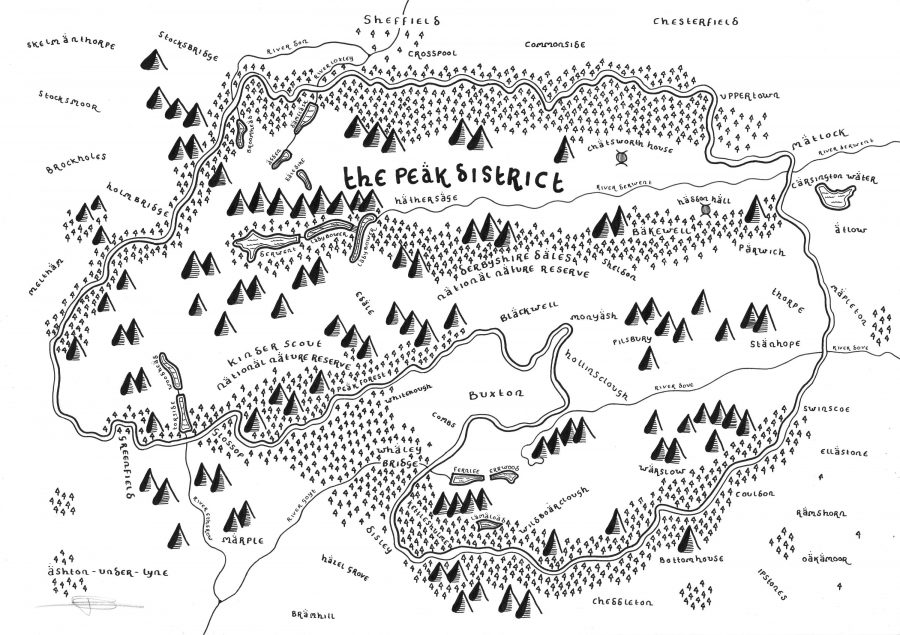
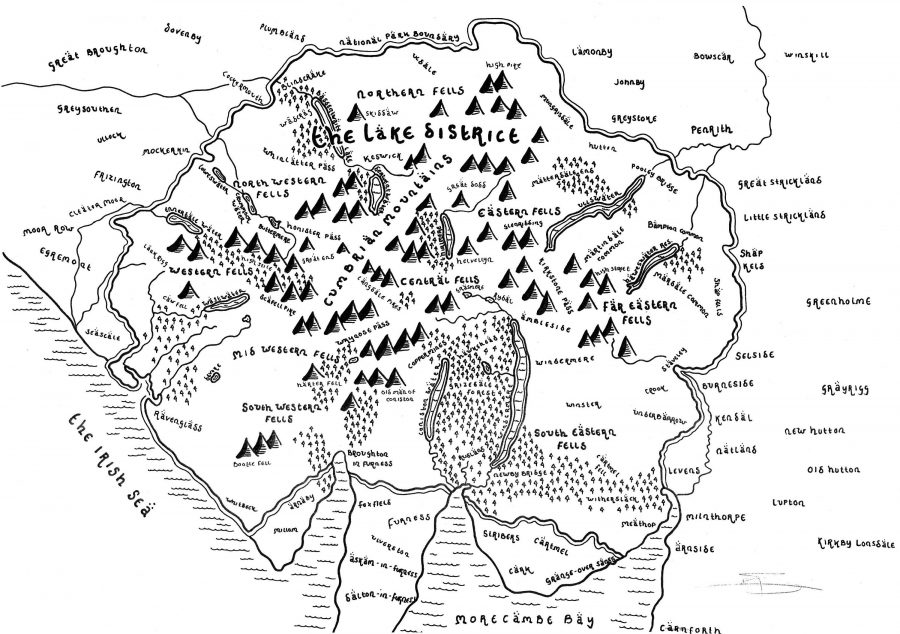
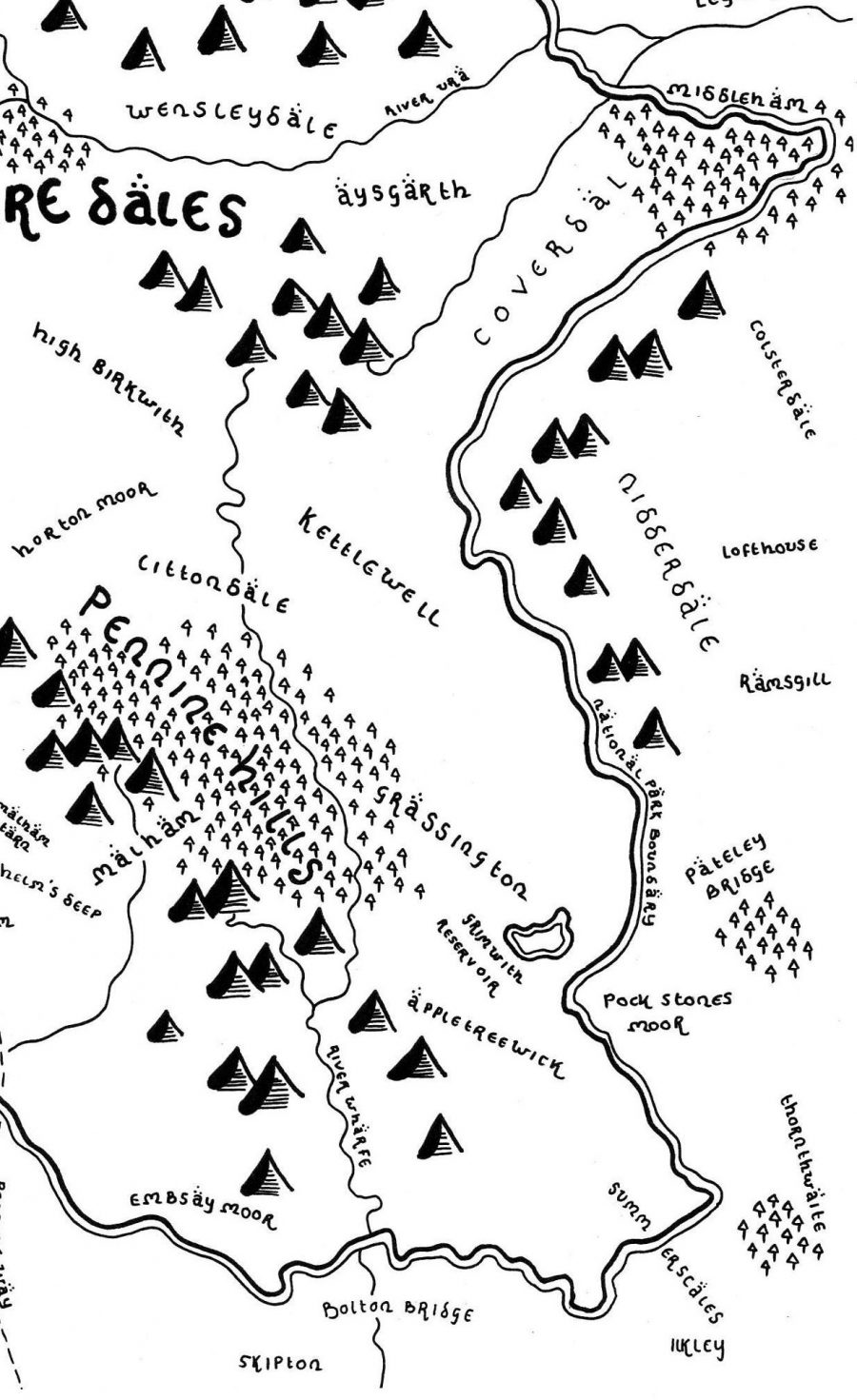
J.R.R. Tolkien imag­ined Mid­dle-Earth by draw­ing not just from far-flung lands and old myths but the Eng­lish land­scape all around him. Of course, every­one who reads The Lord of the Rings tril­o­gy, let alone the relat­ed books writ­ten by Tolkien as well as his fol­low­ers, has their own way of envi­sion­ing the place, and those who go espe­cial­ly deep may even start see­ing their own, real envi­ron­ments as ver­sions of Mid­dle-Earth. That seems to have hap­pened in the case of Dan Bell, an Eng­lish artist who maps his home­land’s nation­al parks in an artis­tic style sim­i­lar to the one in which Tolkien ren­dered Mid­dle-Earth.

Bell “began read­ing Tolkien’s books when he was 11 or 12 years old, and fell in love with them,” writes The Verge’s Andrew Lip­tak. “In par­tic­u­lar, he was struck by Tolkien’s maps.” To start, he “works from an open source Ord­nance Sur­vey map, and begins draw­ing by hand,” adding in such addi­tion­al details, not always found in most nation­al parks, as “forests, Hob­bit holes, tow­ers, and cas­tles.” Hav­ing so adapt­ed the nation­al parks of the Unit­ed Kind­gom “as well as places like Oxford, Lon­don, Yel­low­stone Nation­al Park, and George R.R. Martin’s Wes­t­eros,” he’s made them avail­able for pur­chase on his site.

Most of us who first encounter The Lord of the Rings at the age Bell did have sure­ly wished, if only for a moment or two, that we could live in Mid­dle-Earth our­selves. Bel­l’s maps remind us that places like Mid­dle-Earth always come in some way from, and res­onate on some lev­el with, the real Earth on which we have no choice but to live. Much like how the set­tings of sci­ence fic­tion sto­ries, no mat­ter how tech­no­log­i­cal­ly ampli­fied or cul­tur­al­ly twist­ed and turned, always reflect the time of the sto­ry’s com­po­si­tion, thor­ough­ly real­ized fan­ta­sy realms, no mat­ter how fan­tas­ti­cal — how many hob­bit-holes, cas­tles, or Eyes of Sauron with which they may be dot­ted — are nev­er 100 per­cent made up. Just ask the tourist indus­try of New Zealand.

Enter Bel­l’s map col­lec­tion here.

via The Verge

Relat­ed Con­tent:

Map of Mid­dle-Earth Anno­tat­ed by Tolkien Found in a Copy of Lord of the Rings

110 Draw­ings and Paint­ings by J.R.R. Tolkien: Of Mid­dle-Earth and Beyond

The Only Draw­ing from Mau­rice Sendak’s Short-Lived Attempt to Illus­trate The Hob­bit

Sovi­et-Era Illus­tra­tions Of J. R. R. Tolkien’s The Hob­bit (1976)

226 Ansel Adams Pho­tographs of Great Amer­i­can Nation­al Parks Are Now Online

Down­load 100,000 Pho­tos of 20 Great U.S. Nation­al Parks, Cour­tesy of the U.S. Nation­al Park Ser­vice

Based in Seoul, Col­in Mar­shall writes and broad­casts on cities and cul­ture. His projects include the book The State­less City: a Walk through 21st-Cen­tu­ry Los Ange­les and the video series The City in Cin­e­ma. Fol­low him on Twit­ter at @colinmarshall or on Face­book.

A Map Shows What Happens When Our World Gets Four Degrees Warmer: The Colorado River Dries Up, Antarctica Urbanizes, Polynesia Vanishes

Human­i­ty faces few larg­er ques­tions than what, exact­ly, to do about cli­mate change — and, in a sense larg­er still, what cli­mate change even means. We’ve all heard a vari­ety of dif­fer­ent future sce­nar­ios laid out, each of them based on dif­fer­ent data. But data can only make so much of an impact unless trans­lat­ed into a form with which the imag­i­na­tion can read­i­ly engage: a visu­al form, for instance, and few visu­al forms come more tried and true than the map.

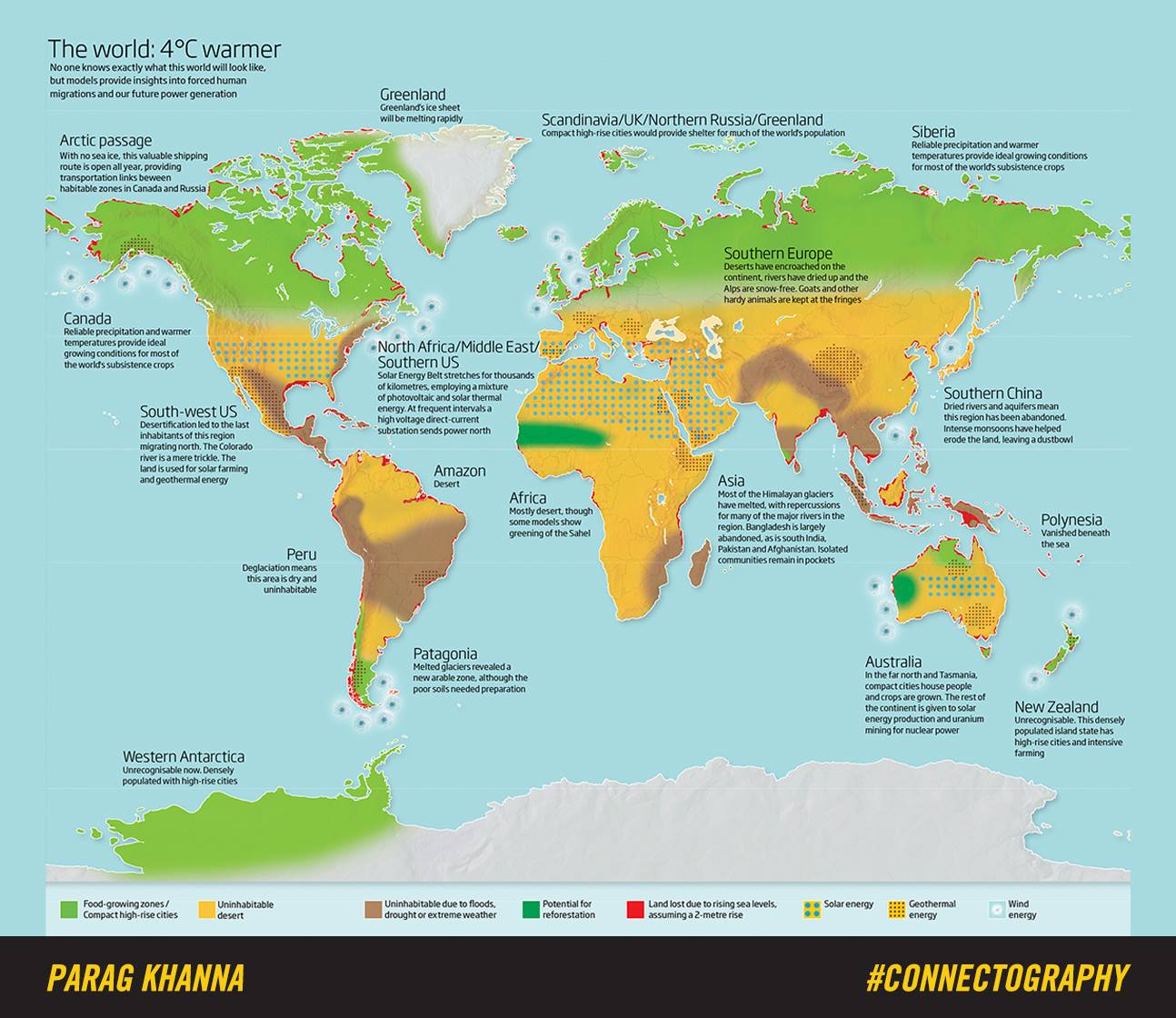
And so “lead­ing glob­al strate­gist, world trav­el­er, and best-sell­ing author” Parag Khan­na has cre­at­ed the map you see above (view in a larg­er for­mat here), which shows us the state of our world when it gets just four degrees cel­sius warmer. “Microne­sia is gone – sunk beneath the waves,” writes Big Think’s Frank Jacobs in an exam­i­na­tion of Khan­na’s map. “Pak­istan and South India have been aban­doned. And Europe is slow­ly turn­ing into a desert.”

But “there is also good news: West­ern Antarc­ti­ca is no longer icy and unin­hab­it­able. Smart cities thrive in new­ly green and pleas­ant lands. And North­ern Cana­da, Scan­di­navia, and Siberia pro­duce boun­ti­ful har­vests to feed the hun­dreds of mil­lions of cli­mate refugees who now call those regions home.”

Not quite as apoc­a­lyp­tic a cli­mate-change vision as some, to be sure, but it still offers plen­ty of con­sid­er­a­tions to trou­ble us. Lands in light green, accord­ing to the map’s col­or scheme, will remain or turn into “food-grow­ing zones” and “com­pact high-rise cities.” Yel­low indi­cates “unin­hab­it­able desert,” brown areas “unin­hab­it­able due to floods, drought, or extreme weath­er.” In dark green appear lands with “poten­tial for refor­esta­tion,” and in red those places that ris­ing sea lev­els have ren­dered utter­ly lost.

Those last include the edges of many coun­tries in Asia (and all of Poly­ne­sia), as well as the area where the south­east of the Unit­ed States meets the north­east of Mex­i­co and the north and south coasts of South Amer­i­ca. But if you’ve ever want­ed to live in Antarc­ti­ca, you won’t have to move into a research base: with­in a cou­ple of decades, accord­ing to Khan­na’s data, that most mys­te­ri­ous con­ti­nent could become unrec­og­niz­able and “dense­ly pop­u­lat­ed with high-rise cities,” pre­sum­ably with their own hip­ster quar­ters. But where best to grow the ingre­di­ents for its avo­ca­do toast?

Any­one inter­est­ed in Parag Khan­na’s map will want to check out his book, Con­nec­tog­ra­phy: Map­ping the Future of Glob­al Civ­i­liza­tion.

via Big Think

Relat­ed Con­tent:

Glob­al Warm­ing: A Free Course from UChica­go Explains Cli­mate Change

A Cen­tu­ry of Glob­al Warm­ing Visu­al­ized in a 35 Sec­ond Video

Ani­ma­tions Show the Melt­ing Arc­tic Sea Ice, and What the Earth Would Look Like When All of the Ice Melts

132 Years of Glob­al Warm­ing Visu­al­ized in 26 Dra­mat­i­cal­ly Ani­mat­ed Sec­onds

Music for a String Quar­tet Made from Glob­al Warm­ing Data: Hear “Plan­e­tary Bands, Warm­ing World”

A Song of Our Warm­ing Plan­et: Cel­list Turns 130 Years of Cli­mate Change Data into Music

Based in Seoul, Col­in Mar­shall writes and broad­casts on cities and cul­ture. His projects include the book The State­less City: a Walk through 21st-Cen­tu­ry Los Ange­les and the video series The City in Cin­e­ma. Fol­low him on Twit­ter at @colinmarshall or on Face­book.

Watch the Making of the Dymaxion Globe: A 3‑D Rendering of Buckminster Fuller’s Revolutionary Map

Last year, we shined a light on Buck­min­ster Fuller’s Dymax­ion Map. Unveiled back in 1943, the Dymax­ion Map (shown below) rev­o­lu­tion­ized map design, allow­ing us to see our world in an entire­ly new way. As the Buck­min­ster Fuller Insti­tute describes it:

Also known as the “Dymax­ion Map,” the Fuller Pro­jec­tion Map is the only flat map of the entire sur­face of the Earth which reveals our plan­et as one island in one ocean, with­out any visu­al­ly obvi­ous dis­tor­tion of the rel­a­tive shapes and sizes of the land areas, and with­out split­ting any con­ti­nents.

Fuller’s map has since inspired the award-win­ning Autha­Graph World Map, cre­at­ed by Japan­ese archi­tect and artist Hajime Narukawa. And it led robot­ics engi­neer Gavin Smith to fash­ion The Dymax­ion Globe, essen­tial­ly by divid­ing the Dymax­ion Map into tri­an­gles and and fold­ing them into a three-dimen­sion­al fig­ure. Smith explains the process of mak­ing a Dymax­ion Globe over at Make Mag­a­zine. But above, you can watch it all hap­pen in a video pro­duced by Adam Sav­age’s Test­ed YouTube chan­nel. They walk you through the cre­ation of a laser-cut Dymax­ion Globe. Enjoy.

Relat­ed Con­tent:

Buck­min­ster Fuller’s Map of the World: The Inno­va­tion that Rev­o­lu­tion­ized Map Design (1943)

Japan­ese Design­ers May Have Cre­at­ed the Most Accu­rate Map of Our World: See the Autha­Graph

Every­thing I Know: 42 Hours of Buck­min­ster Fuller’s Vision­ary Lec­tures Free Online (1975)

The Largest Early Map of the World Gets Assembled for the First Time: See the Huge, Detailed & Fantastical World Map from 1587

We in the ear­ly 21st cen­tu­ry can call up detailed maps of almost any place on Earth with lit­tle more effort than typ­ing its name. Most of us can dim­ly recall a time when it was­n’t quite so easy, but imag­ine try­ing to sat­is­fy your geo­graph­i­cal curios­i­ty in not just decades but cen­turies past. For the 16th-cen­tu­ry Milanese gen­tle­man schol­ar Urbano Monte, fig­ur­ing out what the whole world looked like turned into an enor­mous project, in terms of both effort and sheer size. In 1587, he cre­at­ed his “plani­sphere” map as a 60-page man­u­script, and only now have researchers assem­bled it into a sin­gle piece, ten feet square, the largest known ear­ly map of the world. View it above, or in a larg­er for­mat here.

“Monte appears to have been quite geo-savvy for his day,” writes Nation­al Geo­graph­ic’s Greg Miller, not­ing that “he includ­ed recent dis­cov­er­ies of his time, such as the islands of Tier­ra del Fuego at the tip of South Amer­i­ca, first sight­ed by the Por­tuguese explor­er Fer­di­nand Mag­el­lan in 1520,” as well as an uncom­mon­ly detailed Japan based on infor­ma­tion gath­ered from a vis­it with the first offi­cial Japan­ese del­e­ga­tion to Europe in 1585.

And in accor­dance with the map­mak­ing style of the time, he got more fan­ci­ful in the less-under­stood spaces: “Ani­mals roam the land, and his oceans teem with ships and mon­sters. King Philip II of Spain rides what looks like a float­ing throne off the coast of South Amer­i­ca, a nod to Span­ish promi­nence on the high seas.”


“Mon­te’s map reminds us of why his­tor­i­cal maps are so impor­tant as pri­ma­ry resources,” says Stan­ford Uni­ver­si­ty’s David Rum­sey Map Col­lec­tion, which holds one of only three extant ver­sions of the map and which con­duct­ed the dig­i­tal project of scan­ning each of its pages and assem­bling them into a whole. Not only does its then-unusu­al (but now long stan­dard in avi­a­tion) north polar azimuthal pro­jec­tion show Mon­te’s use of “the advanced sci­en­tif­ic ideas of his time,” but the “the artistry in draw­ing and dec­o­rat­ing the map embod­ies design at the high­est lev­el; and the view of the world then gives us a deep his­tor­i­cal resource with the list­ing of places, the shape of spaces, and the com­men­tary inter­wo­ven into the map.”

You can see/download Mon­te’s plani­sphere in detail at the David Rum­sey Map Col­lec­tion, both as a col­lec­tion of indi­vid­ual pages and as a ful­ly assem­bled world map. There you can also read, in PDF form, car­to­graph­ic his­to­ri­an Dr. Kather­ine Park­er’s â€śA Mind at Work: Urbano Mon­te’s 60-Sheet Man­u­script World Map.” And to bring this mar­vel of 16th-cen­tu­ry car­tog­ra­phy around to a con­nec­tion with a mar­vel of 21st-cen­tu­ry car­tog­ra­phy, they’ve also tak­en Mon­te’s plani­sphere and made it into a three-dimen­sion­al mod­el in Google Earth, a map­ping tool that Monte could scarce­ly have imag­ined — even though, as a close look at his work reveals, he cer­tain­ly did­n’t lack imag­i­na­tion.

via Hyper­al­ler­gic

Relat­ed Con­tent:

Down­load 67,000 His­toric Maps (in High Res­o­lu­tion) from the Won­der­ful David Rum­sey Map Col­lec­tion

The His­to­ry of Car­tog­ra­phy, the “Most Ambi­tious Overview of Map Mak­ing Ever,” Now Free Online

The “True Size” Maps Shows You the Real Size of Every Coun­try (and Will Change Your Men­tal Pic­ture of the World)

Japan­ese Design­ers May Have Cre­at­ed the Most Accu­rate Map of Our World: See the Autha­Graph

Watch the His­to­ry of the World Unfold on an Ani­mat­ed Map: From 200,000 BCE to Today

Based in Seoul, Col­in Mar­shall writes and broad­casts on cities and cul­ture. His projects include the book The State­less City: a Walk through 21st-Cen­tu­ry Los Ange­les and the video series The City in Cin­e­ma. Fol­low him on Twit­ter at @colinmarshall or on Face­book.

The London Time Machine: Interactive Map Lets You Compare Modern London, to the London Shortly After the Great Fire of 1666

er

From ESRI, the mak­er of geo­graph­ic soft­ware, comes the Lon­don Time Machine, an inter­ac­tive map that lets you see how Lon­don has changed over the past 330+ years, mov­ing from a city left in ruins by the Great Fire of 1666, to the sprawl­ing metrop­o­lis that it is today. Here’s how ESRI describes the map:

On Sun­day the 2nd of Sep­tem­ber 1666, the Great Fire of Lon­don began reduc­ing most of the cap­i­tal to ash­es. Among the dev­as­ta­tion and the loss­es were many maps of the city itself.

The Mor­gan Map of 1682 was the first to show the whole of the City of Lon­don after the fire. Pro­duced by William Mor­gan and his ded­i­cat­ed team of Sur­vey­ors and Car­tog­ra­phers it took 6 years to pro­duce, and dis­played a brighter per­spec­tive on city life for a pop­u­la­tion still mourn­ing their loved ones, pos­ses­sions, and homes.

But how much of this sym­bol­ised vision of a hoped-for ide­al city remains today? What now lies on the lush green fields to the south of the riv­er Thames? And how have the river’s banks been eat­en into by the insa­tiable appetite of urban devel­op­ment? Move the spy­glass to find out, and remem­ber to zoom-in to ful­ly inter­ro­gate fin­er details!

Enter the Lon­don Time Machine here.

If you would like to sign up for Open Culture’s free email newslet­ter, please find it here. It’s a great way to see our new posts, all bun­dled in one email, each day.

If you would like to sup­port the mis­sion of Open Cul­ture, con­sid­er mak­ing a dona­tion to our site. It’s hard to rely 100% on ads, and your con­tri­bu­tions will help us con­tin­ue pro­vid­ing the best free cul­tur­al and edu­ca­tion­al mate­ri­als to learn­ers every­where. You can con­tribute through Pay­Pal, Patre­on, and Ven­mo (@openculture). Thanks!

via Hack­er News

Relat­ed Con­tent:

Prize-Win­ning Ani­ma­tion Lets You Fly Through 17th Cen­tu­ry Lon­don

The Old­est Known Footage of Lon­don (1890–1920) Fea­tures the City’s Great Land­marks

What Hap­pens When a Japan­ese Wood­block Artist Depicts Life in Lon­don in 1866, Despite Nev­er Hav­ing Set Foot There

The History of the World in One Video: Every Year from 200,000 BCE to Today

“Where are you from?” a char­ac­ter at one point asks Babe, the hap­less pro­tag­o­nist of the Fire­sign The­atre’s clas­sic com­e­dy album How Can You Be in Two Places at Once When You’re Not Any­where at All. “Nairo­bi, ma’am,” Babe replies. “Isn’t every­body?” Like most of that psy­che­del­ic radio troupe’s pieces of appar­ent non­sense, that mem­o­rable line con­tains a truth: trace human his­to­ry back far enough and you inevitably end up in east Africa, a point illus­trat­ed in reverse by the video above, “A His­to­ry of the World: Every Year,” which traces the march of human­i­ty between 200,000 BCE and the mod­ern day.

To a dra­mat­ic sound­track which opens and clos­es with the music of Hans Zim­mer, video cre­ator Ollie Bye charts mankind’s progress out of Africa and, ulti­mate­ly, into every cor­ner of all the con­ti­nents of the world.

Real, doc­u­ment­ed set­tle­ments, cities, empires, and entire civ­i­liza­tions rise and fall as they would in a com­put­er game, with a con­stant­ly updat­ed glob­al pop­u­la­tion count and list of the civ­i­liza­tions active in the cur­rent year as well as occa­sion­al notes about pol­i­tics and diplo­ma­cy, soci­ety and cul­ture, and inven­tions and dis­cov­er­ies.

All that hap­pens in under 20 min­utes, a pret­ty swift clip, though not until the very end does the world take the polit­i­cal shape we know today, includ­ing even the late late­com­er to civ­i­liza­tion that is the Unit­ed States of Amer­i­ca. Bye’s many oth­er videos tend to focus on the his­to­ry of oth­er parts of the world, such as India, the British Isles, and that cra­dle of our species, the African con­ti­nent, all of which we can now devel­op first-hand famil­iar­i­ty with in this age of unprece­dent­ed human mobil­i­ty. Though the con­di­tion itself takes the ques­tion “Where are you from?” to a degree of com­pli­ca­tion unknown not only mil­len­nia but also cen­turies and even decades ago, at least now you have a snap­py answer at the ready.

Relat­ed Con­tent:

The His­to­ry of Civ­i­liza­tion Mapped in 13 Min­utes: 5000 BC to 2014 AD

Take Big His­to­ry: A Free Short Course on 13.8 Bil­lion Years of His­to­ry, Fund­ed by Bill Gates

The His­to­ry of the World in 46 Lec­tures From Colum­bia Uni­ver­si­ty

The His­to­ry of the World in 20 Odd Min­utes

A Crash Course in World His­to­ry

5‑Minute Ani­ma­tion Maps 2,600 Years of West­ern Cul­tur­al His­to­ry

Based in Seoul, Col­in Mar­shall writes and broad­casts on cities and cul­ture. His projects include the book The State­less City: a Walk through 21st-Cen­tu­ry Los Ange­les and the video series The City in Cin­e­ma. Fol­low him on Twit­ter at @colinmarshall or on Face­book.

« Go BackMore in this category... »
Quantcast