The 38 States of America: Geography Professor Creates a Bold Modern Map of America (1973)

Unless you belong to an old­er gen­er­a­tion, you prob­a­bly can’t remem­ber the last time the map of the Unit­ed States under­went any major change. For decades, the bound­aries have remained pret­ty fixed. And yet the map, as we know it, should­n’t nec­es­sar­i­ly be con­sid­ered set in stone.

If bil­lion­aire Tim Drap­er has his way, Cal­i­for­nia vot­ers will decide in 2018 whether Cal­i­for­nia, the home to near­ly 40 mil­lion peo­ple, should be divid­ed into three states called “North­ern Cal­i­for­nia,” â€śSouth­ern Cal­i­for­nia,” and plain “Cal­i­for­nia.” His argu­ment being that Cal­i­for­nia has become too large to gov­ern, and that pow­er should be moved toward small­er, more local­ly gov­erned enti­ties. Mean­while, on a par­al­lel track, anoth­er group is push­ing for Cal­i­for­nia to leave the union alto­geth­er. Right there, we have two ini­tia­tives that could change the map as we know it.

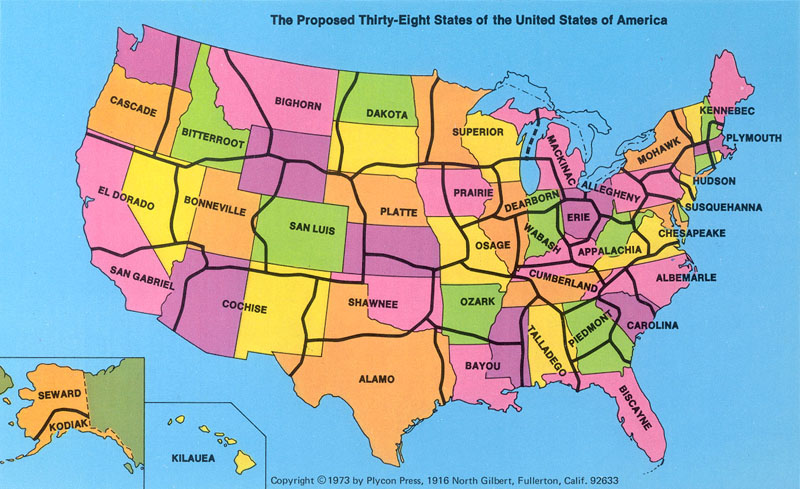
And then there was the time when, back in 1973, George Etzel Pearcy, a Cal­i­for­nia State Uni­ver­si­ty geog­ra­phy pro­fes­sor, pro­posed re-draw­ing the map of the nation, reduc­ing the num­ber of states to 38, and giv­ing each state a dif­fer­ent name. In his cre­ative rework­ing of things, Cal­i­for­nia would be split into two states–“El Dora­do” and “San Gabriel”. Texas would divide into “Alamo” and also “Shawnee” (along with rem­nants of Okla­homa). And the Dako­tas would fuse into one big “Dako­ta.” In case you’re won­der­ing, Pearcy chose the names by polling geog­ra­phy stu­dents.

The log­ic behind the new map was explained in a 1975 edi­tion of The Peo­ple’s Almanac.

Why the need for a new map? Pearcy states that many of the ear­ly sur­veys that drew up our bound­aries were done while the areas were scarce­ly pop­u­lat­ed. Thus, it was con­ve­nient to deter­mine bound­aries by using the land’s phys­i­cal fea­tures, such as rivers and moun­tain ranges, or by using a sim­ple sys­tem of lat­i­tude and lon­gi­tude.… The prac­ti­cal­i­ty of old estab­lished State lines is ques­tion­able in light of Amer­i­ca’s ever-grow­ing cities and the increas­ing mobil­i­ty of its cit­i­zens. Met­ro­pol­i­tan New York, for exam­ple, stretch­es into 2 adja­cent States. Oth­er city pop­u­la­tions which cross State lines are Wash­ing­ton, D.C., St. Louis, Chica­go, and Kansas City. The “strad­dling” of State lines caus­es eco­nom­ic and polit­i­cal prob­lems. Who should pay for a rapid tran­sit sys­tem in St. Louis? Only those cit­i­zens with­in the bound­aries of Mis­souri, or all res­i­dents of St. Louis’s met­ro­pol­i­tan area, includ­ing those who reach over into the State of Illi­nois?…

When Pearcy realigned the U.S., he gave high pri­or­i­ty to pop­u­la­tion den­si­ty, loca­tion of cities, lines of trans­porta­tion, land relief, and size and shape of indi­vid­ual States.  When­ev­er pos­si­ble lines are locat­ed in less pop­u­lat­ed areas. In the West, the desert, semi­desert, or moun­tain­ous areas pro­vid­ed an easy method for divi­sion. In the East, how­ev­er, where areas of scarce pop­u­la­tion are hard­er to deter­mine, Pearcy drew lines “try­ing to avoid the thick­er clus­ters of set­tle­ment.”  Each major city which fell into the “strad­dling” cat­e­go­ry is neat­ly tucked with­in the bound­aries of a new State. Pearcy tried to place a major met­ro­pol­i­tan area in the cen­ter of each State. St. Louis is in the cen­ter of the State of Osage, Chica­go is cen­tered in the State of Dear­born. When this method proved impos­si­ble, as with coastal Los Ange­les, the city is still locat­ed so as to be eas­i­ly acces­si­ble from all parts of the State…

Accord­ing to Rob Lamm­le, writ­ing in Men­tal Floss, Pearcy ini­tial­ly got sup­port from “econ­o­mists, geo­g­ra­phers, and even a few politi­cians.” But the proposal–mainly out­lined in a book called A 38 State U.S.A.–even­tu­al­ly with­ered in Wash­ing­ton, the place where ideas, both good and bad, go to die.

Below you can watch an ani­ma­tion show­ing how US map has changed in 200 years.

If you would like to sign up for Open Culture’s free email newslet­ter, please find it here. It’s a great way to see our new posts, all bun­dled in one email, each day.

If you would like to sup­port the mis­sion of Open Cul­ture, con­sid­er mak­ing a dona­tion to our site. It’s hard to rely 100% on ads, and your con­tri­bu­tions will help us con­tin­ue pro­vid­ing the best free cul­tur­al and edu­ca­tion­al mate­ri­als to learn­ers every­where. You can con­tribute through Pay­Pal, Patre­on, and Ven­mo (@openculture). Thanks!

Relat­ed Con­tent:

Free: Nation­al Geo­graph­ic Lets You Down­load Thou­sands of Maps from the Unit­ed States Geo­log­i­cal Sur­vey

Down­load 67,000 His­toric Maps (in High Res­o­lu­tion) from the Won­der­ful David Rum­sey Map Col­lec­tion

The His­to­ry of Car­tog­ra­phy, the “Most Ambi­tious Overview of Map Mak­ing Ever,” Now Free Online

New York Pub­lic Library Puts 20,000 Hi-Res Maps Online & Makes Them Free to Down­load and Use

by | Permalink | Make a Comment ( 2 ) |

The Roman Roads of Britain Visualized as a Subway Map

Walk around Lon­don with some­one who knows its deep his­to­ry — not hard to arrange, giv­en the way Lon­don enthu­si­asts treat his­tor­i­cal knowl­edge as a hyper­com­pet­i­tive sport — and you’ll have more than a few paths of “Roman roads” point­ed out to you. Even in the city of Big Ben and Buck­ing­ham Palace, the Shard and the Gherkin, chick­en shops and cur­ry hous­es, there remain frag­ments and traces of the 2,000 miles of roads the Roman Army built between British towns and cities between 43 and 410 AD, Britain’s cen­turies as a province of the Roman Empire.

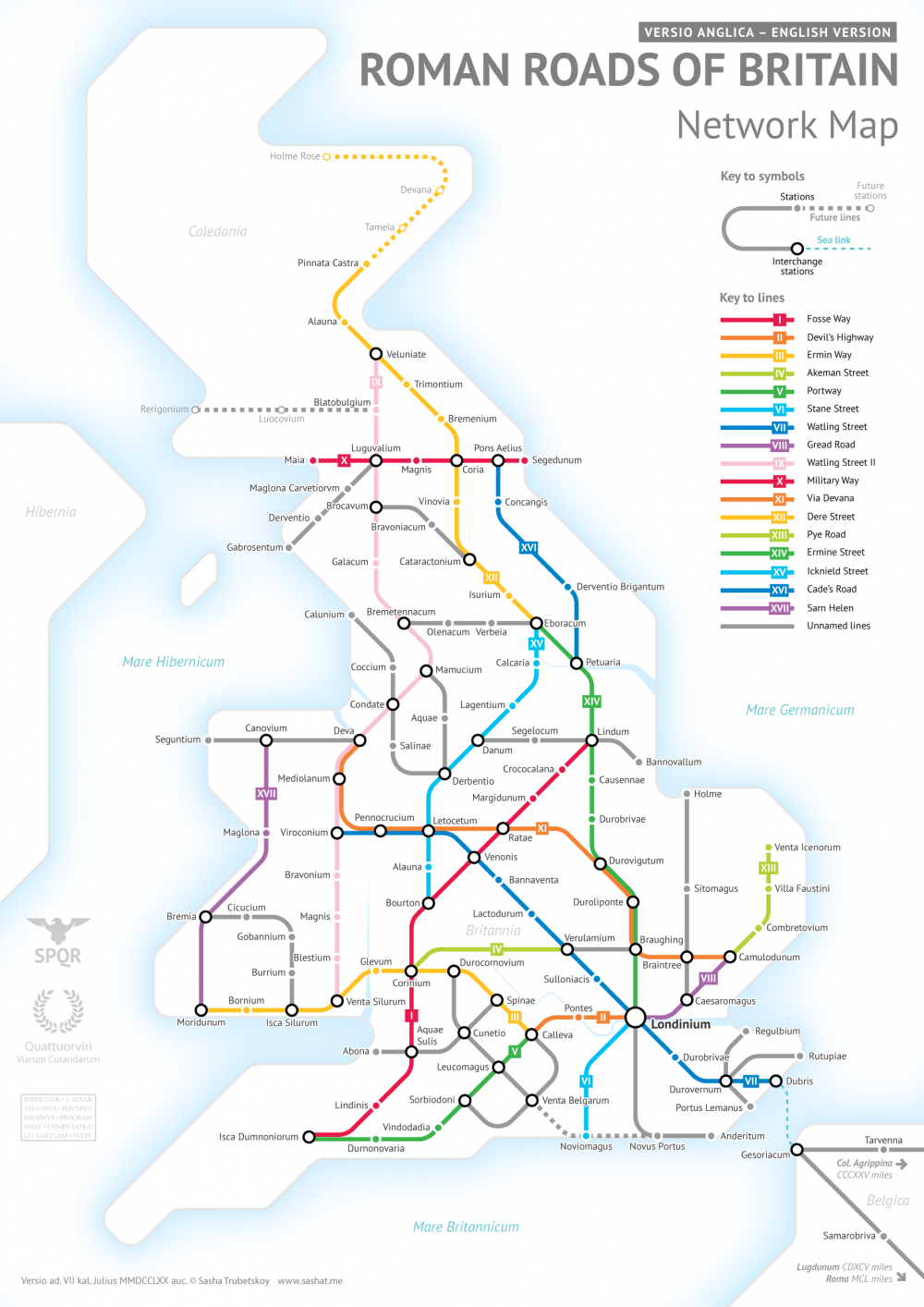
Though some of Britain’s Roman Roads have become mod­ern motor­ways, most no longer exist in any form but those bits and pieces his­to­ry buffs like to spot. This makes it dif­fi­cult to get a sense of how they all ran and where — or at least it did until Sasha Tru­bet­skoy made a Roman Roads of Britain Net­work Map in the graph­ic-design style of the sub­way maps you’ll find in Lon­don or any oth­er major city today. Tru­bet­skoy, an under­grad­u­ate sta­tis­tics major at the Uni­ver­si­ty of Chica­go, first found car­to­graph­i­cal fame a few months ago with his “sub­way map” of roads across the entire Roman Empire cir­ca 125 AD.

“Pop­u­lar request,” he writes, demand­ed a Britain-spe­cif­ic fol­low up, a project he describes as “far more com­pli­cat­ed than I had ini­tial­ly antic­i­pat­ed.” The chal­lenges includ­ed not just the sheer num­ber of Roman Roads in Britain but a lack of clar­i­ty about their exact loca­tion and extents. As in his pre­vi­ous map, Tru­bet­skoy admits, “I had to do some sim­pli­fy­ing and make some tough choic­es on which cities to include.” While this clos­er-up view demand­ed a more geo­graph­i­cal faith­ful­ness, he nev­er­the­less “had to get rather cre­ative with the his­tor­i­cal evi­dence” in places, to the point of using such “not exact­ly Latin-sound­ing” names as â€śWatling Street” and “Ermin Way.”

Still, bar­ring a rev­o­lu­tion­ary dis­cov­ery in Roman his­to­ry, you’re unlike­ly to find a more rig­or­ous exam­ple of sub­way-mapped Roman Roads in Britain than this one. And for $9 USD you can have it as a “crisp PDF” suit­able for print­ing as a poster and giv­ing to any­one pas­sion­ate about the his­to­ry of Britain — or the his­to­ry of Rome, or graph­ic design, or maps that aren’t what they might seem at first glance.

Relat­ed Con­tent:

Ancient Rome’s Sys­tem of Roads Visu­al­ized in the Style of Mod­ern Sub­way Maps

Rome Reborn: Take a Vir­tu­al Tour of Ancient Rome, Cir­ca 320 C.E.

How Did the Romans Make Con­crete That Lasts Longer Than Mod­ern Con­crete? The Mys­tery Final­ly Solved

The Rise & Fall of the Romans: Every Year Shown in a Time­lapse Map Ani­ma­tion (753 BC ‑1479 AD)

A Won­der­ful Archive of His­toric Tran­sit Maps: Expres­sive Art Meets Pre­cise Graph­ic Design

“The Won­der­ground Map of Lon­don Town,” the Icon­ic 1914 Map That Saved the World’s First Sub­way Sys­tem

Based in Seoul, Col­in Mar­shall writes and broad­casts on cities and cul­ture. He’s at work on the book The State­less City: a Walk through 21st-Cen­tu­ry Los Ange­les, the video series The City in Cin­e­ma, the crowd­fund­ed jour­nal­ism project Where Is the City of the Future?, and the Los Ange­les Review of Books’ Korea Blog. Fol­low him on Twit­ter at @colinmarshall or on Face­book.

A Colorful Map Visualizes the Lexical Distances Between Europe’s Languages: 54 Languages Spoken by 670 Million People

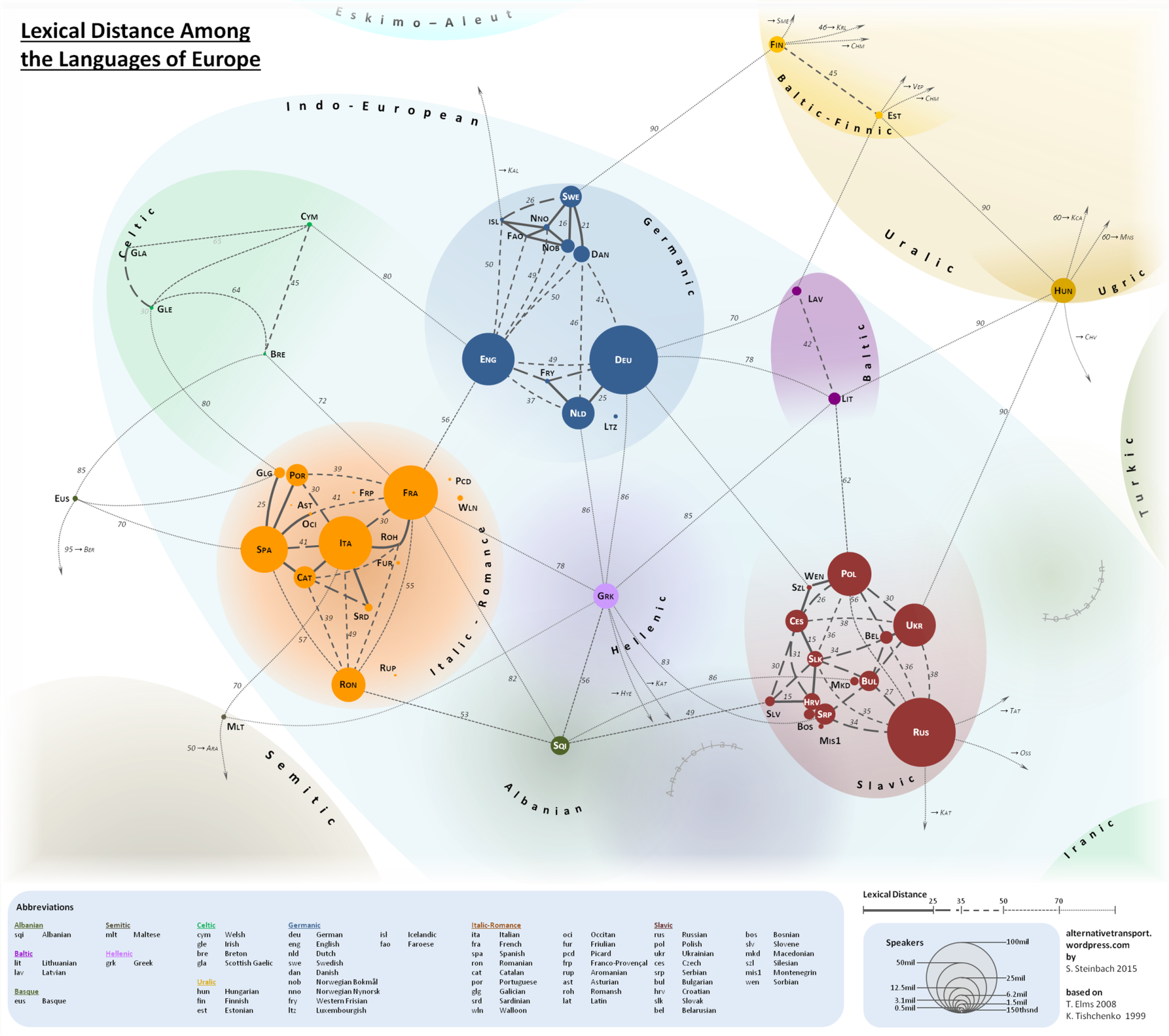
Stephen F. Stein­bach, a res­i­dent of Vien­na and a “car­tog­ra­phy, lan­guage and trav­el enthu­si­ast, with an engi­neer­ing back­ground,” is not a lin­guist. Stein­bach, who runs the site Alter­na­tive Trans­port, seems much more inter­est­ed in map­ping and trans­porta­tion than mor­phol­o­gy and ety­mol­o­gy. But he has made a con­tri­bu­tion to a lin­guis­tic con­cept called “lex­i­cal dif­fer­ence” with the map you see above, a col­or­ful 2015 visu­al­iza­tion of Euro­pean lan­guages, grouped togeth­er in clus­ters accord­ing to their sub­fam­i­lies (Ital­ic-Romance, Baltic, Slav­ic, Ger­man­ic, etc.—see a much larg­er ver­sion here).

Straight and arc­ing lines span the rel­a­tive dis­tance these lan­guages have pre­sum­ably trav­eled from each oth­er. Sol­id lines between lan­guages rep­re­sent a very close prox­im­i­ty, dashed lines of dif­fer­ent thick­ness­es show more dis­tance, and thin dot­ted lines tra­verse the great­est expans­es.

Hun­gar­i­an and Ukrain­ian, for exam­ple, have a lex­i­cal dis­tance score of 90, where Pol­ish and Ukrain­ian, both Slav­ic lan­guages, are only 30 degrees from each oth­er. “The map shows the lan­guage fam­i­lies that cov­er the con­ti­nent,” writes Big Think, “large, famil­iar ones like Ger­man­ic, Ital­ic-Romance and Slav­ic, small­er ones like Celtic, Baltic and Ural­ic; out­liers like Semit­ic and Tur­kic; and isolates—orphan lan­guages, with­out a fam­i­ly: Alban­ian and Greek.”  (Tech­ni­cal­ly, mod­ern Greek does have a family—Hellenic—though it is the only sur­viv­ing mem­ber.)

As we might expect from this sub­set of the durable Indo-Euro­pean schema, the lan­guages with­in each clus­tered group occu­py the short­est dis­tance from each oth­er, with some excep­tions. Roman­ian, for exam­ple, is slight­ly clos­er to Alban­ian than it is to French, its Romance cousin. The Slav­ic lan­guages Russ­ian and Pol­ish seem to have trav­eled a bit fur­ther apart than Pol­ish has from the Baltic lan­guage of Lithuan­ian. What does this mean, exact­ly? Accord­ing to the mea­sure of “lex­i­cal dis­tance” pro­posed by Ukrain­ian lin­guist Kon­stan­tin Tishchenko, it means that clos­er lan­guages might be more mutu­al­ly intel­li­gi­ble, at least from a lex­i­cal stand­point, since they may share more cog­nates (sim­i­lar-sound­ing and mean­ing words) and bor­row­ings.

Gas­ton Ümlaut, the han­dle of a lin­guist on the Stack Exchange Lin­guis­tics beta, cau­tions that the con­cept of “lex­i­cal dis­tance” may be “pret­ty use­less” giv­en that the com­par­isons also include false cognates—words that sound or look sim­i­lar but have no rela­tion­ship to each oth­er. These could account for some seem­ing incon­sis­ten­cies. (Ümlaut admits he has not read the orig­i­nal arti­cle, writ­ten in Russ­ian. If you are able, you can find it online in the book Metathe­o­ry of Lin­guis­tics, here.) Stein­bach has respond­ed in the same thread.

The idea received a much more tren­chant cri­tique more recent­ly. Stein­bach clar­i­fied that the the­o­ry, and the map, only com­pare writ­ten words and not syn­tax or speech. “It has noth­ing to do with gram­mar, syn­tax, rhythm or oth­er impor­tant fea­tures that are impor­tant for intel­li­gi­bil­i­ty,” he writes. “It also com­pares a small list of words and not the entire vocab­u­lary of one lan­guage to anoth­er.” This expla­na­tion does cast doubt on whether “lex­i­cal dis­tance” is a mean­ing­ful con­cept. I’ll leave it to the lin­guists to decide. (Stein­bach reached out to Tis­chchenko but has yet to receive a reply.)

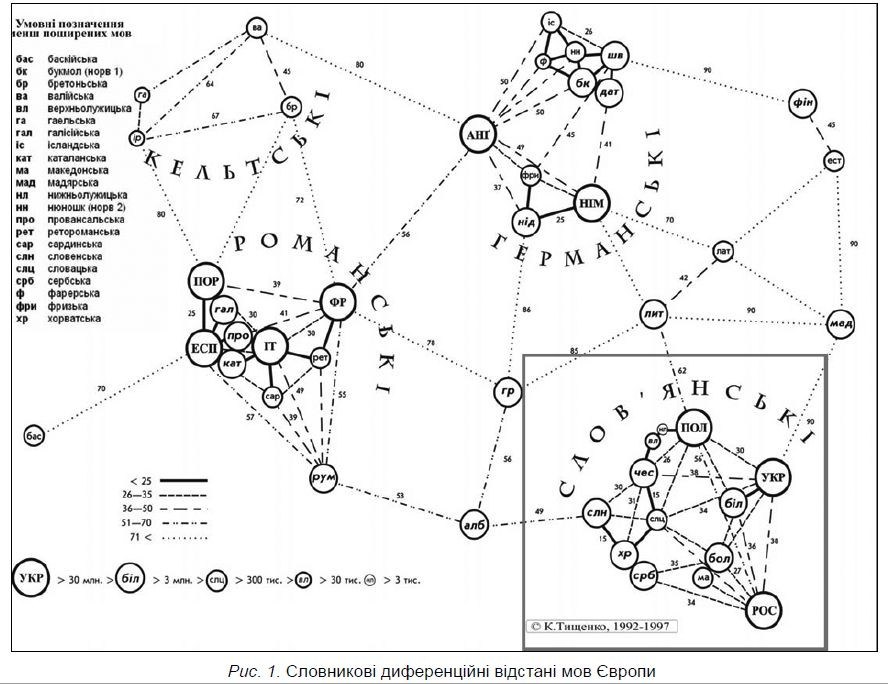
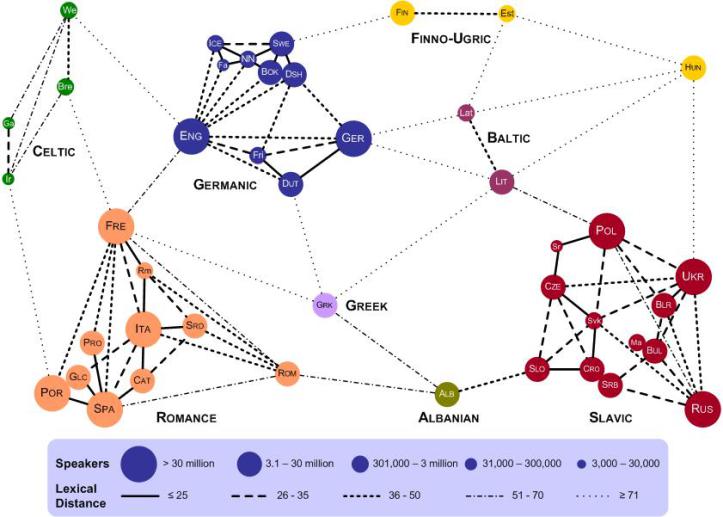
Tischchenko’s orig­i­nal “lex­i­cal dis­tance” map, fur­ther up, drawn in 1997, gets the idea across with min­i­mal fuss, but it leaves much to be desired graph­i­cal­ly. (A large, hand-drawn col­or ver­sion improves upon the print­ed map.) Stein­bach took his ver­sion from a 2008 Eng­lish-lan­guage adap­ta­tion made by Tere­sa Elms in 2008 (above). In his blog post here, he explains all of the changes he made to Elms and Tischchenko’s designs. These include adjust­ing the size of the “bub­bles” to pro­por­tion­al­ly rep­re­sent the num­ber of speak­ers of each lan­guage. Stein­bach also added sev­er­al lan­guages, as well as “grave­stones” for the dead Ana­to­lian and Tochar­i­an branch­es. In all, his map shows “54 lan­guages, rep­re­sent­ing 670 mil­lion peo­ple.” He adds, vague­ly, that “it checks out.”


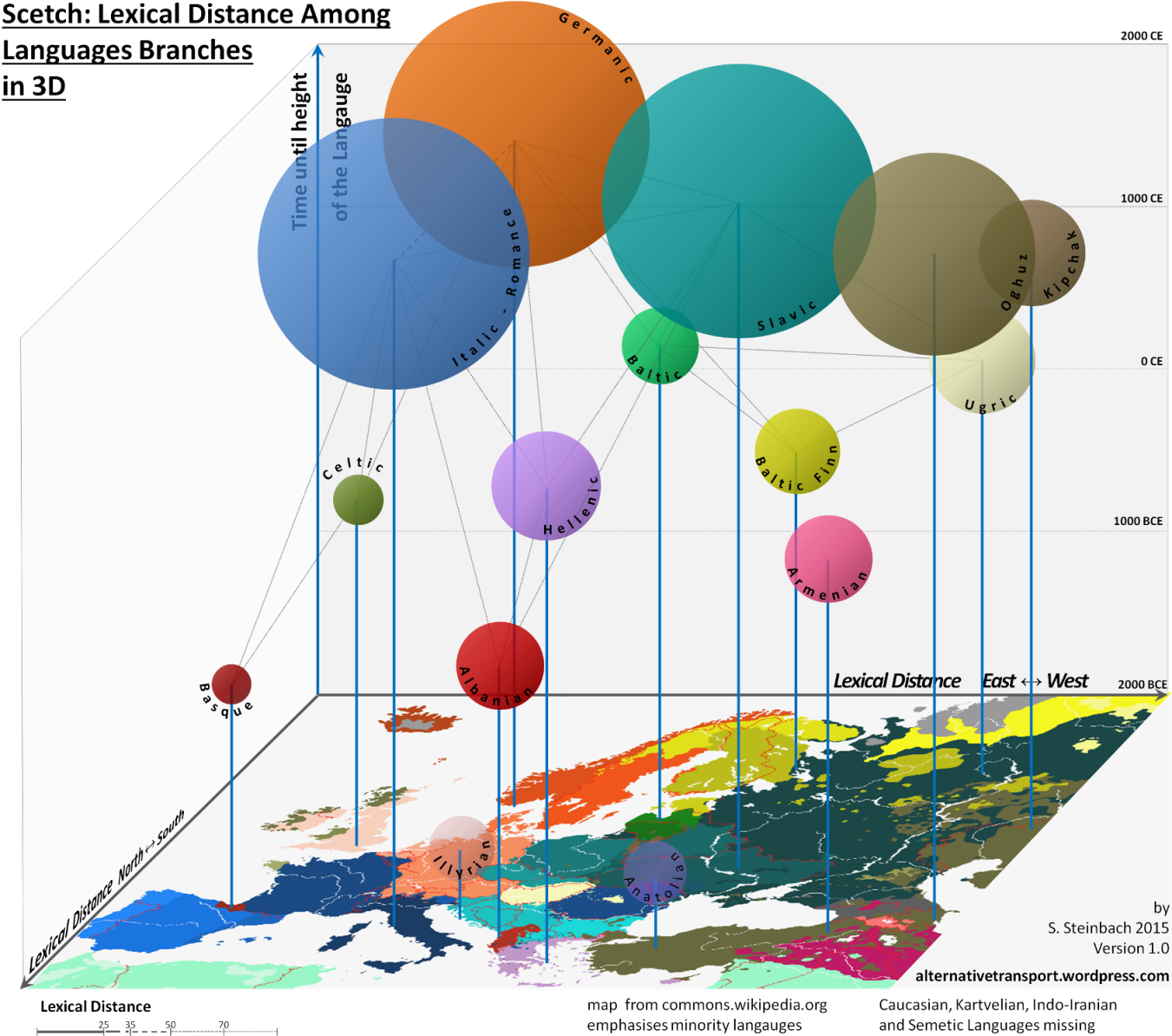
After post­ing his Lex­i­cal Dis­tance Map, Stein­bach pro­posed a “3D” ver­sion, with the added dimen­sion of time. (See his pre­lim­i­nary sketch above.) The maps are intrigu­ing, the the­o­ry of “lex­i­cal dis­tance” an inter­est­ing one, but we should bear in mind, as Stein­bach writes, that he is “no lin­guist,” and that this idea is hard­ly an ortho­dox one with­in the dis­ci­pline.

via Big Think

Relat­ed Con­tent:

The Tree of Lan­guages Illus­trat­ed in a Big, Beau­ti­ful Info­graph­ic

How Lan­guages Evolve: Explained in a Win­ning TED-Ed Ani­ma­tion

Speak­ing in Whis­tles: The Whis­tled Lan­guage of Oax­a­ca, Mex­i­co       

Josh Jones is a writer and musi­cian based in Durham, NC. Fol­low him at @jdmagness

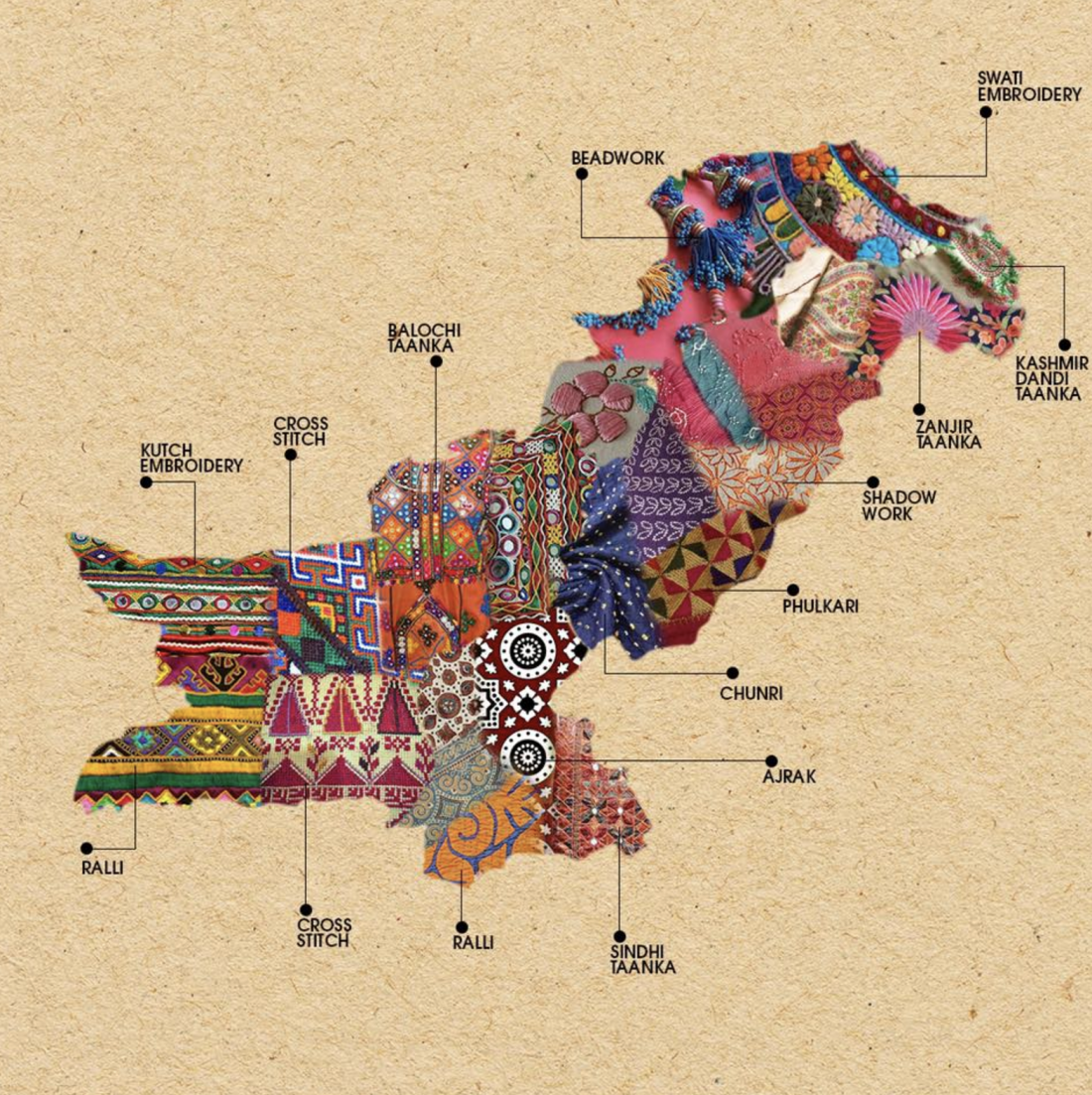
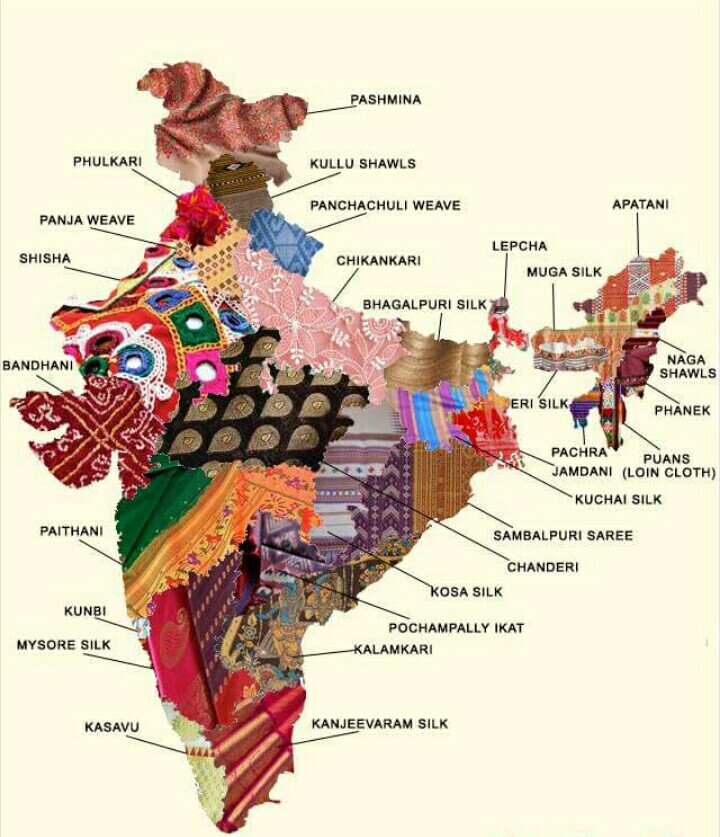
Artistic Maps of Pakistan & India Show the Embroidery Techniques of Their Different Regions

Jour­nal­ist Saima Mir post­ed to Twit­ter this “map of Pak­istan show­ing the embroi­dery tech­niques of its regions.” And, sure enough, it led to some­one sur­fac­ing a cor­re­spond­ing map of Pak­istan’s neigh­bor, India. The under­ly­ing mes­sage of the maps? It’s to show, as @AlmostLived not­ed, â€śhow diverse ele­ments come togeth­er to make beau­ti­ful things.” The map above was orig­i­nal­ly pro­duced by Gen­er­a­tion, a Pak­istani fash­ion com­pa­ny. We’re not clear on the ori­gin of the India map, unfor­tu­nate­ly.

via Boing Boing

If you would like to sign up for Open Culture’s free email newslet­ter, please find it here. It’s a great way to see our new posts, all bun­dled in one email, each day.

If you would like to sup­port the mis­sion of Open Cul­ture, con­sid­er mak­ing a dona­tion to our site. It’s hard to rely 100% on ads, and your con­tri­bu­tions will help us con­tin­ue pro­vid­ing the best free cul­tur­al and edu­ca­tion­al mate­ri­als to learn­ers every­where. You can con­tribute through Pay­Pal, Patre­on, and Ven­mo (@openculture). Thanks!

Relat­ed Con­tent:

New BBC Drama­ti­za­tion of Salman Rushdie’s Midnight’s Chil­dren Now Stream­ing Free for a Lim­it­ed Time

Pak­istani Musi­cians Play an Enchant­i­ng Ver­sion of Dave Brubeck’s Jazz Clas­sic, “Take Five”

Pak­istani Immi­grant Goes to a Led Zep­pelin Con­cert, Gets Inspired to Become a Musi­cian & Then Sells 30 Mil­lion Albums

Intro­duc­tion to Indi­an Phi­los­o­phy: A Free Online Course

India’s Answer to M.I.T. Presents 268 Free Online Cours­es (in Eng­lish)

by | Permalink | Make a Comment ( 13 ) |

All the Rivers & Streams in the U.S. Shown in Rainbow Colors: A Data Visualization to Behold

This is a sight for sore eyes. Cre­at­ed by Hun­gar­i­an geo­g­ra­ph­er and map-design­er Robert Szucs, using open-source QGIS soft­ware, the high res­o­lu­tion map above shows:

all the per­ma­nent and tem­po­rary streams and rivers of the con­tigu­ous 48 states in beau­ti­ful rain­bow colours, divid­ed into catch­ment areas. It shows Strahler Stream Order Clas­si­fi­ca­tion. The high­er the stream order, the thick­er the line.

When you look at the map, you’ll see, as The Wash­ing­ton Post observes, “Every riv­er in a col­or drains to the same riv­er, which then drains into the ocean. The giant basin in the mid­dle of the coun­try is the Mis­sis­sip­pi Riv­er basin. Major rivers like the Ohio and the Mis­souri drain into the behe­moth.” Pret­ty impres­sive.

The map was appar­ent­ly made using data from the Euro­pean Envi­ron­ment Agency and the Rivers Net­work Sys­tem.

You can find the map on Imgur, or pur­chase “ultra high” res­o­lu­tion copies through Etsy for $8.

Szucs has als0 pro­duced data visu­al­iza­tions of the riv­er sys­tems in Chi­na, India, Europe and oth­er parts of the world.

If you would like to sign up for Open Culture’s free email newslet­ter, please find it here. It’s a great way to see our new posts, all bun­dled in one email, each day.

If you would like to sup­port the mis­sion of Open Cul­ture, con­sid­er mak­ing a dona­tion to our site. It’s hard to rely 100% on ads, and your con­tri­bu­tions will help us con­tin­ue pro­vid­ing the best free cul­tur­al and edu­ca­tion­al mate­ri­als to learn­ers every­where. You can con­tribute through Pay­Pal, Patre­on, and Ven­mo (@openculture). Thanks!

Relat­ed Con­tent 

Ancient Rome’s Sys­tem of Roads Visu­al­ized in the Style of Mod­ern Sub­way Maps 

Down­load 67,000 His­toric Maps (in High Res­o­lu­tion) from the Won­der­ful David Rum­sey Map Col­lec­tion

Japan­ese Design­ers May Have Cre­at­ed the Most Accu­rate Map of Our World: See the Autha­Graph

Buck­min­ster Fuller’s Map of the World: The Inno­va­tion that Rev­o­lu­tion­ized Map Design (1943)

by | Permalink | Make a Comment ( 3 ) |

Ancient Rome’s System of Roads Visualized in the Style of Modern Subway Maps

Sasha Tru­bet­skoy, an under­grad at U. Chica­go, has cre­at­ed a “sub­way-style dia­gram of the major Roman roads, based on the Empire of ca. 125 AD.” Draw­ing on Stanford’s ORBIS mod­el, The Pela­gios Project, and the Anto­nine Itin­er­ary, Tru­bet­skoy’s map com­bines well-known his­toric roads, like the Via Appia, with less­er-known ones (in somes cas­es giv­en imag­ined names). If you want to get a sense of scale, it would take, Tru­bet­skoy tells us, â€śtwo months to walk on foot from Rome to Byzan­tium. If you had a horse, it would only take you a month.”

You can view the map in a larg­er for­mat here. And if you fol­low this link and send Tru­bet­skoy a few bucks, he promis­es to email you a crisp PDF for print­ing. Enjoy.

via coudal

If you would like to sign up for Open Culture’s free email newslet­ter, please find it here. It’s a great way to see our new posts, all bun­dled in one email, each day.

If you would like to sup­port the mis­sion of Open Cul­ture, con­sid­er mak­ing a dona­tion to our site. It’s hard to rely 100% on ads, and your con­tri­bu­tions will help us con­tin­ue pro­vid­ing the best free cul­tur­al and edu­ca­tion­al mate­ri­als to learn­ers every­where. You can con­tribute through Pay­Pal, Patre­on, and Ven­mo (@openculture). Thanks!

Relat­ed Con­tent:

“The Won­der­ground Map of Lon­don Town,” the Icon­ic 1914 Map That Saved the World’s First Sub­way Sys­tem

Design­er Mas­si­mo Vignel­li Revis­its and Defends His Icon­ic 1972 New York City Sub­way Map

Ancient Maps that Changed the World: See World Maps from Ancient Greece, Baby­lon, Rome, and the Islam­ic World

Watch the Destruc­tion of Pom­peii by Mount Vesu­vius, Re-Cre­at­ed with Com­put­er Ani­ma­tion (79 AD)

Fash­ion­able 2,000-Year-Old Roman Shoe Found in a Well

The Rise & Fall of the Romans: Every Year Shown in a Time­lapse Map Ani­ma­tion (753 BC ‑1479 AD)

by | Permalink | Make a Comment ( 8 ) |

Animated GIFs Show How Subway Maps of Berlin, New York, Tokyo & London Compare to the Real Geography of Those Great Cities

You can’t make a per­fect­ly accu­rate map, as Jorge Luis Borges so suc­cinct­ly told us, with­out mak­ing it the exact same size and shape as the land it por­trays. But giv­en the utter use­less­ness of such an enor­mous piece of paper (which so frus­trat­ed the cit­i­zens of the imag­i­nary empire in Borges’ sto­ry that, “not with­out some piti­less­ness,” they tossed theirs into the desert), no map­mak­er would ever want to. A more com­pact map is a more use­ful one; unfor­tu­nate­ly, a more com­pact map is also, by its very nature, a less accu­rate one.

New York

The same rule applies to maps of all kinds, and espe­cial­ly to tran­sit maps, quite pos­si­bly the most use­ful spe­cial­ized maps we con­sult today. They show us how to nav­i­gate cities, and yet their clean, bold lines, some­times turn­ing but nev­er waver­ing, hard­ly rep­re­sent those cities — sub­ject as they are to vari­a­tions in ter­rain and den­si­ty, as well as cen­turies of unplannably organ­ic growth — with geo­graph­i­cal faith­ful­ness. One can’t help but won­der just how each urban tran­sit map, some of them beloved works of design, strikes the use­ful­ness-faith­ful­ness bal­ance.

Lon­don

Liv­ing in Seoul, I’ve grown used to the city’s stan­dard sub­way map. I thus get a kick out of scru­ti­niz­ing the more geo­graph­i­cal­ly accu­rate one, which over­lays the train lines onto an exist­ing map of the city, post­ed on some sta­tion plat­forms. It reveals the truth that some lines are short­er than they look on the stan­dard map, some are much longer, and none cut quite as clean a path through the city as they seem to. At Twist­ed Sifter you’ll find a GIF gallery of 15 stan­dard sub­way maps that morph into more geo­graph­i­cal­ly faith­ful equiv­a­lents, a vivid demon­stra­tion of just how much tran­sit map design­ers need to twist, squeeze, and sim­pli­fy an urban land­scape to pro­duce some­thing leg­i­ble at a glance.

Tokyo

All of those ani­ma­tions, just five of which you see in this post, come from the sub­red­dit Data Is Beau­ti­ful, a realm pop­u­lat­ed by enthu­si­asts of the visu­al dis­play of quan­ti­ta­tive infor­ma­tion — enthu­si­asts so enthu­si­as­tic that many of them cre­ate inno­v­a­tive data visu­al­iza­tions like these by them­selves. Accord­ing to their cre­ations, sub­way maps, like that of New York City’s ven­er­a­ble sys­tem, do rel­a­tive­ly lit­tle to dis­tort the city; oth­ers, like Toky­o’s, look near­ly unrec­og­niz­able when made to con­form to geog­ra­phy.

Austin

Even the maps of new and incom­plete tran­sit net­works do a num­ber on the real shape and direc­tion of their paths: the map of Austin, Texas’ Cap­i­tal Metro­Rail, for instance, straight­ens a some­what zig-zag­gy north­east-south­west track into a sin­gle hor­i­zon­tal line. It may take a few gen­er­a­tions before Austin’s “sys­tem” devel­ops into one exten­sive and com­plex enough to inspire one of the great tran­sit maps (the ranks, for exam­ple, of “The Won­der­ground Map of Lon­don Town”). But I would­n’t count out the pos­si­bil­i­ty: the more ful­ly cities real­ize their pub­lic-tran­sit poten­tial, the more oppor­tu­ni­ty opens up for the advance­ment of the sub­way map­mak­er’s art.

See all 15 of the sub­way GIFs at Twist­ed Sifter.

Relat­ed Con­tent:

A Won­der­ful Archive of His­toric Tran­sit Maps: Expres­sive Art Meets Pre­cise Graph­ic Design

Design­er Mas­si­mo Vignel­li Revis­its and Defends His Icon­ic 1972 New York City Sub­way Map

“The Won­der­ground Map of Lon­don Town,” the Icon­ic 1914 Map That Saved the World’s First Sub­way Sys­tem

Bauhaus Artist Lás­zló Moholy-Nagy Designs an Avant-Garde Map to Help Peo­ple Get Over the Fear of Fly­ing (1936)

Why Mak­ing Accu­rate World Maps Is Math­e­mat­i­cal­ly Impos­si­ble

Based in Seoul, Col­in Mar­shall writes and broad­casts on cities and cul­ture. He’s at work on a book about Los Ange­les, A Los Ange­les Primer, the video series The City in Cin­e­ma, the crowd­fund­ed jour­nal­ism project Where Is the City of the Future?, and the Los Ange­les Review of Books’ Korea Blog. Fol­low him on Twit­ter at @colinmarshall or on Face­book.

Timelapse Animation Lets You See the Rise of Cities Across the Globe, from 3700 BC to 2000 AD

Last year, a Yale-led research project pro­duced an inno­v­a­tive dataset that mapped the his­to­ry of urban set­tle­ments. Cov­er­ing a 6,000 year peri­od, the project traced the loca­tion and size of cities across the world, start­ing in 3700 BC (when the first known urban dwellings emerged in Sumer) and con­tin­u­ing through 2000 AD. Accord­ing to Yale’s Mered­ith Reba, if we under­stand “how cities have grown and changed over time, through­out his­to­ry, it might tell us some­thing use­ful about how they are chang­ing today,” and par­tic­u­lar­ly whether we can find ways to make mod­ern cities sus­tain­able.

The Yale dataset was orig­i­nal­ly pub­lished in Sci­en­tif­ic Data in 2016. And before too long, some enter­pris­ing YouTu­ber brought the data to life. Above, the his­to­ry of urban life unfolds before your eyes. The action starts off slow, but then lat­er kicks into high gear.

You can read more about the map­ping of urban set­tle­ments at this Yale web­site. And see the ani­mat­ed map in a larg­er for­mat here.

If you would like to sign up for Open Culture’s free email newslet­ter, please find it here. It’s a great way to see our new posts, all bun­dled in one email, each day.

If you would like to sup­port the mis­sion of Open Cul­ture, con­sid­er mak­ing a dona­tion to our site. It’s hard to rely 100% on ads, and your con­tri­bu­tions will help us con­tin­ue pro­vid­ing the best free cul­tur­al and edu­ca­tion­al mate­ri­als to learn­ers every­where. You can con­tribute through Pay­Pal, Patre­on, and Ven­mo (@openculture). Thanks!

Relat­ed Con­tent

The Rise & Fall of the Romans: Every Year Shown in a Time­lapse Map Ani­ma­tion (753 BC ‑1479 AD)

200,000 Years of Stag­ger­ing Human Pop­u­la­tion Growth Shown in an Ani­mat­ed Map

Buck­min­ster Fuller Cre­ates an Ani­mat­ed Visu­al­iza­tion of Human Pop­u­la­tion Growth from 1000 B.C.E. to 1965

« Go BackMore in this category... »
Quantcast