As Josh Jones observed yesterday, Miles Davis’ legendary jazz album Kind of Blueturns 60 this week. Today, we want to keep the party going a little longer and feature this video essay from Sweetwater. They write:
In 1959, Miles Davis went to Columbia Records in Manhattan to forge a new style of music improvisation. With the company of other legendary musicians, like John Coltrane and Bill Evans, Kind of Blue was recorded; the greatest selling jazz album of all time. Miles chose to take an interpretive dance approach to improvisation, developing ideas and using space to create his unique style. This new style of modal jazz pushed musicians to express themselves through melodic creativity. Take a look into the history and music theory of Kind of Blue with Sweetwater’s Jacob Dupre (piano/trumpet), accompanied by Michael Patterson (bass) and Sean Parr (drums). Karl Stabnau (alto sax) performs the solo on “Blues For Alice,” as played by Charlie Parker.
If you would like to support the mission of Open Culture, consider making a donation to our site. It’s hard to rely 100% on ads, and your contributions will help us continue providing the best free cultural and educational materials to learners everywhere. You can contribute through PayPal, Patreon, and Venmo (@openculture). Thanks!
In a very short span of time, the descriptor “electronic music” has come to sound as overly broad as “classical.” But where what we (often incorrectly) call classical developed over hundreds of years, electronic music proliferated into hundreds of fractal forms in only decades. A far steeper quality curve may have to do with the ease of its creation, but it’s also a factor of this accelerated evolution.
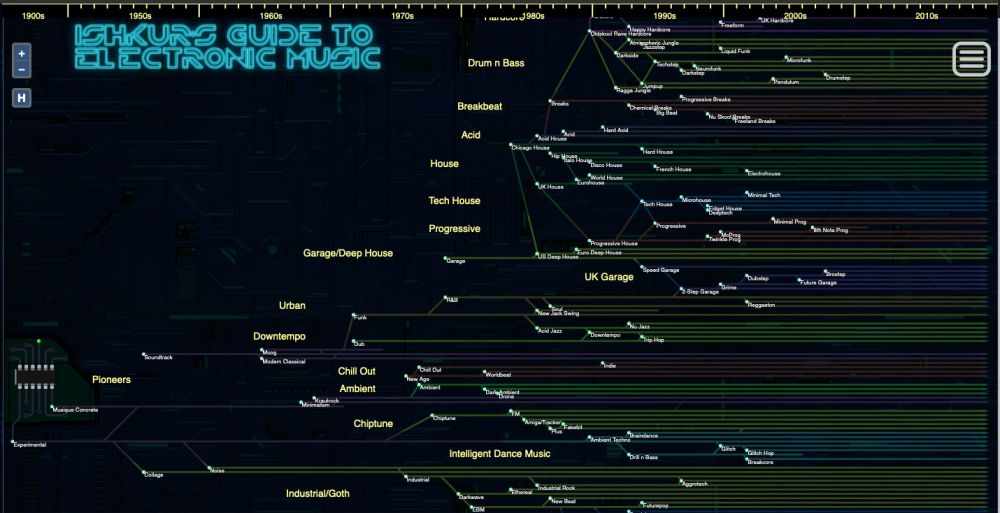
Music made by machines has transformed since its early 20th-century beginnings from obscure avant-garde experiments to massively popular genres of global dance and pop. This proliferation, notes Ishkur—designer of Ishkur’s Guide to Electronic Music—hasn’t always been to the good. Take what he calls “trendwhoring,” a phenomenon that spawns dozens of new works and subgenera in short order, though it’s arguable whether many of them should exist.
Ishkur, describes this process below in an excerpt from his erudite, sardonic “Frequently Unasked Questions”:
If fart noises were suddenly popular, each scene would trendwhore it with fartstep, fartcore, techfart, farthouse, fart trance, etc. It is especially noticeable in classic tracks that are remixed into modern genres, which some might consider sacreligious. A good example is the Dream Trance hit Robert Miles — Children, in which there is now a Hardstyle version, a Dutch House version, a McProg version, a Eurotrance version, a Goa Trance version, and even a Snap version and a shitty Brostep version. None of these genres existed when the original song came out in 1995.
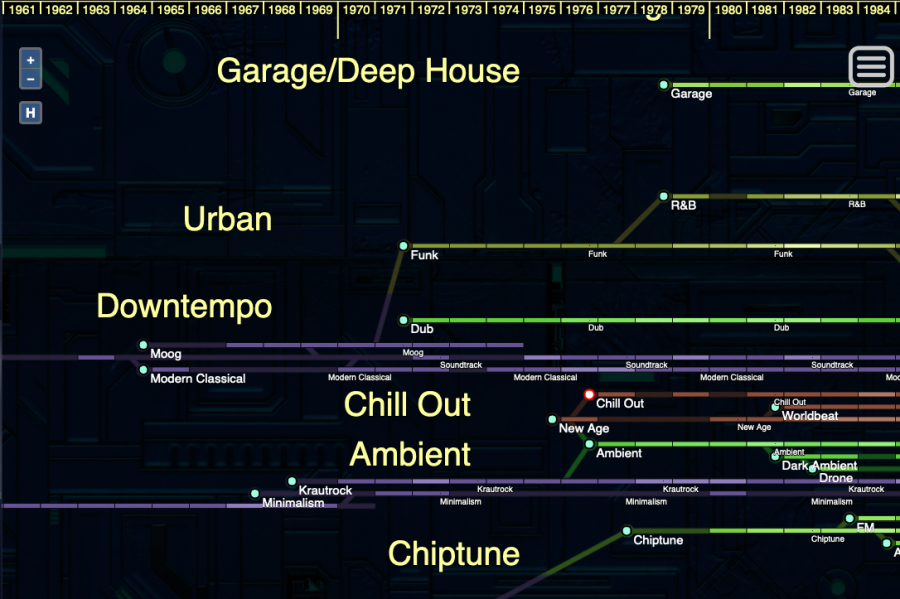
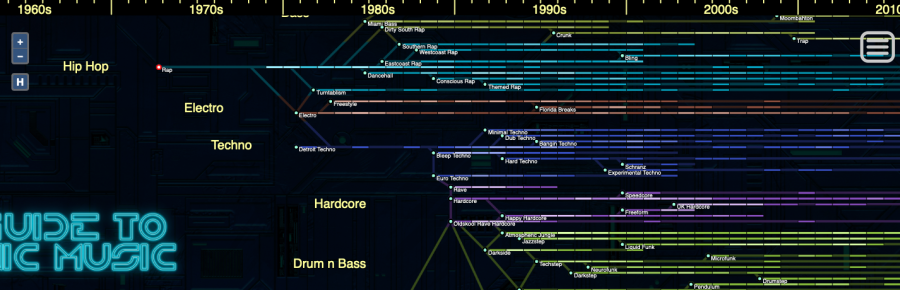
Viciously irreverent tone and completist attention to detail are typical throughout thisencyclopedia, an interactive Flash flowchart that chronicles the development of 100s of genres, subgenres, microgenres, etc., with streaming musical examples of every one. It’s a deeply researched, and continually expanding project first created by Ishkur, aka Kenneth John Taylor, in 1999. In 2003, Taylor updated and expanded the project and moved it to its current location. He has continuously updated it since then.
The recorded examples on Taylor’s timeline currently span around 80 years, from 1937 to 2019—a tiny drop in the great ocean of musical history. Nonetheless, the music shows how rich and complex electronic music history truly is, despite its potential—as its developmental speed (and tempos) increased—to produce disposable, derivative compositions as much as chart-burning classics and innovative, mind-expanding creative work.
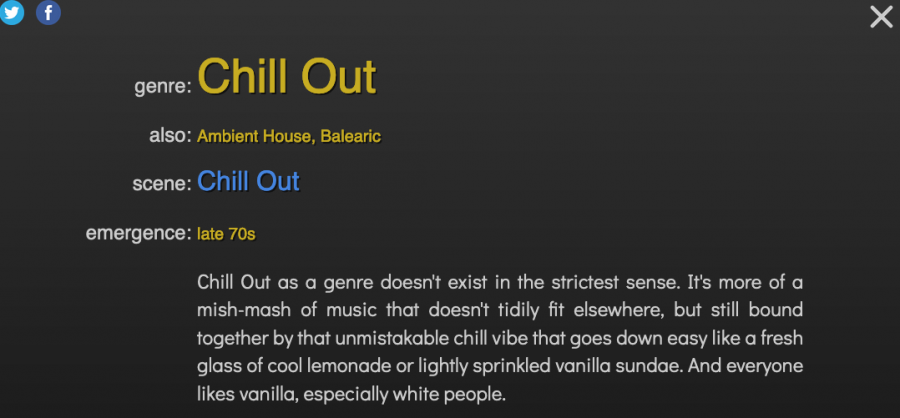
As you zoom into the chart and click on the dots next to each genre, you’ll have the option to pull up Taylor’s witty guides, as informative as they are unsparingly critical. He explains “Chill Out,” for example, as a grab-bag term for electronic easy listening that “goes down easy like a fresh glass of cool lemonade or lightly sprinkled vanilla sundae…. Not only did it appeal to post-comedown party kids but their moms too, as heard in movie soundtracks, advertisement jingles, or played over the radio while shopping at the market.”
Does he approve of any forms of electronic music? Obviously. No one would spend this much time and effort and amass “30 years of back issues of Electronic Music and Keyboard magazine” and “an ungodly number of books” on a subject they despised. It’s just that he’s… well, a purist, you might say. Any media, for example, of any kind, that “uses the acronym ‘EDM,’” he writes “is complete donkey balls and should not be relied on as a source for anything.” He’s also ambitiously comprehensive, including Hip Hop and all of its variants in the mix, a move most historians of electronic music do not make, for fear of getting it wrong, perhaps, or because of cultural biases and narrow ideas about what electronic music is.
The data visualization crossed with extensive pop musicology crossed with an almost quaint kind of ultra-nerdy online snark has something for everyone. But don’t call it art, as one interviewer did. “I feel uneasy about this,” Ishkur answered. “It’s a joke more than anything. Very funny. Very silly. I poke fun at a lot of genres. It’s meant to be entertainment.” This is the standard internet disclaimer, but if you follow the guide’s branching streams through hundreds of expanding genres and scenes, you might just find you’ve become a serious student of electronic music yourself, while learning not to take any of it too seriously.
Ishkur’s guide has recently been updated for 2019. He’s also released a “15 hour DJ set of electronic music,” he announced on Twitter, “spanning several eras and a wide range of genres, all mixed in that inimitable Ishkur style.” Get the mixhere.
No amount of continuous repeats in coffeeshops around the world can dull the crystalline brilliance of Miles Davis’ Kind of Blue one bit. The album turned 60 three days ago, and it still stands as one of the most influential albums, jazz or otherwise, of all time… indeed, as “one of the single greatest achievements in American music.”
So says one of several critics praising the album in the introduction to an interview with Ashley Kahn, author of Kind of Blue: The Making of the Miles Davis Masterpiece. Kind of Blue is a “cornerstone record, not only for jazz. It’s a cornerstone record for music,” another voice comments. It “captures the essence of jazz.” It’s “sort of like the Bible, in a way. You know, you just have one in your house.”
This would make Davis not only the composer of a new jazz Bible, but also a Bible salesman. He had no doubt his product would sell. “Davis was a canny money man and promoter of his own image,” wrote David Yearsley on the album’s anniversary. One 1960 record company memo stated he “’was primarily concerned with the amount of jazz now on jukeboxes in many areas of the country while he is not represented.’”
Columbia responded, and as a result, many people around the U.S. “first heard this music in diners and bars over the jukebox.” The creative tensions in the Birth of the Cool recordings, made ten years earlier, announced a new kind of jazz with their full release in 1957. The cool had matured in Kind of Blue’s fully modal turn. “Its icy hauteur sets the standard for art that draws you in by pretending it doesn’t need anyone or anything but itself.” It’s quite a confident appeal.
Sales are neither necessary nor sufficient to make a classic album, but in the case of Kind of Blue, all of the stars aligned: critics universally praise it, musicians universally love it, and record buyers universally buy it. “The thing about this album,” says Kahn, “that’s different from what happened with some other well-celebrated albums… is that it became an iconic album not when it came out but long after because people kept buying it. People would not let it go out of print.”
Davis knew how to get his work before the public, but he also knew it deserved to be heard by millions both inside and outside jazz. Beloved in the jazz world right away, it was the “vox populi” that spread the album’s fame everywhere else. Drummer Jimmy Cobb talks in the clip at the top about how Davis “fell a little bit into [the] concept” of Bill Evans, the pianist who played a significant role in the music’s construction. “To me,” says Cobb, the gig was “just another Miles Davis session,” with an Evans twist.
None of the musicians in the sextet had any idea the record would get as big as it did. Yet as Davis himself said, in a classic line from an earlier recording session, “I’m gonna play it first, and tell you what it is later.” We look back on 1959 as a watershed year in jazz, thanks in large part to the impact of Kind of Blue. Maybe we still haven’t figured out, 60 years later, what it is. Learn more about the critical, musical, and commercial importance of Kind of Blue in the Polyphonic video explainer above, “How Miles Davis Changed Jazz.”
At her site Ari’s Bass Blog, bass player and teacher Ariane Cap shoots down many of the arguments against solo bass music—that is, music played solely on bass guitar. To the objection that “basses have a job to do in a band context,” she writes, “what this ‘job’ is can vary greatly!” To another complaint, she responds, “even when imitating guitar techniques on the bass, it is still bass playing.” Her defenses of solo bass (and her fine instructions on how to play it well) work equally for the bass solo, when the often least-noticed member of the band steps out and takes the lead for a few moments.
The idea that bass players are all wallflowers or invisible, less-talented members of the band is, of course, a bad rock and roll stereotype. Naturally, the best bass soloists in rock are some of the players who have drawn the most attention to the instrument and shown how critical it is.
But not all great bass players are great soloists. The solo requires a particular combination of power and agility. The bass soloist is something of a musical athlete.
A guitar solo can coast, so to speak, on tone, on perfectly-chosen notes played with just the right vibrato and sustain. A bass solo is another monster. Whether plucked, picked, or slapped, bass solos usually involve a lot of notes attacked very hard and very fast, up and down the neck—a feat anyone who’s held a bass guitar will know requires a lot of dexterity and strength.
Marvel as you watch the shoulders, arms, and fingers on left and right hands of these players move with uncanny precision, in clips from some of the all-time bass solo greats here. At the top, John Entwistle wins top prize for succinctness. His bored expression may seem to give away the pre-recorded TV game, but even live onstage he never seemed to raise an eyebrow when pulling off licks like these.
Below him, Geddy Lee stretches out, and makes your arms tired from watching him move all over the fretboard, building from one figure to another before a final explosive shred. Further up, Stuart Hamm, onstage with Joe Satriani in 1988, gives a solo bass performance at the Montreux Jazz Festival, moving effortlessly from Beethoven’s “Moonlight Sonata” to a series of gorgeous arpeggios to some genre-hopping theatrics the crowd devours.
Though he made his bones as one of the fastest bass soloists on the block, Fleas’s solo bass performance uses delay and echo effects to slow things down significantly and expand the possibilities of solo bass, bringing it into the tonal realm of the guitar while still demonstrating the tremendous physicality bass playing requires. Just above, see Bootsy Collins pull off a similar feat in a full band context, proving that bass solos can be made of slow, soulful melodicism and heavy, fuzzed-out licks.
Collin’s tour-de-force performance is hard to top, but for contrast, and to reemphasize the versatility of the bass as a solo instrument, whether playing all alone or taking a brief turn in the spotlight, see Queen’s John Deacon pull out a flawless, short and seriously sweet bass solo live on “Liar,” just above, looped for ten minutes straight so you can memorize every note.
In 2001 or 2002, guitarist and singer David Gilmour of Pink Floyd recorded a musical interpretation of William Shakespeare’s “Sonnet 18″ at his home studio aboard the historic, 90-foot houseboat the Astoria. This video of Gilmour singing the sonnet was released as an extra on the 2002 DVD David Gilmour in Concert, but the song itself is connected with When Love Speaks, a 2002 benefit album for London’s Royal Academy for the Dramatic Arts.
The project was organized by the composer and conductor Michael Kamen, who died a little more than a year after the album was released. When Love Speaks features a mixture of dramatic and musical performances of Shakespeare’s Sonnets and other works, with artists ranging from John Gielgud to Ladysmith Black Mambazo.
Kamen wrote much of the music for the project, including the arrangement for Sonnet 18, which is sung on the album by Bryan Ferry. A special benefit concert to celebrate the release of the album was held on February 10, 2002 at the Old Vic Theatre in London, but Ferry did not attend. Gilmour appeared and sang the sonnet in his place. It was apparently around that time that Gilmour recorded his own vocal track for Kamen’s song.
“Sonnet 18” is perhaps the most famous of Shakespeare’s 154 sonnets. It was written in about 1595, and most scholars now agree the poem is addressed to a man. The sonnet is composed in iambic pentameter, with three rhymed quatrains followed by a concluding couplet:
Shall I compare thee to a summer’s day? Thou art more lovely and more temperate: Rough winds do shake the darling buds of May, And summer’s lease hath all too short a date; Sometime too hot the eye of heaven shines, And often is his gold complexion dimm’d; And every fair from fair sometime declines, By chance or nature’s changing course untrimm’d But thy eternal summer shall not fade, Nor lose possession of that fair thou ow’st; Nor shall death brag thou wander’st in his shade, When in eternal lines to time thou grow’st: So long as men can breathe or eyes can see, So long lives this, and this gives life to thee.
Note: An earlier version of this post appeared on our site in 2013.
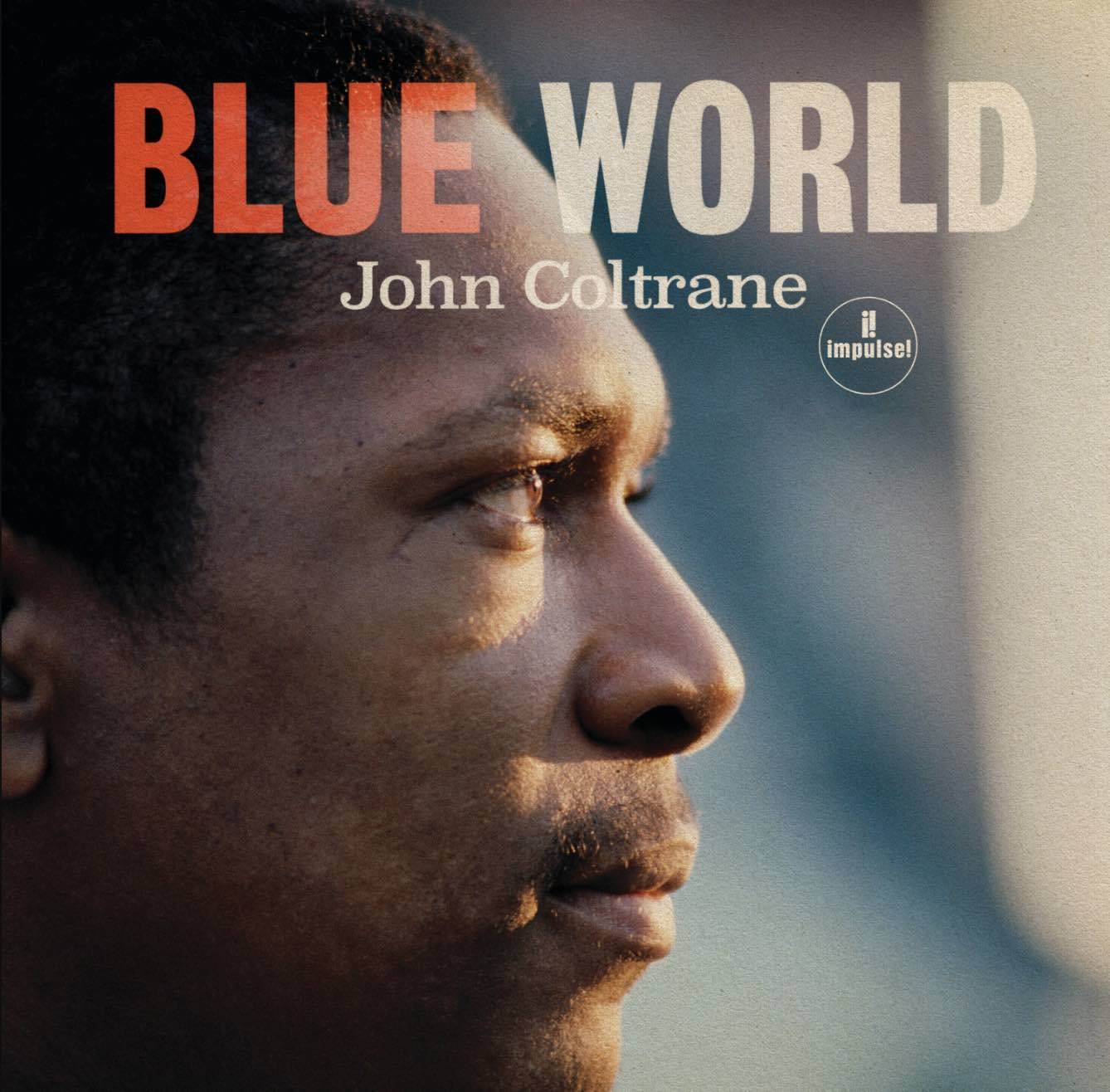
In the photo on the cover of soon-to-be-released Coltrane album Blue World, the legendary saxophonist and composer is shown in profile, gazing into the middle distance, resolute, vigilant, and searching—a ship’s captain sighting a new shore. Recorded at Rudy Van Gelder’s study in New Jersey in 1964, the collection of songs sees Coltrane guiding classic quartet of McCoy Tyner, Jimmy Garrison, and Elvin Jones between 1964’s “epic album” Crescent and their 1965 masterpiece, A Love Supreme.
Like the “lost album,” Both Directions at Once—made in 1963 and released just last year—the newly-discovered Blue Worldshowcases some excellent alternate takes of famous Coltrane compositions, as well as new (to most listeners) original material in the form of the title track, which you can hear in the video above. The album was recorded as a soundtrack to the film Le chat dans le sacby Quebecoise director Gilles Groulx, and the session’s “date had gone unnoticed” for decades “in session recordings logs” reports Nate Chinen at NPR. “The music has occupied a blind spot for Trane-ologists, archivists and historians.
The full album, to be released on September 27th, features two alternate takes of Giant Steps’ “Naima,” three takes of “Village Blues” and alternate recordings of “Like Sonny” and “Traneing In.” Blue World“offers a special opportunity,” notes Ashley Kahn in the album’s liner notes, “to compare these versions with previous perspectives, revealing both Coltrane’s personal progress and the interactive consistency and sonic details the Classic Quartet had firmly established as their collective signature.”
Fans of Groulx’s film will have heard 10 minutes of Blue World in the film, which is all the director ended up using of the 37-minute session, though the movie’s first viewers may not have known exactly what they were hearing in the title track, whose “methodical yet unscripted push into different tonal centers,” writes Chinen, expresses “a form of incantatory fervor” as a prelude to A Love Supreme. This posthumous release presages Coltrane’s modal forms moving into what is arguably the greatest, and most personal, work of his career.
The album also joins the distinguished company of jazz soundtracks for French New Wave films, like the Miles Davis-scored Elevator to the Gallows, directed by Louis Malle. Inspired by Godard and his jazz-loving contemporaries, Groulx’s very New Wave style can be seen in the excerpts from Le Chat dans le sac in the video at the top (and in the full film here). Coltrane’s restless energy continues to surprise and inspire over fifty years after his death, showing, perhaps, that there really “is never any end,” as he told Nat Hentoff around the time of Blue World’s recording. “There are always new sounds to imagine; new feelings to get at” in his timeless sound.
Look for Blue Worldfrom Impulse! records on September 27th. See a full tracklist, courtesy of Spin, below.
01 Naima (Take 1)
02 Village Blues (Take 2)
03 Blue World
04 Village Blues (Take 1)
05 Village Blues (Take 3)
06 Like Sonny
07 Traneing In
08 Naima (Take 2)
Among the slew of iconic late-60s acts who played Woodstock 50 years ago, one name stands out conspicuously for her absence: Joni Mitchell. Was she not invited? Did she decline? Was she double-booked? Mitchell was, of course, invited, and eagerly wanted to be there. The story of her non-appearance involves alarming headlines in The New York Times and an appearance on The Dick Cavett Show the day after the festival that her manager, Elliot Roberts and label head David Geffen, decided she simply couldn’t miss.
Her significant other at the time, Graham Nash, reached the upstate New York festival with CSNY, “by helicopter and a stolen truck hot-wired by Neil Young,” reports the site Nightflight. But Geffen and Mitchell, seeing the headline “400,000 People Sitting in Mud,” and a description of the roads as “so clogged with cars that concertgoers were abandoning them and walking,” decided they shouldn’t take the risk. (She described the scene as a “national disaster area.”) Instead, they watched news about the mud-splattered event from Geffen’s New York City apartment (other accounts say they holed up in the Plaza Hotel).
So how is it Mitchell came to write the definitive Woodstock anthem, with its era-defining lyric “we’ve got to get ourselves back to the garden”? In the way of all artists—she watched, listened, and used her imagination to conjure a scene she only knew of secondhand. CSNY’s version of “Woodstock” (live, below, at Madison Square Garden in 2009) is the one we tend to hear most and remember, but Mitchell’s—her voice soaring high above her piano—best conveys the song’s sense of youthful hippie idealism, mystical wonder, and just a touch of desperation. (At the top, she plays the song live in Big Sur in 1969.) David Yaffe, author of Reckless Daughter: A Portrait of Joni Mitchell describes the song as “purgation. It is an omen that something very, very bad will happen with the mud dries and the hippies go home.”
Mitchell did make the Cavett Show gig, alongside Stephen Stills, David Crosby, and Jefferson Airplane, all just returning from the festival. But she didn’t have much to say. Instead, the gregarious Crosby does most of the talking, describing Woodstock as “incredible, probably the strangest thing that’s ever happened in the world.” Surveying the scene from a helicopter, he says, was like seeing “an encampment of a Macedonian army on a Greek hill crossed with the biggest batch of gypsies you ever saw.” Later on the show, Mitchell played “Chelsea Morning” and other songs, after performances by Jefferson Airplane.
“The deprivation of not being able to go,” she remembered, “provided me with an intense angle” on the festival. “Woodstock, for some reason, impressed me as being a modern miracle, like a modern-day fishes-and-loaves story. For a herd of people that large to cooperate so well, it was pretty remarkable and there was tremendous optimism. So I wrote the song ‘Woodstock’ out of these feelings, and the first three times I performed it in public, I burst into tears, because it brought back the intensity of the experience and was so moving.”
She did finally get the chance to play “Woodstock” at Woodstock, in 1998 (above, on electric guitar), for an appreciative long-haired, tie-dyed audience—many of them nostalgic for a moment they missed or were too young to have experienced. The performance highlights the “sense of longing that became essential to the song’s impact,” as Leah Rosenzweig writes at Vinyl Me, Please. “Sure, it was the irony of the century”: the song that best captured Woodstock for the people who weren’t there was written by someone who wasn’t there. “But it was also a perfect recipe for Mitchell to do what she did best: draw humans together while remaining completely on the sidelines.”
Laurie Anderson began her career as an artist in the late 1960s, and since then she’s made connections both personal and professional with many of the most influential cultural figures of the past five decades. She has also, inevitably, seen a fair few of them depart this earthly existence, including her husband Lou Reed. The question of what happens to the dead is, for Anderson, apparently not without interest, even in the case of the non-human dead: the 2015 documentary Heart of a Dog traces the journey of Anderson’s late pet Lolabelle through the bardo, in Tibetan Buddhism the liminal state between death and rebirth.
The bardo is the central theme of Bardo Thodol, better known to Westerners in translation as The Tibetan Book of the Dead. On the new album Songs from the Bardo, Anderson reads from that eighth-century text with improvisational accompaniment by, among others, Tibetan musician Tenzin Choegyal and composer Jesse Paris Smith.
Stereogum’s Peter Helman writes that “Smith, the daughter of punk legend Patti Smith” — one of the many still-living influential artists in Anderson’s wide network — “first met Choegyal in 2008 at the annual Tibet House US Benefit Concert at Carnegie Hall.” Seven years later, they enlisted Anderson to narrate the first performed version of what would become Songs from the Bardo.
“Anderson narrates text from the Tibetan Book Of the Dead while Choegyal, Smith, cellist Rubin Kodheli, and percussionist Shahzad Ismaily provide the musical accompaniment,” writes Helman. “Smith plays piano and creates drone beds using a collection of crystal bowls, while Choegyal incorporates traditional Tibetan instruments like lingbu (a bamboo flute), dranyen (a lute-like stringed instrument), singing bowls, gong, and his own voice.” In the record’s liner notes, Choegyal writes of trying to “channel the wisdom and traditions of my ancestors through my music in a very contemporary way while holding the depth of my lineage.” The music, Anderson explains, “is meant to help you float out of your body, to go into these other realms, and to let yourself do that without boundaries.”
You can get a taste of this transcendence from “Lotus Born, No Need to Fear” the first sample track from the album the group has released. On it Anderson reads of the experience of the bardo, where “consciousness becomes airy, speeding, swaying, and impermanent.” For a Metafilter user named Capt. Renault, listening brings to mind another of Anderson’s artworks: her virtual-realty piece Aloft, which “has you sitting in an empty airplane which disintegrates around you, leaving you high, high above the ground with no support. You are aware of the possibility of death, but Laurie’s smooth, comforting voice leads to a complete absence of fear, and you are free to explore this world she’s created. Because of Laurie, I faced my death and I didn’t mind it.”
Based in Seoul, Colin Marshall writes and broadcasts on cities, language, and culture. His projects include the book The Stateless City: a Walk through 21st-Century Los Angeles and the video series The City in Cinema. Follow him on Twitter at @colinmarshall or on Facebook.
We're hoping to rely on loyal readers, rather than erratic ads. Please click the Donate button and support Open Culture. You can use Paypal, Venmo, Patreon, even Crypto! We thank you!
Open Culture scours the web for the best educational media. We find the free courses and audio books you need, the language lessons & educational videos you want, and plenty of enlightenment in between.