At an event celebrating the release of his new memoir, The Storyteller, Dave Grohl paid a visit to the Ford Theatre in Los Angeles and revisited his Nirvana days, playing drums to the original track of “Smells Like Teen Spirit.” It’s a little a remembrance of days long past. Enjoy.…
If you would like to support the mission of Open Culture, consider making a donation to our site. It’s hard to rely 100% on ads, and your contributions will help us continue providing the best free cultural and educational materials to learners everywhere. You can contribute through PayPal, Patreon, and Venmo (@openculture). Thanks!
Over the past 59 years, the duty of performing a James Bond movie theme has fallen to the likes of Tom Jones, Paul McCartney, Carly Simon, Bono, Madonna — and most recently, for the latest installment, No Time to Die, Billie Eilish. But one of the greatest Bond themes ever written has never been heard in any of the movies. This, in any case, is the contention of the video essay above, “How Radiohead Wrote the Perfect Bond Theme.” Commissioned for 2015’s Spectre, the second-most recent film in the series, Thom Yorke and company came up with a song that moves Listening In creator Barnaby Martin to declare, “This is Bond, but it’s also unmistakably Radiohead.”
Like many Bond title themes, Radiohead’s “Spectre” is in a minor key with “added blues notes,” working off the distinctive chord progression composer John Barry employed in the series’ original instrumental theme. And while, like most Bond title-theme performers, Radiohead are popular musicians, their actual work has always refused to align perfectly with straightforward pop-music expectations.
“Spectre” embodies both the band’s “love of rhythmical ambiguity” and their “trademark harmonic ambiguity.” The “beauty and simplicity of the music contrast painfully with the words,” reflecting “perfectly that dichotomy in contemporary Bond: a man struggling to reconcile love and duty.”
As if that weren’t enough, Radiohead’s song also includes unexpected but consummately Bond-esque compositional and instrumental moves. “It’s jazzy but discordant,” says Martin. “It’s a modern re-imagining of John Barry’s big-band orchestrations.” In every section the piece exquisitely maintains the tension between Radiohead and Bond, creating “an instantly compelling and dark musical world. Alas, it was ultimately replaced, ostensibly because the mood of the music and lyrics didn’t fit properly with that of the film: “We had this beautiful song,” lamented director Sam Mendes, “and we weren’t able to use it.” But that hasn’t stopped Bond aficionados from imagining what could have been, and you can get a sense of it in a fan video, previously featured here on Open Culture, that reunites “Spectre” with Spectre.
Based in Seoul, Colin Marshall writes and broadcasts on cities, language, and culture. His projects include the Substack newsletterBooks on Cities, the book The Stateless City: a Walk through 21st-Century Los Angeles and the video series The City in Cinema. Follow him on Twitter at @colinmarshall or on Facebook.
To lysergic acid diethylamide, better known as LSD, we owe much of what has endured from Western popular culture of the mid-20th century: consider, for instance, the latter half of the Beatles’ oeuvre. In Revolution in the Head: The Beatles’ Records and the Sixties, Ian MacDonald describes LSD as “a powerful hallucinogen whose function is temporarily to dismiss the brain’s neural concierge, leaving the mind to cope as it can with sensory information which meanwhile enters without prior arrangement — an uncensored experience of reality which profoundly alters one’s outlook on it.”
So profound is that alteration that some came to believe in a utopia achievable through universal ingestion of the drug: “If there be necessary revolution in America,” declared Allen Ginsberg, “it will come this way.” But most Americans didn’t see it quite the same way. It was for them that CBS made its broadcast “The Hippie Temptation.” Aired in August 1967, three months after the release of Sgt. Pepper’s Lonely Heart’s Club Band, it constitutes an exposé of LSD-fueled youth culture as it effervesced at the time in and around San Francisco’s countercultural mecca of Haight-Ashbury.
“The hippies present a strange problem,” says correspondent Harry Reasoner, later known as the host of 60 Minutes. “Our society has produced them. There they are, in rapidly increasing numbers. And yet there seem to be very few definite ideas behind the superficial glitter of their dress and behavior.” In search of the core of the hippie ideology, which seems outwardly to involve “standing apart from society by means of mutual help and love,” Reasoner and his collaborators delve into the nature of LSD, whose users “may see a wild complexity of images, hear a multiplicity of sounds. This is called ‘taking an acid trip.’ ”
Alas, “for many, the price of taking the shortcut to discovery the hippies put forward turns out to be very high.” A young doctor from UCLA’s neuropsychiatric institute named Duke Fisher argues that most LSD users “talk about loving humanity in general, an all-encompassing love of the world, but they have a great deal of difficulty loving one other person, or loving that specific thing.” Also included in “The Hippie Temptation” are interviews with young people (albeit ones cleaner-cut than the average denizen of late-60s Haight-Ashbury) placed into medical facilities due to hallucinogen-related mishaps, including suicide attempts.
“There is the real danger that more and more young people may follow the call to turn on, tune in, drop out,” Reasoner declares, in keeping with the broadcast’s portentous tone. Even then there were signs of what MacDonald calls “the hippie counterculture’s incipient commercialization and impending decline into hard drugs.” But to this day, “that there was indeed something unusual in the air can still be heard from many of the records of the period: a light, joyous optimism with a tangible spiritual aura and a thrillingly fresh informality” — a quality MacDonald finds concentrated in the work of not just The Beatles but the Grateful Dead, who sit for an interview in “The Hippie Temptation.” LSD may no longer be as tempting as it was half a century ago, but many of the creations it inspired then still have us hooked today.
Based in Seoul, Colin Marshall writes and broadcasts on cities, language, and culture. His projects include the Substack newsletterBooks on Cities, the book The Stateless City: a Walk through 21st-Century Los Angeles and the video series The City in Cinema. Follow him on Twitter at @colinmarshall or on Facebook.
Youtuber Polyphonic has done a good job of looking at some hoary old classics of ‘60s rock, but he doesn’t always dip his toe in taking on contemporary music, or even considering a modern canon. Pronouncing what is essential listening of the last few decades is a minefield, especially among the ranks of Commentus YouTubus.
So their choice to explore Nick Cave and the Bad Seeds’ “Red Right Hand” is a deft one. It’s not Cave’s most well-known song—-that would be “The Mercy Seat”—-but it’s one that many non-Cave fans know regardless. Though released in 1994, it’s now best known as the theme song from Peaky Blinders, though it also showed up in all three of the first Scream films. It’s been used to sell tequila and tourism as well.
Polyphonic first delves into the source of the title—the “Red Right Hand”—as coming from Milton’s Paradise Lost, spoken by fallen angel Belial:
“What if the breath that kindled those grim fires,
Awaked, should blow them into sevenfold rage,
And plunge us in the flames; or from above
Should intermitted vengeance arm again
His red right hand to plague us?”
This is the hand of God, and a vengeful, Old Testament one at that. But that will only get you so far into the lyrics of this creepy song. As Polyphonic peels back the layers of Cave’s verses, the man with the red right hand could be God, could be the Devil, could be a man, could be a ghost. He could offer you a Faustian pact, or they could take everything away immediately. It could be government, or capitalism, or the media, or materialism.
Cave, to the song’s credit, leaves everything in a liminal space (as Polyphonic illustrates with the kind of crossroads blues players love to sing about). What’s left is a warning, a sense of unease, a feeling that maybe it’s already too late. Maybe we really are just all fallen angels with no idea how to get back home to paradise.
That’s why Cave includes it in most of his live sets. He can improvise on the lines, adding, as he has been doing, references to Twitter and social media. Cave might have left his religious upbringing in his youth, but he knows that the best way to express the unease of the modern condition is to get biblical. And part of that is mystery. Even fellow Bad Seed Mick Harvey knows not to go looking for answers from his friend about this particular song.
“I still find it mysterious,” he told the New York Post. “I don’t want to know the details, and I’d never ask Nick. Sometimes it’s better to think ‘What the hell’s that all about?’ It’s better that it’s unknowable and spooky.”
As a bonus, here’s Snoop Dogg’s quizzical cover version where he pushes and is pulled between his own style and Cave’s.
Ted Mills is a freelance writer on the arts who currently hosts the Notes from the Shed podcast and is the producer of KCRW’s Curious Coast. You can also follow him on Twitter at @tedmills, and/or watch his films here.
BB King gave one of the best performances of his career from behind the walls of Sing Sing, three years after Cash’s concert at San Quentin. King himself hadn’t done time, but having grown up in poverty on a cotton plantation in Mississippi, he well understood the conditions that led people to incarceration.
As his keyboardist Ron Levy said after an earlier prison concert in Cook County Jail, “If anybody had the blues, it was those people incarcerated. And BB really felt compassion for those guys.” Likewise, Johnny Cash never did hard time, but his childhood poverty, struggles with addiction, and love for underdogs and outcasts lent him an authenticity inmates recognized immediately.
Other matchups between stars and prison audiences have not only been less authentic, but sometimes downright baffling, as when Bonnie Tyler gave a concert at Long Lartin prison in England …. or so the inmates thought. It turned out Tyler had only used her audience as props for a botched music video that never aired. This, clearly, is how not to run a prison concert, also the title of the Bandsplaining video at the top, which begins with Tyler’s kerfuffle and goes on to examine the genre of prison concerts through prison concert films, TV, and albums.
Johnny Cash, the Grateful Dead, BB King, Freddie King, John Lee Hooker, The Cramps, Fugazi, and Fugazi’s previous incarnation, Minor Threat, are all covered here. Missing are artists like Freddy Fender (who did it before Cash), Sonny James, and Big Mama Thornton, who released an album called Jail in 1975, compiled from two different prison performances, and who surely deserves top honors for knowing how to do it right. In prison, writes Music Times, “she finally gets to perform her hit, ‘Ball ‘n’ Chain’ — which was made famous by Janis Joplin and The Holding Company — where it was made to be played: Jail.”
Many and bold are the claims made for the power of classical music: not just that it can enrich your aesthetic sensibility, but that it can do everything from deter juvenile delinquency to boost infant intelligence. Making claims for the latter are CDs with titles like Baby Mozart: Music to Stimulate Your Baby’s Brain, a case of trading on the name of one of the most beloved composers in music history. Alas, the proposition that classical music in general can make anyone smarter has yet to pass the most rigorous scientific trials. But recent research does suggest that Mozart’s music in particular has desirable effects on the brain: his Sonata for Two Pianos in D Major on epilepsy-afflicted brains in particular.
For about 30 years the piece has been thought to reduce symptoms of epilepsy in the brain, a phenomenon known as the “K448 effect” (the number being a reference to its place in the Köchel catalogue). Recent work by researchers at the Geisel School of Medicine, Dartmouth-Hitchcock Medical Center (DHMC) and Dartmouth College’s Bregman Music and Affective Sound Lab has gone deep into the workings of that effect, and you can read the results free online: the paper “Musical Components Important for the Mozart K448 Effect in Epilepsy,” published just last month in Nature. What they’ve found suggests that the K448 effect is real: that the piece is effective, to be more specific, in “reducing ictal and interictal epileptiform activity.”
Writing for non-neuroscientists, Madeleine Mudzakis at My Modern Met explains that when the researchers “played the tune while monitoring brain implant sensors in the subjects,” they detected “events known as interictal epileptiform discharges (IEDs). These brain events are a symptom of epilepsy and are harmful to the brain.” But “after 30 seconds of listening to the sonata, the subjects experienced noticeably fewer IEDs,” and “transitions between musical phases lead to larger effects, possibly because of anticipation being created which culminates in the pleasant nature of a shifted tune.” These neurologically soothing qualities may also have something to do with the pleasure all Mozart aficionados, epileptics or otherwise, feel when they hear the Sonata for Two Pianos in D Major — or what they don’t feel when they hear Wagner, whose music was here employed as the control that every proper scientific experiment needs.
Based in Seoul, Colin Marshall writes and broadcasts on cities, language, and culture. His projects include the Substack newsletterBooks on Cities, the book The Stateless City: a Walk through 21st-Century Los Angeles and the video series The City in Cinema. Follow him on Twitter at @colinmarshall or on Facebook.
Access to technology has transformed the creative process, and many artists who’ve come to depend on it have long ceased to marvel at the labor and time saved, seething with resentment when devices and digital access fails.
Musician Nick Cave, founder and frontman of The Bad Seeds, is one who hasn’t abandoned his analog ways, whether he’s in the act of generating new songs, or seeking respite from the same.
“There has always been a strong, even obsessive, visual component to the (songwriting) process,” he writes, “a compulsive rendering of the lyric as a thing to be seen, to be touched, to be examined:”
I have always done this—basically drawn my songs—for as long as I’ve been writing them…when the pressure of song writing gets too much, well, I draw a cute animal or a naked woman or a religious icon or a mythological creature or something. Or I take a Polaroid or make something out of clay. I do a collage, or write a child’s poem and date stamp and sticker it, or do some granny-art with a set of watercolour paints.
Last year, these extra creative labors became fruits in their own right, with the opening of Cave Things, an online shop well stocked with quirky objects “conceived, sourced, shaped, and designed” by the musician.
These include such longtime fascinations as prayer cards, picture discs, and Polaroids, and a series of enameled charms and ceramic figures that evoke Victorian Staffordshire “flatbacks.”
T‑shirts, guitar picks and egg cups may come graced with doodles of frequent collaborator Warren Ellis’ bearded mug, or the aforementioned naked women, which Cage describes to Interview’s Ben Barna as “a compulsive habit I have had since my school days”:
They have no artistic merit. Rather, they are evidence of a kind of ritualistic and habitual thinking, not dissimilar to the act of writing itself, actually.
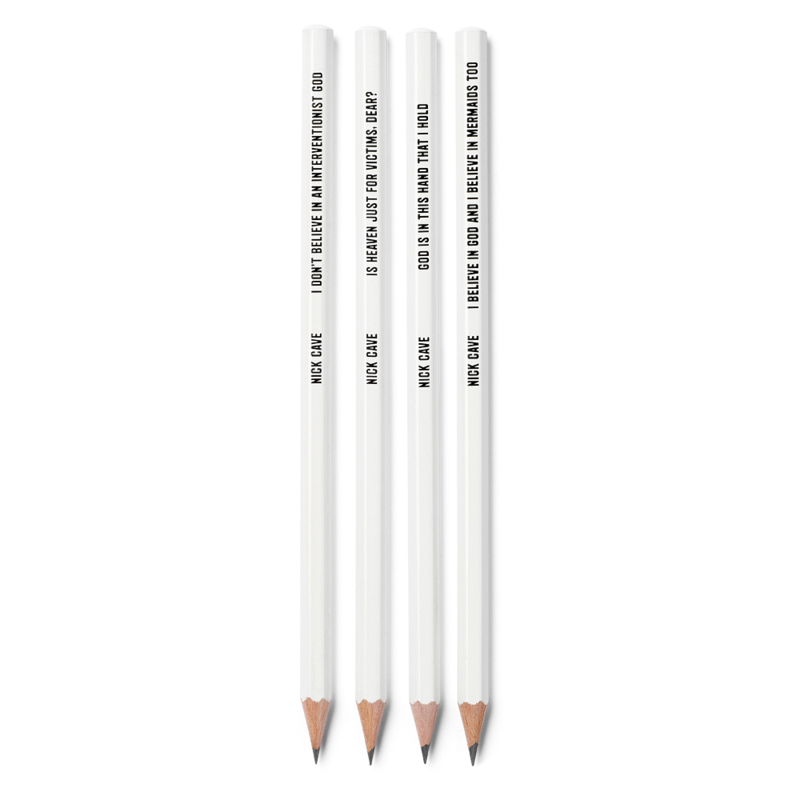
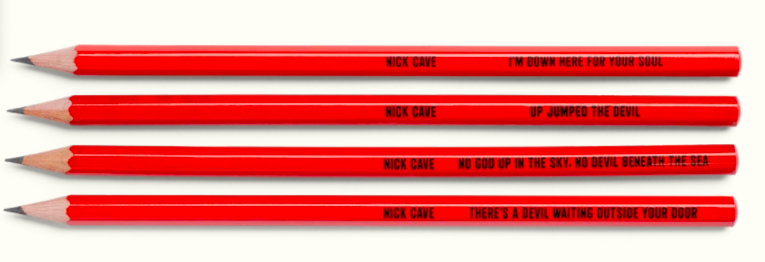
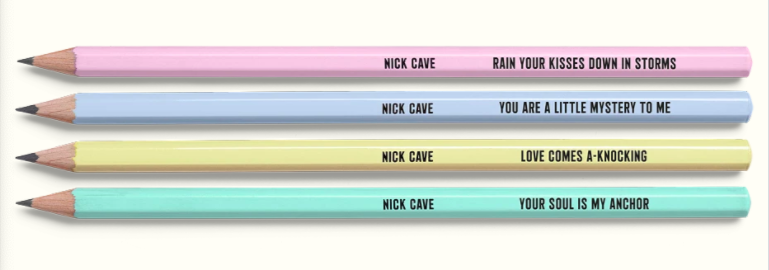
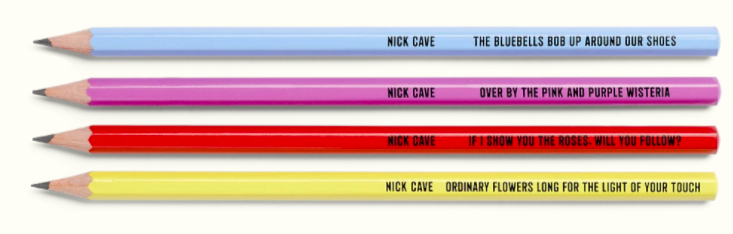
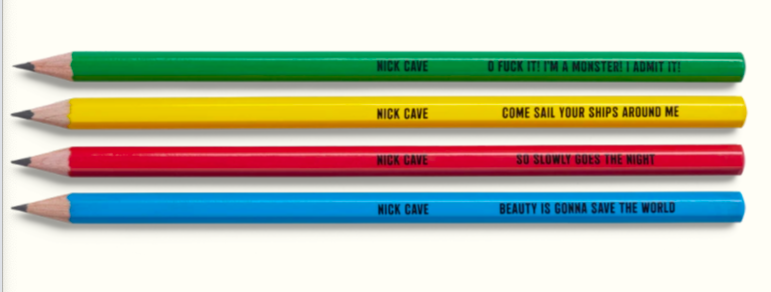
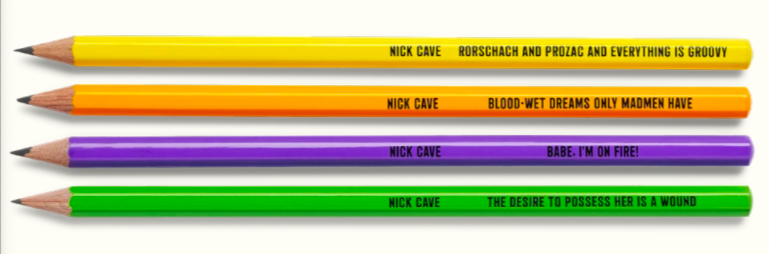
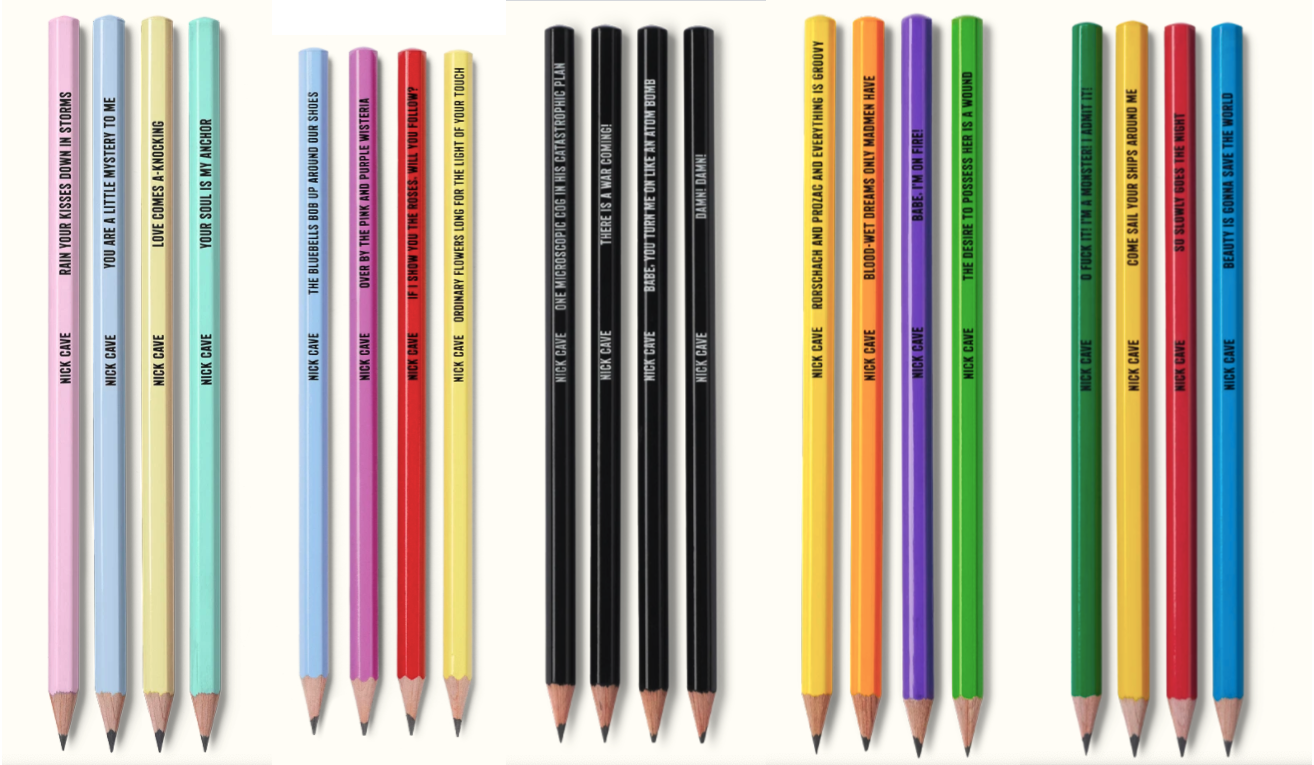
Of all of Cave’s Cave Things, the ones with the broadest appeal may be the pencil sets personalized with thematic snippets of his lyrics.
A red devil pencil bearing lines from “Brompton Oratory” slips a bit of god into the mix, as well as a reference to the sea, a frequent Cave motif.
Madness and war pencils are counterbalanced by pencils celebrating love and flowers.
Put them all in a cup and draw one out at random, or let your mood or feelings about what said pencil will be writing or drawing determine your pick.
Meanwhile Cave’s implements of choice may surprise you. As he told NME’s Will Richards last December:
My process of lyric writing is as follows: For months, I write down ideas in a notebook with a Bic medium ballpoint pen in black. At some point, the songs begin to reveal themselves, to take some kind of form, which is when I type the new lyrics into my laptop. Here, I begin the long process of working on the words, adding verses, taking them away, and refining the language, until the song arrives at its destination. At this stage, I take one of the yellowing back pages I have cut from old second-hand books, and, on my Olympia typewriter, type out the lyrics. I then glue it into my bespoke notebook, number it, date-stamp it, and sticker it. The song is then ‘officially’ completed.
“If you had tried to give rock and roll another name, you would call it Chuck Berry,” says John Lennon by way of introduction to his hero in the clip above from The Mike Douglas Show. The two perform Berry’s “Memphis, Tennessee” and “Johnny B. Goode” (with Lennon’s backing band, Elephant’s Memory, and unwelcome discordant backing vocals from Yoko). The moment was a major highlight of Lennon’s post-Beatles’ career. The year was 1972, and Lennon and Yoko Ono had taken over Douglas’ show for the week, booking such guests as Ralph Nader, Jerry Rubin, and then Surgeon General Dr. Jesse Steinfeld. Douglas called it “probably the most memorable week I did in all my 20-something years on air,” Guitar World notes. Lennon used it as the opportunity to finally meet, and jam out, with his idol.
Berry wasn’t just a major inspiration for the young Lennon; “From his songwriting and lyrics, to his guitar playing and stage antics, perhaps nobody else short of Elvis Presley was as influential on [all] the young Beatles as Chuck Berry,” writes Beatles scholar Aaron Krerowicz, listing “at least 15” of Berry’s songs the band covered (as either the Quarrymen or the Beatles). Paul McCartney credits Berry for the Beatles’ very existence. They were fans, he wrote in tribute after Berry’s death, “from the first minute we heard the great guitar intro to ‘Sweet Little Sixteen.’” But it wasn’t only Berry’s playing that hooked them: “His stories were more like poems than lyrics…. To us he was a magician.”
McCartney first pointed out the similarities between Lennon’s “Come Together” (originally penned as a campaign song for Timothy Leary’s run against Ronald Reagan for the governorship of California) and Berry’s 1956 “You Can’t Catch Me,” he tells Barry Miles in Many Years From Now. “John acknowledged it was rather close to it,” says Paul, “so I said, ‘Well, anything you can do to get away from that.’” Despite the resulting “swampy” tempo, Berry’s legal team still sued over the lyric “here comes old flat-top,” a direct lift from Berry’s song. In an out-of-court settlement, Lennon agreed to record even more of Berry’s tunes. “You Can’t Catch Me” appears on Lennon’s 1975 album of classic covers, Rock ‘n’ Roll.
This legal tussle aside, there was no beef between the two. The appearance on Douglas’ show proved to be a huge boost for Berry, who revitalized his career that year with the suggestive, controversial “My Ding-a-Ling,” his biggest-selling hit, and — in an ironic twist — originally a goofy novelty song composed and recorded by Dave Bartholomew 20 years earlier. When asked by Douglas, however, what drew him to Berry’s music, Lennon echoes McCartney: “[Berry] was writing good lyrics and intelligent lyrics in the 1950s when people were singing ‘Oh baby, I love you so.’ It was people like him that influenced our generation to try and make sense out of the songs rather than just sing ‘do wah diddy.’”
Lennon wasn’t above covering Gene Vincent’s “Be-Bop-a-Lula” a few years later, and the Beatles themselves mixed intelligent narrative songwriting with healthy doses of pop nonsense — patterning themselves after the man Lennon called “my hero, the creator of Rock and Roll.” A few years after Lennon’s 1980 death, Berry returned the compliment, calling Lennon “the greatest influence in rock music” before bringing Julian Lennon onstage and exclaiming, “ain’t he like his pa!”
The year was 1986 and the occasion was Berry’s 60th birthday concert. After their performance of “Johnny B. Goode,” Berry leaned over to Julian and said, “Tell papa hello. I’ll tell you what he says. I’ll see him.” It’s a bittersweet moment. Little, I guess, did Berry suspect that he would rock on for another 30 years, releasing his final, posthumous album in 2017 after his death at age 90.
We're hoping to rely on loyal readers, rather than erratic ads. Please click the Donate button and support Open Culture. You can use Paypal, Venmo, Patreon, even Crypto! We thank you!
Open Culture scours the web for the best educational media. We find the free courses and audio books you need, the language lessons & educational videos you want, and plenty of enlightenment in between.