If you have not yet seen the first installment of Denis Villeneuve’s reimagining of Dune, you will find no spoilers here, though if you’ve read Frank Herbert’s cult classic novel and/or seen David Lynch’s film adaptation (or even the forgettable TV miniseries from 20 years ago), you are familiar with the story. You can, however, hear Hans Zimmer’s complete soundtrack above. If you love it, and if film critic Mick LaSalle is right, you’re in for a treat: “If you like the music here, you’ll probably like the movie,” LaSalle writes in a San FranciscoChronicle review. “If you hate it, you can’t possibly enjoy Dune.”
The film’s music is relentless and creates a “sense of something strange and unfamiliar,” making sure “we never forget we’re watching an entirely alien universe.” Veteran blockbuster composer Hans Zimmer created this sonic atmosphere with studio effects and nontraditional instrumentation, though one familiar element remains, as he tells Indiewire:
I kept thinking, wherever you are in the future, the instruments will change due to technology, and we could be far more experimental, but the one thing that remains is the human voice, which there is a lot of.
Those voices include that of singer Lisa Gerrard, formerly of Dead Can Dance, who “came up with this language that is all her own. It could be from the future, it could be from a different world.”
Zimmer’s approach almost mirrors that of his first big break, the score for 1988’s Rain Man, of which he said in 2008, “The Raymond character doesn’t actually know where he is. The world is so different to him. He might as well be on Mars. So, why don’t we just invent our own world music for a world that doesn’t really exist?” Villeneuve’s Dune gives us an entire interplanetary civilization for which to invent music that didn’t exist before. “I felt like there was a freedom to get away from a Western Orchestra,” Zimmer told The New York Times, in a major understatement.
One piece of music, played as the Atreides family arrives on Arrakis, involved 30 bagpipers, recorded together in Edinburgh while socially distanced. “Along with synthesizers,” writes The New York Times’ Darryn King, “you can hear scraping metal, Indian bamboo flutes, Irish whistles, a juddering drum phrase that Zimmer calls an ‘anti-groove,’ seismic rumbles of distorted guitar” and “a war for that is actually a cello.” The result “might be one of Zimmer’s most unorthodox and most provocative” pieces of work, and a far cry from the music that accompanied David Lynch’s beautiful failure of a film in 1984.
Zimmer claims never to have seen Lynch’s film nor heard the soundtrack by soft-rock superstars Toto, unwilling to compromise the Dune he’d been imagining since he first read the book. “I’ve been thinking about Dune for nearly 50 years,” he says. Lynch has been trying to forget his film for almost as long. The dense, complicated mess of an adaptation so confused film execs and test audiences that the studio added introductory exposition, above, and handed out glossaries to audiences at the first screenings (though not, presumably, flashlights).
The choice of superstars Toto, of “Africa” fame, brought audiences of Lynch’s film a “luxuriant and peculiar soundtrack,” supplemented by the Vienna Symphony Orchestra and a composition by Brian Eno. But it also integrated familiar 80’s rock touches (as in “Desert Theme,” above), giving the alien world Lynch imagined both a familiar sonic texture and a dated sound. Thirty-seven years later, science fiction films need no such comforting apparatus to make them palatable. As both Villeneuve and Zimmer realized in their work on Dune, a film about a totally unfamiliar future civilization — even one filled with humans who look like us — can look and sound as strange as technology and imagination will allow.
Since its launch in 2015, Masterclass has not only expanded the variety of its online course offerings but sought out ever-bigger names for its teachers. Names don’t come much bigger than Metallica in the world of heavy metal, and indeed in the world of rock music in general. Hence the broad title of the new Masterclass “Metallica Teaches Being a Band.” Having been a band for 40 years now, they presumably know more than a little about everything involved in that enterprise: not just recording hit albums like Master of Puppets and songs like “Enter Sandman,” but also weathering dramatic changes in both the music business and popular culture while cooperating for the good of the group.
Not that, to the men of Metallica, such cooperation has always come naturally. “There’ve been times when it’s been fractured and it looks like we were on the verge of breaking up,” says guitarist Kirk Hammett in the trailer for their Masterclass above.
He joined the band in 1983, which means he has very nearly as long a standing in the band as its founders, lead vocalist/rhythm guitarist James Hetfield and drummer Lars Ulrich. All of them, along with bassist Robert Trujillo, appear here as teachers to share their accumulated wisdom, have to do as it may with songwriting, performance, interpersonal communication, or the management of time and anger.
Like all Masterclasses, Metallica’s course is divided into many easily watchable video lessons, most with a practical slant. Musically inclined viewers, even those with no interest in becoming heavy-metal icons, will benefit from learning to work “From Riff to Song,” the principles of “Putting Together an Album,” and the art of “Navigating Egos.” But for Metallica fans in particular — whom, collectively, the band consider their fifth member — few lessons in any Masterclass could be as gripping as the deconstructions of “Enter Sandman,” “Master of Puppets,” and “One.” They do all this in a calmer, more reflective psychological place than the bitter, near-dysfunctional one in which the 2004 documentary Metallica: Some Kind of Monster found them — but not so calm and reflective that they can’t finish the course off with, as Hammett puts it, “a bad-ass performance.”
When you sign up to become a Masterclass member ($180 per year), you will have access to Metallica’s course plus 100 others.
Note: If you sign up for a MasterClass course by clicking on the affiliate links in this post, Open Culture will receive a small fee that helps support our operation.
Based in Seoul, Colin Marshall writes and broadcasts on cities, language, and culture. His projects include the Substack newsletterBooks on Cities, the book The Stateless City: a Walk through 21st-Century Los Angeles and the video series The City in Cinema. Follow him on Twitter at @colinmarshall or on Facebook.
A little more than a month after the terrorist attacks on 9/11, with the nation and world still reeling from that day, Madison Square Garden hosted The Concert for New York City. A benefit concert of the first order, it was also a thank you to the sacrifice of NYC’s fire and police departments, which had lost many members during that day. (The former had lost 343 firefighters.) But like a lot of things about that day twenty years later, it has sort of vanished down the cultural memory hole.
However, if you need reminding, the Who came out of retirement and delivered what some considered the set of the night. Tom Watson, writing in Forbes magazine, called it “The Night The Who Saved New York.”
The concert was free to any firefighter or policeman who came in uniform. Watson describes the vibe thus:
“To say that occupancy laws were stretched that night is to undersell the size of the place. Picture a Knicks game, then double the crowd. From the start, the building ran on a river of emotion and beer, which, if you wore a uniform — or your late loved one’s cap — was free. The thousands of cops in attendance studiously ignored thousands of other cops and firefighters lighting up a little reefer. Large bottles of high proof spirits were produced. The Garden was the biggest Irish wake in history.”
In a moment like this, a lot of the artists headed towards jingoism. It was understandable. Songs about America (David Bowie), songs about New York City (Billy Joel), songs about freedom (Paul McCartney), songs about heroes (also Bowie). But, what the crowd wanted that night was catharsis, and that’s what the Who brought.
The set is the Who at their most anthemic, but also the most representative of the classic rock radio these uniformed men and women and their families grew up with: “Who Are You,” “Baba O’Reilly,” “Behind Blue Eyes,” and ending with “Won’t Get Fooled Again.” However the line “meet the new boss, same as the old boss” is quietly deleted. Not this time, cynicism.
The concert was exactly what was needed for the grief of the community. And death hangs over the whole event, as camera cut to family members holding up photos of lost loved ones, while the World Trade Center rubble still smoldered.
And then there’s what nobody knew at the time: this would be bassist John Entwistle’s last gig before his fatal heart attack eight months later. So many of the remaining first responders would die from the toxic chemicals breathed in on 9/11, and still they fight for some recompense from the government that honored them at first. Mayor Giuliani…well, we know what happened to him. And that ass whoopin’ we promised the Middle East wound up kicking America’s economy in the butt instead.
Twenty years later the performance still holds up, a moment in time just before we all got fooled again.
Ted Mills is a freelance writer on the arts who currently hosts the Notes from the Shed podcast and is the producer of KCRW’s Curious Coast. You can also follow him on Twitter at @tedmills, and/or watch his films here.
Wassily Kandinsky could hear colors. Maybe you can too, but since studies so far have suggested that the underlying condition exists in less than five percent of the population, the odds are against it. Known as synesthesia, it involves one kind of sense perception being tied up with another: letters and numbers come with colors, sequences take on three-dimensional forms, sounds have tactile feelings. These unusual sensory connections can presumably encourage unusual kinds of thinking; perhaps unsurprisingly, synesthetic experiences have been reported by a variety of creators, from Billy Joel and David Hockney to Vladimir Nabokov and Nikola Tesla.
Few, however, have described synesthesia as eloquently as Kandinsky did. “Color is the keyboard,” he once said. “The eye is the hammer. The soul is the piano with its many strings. The artist is the hand that purposely sets the soul vibrating by means of this or that key.”
That quote must have shaped the mission of Play a Kandinsky, a collaboration between Google Arts and Culture and the Centre Pompidou. Enlisting the compositional services of experimental musicians Antoine Bertin and NSDOS, it gives even us non-synesthetes a chance to experience the intersection of sound and not just color but shape as well, in something of the same manner as the pioneering abstract painter must have.
As explained in the Listening In video above, Kandinsky heard yellow as a trumpet, red as a violin, and blue as an organ. An image of sufficient chromatic and formal variety must have set off a symphony in his head, much like the one Play a Kandinsky gives us a chance to conduct. As an interface it uses his 1925 painting Yellow-Red-Blue, each element of which, when clicked, adds another synesthetic layer of sound to the mix. These visual-sonic correspondences are based on Kandinsky’s own color theories as well as the music he would have heard, all processed with the formidable machine-learning resources at Google’s command. “What was he trying to make us feel with this painting?” Play a Kandinsky asks. But of course he didn’t have just one set of emotions in mind for his viewers, and making that possible was perhaps the most enduring achievement of his journey into abstraction.
Based in Seoul, Colin Marshall writes and broadcasts on cities, language, and culture. His projects include the Substack newsletterBooks on Cities, the book The Stateless City: a Walk through 21st-Century Los Angeles and the video series The City in Cinema. Follow him on Twitter at @colinmarshall or on Facebook.
Few jazz guitarists today could claim to be entirely free of the influence of Django Reinhardt. This despite the fact that he lost the use of two fingers — which ultimately encouraged him to develop a distinctive playing style — and that he died 68 years ago. The unfortunate abbreviation of Reinhardt’s life means that he never built a substantial body of solo work, though he did play on many recorded dates that include performances alongside Coleman Hawkins and Benny Carter. It also means that he left even less in the way of footage, though we do get a crisp and illuminating view of him and his guitar in the 1938 documentary short “Jazz ‘Hot,’ ” previously featured here on Open Culture.
“Jazz ‘Hot’ ” also features violin-playing from Stéphane Grappelli, who founded the group Quintette du Hot Club de France with Reinhardt in 1934. As they deepened their knowledge of jazz, the two influenced each other so thoroughly as to develop their own style of music.
Grappelli lived long enough to play with the likes of Jean-Luc Ponty, Paul Simon, Yo Yo Ma, and even Pink Floyd. Still, more than a few jazz fans would surely claim that none of his professional collaborators was more important to his musical formation than Reinhardt. Now you can see them playing together in color, and fairly realistic color at that, in the clip at the top of the post.
The original black-and-white footage (which appears just above) was colorized with DeOldify, a deep learning-based application developed to restore photographs and motion pictures from bygone times. Perhaps you’ve seen the previous DeOldify colorization projects we’ve featured here, which run the gamut from musical numbers in Stormy Weather and Hellzapoppin’ to scenes of 1920s Berlin and even an 1896 snowball fight in Lyon. Granted access to a time machine, more than a few jazz-lovers would no doubt choose to go back to the Paris of the 1930s to see the Quintette du Hot Club de France in action. Technology has yet to make that a viable proposition, but it’s given us a next-best-thing that no appreciator of jazz guitar — or jazz violin — could fail to enjoy.
Based in Seoul, Colin Marshall writes and broadcasts on cities, language, and culture. His projects include the Substack newsletterBooks on Cities, the book The Stateless City: a Walk through 21st-Century Los Angeles and the video series The City in Cinema. Follow him on Twitter at @colinmarshall or on Facebook.
“Believe it or not, this was the very first piece of music I started on the cello when I was four years old,” said Yo Yo Ma before playing the “Prelude” from J.S. Bach’s Unaccompanied Cello Suite No. 1 for NPR’s Tiny Desk concert series in 2018. That same year, the world-famous cello prodigy released his third recording of all six suites in an album titled Six Evolutions — Bach: Cello Suites. The “two-and-a-half hours of sounds that map humanity in all its triumphs, joys and sorrows,” write NPR’s Mary Louise Kelly and Tom Huizenga, “has become a lodestar for the celebrated cellist.”
Ma made his first recording of the Unaccompanied Cello Suites in 1983, and won a Grammy the following year. “He released another set in 1997,” a recording that shows the musician’s own evolution in collaboration with “architects, ice skaters and Kabuki artists.” But his performance of the suites has always been evolutionary, as a New York Times reviewer noted of a live performance in 1991: “Certainly solitary study or at most the presence of a few colleagues was the intended milieu, not the vastness of Carnegie Hall, the presence of 2,800 listeners and the marathon format of two complete recitals with an hour’s break between them.”
No matter Bach’s intentions for the pieces, they have served as Ma’s musical home, and he’s carried them with him wherever he goes, as in the full 2015 performance above at the Royal Albert Hall. See time stamps of the performance just below:
0:00 Introduction 3:49 Suite I in G Major 22:25 Suite II in D Minor 42:51 Suite III in C Major — with interview and short break 1:13:09 Suite IV in E‑Flat Major 1:40:50 Suite V in C Minor 2:08:46 Suite VI in D Major
Here, as he had done nearly a quarter of a century earlier at Carnegie Hall, Ma not only proves that Bach’s music “travels well,” but he also reaffirms his commitment to the Unaccompanied Cello Suites. As he writes in the notes to Six Evolutions:
Bach’s Cello Suites have been my constant musical companions. For almost six decades, they have given me sustenance, comfort, and joy during times of stress, celebration, and loss. What power does this music possess that even today, after three hundred years, it continues to help us navigate through troubled times? Now that I’m in my sixties, I realize that my sense of time has changed, both in life and in music, at once expanded and compressed. Music, like all of culture, helps us to understand our environment, each other, and ourselves. Culture helps us to imagine a better future. Culture helps turn ‘them’ into ‘us.’ And these things have never been more important.
These are the principles upon which Ma has staked his musical claim, as he now travels the world to deliver Bach to audiences everywhere. The Bach Project aims for “36 concerts. 36 days of action. 6 continents,” and “1 experiment: how culture connects us.”
Unable to travel in May of 2020, Ma instead played all six cello suites live on television at Boston’s WGBH studios, live-streaming the broadcast on YouTube. Now, he’s back on his trek, playing everywhere “the same masterpiece,” notes Radio Open Source, “the rarest solo performance piece that can show you infinity… an old artistic masterpiece that’s also a modern showpiece for a solo performer who fills giant venues, East and West, indoors and out, in Chile and China, in Africa and the Andes, with audiences that seem to sit breathless for most of two and a half hours.” Does Ma’s belief that Bach can “save the world” seem a little Pollyanish? Perhaps. But what other piece of music, and what other performer, has attained such universal goodwill? Learn more about Ma’s Bach Project here and see him play the Prelude for the whole world in the video above.
Oh, to be in the studio audience of CBS’ Television City in Hollywood on September 9th, 1956, to see Elvis Presley’s gyrating pelvis rocket him to superstardom on The Ed Sullivan Show.
His appearance made television history, but 60 million home viewers were left to fill in some major blanks, as the rising heartthrob was filmed from the waist up whenever he was in motion.
Sullivan had been hesitant to book Elvis, not wanting to court the outrage the magnetic young singer had sparked in two “suggestive” appearances on The Milton Berle Show earlier that year. Elvis, he told the press, was “not my cup of tea” and “wasn’t fit for family entertainment.”
Elvis was displeased by this jokey spin, but submitted, and newcomer Allen’s ratings clobbered Sullivan’s that week.
Sullivan sent Steve Allen a telegram:
Steven Presley Allen, NBC TV, New York City. Stinker. Love and kisses. Ed Sullivan.
Whether Sullivan was throwing down a gauntlet, or delivering congratulations with a side of poor sportsmanship is somewhat unclear, but Sullivan was now ready to claim his stake, at ten times the price.
The $5,000 appearance fee that had been floated prior to Elvis’ appearance on The Milton Berle Show, had ballooned to the jaw dropping sum of $50,000 for 3 episodes.
Sullivan and Presley’s names are forever linked for that historic first appearance, but injuries from a car crash knocked the host out of commission. Actor Charles Laughton subbed in as host from Sullivan’s New York studio, and was charged with ushering in Elvis’s remote appearance in a very particular way.
Presley was the headliner, and a Sullivan headliner normally opened the show, but Sullivan was burying him. Laughton had to make the moment invisible: to act as if nobody was actually waiting for anything. He did it instantly, with complete command, with the sort of television presence that some have and some — Steve Allen, or Ed Sullivan himself — don’t. It’s a sense of ease, a querulous interrogation of the medium itself, affirming one’s own odd, irreducible subjectivity against the objectivity enforced by any system of representations: that is, getting it across that at any moment that you might forget where you are and say whatever comes into your head, which was exactly what half the country hoped and half the country feared might be the case with Elvis Presley.
Laughton, who elsewhere in the show used a reading of James Thurber’s Red Riding Hood parody, “The Little Girl and the Wolf” to insinuate that “it’s not so easy to fool little girls nowadays as it used to be,” settled on a non-committal “and now, away to Hollywood to meet Elvis Presley!”
Elvis, clad in a non-threatening plaid jacket on a set trimmed with guitar-shaped cut outs, thanked Laughton, and wiped his brow:
Wow. This is probably the greatest honor I’ve ever had in my life. Ah. There’s not much I can say except, it really makes you feel good. We want to thank you from the bottom of our heart.
His first number, “Don’t Be Cruel,” had an immediate effect on the teenage girls in attendance, who knew what they were seeing.
“Thank you, ladies,” he said, coyly acknowledging what all knew to be true, before going on to debut the title song of the motion picture he was in town to film, Love Me Tender, his first of 31 such vehicles.
Disc jockeys tuned in to tape the unreleased song for play on their radio shows, shooting pre-sales up to nearly a million.
As a great philosopher once said…’You ain’t nothin’ but a hound dog!’
Cue screams.
A week later, The New York Times’ Jack Gould alleged that in booking Elvis, Sullivan had failed to “exercise good sense and display responsibility,” moralizing that “in some ways it was perhaps the most unpleasant of (the singer’s) recent three performances:
Mr. Presley initially disturbed adult viewers — and instantly became a martyr in the eyes of his teen- age following — for his striptease behavior on last spring’s Milton Berle program. Then with Steve Allen he was much more sedate. On the Sullivan program he injected movements of the tongue and indulged in wordless singing that were singularly distasteful.
At least some parents are puzzled or confused by Presley’s almost hypnotic power; others are concerned; perhaps most are a shade disgusted and content to permit the Presley fad to play itself out.
Neither criticism of Presley nor of the teen-agers who admire him is particularly to the point. Presley has fallen into a fortune with a routine that in one form or another has always existed on the fringe of show business; in his gyrating figure and suggestive gestures the teen-agers have found something that for the moment seems exciting or important.
Cue more screams.
A month and a half after his first Sullivan Show booking, Elvis and Sullivan met in the New York studio for a follow up, along with a chaste youth choir, the Little Gaelic Singers, and ventriloquist Señor Wences. (S’alright? S’alright.)
“Don’t Be Cruel,” “Love Me Tender,” and “Hound Dog” were on the menu again, along with a brand new release — “Love Me,” above.
Señor Wences was not the tough act to follow here.
The appearance resulted in more wildly high ratings for Sullivan, and a growing awareness of the perils of rock n’ roll, as embodied by Elvis’ well lubricated nether regions, which the camera, fooling no one, again shied from at crucial moments.
Cue another million teenage fan club enrollments, as well as parents, clergy and other concerned citizens who came together to burn the singer in effigy in Nashville and St. Louis.
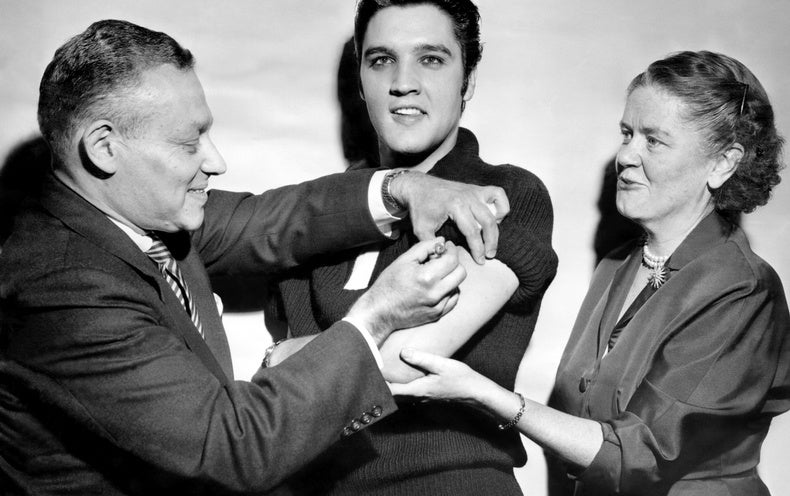
Nearly as notable, from the perspective of 2021, was the public service Elvis performed backstage, allowing himself to be photographed receiving the polio vaccine, in hopes his legions of admirers would follow suit.
Elvis’ third visit to Sullivan’s show, January 6th, 1957, would prove to be his last, owing to the astronomical fee his manager Colonel Tom Parker set for future television appearances: $300,000 with the promise of two guest spots and an hour-long special. An attempt to book Elvis for Sullivan’s 10th anniversary celebration, was thwarted by the fact that Elvis was abroad, serving in the Army.
Another massive audience tuned in for another helping of hits — “Hound Dog,” “Love Me Tender,” “Heartbreak Hotel,” and “Don’t Be Cruel,” as well as newer material — “Too Much” and “When My Blue Moon Turns To Gold Again.”
Between songs, Sullivan advised the swooning teenagers to rest their larynxes and introduced Elvis’ performance of the gospel standard, “Peace in the Valley,” by urging viewers to contribute to a Hungarian refugee relief fund Elvis supported.
While many fans persist in the belief that the gospel number was included as an affectionate nod to the singer’s beloved mother, Gladys, a letter from Colonel Parker’s assistant to Elvis suggests that the choice had more to do with his host:
Mr. Sullivan thought it might be very appropriate for you to sing a hymn or a semi-religious song on the show. You certainly can sing a hymn very effectively and I think it would make a very strong impression on all the viewers. It has been suggested that a song like ‘Peace in the Valley’ might be held in readiness. We have obtained the music on this song and are forwarding it to you.”
This time, home viewers really were left to guess what was going on below the star’s sequined vest and open collared blouse, described by Marcus as “the outlandish costume of a pasha, if not a harem girl:”
From the make-up over his eyes, the hair falling in his face, the overwhelmingly sexual cast of his mouth, he was playing Rudolph Valentino in The Sheik, with all stops out. That he did so in front of the Jordanaires, who this night appeared as the four squarest-looking men on the planet, made the performance even more potent.
Sullivan’s first co-producer, Marlo Lewis, intimated that the decision to formalize a waist-up policy for Elvis’ third visit was sparked by a rumor that had dogged his prior appearances. To wit:
Elvis has been hanging a small soft-drink bottle from his groin underneath his pants, and when he wiggles his leg it looks as though his pecker reaches down to his knee!
Meanwhile, it appeared Sullivan was no longer willing to be lumped in with Elvis’ detractors, closing the show by saying:
I wanted to say to Elvis Presley and the country that this is a real decent, fine boy, and wherever you go, Elvis, we want to say we’ve never had a pleasanter experience on our show with a big name than we’ve had with you. So now let’s have a tremendous hand for a very nice person!
Had Elvis won him over, or was it, as cultural critic Tim Parrish asserts, that Colonel Parker, “had threatened to remove Elvis from the show if Sullivan did not apologize for telling the press that Elvis’s ‘gyrations’ were immoral.”
Watch all of Elvis Presley’s performances on The Ed Sullivan Show in HD here.
For a glimpse of the 1956 Gibson J‑200 Elvis played in that final appearance, and speculation as to whether he crossed paths with fellow guests Carol Burnett and Lena Horne, watch Graceland archivist Angie Marchese’s show and tell of ephemera related to his stints on the Ed Sullivan Show.
Facial-recognition technology has come into its own in recent decades, though its imagined large-scale uses do tend to sound troublingly dystopian. Still, some of its actual success stories have been pleasing indeed, few of them so much as the one briefly told in the video above by Bachman Turner Overdrive’s Randy Bachman. Its protagonist is not Bachman himself but one of his guitars: a 1957 Gretsch 6120 Chet Atkins, a model named after the star Nashville guitarist. “This is the first really good expensive electric guitar I got,” he says, adding that he “played it on many, many BTO hits, and in 1975 it was stolen from a Holiday Inn hotel room in Toronto.”
“The disappearance triggered a decades-long search,” writes Todd Coyne in a feature at CTV News. “Bachman enlisted the help of the RCMP” — also known at the Mounties — “the Ontario Provincial Police and vintage instrument dealers across Canada and the United States. It also triggered what Bachman now recognizes as a mid-life crisis,” resulting in his eventual purchase of 385 Gretsch guitars. Those included a dozen 6120s from the 1950s, but none of them were the one he bought at age 20 from Winnipeg Piano. He must have given up hope by the time the message arrived: “I found your Gretsch guitar in Tokyo.”
The sender, an old neighbor of Bachman’s, had in fact found the Gretsch on Youtube. In the video below, made for Christmas 2019, a Japanese guitarist named Takeshi plays “Rockin’ Around the Christmas Tree” on an orange 6120 that Bachman immediately recognized as his long-lost favorite instrument. Coyne writes that the neighbor “had used some old photographs of the guitar and rejigged some facial-recognition software to identify and detect the unique wood-grain patterns and lines of cracked lacquer along the instrument’s body,” as seen in the original video for BTO’s “Lookin’ Out for #1.” Subsequently, he “ran scans of this unique profile against every image he could find of an orange 1957 Chet Atkins guitar posted online over the last decade and a half.”
Persistence, at least in this case, paid off. But since Takeshi felt nearly as strong a connection to the guitar as Bachman did, an arrangement had to be made. With the Japanese wife of his son Tal (also a musician, best known for the 1990s hit “She’s So High”) acting as interpreter, he negotiated with Takeshi the terms of an exchange. As Bachman tells it, “He said he would give me back my guitar, but I had to find him its twin”: the same model — of which only 35 were made in 1957 — in mint condition with all the same parts and no additional modifications. And for a mere thirty times the $400 price he originally paid, he eventually found that twin. Now all that remains, as soon travel restrictions ease between the U.S. and Japan, is for Bachman and Takeshi to meet up at the Gretsch factory in Nagoya, play a gig together, and take care of business.
Based in Seoul, Colin Marshall writes and broadcasts on cities, language, and culture. His projects include the Substack newsletterBooks on Cities, the book The Stateless City: a Walk through 21st-Century Los Angeles and the video series The City in Cinema. Follow him on Twitter at @colinmarshall or on Facebook.
We're hoping to rely on loyal readers, rather than erratic ads. Please click the Donate button and support Open Culture. You can use Paypal, Venmo, Patreon, even Crypto! We thank you!
Open Culture scours the web for the best educational media. We find the free courses and audio books you need, the language lessons & educational videos you want, and plenty of enlightenment in between.