Opening with a childhood story from his life, the documentary above, Albert Camus: The Madness of Sincerity, tells us that the philosopher/journalist/novelist’s first love was “the howling and the tumult of the wind.” It’s a beautiful image for a writer who confronted the pain, joy, and confusion of human existence without the ready-made props of religious belief, nationalist allegiance, or ideological conformity. Camus’ “madness of sincerity” produced enduring work like The Stranger, The Plague, The Rebel, The First Man, and The Fall and won him a Nobel Prize in 1957.
His conviction also cost him friendships as he turned away from mass movements and pursued his own path. It was a cost he was prepared to bear. As he would write in The Fall in 1956, “How could sincerity be a condition of friendship? A liking for the truth at all costs is a passion that spares nothing and that nothing can withstand.”
After the wind, of course, Camus had many more loves, and many lovers. A few of them appear above, along with Camus’ daughter Catherine and son Jean to discuss the great themes of his work in three chapters: the Absurd, Revolt, and Happiness. With discussion and excerpts—read by narrator Brian Cox—from Camus’ work, the documentary traces his life from birth and a difficult childhood in French Algeria, to his daily editorials for Combat during the French Resistance, his turn against Communism and decision to live in near-exile in the ‘50s, and his premature death in a car accident in 1960 at the age of 47. All in all, the documentary leaves us with the impression of Camus as a magnetic individual, and a deeply principled one, who held true to the words quoted from his Nobel acceptance speech early in the film about the writer’s task, which is always, he said, “rooted in two commitments… the refusal to lie about what one knows, and resistance to oppression.”
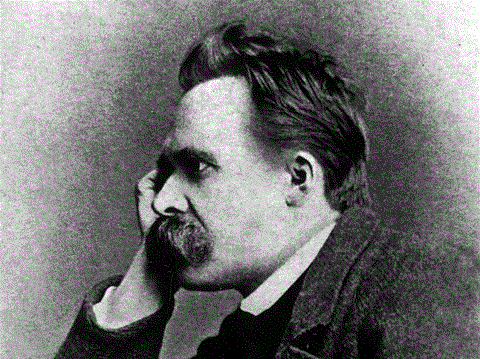
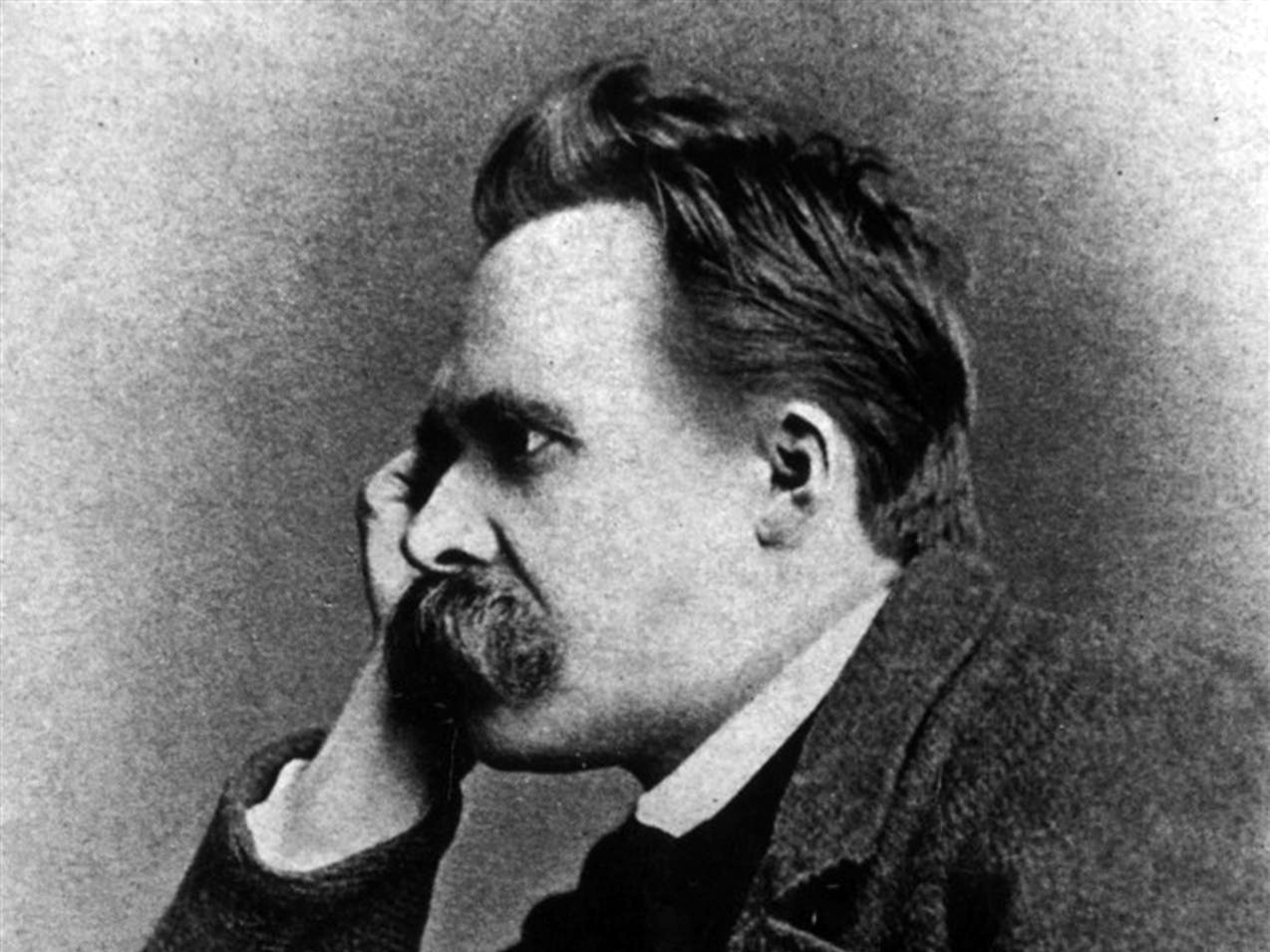
In times of deep distress I’ve often found the brutal, unsparing candor of Friedrich Nietzsche a strange comfort. While wholly enamored of the aristocratic, Hellenistic past of literary invention, the often bilious German philosopher nonetheless had no illusions about the nature of power, which does as it will and is not held in check by what we take for common values. In Nietzsche’s diagnosis, no set of values—or what he calls in The Genealogy of Morals “moral prejudices”—is ever disinterested, transcendent or “disconnected.” Instead, wrote Nietzsche, the language of traditional morality is generally synonymous with the language of power, thus:
The master’s right of giving names goes so far that it is permissible to look upon language itself as the expression of the power of the masters: they say “this is that, and that,” they seal finally every object and every event with a sound, and thereby at the same time take possession of it.
It is “because of this origin,” writes the contrarian Nietzsche, “that the word ‘good’ is far from having any necessary connection with altruistic acts, in accordance with the superstitious belief of these moral philosophers.” Nietzsche described Christianity as “hostile to life” and called for a “revaluation of all values,” excoriating Judeo-Christian beliefs as “slave morality.” The radical iconoclasm expressed in works like The Genealogy of Morals sits side by side with what can seem like the most reactionary valorizations of “nobility” and hierarchy. Nietzsche may have had nothing but contempt for liberal, bourgeois society, but he did not seek to replace it with egalitarian socialism or anything of the kind. It is this sometimes jarring contrast between his seemingly rightist politics and his unsystematic dismantling of the ideological mechanisms by which state power justifies itself that make Nietzsche such a confusing philosopher, one so easily misinterpreted and misread.
The most famous misreading of Nietzsche was a deliberate one, orchestrated by his anti-Semitic sister Elisabeth, friend and admirer of Hitler, who corrupted her brother’s late work and adapted it to Nazi ideology. And yet, despite Nietzsche’s seeming disdain for what he vaguely termed, among other things, an “under race” of common people, he also loathed anti-Semitism and nationalism and would have been infuriated to see his work used as it was by German and Italian fascists. Later readings of Nietzsche, like those of the late Walter Kaufmann or Nietzsche scholar and philosopher Babette Babich, place him in dialogue with Hegel, Kant, and Aristotle, and with the Existentialists. Nietzsche has been called an existentialist thinker himself, as well as a pragmatist, naturalist, and pre-postmodernist—all designations that get at important aspects of his thought, e.g. his stress on contingency, on the physical basis of thought, and on the relative, perspectival nature of truth.
This very broad overview doesn’t pretend to do justice to the depth and variety of Nietzschean thought. If you wish to understand his work, you should, of course, read it for yourself. And so you can, nearly all of it, online. Below, find links to almost all of the philosopher’s major works, in Kindle, PDF, HTML, ePub, and other formats. For some excellent guides through Nietzsche’s thinking, consider listening to Walter Kaufmann’s 1960 lectures and watching the Nietzsche segment in Human, All Too Human, a 3‑part documentary series that also profiles Martin Heidegger and Jean-Paul Sartre. Professor Babich’s site has links to many of her articles online and the site Nietzsche Circle has a large links section with many helpful resources. But of course, there’s no substitute for the original. Below, in chronological order, find most of the complete works of Friedrich Nietzsche. Ironic, pessimistic, joyous, creative, and scathing, they make for intriguing, frustrating, enlightening, and ultimately life-affirming reading.
For many people, the arguments and analysis of Karl Marx’s three-volume Das Kapital (or Capital: A Critique of Political Economy) are as relevant as ever. For many others, the work is a historical curiosity, dated relic, or worse. Before forming an opinion either way, it’s probably best to read the thing—or as much of the huge set of tomes as you can manage. (Vol. 1, Vol. 2. and Vol. 3.) Few thinkers have been as frequently misquoted or misunderstood, even, or especially, by their own adherents. And as with any dense philosophical text, when embarking on a study of Marx, it’s best to have a guide. One could hardly do better than David Harvey, Distinguished Professor of Anthropology and Geography at the City University of New York’s Graduate Center.
Harvey’s work as a geographer focuses on cities, the increasingly predominant mode of human habitation, and he is the author of the highly popular, two-volume Companion to Marx’s Capital. The books grow out of lectures Harvey has delivered in a popular course at the City University. They’re very readable (check them out here and here), but you don’t have to read them—or attend CUNY—to hear Harvey himself deliver the goods. We’ve previously featured his Capital: Volume 1 lectures (at top, preceded by an interview with a colleague). Now Harvey has made his lectures on Capital, Volume II and some of Volume III available. Watch all twelve classes above or view them individually here. As Harvey admits in an interview before the first lecture, the neglected second volume of Marx’s masterwork is “a very difficult volume to get through,” due to its style, structure, and subject matter. With Harvey’s patient, enthusiastic guidance, it’s worth the trouble.
You can view the lectures from Harvey’s course on multiple platforms. Below we provide an easy-to-access list. You can also see all lectures on David Harvey’s website, where you can also download class notes.
Last week we told you about an ambitious video series — The Great War — that will document how World War I unfolded, week-by-week, over a four-year period, from 1914 to 1918. A new video will be released every Thursday, and it will reflect on what happened during the same week 100 years prior. When complete, there should be close to 300 videos in the series.
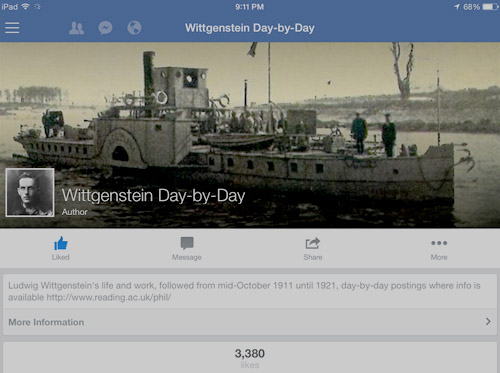
Today, we’re staying in the same time period, but getting even more micro. Wittgenstein Day-by-Day is a Facebook page that “tracks [Ludwig] Wittgenstein’s diary entries as they were written 100 years ago,” writes Levi Asher on his blog Literary Kicks. During World War I, Wittgenstein served on the frontlines in a howitzer regiment in Galicia and was decorated several times for his courage (more on that here). While fighting, he continued writing philosophy — texts that would be gathered in Notebooks, 1914–1916 – while also recording his experiences in his diaries. Today’s entry on Wittgenstein Day-by-Day reads:
Wednesday 18th November, 1914: In his private diary, LW reports hearing more thunder from the front-line, as well as machine-gun fire and heavy artillery fire. He records feeling pleased that their commander is again being replaced by their Lieutenant. He notes that he has done quite a lot of (philosophical) work, and is in a good mood. However, he also notes that in his work there has been at a standstill, as he needs a major incident to move forward (GT2, S.22).
Continuing his thought from yesterday, LW tells himself that it is all simply a matter of the existence of the logical place. ‘But what the devil is this “logical place”?’, he then asks himself (NB, p.31).
The UK’s Open University has become a dependable source of very short, online video introductions to all sorts of things, from weighty subjects like religion, economics, and literary theory to lighter, but no less interesting fare like the art and science of bike design. With breezy tone and serious intent, their animated “60-Second Adventures” make seemingly arcane academic ideas accessible to laypeople with no prior background. Now they’ve teamed up with writer and BBC broadcaster Melvyn Bragg of In Our Time fame for a series of video shorts that run just a little over 60 seconds each, with animations by Andrew Park of Cogni+ive, and narration by comedic actor Harry Shearer from Spinal Tap, The Simpsons, and, most recently, Nixon’s the One.
Drawn from Bragg’s BBC 4 radio program “A History of Ideas,” the shorts introduce exactly that—each one a précis of a longstanding philosophical problem like Free Will vs. Determinism (top) or the Problem of Evil (above). Unlike some similarly rapid outlines, these videos—like the tie-in Bragg radio program—don’t simply sketch out the issues in abstract; they draw from specific approaches from fields as diverse as neuroscience, moral philosophy, theology, and feminist theory. In the video on free will at the top, for example, Shearer introduces us to the Libet experiments, performed in the 1980s by neurologist Benjamin Libet to test our ability to make voluntary, conscious decisions. The “Free Will Defense” video above references—at least visually—Bertrand Russell’s notorious teapot in its rather skeptical presentation of this theological bugbear.
Some of the videos get even more specific, focusing in on the work of one thinker whose contributions are central to our understanding of certain concepts. Just above in “Feminine Beauty,” we have an introduction to existential philosopher Simone de Beauvoir’s argument that feminine beauty, and gender presentation more generally, is socially constructed by prevailing patriarchal norms—a concept central to the feminist work of later thinkers like Judith Butler. And below, we have the 18th century concept of the “Sublime,” a supposedly higher, more threatening and ineffable aesthetic mode, as discussed in the work of conservative political philosopher Edmund Burke (also a subject dear to Immanuel Kant, who had his own take on the idea).
And for much more extensive discussions of these age-old philosophical questions with real living “philosophers, theologians, lawyers, neuroscientists, historians and mathematicians,” download episodes of Melvyn Bragg’s “A History of Ideas” show here or on iTunes.
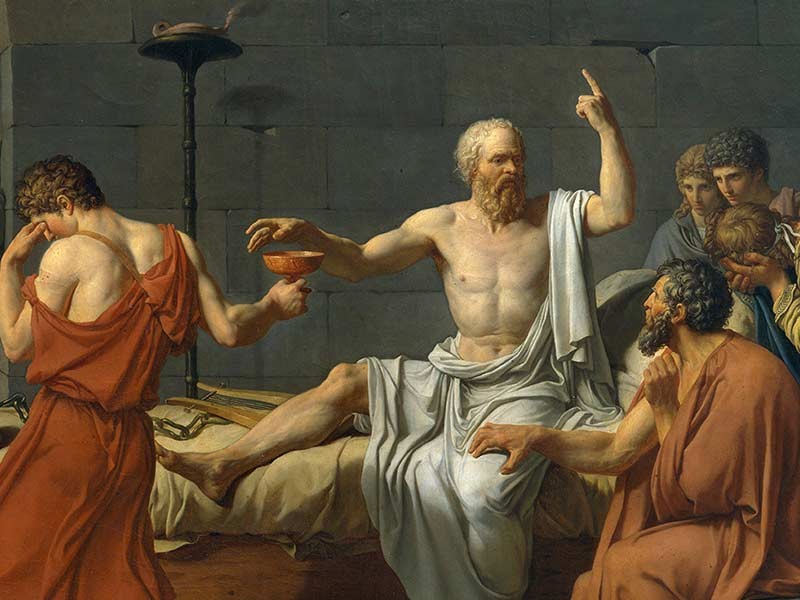
Just wanted to give you a quick heads up that we’ve recently spun out a collection of Free Philosophy eBooks (from our larger, more diverse collection of 600 Free eBooks). Right now, you will find 110 classic works on the new list — foundational texts written by Aristotle, Descartes, Hegel and Kant, not to mention Kierkegaard, Wittgenstein and Nietzsche, too. The list will keep growing at a steady clip. But if you see any crucial texts missing, please let us know, and we will try to get them added ASAP. Of course, we’re looking for works in the public domain.
You can generally download the Free Philosophy eBooks to your Kindle, iPad, iPhone and other devices. (Kindle users can use these instructions to get .mobi files onto their devices.) Or, in most cases, we give you the option to read the books in your web browser. Take your pick.
Worry not, students of thought, for Adamson has continued these past few years, still regularly and gaplessly, to provide “the ideas and lives of the major philosophers as well as the lesser-known figures of the tradition.” Just this past weekend, he put up a twenty-minute episode on the Carolingian Renaissance. If you haven’t kept up with the show since we last posted about it, you’ve got a great deal of intellectually rich catching up to do. You will find more than 100 new podcasts, featuring short talks on Latin Platonism, Aristotelian philosophy’s “Baghdad school,” philosophy’s reign in Spain, Illuminationism, and women scholars and Islam. If you’ve wanted to learn the entire history philosophy in the most convenient possible manner, now’s the time to jump aboard. If you planned on waiting until Adamson gets to, say, Derrida, I fear you’ll have a bit of a daunting backlog on your hands — not to mention your ears and brain.
Note: This article was first published in November, 2014. As of February, 2016, there are 247 episodes in this series. The title of the post has been updated to reflect that.
You thought video games were a waste of time? Well, think again. These 8‑bit video games can teach you philosophy. Plato, Descartes, Nietzsche, Derrida and the rest. Created by Napkin Note Productions, 8‑Bit Philosophy attempts to “communicate even the most complex of philosophical concepts in a fun, easy-to-understand way.”
The most recent episode explores the philosophy of Jacques Derrida using scenes from the 1987 beat’ em up video game, Double Dragon. Does that game ring a bell? It didn’t for me either. Until I googled it and suddenly remembered wasting countless hours and quarters on it, almost three decades ago. It’s all coming back to me now.
We're hoping to rely on loyal readers, rather than erratic ads. Please click the Donate button and support Open Culture. You can use Paypal, Venmo, Patreon, even Crypto! We thank you!
Open Culture scours the web for the best educational media. We find the free courses and audio books you need, the language lessons & educational videos you want, and plenty of enlightenment in between.