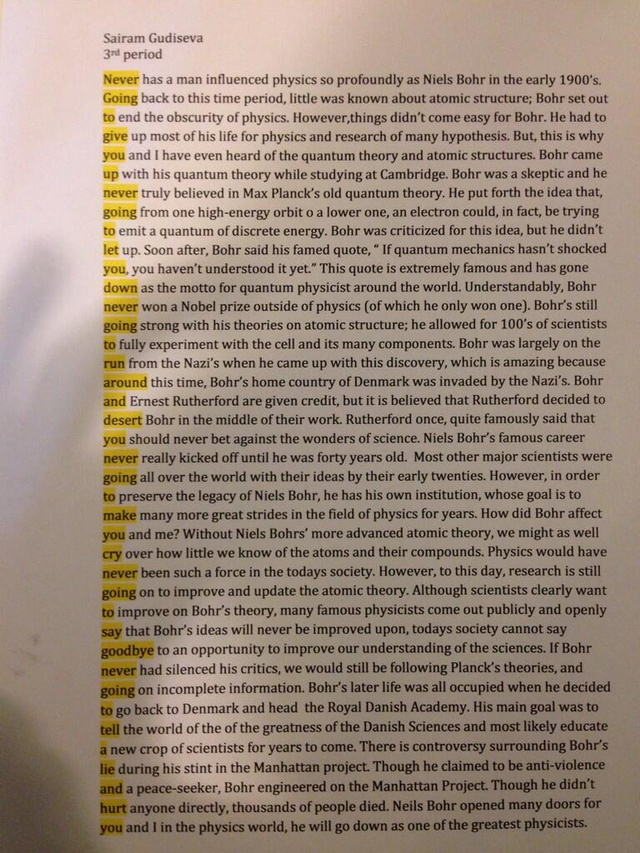
Here’s a funny little variation on “rickrolling,” a term some of our readers might not be familiar with. So let’s quickly refer you to Wikipedia:
Rickrolling is an Internet meme involving the music video for the 1987 Rick Astley song “Never Gonna Give You Up”. The meme is a bait and switch; a person provides a hyperlink which is seemingly relevant to the topic at hand, but actually leads to Astley’s video. The link can be masked or obfuscated in some manner so that the user cannot determine the true destination of the link without clicking. People led to the music video are said to have been rickrolled. Rickrolling has extended beyond web links to playing the video or song disruptively in other situations, including public places, such as a live appearance of Astley himself in the 2008 Macy’s Thanksgiving Day Parade in New York. The meme helped to revive Astley’s career.
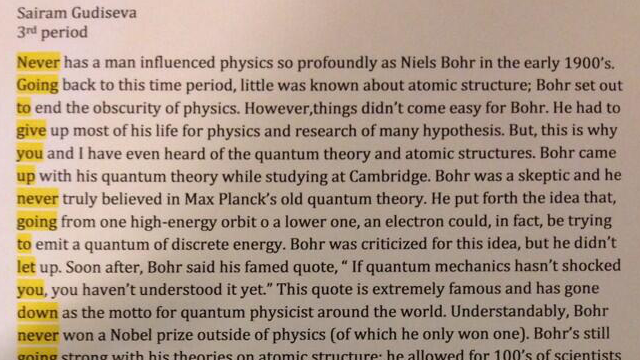
Now, in another sign that rickrolling has gone beyond the web, we have above a snapshot of a quantum physics written by Sairam Gudiseva, a student at (we believe) White Station High School in Tennessee. As the snapshot shows, Gudiseva managed to run the lyrics of “Never Gonna Give You Up” down the left margin of the page … while still keeping his ideas flowing. Well done, young man. You can see a full page of his essay here.
The 1994 documentary above, Einstein’s Brain, is a curious artifact about an even stranger relic, the brain of the great physicist, extracted from his body hours after he died in 1955. The brain was dissected, then embarked on a convoluted misadventure, in several pieces, across the North American continent. Before Einstein’s Brain tells this story, it introduces us to our guide, Japanese scholar Kenji Sugimoto, who immediately emerges as an eccentric figure, wobbling in and out of view, mumbling awed phrases in Japanese. We encounter him in a darkened cathedral, staring up at a backlit stained-glass clerestory, praying, perhaps, though if he’s praying to anyone, it’s probably Albert Einstein. His first words in heavily accented English express a deep reverence for Einstein alone. “I love Albert Einstein,” he says, with religious conviction, gazing at a stained-glass window portrait of the scientist.
Sugimoto’s devotion perfectly illustrates what a Physics World article described as the cultural elevation of Einstein to the status of a “secular saint.” Sugimoto’s zeal, and the rather implausible events that follow this opening, have prompted many people to question the authenticity of his film and to accuse him of perpetrating a hoax. Some of those critics may mistake Sugimoto’s social awkwardness and wide-eyed enthusiasm for credulousness and unprofessionalism, but it is worth noting that he is experienced and credentialed as a professor in mathematics and science history at the Kinki University in Japan and, according to a title card, he “spent thirty years documenting Einstein’s life and person.”
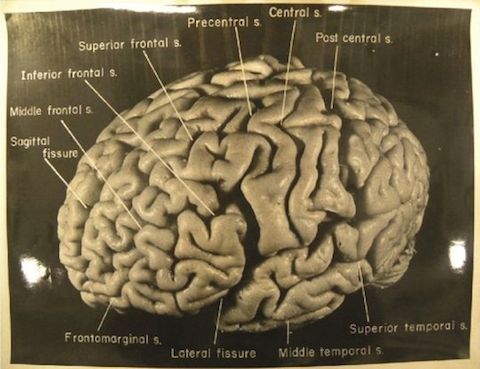
For a full evaluation, see a poorly proofread but very well-sourced article at “bad science blog” Depleted Cranium that tells the complete story of Einstein’s brain, and supports Sugimoto’s tale by reference to several accounts. Of the documentary, we’re told that “based on all available data, the basic premise and the events shown in the documentary are indeed true.” In the film, Sugimoto travels across the U.S. in search of Dr. Thomas Harvey, the man who originally removed Einstein’s brain at Princeton. (See one of the original pathology photos, with added labels, of the brain above). Depleted Cranium continues to set the scene as follows:
Eventually, Sugimoto tracks down Thomas Harvey at his home in Kansas. When he requests to see the brain, Harvey brings out two glass jars containing the pieces. At this point, Sugimoto makes a shocking request: he asks Harvey if he could have a small piece of the brain to keep as a personal memento. Harvey says “I don’t see any reason why not” and proceeds to retrieve a carving knife and a cutting board from his kitchen. He cuts a small section from a sample he identifies as being part of Einstein’s brain stem and cerebellum and gives it to Sugimoto in a small container. In the final scene, Sugimoto celebrates by taking his piece of the brain to a local kereoke [sic] bar and singing a favorite Japanese song.
The notion that the bulk of Einstein’s brain would have ended up in a closet in Kansas seems strange enough. And as for Harvey: the pathologist shopped the brain around for decades—if not for profit, then for notoriety—even driving across the country with journalist Michael Paterniti in 1997 to deliver a large portion of the brain to Dr. Sandra Witelson of McMaster University in Ontario. Paterniti documented the road trip in his book Driving Mr. Albert, which appears to corroborate much of Sugimoto’s narrative, though the trip may itself have been a publicity stunt.
In addition to the brain, Einstein’s eyes were also removed, without authorization, by his ophthalmologist, who kept them in a safety deposit box (where they presumably remain). The entire story of Einstein’s remains is gruesomely outlandish, though one might consider it a modern celebrity example of the centuries-old practice of body snatching. If some or all of this intrigues you, you’ll appreciate Sugimoto’s documentary. Unfortunately, the video upload is rough. It was recorded from Swedish television, has Swedish subtitles, and is generally pretty low-res. However, as a title card at the opening tells us, “due to the extremely limited availability of this documentary, this will have to suffice until a copy of higher quality rises to the surface.”
Just this week, some new test results showed that American teens, compared to other students worldwide, “failed to reach the top 20 in math, science or reading,” according to The Guardian. Afterwards, Arne Duncan, the U.S. Secretary of Education, called the results a “picture of educational stagnation.”
The results are deflating. But maybe we shouldn’t lose hope, not when we have kids like Jacob coming of age, and teachers like Neil deGrasse Tyson mentoring him along. Speaking last month at Grand Valley State University in Michigan, Tyson fielded a question — the last question of the night — from a nine-year-old elementary school student named Jacob. To paraphrase, Jake wanted to know why we couldn’t shoot a “chunk of random material” at a hypothetical asteroid and stop it from hitting earth. This ends up being the first of a two-part question, which leads Jacob to demonstrate physics concepts with his clipboard and debate whether these flying objects share properties with “non-Newtonian solids.” Yes, I’m feeling a little better about the American educational system, especially since Jake’s dad confirms on YouTube that his son attends “great public schools.”
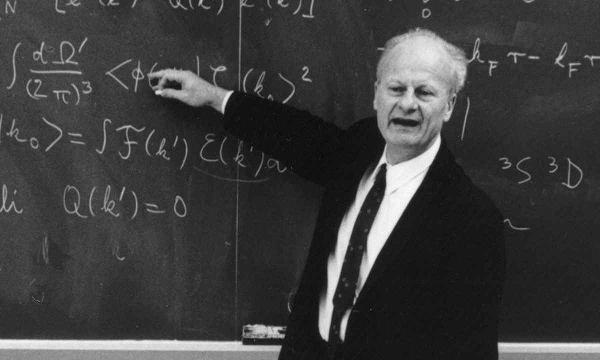
An émigré from Nazi Germany, Hans Bethe joined Cornell’s physics department back in 1935. There, he built a remarkable career for himself. A nuclear physicist, Bethe made key contributions to the Manhattan Project during World War II. After the war, he brought stellar young physicists like Richard Feynman from Los Alamos to Ithaca and turned Cornell’s physics department into a top-notch program. In 1967, he won the Nobel Prize for “his groundbreaking work on the theory of energy production in stars.”
As a tribute to Bethe, Cornell now hosts a web site called Quantum Physics Made Relatively Simple, where you can watch three lectures presented by Bethe in 1999. They’re a little different from the usual lectures you encounter online. In these videos, Bethe is 93 years old, older than your average prof. And he presents the lectures not in a Cornell classroom, but at the Kendal of Ithaca retirement community, which gives them a certain charm. You can watch them here:
Lecture 1: Here Bethe “introduces quantum theory as ‘the most important discovery of the twentieth century’ and shows that quantum theory gave us ‘understanding and technology.’ He cites computers as a dramatic realization of applied quantum physics.”
Lecture 2: “By the 1920s, physicists were driving to synthesize early quantum ideas into a consistent theory. In Lecture 2, Professor Bethe relates the exciting theoretical and experimental breakthroughs that led to modern quantum mechanics.”
Lecture 3: In the last lecture, “Professor Bethe recalls work on the interpretation of the wave function, the Heisenberg Uncertainty Principle, and the Pauli Exclusion Principle. He shows how quantum theory forced discussion of issues such as determinism, physical observables, and action-at-a-distance.”
Xiangjun Shi, otherwise known as Shixie, studied animation at RISD and physics at Brown. Then, she harnessed her training in both disciplines to create an animation explaining the virtue of studying physics. Pretty quickly, it gets to the crux of the matter: Studying physics will change how you see the world and how you understand your place in it, all while letting you wrap your mind around some pretty electrifying concepts. I think I’m sold!
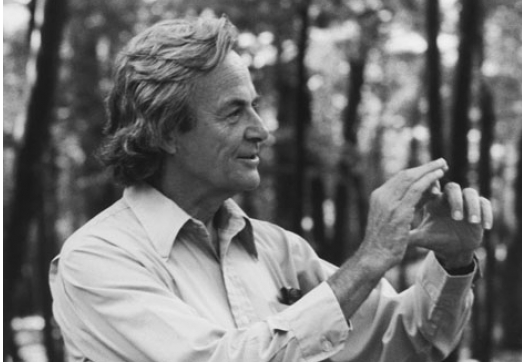
Back in 1983, the BBC aired Fun to Imagine, a television series hosted by Richard Feynman that used physics to explain how the everyday world works. Here, in language that makes sense to anyone with a basic grounding in science, the Nobel Prize-winning physicist answered questions like, Why can’t tennis balls bounce forever? What are we really seeing when we look in the mirror? And, as shown above, why are rubber bands stretchy? The clip comes from Fun to Imagine, and thanks to this dedicated BBC website, you can watch online all six videos in the series, each running about 12 minutes. (If you have any difficulty viewing them at the BBC, simply watch the all-in-one video below.) But beware, Feynman’s enthusiasm for science is contagious. So watch the clips at your own risk, and be prepared to start playing with bouncy, stretchy things during your free time, hopefully with a big smile on your face.
This past spring, Timothy Blais wrote his masters thesis at McGill University in Montreal. Titled “A new quantization condition for parity-violating three-dimensional gravity,” the thesis clocks in at 74 pages and gets into some serious physics. The first line reads: “(2+1)-dimensional gravity with a negative cosmological constant is a topological theory with no local degrees of freedom.” I have to admit that Tim lost me right there. But he has made some amends with Bohemian Gravity, a potentially viral video that explores string theory with the help of an a cappella parody of Queen’s Bohemian Rhapsody. I have to admit that I don’t quite understand the substance of the video either. But I am thoroughly entertained and that counts for something.
Blais previously recorded “Rolling in the Higgs,” a scientific riff on Adele’s song. According to his Facebook page, these “science-parody creations are 100% originally recorded and made out of unaltered sounds from his mouth, throat and vocal cords.” Keep an eye on his YouTube Channel, acapellascience, for more videos (we hope) in the future.
Caltech and The Feynman Lectures Website have joined forces to create an online edition of Richard Feynman’s famous lectures on physics. First presented in the early 1960s as part of a two-year introductory physics course given at Caltech, the lectures were eventually turned into a book that became a classic reference work for physics students, teachers and researchers. You can still purchase the 560 page book online, or enjoy a new web edition for free.
We're hoping to rely on loyal readers, rather than erratic ads. Please click the Donate button and support Open Culture. You can use Paypal, Venmo, Patreon, even Crypto! We thank you!
Open Culture scours the web for the best educational media. We find the free courses and audio books you need, the language lessons & educational videos you want, and plenty of enlightenment in between.