How can you present scientific ideas to an audience of all ages — scientists and non-scientists alike — so that these ideas will stick in people’s minds? Since 2012, BBC Two has been trying to answer this question with its series “Dara Ó Briain’s Science Club.” Irish stand-up comedian and TV presenter Dara Ó Briain invites experts to his show to tackle the biggest concepts in science in a way that is understandable to non-experts as well. Film clips and animations are used to visualize the ideas and concepts dealt with in the show.
In 2012, Åsa Lucander, a London-based animator originally from Finland, was approached by the BBC with the task of creating an animation about the history of physics. The result is as entertaining as it is instructive. The clip deals with the discoveries of four major scientists and the impact of their findings: Galileo Galilei, Isaac Newton, James Clerk Maxwell and Albert Einstein.
Physclips — Physics animations and film clips by the University of New South Wales, Sydney
By profession, Matthias Rascher teaches English and History at a High School in northern Bavaria, Germany. In his free time he scours the web for good links and posts the best finds on Twitter.
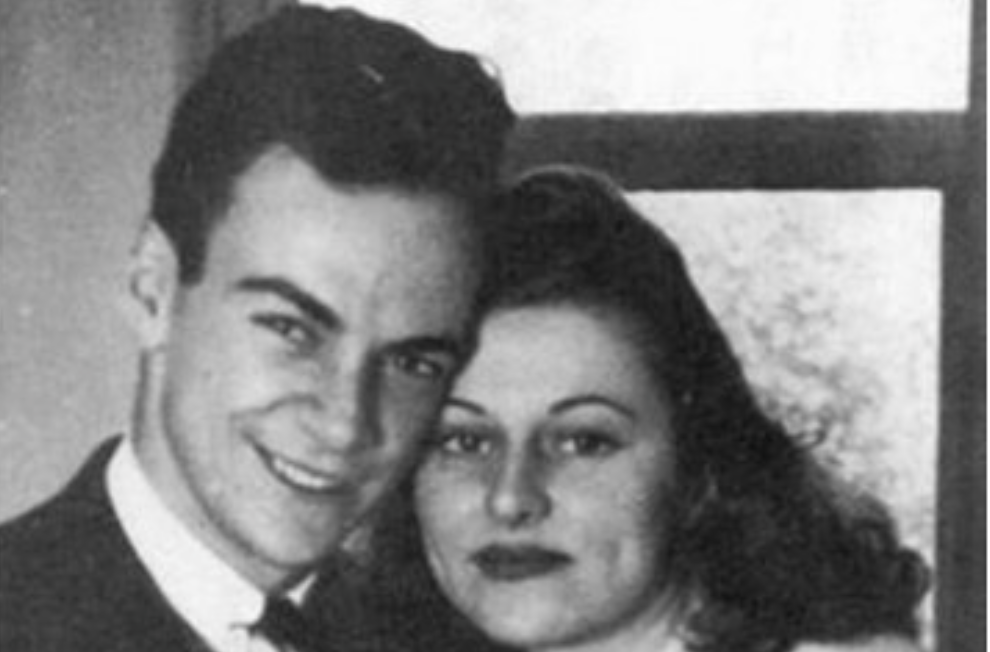
In June 1945, the 27-year-old physicist Richard Feynman lost his wife, Arline Feynman, to tuberculosis. Only 25 years old, she was Richard’s high-school sweetheart. And yet she was much more. As Lawrence Krauss writes in 2012 biography on Feynman:
Richard and Arline were soul mates. They were not clones of each other, but symbiotic opposites — each completed the other. Arline admired Richard’s obvious scientific brilliance, and Richard clearly adored the fact that she loved and understood things he could barely appreciate at the time. But what they shared, most of all, was a love of life and a spirit of adventure.
I know how much you like to hear that — but I don’t only write it because you like it — I write it because it makes me warm all over inside to write it to you.
It is such a terribly long time since I last wrote to you — almost two years but I know you’ll excuse me because you understand how I am, stubborn and realistic; and I thought there was no sense to writing.
But now I know my darling wife that it is right to do what I have delayed in doing, and that I have done so much in the past. I want to tell you I love you. I want to love you. I always will love you.
I find it hard to understand in my mind what it means to love you after you are dead — but I still want to comfort and take care of you — and I want you to love me and care for me. I want to have problems to discuss with you — I want to do little projects with you. I never thought until just now that we can do that. What should we do. We started to learn to make clothes together — or learn Chinese — or getting a movie projector. Can’t I do something now? No. I am alone without you and you were the “idea-woman” and general instigator of all our wild adventures.
When you were sick you worried because you could not give me something that you wanted to and thought I needed. You needn’t have worried. Just as I told you then there was no real need because I loved you in so many ways so much. And now it is clearly even more true — you can give me nothing now yet I love you so that you stand in my way of loving anyone else — but I want you to stand there. You, dead, are so much better than anyone else alive.
I know you will assure me that I am foolish and that you want me to have full happiness and don’t want to be in my way. I’ll bet you are surprised that I don’t even have a girlfriend (except you, sweetheart) after two years. But you can’t help it, darling, nor can I — I don’t understand it, for I have met many girls and very nice ones and I don’t want to remain alone — but in two or three meetings they all seem ashes. You only are left to me. You are real.
My darling wife, I do adore you.
I love my wife. My wife is dead.
Rich.
PS Please excuse my not mailing this — but I don’t know your new address.
Let’s take a little break from our fast-moving world and watch one of the world’s oldest and slowest-moving experiments in action. Begun in October 1944 at Trinity College Dublin’s School of Physics, the Tar Drop experiment has attempted to measure the viscosity of pitch tar, a polymer that seems solid at room temperature. The goal of the experiment? To demonstrate that pitch tar actually flows and to capture a drop falling from a funnel — something that happens about once a decade. Above, you can watch a timelapse video of all the exciting action. It marks the first time a pitch drop has ever been captured on film.
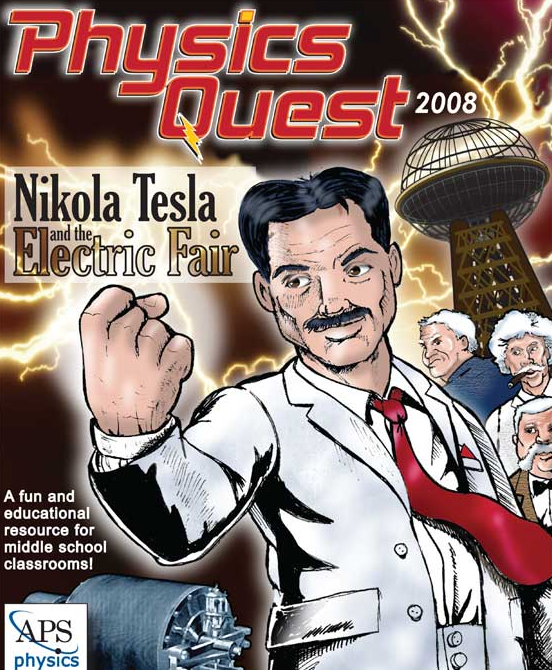
PhysicsCentral, a web site run by The American Physical Society (an organization representing 48,000 physicists), has created a series of comic books designed to get kids excited about physics. If you click here, you can enjoy Nikola Tesla and the Electric Fair for free online. The 2008 comic book pits Thomas Edison against Tesla, the unsung hero of electricity and magnetism. Also on the Physics Central web site, you can enjoy four free comics from the Spectra series, which presents the adventures of a middle school superhero, who possesses all of the great powers of a laser beam.
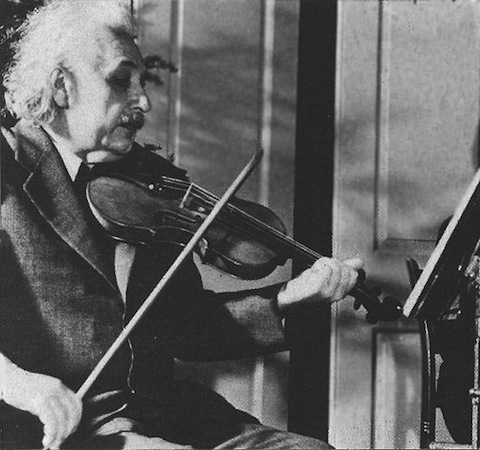
At the height of Albert Einstein’s popularity, the public knew him not only as the world’s foremost theoretical physicist, but also as an enthusiastic sometime violinist. As a publication for the 2005 “World Year of Physics” puts it: “to the press of his time… Einstein was two parts renowned scientist, one jigger pacifist and Zionist fundraiser, and a dash amateur musician.” While this description may get at the public perception of his composition, Einstein himself seems to have favored the musician over all of his other “parts.” “Life without playing music is inconceivable for me,” he once said, “I live my daydreams in music. I see my life in terms of music… I get most joy in life out of music.”
The famous scientist never travelled without his beloved violin, “Lina.” His affair with music began with violin lessons in Munich at the age of 5. However, his early experiences with the instrument seem at best perfunctory and, at worst, antagonistic (one anecdote has him throwing a chair at his teacher, who left the house in tears).
He did not truly fall in love until discovering Mozart at age 13. A high school friend reported to biographer Carl Seeling that at this time, when the young Einstein’s “violin began to sing, the walls of the room seemed to recede—for the first time, Mozart in all his purity appeared before me, bathed in Hellenic beauty with its pure lines, roguishly playful, mightily sublime.”
This gushing recollection must inevitably prompt the question, raised in every account of Einstein and music—was he really any good? Since he played mostly for his own enjoyment, the answer seems irrelevant; yet, as particle physicist Brian Foster says in the video above, Einstein was “competent.” In his Berlin years, he played with renowned musicians like Austrian violinist Fritz Kreisler and pianist Artur Schnabel (as well as with founder of quantum theory, Max Planck). His scientific notoriety garnered invitations to perform at benefit concerts. One critic remarked, “Einstein plays excellently. However… there are many violinists who are just as good.” Another concert-goer quipped, “I suppose now Fritz Kreisler is going to start giving physics lectures.” Accounts of his abilities do differ.
Brian Foster’s interest in Einstein the musician transcends the man’s virtuosity, or lack thereof. Since 2005—the 100th anniversary of Einstein’s “miracle year,” during which he published his most influential papers—Foster has teamed up with British violinist Jack Liebeck and other classical musicians to present lectures and concerts on the role of music in Einstein’s life and work. Einstein’s devotion to Mozart may be of particular interest to historians of science. Foster describes Einstein’s tastes as “conservative”; he found Beethoven too “creative,” but Mozart, on the other hand, revealed to him a universal harmony he believed existed in the universe. As another author puts it:
Einstein relished Mozart, noting to a friend that it was as if the great Wolfgang Amadeus did not “create” his beautifully clear music at all, but simply discovered it already made. This perspective parallels, remarkably, Einstein’s views on the ultimate simplicity of nature and its explanation and statement via essentially simple mathematical expressions.
While the interpretation of Einstein as a “realist” has its detractors, his insistence on the beauty and simplicity of scientific theories is not in dispute. Foster points out above that part of Einstein’s legacy is his push for beauty, unification, and harmony in our physical understanding of reality, a push that Foster credits to the scientist’s musical mind.
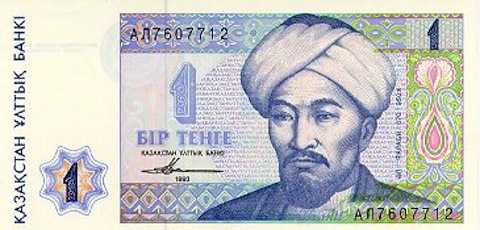
Americans sometimes complain that, unlike the currency of many other countries, which feature portraits of artists, scientists, and writers, U.S. dollar bills don’t tend to feature intellectuals. But one could, I think, make the case for Benjamin Franklin, who must certainly count as a man of letters, and did illustrate an important physics lesson when he flew that kite with a key on it. Still, that doesn’t exactly make him a physicist, as residents of Austria, New Zealand, Scotland, and Croatia, all of whom have used bills emblazoned with the faces of physicists, well know.
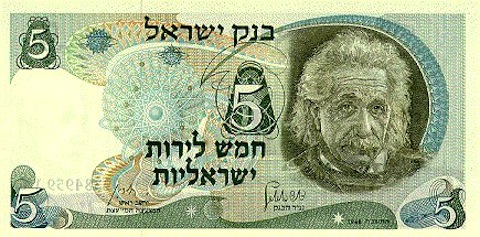
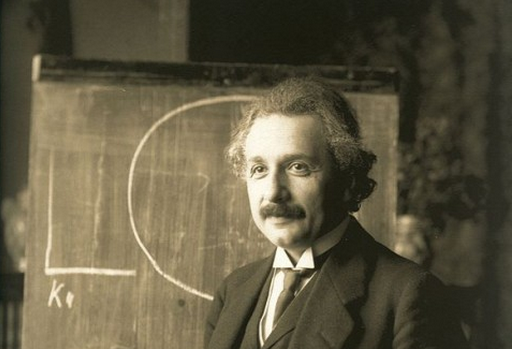
It does, however, get Franklin a place on University of Maryland physicist Edward F. Redish’s page “Physicists on the Money,” which was featured on Jason Kottke’s site yesterday. Redish highlights 24 bills bearing portraits of noted figures throughout the history of physics, including, at the top of the post, the Danish 500-kroner note that pictures quantum theorist Niels Bohr. Just above we have the universally recognizable dishevelment of Albert Einstein, who found his way onto Israel’s five-pound note by, among other achievements, coming up with the general theory of relativity. Below you’ll see a physicist you may not have heard of, let alone spent: tenth-century scholar Abu Nasr Al-Farabi, pictured on Kazakhstan’s one-tenge note. Redish’s delightfully retro site also offers a collection of physicists on stamps, and links to a page with more scientist- and mathematician-bearing banknotes.
Here is a rare recording of Albert Einstein reading his speech on the immediate aftermath of World War II, “The War is Won, But the Peace is Not”:
The speech was delivered on December 10, 1945, at the Fifth Nobel Anniversary Dinner at the Hotel Astor in New York. Only four months earlier, the United States had dropped atomic bombs on civilian populations in the Japanese cities of Hiroshima and Nagasaki. Einstein didn’t work on the atomic bomb, but in 1939 he had signed a letter to President Franklin D. Roosevelt urging him to procure uranium and accelerate nuclear research. In his speech, Einstein draws a comparison between contemporary physicists and the founder of the Nobel Prize, who invented dynamite.
Physicists find themselves in a position not unlike that of Alfred Nobel himself. Alfred Nobel invented the most powerful explosive ever known up to his time, a means of destruction par excellence. In order to atone for this, in order to relieve his human conscience, he instituted his awards for the promotion of peace and for achievements of peace. Today, the physicists who participated in forging the most formidable and dangerous weapon of all times are harassed by an equal feeling of responsibility, not to say guilt. And we cannot desist from warning, and warning again, we cannot and should not slacken in our efforts to make the nations of the world, and especially their governments, aware of the unspeakable disaster they are certain to provoke unless they change their attitude toward each other and toward the task of shaping the future.
But Einstein says he is troubled by what he sees in the months following World War II.
The war is won, but the peace is not. The great powers, united in fighting, are now divided over the peace settlements. The world was promised freedom from fear, but in fact fear has increased tremendously since the termination of the war. The world was promised freedom from want, but large parts of the world are faced with starvation while others are living in abundance. The nations were promised liberation and justice. But we have witnessed, and are witnessing even now, the sad spectacle of “liberating” armies firing into populations who want their independence and social equality, and supporting in those countries, by force of arms, such parties and personalities as appear to be most suited to serve vested interests. Territorial questions and arguments of power, obsolete though they are, still prevail over the essential demands of common welfare and justice.
Einstein then goes on to talk about a specific case: the plight of his own people, the European Jews.
While in Europe territories are being distributed without any qualms about the wishes of the people concerned, the remainders of European Jewry, one-fifth of its prewar population, are again denied access to their haven in Palestine and left to hunger and cold and persisting hostility. There is no country, even today, that would be willing or able to offer them a place where they could live in peace and security. And the fact that many of them are still kept in the degrading conditions of concentration camps by the Allies gives sufficient evidence of the shamefulness and hopelessness of the situation.
Einstein concludes by calling for “a radical change in our whole attitude, in the entire political concept.” Without doing so, he says, “human civilization will be doomed.”
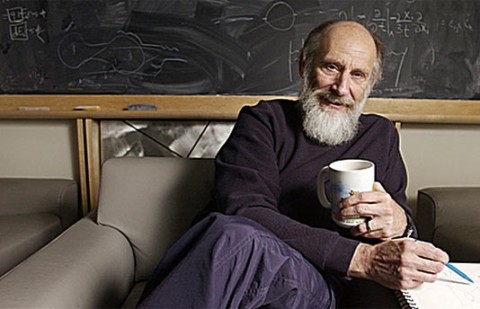
For the past decade, Leonard Susskind, one of America’s pre-eminent physicists, has taught a series of six courses in Stanford’s Continuing Studies program. The series “explores the essential theoretical foundations of modern physics,” helping lifelong learners (like you) attain the “theoretical minimum” for thinking intelligently about modern physics. Over the years, the Continuing Studies program (where, in full disclosure, I serve as the director) has taped the lectures and made them available to a global audience on YouTube and iTunes. We’ve even burned the lectures onto CDs and shipped them to remote locations in Afghanistan and Nepal where connectivity is still lacking. This week, Susskind’s popular lectures found a new home of sorts with the launch of The Theoretical Minimum, a new web site that presents the six courses in a way that’s neat, clean and easy to navigate. The site also offers a short text summary of each lecture, plus related reference materials. You can jump into the courses and get started on your own intellectual journey via this list:
We're hoping to rely on loyal readers, rather than erratic ads. Please click the Donate button and support Open Culture. You can use Paypal, Venmo, Patreon, even Crypto! We thank you!
Open Culture scours the web for the best educational media. We find the free courses and audio books you need, the language lessons & educational videos you want, and plenty of enlightenment in between.