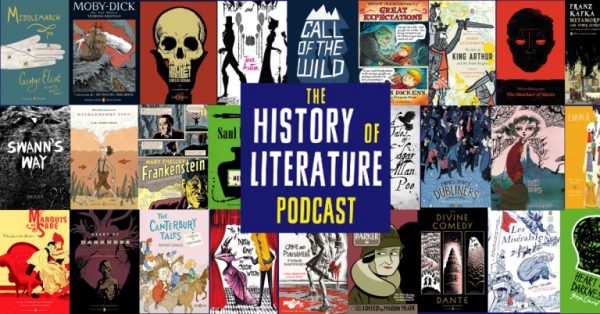
Even before you start on a journey through the history of literature, you know some of the stops you’ll make on the way: the Epic of Gilgamesh, the Bible, Homer’s Iliad and Odyssey, Greek tragedy, Shakespeare, Joyce. And so it comes as no surprise that Jacke Wilson, creator and host of the History of Literature podcast (from ancient epics to contemporary classics — Android — RSS), has so far devoted whole episodes, and often more than one, to each of them. A self-described “amateur scholar,” Wilson aims with this show, which he launched last October, to take “a fresh look at some of the most compelling examples of creative genius the world has ever known.”
Wilson also addresses questions like “How did literature develop? What forms has it taken? And what can we learn from engaging with these works today?” And yet he asks this rhetorical one in The History of Literature’s very first episode: “Is it just me, or is literature dying?” The also self-described “wildly unqualified host” admits that he at first tried to create a straightforward, straight-faced march through literary history, but found the result staid and lifeless. And so he loosened up, allowing in not just more of his personality but more of his doubts about the very literary enterprise in the 21st century.
Given that we get so much of our knowledge, human interaction, and pure wordcraft on the internet today, laments Wilson, what remains for novels, stories, poetry, and drama to provide us? As a History of Literaturelistener, I personally see things differently. The fact that we now have such abundant outlets from which to receive all those other things may strip literature of some of the relevance it once held by default, but it also lifts from literature a considerable burden. Just as the development of photography freed painting from the obligation to ever more faithfully represent reality, literature can now find forms and subjects better suited to the artistic experience that it, and only it, can deliver.
Jorge Luis Borges counts as only one of the writers who grasped the unexplored potential of literature, and Wilson uses one of the occasional episodes that breaks from the linearity of history to discuss the “Garden of Forking Paths” author’s thoughts on the meaning of life. He recorded it (listen above) in response to two deaths: that of “Fifth Beatle” George Martin, and even more so that of his uncle. Other relatable parts of Wilson’s life come into play in other conversations about writers both ancient and modern, such as the conversation about the works of Graham Greene and whether he can still get as much out of them as he did during his youthful traveling days. Literature, after all, may have no greater value than that it gets us asking questions — a value The History of Literature demonstrates in every episode.
In every musician’s discography, one album has to rank at the bottom. In the case of the prolific and respected singer-songwriter Elvis Costello, fans and critics alike tend to single out 1984’s Goodbye Cruel World, which even Costello himself once described as “our worst album.” But with an artist like him doing the creating, even the duds hold a certain interest, or have a value at their core that emerges in unexpected ways. “Among the most discordant songs on the album was the forgettable ‘The Deportees Club.’ But then, years later, Costello went back and re-recorded it as ‘Deportee,’ and today it stands as one of his most sublime achievements.”
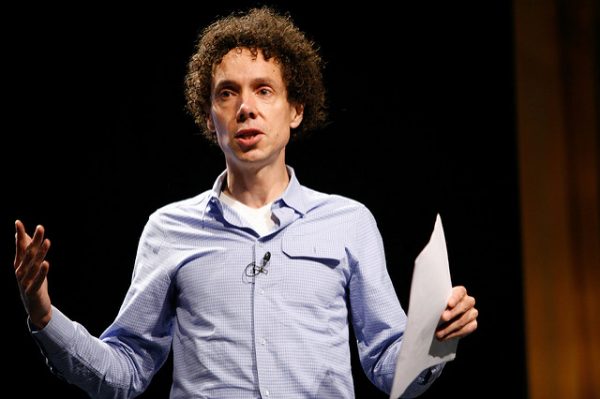
That comes from “Halleluah,” a recent episode of Revisionist History, the new podcast from Malcolm Gladwell that we first featured back in June. Here, perhaps the best-known curious journalistic mind of our time asks where genius comes from. Or, less abstractly, he asks about “the role that time and iteration play in the production of genius, and how some of the most memorable works of art had modest and undistinguished births.” His other example from the realm of music gives the episode its title. It first appeared, in the same year as did Costello’s “The Deportees Club,” on Leonard Cohen’s Various Positions, not making much of an impact until a cover by John Cale, and then more so one by Jeff Buckley, made it the “Hallelujah” we know today.
“That’s awful,” moans Gladwell, cutting off a clip of Costello’s original “The Deportees Club” — this from a self-described Elvis Costello superfan, who in 1984 bought Goodbye Cruel World the week it came out, just like he bought every other Elvis Costello album the week it came out. He regarded it as unlistenable then and still regards it as unlistenable today, applying that adjective at least twice in this podcast alone. He goes easier on Cohen’s original “Hallelujah,” poking fun at its dirge-like seriousness. Then, being Malcolm Gladwell, he goes on to frame the story of how both songs became great—the former a personal obsession of his own, the latter a phenomenon covered by “nearly everyone”—in terms of a theory: some artists are Picasso, and others are Cézanne.
Artists of the Picasso model execute their works seemingly at a stroke, often after long periods spent consciously or unconsciously assembling a coherent vision. Artists of the Cézanne model execute, execute, and execute again, refining their way from an imperfect first product to a much more perfect final one. Sometimes the first iteration a Cézanne puts out emerges at the wrong time, the initial fate of “The Deportees Club” and “Hallelujah.” Neither song, each by a musician in his own way unsuited to the climate of pop perfectionism that prevailed in the mid-1980s, found its form right away. Both would fit well into an institution I’ve long dreamed of called the Museum of First Drafts: enter and behold just how far a creation still needs to go even after its “creation”—even when created by a Costello, a Cohen or a Cézanne.
In episode one, for instance, indie rock icon and activist for artist rights David Lowery deconstructed the lyrics for his story songs “All Her Favorite Fruit” (Camper Van Beethoven, 1989) and “I Sold the Arabs the Moon” (from his 2011 solo album), contrasting these with the nonsense song that launched his career, “Take the Skinheads Bowling.”
The songs discussed are played in full, and the idea is to get a sense of the artist’s approach in very specific terms, and how this has changed over time. In episode 15, Craig Wedren shows us his development from writing heavy (“post-hardcore”), dissonant music in the 90s with Shudder to Think, to creating disco synthscapes with his early 00’s band Baby, to now composing music for soundtracks like Netflix’s “Wet Hot American Summer: First Day of Camp.”
The emphasis in a given interview depends on the artist: Guitar virtuoso Gary Lucas (Captain Beefheart, Jeff Buckley) eschews music theory, so the focus is more on the ideology of creation, whereas tap-guitar wizard Trey Gunn (King Crimson, David Sylvian) instructs us in combining time signatures and soloing in modes. The interviews both teach us how to listen to and appreciate music by showing us what to focus on, and also serve to instruct songwriters real and vicarious about decisions that go into a choice of chord or lyric or instrumentation.
What kind of music can you expect to hear? Officially, anything that has thought behind it, but I’m starting with my experience as musician (see www.marklint.com) and music lover growing up in the 80s and 90s listening to popular, indie, folk, punk, and progressive rock. There hare been some movement into soul (Episode 16 features the great Narada Michael Walden, who produced Whitney Houston among many others), electronica (Gareth Mitchell), country (Beth Kille), and future episodes will venture into classical, hip-hop, and world music. More typical, however (i.e. more akin to my own writing), are figures like 90s sweetheart and political activist Jill Sobule, cow-punk pioneer Jon Langford (Mekons), grunge-peddler turned symphonist Jonathan Donahue (Mercury Rev), NPR darling Chad Clark (Beauty Pill), and 80s Cutting Crew front-man Nick Eede. One of the episodes next to be released will feature Bill Bruford (Yes, King Crimson, Earthworks).
In one of the most interesting interviews (episode 3), major league music video director–and member of 70s supergroup 10cc and 80s duo Godley & Creme–Kevin Godley takes us from 70s prog excess (and getting to record jazz legend Sarah Vaughan) into the New Wave and out of music altogether, only to rediscover it post-retirement.
This is not about getting behind the scenes with your favorite stars or any other hype of that sort, but about talking with smart people to figure out the language of music, the motivations behind creation, and the techniques available for self-expression. In the course of these discussions, we get into changing trends in making a living in music (or not!), new music technologies, and, of course, philosophical issues.
Mark Linsenmayer is a writer and musician in Madison, WI. His Partially Examined Life Philosophy Podcast has been downloaded more than 15 million times. Learn more about Nakedly Examined Music at www.nakedlyexaminedmusic.com, subscribe via iTunes, or follow on Facebook.
Malcolm Gladwell’s Revisionist History podcast kicked off this summer and in his very first episode, he took on the question of how women have broken into male-dominated fields, and the many reasons that so often hasn’t happened. Having set this tone, Gladwell asks in a more recent inquiry—a three-part series spanning Episodes 4 through 7—a similar question about what we might call meritocracy in education, a value fundamental to liberal democracy, however that’s interpreted. As Gladwell puts it in “Carlos Doesn’t Remember,” “This is what civilized societies are supposed to do: to provide opportunities for people to make the most of their ability. So that if you’re born poor, you can move up. If you work hard, you can improve your life.”
Over some sentimental, homespun orchestration, Gladwell points out that Americans have told ourselves that this is our birthright, “that every kid can become president.” We have seen ourselves this way despite the fact that at the country’s origin, higher offices were solely the property of propertied men, a small minority even then. Lest we forget, for all their good intentions, Ben Franklin’s Poor Richard’s Almanack and later collection, “The Way to Wealth,” were written as satires, “relentlessly scathing social and political commentary,” writes Jill Lepore, that mock wishful thinking and exaggerated ambition even as they offer helpful hints for organized, diligent living. Americans, the more cynical of us might think, have always believed impossible things, and the myth of meritocracy is one of them.
But Gladwell, skimming past the cultural history, wants to genuinely ask the question, “is it true? Is the system geared to serve the poor smart kid, or the rich smart kid?” Apart from our beliefs and political ideologies, what can we really say about what he calls, in economics terms, “the rate of capitalization” in the U.S.? This number, Gladwell explains, measures “the percentage of people in any group who are able to reach their potential.” Better than “its GDP, or its growth rate, or its per-capita income,” a society’s capitalization rate, he says, allows us to judge “how successful and just” a country is—and in the case of the U.S. in particular, how much it lives up to its ideals.
The first episode in the series (Episode 4 of the podcast, stream it above) introduces us to Gladwell’s first subject, Carlos, a very bright high school student in Los Angeles, and Eric Eisner, a retired entertainment lawyer who devotes his time to scouting out talented kids from low income families and helping them get into private schools. Eisner did exactly that for Carlos, finding him a place in an upscale private Brentwood school in the fifth grade. Early in Gladwell’s interview with Carlos, the question of what James Heckman at Boston Review identifies as the “non-cognitive characteristics” that inhibit social success comes up. These are as often “physical and mental health” and the soft skills of social interaction as they are access to something as seemingly mundane as a pair of tennis shoes that fit.
Carlos, a “really, really gifted kid,” Gladwell reiterates, cannot make it into and through the complicated social system of private school without Eisner, who bought him new tennis shoes, and who provides other material and social forms of support for the students he mentors. Students like Carlos, Gladwell argues, need not only mentors, but patrons in the mold of an ancient Roman patrician: “not just any advocate: a high-powered guy with lots of connections, who can get you in and watch over you.” The key to class mobility, in other words, lies with the arbitrary noblesse oblige of those who have already made it, generally with some considerable advantages of their own. The remainder of the episode explores the obvious and non-obvious problems with this modern-day patronage system.
In “Food Fight,” the next part of the mini-series on “capitalization,” Gladwell and his colleagues open the door on the world of prestigious liberal arts colleges’ dining services, starting at Bowdoin College in Maine, a place where the food services are “in a whole different class.” Bowdoin’s excellent food, Gladwell argues, represents a “moral problem.” To help us understand, he makes a direct comparison with Bowdoin’s elite competitor, Vassar College, whose student dining is more in line with what most of us experienced at college; in one student’s understated phrase, there’s “room for improvement.” What the food comparison illustrates is this: when many elite institutions doubled their financial aid budgets a decade or so ago to increase enrollment of low-income students, other budget lines, so Vassar’s president claims, took such a hit that food, facilities, and other services suffered.
Vassar’s current president transformed the student body from primarily full-tuition-paying students to primarily students “who pay very little.” The egalitarian move means the college must lean too heavily on its endowment and on the paying students. Gladwell doesn’t delve into what we’ve also been hearing about for at least the last decade: as institutions like Vassar accept and fund increasing numbers of low-income students, other schools charged legally with providing for the public good, like the University of California system, have raised tuition to levels unaffordable to thousands of prospective students.
Colleges across the country may have raised tuition rates to their current astronomical levels in part to better fund poorer applicants, but they have also faced stiff criticism for spending huge amounts on athletics, building projects, and exorbitant administrative salaries. The food comparison presents us with an either/or scenario, but the moral problem inhabits a much grayer reality than Gladwell acknowledges. Likewise, in the story of Carlos, we come to understand why smart kids from poor neighborhoods face so many impediments once they arrive at elite institutions. But we don’t hear about why so many poor kids fail to achieve at all due to what what Heckman calls “the principle source of inequality today”—children born into poverty begin life at a severe disadvantage from the very start, leading to social divisions of the “skilled and unskilled” even in early childhood.
We do get a broader picture in the final episode in the series, “My Little Hundred Millions,” in which Gladwell looks into another moral problem: In the story of Henry Rowan, who in the early ‘90s donated $100 million to a tiny university in New Jersey, we see a stark contrast to the way most philanthropists operate, almost as a rule making their generous gifts to elite, already wealthy schools like Harvard, Stanford, and Yale. This system of philanthropy perpetuates inequality in higher education and keeps elite institutions elite, even as—in places like Vassar—it gives them the reserve capital they need to fund lower-income students. Like any complex institutional system with a long, tangled history of exclusion and privilege, higher education in the U.S. offers us a very good model for studying inequality.
To hear Gladwell’s full assessment of meritocracy or “capitalization,” you’ll need to listen to the full series as it builds on each example to make its larger point. Each episode’s webpage also includes links to reference documents and featured books so that you can continue the investigation on your own, correcting for the podcast’s blind spots and biases. What Gladwell’s series does well, as do many of his pop sociological bestsellers, is give us concrete examples that run up against many of our abstract preconceptions. It’s an interesting approach—structuring an extended look at exceptionalism and its problems around three exceptional cases. But it is these cases, with all their complications and complexity, that often get lost in over-generalized discussions about higher education and the myths and realities of social mobility.
Malcolm Gladwell has a podcast. Some of you will require no further information, and in fact have already clicked over to iTunes (or another podcast downloading application of your choice), desperate to download the first episode. Allow me to inform those cooler heads who remain that Revisionist Historywon’t begin its ten-week run, with one episode out per week, until June 16th. (Update: The first episode is now live and you can stream it below.) But you can subscribe right now (iTunes — Stitcher — RSS), and while you wait over the next few days, you can listen to the preview that Gladwell has already posted.
You can also get a little a taste of Gladwell’s new project by watching the trailer at the top of the post. “Every week, I’m going to take you back into the past,” Gladwell promises in the video’s narration, “to examine something that I think has been overlooked and misunderstood.”
He gets into more detail on theBrian Lehrer Show segment below, in which he describes the first episode of Revisionist History as about the question of what it means to be “the first outsider to enter a closed world,” starting from the career of British painter Elizabeth Thompson, whose 1874 canvas The Roll Call became, for a time, the most famous image in the country. It broke its female artist into the male-dominated world of painting, and seemed, for an even shorter time, to herald a new era rich with high-profile female painters. “Everyone waits and waits for the revolution to happen,” Gladwell says, already into his characteristic storytelling mode, “and it never happens.”
Lehrer reacts to Gladwell’s choice of the story of “the first woman to break through in a male-dominated field” with the obvious question: “Is that a coincidence?” It is absolutely not a coincidence, Gladwell replies, going on to connect the phenomenon in question to not just modern figures like Hillary Clinton but Barack Obama, Julia Gillard, and Margaret Thatcher as well, and in the podcast itself surely many others besides. He also hints at an episode later in the season that begins with an obscure Elvis Costello song — and a “terrible” one at that, he adds — and uses it “as a way of finding out how creativity works, and how an awful lot of what we consider works of genius had an incredibly circuitous path to greatness,” ending up at a gallery looking at Cézannes.
You can sign up for episode updates at the official RevisionistHistory site. The show comes as a product of Panoply, the podcast network of The Slate Group, and its first season promises slick production in addition to the kind of compelling stories and memorable social-science insights with which Gladwell has made himself famous. And we shouldn’t ignore his talent for marketing, either, fully in evidence from nothing more than the tagline he speaks in the trailer: “Because sometimes the past deserves a second chance.” All this together sounds like more than a good reason to give his podcast a first one.
For those who love to explore the minutia of song writing and production, Hrishikesh Hirway’s Song Exploder podcast is a godsend, and shows off the potential and power of this new media. Where else could one song get a 15 minute exploration of its meaning, writing, and recording, and from–as per this episode–Iggy Pop and Josh Homme themselves?
Iggy Pop, now 68 years old and with a voice more sepulchral than ever, has returned with Post Pop Depression, his 23rd album, his 17th as a solo artist. And according to this interview, it might just be his last. Homme, Queens of the Stone Age’s frontman, co-wrote and produced the album with Pop, and it is fair to say the collaboration is similar to those between David Bowie and Pop during the ‘70s. The instrument choice is odd and creative, with rock clichés avoided by two musicians who know them well.
In this episode, the two walk through the creation of the album’s centerpiece track “American Valhalla,” starting with Homme’s “Shitty Demo” (literally the title of the instrumental he sent to Pop) and delving into the lyric writing, Pop’s thoughts about veterans, mortality, the afterlife, and that final line, “I’ve nothing but my name.” Sure, Pop says it’s a character speaking, but it sounds a bit like an epitaph.
There’s many more surprises in this mini doc that we won’t spoil. Be sure to check out Song Exploder’s other episodes as well. Even if you’ve never heard of the song at the beginning, you’ll know it inside out by the end.
Ted Mills is a freelance writer on the arts who currently hosts the artist interview-based FunkZone Podcast. You can also follow him on Twitter at @tedmills, read his other arts writing at tedmills.com and/or watch his films here.
Some songs are so straightforward there’s no need to debate their meanings with friends and Reddit users. Others remain opaque, despite fans’ best attempts to crack lyrical codes.
“Stonemilker,” the first track on Björk’s self-described “complete heartbreak album” Vulnicura, seems to fall into the former category:
Show me emotional respect, oh respect, oh respect
And I have emotional needs, oh needs, oh ooh
I wish to synchronize our feelings, our feelings, oh ooh
“Probably the most obvious lyrics I’ve ever written” she remarks in her above appearance on Hrishikesh Hirway’s Song Exploder, a podcast wherein musicians deconstruct a song’s meaning, origin, and recording process.
Björk was walking on a beach when the simple lyrics of “Stonemilker” popped into her head. She quickly realized that she should steer clear of the impulse to make them more clever, and chose the primal over the poetic.
As to its inspiration, she diplomatically refrains from naming her ex-husband, filmmaker Matthew Barney, on the podcast, saying only that “Stonemilker”’s narrator has achieved emotional clarity, unlike “the person” to whom she is singing, someone who prefers for things to stay foggy and complex.
She strove for arrangements that would support that feeling of clarity, waiting for the right microphone, hammering out every beat with producer Alejandro “Arca” Ghersi, and releasing a second, strings only version.
I had like twenty technological threads of things I could have done, but the album couldn’t be futuristic. It had to be singer/songwriter. Old-school. It had to be blunt. I was sort of going into the Bergman movies with Liv Ullmann when it gets really self-pitying and psychological, where you’re kind of performing surgery on yourself, like, What went wrong?
The accompanying 360-degree virtual reality music video, above, can now be viewed online as well as with Oculus Rift. Every instrument was miked and if you can’t get clear on an Icelandic beach, well then…
As for those plaintive, crystalline vocals, Björk intentionally held off, waiting for the sort of day when impulsiveness reigns. (I know she’s a classically trained musician, but isn’t that pretty much every day when you’re Björk?)
Having some insights into what the artist was aiming for can guide listeners toward deeper appreciation. Björk obligingly offers Song Exploder listeners a vast buffet. Surely something will resonate:
A tower of equilibrium…
Smooth cream-like perfection…
A net…
A cradle…
Compare those simple goals to Flavorwire’s Moze Halperin’s analysis of what he calls “Vulnicura’s most tragic track — and perhaps the saddest Björk has ever written”:
“Stonemilker” has the grandiose sound of having been sung in a cathedral, but like one tiny person confronted by the largeness of ideas of God or the architectural complexity of one such structure, Björk’s voice sounds distant, echoing, fighting not to get sucked in by the threat of a vast abyss. When, in the coming songs, she actually confronts the abyss, her voice becomes stronger. The crushing sadness of this song is that it’s the beginning of the end, and in listening to it, we feel at once closest to the love that was recently lost, while also being aware of the turmoil ahead.
The song’s near-nonchalant melancholy — its false impression that it can afford nonchalance because the lovers’ disconnect is just a bump in the road — makes it more unbearably sad than the rest of the album. In this song, she carries all of her previous work on her back like arrows in a quiver, pulling references out one by one and shooting them at listeners to remind them of the manifold ways she once documented the complexities of her love. For now, she’s about to document the complexities of its disappearance.
Basically, if you wind up feeling like you’re “lying at home in the moss looking at the sky,” Björk’s mission has been accomplished.
If you’ve been wondering how the Serial podcast would follow up on its remarkable first season, the suspense is over. This morning, Season 2 is getting underway. Episode 1 is now online, ready for download.
A year ago, we got intimately familiar with the 1999 murder of Hae Min Lee and the trial of Adnan Syed. Now, host Sarah Koenig will take us deeper into the world of Sgt. Bowe Bergdahl, the soldier held captive by the Taliban for five years, who is now facing desertion charges by the US Army.
Follow Open Culture on Facebook and Twitter and share intelligent media with your friends. Or better yet, sign up for our daily email and get a daily dose of Open Culture in your inbox. And if you want to make sure that our posts definitely appear in your Facebook newsfeed, just follow these simple steps.
We're hoping to rely on loyal readers, rather than erratic ads. Please click the Donate button and support Open Culture. You can use Paypal, Venmo, Patreon, even Crypto! We thank you!
Open Culture scours the web for the best educational media. We find the free courses and audio books you need, the language lessons & educational videos you want, and plenty of enlightenment in between.