‘The Ballad of the Skeletons’: Allen Ginsberg’s 1996 Collaboration with Philip Glass and Paul McCartney

Allen Gins­berg was an unlike­ly MTV star. In late 1996 the Beat poet was 70 years old and in declin­ing health. He had less than a year to live. But Gins­berg man­aged to stay cul­tur­al­ly and polit­i­cal­ly rel­e­vant, right up to the end. His last major project was a col­lab­o­ra­tion with Paul McCart­ney and Philip Glass, among oth­ers, on a musi­cal adap­ta­tion of his poem, “The Bal­lad of the Skele­tons.”

The poem was first pub­lished in 1995. The Amer­i­can polit­i­cal cli­mate from which it arose bears a strik­ing resem­blance to the one we’re liv­ing in today. “I start­ed it,” Gins­berg told Har­vey Kubernik of The Los Ange­les Times in 1996, “because [of] all that inflat­ed bull about the fam­i­ly val­ues, the ‘con­tract with Amer­i­ca,’ Newt Gin­grich and all the loud­mouth stuff on talk radio, and Rush Lim­baugh and all those oth­er guys. It seemed obnox­ious and stu­pid and kind of sub-con­tra­dic­to­ry, so I fig­ured I’d write a poem to knock it out of the ring.”

The skele­tal imagery was inspired by the Mex­i­can hol­i­day, the Day of the Dead, and takes a play­ful poke at the van­i­ty of human desires. “It’s an old trick,” Gins­berg told Steve Sil­ber­man in a 1996 inter­view for HotWired, “to dress up arche­typ­al char­ac­ters as skele­tons: the bish­op, the Pope, the Pres­i­dent, the police chief. There’s a Mex­i­can painter–Posa­da–who does exact­ly that.”

In Octo­ber of 1995, Gins­berg vis­it­ed Paul McCart­ney and his fam­i­ly at their home in Eng­land. He recit­ed “The Bal­lad of the Skele­tons while one of McCart­ney’s daugh­ters filmed it. As Gins­berg recalled to Sil­ber­man, he men­tioned that he had to give a read­ing with Anne Wald­man and oth­er poets at the Roy­al Albert Hall, and was look­ing for a gui­tarist to accom­pa­ny him. “Why don’t you try me,” McCart­ney said. “I love the poem.” Gins­berg con­tin­ued the sto­ry:

He showed up at 5 p.m. for the sound check, and he bought a box for his fam­i­ly. Got all his kids togeth­er, four of them, and his wife, and he sat through the whole evening of poet­ry, and we did­n’t say who my accom­pa­nist was going to be. We intro­duced him at the end of the evening, and then the roar went up on the floor of the Albert Hall, and we knocked out the song. He said if I ever got around to record­ing it, let him know. So he vol­un­teered, and we made a basic track, and sent it to him, on 24 tracks, and he added mara­cas and drums, which it need­ed. It gave it a skele­ton, gave it a shape. And also organ, he was try­ing to get that effect of Al Koop­er on the ear­ly Dylan. And gui­tar, so he put a lot of work in on that. And then we got it back just in time for Philip Glass to fill in his arpeg­gios on piano.

The record­ing was pro­duced by Lenny Kaye, gui­tarist for the Pat­ti Smith Group, who had put togeth­er a group of musi­cians for a per­for­mance of the song at a Tibet House ben­e­fit in April of 1996. One mem­ber of the audi­ence that night was Dan­ny Gold­berg, pres­i­dent of Mer­cury Records and a fan of Gins­berg. He invit­ed the poet to record the song, and it all came togeth­er quick­ly. In a 1997 arti­cle in Tikkun, Gold­berg remem­bered Gins­berg’s gid­di­ness over the project: “He loved that Paul McCart­ney had over­dubbed drums on ‘Skele­tons.’ He said, ‘It’s the clos­est I’m going to ever come to being in the Bea­t­les,’ and gig­gled like a teenag­er.”

The record­ing fea­tures Gins­berg on vocals, Glass on key­boards, McCart­ney on gui­tar, drums, Ham­mond organ and mara­cas, Kaye on bass, Marc Ribot on gui­tar and David Mans­field on Gui­tar. Mer­cury released the song as a CD sin­gle in two ver­sions, includ­ing one with the lan­guage san­i­tized for radio and tele­vi­sion. The “B side” was a record­ing of Gins­berg’s “New Stan­zas for Amaz­ing Grace that did not include McCart­ney or Glass. The next step was to cre­ate a video. As Gold­berg recalled, Gins­berg knew an oppor­tu­ni­ty when he saw one:

When Tom Fre­ston, the CEO of MTV, bought five of Allen’s pho­tos, Gins­berg prompt­ly called me, not too sub­tly imply­ing that if Mer­cury would fund pro­duc­tion of a video, we might be able to get on MTV. Allen had an unerr­ing instinct of how to mobi­lize his mys­tique for those who were inter­est­ed. He regaled Fre­ston with sto­ries of the beat­niks one night at our house, which made it almost impos­si­ble for MTV to reject his video despite the fact that he was decades old­er than typ­i­cal MTV artists and audi­ence mem­bers. A polit­i­cal satire of both gen­er­a­tions, “Skele­tons” received high­ly pubi­cized and much-cov­et­ed “buzz bin” rota­tion on MTV in the weeks before the last election–to the con­ster­na­tion of oth­er record com­pa­nies who were sub­mit­ting artists with more con­ven­tion­al cre­den­tials. This made Allen the only sev­en­ty-year-old besides Tony Ben­nett to ever be played on MTV.

The video was direct­ed by Gus Van Sant, who had ties to sur­viv­ing mem­bers of the Beat gen­er­a­tion. Van Sant had direct­ed William S. Bur­roughs in the film Drug­store Cow­boy, and had made short films–Thanks­giv­ing Prayer and The Dis­ci­pline of DE– based on writ­ing by Bur­roughs. Gins­berg was hap­py with Van San­t’s work, despite a tight film­ing bud­get. “It’s a great col­lage,” Gins­berg told Sil­ber­man. “He went back to old Pathé, Satan skele­tons, and mixed them up with Rush Lim­baugh, and Dole, and the local politi­cians, Newt Gin­grich, and the Pres­i­dent. And mixed those up with the atom bomb, when I talk about the elec­tric chair– ‘Hey, what’s cookin?’–you got Satan set­ting off an atom bomb, and I’m trem­bling with a USA hat on, the Uncle Sam hat on. So it’s quite a pro­duc­tion, it’s fun.”

via @WFMU

Robert Frost Recites ‘Stopping by Woods on a Snowy Evening’

Today is the birth­day of Robert Frost, who once said that a poem can­not be wor­ried into being, but rather, “Like a piece of ice on a hot stove the poem must ride on its own melt­ing.” Those words are from Frost’s 1939 essay, “The Fig­ure a Poem Makes,” which includes the famous pas­sage:

The fig­ure a poem makes. It begins in delight and ends in wis­dom. The fig­ure is the same as for love. No one can real­ly hold that the ecsta­sy should be sta­t­ic and stand still in one place. It begins in delight, it inclines to the impulse, it assumes direc­tion with the first line laid down, it runs a course of lucky events, and ends in a clar­i­fi­ca­tion of life–not nec­es­sar­i­ly a great clar­i­fi­ca­tion, such as sects and cults are found­ed on, but in a momen­tary stay against con­fu­sion.

To cel­e­brate the 138th anniver­sary of the poet­’s birth, we bring you rare footage of Frost recit­ing his clas­sic poem, “Stop­ping by Woods on a Snowy Evening.” You can also lis­ten to a four-part record­ing (below) of Frost read­ing a selec­tion of his poems in 1956, cour­tesy of Harp­er Audio.

  • Robert Frost Read­ing, Part One: “The Road Not Tak­en,” “The Pas­ture,” “Mow­ing,” “Birch­es,” “After Apple-Pick­ing,” and “The Tuft of Flow­ers.”
  • Robert Frost Read­ing, Part Two: “West-Run­ning Brook” and “The Death of the Hired Man.”
  • Robert Frost Read­ing, Part Three: “Mend­ing Wall,” “One More Brevi­ty,” “Depart­men­tal,” “A Con­sid­er­able Speck,” and “Why Wait for Sci­ence.”
  • Robert Frost Read­ing, Part Four: “Ethe­re­al­iz­ing,” “Pro­vide, Pro­vide,” “One Step Back­ward Tak­en,” “Choose Some­thing Like a Star,” “Hap­pi­ness Makes Up in Height,” and “Reluc­tance.”

The Animation of Billy Collins’ Poetry: Everyday Moments in Motion

The first time I saw Bil­ly Collins speak, he appeared at my col­lege con­vo­ca­tion, toward the end of his years as Unit­ed States Poet Lau­re­ate. Now, the sec­ond time I’ve seen Bil­ly Collins speak, he appears giv­ing this TEDTalk, “Every­day Moments, Caught in Time,” in which he makes fun of his own ten­den­cy to men­tion his years as Unit­ed States Poet Lau­re­ate. But he most­ly uses his fif­teen min­utes onstage in Long Beach in front of TED’s swoop­ing cam­eras to talk about how the Sun­dance Chan­nel ani­mat­ed five of his poems. A boost­er of poet­ry “off the shelf” and into pub­lic places — sub­ways, bill­boards, cere­al box­es — he fig­ured that even such an “unnat­ur­al and unnec­es­sary” merg­er could fur­ther the cause of elud­ing humanity’s “anti-poet­ry deflec­tor shields that were installed in high school.”

Collins also notes that the idea for the project stirred the embers of his “car­toon junkie” child­hood, when Bugs Bun­ny was his muse. Styl­is­ti­cal­ly, how­ev­er, the pro­duc­ers at the Sun­dance Chan­nel kept quite far indeed from the Mer­rie Melodies. These ani­mat­ed poems opt instead for an aes­thet­ic that takes pieces of visu­al real­i­ty and repur­pos­es them in ways we don’t expect: look at the real arm slith­er­ing across the pages in the first poem, the tan­gi­ble-look­ing dolls and doll envi­ron­ments of the sec­ond poem, or the drift­ing pho­to­graph­ic cutouts of the third. Not to get too grand about it, but isn’t this what poet­ry itself is sup­posed to do? Don’t the words them­selves also cut out frag­ments of actu­al exis­tence and posi­tion them, recon­tex­tu­al­ize them, and move them around in ways that sur­prise us? The sub­stance of these shorts — foun­tain pens, fig­urines, car keys, paper boats, match­sticks, mice — may seem like the last word in mun­dan­i­ty, but per­ceived through the dif­fer­ent­ly “real” lens­es of Collins’ poet­ry and this unusu­al ani­ma­tion, they inspire curios­i­ty again.

Relat­ed con­tent:

3 Year Old Recites Poem, “Litany” By Bil­ly Collins

Bill Mur­ray Reads Poet­ry At Con­struc­tion Site

Col­in Mar­shall hosts and pro­duces Note­book on Cities and Cul­ture. Fol­low him on Twit­ter at @colinmarshall.

Bono Reads Two Poems by Charles Bukowski, “Laureate of American Lowlife”

Eons ago, we brought you Tom Waits read­ing Charles Bukowski’s poem “The Laugh­ing Heart” in his ever so dis­tinc­tive grav­el­ly voice. Today, we’re head­ing to the oth­er end of the rock audio spec­trum. We’re bring­ing you Bono — short, of course, for the Latin “Bonovox,” or “Good Voice” — read­ing two poems by Bukows­ki, the poet once called the “lau­re­ate of Amer­i­can lowlife” by Pico Iyer. That’s because Bukows­ki made the ordi­nary lives of poor Amer­i­cans and their many tra­vails the sub­ject of his poet­ry.

First up comes “Roll the Dice,” a poem from the col­lec­tion, What Mat­ters Most is How Well You Walk Through the Fire (1999). Next, “The Crunch,” pub­lished in Love is a Dog From Hell (1977). Both Bono read­ings orig­i­nal­ly appeared in the 2003 Bukows­ki doc­u­men­tary Born Into This. You can find the film list­ed in our col­lec­tion of Free Movies Online (in the Doc­u­men­tary sec­tion), and also more Bukows­ki read­ings in our big list of Free Audio Books.

If you would like to sign up for Open Culture’s free email newslet­ter, please find it here. It’s a great way to see our new posts, all bun­dled in one email, each day.

If you would like to sup­port the mis­sion of Open Cul­ture, con­sid­er mak­ing a dona­tion to our site. It’s hard to rely 100% on ads, and your con­tri­bu­tions will help us con­tin­ue pro­vid­ing the best free cul­tur­al and edu­ca­tion­al mate­ri­als to learn­ers every­where. You can con­tribute through Pay­Pal, Patre­on, and Ven­mo (@openculture). Thanks!

by | Permalink | Make a Comment ( 2 ) |

Did Shakespeare Write Pulp Fiction? (No, But If He Did, It’d Sound Like This)

Imag­ine a high school class on the Great Works of West­ern Civ­i­liza­tion, cir­ca 2400. The teacher shows the stu­dents a selec­tion of films by Quentin Taran­ti­no, that exalt­ed late-20th- and ear­ly-21st-cen­tu­ry drama­tist who worked in the medi­um then known as film. The series cul­mi­nates in Pulp Fic­tion, per­haps, for mod­ern audi­ences, the most endur­ing and acces­si­ble exam­ple of the mas­ter’s art. Yet most of the kids in the room fal­ter on the edge of com­pre­hen­sion, and one even­tu­al­ly explodes in frus­tra­tion. “Why do they all dress like that?” the stu­dent demands, in what­ev­er the Eng­lish lan­guage has evolved into. “And seri­ous­ly, why do they talk that way? Why do we even have to watch this, any­way?” Then the teacher, return­ing to his dry­ing well of patience, his face set­tling into the creas­es worn by decades of sto­ical­ly borne dis­ap­point­ment, explains to his despon­dent charge that Taran­ti­no’s all about the lan­guage. “He used Eng­lish in ways nobody had before,” he says, for noth­ing close to the first nor last time, “and if you put in just a lit­tle more study time, you’d under­stand that.”

Her Majesty’s Secret Play­ers do seem to under­stand that, bring as they will a pro­duc­tion called Pulp Shake­speare (or, A Slur­ry Tale) to its West Coast pre­miere at this sum­mer’s Hol­ly­wood Fringe Fes­ti­val. To view the clip of the show above is to feel at least two sens­es of odd famil­iar­i­ty at once: don’t I know this scene and these char­ac­ters from some­where, and don’t I know these words from some­where? Were you to watch it with­out con­text, you’d prob­a­bly guess that the dia­logue sound­ed Shake­speare­an, and in the first few min­utes, that guess might even take you as far as won­der­ing which of the less­er-known plays this might be. But Pulp Shake­speare offers not Shake­speare’s words but a pas­tiche of Shake­speare through which to watch Pulp Fic­tion, effec­tive­ly bring­ing that 25th-cen­tu­ry class­room sce­nario into the present. Ren­der­ing Taran­ti­no’s dia­logue in Shake­speare­an dra­mat­ic poet­ry both famil­iar­izes Shake­speare’s style and de-famil­iar­izes Taran­ti­no’s, giv­ing strong hints to any­one look­ing to under­stand Shake­speare’s appeal in his day, how his­to­ry might treat Taran­ti­no, and how the two have more in com­mon than we’d have assumed.

(Note to 21st-cen­tu­ry teach­ers: we nonethe­less do not sug­gest you intro­duce Shake­speare as “sort of the Quentin Taran­ti­no of his day.”)

Col­in Mar­shall hosts and pro­duces Note­book on Cities and Cul­ture. Fol­low him on Twit­ter at @colinmarshall.

Harold Bloom Recites ‘Tea at the Palaz of Hoon’ by Wallace Stevens

Lit­er­ary crit­ic Harold Bloom once called Wal­lace Stevens (1879–1955) “the best and most rep­re­sen­ta­tive Amer­i­can poet of our time.” In this video from Boston Col­lege’s Guest­book Project, Bloom recites a poem from Steven­s’s first book, Har­mo­ni­um, which was pub­lished in 1923:

Tea at the Palaz of Hoon

Not less because in pur­ple I descend­ed
The west­ern day through what you called
The loneli­est air, not less was I myself.

What was the oint­ment sprin­kled on my beard?
What were the hymns that buzzed beside my ears?
What was the sea whose tide swept through me there?

Out of my mind the gold­en oint­ment rained,
And my ears made the blow­ing hymns they heard.
I was myself the com­pass of that sea:

I was the world in which I walked, and what I saw
Or heard or felt came not but from myself;
And there I found myself more tru­ly and more strange.

“The palaz of Hoon is sky and space seen as a gaudy and ornate dwelling,” writes Bloom in Wal­lace Stevens: The Poems of Our Cli­mate; “to have tea at the palaz is to watch the twi­light while con­vers­ing with the set­ting sun, who is hard­ly lone­ly since all the air is his and since all direc­tions are at home in him. He is him­self when most impe­r­i­al, in pur­ple and gold, and his set­ting is a coro­na­tion.”

The video con­cludes with Bloom recit­ing the open­ing stan­za from a lat­er poem by Stevens that echoes the ear­li­er one, a poem regret­tably titled “Like Dec­o­ra­tions in a Nig­ger Ceme­tery”:

In the far South the sun of autumn is pass­ing
Like Walt Whit­man walk­ing along a rud­dy shore.
He is singing and chant­i­ng the things that are part of him,
The worlds that were and will be, death and day.
Noth­ing is final, he chants. No man shall see the end.
His beard is of fire and his staff is a leap­ing flame.

“Whit­man, like Hoon,” writes Bloom, “both con­tains every­thing else and is an idea of the sun, not as a god but as a god might be. Hoon is him­self the com­pass of the sea whose tides sweep through him; Walt encom­pass­es worlds but him­self is not to be encom­passed.”

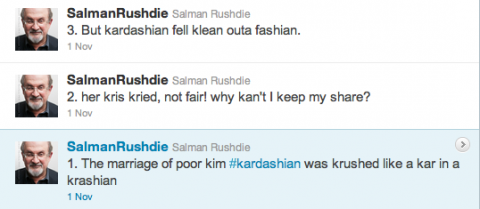
Kim Kardashian Gets Divorced; Salman Rushdie Writes Limerick

Per­haps you know the back­sto­ry; per­haps you don’t. This week, socialite and real­i­ty “star” Kim Kar­dashi­an announced that her 72-day mar­riage to Kris Humphries will end in divorce. In response, the tabloids buzzed … and famed author Salman Rushdie (Midnight’s Chil­dren, The Satan­ic Vers­es and The Moor’s Last Sigh) took to Twit­ter and offered up a nice lit­tle lim­er­ick. It starts with the blue sec­tion and moves up the page…

Fol­low the author at @SalmanRushdie, and us at @openculture.

Relat­ed Con­tent:

Salman Rushdie on Machiavelli’s Bad Rap

Leonard Cohen Gives a Great Speech on How His Love Affair with Music First Began (2011)

Sev­er­al weeks back, we fea­tured Ladies and Gen­tle­men… Mr. Leonard Cohen, the 1965 film that doc­u­ment­ed the life and times of the young poet who had­n’t yet start­ed his leg­endary song­writ­ing career. Now comes a lit­tle post­script. Speak­ing last Fri­day at the Prince of Asturias Awards, Mr. Cohen recalls the defin­ing lit­tle moment when he shift­ed towards music and song­writ­ing. He calls it the moment that explains “How I Got My Song,” and it’s all bound up with Spain and tragedy. The 11-minute talk is filled with humil­i­ty and grat­i­tude in equal parts. You can find a tran­script here. H/T Metafil­ter

Relat­ed Con­tent:

Leonard Cohen Reads “The Future” (Not Safe for Work)

Leonard Cohen: I’m Your Man. Watch the Film

Learn Span­ish with our Col­lec­tion of Free Lan­guage Lessons

« Go BackMore in this category... »
Quantcast