Or some lavish dish you never had a chance to taste?
What might your choice reveal about your race, regional origins, or economic circumstances?
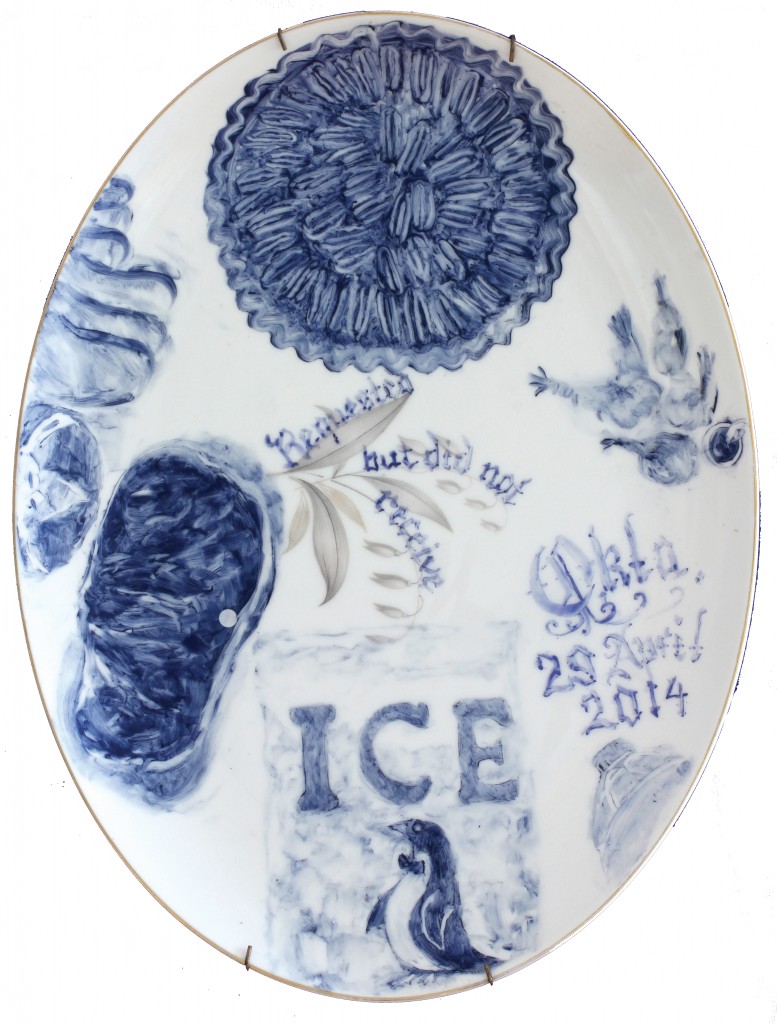
Artist Julie Green developed a fascination with death row inmates’ final meals while teaching in Oklahoma, where the per capita execution rate exceeds Texas’ and condemned prisoners’ special menu requests are a matter of public record:
Fried fish fillets with red cocktail sauce from Long John Silver’s
Large pepperoni pizza with sausage and extra mushrooms and a large grape soda.
The latter order, from April 29, 2014, was denied on the grounds that it would have exceeded the $15-per-customer max. The prisoner who’d made the request skipped his last meal in protest.
One man got permission for his mother to prepare his last meal in the prison kitchen. Another was surprised with a birthday cake after prison staff learned he had never had one before.
Each meal Green paints is accompanied by a menu, the date, and the state in which it was served, but the prisoners and their crimes go unnamed. She has committed to producing fifty plates a year until capital punishment is abolished.
Since the Harry Potter craze began, we’ve seen young adult fiction gain massive popularity with adults, in ways some critics have lamented as a trend that infantilizes the buying public. (Some say the same about superhero films and adult fans of boy bands). Katie Couric identified the phenomenon as “the rise of so-called Peter Pan activities,” throwing “adult summer camps and Lego leagues” in the mix. Critics of Peter Panism can add another trend to their battery of examples: the rise of the adult coloring book. Business Insiderreported in April that “in Britain, four out of the top 10 Amazon bestsellers are coloring (or colouring, as the Brits insist) books for adults.” Currently, Amazon’s top 20 bestsellers for 2015 includes three adult coloring books. Among so many other consumer signs and portents, adult coloring books may indeed herald a coming apocalypse, at least for Russell Brand, who wonders, “What has turned us into terrified divs that want to live in childish stupors?”
Well, whether “childish,” art therapy or “Zen,” adult coloring books meet a need millions of grown-ups have to soothe their jangled nerves, and it seems almost cruel to mock people so anxiety-ridden they’ve returned to kindergarten remedies. Then again, it’s worth noting, as Smithsonian did recently, “the adult coloring concept is not exactly new.”
It dates back to the 1960s, when “bookstores exploded” with coloring books geared exclusively toward adults. The difference between then and now lies in the fact that those books were adult in content as well as form—“satirical and subversive,” offering “a mocking look at American society.” The first of these, The Executive Coloring Book, arrived in 1961, followed by The John Birch Society Coloring Book and many similar titles “satirizing conformism, John F. Kennedy and the Soviet Union,” among other targets. And yet, “Unlike the adult coloring books flying off the shelves today,” Smithsonian writes, “these books were not created with the intention to be colored in.”
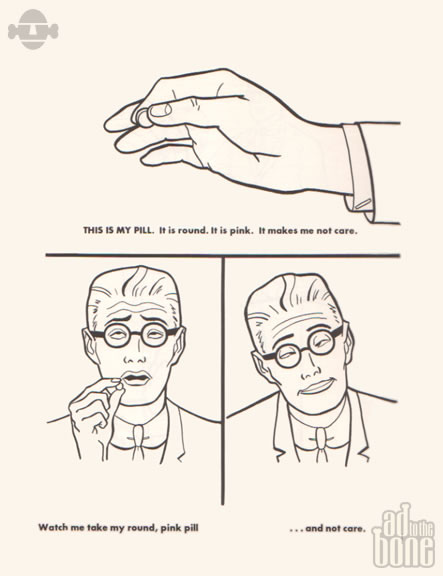
Take the two pages from The Executive Coloring Book above. The first, at the top, shows us our executive preparing for his day with the caption “THIS IS MY SUIT. Color it gray or I will lose my job.” Above, a line of identical executives boards a train. Hammering home the point, we’re told “THIS IS MY TRAIN. It takes me to my office every day. You meet lots of interesting people on the train. Color them all gray.” A notable exception to these dreary instructions, below, tells us “THIS IS MY PILL. It is round. It is pink. It makes me not care. Watch me take my round, pink pill… and not care.” The contents of the pill may have changed, but the medicated worker bee is still very much with us, though the gray flannel suit is a thing of the past.
Rather than giving its target audience a chance to become kids again, The Executive Coloring Book pokes fun at the ways in which pampered executives of the Mad Men-era could themselves be shallow manchildren. One page, below, shows the executive’s secretary with the caption “THIS IS MY SECRETARY. I hate her. She is mean. I used to have a soft, round lady. But my wife called her papa.” Another (bottom), reminiscent of the business card scene in American Psycho, shows us the executive’s important phone: “THIS IS MY TELEPHONE. It has five buttons. Count them. One, two, three, four, five. Five buttons. How many buttons does your telephone have? Mine has five.”
From its faux-leather cover to its final page of business-speak gibberish, the whole thing is a masterfully simple, self-contained piece of conceptual art. The next publication by the same authors, The John Birch Coloring Book, made its intentions a little more obvious. A Sunday Herald review quotes from its introduction: “This book is respectfully dedicated to Dwight D. Eisenhower and many other loyal Americans who have been maligned by extremist groups.” One caption reads “This is our eagle. We cut off his left wing. Now he is an all American eagle. But he flies only in circles.” The “Birchers will have to learn to smile,” writes the reviewer, as the book “spare[s] not their feelings.” Not likely. Rather than selling relaxation, the adult coloring books of the 60s were “engaged,” wrote Milton Bracker in a 1962 New York Times review, “in political warfare.”
Producer David Merrick pulled the plug on a 1966 musical adaptation of Breakfast at Tiffany’s starring Mary Tyler Moore long before its official opening night, thus sparing the drama critics and the public “an excruciatingly boring evening.”
And then there is 1970’s Big Time Buck White, activist Oscar Brown, Jr.’s adaptation of Joseph Dolan Tuotti’s play. It featured Muhammad Ali—temporarily benched from boxing for draft evasion—in the titular role of a militant lecturer, delivering a Black Power message to a character named Whitey.
The primarily white Broadway-going audience that embraced the countercultural “Tribal Love-Rock Musical” Hairtwo years earlier withheld its love. In a colorblind world, we might be able to chalk that up to the champ’s sub-par singing chops or some clunky lyrics, but it would be a mistake to turn a blind eye to the political climate.
(Eight years later, Ain’t Misbehavin’, a tribute to Fats Waller and the Harlem Renaissance was a bonafide hit.)
Big Time Buck White ran for just seven performances, posting its closing notice well in advance of its January 18th appearance on the Ed Sullivan Show, above.
These days, the producers would probably scramble to find a replacement, but Sullivan, a staunch supporter of Civil Rights, honored the booking, commanding his studio audience to give the costumed players “a fine reception.”
Afterward, the champ thanked Sullivan for inviting him and “the group” so that viewers who didn’t get a chance to could see “what type of play i was participating in.”
A bit of trivia. Playbill credits actor Donald Sutherland, in the role of Black Man. He may be a movie star, but he’s something of a Broadway flop himself, his only other credit that of Humbert Humbert in 1980’s Lolita, People Magazine’s Bomb of the Year.
Above is another scene from the musical, shared by Ali’s admirer, Mike Tyson.
In ostensibly liberal democracies in the West, attitudes towards free speech vary widely given different historical contexts, and can shift dramatically over time. We’re living in the midst of a generational shift on the issue in the U.S.; a recent Pew survey found that 40 percent of millennials—18–34 year olds—favor government bans on offensive speech. The usual caveats apply when reading this data; New York magazine’s Science of Us blog breaks down the demographics and points out problems with definitions, particularly with that of the word “offensive.” They write, “plenty of folks freak out about anti-cop sentiments but are fine with racially loaded language—or insert your own examples.” As commentators note almost daily, various free speech advocates show all manner of partiality when it comes to whose speech they choose to defend and whose they, unwittingly perhaps, suppress.
European countries, of course, already have all sorts of laws that curb offensive speech and impose harsh penalties, from large fines to jail time. Those laws are extending to the internet as well, a speech domain long censored by Chinese authorities.
Whether European measures against racist and xenophobic speech actually lessen racism and xenophobia is an open question, as is the problem of exceptions to the laws that seem to allow certain kinds of prejudices as they strongly censor others. Much more extreme examples of the suppression of free speech have recently come to light under autocratic regimes in the Middle East. In Syria, software developer and free speech advocate Bassel Khartabil has been held in prison since 2012 for his activism. In Saudi Arabia, artist, poet, and Palestinian refugee Ashraf Fayadh has been sentenced to death for “renouncing Islam.”
We could add to all of these examples hundreds of others, from all over the world, but in addition to the statistics and the disturbing individual cases, it is worth asking broader, more philosophical questions about free speech as we draw our own conclusions about the issues. What exactly do we mean by “free speech”? Should all speech be protected, even that meant to libel individuals or whole groups or to deliberately incite violence? Should we tolerate a public discourse made up of lies, misinformation, prejudicial invective, and personal attacks? Should citizens and the press have the right to question official government narratives and to demand transparency?
To help us think through these politically and emotionally fraught discussions, we could listen to Free Speech Bites, a podcast sponsored by the Index on Censorship and hosted by freelance philosopher Nigel Warburton, who also hosts the popular podcast Philosophy Bites. The format is identical to that long-standing show, but instead of short conversations with philosophers, Warburton has brief, lively discussions with free speech advocates, including authors, artists, politicians, journalists, comedians, cartoonists, and academics. In the episode above, Warburton talks with DJ Taylor, biographer of the man considered almost a saint of free speech, George Orwell.
Of his subject, Taylor remarks, “I think it’s true to say that most of Orwell’s professional life, large amounts of the things that he wrote, are to do with the suppression of the individual voice.” At the same time, he points out that Orwell’s “view of free speech is by no means clear cut.” The “whole free speech issue became much more delicately shaded than it would otherwise have been” during the extraordinary times of the Spanish Civil War and World War II. Taylor refers to the “classic liberal dilemma: how far do we tolerate something that, if tolerated, will cease to tolerate us…. If you are living in a democracy and somebody’s putting out fascist pamphlets encouraging the end of that democracy, how much rope do you give them?”
In another episode, Irshad Manji—feminist, self-described “Muslim refusenik,” and author of The Trouble with Islam Today—talks free speech and religion, and offers a very different perspective than what we’re used to hearing reported from Islamic thinkers. When Warburton says that Islam and free expression sound “like two incompatible things,” Manji counters that as a “person of faith” she believes “free expression is as much a religious obligation as it is a human right.” In her estimation, “no human being can legitimately behave as if he or she owns a monopoly on truth.” Anything less than a society that tolerates civil disagreement, she says, means that “we’re playing God with one another.” In her religious perspective, “devoting yourself to one god means that you must defend human liberty.” Manji sounds much more like Enlightenment Christian reformers like John Locke than she does many interpreters of Islam, and she is well aware of the unpopularity of her point of view in much of the Islamic world.
Addressing the question of why free speech matters, broadcaster and writer Jonathan Dimbleby—former chair of the Index on Censorship—inaugurated the podcast in 2012 with a more classically philosophical discussion of John Stuart Mill’s On Liberty and the liberal argument against censorship Mill and others articulated. For Dimbleby, “freedom of expression [is] not only a right but a defining characteristic of what it means to be a civilized individual.” It’s a view he holds “very strongly,” but he admits that the valid exceptions to the rule are “where the difficult territory starts.” Dimbleby points to “very obvious circumstances when you don’t have freedom of expression and should not have freedom of expression.” One of the exceptions involves “laws that say that if you express yourself freely, you are directly putting someone else’s life at risk.” This is not as clear-cut as it seems. The “dangerous territory,” he argues, begins with circumscribing language that incites anger or offense in others. We are back to the question of offense, and it is not a uncomplicated one. Although activists very often need to be uncivil to be heard at all, there’s also a necessary place for public discussions that are as thoughtful and careful as we can manage. And for that reason, I’m grateful for the intervention of Free Speech Bites and the international variety of views it represents.
What kind of delusional self-aggrandizer, called to testify before a United States Senate Subcommittee, uses it as an opportunity to quote the lyrics of a song he’s written… in their entirety!?
Only children’s television host Fred Rogers could pull such a stunt and emerge unscathed, nay, even more beloved, as he does above in documentary footage from 1969.
Newly elected President Richard Nixon opposed public television, believing that its liberal bent could only undermine his administration. Determined to strike first, he proposed cuts equal to half its $20 million annual operating budget, a measure that would have seriously hobbled the fledgling institution.
Mr. Rogers appeared before the Committee armed with a “philosophical statement” that he refrained from reading aloud, not wishing to monopolize ten minutes of the Committee’s time. Instead, he sought Pastore’s promise that he would give it a close read later, speaking so slowly and with such little outward guile, that the tough nut Senator was moved to crack, “Would it make you happy if you did read it?”
Rather than taking the bait, Rogers touched on the ways his show’s budget had grown thanks to the public broadcasting model. He also hipped Pastore to the qualitative difference between frenetic kiddie cartoons and the vastly more thoughtful and emotionally healthy content of programming such as his. Mr. Roger’s Neighborhood was a place where such topics as haircuts, sibling relationships, and angry feelings could be discussed in depth.
Rogers’ emotional intelligence seems to hypnotize Pastore, whose challenging front was soon dropped in favor of a more respectful line of questioning. By the end of Rogers’ heartfelt, non-musical rendition of What Do You Do… (it’s much peppier in the original), Pastore has goosebumps, and the Corporation for Public Broadcasting has its 2 mil’ back in the bag.
The Gandhi of history doesn’t line up with the Gandhi of legend, just as the beatified Mother Teresa presents a very different picture in certain astute critics’ estimation. But as with most saints, ancient and modern, people tend to ignore Gandhi’s many contradictions and troublingly racist and casteist views. He comes to us more as myth and martyr than deeply flawed human individual. An indispensable part of the mythmaking, Richard Attenborough’s 1982 biopic, Gandhi, may be “over-sanitized,” as The Guardian writes, but Ben Kingsley’s performance as the anti-colonial leader is genuinely “sublime” in his evocation of Gandhi’s “intensity… wit and even the distinctive, determined walk.” It’s these personal qualities—and of course Gandhi’s defeat of the largest empire on the planet with nonviolent action and a spiritual philosophy—that continue to inspire movements for justice and civil rights.
We see a little of that determined walk in the short newsreel interview above, the very first “talking picture” made of Gandhi, and we also hear his intensity and wit, though much subdued by his physical frailty after years of fasting. Taken in 1947 by Fox Movietone News, the film marks a pivotal period in the Indian leader’s life. Very shortly after this Parliament passed the Indian Independence Act. That year also marked the start of a bloody new struggle, instigated by another colonial intervention, as the British partitioned India into two warring countries, an act so poignantly dramatized in Salmon Rushdie’s Midnight’s Children.
This year of turmoil was also Gandhi’s last; he was assassinated in 1948 by a Hindu nationalist who accused him of siding with Pakistan. In the interview, we hear what we might think of as some of Gandhi’s final public pronouncements on such subjects as child marriage, prohibition, his deeply held convictions about an authentic Indian cultural identity, and the lengths that he would go for his country’s independence. At the end of the short interview, the American reporter asks Gandhi, presciently, “would you be prepared to die in the cause of India’s Independence?” to which Gandhi replies, “this is a bad question.”
A rousing sentiment, and one rarely expressed by those running for the nation’s highest office.
Once a candidate has been safely elected, he may feel comfortable betraying a deeper affinity, or ceding to the tastes of an arts-inclined First Lady. Sanders isn’t waiting, pledging in the video above, that he will be an Arts President.
He recorded a 1987 folk album with the help of 30 Vermont musicians, stoutly pronouncing the lyrics to “This Land is Your Land” and “Where Have All the Flowers Gone” a la Rex Harrison.
As Sanders fans wait to see whether Fairey will perform a similar service for his 2016 pick, Stencils for Bernie is taking up the slack with downloadable images for the DIY-inclined.
I presume that it’s only a matter of time before some young animator puts him or herself at Sanders’ disposal, though I kind of hope not. The candidate’s short video is reassuringly devoid of the snappy visuals that have become a staple of the form, thanks to such popular series as Crash Course, CGP Grey, The School of Life, and TED Ed.
Ayun Halliday is an author, illustrator, and Chief Primatologist of the East Village Inky zine. Her play, Fawnbook, opens in New York City later this month. Follow her @AyunHalliday
Some of the most rigorous moral thinkers of the past century have spent time on the wrong side of questions they deemed of vital importance. Mohandas Gandhi, for example, at first remained loyal to the British, manifesting many of the vicious prejudices of the Empire against Black South Africans and lobbying for Indians to serve in the war against the Zulu. Maya Jasanoff in New Republic describes Gandhi during this period of his life as a “crank.” At the same time, he developed his philosophy of non-violent resistance, or satyagraha, in South Africa as an Indian suffering the injustices inflicted upon his countrymen by both the Boers and the British.
Gandhi’s sometime contradictory stances may be in part understood by his rather aristocratic heritage and by the warm welcome he first received in London when he left his family, his caste, and his wife and child in India to attend law school in 1888. And yet it is in London that he first began to change his views, becoming a staunch vegetarian and encountering theosophy, Christianity, and many of the contemporary writers who would shift his perspective over time. Gandhi received a very different reception in England when he returned in 1931, the de facto leader of a burgeoning revolutionary movement in India whose example was so important to both the South African and U.S. civil rights movements of succeeding decades.
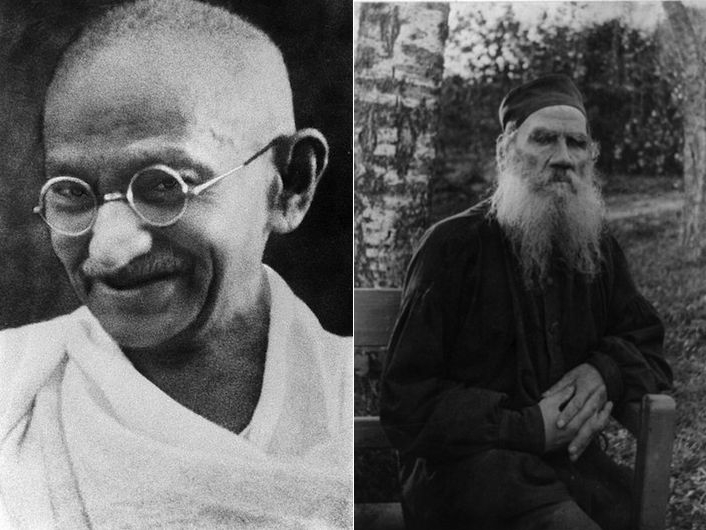
One of the writers who most deeply guided Gandhi’s political, spiritual, and philosophical evolution, Leo Tolstoy, experienced his own dramatic transformation, from landed aristocrat to social radical, and also renounced property and position to advocate strenuously for social equality. Gandhi eagerly read Tolstoy’s The Kingdom of God is Within You, the novelist’s statement of Christian anarchism. The book, Gandhi wrote in his autobiography, “left an abiding impression on me.” After further study of Tolstoy’s religious writing, he “began to realize more and more the infinite possibilities of universal love.”
It was in England, not India, where Gandhi first read “A Letter to a Hindu,” Tolstoy’s 1908 reply to a note from Indian revolutionary Taraknath Das on the question of Indian independence. Tolstoy divides his lengthy, thoughtful “Letter” into short chapters, each of which begins with a quotation from the Vedas. “Indeed,” writes Maria Popova, the missive “puts in glaring perspective the nuanceless and hasty op-eds of our time.” It so affected Gandhi that, in 1909, he wrote to Tolstoy, thus beginning a correspondence between the two that lasted through the following year. “I take the liberty of inviting your attention to what has been going on in the Transvaal for nearly three years,” begins Gandhi’s first letter, somewhat abruptly, “There is in that Colony a British Indian population of nearly 13,000. These Indians have, for several years, labored under various legal disabilities.”
The prejudice against color and in some respects against Asians is intense in that Colony….The climax was reached three years ago, with a law that many others and I considered to be degrading and calculated to unman those to whom it was applicable. I felt that submission to a law of this nature was inconsistent with the spirit of true religion. Some of my friends and I were and still are firm believers in the doctrine of nonresistance to evil. I had the privilege of studying your writings also, which left a deep impression on my mind.
Gandhi refers to a law forcing the Indian population in South Africa to register with the authorities. He goes on to inquire about the authenticity of the “Letter” and asks permission to translate it, with payment, and to omit a negative reference to reincarnation that offended him. Tolstoy responded a few months later, in 1910, allowing the translation free of charge, and allowing the omission, with the qualification that he believed “faith in re-birth will never restrain mankind as much as faith in the immortality of the soul and in divine truth in love.” Overall, however, he expresses solidarity, greeting Gandhi “fraternally” and writing,
God help our dear brothers and co-workers in the Transvaal! Among us, too, this fight between gentleness and brutality, between humility and love and pride and violence, makes itself ever more strongly felt, especially in a sharp collision between religious duty and the State laws, expressed by refusals to perform military service.
The two continued to write to each other, Gandhi sending Tolstoy a copy of his Indian Home Rule and the translated “Letter,” and Tolstoy expounding at length on the errors—and what he saw as the superior characteristics—of Christian doctrine. You can read their full correspondence here, along with Tolstoy’s “Letter to a Hindu” and Gandhi’s introduction to his edition. Despite their religious differences, the exchange further galvanized Gandhi’s passive resistance movement, and in 1910, he founded a community called “Tolstoy Farm” near Johannesburg.
Gandhi’s views on African independence would change, and Nelson Mandela later adopted Gandhi and the Indian independence movement as a standard for the anti-apartheid movement. We’re well aware, of course, of Gandhi’s influence on Martin Luther King, Jr. For his part, Gandhi wrote glowingly of Tolstoy, and the model the novelist provided for his own anti-colonial campaign. In a speech 18 years later, he said, “When I went to England, I was a votary of violence, I had faith in it and none in nonviolence.” After reading Tolstoy, “that lack of faith in nonviolence vanished…Tolstoy was the very embodiment of truth in this age. He strove uncompromisingly to follow truth as he saw it, making no attempt to conceal or dilute what he believed to be the truth. He stated what he felt to be the truth without caring whether it would hurt or please the people or whether it would be welcome to the mighty emperor. Tolstoy was a great advocate of nonviolence in his age.”
We're hoping to rely on loyal readers, rather than erratic ads. Please click the Donate button and support Open Culture. You can use Paypal, Venmo, Patreon, even Crypto! We thank you!
Open Culture scours the web for the best educational media. We find the free courses and audio books you need, the language lessons & educational videos you want, and plenty of enlightenment in between.