James Baldwin Debates Malcolm X (1963) and William F. Buckley (1965): Vintage Video & Audio

One often hears lament­ed the lack of well-spo­ken pub­lic intel­lec­tu­als in Amer­i­ca today. Very often, the lamenters look back to James Bald­win, who in the 1950s and 1960s wrote such pow­er­ful race‑, class‑, and sex-exam­in­ing books as Go Tell It on the Moun­tainGio­van­ni’s Room, and The Fire Next Time, as one of the great­est fig­ures in the field. Though Bald­win expa­tri­at­ed him­self to France for much of his life, he seems nev­er to have let the state of his home­land drift far from his mind, and his opin­ions on it con­tin­ued to put a charge into the grand Amer­i­can debate.

Upon one return from Paris in 1957, Bald­win found him­self wrapped up in the con­tro­ver­sy around the Civ­il Rights Act and the relat­ed move­ments across the south. He wrote sev­er­al high-pro­file essays on the sub­ject, even end­ing up him­self the sub­ject of a 1963 Time mag­a­zine cov­er sto­ry on his views. That same year, he went on a lec­ture tour on race in Amer­i­ca which put him in close con­tact with a vari­ety of stu­dent move­ments and oth­er protests, whose effi­ca­cy he and Mal­colm X debat­ed in the broad­cast above.

“While Mal­colm X crit­i­cized the sit-in move­ment as pas­sive,” writes Rhon­da Y. Williams in Con­crete Demands: The Search for Black Pow­er in the 20th Cen­tu­ry, “Bald­win argued that ‘main­tain­ing calm in the face of vit­ri­ol demands a tremen­dous amount of pow­er.’ ” He goes on to say that “when the sit-in move­ment start­ed or when a great many things start­ed in the west­ern world, I think it had a great deal less to do with equal­i­ty than with pow­er.” This got him won­der­ing about what he saw as the all-impor­tant dis­tinc­tion between “pow­er and equal­i­ty” and “pow­er and free­dom.”

Two years lat­er, Bald­win appeared in anoth­er high-pro­file debate with about as dif­fer­ent an inter­locu­tor from Mal­colm X as one can imag­ine: Fir­ing Line host William F. Buck­ley, across from whom every well-spo­ken pub­lic intel­lec­tu­al in Amer­i­ca of that era must have sat at one time or anoth­er. They dis­cussed whether the Amer­i­can Dream comes “at the expense of the Amer­i­can negro.” Buck­ley, as Josh Jones wrote here in 2012, “had come out four years ear­li­er against deseg­re­ga­tion and Civ­il Rights leg­is­la­tion” and could ably defend his posi­tions, but “Bald­win proved the more per­sua­sive voice.”

Dis­sect­ing the skills of Bald­win the debater, John Warn­er of Inside High­er Edu­ca­tion writes that “Baldwin’s remarks dis­play all the skill and moves of an expert per­suad­er” such as “the atten­dance to audi­ence, the acknowl­edge­ment of their needs, the com­bi­na­tion of both emo­tion­al and log­i­cal argu­ment.” His argu­ments also have their roots not in “atti­tudes or beliefs, which are var­ied and change­able, but val­ues, which are wide­ly shared and immutable.”

Bald­win, Warn­er con­tin­ues, “reminds us that Amer­i­ca is the land of the free, the home of the brave, that all men are cre­at­ed equal, that we are here to pur­sue life, lib­er­ty, hap­pi­ness,” but “while these val­ues are pow­er­ful and time­less, our under­stand­ing of how they may be best achieved, the con­di­tions under which they can be fos­tered change all the time.” Whether on the air or in text, against Mal­colm X, William F. Buck­ley, or any­one else, his per­for­mance in debate shows that “the best and most last­ing per­sua­sion is sim­ply the act of remind­ing peo­ple of what they already believe to be true.”

Relat­ed Con­tent:

James Bald­win Bests William F. Buck­ley in 1965 Debate at Cam­bridge Uni­ver­si­ty

James Bald­win: Wit­ty, Fiery in Berke­ley, 1979

Mal­colm X, Debat­ing at Oxford, Quotes Shakespeare’s Ham­let (1964)

Mal­colm X at Oxford Uni­ver­si­ty 1964

Col­in Mar­shall writes on cities, lan­guage, Asia, and men’s style. He’s at work on a book about Los Ange­les, A Los Ange­les Primer, and the video series The City in Cin­e­ma. Fol­low him on Twit­ter at @colinmarshall or on Face­book.

A Look Inside Hannah Arendt’s Personal Library: Download Marginalia from 90 Books (Heidegger, Kant, Marx & More)

Hannah_Arendt

It does seem pos­si­ble, I think, to over­val­ue the sig­nif­i­cance of a writer’s library to his or her own lit­er­ary pro­duc­tions. We all hold on to books that have long since ceased to have any pull on us, and lose track of books that have great­ly influ­enced us. What we keep or don’t keep can be as much a mat­ter of hap­pen­stance or sen­ti­ment as delib­er­ate per­son­al archiv­ing. But while we may not always be con­scious cura­tors of our lives’ effects, those effects still speak for us when we are gone in ways we may nev­er have intend­ed. In the case of famous—and famous­ly controversial—thinkers like Han­nah Arendt, what is left behind will always con­sti­tute a body of evi­dence. And in some cases—such as that of Arendt’s teacher and one­time lover Mar­tin Hei­deg­ger’s glar­ing­ly anti-Semit­ic Black Note­books—the evi­dence can be irrev­o­ca­bly damn­ing.

Heidegger Early Greek

In Arendt’s case, we have no such smok­ing gun to sub­stan­ti­ate argu­ments that, despite her own back­ground, Arendt was anti-Jew­ish and blamed the vic­tims of the Holo­caust. Dur­ing the so-called “Eich­mann wars” in the mid-twen­ti­eth cen­tu­ry, a tor­rent of crit­i­cism bom­bard­ed Arendt’s Eich­mann in Jerusalem, the com­pi­la­tion of dis­patch­es she penned as an observ­er of the Nazi arch-bureaucrat’s tri­al. These days, writes Corey Robin in The Nation, “while the con­tro­ver­sy over Eich­mann remains, the con­tro­ver­sial­ists have moved on.” The debate now seems more cen­tered on Arendt’s book itself than on her moti­va­tions. What do Arendt’s obser­va­tions reveal to us today about the log­ic of total­i­tar­i­an­ism and geno­ci­dal state actions? One way to approach the ques­tions of mean­ing in Eich­mann, and in her mon­u­men­tal The Ori­gins of Total­i­tar­i­an­ism, is to exam­ine the sources of her thought—and her use of those sources.

Arendt Nicomachean

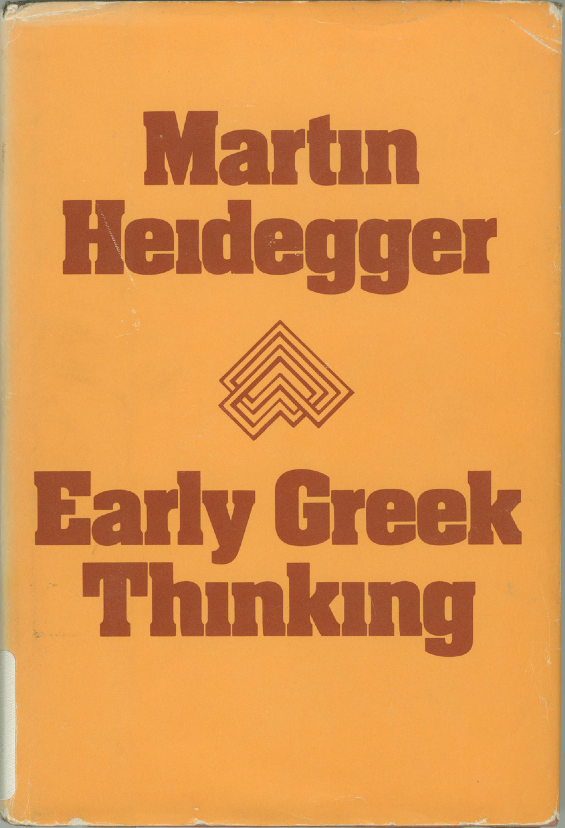
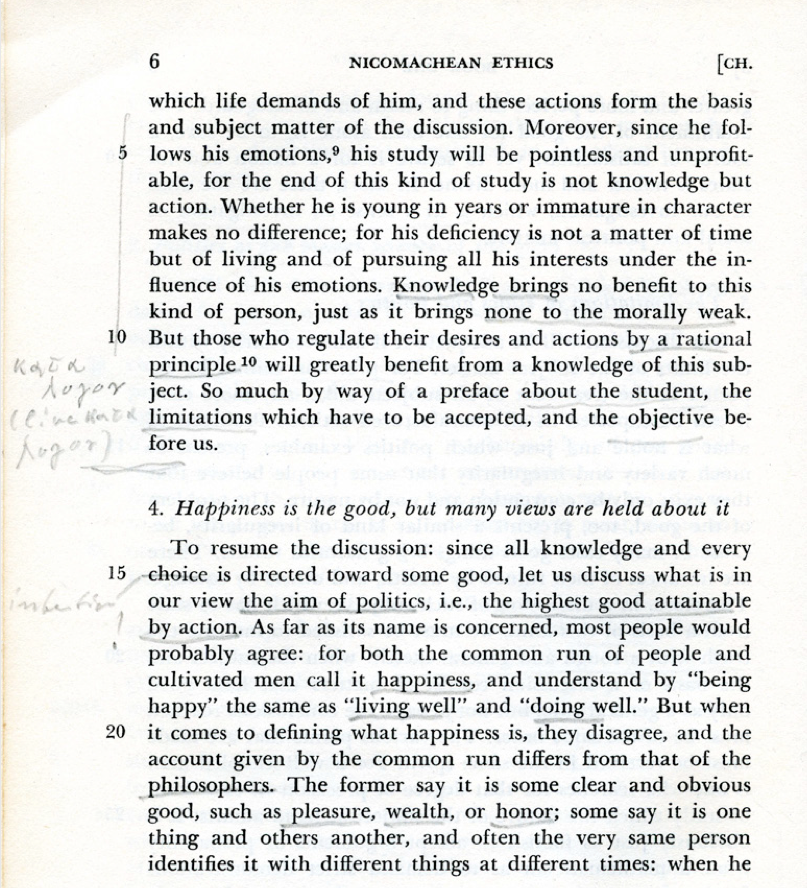
Arendt’s library—much of it on view online thanks to Bard col­lege—offers us a unique oppor­tu­ni­ty to do just that, not only by giv­ing us access to the spe­cif­ic edi­tions and trans­la­tions that she her­self read and saved (for what­ev­er rea­son), but also by offer­ing insight into what Arendt con­sid­ered impor­tant enough in those texts to under­line and anno­tate. In Bard’s dig­i­tal col­lec­tion of “Arendt Mar­gin­a­lia”—selec­tions of her anno­tat­ed books in down­load­able PDFs—we see a polit­i­cal phi­los­o­phy informed by Aris­to­tle (see a page from her copy of Nico­machean Ethics above), Pla­to, and Kant, but also by con­ser­v­a­tive Ger­man polit­i­cal the­o­rist Carl Schmitt, a mem­ber and active sup­port­er of Nazism, and of course, by Hei­deg­ger, whose work occu­pies a cen­tral place in her library: in Ger­man and Eng­lish (like his Ear­ly Greek Think­ing above, inscribed by the trans­la­tor), and in pri­ma­ry and sec­ondary sources.

While it may go too far to claim, as promi­nent schol­ar Bernard Wasser­stein did in 2009, that an exam­i­na­tion of Arendt’s sources shows her inter­nal­iz­ing the val­ues of Nazis and anti-Semi­tes, the pre­pon­der­ance of con­ser­v­a­tive Ger­man thinkers in her per­son­al library does give us a sense of her intel­lec­tu­al lean­ings. But we can­not draw broad con­clu­sions from a cur­so­ry sur­vey of a life­time of read­ing and re-read­ing, though we do see a par­tic­u­lar­ly Aris­totelian strain in her think­ing: that the indi­vid­ual is only as healthy as his or her polit­i­cal cul­ture. What schol­ars of Arendt will find in Bard’s dig­i­tal col­lec­tion are ample clues to the devel­op­ment and evo­lu­tion of her phi­los­o­phy over time. What lay read­ers will find is the out­line of a course on the sources of Arendt-ian thought, includ­ing not only Greeks and Ger­mans, but the Amer­i­can poet Robert Low­ell, who wrote a glow­ing pro­file of Arendt and con­tributed at least four signed books of his to her library.

I say “at least” because the Bard dig­i­tal col­lec­tion is yet incom­plete, rep­re­sent­ing only a por­tion of the phys­i­cal media in the college’s phys­i­cal archive of “approx­i­mate­ly 4,000 vol­umes, ephemera and pam­phlets that made up the library in Han­nah Arendt’s last apart­ment in New York City.” What we don’t have online are books inscribed to her by Jew­ish schol­ar and mys­tic Ger­shom Scholem, by W.H. Auden and Ran­dall Jar­rell, and many oth­ers. Nonethe­less the “Arendt Mar­gin­a­lia” gives us an oppor­tu­ni­ty to peer into a writer and scholar’s process, and see her wres­tle with the thought of her pre­de­ces­sors and con­tem­po­raries. The full Arendt col­lec­tion gives us even more to sift through, includ­ing pri­vate cor­re­spon­dence and record­ings of pub­lic speech­es. The dig­i­ti­za­tion of these sources offers many oppor­tu­ni­ties for those who can­not trav­el to New York and access the phys­i­cal archives to delve into Arendt’s intel­lec­tu­al world in ways pre­vi­ous­ly only avail­able to pro­fes­sion­al aca­d­e­mics.

Relat­ed Con­tents:

Enter the Han­nah Arendt Archives & Dis­cov­er Rare Audio Lec­tures, Man­u­scripts, Mar­gin­a­lia, Let­ters, Post­cards & More

Han­nah Arendt Dis­cuss­es Phi­los­o­phy, Pol­i­tics & Eich­mann in Rare 1964 TV Inter­view

Han­nah Arendt’s Orig­i­nal Arti­cles on “the Banal­i­ty of Evil” in the New York­er Archive

Josh Jones is a writer and musi­cian based in Durham, NC. Fol­low him at @jdmagness

Allen Ginsberg’s Handwritten Poem For Bernie Sanders, “Burlington Snow” (1986)

Ginsberg Sanders

Spe­cial Col­lec­tions, Uni­ver­si­ty of Ver­mont Libraries

No mat­ter how much of a polit­i­cal junkie you are, you must sure­ly have had enough of the spec­ta­cle that is the 2016 cam­paign for the pres­i­den­cy. At cur­rent count, we are faced with an astound­ing 15 can­di­dates for the Repub­li­can nom­i­na­tion, one of whom is doing his best to revive the ugli­est nativism of the 19th cen­tu­ry. On the oth­er side of our bina­ry par­ty sys­tem, we have only One. Or so it would seem if you were to pay atten­tion to much of the media cov­er­age, which only rarely men­tions the hand­ful of oth­er Demo­c­ra­t­ic con­tenders and most­ly ignores the ris­ing tide of sup­port for Bernie Sanders.

The Sen­a­tor from Ver­mont has unabashed­ly referred to him­self, through­out his long polit­i­cal career, as a demo­c­ra­t­ic social­ist or, on occa­sion, sim­ply a “socialist”—a word that strikes fear into the heart of many an Amer­i­can, and res­onates wide­ly with anoth­er por­tion of the elec­torate. Debates over what this means rage on. George Will calls Sanders’ social­ism a “cha­rade.” Thor Ben­son in the New Repub­lic accus­es him of play­ing “loose with the ter­mi­nol­o­gy.” The his­to­ry and cur­rent state of “social­ism” is so long and com­plex that no one def­i­n­i­tion seems to suit. Its polit­i­cal bag­gage in Amer­i­can dis­course, how­ev­er, is unde­ni­able.

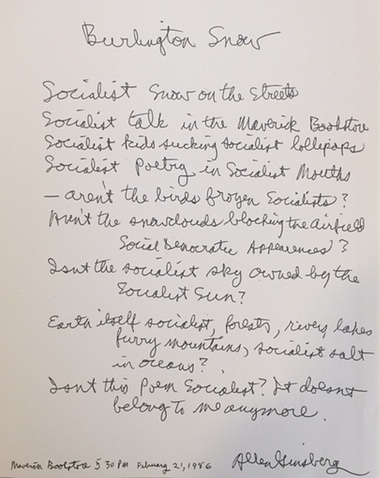
This was just as true in 1986, when Allen Gins­berg wrote a poem in praise of Sanders, then may­or of Burling­ton, Ver­mont. Gins­berg play­ful­ly draws on the loose asso­ci­a­tions we have with the word, ham­mer­ing it home with tongue-in-cheek rep­e­ti­tion, then turn­ing reflec­tive.

Social­ist snow on the streets
Social­ist talk in the Mav­er­ick book­store
Social­ist kids suck­ing social­ist lol­lipops
Social­ist poet­ry in social­ist mouths
—aren’t the birds frozen social­ists?
Aren’t the snow­clouds block­ing the air­field
Social Demo­c­ra­t­ic Appear­ances?
Isn’t the social­ist sky owned by
the social­ist sun?
Earth itself social­ist, forests, rivers, lakes
fur­ry moun­tains, social­ist salt
in oceans?
Isn’t this poem social­ist? It does­n’t
belong to me any­more.

Call­ing it “Burling­ton Snow,” Gins­berg com­posed the poem—equal parts goofy and sincere—on a vis­it to the city, one of many pil­grim­ages made by left-wing writ­ers and artists after Sanders’ string of attempt­ed for­eign pol­i­cy inter­ven­tions. You can read all about the opti­mistic socialist—or demo­c­ra­t­ic social­ist, or whatever—in Paul Lewis’ Guardian por­trait.

via Moth­er Jones

Relat­ed Con­tent:

Allen Gins­berg & The Clash Per­form the Punk Poem “Cap­i­tal Air,” Live Onstage in Times Square (1981)

‘The Bal­lad of the Skele­tons’: Allen Ginsberg’s 1996 Col­lab­o­ra­tion with Philip Glass and Paul McCart­ney

The First Record­ing of Allen Gins­berg Read­ing “Howl” (1956)

Josh Jones is a writer and musi­cian based in Durham, NC. Fol­low him at @jdmagness

2,200 Radical Political Posters Digitized: A New Archive

labadiecollectionposter07

I recent­ly heard some­one say his col­lege-bound nephew asked him, “What’s a union?” Whether you love unions, loathe them, or remain indif­fer­ent, the fact that an osten­si­bly edu­cat­ed young per­son might have such a sig­nif­i­cant gap in their knowl­edge should cause con­cern. A his­toric labor con­flict, after all, pro­vid­ed the occa­sion for Ronald Rea­gan to prove his bona fides to the new con­ser­v­a­tive move­ment that swept him into pow­er. His crush­ing of the Pro­fes­sion­al Air Traf­fic Con­trollers Orga­ni­za­tion (PATCO) in 1981 set the tone for the ensu­ing 30 years or so of eco­nom­ic pol­i­cy, with the labor move­ment fight­ing an uphill bat­tle all the way. Pri­or to that defin­ing event, unions held sway over pol­i­tics local and nation­al, and had con­sol­i­dat­ed pow­er blocks in the Amer­i­can polit­i­cal land­scape through decades of strug­gle against oppres­sive and dehu­man­iz­ing work­ing con­di­tions.

In prac­ti­cal terms, unions have stood in the way of cap­i­tal’s unceas­ing search for cheap labor and new con­sumer mar­kets; in social and cul­tur­al terms, the pol­i­tics of labor have rep­re­sent­ed a for­mi­da­ble ide­o­log­i­cal chal­lenge to con­ser­v­a­tives as well, by way of a vibrant assem­blage of anar­chists, civ­il lib­er­tar­i­ans, anti-colo­nial­ists, com­mu­nists, envi­ron­men­tal­ists, paci­fists, fem­i­nists, social­ists, etc. A host of rad­i­cal isms flour­ished among orga­nized work­ers espe­cial­ly in the decades between the 1870s and the 1970s, find­ing their voice in newslet­ters, mag­a­zines, pam­phlets, leaflets, and posters—fragile medi­ums that do not often weath­er well the rav­ages of time. Thus the advent of dig­i­tal archives has been a boon for stu­dents and his­to­ri­ans of work­ers’ move­ments and oth­er pop­ulist polit­i­cal groundswells. One such archive, the Joseph A. Labadie Col­lec­tion at the Uni­ver­si­ty of Michi­gan Library, has recent­ly announced the dig­i­ti­za­tion of over 2,200 posters from their col­lec­tion, a data­base that spans the globe and the spec­trum of left­ist polit­i­cal speech and iconog­ra­phy.

labadiecollectionposter06

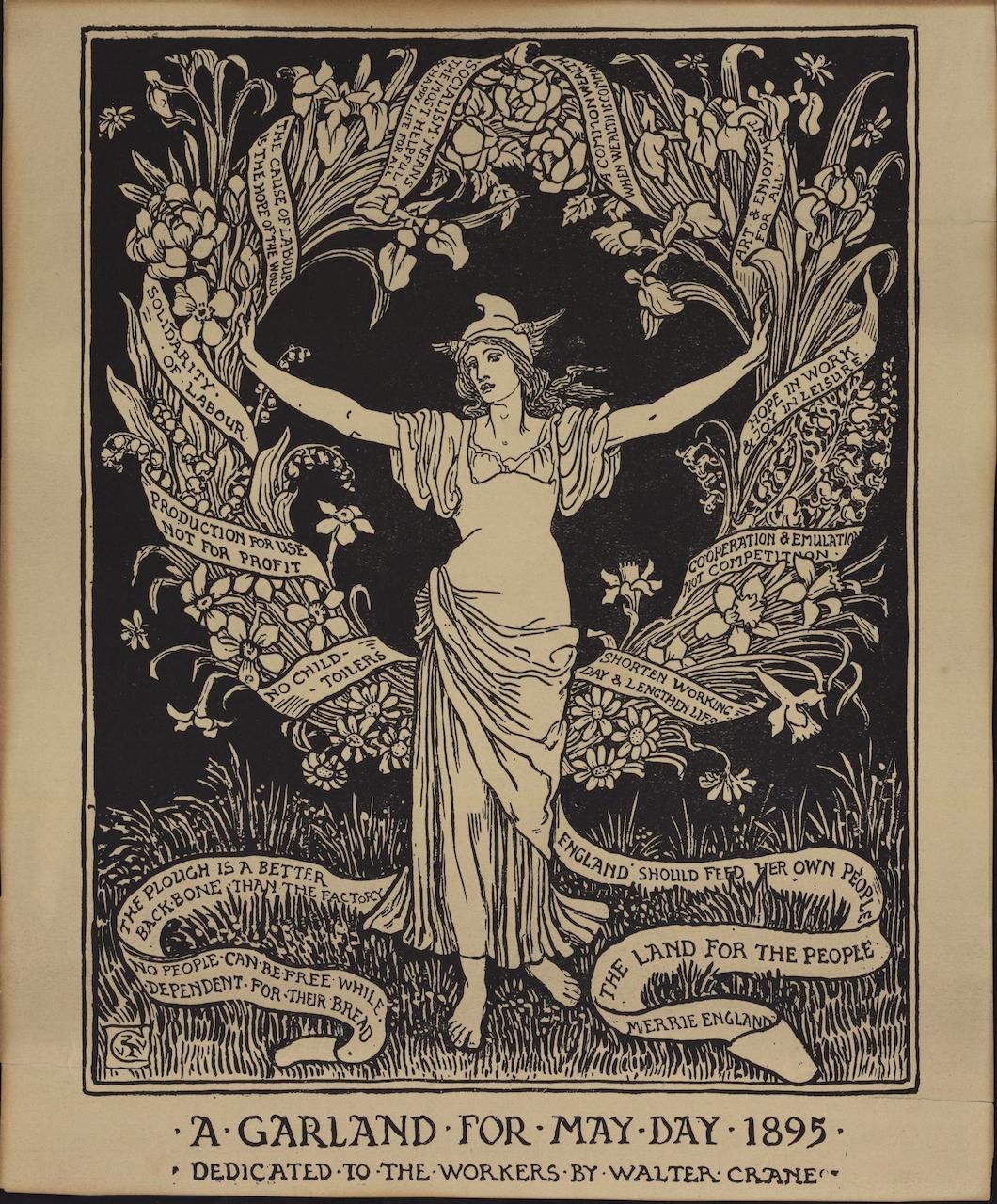
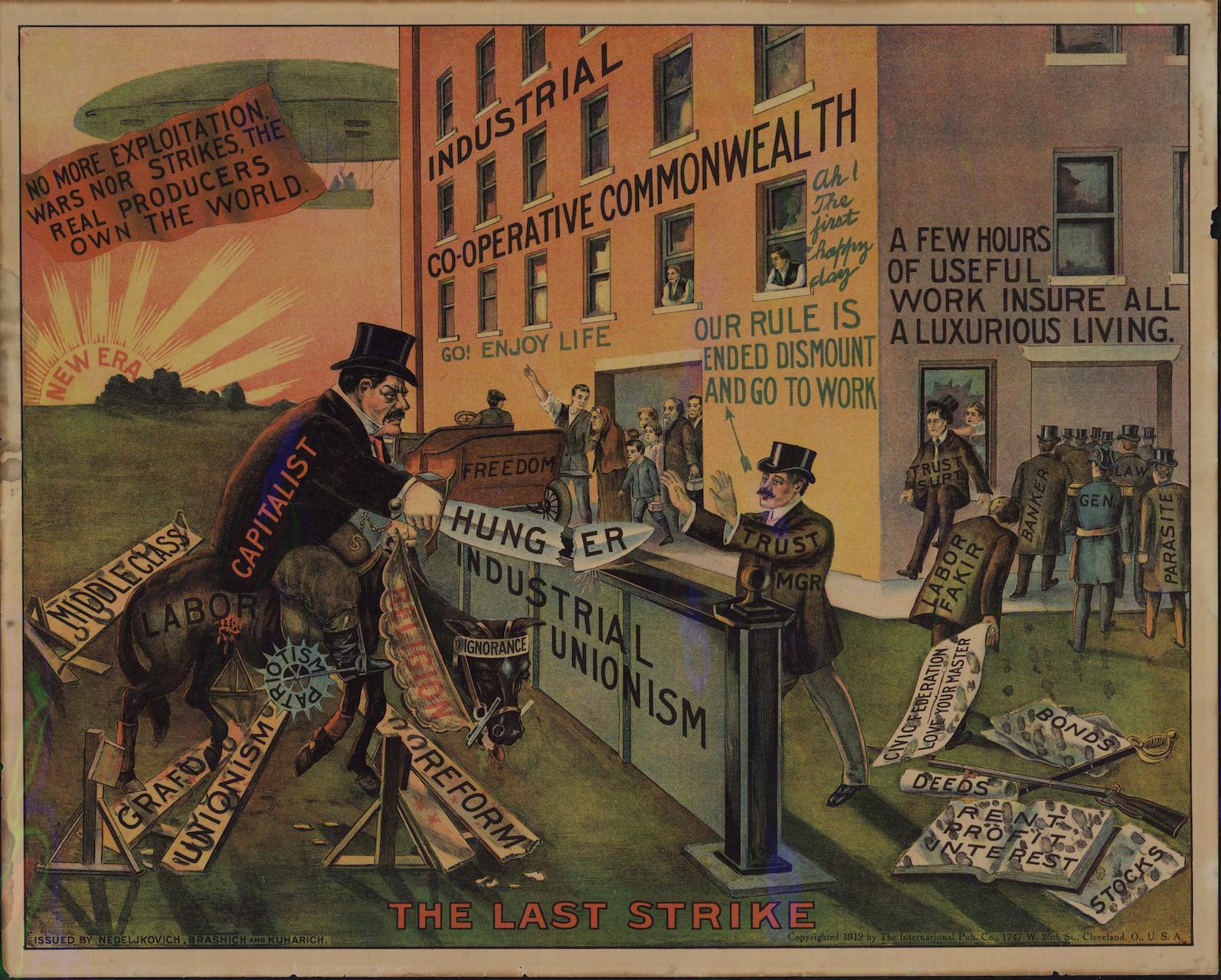
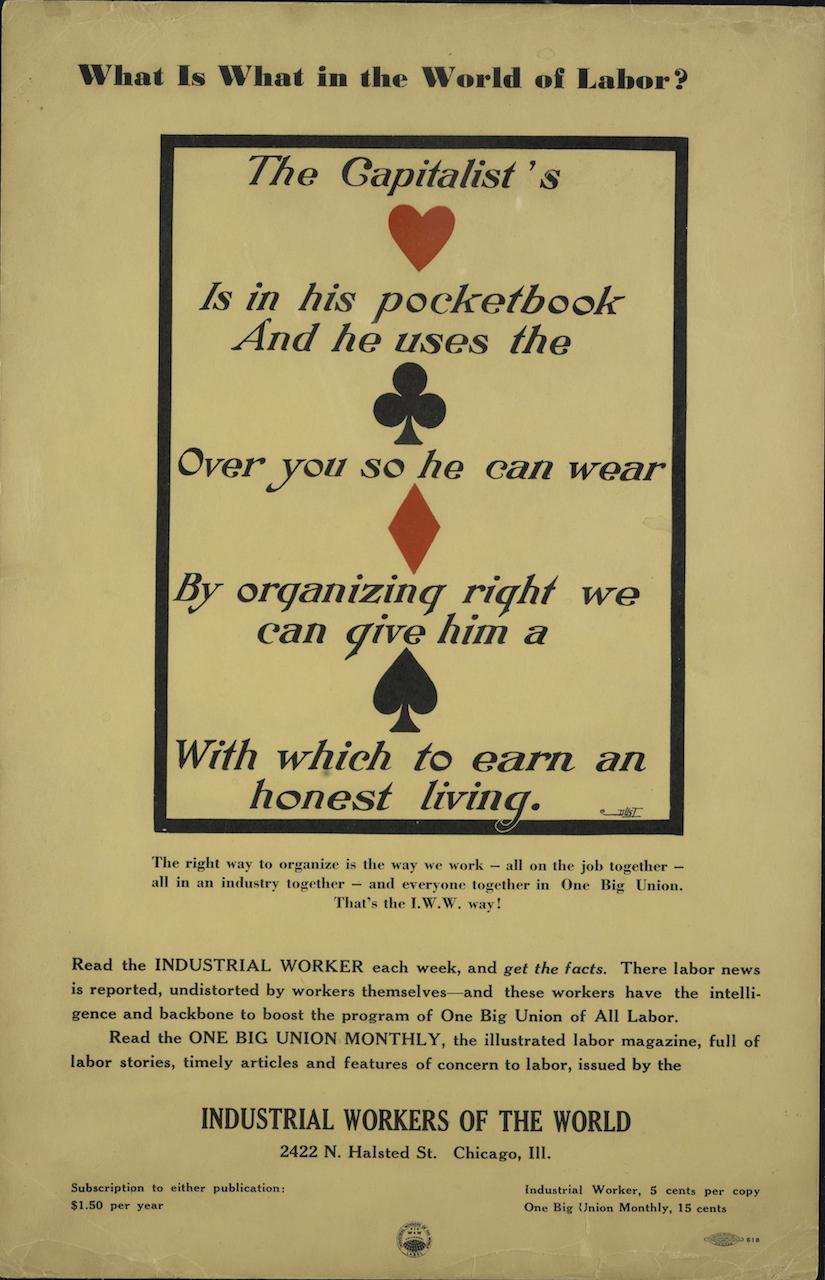
We have clev­er­ly-designed visu­al puns like the Chica­go Indus­tri­al Work­ers of the World poster just above, titled “What is what in the world of labor?” Pro­mot­ing itself as “One Big Union of All Labor,” the IWW made some of the most ambi­tious pro­pa­gan­da, like the 1912 poster (mid­dle) in which an “Indus­tri­al Co-Oper­a­tive Com­mon­wealth” replaces the tyran­ny of the cap­i­tal­ist, who is told by his “trust man­ag­er” peer, “Our rule is end­ed, dis­mount and go to work.” In this post-rev­o­lu­tion­ary fan­ta­sy, the IWW promis­es that “A few hours of use­ful work insure all a lux­u­ri­ous liv­ing,” though it only hints at the details of this utopi­an arrange­ment. Up top, we have an ornate May Day poster from 1895 by Wal­ter Crane, hop­ing for a “Mer­rie Eng­land” with “No Child Toil­ers,” “Pro­duc­tion for Use Not For Prof­it,” and “The Land For the Peo­ple,” among oth­er, more nation­al­ist, sen­ti­ments like “Eng­land Should Feed Her Own Peo­ple.”

labadiecollectionposter05

“While all of the posters were scanned at high res­o­lu­tion,” writes Hyper­al­ler­gic, “they appear online as thumb­nails with nav­i­ga­tion to zoom.” You can down­load the images, but only the small­er, thumb­nail size in most cas­es. These hun­dreds of posters rep­re­sent “just a por­tion of the mate­r­i­al in the Labadie Collection”—named for a “Detroit-area labor orga­niz­er, anar­chist, and author” who “had the idea for the social protest archive at the uni­ver­si­ty in 1911.” You can view oth­er polit­i­cal arti­facts in the UMich library’s dig­i­tal col­lec­tions here, includ­ing anar­chist pam­phlets, polit­i­cal but­tons, and a dig­i­tal pho­to col­lec­tion. The col­lec­tion as a whole gives us a poten­tial­ly inspir­ing, or infu­ri­at­ing, mosa­ic of polit­i­cal thought at its bold­est and most graph­i­cal­ly assertive from a time before online peti­tions and hash­tag cam­paigns took over as the pri­ma­ry cir­cu­la­tors of pop­u­lar rad­i­cal thought.

via Hyper­al­ler­gic (where you can find some oth­er big, visu­al­ly strik­ing posters)

Relat­ed Con­tent:

The Red Men­ace: A Strik­ing Gallery of Anti-Com­mu­nist Posters, Ads, Com­ic Books, Mag­a­zines & Films

Won­der­ful­ly Kitschy Pro­pa­gan­da Posters Cham­pi­on the Chi­nese Space Pro­gram (1962–2003)

Free Online Polit­i­cal Sci­ence Cours­es

Josh Jones is a writer and musi­cian based in Durham, NC. Fol­low him at @jdmagness

Animated Introductions to Three Sociologists: Durkheim, Weber & Adorno

Is soci­ol­o­gy an art or a sci­ence? Is it phi­los­o­phy? Social psy­chol­o­gy? Eco­nom­ics and polit­i­cal the­o­ry? Sur­vey­ing the great soci­ol­o­gists since the mid-19th cen­tu­ry, one would have to answer “yes” to all of these ques­tions. Soci­ol­o­gists like Karl Marx, Émile Durkheim, Max Weber, and Theodor Adorno con­duct­ed seri­ous schol­ar­ly and social-sci­en­tif­ic analy­ses, and wrote high­ly spec­u­la­tive the­o­ry. Though it may seem like we’re all soci­ol­o­gists now, mak­ing crit­i­cal judg­ments about large groups of peo­ple, the soci­ol­o­gists who cre­at­ed and car­ried on the dis­ci­pline gen­er­al­ly did so with sound evi­dence and well-rea­soned argu­ment. Unlike so much cur­rent knee-jerk com­men­tary, even when they’re wrong they’re still well worth read­ing.

Hav­ing already sur­veyed Marx in his series on Euro-Amer­i­can polit­i­cal philoso­phers, School of Life founder Alain de Bot­ton now tack­les the oth­er three illus­tri­ous names on the list above, start­ing with Durkheim at the top, then Weber above, and Adorno below. The first two fig­ures were con­tem­po­raries of Marx, the third a lat­er inter­preter. Like that beard­ed Ger­man scourge of cap­i­tal­ism, these three—in more mea­sured or pes­simistic ways—levied cri­tiques against the dom­i­nant eco­nom­ic sys­tem. Durkheim took on the prob­lem of sui­cide, Weber the anx­ious reli­gious under­pin­nings of cap­i­tal­ist ide­ol­o­gy, and Adorno the con­sumer cul­ture of instant grat­i­fi­ca­tion.

That’s so far, at least, as de Bot­ton’s very cur­so­ry intro­duc­tions get us. As with his oth­er series, this one more or less ropes the thinkers rep­re­sent­ed here into the School of Life’s pro­gram of pro­mot­ing a very par­tic­u­lar, mid­dle class view of hap­pi­ness. And, as with the oth­er series, the thinkers sur­veyed here all seem to more or less agree with de Bot­ton’s own views. Per­haps oth­ers who most cer­tain­ly could have been includ­ed, like W.E.B. Dubois, Jane Addams, or Han­nah Arendt, would offer some very dif­fer­ent per­spec­tives.

De Bot­ton again makes his points with pithy gen­er­al­iza­tions, num­bered lists, and quirky, cut-out ani­ma­tions, breezi­ly reduc­ing life­times of work to a few obser­va­tions and moral lessons. I doubt Adorno would approach these less-than-rig­or­ous meth­ods char­i­ta­bly, but those new to the field of soci­ol­o­gy or the work of its prac­ti­tion­ers will find here some tan­ta­liz­ing ideas that will hope­ful­ly inspire them to dig deep­er, and to per­haps improve their own soci­o­log­i­cal diag­noses.

Note: For those inter­est­ed, Yale has a free open course on Soci­ol­o­gy called “Foun­da­tions of Mod­ern Social The­o­ry,” which cov­ers most of the fig­ures list­ed above. You can always find it in our col­lec­tion, 1,700 Free Online Cours­es from Top Uni­ver­si­ties.

Relat­ed Con­tent:

6 Polit­i­cal The­o­rists Intro­duced in Ani­mat­ed “School of Life” Videos: Marx, Smith, Rawls & More

Niet­zsche, Wittgen­stein & Sartre Explained with Mon­ty Python-Style Ani­ma­tions by The School of Life

Theodor Adorno’s Rad­i­cal Cri­tique of Joan Baez and the Music of the Viet­nam War Protest Move­ment

Josh Jones is a writer and musi­cian based in Durham, NC. Fol­low him at @jdmagness

6 Political Theorists Introduced in Animated “School of Life” Videos: Marx, Smith, Rawls & More

“It may come as a sur­prise to some aca­d­e­mics,” writes left­ist polit­i­cal the­o­rist Michael Par­en­ti in his sprawl­ing text­book Democ­ra­cy for the Few, “but there is a marked rela­tion­ship between eco­nom­ic pow­er and polit­i­cal pow­er.” Par­en­ti exaggerates—I have nev­er met such an aca­d­e­m­ic in a human­i­ties depart­ment, though it may be true in the worlds of polit­i­cal phi­los­o­phy and polit­i­cal sci­ence.

Yet in cen­turies past, philoso­phers and schol­ars had no trou­ble draw­ing con­clu­sions about the inter­twin­ing of the polit­i­cal and the eco­nom­ic. One may imme­di­ate­ly think of Karl Marx, who—according to the above video from a new School of Life series on famous polit­i­cal theorists—was “capitalism’s most famous and ambi­tious crit­ic.” The prac­ti­cal effects of Marx’s polit­i­cal ideas may be anath­e­ma for good rea­son, Alain de Bot­ton admits, but his eco­nom­ic analy­sis deserves con­tin­ued atten­tion.

“Cap­i­tal­ism is going to have to be reformed,” de Bot­ton says, “and Marx’s analy­ses are going to be part of any answer.” One might imag­ine many aca­d­e­mics object­ing to his cer­tain­ty. Marx’s rel­e­vance is in ques­tion across the polit­i­cal spec­trum, in part because the kind of cap­i­tal­ism he so painstak­ing­ly doc­u­ment­ed is hard­ly rec­og­niz­able to us now.

70 years before Marx diag­nosed the social and eco­nom­ic ills of Vic­to­ri­an cap­i­tal­ism, Scot­tish philoso­pher Adam Smith made sim­i­lar obser­va­tions of its 18th cen­tu­ry pre­cur­sor. Reg­u­lar­ly cit­ed in defense of so-called free mar­ket prin­ci­ples, Smith’s Wealth of Nations as often shows how lit­tle free­dom actu­al­ly exists in cap­i­tal­ist soci­eties because of the undue influ­ence of “the mas­ters” and the hyper-spe­cial­iza­tion of the work force, who were unable in Smith’s time, and often in ours, to orga­nize for their mutu­al inter­ests.

Smith may not have gone as far as Marx in his con­clu­sions, but he did advo­cate pro­gres­sive tax­a­tion and a robust wel­fare state. In the 20th cen­tu­ry, John Rawls argued for a stricter stan­dard of polit­i­cal and eco­nom­ic equal­i­ty than Smith’s appeal to sym­pa­thy. Rawls’ 1971 The­o­ry of Jus­tice intro­duced a “sim­ple, eco­nom­i­cal, and polem­i­cal way to show peo­ple how their soci­eties were unfair”: the “veil of igno­rance.”

This thought exper­i­ment asks us to elim­i­nate unfair­ness by pre­sum­ing we might poten­tial­ly have been born into the cir­cum­stances of any oth­er liv­ing per­son on earth. Though it may not be par­tic­u­lar­ly appar­ent, Rawls’ ideas have had some influ­ence on pol­i­cy. As de Bot­ton points out above, he dined reg­u­lar­ly at the Clin­ton White House. But his prin­ci­ples haven’t much changed the way we live our eco­nom­ic lives, in part because of his cri­tique of the rags-to-rich­es sto­ry, almost a sacred myth in Amer­i­can soci­ety.

Like Adam Smith, Hen­ry David Thoreau’s pol­i­tics seem a lit­tle hard­er to pin down. A con­tem­po­rary of Marx, Thore­au thought in terms of the indi­vid­ual, pen­ning per­haps a found­ing text for both hip­pie home­stead­ers and sur­vival­ists. In Walden—writ­ten while he lived alone in a cab­in on land owned by his friend and patron Ralph Wal­do Emerson—Thoreau makes the case for near total self-reliance. In his Civ­il Dis­obe­di­ence, he writes, “I hearti­ly accept the motto—‘That gov­ern­ment is best which gov­erns least.’”

Thore­au also believed “That gov­ern­ment is best which gov­erns not at all.” Yet, despite its author’s fierce lib­er­tar­i­an bent (he refused to pay his tax­es on prin­ci­ple), Civ­il Dis­obe­di­ence has served a found­ing text of pro­gres­sive social and envi­ron­men­tal move­ments world­wide. Speak­ing “prac­ti­cal­ly and as a cit­i­zen, unlike those who call them­selves no-gov­ern­ment men,” Thore­au went on, “I ask for, not at once no gov­ern­ment, but at once a bet­ter gov­ern­ment.”

De Botton’s series on polit­i­cal the­o­ry pro­files two more Vic­to­ri­an-era thinkers—poet and writer on polit­i­cal econ­o­my William Mor­ris, above, and art and lit­er­ary crit­ic John Ruskin, below. Both thinkers—with rar­i­fied focus on craft and aesthetics—made their own cri­tiques of cap­i­tal­ism from posi­tions of rel­a­tive lux­u­ry. Though the School of Life series doesn’t say so direct­ly, it seems as though the six philoso­phers it surveys—very cur­so­ri­ly, I should add—were cho­sen as his­tor­i­cal coun­terex­am­ples to the idea that polit­i­cal the­o­rists don’t observe the rela­tion­ship between the polit­i­cal and the eco­nom­ic. It may be the case today in cer­tain aca­d­e­m­ic depart­ments, but it cer­tain­ly was not for over the first two hun­dred years of cap­i­tal­is­m’s exis­tence.

Relat­ed Con­tent:

David Harvey’s Course on Marx’sCapital: Vol­umes 1 & 2 Now Avail­able Free Online

Niet­zsche, Wittgen­stein & Sartre Explained with Mon­ty Python-Style Ani­ma­tions by The School of Life

Alain de Botton’s School of Life Presents Ani­mat­ed Intro­duc­tions to Hei­deg­ger, The Sto­ics & Epi­cu­rus

East­ern Phi­los­o­phy Explained with Three Ani­mat­ed Videos by Alain de Botton’s School of Life

Leo Strauss: 15 Polit­i­cal Phi­los­o­phy Cours­es Online

Free Online Phi­los­o­phy Cours­es

Josh Jones is a writer and musi­cian based in Durham, NC. Fol­low him at @jdmagness

Michael Moore’s 13 Rules for Making Documentaries — Really Powerful & Entertaining Documentaries

66ème Festival de Venise (Mostra)

Flickr Com­mons Image by Nico­las Genin

You don’t rile up as many peo­ple as Michael Moore has with­out mas­ter­ing the art of but­ton push­ing. Clint East­wood threat­ened to kill him (alleged­ly). Christo­pher Hitchens, echo­ing the sen­ti­ments of many Iraq war sup­port­ers, called his work “dis­hon­est and dem­a­gog­ic.” And the State Department—opponents of both social­ized health­care and the Cuban government—attempted to dis­cred­it Moore with lies about his film Sicko. Those are some pow­er­ful ene­mies, espe­cial­ly for a “come­di­an and a pop­ulist” whose only weapons are cam­eras, micro­phones, and best­selling top­i­cal rants. On the oth­er hand, Moore inspires mil­lions of reg­u­lar folks. As far back as 2004, a pro­file in The New York­er described the simul­ta­ne­ous­ly angry and jovial doc­u­men­tar­i­an as “a polit­i­cal hero” to mil­lions who “revere” him.

How does a doc­u­men­tary film­mak­er cre­ate such pas­sion? Moore, writes The New York­er, inten­tion­al­ly pro­vokes; but he is also “exquis­ite­ly sen­si­tive to his audience’s mood and response. The harsh­ness of his com­e­dy, the pro­por­tion of com­e­dy to polit­i­cal anger, the flat­tery or mock­ery of the audi­ence, the num­ber and type of swear­words he uses….” All care­ful­ly con­trolled. And all of it adds up to some­thing more than doc­u­men­tary. Moore treats the term almost as a pejo­ra­tive, as he told an audi­ence in his keynote speech at the 2014 Toron­to Inter­na­tion­al Film Festival’s Doc Con­fer­ence. Typ­i­cal doc­u­men­tar­i­ans, Moore said, “sound like a scold. Like you’re Moth­er Supe­ri­or with a wood­en ruler in your hand.”

Some crit­ics of Moore make this very charge against him. Nonethe­less, his abil­i­ty to move peo­ple, both in the­aters and live audi­ences, to tears, peals of laugh­ter, and fits of rage, speaks of much more than humor­less moral­ism. Doc­u­men­tar­i­ans, Moore says in the 13-point “man­i­festo” of his speech, should aspire to more. Hence his first rule, which he derives part­ly from Fight Club. Below it, see abridg­ments of the oth­er twelve guide­lines, and read Moore’s speech in its entire­ty at Indiewire. If he repeats him­self, and he does, a lot, I sup­pose it’s because he feels the point is impor­tant enough to dri­ve home many times:

1. The first rule of doc­u­men­taries is: Don’t make a doc­u­men­tary — make a MOVIE.

…the audi­ence, the peo­ple who’ve worked hard all week — it’s Fri­day night, and they want to go to the movies. They want the lights to go down and be tak­en some­where. They don’t care whether you make them cry, whether you make them laugh, whether you even chal­lenge them to think — but damn it, they don’t want to be lec­tured, they don’t want to see our invis­i­ble wag­ging fin­ger pop­ping out of the screen. They want to be enter­tained.

2. Don’t tell me shit I already know.

Oh, I see — you made the movie because there are so many peo­ple who DON’T know about genet­i­cal­ly mod­i­fied foods. And you’re right. There are. And they just can’t wait to give up their Sat­ur­day to learn about it

3. The mod­ern doc­u­men­tary sad­ly has mor­phed into what looks like a col­lege lec­ture, the col­lege lec­ture mode of telling a sto­ry.

That has to stop. We have to invent a dif­fer­ent way, a dif­fer­ent kind of mod­el.

4. I don’t like Cas­tor Oil…. Too many of your doc­u­men­taries feel like med­i­cine.

The peo­ple don’t want med­i­cine. If they need med­i­cine, they go to the doc­tor. They don’t want med­i­cine in the movie the­aters. They want Goobers, they want pop­corn, and they want to see a great movie.

5. The Left is bor­ing.

…we’ve lost our sense of humor and we need to be less bor­ing. We used to be fun­ny. The Left was fun­ny in the 60s, and then we got real­ly too damn seri­ous. I don’t think it did us any good.

6. Why don’t more of your films go after the real vil­lains — and I mean the REAL vil­lains?

Why aren’t you nam­ing names? Why don’t we have more doc­u­men­taries that are going after cor­po­ra­tions by name? Why don’t we have more doc­u­men­taries going after the Koch Broth­ers and nam­ing them by name?

7. I think it’s impor­tant to make your films per­son­al.

I don’t mean to put your­self nec­es­sar­i­ly in the film or in front of the cam­era. Some of you, the cam­era does not like you. Do not go in front of the cam­era. And I would count myself as one of those. … But peo­ple want to hear the voice of a per­son. The vast major­i­ty of these doc­u­men­tary films that have had the most suc­cess are the ones with a per­son­al voice.

8. Point your cam­eras at the cam­eras.

Show the peo­ple why the main­stream media isn’t telling them what is going on.      

9. Books and TV have non­fic­tion fig­ured out. Peo­ple love to watch Stew­art and Col­bert. Why don’t you make films that come from that same spir­it? 

Why would­n’t you want the same huge audi­ence they have? Why is it that the Amer­i­can audi­ence says, I love non­fic­tion books and I love non­fic­tion TV — but there’s no way you’re drag­ging me into a non­fic­tion movie! Yet, they want the truth AND they want to be enter­tained. Yes, repeat after me, they want to be enter­tained!

10. As much as pos­si­ble, try to film only the peo­ple who dis­agree with you.

That is what is real­ly inter­est­ing. We learn so much more by you train­ing your cam­era on the guy from Exxon or Gen­er­al Motors and get­ting him to just blab on.

11. The audi­ence is part of the film.

While you are film­ing a scene for your doc­u­men­tary, are you get­ting mad at what you are see­ing? Are you cry­ing? Are you crack­ing up so much that you are afraid that the micro­phone is going to pick it up? If that is hap­pen­ing while you are film­ing it, then there is a very good chance that’s how the audi­ence is going to respond, too. Trust that. You are the audi­ence, too.

12. Less is more. You already know that one.

Edit. Cut. Make it short­er. Say it with few­er words. Few­er scenes. Don’t think your shit smells like per­fume. It does­n’t.

13. Final­ly… Sound is more impor­tant than pic­ture.

Pay your sound woman or sound man the same as you pay the DP, espe­cial­ly now with doc­u­men­taries. Sound car­ries the sto­ry. It’s true in a fic­tion film, too.

So there you have it aspir­ing film­mak­ers. Should you to wish to gal­va­nize, polar­ize, move, and inspire your audi­ence as you tell them the truth (as you see it), you’d do well to take a few point­ers from Michael Moore. Polit­i­cal differences—and homi­ci­dal urges—aside, even par­tic­u­lar­ly right-lean­ing doc­u­men­tary direc­tors might con­sid­er tak­ing a few pages from Moore’s play­book. A few media per­son­al­i­ties, it seems, already have, at least when it comes to defin­ing their pur­pose. One last time, with feel­ing, for the TL;DR crowd: “Yes, repeat after me, [audi­ences] want to be enter­tained! If you can’t accept that you are an enter­tain­er with your truth, then please get out of the busi­ness.”

via Indiewire

Relat­ed Con­tent:

Michael Moore Tells Wis­con­sin Teach­ers “Amer­i­ca Isn’t Broke”

Bowl­ing for Columbine: It’s Online and 10 Years Lat­er the School Mas­sacres Con­tin­ue. Have You Had Enough?!

Josh Jones is a writer and musi­cian based in Durham, NC. Fol­low him at @jdmagness

Slavoj Žižek Calls Political Correctness a Form of “Modern Totalitarianism”

Opin­ions on what we gen­er­al­ly mean by the phrase “polit­i­cal cor­rect­ness” vary wide­ly. Does it refer to the ways we try to main­tain basic polite­ness and com­mon decen­cy in what we like to think of as a plu­ral­is­tic, egal­i­tar­i­an soci­ety? Or is it a form of Orwellian, state-spon­sored mind con­trol that squash­es dis­sent and ban­ish­es unpop­u­lar ideas from pub­lic dis­course? On the one hand, sto­ries of unac­cept­ably abu­sive behav­ior in work­places, class­rooms, and gov­ern­ment build­ings abound, seem­ing to require plac­ing rea­son­able lim­its on speech. On the oth­er hand, extreme exam­ples of ram­pant “trig­ger warn­ings” and oth­er such qual­i­fiers—on col­lege lit­er­a­ture syl­labi, for exam­ple—can seem hyper­sen­si­tive, patron­iz­ing, and sil­ly at best.

In the Big Think video above, Marx­ist the­o­rist, cul­tur­al crit­ic, and pro­fes­sion­al provo­ca­teur Slavoj Žižek approach­es the term as a kind of enforced nice­ness that obscures oppres­sive pow­er rela­tion­ships. He begins with an exam­ple, of a so-called “post­mod­ern, non-author­i­tar­i­an father,” who uses a sub­tle form of emo­tion­al coer­cion, play­ing on feel­ings of guilt, to enforce love and respect for a grand­par­ent. This mod­el, says Žižek, is “par­a­dig­mat­ic” of “mod­ern total­i­tar­i­an­ism”:

This is why the for­mu­la of mod­ern total­i­tar­i­an­ism is not “I don’t care what you think, just do it.” This is tra­di­tion­al author­i­tar­i­an­ism. The total­i­tar­i­an for­mu­la is, “I know bet­ter than you what you real­ly want.”

“In this sense,” says Žižek, “I am hor­ri­fied by this new cul­ture of experts.” In his typ­i­cal­ly ani­mat­ed style, he leaps from case to case—the ban­ning of pub­lic e‑cigarette smok­ing, for example—to show how con­cerns about pub­lic health or racism give way to mean­ing­less, cul­tur­al­ly stul­ti­fy­ing mor­al­iz­ing. His point that polit­i­cal cor­rect­ness can be a humor­less “self-dis­ci­pline” is per­sua­sive. Whether his exam­ples of “pro­gres­sive racism”—or the social release valve of obscene or racist jokes—translate to an Amer­i­can con­text is debat­able. (Trig­ger warn­ing: Žižek drops a cou­ple n‑words).

Does the uncouth Žižek get a pass because he dis­avows per­son­al prej­u­dice, even as he makes light of it? Is there real­ly a “great art” to the racist joke that can bring peo­ple clos­er togeth­er? Do we need a “tiny exchange of friend­ly obscen­i­ties” to estab­lish “real con­tact” with oth­er peo­ple? I for one wouldn’t want to live in a soci­ety with­out obscene humor and hon­est, open con­ver­sa­tion. But whether all forms of polit­i­cal cor­rect­ness— what­ev­er it is—are “mod­ern total­i­tar­i­an­ism,” I leave to you to decide. It does seem to me that if we can’t have polit­i­cal debates with­out fear and shame then we real­ly have lost some mea­sure of free­dom; but if we’re unable to debate with good will and sen­si­tiv­i­ty, then we’ve lost some impor­tant mea­sure of our human­i­ty.

Relat­ed Con­tent:

Slavoj Žižek: What Full­fils You Cre­ative­ly Isn’t What Makes You Hap­py

Slavoj Žižek on the Feel-Good Ide­ol­o­gy of Star­bucks

Slavoj Žižek’s Pervert’s Guide to Ide­ol­o­gy Decodes The Dark Knight and They Live

Josh Jones is a writer and musi­cian based in Durham, NC. Fol­low him at @jdmagness

« Go BackMore in this category... »
Quantcast