As I write this, the smoke from the numerous forest fires across California are making the air quality terrible, so we are being told to stay inside. However, the heatwave is making it insufferable to *be* inside. And we also have to be wary of COVID-19 and wear a mask. You could say this is a slightly stressful situation. And a lot of us are dealing with even more than that–job stability, rent, and on and on. Just typing this made me anxious!
During this time we should try not to neglect our mental health. Fortunately Coursera offers free online courses about Mental Health and Well-Being.
The Coursera video above comes from a Facebook live event that features Yale University’s Laurie Santos, who teaches Coursera’s Science of Well-Being course. This 30 minute Q&A dives right in to our current situation, with Santos outlining a protocol for mental health that should be as much a part of your regimen as wearing a mask and washing your hands with soap (while singing Happy Birthday to yourself, don’t forget.)
Here’s a top ten of Coursera’s most popular health & well-being courses to check out:
Santos answers questions from viewers, covering topics like avoiding tension and arguments with our loved ones, staying informed on the world without creating more anxiety, how can frontline/healthcare workers combat anxiety, how to keep yourself positive when living alone without family or friends, how to keep productive and healthy at work with the threat of layoffs, how to look for a new job after being laid off because of COVID, how to help your child who is missing their school friends, how do we create good experiences to create good memories, what we can do about sleep problems, how to care for family members with COVID while also working a job, and how to show random acts of kindness during this time (which is what Santos covers often in her Happiness Lab podcast).
Overall, focus on self-compassion, Santos says, which has to be the starting point for all of this. When you enroll in these courses, Coursera gives you two options. You can enroll as a paid student and get a certificate at the end. Or choose to “audit” the course (as shown here) and the course is free. Just like in college! All the learning, none of the blue book essays!
Ted Mills is a freelance writer on the arts who currently hosts the Notes from the Shed podcast and is the producer of KCRW’s Curious Coast. You can also follow him on Twitter at @tedmills, and/or watch his films here.
The Great Courses has made available a free and rather timely course–Building Your Resilience: Finding Meaning in Adversity. Divided into 24 lectures and taught by Molly Birkholm, the course gets introduced with the following text:
Recent research shows that we grow into our best and most joyful selves not when we avoid our problems but when we embrace them, confident that we are resilient enough to work through them to an appropriate resolution. Our problems are an important part of our path.
Resilience is our ability to physically, emotionally, and mentally bounce back from adverse circumstances. Without it, we would be down for the count every time we ran into a problem. Stuck in traffic and late for a meeting? It’s your resilience that allows you to make the necessary phone calls and keep moving forward, confident that you can handle this stressful situation as it evolves. Without it, you’d make a U‑turn and give up. Recovering from the flu or recent surgery? It’s your resilience that helps you take care of yourself appropriately and look forward to a better future. Our capacity to thrive in life depends directly on our resilience.
Sharing her own fascinating journey, as well as the latest research by neurologists and psychologists, trauma specialist Molly Birkholm shows us how to gauge our current level of resilience and improve from there. In Building Your Resilience: Finding Meaning in Adversity, you’ll learn how all of our challenges—from everyday stresses to life-altering traumas—can bring wisdom and growth. In 17 fascinating classes and 7 “hands-on” practice sessions, you’ll learn about and experience the process of building the inner calm and clarity of mind that create greater resilience. With Ms. Birkholm’s warm and optimistic demeanor, you’ll feel her encouragement every step of the way as you move toward building your best and most fulfilling life.
If you would like to support the mission of Open Culture, consider making a donation to our site. It’s hard to rely 100% on ads, and your contributions will help us continue providing the best free cultural and educational materials to learners everywhere. You can contribute through PayPal, Patreon, and Venmo (@openculture). Thanks!
There are many roads through the coronavirus crisis. One is denial, which only makes things worse. Another is service and self-sacrifice, a choice we honor in the medical professionals putting their lives at risk every day. For most of us, however, the best course of action is non-action—staying home and isolating ourselves from others. Days bleed into weeks, weeks into months. It can seem like life has come to a complete halt. It hasn’t, of course. All sorts of things are happening inside us. We don’t know how long this will last; current courses of action don’t bode well. What do we do with the fear, anger, loneliness, grief, and buzzing, ever-present anxiety?
Maybe the first thing to do is to accept that we have those feelings and feel them, instead of stuffing them down, covering them up, or pushing them onto someone else. Then we can recognize we aren’t by any means alone. That’s easier said than done in quarantine, but psychologists and inspirational writers and speakers like Elizabeth Gilbert have come together under the auspices of the TED Connect series, hosted by the head of TED Chris Anderson, to help.
TED, known for showcasing “thinkers and doers [giving] the talk of their lives in 18 minutes (or less),” has wisely recognized the need to dig much deeper. Anderson and head of curation Helen Walters’ conversation with Gilbert, above, runs a little over an hour.
As for that ceaseless anxiety, Gilbert suggests we should all give ourselves “a measure of mercy and compassion.” We might feel like we need permission to do so in societies that demand we constantly justify our existence. But admitting vulnerability is the beginning of strength. Then we find constructive ways forward. The kind of resilience we can build in isolation is the kind that can outlast a crisis. Still, it is hard won. As Anderson says above, in addition to the external battle we must fight with the virus and our own governments, “there’s this other battle as well, that is probably equally as consequential. It’s a battle that’s going on right inside our minds.”
Rather than killing time waiting fitfully for some acceptable form of normal to return, we can build what psychologist Susan David calls “emotional courage.” In conversation with TED’s Whitney Pennington Rogers, above, David reveals that she herself has good reason to fear: her husband is a physician. She also understands the consequences of a collective denial of suffering and death. “The circumstance that we are in now is not something that we asked for, but life is calling on every single one of us to move into the place of wisdom in ourselves… into the space of wisdom and fortitude, solidarity, community, courage.” We move into that space by recognizing that “life’s beauty is inseparable from its fragility.”
Themes of courage and connection come up again and again in other TED Connects interviews, such as that above with Rabbi Lord Jonathan Sacks and below with author Priya Parker. Elsewhere on the internet, you’ll find similar kinds of advice.
Stoicism has gathered a particularly rich store of wisdom about how to live in crisis. In his own meditation on isolation, Michel de Montaigne drew on the Stoics in advising readers to “reserve a backshop, wholly our own and entirely free, wherein to settle our true liberty, our principle solitude and retreat…. We have a mind pliable in itself, that will be company; that has wherewithal to attack and to defend, to receive and to give: let us not then fear in this solitude to languish under an uncomfortable vacuity.” In other words, the road through isolation, though fraught with painful emotions and uncertainties, can be, if we choose, one of significant personal and collective growth.
The close associations between Surrealism and Freudian psychoanalysis were liberally encouraged by the most famous proponent of the movement, Salvador Dalí, who considered himself a devoted follower of Freud. We don’t have to wonder what the founder of psychoanalysis would have thought of his self-appointed protégé.
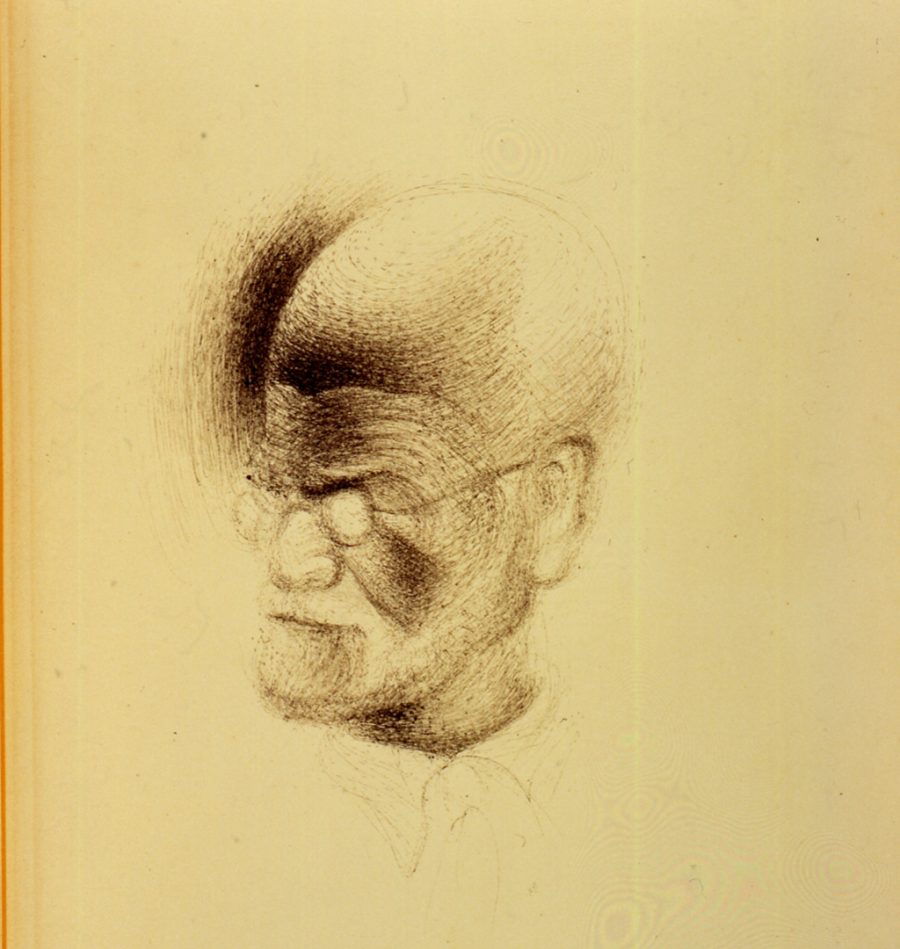
We have them recording, in their own words, their impressions of their one and only meeting—which took place in July of 1938, at Freud’s home in London. Freud was 81, Dali 34. We also have sketches Dali made of Freud while the two sat together. Their memories of events, shall we say, differ considerably, or at least they seemed totally bewildered by each other. (Freud pronounced Dali a “fanatic.”)
In any case, There’s absolutely no way the encounter could have lived up to Dali’s expectations, as the Freud Museum London notes:
[Dalí] had already travelled to Vienna several times but failed to make an introduction. Instead, he wrote in his autobiography, he spent his time having “long and exhaustive imaginary conversations” with his hero, at one point fantasizing that he “came home with me and stayed all night clinging to the curtains of my room in the Hotel Sacher.”
Freud was certainly not going to indulge Dalí’s peculiar fantasies, but what the artist really wanted was validation of his work—and maybe his very being. “Dali had spent his teens and early twenties reading Freud’s works on the unconscious,” writes Paul Gallagher at Dangerous Minds, “on sexuality and The Interpretation of Dreams.” He was obsessed. Finally meeting Freud in ’38, he must have felt “like a believer might feel when coming face-to-face with God.”
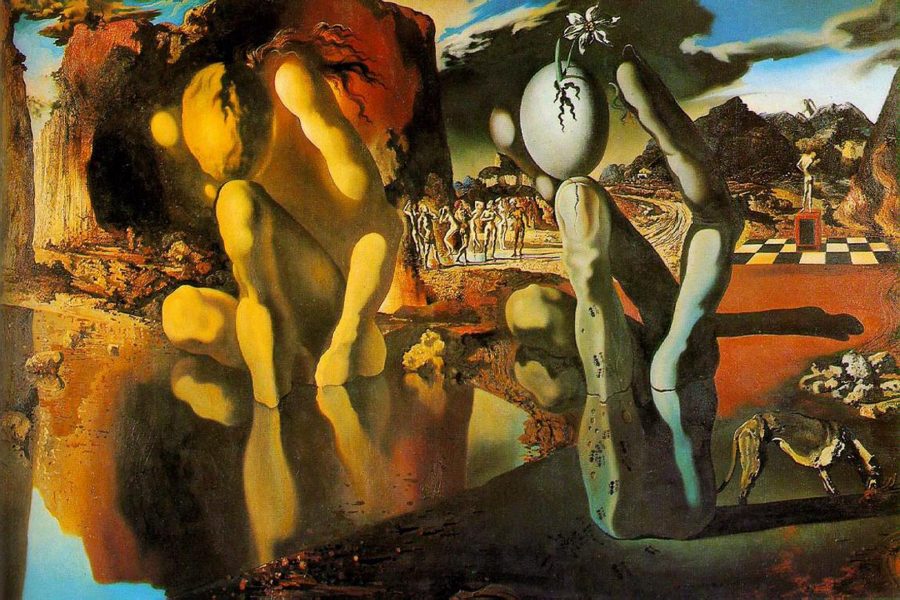
He brought with him his latest painting The Metamorphosis of Narcissus, and an article he had published on paranoia. This, especially, Dali hoped would gain the respect of the elderly Freud.
Trying to interest him, I explained that it was not a surrealist diversion, but was really an ambitiously scientific article, and I repeated the title, pointing to it at the same time with my finger. Before his imperturbable indifference, my voice became involuntarily sharper and more insistent.
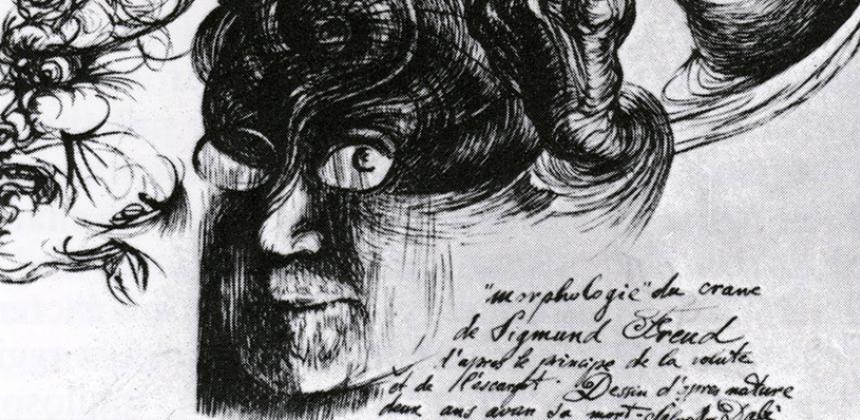
On being shown the painting, Freud supposedly said, “in classic paintings I look for the unconscious, but in your paintings I look for the conscious.” The comment stung, though Dali wasn’t entirely sure what it meant. But he took it as further evidence that the meeting was a bust. Sketching Freud in the drawing below, he wrote, “Freud’s cranium is a snail! His brain is in the form of a spiral—to be extracted with a needle!”
One might see why Freud was suspicious of Surrealists, “who have apparently chosen me as their patron saint,” he wrote to Stefan Zweig, the mutual friend who introduced him to Dali. In 1921, poet and Surrealist manifesto writer André Breton “had shown up uninvited on [Freud’s] doorstep.” Unhappy with his reception, Breton published a “bitter attack,” calling Freud an “old man without elegance” and later accused Freud of plagiarizing him.
Despite the memory of this nastiness, and Freud’s general distaste for modern art, he couldn’t help but be impressed with Dali. “Until then,” he wrote to Zweig, “I was inclined to look upon the surrealists… as absolute (let us say 95 percent, like alcohol), cranks. That young Spaniard, however, with his candid and fanatical eyes, and his undeniable technical mastery, has made me reconsider my opinion.”
Can you spot a liar? We all know people who think they can, and very often they claim to be able to do so by reading “body language.” Clearing one’s throat, touching one’s mouth, crossing one’s arms, looking away: these and other such gestures, they say, indicate on the part of the speaker a certain distance from the truth. In the WIRED “Tradecraft” video above, however former FBI special agent Joe Navarro more than once pronounces ideas about such physical lie indicators “nonsense.” And having spent 25 years working to identify people presenting themselves falsely to the world — “my job was to catch spies,” he says — he should know, at the very least, what isn’t a tell.
Not that all the throat-clearing and arm-crossing doesn’t indicate something. Navarro calls such behaviors “self-soothers,” physical actions we use to pacify ourselves in stressful moments. Of course, even if self-soothers provide no useful information about whether a person is telling the truth, that doesn’t mean they provide no useful information at all.
But Navarro’s career has taught him that actions decisively indicating deception are much more specific, and without relevant knowledge completely illegible: take the suspected spy he had under surveillance who gave the game away just by leaving a flower shop holding a bouquet facing not upward but downward, “how they carry flowers in eastern Europe.”
For the most part, detecting a liar requires a great deal of what Navarro calls “face time,” a necessity when it comes to observing the full range of and patterns in an individual’s forms of non-verbal communication. In the video he analyzes footage of a poker game, the kind of setting that heightens our awareness of such non-verbal communication. At the table we all know to put on a “poker face” and shut our mouths, but even when we say nothing, Navarro emphasizes, we’re constantly transmitting a high quantity of information about ourselves. Whatever the setting, it comes through in how we dress, how we walk, how we carry ourselves — especially if we think it doesn’t. In the eyes of those who know how to interpret this information, all the world becomes a poker game.
Based in Seoul, Colin Marshall writes and broadcasts on cities, language, and culture. His projects include the book The Stateless City: a Walk through 21st-Century Los Angeles and the video series The City in Cinema. Follow him on Twitter at @colinmarshall or on Facebook.
Kintsugi, the Japanese art of joining broken pottery with gleaming seams of gold or silver, creates fine art objects we can see as symbols for the beauty of vulnerability. Surely, these bowls, cups, vases, etc. remind of us Leonard Cohen’s oft-quoted lyric from “Anthem” (“There is a crack in everything, that’s how the light gets in.”) Writer and artist Austin Kleon touches on this same sentiment in a recent post on his blog. “The thing I love the most about Kintsugi is the visible trace of healing and repair—the idea of highlighted, glowing scars.”
Kintsugi, which translates to “golden joinery,” has a history that dates back to the 15th century, as Colin Marshall explained in a previous post here. But it’s fascinating how much this art resonates with our contemporary discourse around trauma and healing.
“We all grow up believing we should emphasize the inherent positives about ourselves,” writes Marshall, “but what if we also emphasized the negatives, the parts we’ve had to work to fix or improve? If we did it just right, would the negatives still look so negative after all?”
A key idea here is “doing it just right.” Kintsugi is not a warts-and-all presentation, but a means of turning brokenness into art, a skillful realization of the Japanese idea of wabi-sabi, the “beauty of things imperfect, impermanent, and incomplete,” as Leonard Koren writes in Wabi-Sabi for Artists, Designers, Poets & Philosophers. Objects that represent wabi-sabi “may exhibit the effects of accident, like a broken bowl glued back together again.” In kintsugi, those effects are due to the artist’s craft rather than random chance.
When it comes to healing psychic wounds so that they shine like precious metals, there seems to be no one perfect method. But when we’re talking about the artistry of kintsugi, there are some—from the most refined artisanship to less rigorous do-it-yourself techniques—we can all adopt with some success. In the video at the top, learn DIY kintsugi from World Crafted’s Robert Mahar. Further up, we have an intensive, wordless demonstration from professional kintsugi artist Kyoko Ohwaki.
And just above, see psychologist Alexa Altman travel to Japan to learn kintsugi, then make it “accessible” with an explanation of both the physical process of kintsugi and its metaphorical dimensions. As Altman shows, kintsugi can just as well be made from things broken on purpose as by accident. When it comes to the beautifully flawed finished product, however, perhaps how a thing was broken matters far less than the amount of care and skill we use to join it back together.
After his dismissal from Harvard for researching LSD with Timothy Leary, Richard Alpert left the U.S. for India in 1967. He devoted himself to the teachings of Hindu teacher Neem Karoli Baba and returned to the States a permanently changed man, with a new name and a message he first spread via the collaboratively-edited and illustrated 1971 classic Be Here Now.
In the “philosophically misty, stubbornly resonant Buddhist-Hindu-Christian mash-up,” writes David Marchese at The New York Times, Ram Dass “extolled the now-commonplace, then-novel (to Western hippies, at least) idea that paying deep attention to the present moment—that is, mindfulness—is the best path to a meaningful life.” We’ve grown so used to hearing this by now that we’ve likely become a little numb to it, even if we’ve bought into the premise and the practice of meditation.
Ram Dass discovered that mindful awareness was not part of any self-improvement project but a way of being ordinary and abandoning excess self-concern. “The more your awareness is expanded, the more it becomes just a natural part of your life, like eating or sleeping or going to the toilet” he says in the excerpt above from a talk he gave on “Conscious Aging” in 1992. “If you’re full of ego, if you’re full of yourself, you’re doing it out of righteousness to prove you’re a good person.”
To really open ourselves up to reality, we must be willing to put desire aside and become “irrelevant.” That’s a tough ask in a culture that values few things more highly than fame, youth, and beauty and fears nothing more than aging, loss, and death. Our culture “denigrates non-youth,” Ram Dass wrote in 2017, and thus stigmatizes and ignores a natural process everyone must all endure if they live long enough.
[W]hat I realized many years ago was I went into training to be a kind of elder, or social philosopher, or find a role that would be comfortable as I became irrelevant in the youth market. Now I’ve seen in interviewing old people that the minute you cling to something that was a moment ago, you suffer. You suffer when you have your face lifted to be who you wish you were then, for a little longer, because you know it’s temporary.
The minute you pit yourself against nature, the minute you pit yourself with your mind against change, you are asking for suffering.
Older adults are projected to outnumber children in the next decade or so, with a healthcare system designed to extract maximum profit for the minimal amount of care. The denial of aging and death creates “a very cruel culture,” Ram Dass writes, “and the bizarre situation is that as the demographic changes, and the baby boomers come along and get old, what you have is an aging society and a youth mythology”—a recipe for mass suffering if there ever was one.
We can and should, Ram Dass believed, advocate for better social policy. But to change our collective approach to aging and death, we must also, individually, confront our own fears of mortality, no matter how old we are at the moment. The spiritual teacher and writer, who passed away yesterday at age 88, confronted death for decades and helped students do the same with books like 2001’s Still Here: Embracing Aging, Changing, and Dying and his series of talks on “Conscious Aging,” which you can hear in full further up.
“Recorded at the Conscious Aging conference sponsored by the Omega Institute in 1992,” notes the Ram Dass Love Serve Remember Foundation, the conference “was the first of its kind on aging. Ram Dass had just turned sixty.” He begins his first talk with a joke about purchasing his first senior citizen ticket and says he felt like a teenager until he hit fifty. But joking aside, he learned early that really living in the present means facing aging and death in all its forms.
Clutch imaginary pearls, rest the back of your hand on your forehead, look wan and stricken, begin to wilt, and most people will recognize the symptoms of your sarcasm, aimed at some pejoratively feminized qualities we’ve seen characters embody in movies. The “literary swoon” as Iaian Bamforth writes at the British Journal of General Practice, dates back much further than film, to the early years of the modern novel itself, and it was once a male domain.
“Somewhere around the time of the French Revolution (or perhaps a little before it) feelings were let loose on the world.” Rationalism went out vogue and passion was in—lots of it, though not all at once. It took some decades before the discovery of emotion reached the climax of Romanticism and denouement of Victorian sentimentality:
Back in 1761, readers had swooned when they encountered the ‘true voice of feeling’ in Jean-Jacques Rousseau’s novel La Nouvelle Héloïse; by the end of the decade, all of Europe was being sentimental in the manner made fashionable a few years later by Laurence Sterne in his A Sentimental Journey. Then there was Goethe’s novella, The Sorrows of Young Werther (1774), which made its author a celebrity.
It’s impossible to overstate how popular Goethe’s book became among the aristocratic young men of Europe. Napoleon “reputedly carried a copy of the novel with him on his military campaign.” Its swooning hero, whom we might be tempted to diagnose with any number of personality and mood disorders, develops a disturbing and debilitating obsession with an engaged woman and finally commits suicide. The novel supposedly inspired many copycats and “the media’s first moral panic.”
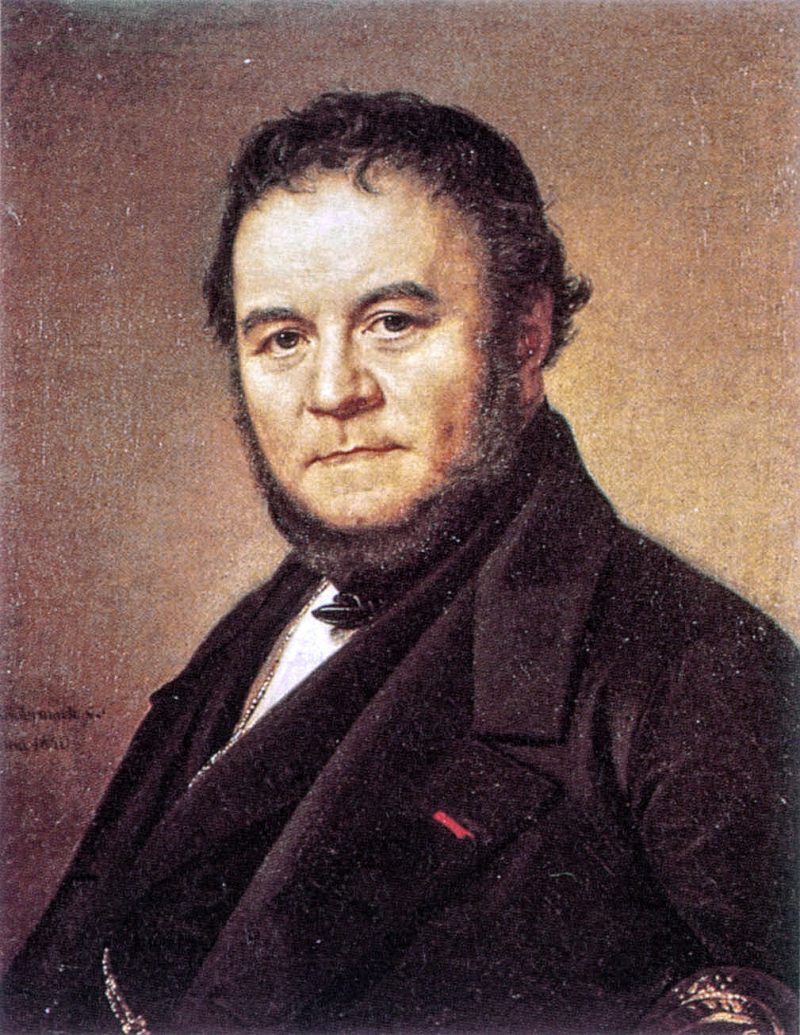
If we can feel such exaltation, disquiet, and fear when in the grip of romantic passion, or when faced with nature’s implacable behemoths, as in Kant’s Sublime, so too may we be overcome by art. Napoleonic novelist Stendhal suggested as much in a dramatic account of such an experience. Stendhal, the pen name of Marie-Henri Beyle, was no inexperienced dreamer. He had traveled and fought extensively with the Grand Army (including that fateful march through Russia, and back) and had held several government offices abroad. His realist fiction didn’t always comport with the more lyrical tenor of the times.
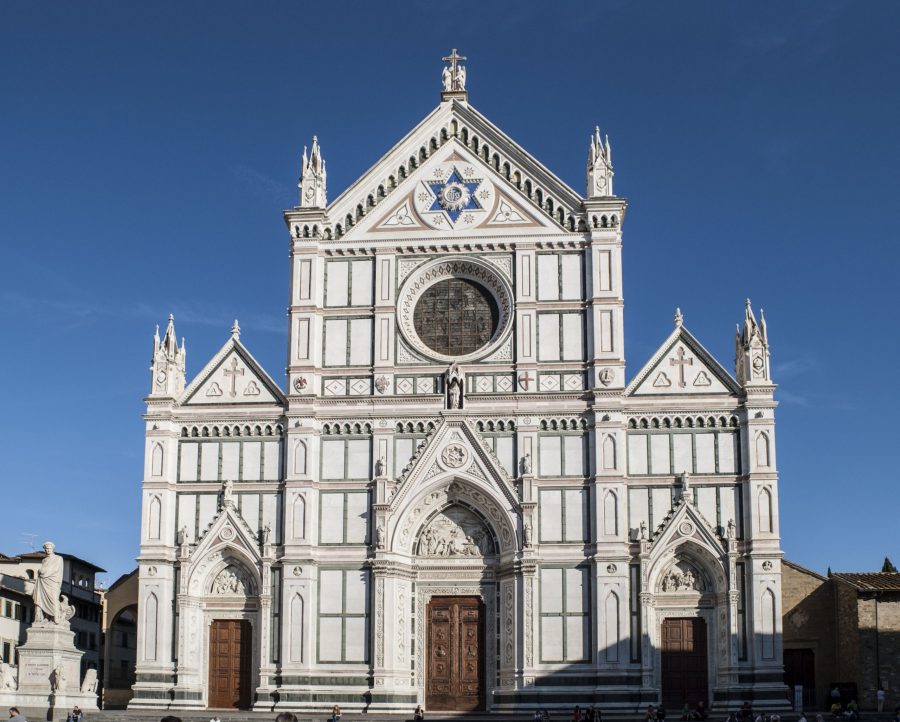
Photo of the Basilica of Santa Croce by Diana Ringo, via Wikimedia Commons
But he was also of the generation of young men who read Werther while touring Europe, contemplating the varieties of emotion. He had held a similarly unrequited obsession for an unavailable woman, and once wrote that “in Italy… people are still driven to despair by love.” During a visit to the Basilica of Santa Croce in 1817, he “found a monk to let him into the chapel,” writes Bamforth, “where he could sit on a genuflecting stool, tilt his head back and take in the prospect of Volterrano’s fresco of the Sibyls without interruption.” As Stendhal described the scene:
I was already in a kind of ecstasy by the idea of being in Florence, and the proximity of the great men whose tombs I had just seen. Absorbed in contemplating sublime beauty, I saw it close-up—I touched it, so to speak. I had reached that point of emotion where the heavenly sensations of the fine arts meet passionate feeling. As I emerged from Santa Croce, I had palpitations (what they call an attack of the nerves in Berlin); the life went out of me, and I walked in fear of falling.
With the recording of this experience, Stendhal “brought the literary swoon into tourism,” Bamforth remarks. Such passages became far more commonplace in travelogues, not least those involving the city of Florence. So many cases similar to Stendhal’s have been reported in the city that the condition acquired the name Stendhal syndrome in the late seventies from Dr. Graziella Magherini, chief of psychiatry at the Santa Maria Nuova Hospital. It presents as an acute state of exhilarated anxiety that causes people to feel faint, or to collapse, in the presence of art.
Magherini and her assistants compiled studies of 107 different cases in 1989. Since then, Santa Maria Nuova has continued to treat tourists for the syndrome with some regularity. “Dr. Magherini insists,” writes The New York Times, that “certain men and women are susceptible to swooning in the presence of great art, especially when far from home.” Stendhal didn’t invent the phenomenon, of course. And it need not be solely caused by sufferers’ love of the 15th century.
The stresses of travel can sometimes be enough to make anyone faint, though further research may rule out other factors. The effect, however, does not seem to occur with nearly as much frequency in other major cities with other major cultural treasures. “It is surely the sheer concentration of great art in Florence that causes such issues,” claims Jonathan Jones at The Guardian. Trying to take it all in while navigating unfamiliar streets and crowds.… “More cynically, some might say the long queues do add a layer of stress on the heart.”
There’s also no discounting the effect of expectation. “It is among religious travelers that Stendhal’s syndrome seems to have found its most florid expression,” notes Bamforth. Stendhal admitted that his “ecstasy” began with an awareness of his “proximity of the great men whose tombs I had just seen.” Without his prior education, the effect might have disappeared entirely. The story of the Renaissance, in his time and ours, has impressed upon us such a reverence for its artists, statesmen, and engineers, that sensitive visitors may feel they can hardly stand in the actual presence of Florence’s abundant treasures.
Perhaps Stendhal syndrome should be regarded as akin to a spiritual experience. A study of religious travelers to Jerusalem found that “otherwise normal patients tended to have ‘an idealistic subconscious image of Jerusalem’” before they succumbed to Stendhal syndrome. Carl Jung described his own such feelings about Pompeii and Rome, which he could never bring himself to visit because he lived in such awe of its historical aura. Those primed to have symptoms tend also to have a sentimental nature, a word that once meant great depth of feeling rather than a callow or mawkish nature.
We might all expect great art to overwhelm us, but Stendhal syndrome is rare and rarified. The experience of many more travelers accords with Mark Twain’s 1869 The Innocents Abroad, or The New Pilgrim’s Progress, a fictionalized memoir “lampooning the grandiose travel accounts of his contemporaries,” notes Bamforth. It became “one of the best-selling travel books ever” and gave its author’s name to what one researcher calls Mark Twain Malaise, “a cynical mood which overcomes travelers and leaves them totally unimpressed with anything UNESCO has on its universal heritage list.” Sentimentalists might wish these weary tourists would stay home and let them swoon in peace.
We're hoping to rely on loyal readers, rather than erratic ads. Please click the Donate button and support Open Culture. You can use Paypal, Venmo, Patreon, even Crypto! We thank you!
Open Culture scours the web for the best educational media. We find the free courses and audio books you need, the language lessons & educational videos you want, and plenty of enlightenment in between.




_-_Facade.jpg)