Ten months before his death — a death he knew was coming — Christopher Hitchens debated the question, “Is there an afterlife?”. Sharing the stage with Sam Harris, and Rabbis David Wolpe and Bradley Shavit Artson at the American Jewish University in Los Angeles, Hitchens lamented how “It’s considered perfectly normal in this society to approach dying people who you don’t know, but who are unbelievers, and say, ‘Now are you gonna change your mind [about the existence of God]?’ That is considered almost a polite question.” “It’s a religious falsification that people like myself scream for a priest at the end. Most of us go to our end with dignity.”
After spending years as an unapologetic atheist, Hitchens also wasn’t going to start believing in an afterlife — or what he half jokingly called “The Never Ending Party.” The video above takes some of Hitchens comments from the debate and turns them into a whimsical animation. It’s classic Hitchens. Equal parts emphatic and funny. Below, you can watch the original debate in its entirety.
Humanists believe that human beings produced the progressive advance of human society and also the ills that plague it. They believe that if the ills are to be alleviated, it is humanity that will have to do the job. They disbelieve in the influence of the supernatural on either the good or the bad of society, on either its ills or the alleviation of those ills.
There’s a widely disseminated Kurt Vonnegut quote that puts things even more succinctly:
I am a humanist, which means, in part, that I have tried to behave decently without any expectation of rewards or punishment after I’m dead.
It’s a definition Vonnegut, Asimov’s honorary successor as AHA president, a scientist’s son, and, famously, a survivor of the firebombing of Dresden, embodied, though surely not the only one he coined.
…a humanist, perhaps, was somebody who was crazy about human beings, who, like Will Rogers, had never met one he didn’t like. That certainly did not describe me. It did describe my dog, though.
As the title of Vonnegut’s speech implies (“Why My Dog is Not a Humanist”), Sandy, his undiscriminating Hungarian sheepdog, ultimately fell short of satisfying the criteria that would have labelled him a humanist. He lacked the capacity for rational thought of the highest order, and moreover, he regarded all humans — not just Vonnegut — as gods.
Ergo, your dog is probably not a humanist either.
Characteristically, Vonnegut ranged far and wide in his consideration of the matter, touching on a number of topics that remain germane, some 20 years after his remarks were made: race, excessive force, the treatment of prisoners…and Bill Cosby.
For some time now, people like poet Robert Graves and countercultural guru Timothy Leary have assumed that ancient religion and mysticism were the products of mind-altering drugs. But in the case of one modern religious experience—the inspiration behind John Coltrane’s holy four-part suite, A Love Supreme—it was the distinct absence of drugs that lit the flame. Like many recovering addicts, Coltrane found God in 1957, after having what he called in the album’s liner notes “a spiritual awakening.” Seven years later, he dedicated his masterpiece, “a humble, offering,” to the deity he credited with “a richer, fuller, more productive life.” No rote hymnal, chant, or psalter, A Love Supreme offers itself up to the listener as the product of intensely personal devotion. And like the ecstatic revelations of many a saint, Coltrane’s work has inspired its own devotional cult—The Church of St. Coltrane.
Presided over by Bishop Franzo King and his wife Reverend Mother Marina King, the Saint John Coltrane African Orthodox Church in San Francisco reminds people, says Bishop King in the short documentary at the top of the post, “that God is never without a witness. St. John Coltrane is that witness for this time and this age.” Dig. The vibe of the Coltrane congregation is “a rapturous out-of-your-head-ness” writes Aeon magazine in their introduction to another short film about the church. And just above, you can meet more of the worshippers—of the music, its creator, and his god—in “The Saxophone Saint,” yet another profile of St. Coltrane’s prodigious religious influence. The congregation, NPR tells us, “mixes African Orthodox liturgy with Coltrane’s quotes” and of course music, and A Love Supreme is “the cornerstone of the [Bishop King’s] 200-member church.”
King cites the titles of the suite’s four movements—“Acknowledgement,” “Resolution,” “Pursuance,” and “Psalm”—as the basis for his form of worship: “It’s like saying, ‘Father, Son and Holy Ghost.’ It’s like saying Melody, harmony and rhythm.’ In other words, you have to acknowledge and then you resolve and then you pursue, and the manifestation of it is a love supreme.” The Kings founded the church in 1969, but their introduction to the power of Coltrane came four years earlier when they saw him perform at the San Francisco Jazz Workshop, an experience they describe on their website as a “sound baptism.” Since its inception, they tell us, the church “has grown beyond the confines of San Francisco to include the whole globe. Every Sunday, the congregation includes members and visitors from throughout the world.”
That diverse assembly recently filled the sanctuary of San Francisco’s Grace Cathedral for a service in celebration of the 50th anniversary of Coltrane’s A Love Supreme on Monday, December 8th. Just above you can see Bishop King open the service. His inspired delivery should convince you, as it did New York Times reporter Samuel Freedman, that “the Coltrane church is not a gimmick or a forced alloy of nightclub music and ethereal faith. Its message of deliverance through divine sound is actually quite consistent with Coltrane’s own experience and message.”
Since the 19th century, thinkers like Ludwig Feuerbach, Friedrich Nietzsche, and Sigmund Freud have theorized religion as a strictly psychological and anthropological phenomenon born of the tendency of the human mind to project its contents out into the heavens. The Darwinian revolution provided another framework—one grounded in experimental science—to explain religion. Social scientists like Pascal Boyer have integrated these paradigms in comprehensive accounts of the origins of religious belief, and in theories like E.O. Wilson’s Sociobiology, evolutionary biology provides an explanation for all social phenomena, of which religion is but one among many human adaptations. Advances in neurobiology have furthered scientists’ understanding of religion as a product not only of human consciousness, but also of the physical structure of the brain. In experiments like the “God helmet,” for example, scientists can induce religious experiences by prodding certain areas of subjects’ brains.
It is in this context of psychology, anthropology, and evolutionary and neurobiology that we need to situate the lecture above from Stanford professor Robert Sapolsky. Where many critics of religion explicitly reject religious authority and belief, Sapolsky, though himself “stridently atheistic,” has no such agenda. As an article in the Colorado Springs Independent puts it, “he’s no Christopher Hitchens.” Sapolsky freely admits, as do many scientists—religious and non—that religion has many benefits: “It makes you feel better. It tends to decrease anxiety, and it gets you a community.” However, he claims, these positives are the result of evolutionary adaptations, not proofs of any supernatural realm. In fact, religiosity, Professor Sapolsky argues above, is biologically based and related to seemingly much less adaptive traits like obsessive compulsive disorder, schizophrenia, and epilepsy.
Part of a lecture course on “Human Behavioral Biology” at Stanford, the religion lecture is one Sapolsky admits he is “most nervous for, simply because this one people wind up having strong opinions about.” As he moves ahead, he presents his case (with occasional interruptions from his students) for religiosity as a result of natural selection, connecting belief to the selection of genes for diseases like Tay-Sachs, the existence of which can help to explain dispiriting historical cases like the European Pogroms against the Jews in the Middle Ages. Throughout his lecture, Sapolsky makes connections between religiosity and biology, theorizing, for example, that St. Paul had temporal-lobe epilepsy.
At the end of his lecture, around the 1:19:30 mark, Sapolsky issues a disclaimer about what he’s “not saying”: “I’m not saying ‘you gotta be crazy to be religious.’ That would be nonsense. Nor am I saying, even, that most people who are, are psychiatrically suspect.” What he is saying, he continues, is that “the same exact traits which in a secular context are life-destroying” and “separate you from the community” are, “at the core of what is protected, what is sanctioned, what is rewarded, what is valued in religious settings.” What fascinates Sapolsky is the “underlying biology” of these traits. Sapolsky even confesses that he “most regrets” his own break with the Orthodox religion of his upbringing, but that his atheism is something he “appears to be unable to change.” The questions Sapolsky asks broadly cover the physical determinism of gaining faith, and of losing it, which he says, is “just as biological.” What we are to make of all this is a question he leaves open.
The Beatles’ sojourn in India can seem like a bit of a stunt, as much a rock n’ roll cliché as Led Zeppelin’s trashed hotel rooms or Fleetwood Mac’s coke binges. Easily parodied in, for example, Walk Hard: The Dewey Cox Story, the band’s turn Eastward looks in hindsight like faddish spiritual tourism. That impression may not be so far off. As one writer puts it:
By the late 1960s, The Beatles had engineered another pop culture revolution (at least in Europe and North America) by wearing Indian-style clothing, spouting religious and philosophical aphorisms that seemed to borrow from ‘Eastern’ thought, and later even visiting India for a highly-publicized training session to learn Transcendental Meditation with the fraudulent ‘mystic’ Maharishi Mahesh Yogi.
But while for John, Paul, and Ringo, “interest in Indian/Hindu culture was rather fleeting and temporal […] for George, India completely overhauled and changed his life permanently.” As Harrison himself would later recount of his first journey in 1966, “it was the first feeling I’d ever had of being liberated from being a Beatle or a number.” The rest of the band wouldn’t make the trip until two years later.
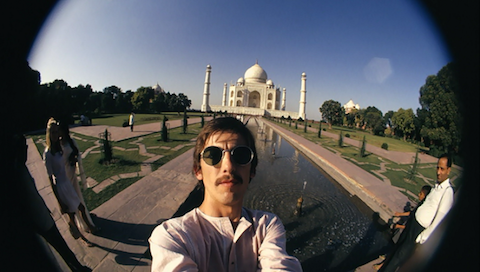
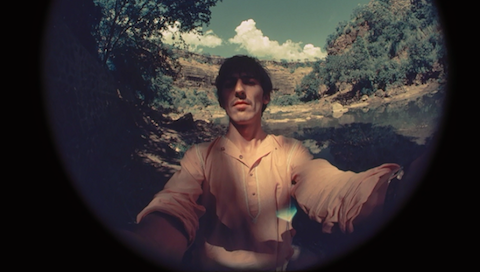
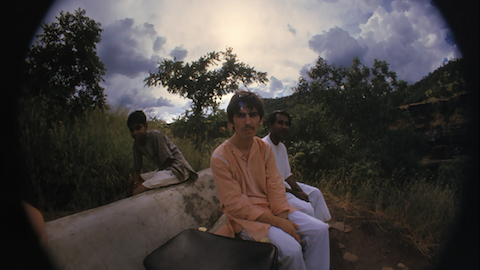
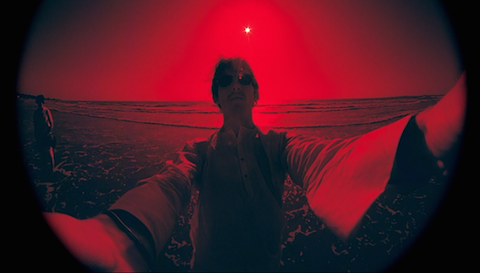
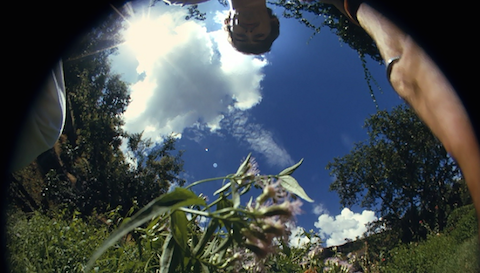
Harrison had principally embarked to study sitar under Ravi Shankar and learn yoga, but this was also a period of self-discovery and escape from, as he says, the “mania.” Traveling, as he always did, with a camera, he documented his journey. His pictures are far from ordinary tourist images.
While he describes in writing the “mixture of unbelievable things” he saw, he just as often turned the camera on himself, his photographic introspection made even more pronounced by his use of a fisheye lens.
Interestingly, in his recollection of the trip, Harrison references the surreal cult, sci-fi show The Prisoner as a prime illustration of life as “a number.” One of the show’s most memorable devices involves a huge, mysterious white bubble that captures or kills anyone trying to escape the sinister organization that holds the main character captive. In Harrison’s photos, the bubble becomes a paradoxical representation of his way out of fame’s fishbowl, of the prison of Beatlemania and an identity that felt contrived and alienating.
Behind his steady, serious gaze open up vistas that presage the breadth and depth of his immersion in Indian spiritual practices. Whatever one thinks of his conversion, there’s no doubt it was sincere, and lifelong. Not long after this first trip, at the age of 24, he wrote to his mother, “I want to be self-realized. I want to find God. I’m not interested in material things, this world, fame.” Harrison expressed the very same mystical aspirations in his final, 1997 interview, still playing and singing with his mentor Ravi Shankar.
In Mexico on November 2, mortality is approached with music and laughter.
“On the Day of the Dead, when the spirits come back to us,” explains the Dr. Vigil character in the 1984 film of Malcolm Lowry’s Under the Volcano, “the road from heaven must be made easy, and not slippery with tears.”
The souls of the dead are welcomed back with offerings of food and drink. Skulls and frolicking skeletons, often dressed in full costume, are depicted on alters, food and elsewhere — a playful reminder that all of us, despite our vanities, will one day turn to dust.
The origins of the Day of the Dead and its basic motifs can be traced back 3000 years, to the Aztecs, but the satirical skeletons of its present-day iconography bear the strong influence of one man who died 101 years ago: the printmaker and draughtsman José Guadalupe Posada.
Posada was an obscure newspaper illustrator when he settled in Mexico City in 1888 and began working for a company that published graphic flyers designed to bring the news of the day to a largely illiterate public. Posada’s engravings soon caught on.
“Long drawn to the sensational,” writes Jesse Cordes Selbin at the Henry Ransom Center, “Posada’s interest centered on such fantastic and unsavory aspects of life as murders, robberies, bullfights, political scandals, and illicit love affairs. While his political work alternately satirized President Porfirio Díaz and lauded the populist revolutionary leaders Emiliano Zapata and Francisco Madero, for the most part his prints successfully struck the fine line between hard-hitting and light-hearted, resonating widely throughout Mexico.”
Despite their humble purpose, Posada’s engravings were a major influence on the development of 20th century Mexican art. Octavio Paz described his technique as “a minimum of lines and a maximum of expression.” In his introduction to Mexico: Splendors of Thirty Centuries, Paz writes, “By birthright Posada belongs to a manner that has left its stamp on the twentieth century: Expressionism. Unlike the majority of Expressionist artists, however, Posada never took himself too seriously.”
Others, however, did. The muralists who flourished in post-revolutionary Mexico revered Posada. Diego Rivera and José Clemente Orozco, in particular, praised him as an inspirational figure. In his autobiography, Orozco writes:
Posada used to work in full view, behind the shop windows, and on my way to school and back, four times a day, I would stop and spend a few enchanted minutes in watching him, and sometimes I even ventured to enter the shop and snatch up a bit of the metal shavings that fell from the minimum-coated metal plate as the master’s graver passed over it. This was the push that first set my imagination in motion and impelled me to cover paper with my earliest little figures; this was my awakening to the existence of the art of painting.
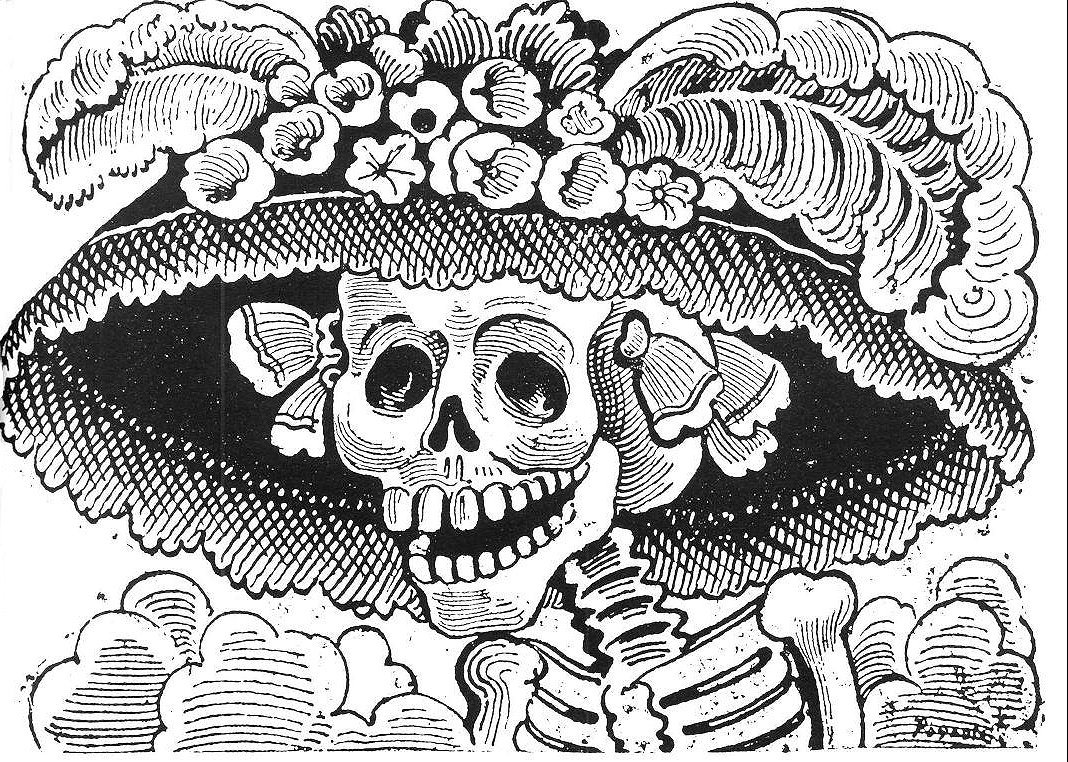
The most influential of Posada’s works were his Calaveras, meaning “skulls,” or, by extension, “skeletons.” Perhaps the most famous work from the series is Calavera Catrina (above), a zinc etching completed in about 1910. It depicts a womanof the social class known as the Catrins (from a Spanish word meaning “over-elegant”), a group who denied their Maya heritage and thought of themselves only as European.
In 1947 Diego Rivera paid homage to Posada by placing him at the center of his panoramic Dream of a Sunday Afternoon in the Alameda Centralwith a full-length version of the Calavera Catrina on his arm, while Rivera himself, depicted as a young boy, stands on the other side holding her bony hand. For more of Posada’s Calaveras, scroll down.
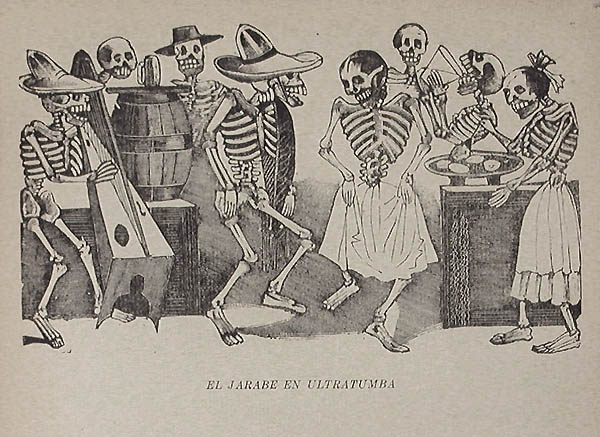
The Folk Dance Beyond the Grave:
Another zinc etching from around 1910, El Jarabe en ultratumba (“The Folk Dance Beyond the Grave”) depicts a merry group of skeletons eating, drinking, making music and dancing the traditional jarabe. The reproduction is from the posthumous 1930 monograph Las Obras de José Guadalupe Posada, Grabador Mexicano.
Calavera from Oaxaca:
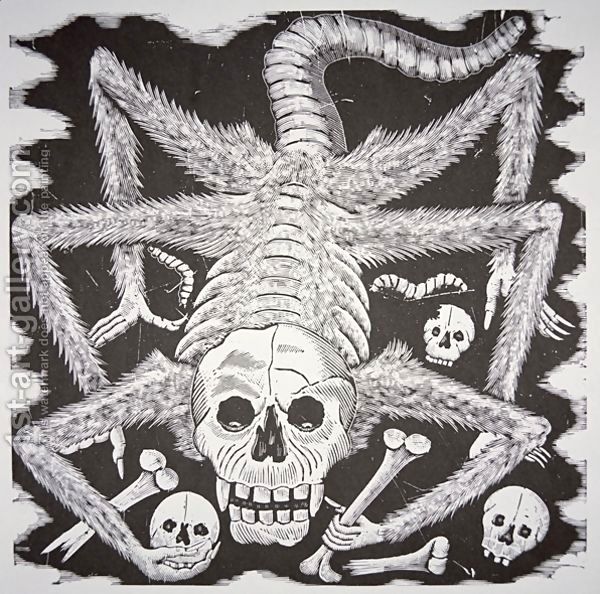
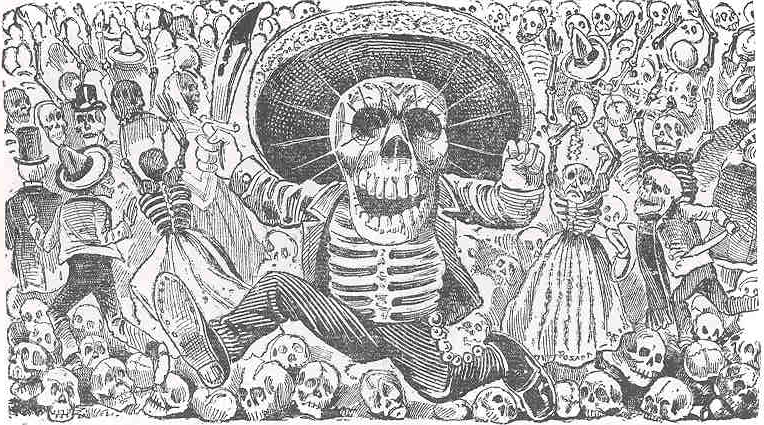
Calavera Oaxaqueña (“Calavera from Oaxaca”) was first published on a broadside in 1910. It shows a proud-looking skeleton dressed as a charro, running past a crowd of skeletons with a blood-stained knife in his hand.
Calavera of Don Quixote:
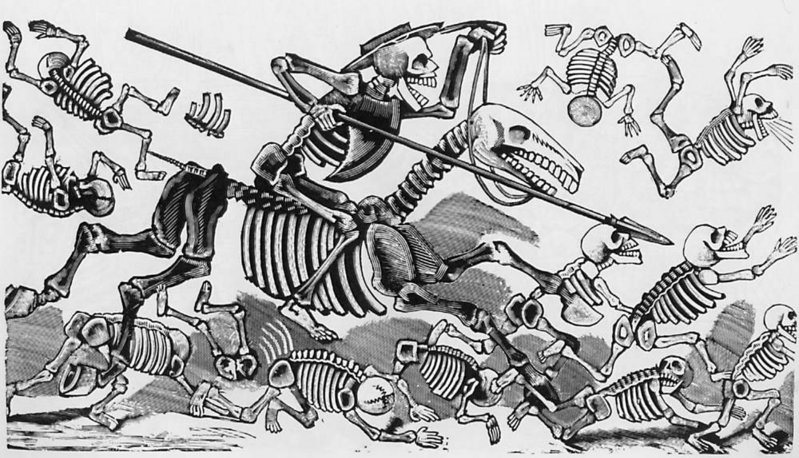
In this etching made sometime between 1910 and Posada’s death in 1913, Don Quixote rides into battle wearing an upside-down barber’s basin he imagines to be the legendary helmet of Mambrino, a solid-gold relic said to make its wearer invulnerable. He vanquishes every foe. “This is the calavera of Don Quixote,” says the caption on the original broadside publication, “the first-class one, the matchless one, the gigantic one.”
Click on the images above to view them in a larger format. You can view more prints by Posada at MoMA and The Public Domain Review.
Answers to life’s big questions don’t come cheap, but they very often come free, or at least we feel they should. Which answers you find compelling among your available options is up to you. In the widely pluralist parts of the world—or at least in their urban centers—the answers come as often in the form of secular humanism as they do in any other variety, and they generally come with a certain amount of satisfaction that it is humanism, in part, that makes such variety possible. So what is humanism and why is it sometimes so proud of itself? You could do much worse than ask Stephen Fry, the genial English actor, comedian, writer, and passionate activist and advocate.
Fry narrates the video series here, “That’s Humanism,” for the British Humanism Association. He begins in “How do we know what is true?” at the top of the post by telling us what humanism is not. It is not a belief that knowledge comes from a supernatural source, from revelations, prophetic visions, or divinely inspired books. While many a humanist has found poetic inspiration in such things, as Fry explains, it’s only the scientific method that provides us with reliable information about the natural world.
In the video just above, Fry takes an evidence-based approach to the question of questions: what happens when we die. The humanist answer, as he plainly states, seems perfectly obvious to anyone—everyone dies, and everyone can live on in the lives of the people who’ve loved them. We leave the work we’ve done behind, and our bodies return to the elements from which they came. Anything else, he suggests, is wishful thinking.
The third video confronts the question that runs neck and neck with fear of death as a reason people seem to believe in the supernatural. “What makes something right or wrong?” Fry asks, then goes on to contrast in layman’s terms two moral theories: divine command and a generally altruist, prosocial ethical stance. Not all humanists subscribe to his ethics and not all, as Fry does above, would describe empathy as the prime motive of moral choice. He also cites “Reason,” “Experience,” and “Respect for Others” as methods by which humanists determine right from wrong, and he touches superficially on the role of culture as a container of morality, though he avoids the many thorny issues implied in that assertion.
The fourth video of the series, below, takes on the much more classically philosophical question, “How can I be happy?” For Fry, who has candidly discussed his struggles with bipolar disorder and suicidal depression, the question is not a purely abstract one. His answers eschew grand cosmic narratives for the value of the natural, the familial, and the observable. Throughout the series, Fry remains upbeat and confident, but if you think him innocent of life’s cruelties, I invite you to read the brief biography in this Guardian article.
If this seems like evangelism, perhaps it is. The British Humanist Association is, after all, the organization behind Richard Dawkins’ atheist bus campaign in England, which plastered signs on “bendy buses” around London saying “There’s probably no God. Now stop worrying and enjoy your life.” But Fry is a much more approachable, avuncular face of humanism than the cantankerous, sometimes callous, Dawkins (or the confrontational Sam Harris). What these videos don’t address are the specific advocacy goals and programs of the British Humanist Association, which include such perennially controversial subjects as assisted dying and abortion rights. Learn more about the association’s campaigns, goals, and outreach attempts at their website.
One reason I’m glad for having had a childhood religious education: it has made me conversant in even some of the most obscure stories and ideas in the Christian Bible, which is everywhere in English literature. Not only was the King James translation formative for early modern English, but stories like that of King David and his son Absalom have furnished material for great works from John Dryden’s dense political allegory “Absalom and Achitophel” to William Faulkner’s dense modernist fable Absalom, Absalom! Then, of course, there’s so much of the work of Blake, Shakespeare, and Milton to account for. Without a fairly solid grounding in Biblical literature, it can be doubly difficult to make headway in a study of the secular variety.
The students of highly regarded Canadian literary critic Northrop Frye found this to be true. As a junior instructor, Frye had difficulty getting his class to understand what was going on in John Milton’s Paradise Lost because so many of the Biblical allusions were lost on them. (It’s a hard enough poem to grasp when you get the references.) “How do you expect to teach Paradise Lost,” said the chair of Frye’s department, “to people who don’t know the difference between a Philistine and a Pharisee?” Responding to this gap in cultural literacy, Frye designed and taught “The Bible and English Literature.” The entire, videotaped course from a 1981 session at the University of Toronto is available online in 25 lectures.
It’s very much a treat to sit in on these lectures. Frye’s work on myth and folktale in English literature is still nearly definitive; his 1957 Anatomy of Criticism, though picked apart many times over through the decades, retains an authoritative place in studies of literary archetypes and rhetoric. Frye’s lectures on the Bible focus on what he sees as its “narrative unity,” due in part to “a number of recurring images: mountain, sheep, river, hill, pasture, bride, bread, wine and so on.” He also spends a good deal of time, at least in his first lecture above, discussing church history, theological and critical conflicts, and the history of various translations. The UToronto site includes full transcripts of each lecture, and the entire course promises to be enlightening for students of literature, of the Bible and church history, or both.
We're hoping to rely on loyal readers, rather than erratic ads. Please click the Donate button and support Open Culture. You can use Paypal, Venmo, Patreon, even Crypto! We thank you!
Open Culture scours the web for the best educational media. We find the free courses and audio books you need, the language lessons & educational videos you want, and plenty of enlightenment in between.