A quick fyi: This month, Twitch is presenting a marathon streaming of classic Doctor Who episodes. Continuing through January 25th, they plan to broadcast “11 to 12 hours of new episodes per day (~27 episodes), repeating once so you can catch Doctor Who nearly 24 hours a day, every day…” Stream the episodes right above, or here on Twitch.
If you would like to support the mission of Open Culture, consider making a donation to our site. It’s hard to rely 100% on ads, and your contributions will help us continue providing the best free cultural and educational materials to learners everywhere. You can contribute through PayPal, Patreon, and Venmo (@openculture). Thanks!
“It’s difficult to make predictions,” they say, “especially about the future.” The witticism has been variously attributed. If Yogi Berra said it, it’s adorable nonsense, if Mark Twain, dry plainspoken irony. If Niels Bohr, however, we have a statement that makes us wonder what exactly “the future” could mean in a radically uncertain universe.
If scientists can’t predict the future, who can? Science fiction writers, of course. They may be spectacularly wrong at times, but few professionals seem better equipped to imaginatively extrapolate from current conditions—cultural, technological, social, and political—and show us things to come. J.G. Ballard, Octavia Butler, Arthur C. Clarke, Kurt Vonnegut… all have foreseen many of the marvels and dystopian nightmares that have arrived since their time.
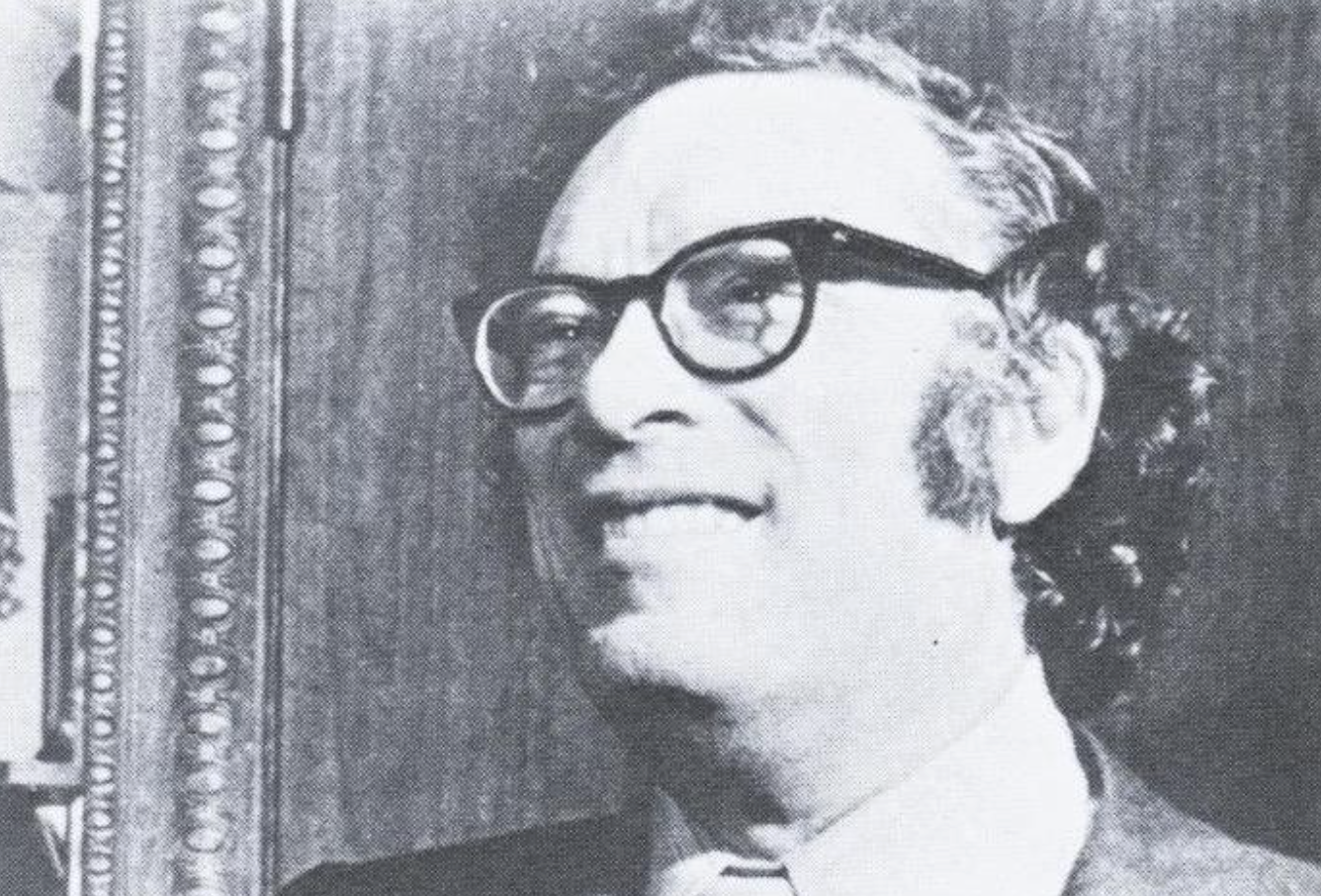
In 1964, Asimov used the occasion of the New York World’s Fair to offer his vision of fifty years hence. “What will the World’s Fair of 2014 be like?” he asked in The New York Times, the question itself containing an erroneous assumption about the durability of that event. As a scientist himself, his ideas are both technologically farseeing and conservative, containing advances we can imagine not far off in our future, and some that may seem quaint now, though reasonable by the standards of the time (“fission-power plants… supplying well over half the power needs of humanity”).
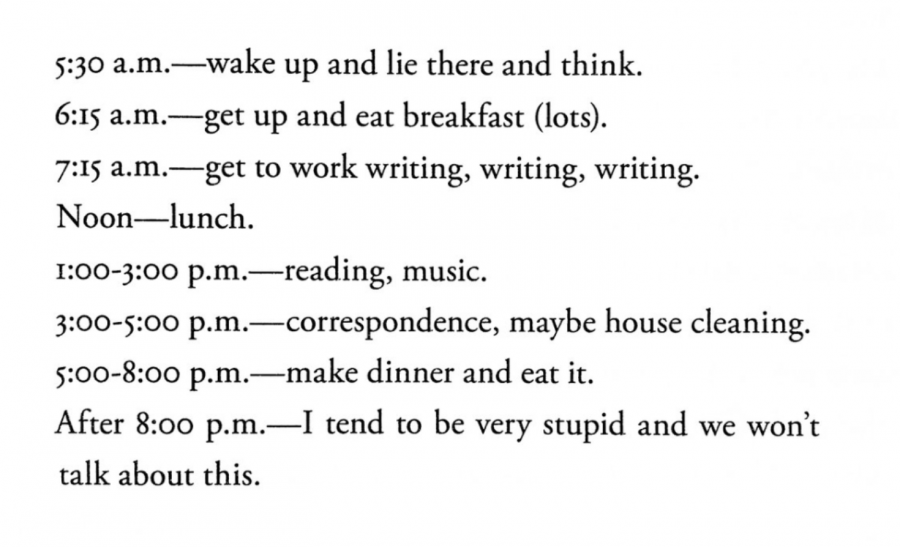
Nineteen years later, Asimov ventured again to predict the future—this time of 2019 for The Star. Assuming the world has not been destroyed by nuclear war, he sees every facet of human society transformed by computerization. This will, as in the Industrial Revolution, lead to massive job losses in “clerical and assembly-line jobs” as such fields are automated. “This means that a vast change in the nature of education must take place, and entire populations must be made ‘computer-literate’ and must be taught to deal with a ‘high-tech’ world,” he writes.
The transition to a computerized world will be difficult, he grants, but we should have things pretty much wrapped up by now.
By the year 2019, however, we should find that the transition is about over. Those who can be retrained and re-educated will have been: those who can’t be will have been put to work at something useful, or where ruling groups are less wise, will have been supported by some sort of grudging welfare arrangement.
In any case, the generation of the transition will be dying out, and there will be a new generation growing up who will have been educated into the new world. It is quite likely that society, then, will have entered a phase that may be more or less permanently improved over the situation as it now exists for a variety of reasons.
Asimov foresees the climate crisis, though he doesn’t phrase it that way. “The consequences of human irresponsibility in terms of waste and pollution will become more apparent and unbearable with time and again, attempts to deal with this will become more strenuous.” A “world effort” must be applied, necessitating “increasing co-operation among nations and among groups within nations” out of a “cold-blooded realization that anything less than that will mean destruction for all.”
He is confident, however, in such “negative advances” as the “defeat of overpopulation, pollution and militarism.” These will be accompanied by “positive advances” like improvements in education, such that “education will become fun because it will bubble up from within and not be forced in from without.” Likewise, technology will enable increased quality of life for many.
… more and more human beings will find themselves living a life rich in leisure.
This does not mean leisure to do nothing, but leisure to do something one wants to do; to be free to engage in scientific research. in literature and the arts, to pursue out-of-the-way interests and fascinating hobbies of all kinds.
If this seems “impossibly optimistic,” he writes, just wait until you hear his thoughts on space colonization and moon mining.
The Asimov of 1983 sounds as confident in his predictions as the Asimov of 1964, though he imagines a very different world each time. His future scenarios tell us as much or more about the time in which he wrote as they do about the time in which we live. Read his full essay at The Star and be the judge of how accurate his predictions are, and how likely any of his optimistic solutions for our seemingly intractable problems might be in the coming year.
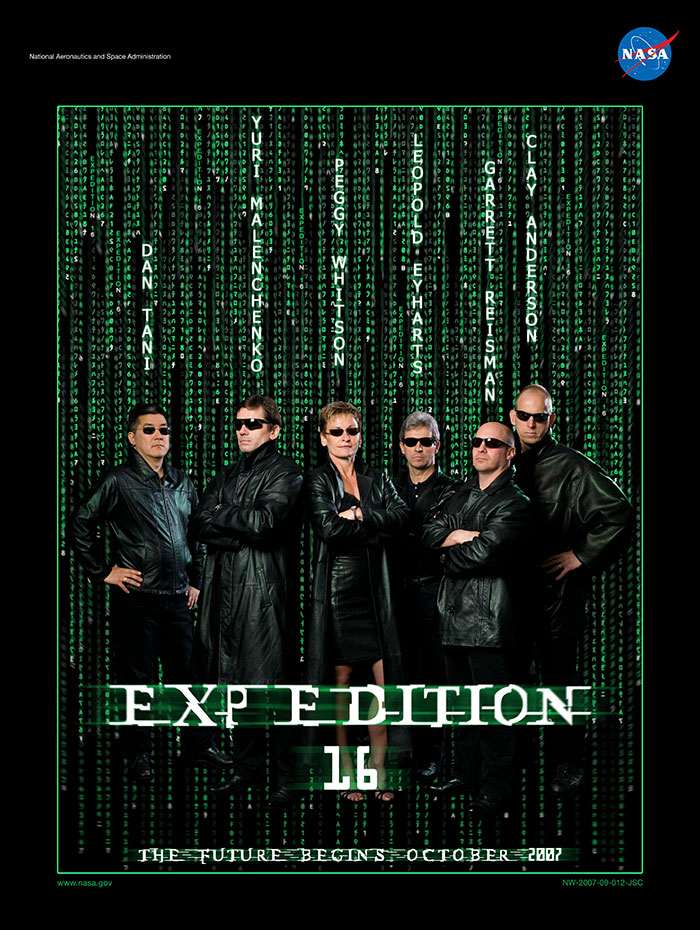
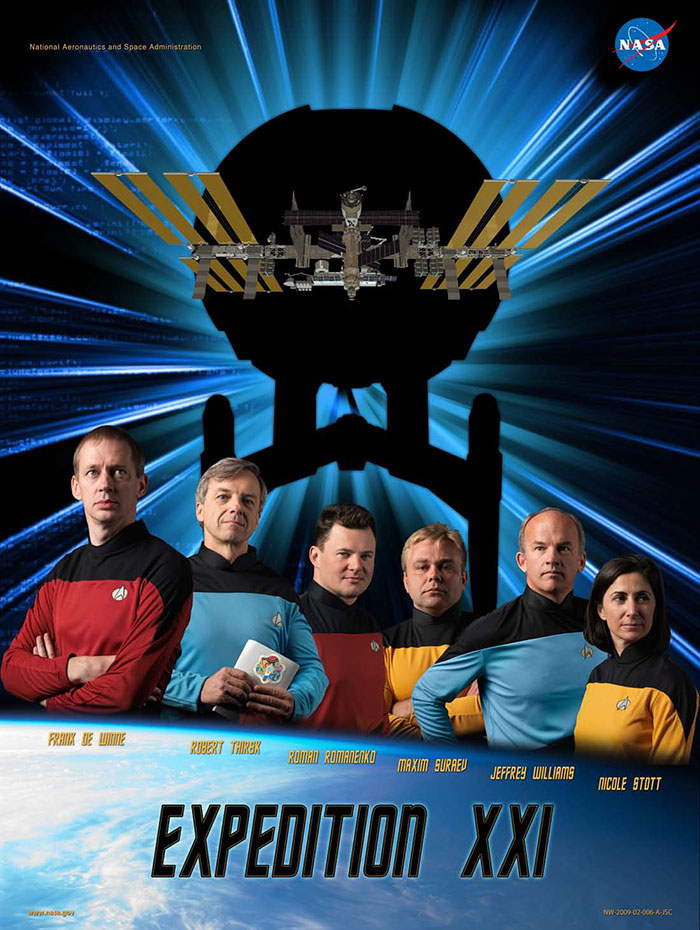
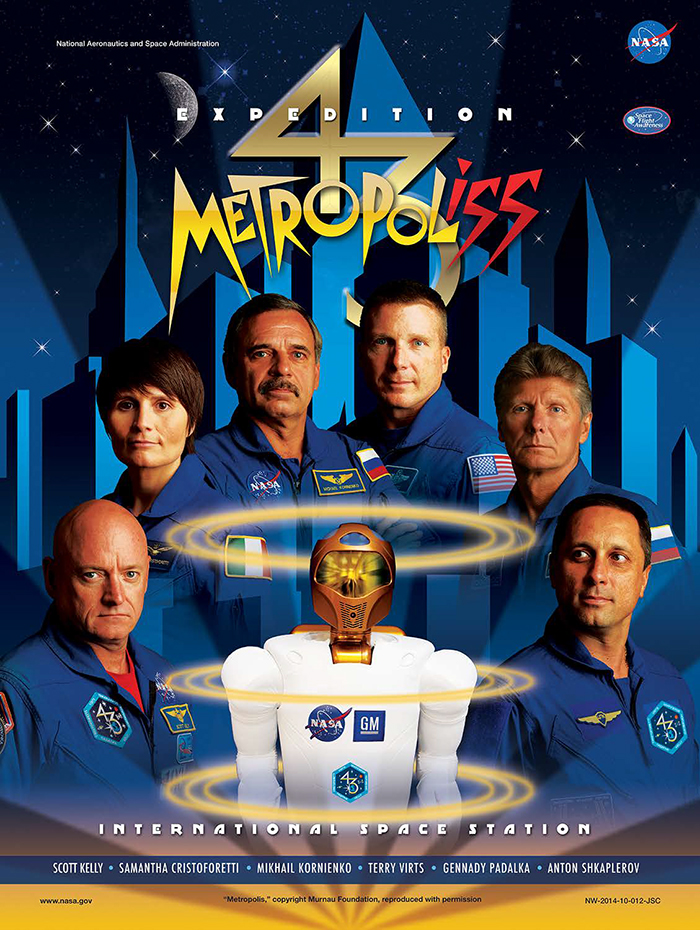
For just over eighteen years now, NASA has been conducting expeditions to the International Space Station. Each of these missions has not just a name, or at least a number (last week saw the launch of Expedition 58), but an official poster with a group photo of the crew. “These posters were used to advertise expeditions and were also hung in NASA facilities and other government organizations,” says Bored Panda. “However, when astronauts got bored of the standard group photos they decided to spice things up a bit.”
And “what’s a better way to do that other than throwing in some pop culture references?” As anyone who has ever worked with scientists knows, a fair few of them have somehow made themselves into living compendia of knowledge of not just their field but their favorite books, movies, and television shows — not always, but very often, books, movies, and television shows science-fictional in nature.
The prime example, it hardly bears mentioning, would be Star Trek, but the well of fandom at NASA runs much deeper than that.
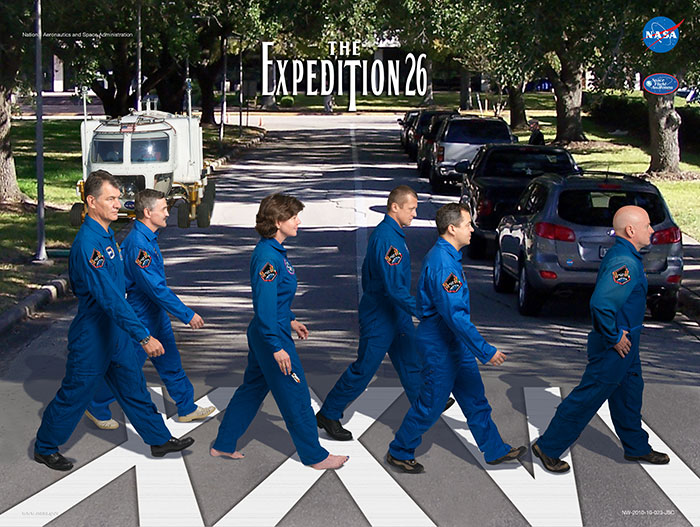
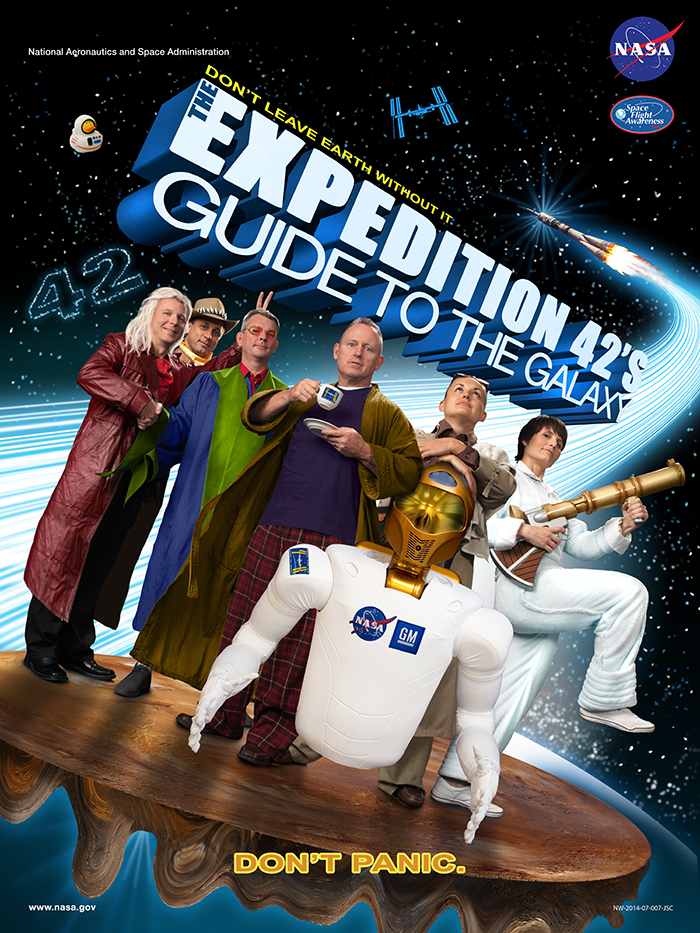
You’ll get a sense of how far that well goes if you have a look through the Expedition poster archive at NASA’s web site. There you’ll find not just pop culture references but elaborately designed tributes — downloadable in high resolution — to the likes of not just Star Trek but Star Wars, The Matrix, The Hitchhiker’s Guide to the Galaxy (the sole possible theme, Douglas Adams fans will agree, for Expedition 42), and even Fritz Lang’s Metropolis, which first gave dystopian sci-fi its visual form in 1927 (and which you can watch here). Albums are also fair game, as evidenced by the Abbey Road poster for Expedition 26.
Bored Panda calls these posters “hilariously awkward,” but opinions do vary: “I love them,” writes Boing Boing’s Rusty Blazenhoff. “I think they’re fun and creative.” And whatever you think of the concepts, can you fail to be impressed by the sheer attention to detail that has clearly gone into replicating the source images? It’s all more or less in line with the formidable graphic design skill at NASA, previously featured here on Open Culture, that has gone into its posters celebrating space travel and the 40th anniversary of the Voyager missions.
Going through the Expedition poster archive, I notice that none seems yet to have paid tribute to Andrei Tarkovsky’s Solaris, surely one of the most powerful pieces of outer space-related cinema ever made. Granted, that film has much less to do with teamwork and camaraderie than the intense psychological isolation of the individual, which would make it tricky indeed to recreate any of its memorable images as proud group photos. But if NASA’s poster designers can’t take on that mission, nobody can.
Based in Seoul, Colin Marshall writes and broadcasts on cities, language, and culture. His projects include the book The Stateless City: a Walk through 21st-Century Los Angeles and the video series The City in Cinema. Follow him on Twitter at @colinmarshall or on Facebook.
Isaac Asimov’s readers have long found something prophetic in his work, but where did Asimov himself look when he wanted to catch a glimpse of the future? In 1964 he found one at the New York World’s Fair, the vast exhibition dedicated to “Man’s Achievement on a Shrinking Globe in an Expanding Universe” that history now remembers as the most elaborate expression of the industrial and technological optimism of Space Age America. Despite the fanciful nature of some of the products on display, visitors first saw things there — computers, for instance — that would become essential in a matter of decades.
“What is to come, through the fair’s eyes at least, is wonderful,” Asimov writes in a piece on his experience at the fair for the New York Times. But it all makes him wonder: “What will life be like, say, in 2014 A.D., 50 years from now? What will the World’s Fair of 2014 be like?” His speculations begin with the notion that “men will continue to withdraw from nature in order to create an environment that will suit them better,” which they certainly have, though not so much through the use of “electroluminescent panels” that will make “ceilings and walls will glow softly, and in a variety of colors that will change at the touch of a push button.” Still, all the other screens near-constantly in use seem to provide all the glow we need for the moment.
“Gadgetry will continue to relieve mankind of tedious jobs,” Asimov predicts, and so it has, though our kitchens have yet to evolve to the point of preparing “ ‘automeals,’ heating water and converting it to coffee; toasting bread; frying, poaching or scrambling eggs, grilling bacon, and so on.” He hits closer to the mark when declaring that “robots will neither be common nor very good in 2014, but they will be in existence.” He notes that IBM’s exhibit at the World’s Fair had nothing about robots to show, but plenty about computers, “which are shown in all their amazing complexity, notably in the task of translating Russian into English. If machines are that smart today, what may not be in the works 50 years hence? It will be such computers, much miniaturized, that will serve as the ‘brains’ of robots.”
“The appliances of 2014 will have no electric cords,” Asimov writes, and in the case of our all-important mobile phones, that has turned out to be at least half-true. But we still lack the “long-lived batteries running on radioisotopes” produced by “fission-power plants which, by 2014, will be supplying well over half the power needs of humanity.” The real decade of the 2010s turned out to be more attached to the old ways, not least by cords and cables, than Asimov imagined. Even the United States of America hasn’t quite mastered the art of designing highways so that “long buses move on special central lanes” along them, let alone forms of ground travel that “take to the air a foot or two off the ground.”
But one advance in transportation Asimov describes will sound familiar to those of us living in the 2010s: “Much effort will be put into the designing of vehicles with ‘Robot-brains,’ vehicles that can be set for particular destinations and that will then proceed there without interference by the slow reflexes of a human driver.” Indeed, we hear about few reportedly imminent technologies these days as much as we hear about self-driving cars and their potential to get us where we’re going while we do other things, such as engage in communications that “will become sight-sound and you will see as well as hear the person you telephone,” on a screen used “not only to see the people you call but also for studying documents and photographs and reading passages from books.”
Conversations with the moon colonies, Asimov needlessly warns us, “will be a trifle uncomfortable” because of the 2.5‑second delay. But immediately thereafter comes the much more realistic prediction that “as for television, wall screens will have replaced the ordinary set.” Still, “all is not rosy” in the world of 2014, whose population will have swelled to 6,500,000,000 — or 7,298,453,033, as it happened. This has many implications for development, housing, and even agriculture, though the “mock-turkey” and “pseudosteak” eaten today has more to do with lifestyle than necessity. (“It won’t be bad at all,” Asimov adds, “if you can dig up those premium prices.”)
Finally, and perhaps most importantly, “the world of A.D. 2014 will have few routine jobs that cannot be done better by some machine than by any human being. Mankind will therefore have become largely a race of machine tenders.” Asimov foresees the need for a change in education to accommodate that, one hinted at even in General Electric’s exhibit in 1964, which “consists of a school of the future in which such present realities as closed-circuit TV and programmed tapes aid the teaching process.” His envisioned high-school curriculum would have students master “the fundamentals of computer technology” and get them “trained to perfection in the use of the computer language.”
But even with all these developments, “mankind will suffer badly from the disease of boredom, a disease spreading more widely each year and growing in intensity.” The “serious mental, emotional and sociological consequences” of that will make psychiatry an important medical specialty, and “the lucky few who can be involved in creative work of any sort will be the true elite of mankind, for they alone will do more than serve a machine.” Though Asimov may have been surprised by what we’ve come up with in the quarter-century since his death, as well as what we haven’t come up with, he would surely have understood the sorts of anxieties that now beset us in the future-turned-present in which we live. But even given all the ways in which his predictions in 1964 have proven more or less correct, he did miss one big thing: there was no World’s Fair in 2014.
Based in Seoul, Colin Marshall writes and broadcasts on cities, language, and culture. His projects include the book The Stateless City: a Walk through 21st-Century Los Angeles and the video series The City in Cinema. Follow him on Twitter at @colinmarshall or on Facebook.
You may remember, in the run-up to the theatrical release of Blade Runner 2049 last October, that three short prequels appeared on the internet. Black Out 2022(above), the most discussed installment of that miniature trilogy, stood out both aesthetically and culturally: directed by famed Japanese animator Shinichiro Watanabe, it expanded the reality of Blade Runner through a form that has drawn so much from that universe over the previous 35 years. “I just want an animated bladerunner series now,” says the current top-rated comment below that video, “this was magical.” And so, a year later, the answer to the prayer of that commenter (and clearly many other viewers besides) has appeared on the horizon: a Japanese animated series called Blade Runner — Black Lotus.
Overseen by Watanabe in the producer role and directed by Kenji Kamiyama and Shinji Aramaki, the latter of whom worked in the art department on Black Out 2022, the new series will take place in 2032, between the events of the short and those of Blade Runner 2049.
“It will also include some ‘established characters’ from the Blade Runner universe, but that could mean all sorts of things,” writes The A.V. Club’s Sam Barsanti. “Harrison Ford’s Rick Deckard would already be in hiding at that point after fathering the miracle replicant baby, so it could be about him going off on some cool guy adventures, but Deckard doesn’t exactly seem like a guy who goes on cool guy adventures. Ryan Gosling’s K probably wasn’t ‘born’ yet, since he’s a Nexus‑9 replicant and those weren’t created until later in the 2030s, but we don’t know for sure.”
Perhaps supporting characters from both movies, “like Edward James Olmos’ Gaff (he might still be an LAPD cop) or Jared Leto’s Niander Wallace (he’s definitely hanging around, being an evil rich guy),” will show up. Whatever happens, the thirteen episodes of Blade Runner — Black Lotus will certainly have no small amount of both familiarity and surprise in store for fans of Blade Runner, as well as those of Watanabe’s other work. That goes especially for his philosophical space bounty-hunter series Cowboy Bebop, itself the source material for a new live-action television series on Adult Swim, who will air Blade Runner — Black Lotus at the same time as it’s streamed on anime site Crunchyroll.com. No release date has thus far been announced, but odds are the show’s debut will happen some time in 2019 — the perfect year for it, as everyone thrilling to the prospect of more Blade Runner already knows.
Based in Seoul, Colin Marshall writes and broadcasts on cities, language, and culture. His projects include the book The Stateless City: a Walk through 21st-Century Los Angeles and the video series The City in Cinema. Follow him on Twitter at @colinmarshall or on Facebook.
Who invented cyberpunk, that vivid subgenre of science fiction at the intersection of “high tech and low life”? Some put forth the name of William Gibson, whose 1984 novel Neuromancer crystallized many of the elements of cyberpunk that still characterize it today, even if it wasn’t the first example of all of them. And who, for that matter, invented science fiction? Brian Aldiss, a sci-fi writer and a respected scholar of the tradition, argued for Mary Shelley, author of Frankenstein. “The seminal point about Frankenstein,” Aldiss writes, “is that its central character makes a deliberate decision. He succeeds in creating life only when he throws away dusty old authorities and turns to modern experiments in the laboratory.”
In other words, Victor Frankenstein uses science, which according to Aldiss had not propelled a narrative before Frankenstein’s publication in 1818. The novel came out, in an edition of just 500 three-volume copies, under the full title Frankenstein; or, The Modern Prometheus, and without any author’s name. Shelley’s decision to publish her work anonymously, with a preface by her husband Percy Bysshe Shelley, led readers to assume that the poet himself had written the book. Though he hadn’t, he had accompanied the then-18-year-old Mary Shelley on the trip to Switzerland where she came up with the story. There, kept indoors by foul weather at Lake Geneva’s Villa Diodati, the couple and Lord Byron, whom they had come to visit, binge-read ghost stories to one another until they decided to each write an original one.
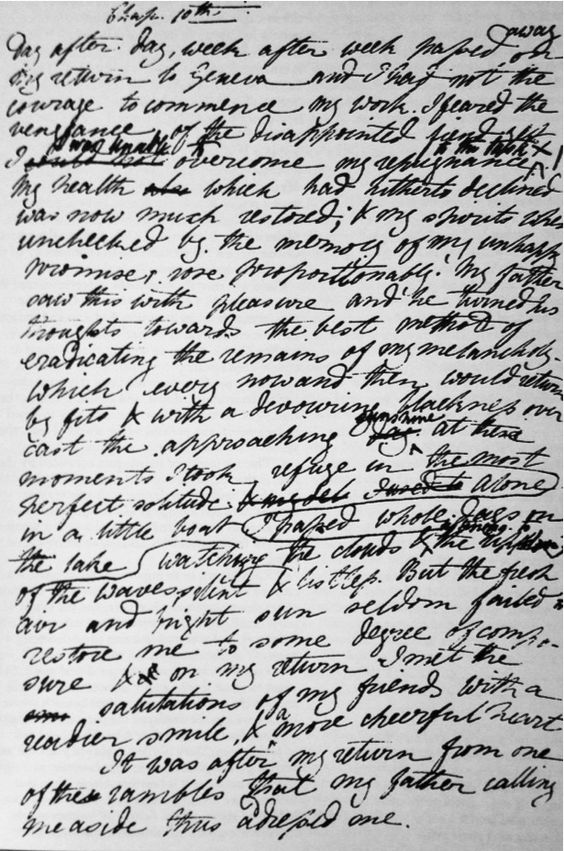
It took Shelley some time to come up with an idea, but when inspiration finally struck, it brought on an unignorable vision. “I saw the pale student of unhallowed arts kneeling beside the thing he had put together,” Shelley writes in her introduction to the non-anonymous 1831 edition of Frankenstein. “I saw the hideous phantasm of a man stretched out, and then, on the working of some powerful engine, show signs of life, and stir with an uneasy, half vital motion.” She thus began to write her story, first in short form and later, with Percy’s encouragement, expanding it into a novel. A few days ago, Gibson retweeted a page of one of Shelley’s handwritten manuscripts, adding only, “This is, literally, ground zero of science fiction.”
The original tweeter of the image, someone called Laura N, describes it as “the first page of Frankenstein,” although its text page appears in the published book as the first page of its eighteenth chapter. She also links to the Shelley-Godwin Archive, home of digitized manuscripts of Percy Bysshe Shelley, Mary Wollstonecraft Shelley, her father William Godwin, and her mother Mary Wollstonecraft. There, as we’ve previously featured on Open Culture, you can trace the evolution of Frankenstein by viewing all the extant pages of all its extant manuscripts. A full two centuries after its publication, Shelley’s novel continues to fascinate, and its central ideas and characters have become familiar to readers — and even non-readers — around the world. And in the view of Aldiss, Gibson, and many others besides, this story of a monster’s creation also brought to life a whole new cultural universe.
Based in Seoul, Colin Marshall writes and broadcasts on cities and culture. His projects include the book The Stateless City: a Walk through 21st-Century Los Angeles and the video series The City in Cinema. Follow him on Twitter at @colinmarshall or on Facebook.
Alejandro Jodorowsky may never have made his film adaptation of Frank Herbert’s Dune, but plenty came out of the attempt — including, one might well argue, Blade Runner. Making that still hugely influential adaptation of Philip K. Dick’s Do Androids Dream of Electric Sheep?, Ridley Scott and his collaborators looked to a few key visual sources, one of them a two-part short story in comic form called “The Long Tomorrow.”
Illustrated by none other than French artist Mœbius, one of the richest visual imaginations of our time, it tells the futuristic hard-boiled story of a private detective in a dense, vertical underground city filled with androids, rowdy bars, assassins, and flying cars. “I’m a confidential nose,” says the protagonist by way of introduction. “My office is on the 97th level. Club’s the name, Pete Club.”
Then comes the fateful piece of narration that begins any detective story worth its salt: “It started out a day like any other day.” But by the end of that day, Club has taken a job from a classic dame in need, fended off both a four-armed thug and a hired assassin, slain an alien monster with whom he finds himself in bed, and recovered the president’s missing brain.
The story was written written by Dan O’Bannon, then known mainly for the film Dark Star, a science-fiction comedy he’d made with his University of Southern California classmate John Carpenter. On the strength of that, Jodorowsky had brought him onto Dune to work on its special effects, just as he’d brought Mœbius on to create its storyboards and concept art. With nothing to do before shooting began — which it never did — O’Bannon first drew “The Long Tomorrow” himself as a way of keeping busy. Mœbius took one look at it and immediately saw its promise.
The French may have coined the term film noir, but this early work of future noir benefited from having an American writer. “When Europeans try this kind of parody, it is never entirely satisfactory,” Mœbius writes in the introduction to the book version of “The Long Tomorrow.” “The French are too French, the Italians are too Italian … so, under my nose was a pastiche that was more original than the originals.” It also, with Mœbius’ art, laid the visual groundwork for generations of sci-fi stories to come.
“The way Neuromancer-the-novel ‘looks’ was influenced in large part by some of the artwork I saw in Heavy Metal,” said William Gibson, referring to the English version of Métal hurlant, the magazine that popularized Mœbius’ work. (O’Bannon also worked on the animated Heavy Metal anthology film, released in 1981.) But perhaps Ridley Scott, who started working with the artist on 1979’s O’Bannon-scripted Alien, described the influence of Mœbius’ art on our visions of the future best: “You see it everywhere, it runs through so much you can’t get away from it.” In a cultural sense, all of us live in Pete Club’s city now.
Based in Seoul, Colin Marshall writes and broadcasts on cities and culture. His projects include the book The Stateless City: a Walk through 21st-Century Los Angeles and the video series The City in Cinema. Follow him on Twitter at @colinmarshall or on Facebook.
What turns people into science-fiction fans? Many enter through the gateway of Star Trek, an early 1960s television series “set on the worlds visited by a giant Spaceship, the U.S.S. Enterprise, and on the ship itself. Its crew is on a mission to explore new worlds and ‘to boldly go where no man has gone before.’ ” Though “not particularly successful in the ratings,” Star Trek nevertheless “attracted a hard core of devoted fans, ‘Trekkies,’ who made up in passionate enthusiasm what they lacked in numbers.” Perhaps creator Gene Roddenberry’s signature “blend of the mildly fantastic with the reassuringly familiar, and his use of an on the whole very likeable cast, attracted viewers precisely because its exoticism was manageable and unthreatening.”
Those quotes come from The Encyclopedia of Science Fiction, a free online resource featuring more than 17,500 entries explaining all things sci-fi, whether new or old, mainstream or obscure. Some of its pages deal with works of doubted status as science fiction at all: Star Wars, for example, “an entertaining pastiche that draws upon comic strips, old movie serials, Westerns, James Bond stories, The Wizard of Oz, Snow White, Errol Flynn swashbucklers and movies about World War Two” whose “gratifyingly spectacular – at the time – special effects and martial music hypnotized the audience into uncritical acceptance of the basically absurd, deliberately Pulp-magazine-style conflict between Good and Evil.”
That sort of thing is a long way indeed from the work of, say, a science-fiction grandmaster like Isaac Asimov, who wrote prolifically in “the clear unerring voice of a man speaking reason, uttering tales about how to solve the true world.” Some readers of Open Culture might well have found their way into science fiction through Ridley Scott’s Blade Runner, which despite its “many narrative flaws” remains “one of the most important sf movies made,” having showed “almost for the first time – though fans had spent years hoping – how visually sophisticated sf in film form can be.”
Blade Runner’s entry includes, of course, a reference to the script’s basis on Do Androids Dream of Electric Sheep? by Philip K. Dick, “a figure who helps define by contrast those identified in this Encyclopedia as Mainstream Writers of SF: writers, that is, whose comprehension of the significant literatures of the last century has sometimes seemed less than full. An author like ThomasPynchon, who is not described in this encyclopedia as mainstream, will understand what he owes Dick; a mainstream author like MargaretAtwood has worked to make it clear that she does not.”
Stanley Kubrick’s 2001: A Space Odyssey, “the most ambitious sf film of the 1960s and perhaps ever,” has also done its part to propagate a sci-fi way of looking at the world, exploring as it does “the idea of human deficiency in the twenty-first century.” Kubrick developed it in collaboration with novelist Arthur C. Clarke, another of the genre’s titans, indeed “the very personification of sf. Never a ‘literary’ author, he nonetheless always wrote with lucidity and candour, often with grace, sometimes with a cold, sharp evocativeness that produced some of the most memorable images in sf.”
Other entries tell of writers not so closely associated with traditional science fiction but highly regarded and enduringly influential in the wider world of speculative literature: Jorge Luis Borges, for instance, with his “ ‘sense of ecstatic enclosedness in the Word Incarnate’ that may be uniquely intense in world literature,” or J.G. Ballard, “revered (and detested) for the corrosively inescapable vision of the late twentieth-century world, which his stories seemed not so much to reflect in a distorting mirror as (alarmingly) to reflect, for the first time, without defensive evasions.”
“Originally published in physical form in 1979,” writes Lithub’s MH Rowe, “the Encyclopedia of Science Fiction won a Hugo award for best nonfiction book in 1980. A second edition followed in 1993, with a CD-ROM supplement a few years later. The encyclopedia won another Hugo in 1994, and a decade later began its migration online, where it launched in 2011 as a precursor to its current digital form” — albeit a far cry from a crowdsourced, objectivity-oriented resource like Wikipedia. “Making no effort to avoid the partisanship that’s a hallmark of being a fan, the SFE possesses the kind of purity you can only get from corrupt endeavors. It’s by turns cranky, self-doubting, and ultra-confident, but it couldn’t be more deeply engaged with the genre of science fiction.” And if anything characterizes science-fiction fandom more than deep engagement, even the genre’s most powerful imaginations haven’t dreamed of it.
Based in Seoul, Colin Marshall writes and broadcasts on cities and culture. His projects include the book The Stateless City: a Walk through 21st-Century Los Angeles and the video series The City in Cinema. Follow him on Twitter at @colinmarshall or on Facebook.
We're hoping to rely on loyal readers, rather than erratic ads. Please click the Donate button and support Open Culture. You can use Paypal, Venmo, Patreon, even Crypto! We thank you!
Open Culture scours the web for the best educational media. We find the free courses and audio books you need, the language lessons & educational videos you want, and plenty of enlightenment in between.