South African–Canadian film director Neill Blomkamp recently launched Oats Studios, a new film project devoted to creating experimental short films. And now comes their very first production, a short film called “Rakka.” Starring Sigourney Weaver, “Rakka” takes us inside the aftermath of an alien invasion sometime in the year 2020. The Verge rightly notes that “Rakka” isn’t “a conventional short film. Instead, it’s a series of scenes depicting various points of view. Some scenes show what the aliens are doing to humanity; others track a resistance movement led by Weaver, and an escaped prisoner named Amir.” The new short runs 21 minutes and is streaming free on YouTube. ” Watch it above, and to learn about the making of “Rakka” and Oats Studios, read this interview over at Cartoon Brew.
If you would like to support the mission of Open Culture, consider making a donation to our site. It’s hard to rely 100% on ads, and your contributions will help us continue providing the best free cultural and educational materials to learners everywhere. You can contribute through PayPal, Patreon, and Venmo (@openculture). Thanks!
All of us who excitedly write about Blade Runner 2049, the upcoming sequel to Blade Runner, have at some point described the film as “long-awaited.” Since the original came out in 1982, that makes a certain literal sense, but the wait hasn’t stretched to 35 years without cause. As Blade Runner rose higher and higher in stature, following it up properly grew into a more and more daunting challenge. But now, as Blade Runner 2049 approaches its October release, the prospect that this most respected of all science-fiction movies will have its continuation feels more real than ever — and it will feel even more real than that after you watch the short making-of featurette above.
Though he didn’t return to direct Blade Runner 2049, ceding the chair to Sicario and Arrival director Denis Villeneuve and taking on the role of producer instead, he does make quite a few appearances in this featurette as a kind of presiding spirit. “Blade Runner revolutionized the way we view science fiction,” says Villeneuve. “I’ve never felt that much pressure on my shoulders — thinking that Ridley Scott will see this movie.”
But more than anything the cast and filmmakers have to say, Blade Runner fans will savor the video’s glimpses of the new picture’s aesthetic, clearly both modeled after and deliberately made different from that of the original. As the title makes obvious, the story takes place thirty years after Blade Runner’s 2019, and just as things have changed in our world, so they’ve changed in its world — not least in the form of a Korean influence that has its found its way in with the Japanese and Chinese ones that so characterized Blade Runner’s future Los Angeles. “Defining this was like walking on a knife’s edge,” says production designer Dennis Gassner, “riding the line between the original film and what we’re doing now.”
If you’d like to compare the build-up to Blade Runner 2049 with the build-up to Blade Runner, have a look at its own thirteen-minute promotional featurette above. Made well before the time of the modern internet, let alone modern internet videos, this 16-millimeter film production, which featured Scott, “visual futurist” Syd Mead, and special effects artist Douglas Trumbull, circulated by making the screening rounds sci-fi, fantasy, and even horror conventions all across America. Few movies, let alone sequels, have built up as much anticipation as Blade Runner 2049 has, and even fewer have such a legacy to live up to. At least the filmmakers can rest assured that, if the critics don’t happen to like it, well, they didn’t like the first one either.
Those productions will keep you busy for a good while. But if you’re wondering what the 1980s delivered, then tune into Sci-Fi Radio, a series of 26 half-hour shows which aired on NPR Playhouse, starting in 1989. Some of the adapted stories include: “Sales Pitch” and “Imposter” by Philip K. Dick, “Diary of the Rose” and “Field of Vision” by Ursula K. LeGuin, “Wall of Darkness” by Arthur C. Clarke, and “Frost and Fire” by Ray Bradbury.
If you would like to support the mission of Open Culture, consider making a donation to our site. It’s hard to rely 100% on ads, and your contributions will help us continue providing the best free cultural and educational materials to learners everywhere. You can contribute through PayPal, Patreon, and Venmo (@openculture). Thanks!
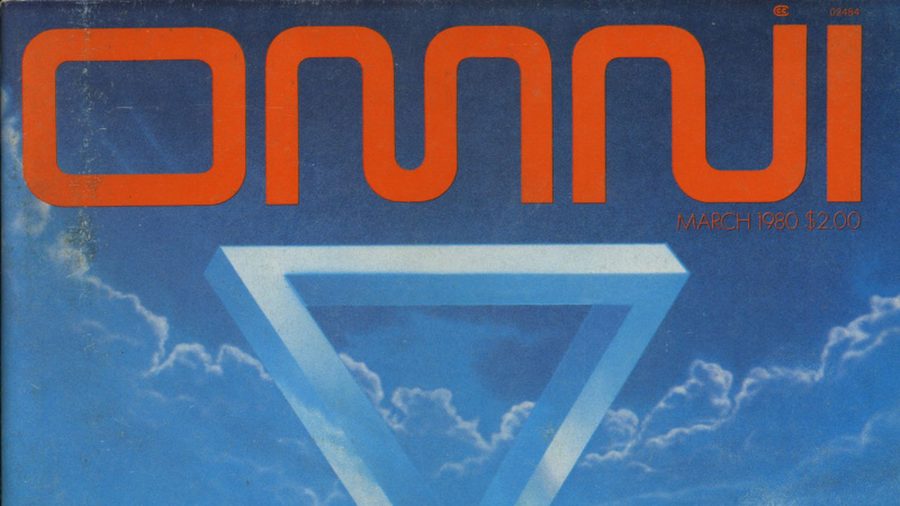
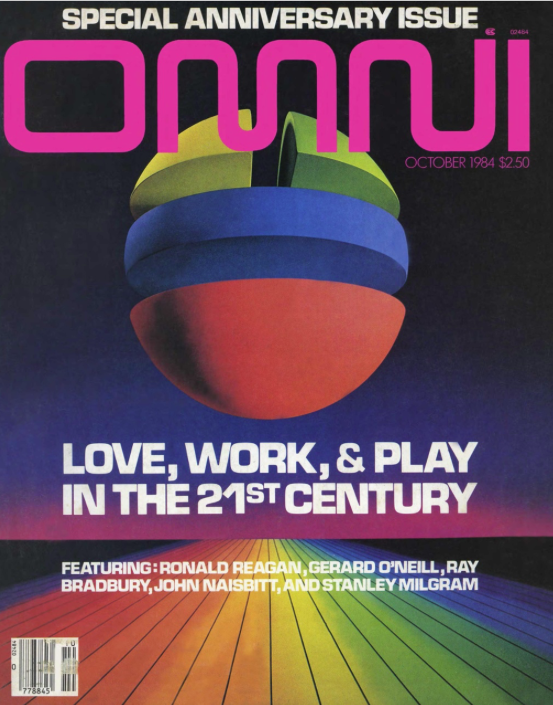
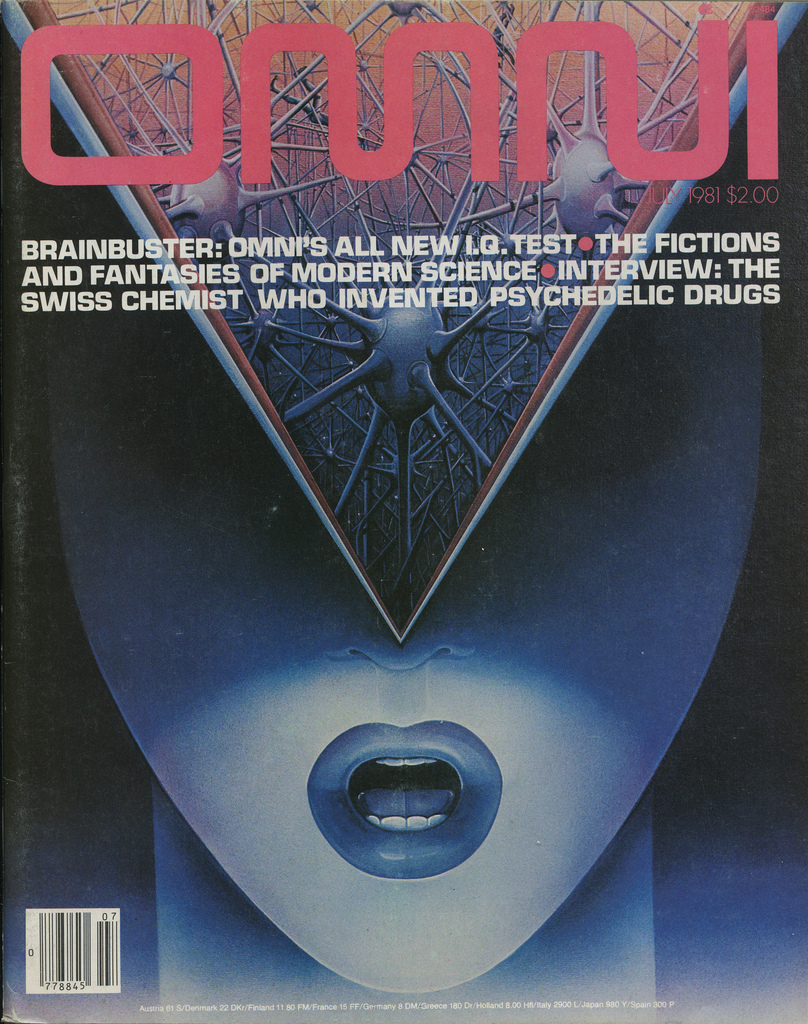
There was a time, not so long ago, when not only could a blockbuster Hollywood comedy make a reference to a science magazine, but everyone in the audience would get that reference. It happened in Ghostbusters, right after the titular boys in gray hit it big with their first high-profile busting of a ghost. In true 1980s style, a success montage followed, in the middle of which appeared the cover of Omni magazine’s October 1984 issue which, according to the Ghostbusters Wiki, “featured a Proton Pack and Particle Thrower. The tagline read, ‘Quantum Leaps: Ghostbusters’ Tools of the Trade.’ ”
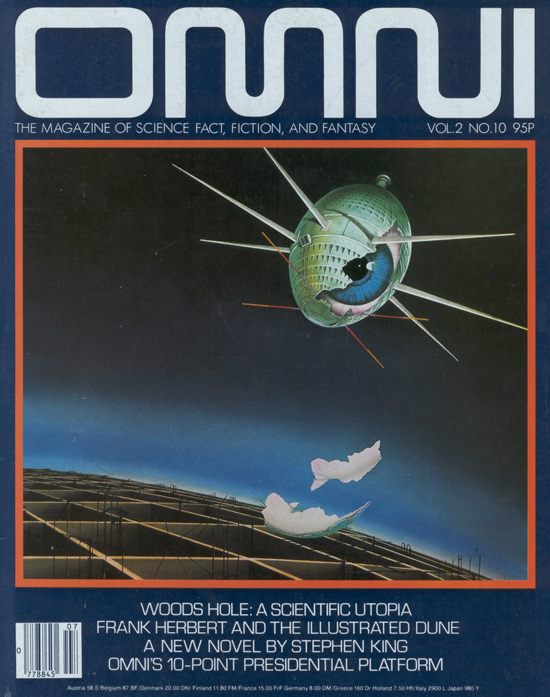
The movie made up that cover, but it didn’t make up the publication. In reality, the cover of Omni’s October 1984 issue, a special anniversary edition which appears at the top of the magazine’s Wikipedia page today, promised predictions of “Love, Work & Play in the 21st Century” from the likes of beloved sci-fi writer Ray Bradbury, social psychologist Stanley Milgram, physicist Gerard O’Neill, trend-watcher John Naisbitt — and, of course, Ronald Reagan. Now you can find that issue of Omni, as well as every other from its 1978-to-1995 run, digitized in high-resolution and made available on Amazon.
“Omni was a magazine about the future,” writes Motherboard’s Claire Evans, telling the story of “the best science magazine that ever was.” In its heyday, it blew minds by regularly featuring extensive Q&As with some of the top scientists of the 20th century–E.O. Wilson, Francis Crick, Jonas Salk–tales of the paranormal, and some of the most important science fiction to ever see magazine publication” by William Gibson, Orson Scott Card, Harlan Ellison, George R. R. Martin — and even the likes of Stephen King, Joyce Carol Oates, and William S. Burroughs. “By coupling science fiction and cutting-edge science news, the magazine created an atmosphere of possibility, where even the most outrageous ideas seemed to have basis in fact.”
Originally founded by Kathy Keeton (formerly, according to Evans, “a South African ballerina who went from being one of the highest-paid strippers in Europe”) and Penthouse publisher Bob Guccione, Omni not only had an impact in unexpected areas (the eccentric musical performer Klaus Nomi, himself a cultural innovator, took his name in part from the magazine’s) but took steps into the digital realm long before other print publications dared. It first established its online presence on Compuserve in 1986; seven years later, it opened up its archives, along with forums and new content, on America Online, a first for any major magazine. Now Amazon users can purchase Omni’s digital back issues for $2.99 each, or read them for free if they have Kindle Unlimited accounts. (You can sign up for a 30-day free trial for Kindle Unlimited and start binge-reading Omni here.)
Jerrick Media, owners of the Omni brand, have also begun to make available on Vimeo on Demand episodes of Omni: The New Frontier, the 1980s syndicated television series hosted by Peter Ustinov. And without paying a dime, you can still browse the fascinating Omni material archived at Omni Magazine Online, an easy way to get a hit of the past’s idea of the future — and one presenting, in the words of 1990s editor-in-chief Keith Farrell, “a fascination with science and speculation, literature and art, philosophy and quirkiness, serious speculation and gonzo speculation, the health of the planet and its cultures, our relationship to the universe and its (possible) cultures, and a sense that whatever else, tomorrow would be different from today.”
Need to put a little geek in your sleep? We’ve got just what you need…
Back in 2009, the musician dubbed Cheesy Nirvosa” began experimenting with ambient music, before launching a YouTube channel where he “composes longform space and scifi ambience,” much of it designed to help you relax, or ideally fall asleep. He calls the videos “ambient geek sleep aids.”
You can sample his work with the playlist above. Called “Video Game Relaxation Sounds,” the playlist features “long relaxing soundscapes from video games.” Sci-fi video games, to be precise. The playlist gives you access to 21 soundscapes, running more than 240 hours in total. Lull yourself to sleep, for example, with ambient sounds from the 1997 Blade Runner video game, a “sidequel” to the Ridley Scott film. Or de-stress with this ambient noise produced by the A/SF-01 B‑Wing Starfighter. It’s taken from this 2001 Star Wars game created by LucasArts.
Stream the playlist above. And hope you enjoy dreaming of electric sheep.
The story of malicious space aliens invading Earth has a resonance that knows no national boundaries. In fact, many modern versions make explicit the moral that only fighting off an existential threat from another planet could unify the inherently fractious human species. H.G. Wells’ 1898 novel The War of the Worlds, in many ways the archetypal telling of the space-invaders tale, certainly proved compelling on both sides of the pond: though set in Wells’ homeland of England, it made a lasting impact on American culture when Orson Welles produced a thoroughly localized version for radio, his infamous War of the WorldsHalloween 1938 broadcast. (Listen to it here.)
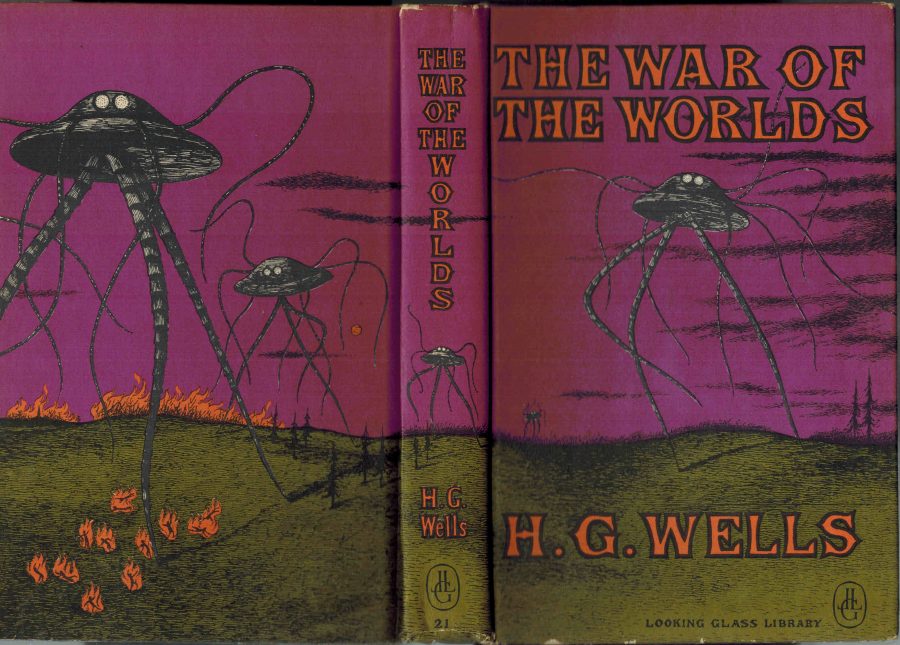
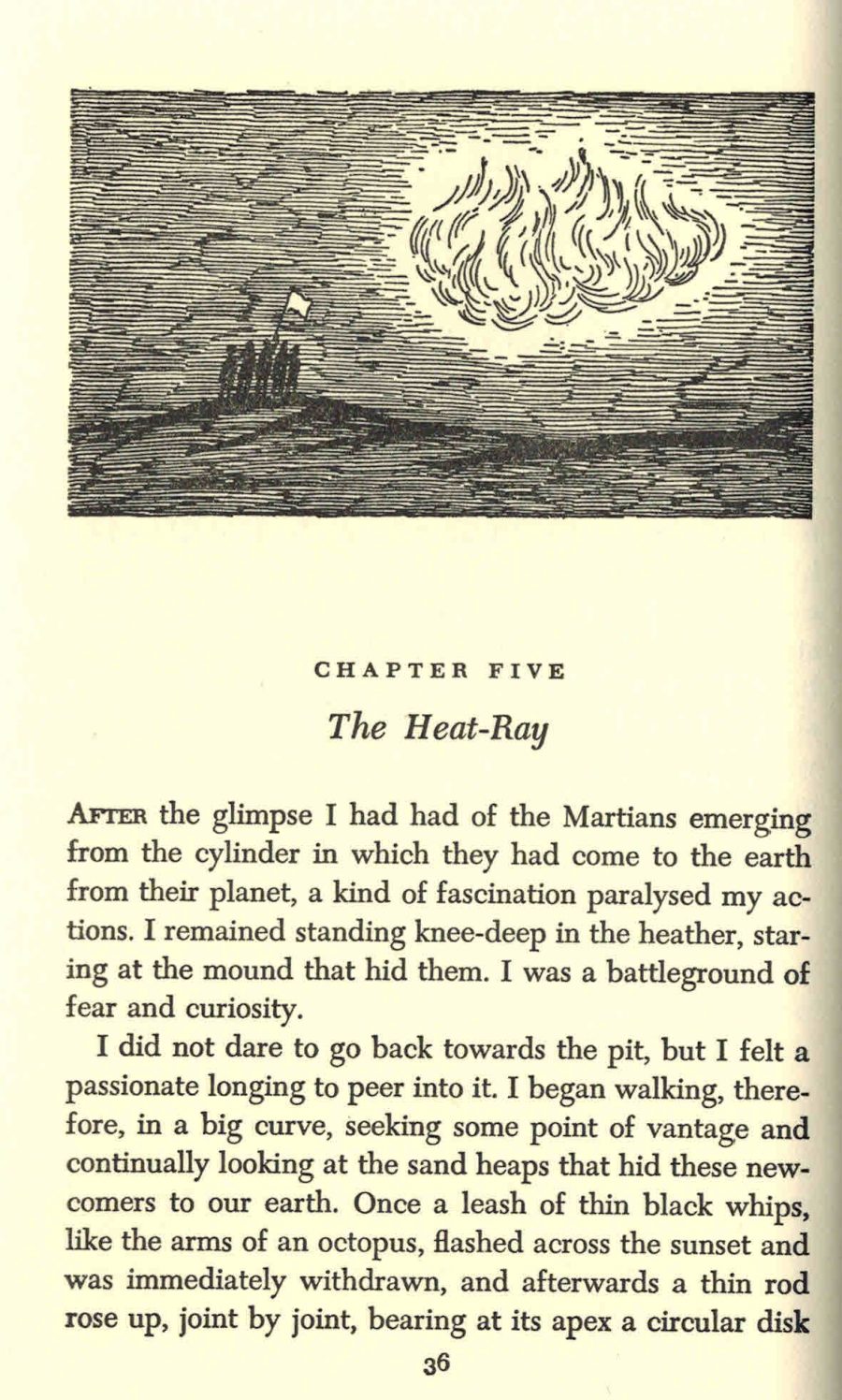
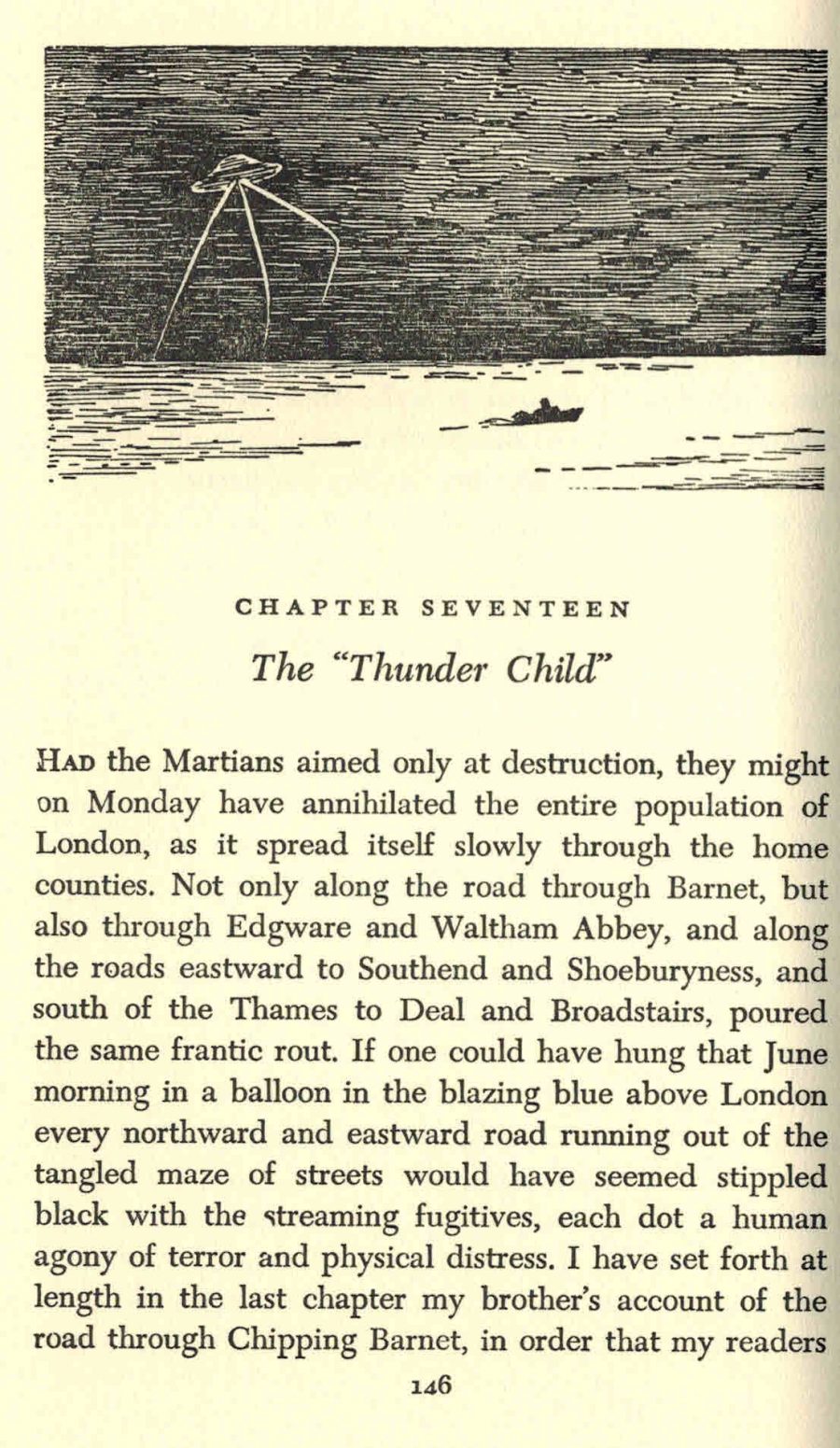
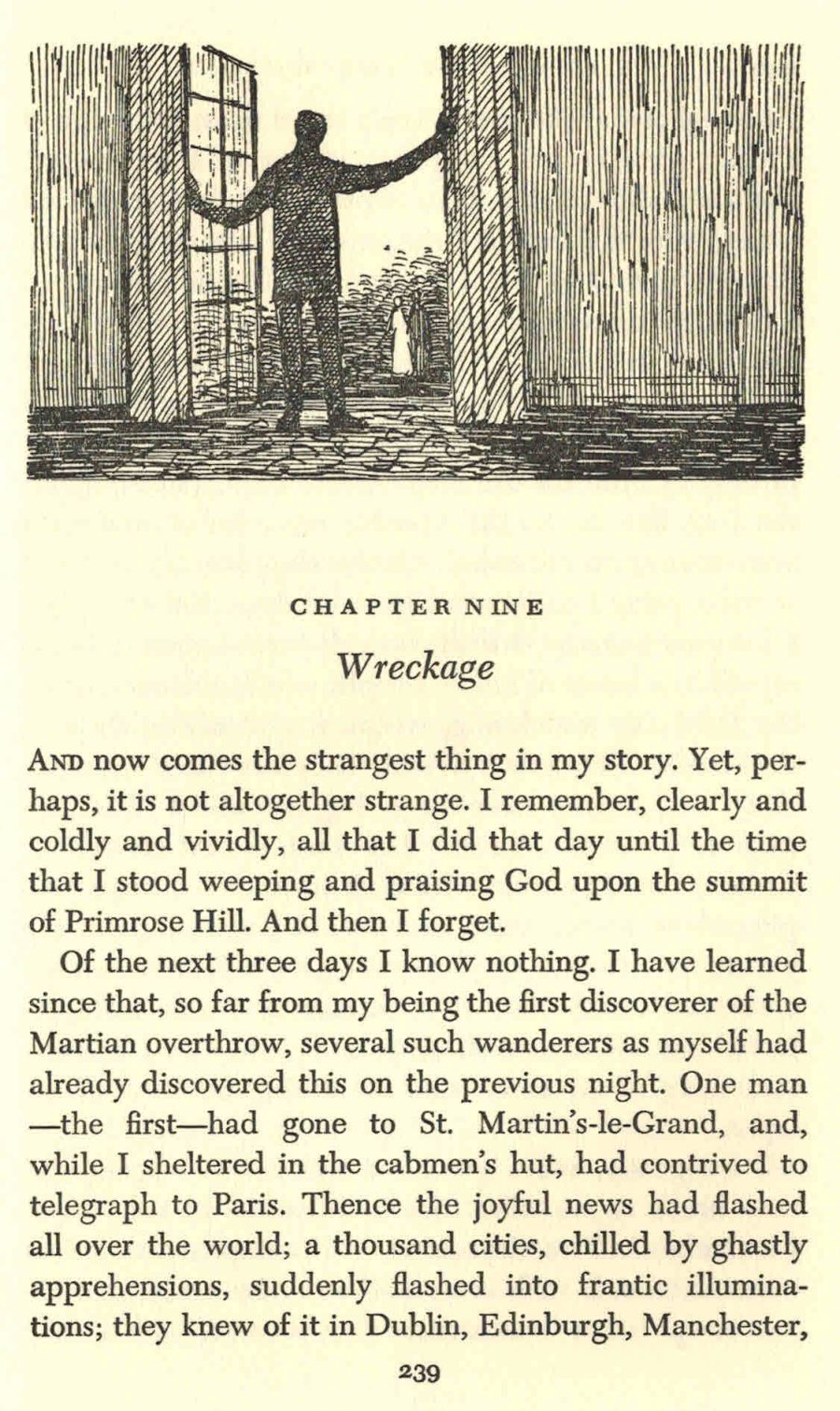
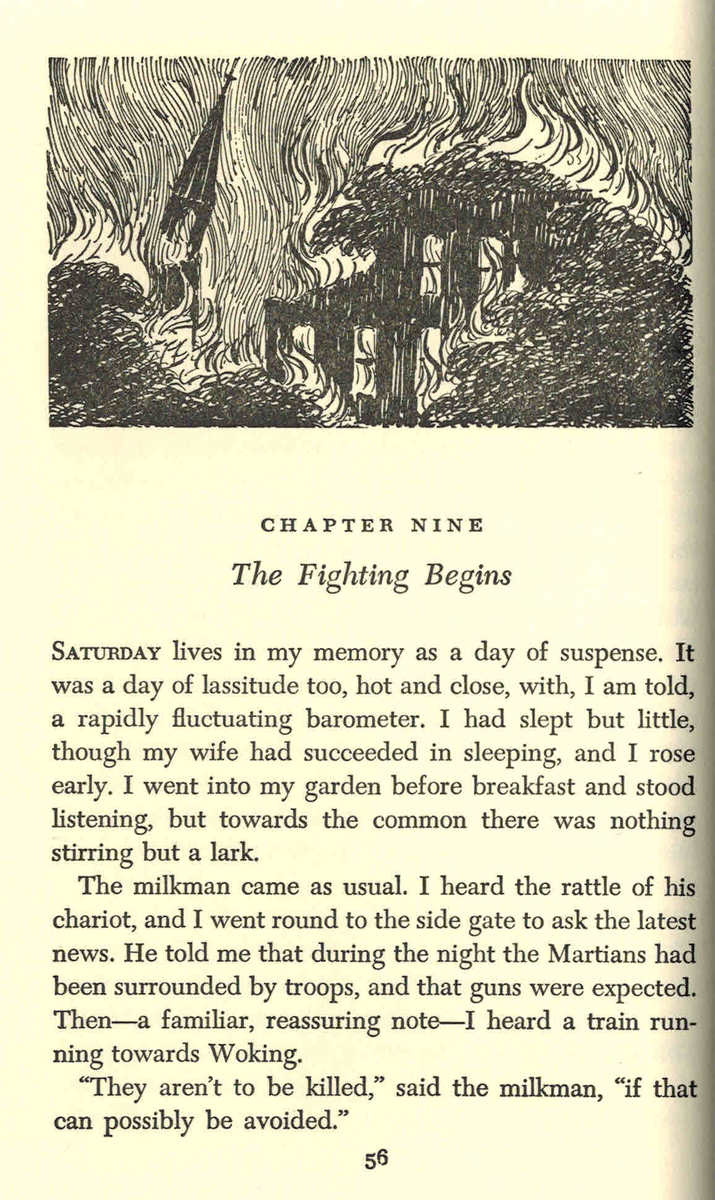
And so who better to illustrate a mid-2oth-century edition of the novel than Edward Gorey? He was born in and spent nearly all his life in America, but developed an artistic sensibility that struck its many appreciators as uncannily mid-Atlantic. His work continues to draw descriptions like “Victorian” and “gothic,” surely underscored by his association with the British literature-adapting television show Mystery!, for whose title sequences he drew characters and settings, and the young-adult gothic mystery novels of Anglophile author John Bellairs. The Gorey-illustrated War of the Worlds came out in 1960 from Looking Glass Library, featuring his drawings not just at the top of each chapter but on its wraparound cover as well. Though out of print, you can find old copies for sale online.
Gorey had begun his career in the early 1950s at the art department of publisher Doubleday Anchor, creating book covers and occasionally interior illustrations. In addition to Bellairs’ novels, he would also go on to put his artistic stamp on such literary classics as Bram Stoker’s Dracula and T.S. Eliot’s Old Possum’s Book of Practical Cats, bringing to each his signature combination of whimsy and dread in just the right proportions. Given the inherent ominousness and threat of The War of the Worlds, Gorey’s dark side comes to the fore as the story’s long-legged terrors arrive and wreak havoc on Earth, only to fall victim to common disease.
Though conceptually similar to the illustrations in Pearson’s, drawn by an artist (usually of children’s books) named Warwick Goble, they don’t get into quite as much detail — but then, they don’t have to. To evoke a complex mixture of fascinated anticipation and creeping fear, Gorey never needed more than an old house, a huddle of silhouettes, or a pair of eyes glowing in the darkness.
Ridley Scott’s Blade Runner (1982) has provided us material for many posts over the years (find some favorites below). If his upcoming sequel Blade Runner 2049 yields half as much, we’ll count ourselves lucky.
The official trailer for the new film came out today. Look for the film in theaters on October 6th.
If you would like to support the mission of Open Culture, consider making a donation to our site. It’s hard to rely 100% on ads, and your contributions will help us continue providing the best free cultural and educational materials to learners everywhere. You can contribute through PayPal, Patreon, and Venmo (@openculture). Thanks!
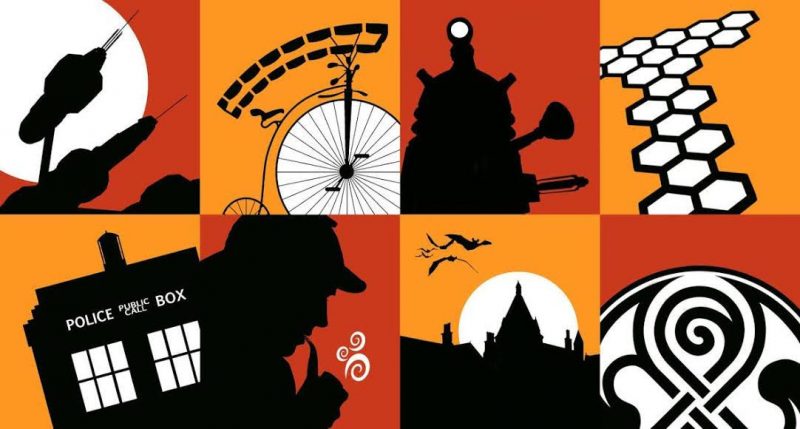
“Yes, this should provide adequate sustenance for the Doctor Who marathon,” once said The Simpsons’ Comic Book Guy while pushing a wheelbarrow full of fast-food tacos down the street. As the embodiment of fandom for all things fantasy and sci-fi, he would certainly know that Doctor Who, no longer an obscure BBC television show but an ever-expanding fictional universe with a global fan base, constitutes the ideal material for binge-watching, which he could now do at his convenience on a service like Britbox. But it isn’t just watching: now, on Spotify (whose free software you can download here if you don’t have it already), you can binge-listen to thirty straight hours of Doctor Who audio dramas as well.
“An icon of modern British culture and the longest-running science-fiction TV show in history, Doctor Who has never been more popular than it is today,” wrote Christopher Bahn in the AV Club’s 2010 primer on the series, which had relaunched five years earlier after initially running from 1963 to 1989. “No matter who’s playing the lead, the basic premise has been essentially the same since the show’s debut: A mysterious, eccentric alien known only as The Doctor (not ‘Doctor Who,’ in spite of the title) travels through time and space having adventures and fighting evil. He’s usually accompanied by one or two humans picked up along the way. They journey with him in a time machine called a TARDIS, which looks like a blue phone booth.”
This format “allowed the show to literally go anywhere in the universe and sometimes outside it, with virtually limitless storytelling possibilities.” At its best, “Doctor Who relied on solid, imaginative scripts to create smart science-fiction thrillers with a humanistic, anti-authoritarian heart. Consistently popular through the 1960s and 1970s, the show began to falter in the following decade as tight budgets and questionable artistic choices took their toll.” After its cancellation in 1989, Doctor Who “lived on through the ’90s, as science-fiction shows often do, in the wilderness genres of semi-official novels and radio plays.”
The best known of these Doctor Who radio plays, which you can hear on this playlist, come produced by a company called Big Finish. Having acquired a license from the BBC in 1999 (and recently renewed it into 2025), they’ve put out a range of audio dramas, both one-offs and series of various lengths, using not just the characters but many of the actual actors from the television show, including six of those who have taken on the iconic Doctor role onscreen. Owing to the fact that Doctor Who officially has no canon and thus no need for continuity, rigorous or otherwise, they can get even more imaginative than their source material, going so far as to explore counterfactual storylines such as one where the Doctor never leaves his home planet in the first place.
Below you’ll find a complete list, assembled by a fan on Reddit, of the series and episodes of Big Finish’s Doctor Who audio dramas now available on Spotify and are now housed to our collection of Free Audio Books. The material comes to thirty hours in total, but the question of when to listen to it falls second to a more important consideration: what sort of sustenance will best ensure that you can keep up with all of the Doctor’s audio adventures?
We're hoping to rely on loyal readers, rather than erratic ads. Please click the Donate button and support Open Culture. You can use Paypal, Venmo, Patreon, even Crypto! We thank you!
Open Culture scours the web for the best educational media. We find the free courses and audio books you need, the language lessons & educational videos you want, and plenty of enlightenment in between.