Was There a First Human Language?: Theories from the Enlightenment Through Noam Chomsky

Dur­ing the 17th and 18th cen­turies, Euro­pean Enlight­en­ment philoso­phers dis­card­ed the ori­gin sto­ries in reli­gious texts as wild­ly implau­si­ble or sim­ply alle­gor­i­cal. But they found them­selves charged with com­ing up with their own, nat­u­ral­is­tic expla­na­tions for the ori­gins of life, law, moral­i­ty, etc. And most press­ing­ly for their inquiries into psy­chol­o­gy and cog­ni­tion, many of those thinkers sought to explain the ori­gins of lan­guage.

The Bib­li­cal sto­ry of the Tow­er of Babel had long been wide­ly accept­ed, either lit­er­al­ly or metaphor­i­cal­ly, as indica­tive that all humans once spoke the same lan­guage (The so-called “Adam­ic Lan­guage”). Many com­pet­ing the­o­ries came from philoso­phers like Locke, Rousseau, Condil­lac, Herder, and the Scot­tish jurist and philoso­pher James Bur­nett, known by his hered­i­tary title, Mon­bod­do.

Antic­i­pat­ing Dar­win­ian evo­lu­tion as well as com­par­a­tive lin­guis­tics, Mon­bod­do argued that lan­guage arose as a response to a chang­ing envi­ron­ment, and that it came into being, along with human beings, in one place, then diver­si­fied as humans spread across the globe and diverged cul­tur­al­ly. This was known as the the­o­ry of mono­gen­e­sis, or the “sin­gle-ori­gin the­o­ry” of lan­guage.

As the nar­ra­tor in the video above, from lin­guis­tics YouTube chan­nel NativLang, puts it, even after the sto­ry had been naturalized—and the lan­guages of the world mapped into pro­to-evo­lu­tion­ary fam­i­ly trees—“Babel still held one intrigu­ing idea over us; that orig­i­nal lan­guage.” And yet, rather than search for the mys­ti­cal Adam­ic Lan­guage—the rev­e­la­tion of a divinity—as many alchemists and occultists had done, nat­ur­al philoso­phers like Mon­bod­do used emerg­ing com­par­a­tive lin­guis­tics meth­ods to attempt a his­tor­i­cal recon­struc­tion of the first human lan­guage.

They were less than suc­cess­ful. Giv­ing it up as futile, in 1866, the Soci­ety of Lin­guis­tics in Paris banned all dis­cus­sion of the issue. “Enter the late Joseph Green­berg” to begin the search anew, says NativLang. A 20th-cen­tu­ry Amer­i­can lin­guist, Green­berg used mass com­par­i­son and typol­o­gy to com­pare “super­fam­i­lies.” Lat­er lin­guists took up the chal­lenge, includ­ing Mer­ritt Ruhlen, who “com­pared vocab­u­lary from across the globe and recon­struct­ed 27 pro­to-words” sup­pos­ed­ly belong­ing to the first human lan­guage, called “Pro­to-World.” Ruhlen’s the­o­ry has since been crit­i­cal­ly sav­aged, says NativLang, and “con­fi­dent­ly tossed… into the bins of fringe lin­guis­tics, pseu­do­science… and yet, Babel’s first, and biggest claim lingers.”

The intel­lec­tu­al his­to­ry in this five-minute video is obvi­ous­ly over­sim­pli­fied, but it high­lights some fas­ci­nat­ing fea­tures of the cur­rent debate. As Avi Lif­schitz, his­to­ri­an of Enlight­en­ment the­o­ry of lan­guage, writes, we tend “to assume that our own cog­ni­tive the­o­ries are the lat­est word when com­pared with those of our pre­de­ces­sors. Yet in some areas, the ques­tions we are now ask­ing are not too dif­fer­ent from those posed some two or three cen­turies ago.” In the case of the ori­gins of lan­guage, that is most cer­tain­ly so. Cen­tral to the the­o­ries of Locke and oth­ers, for exam­ple, “the pre­cise role of lan­guage in the brain and in human per­cep­tion” remains “one of the most top­i­cal ques­tions in today’s cog­ni­tive sci­ence.”

Although many schol­ars have giv­en up attempt­ing to recon­struct the orig­i­nal lan­guage, lin­guists, cog­ni­tive sci­en­tists, and evo­lu­tion­ary biol­o­gists con­tin­ue to find com­pelling evi­dence for the sin­gle-ori­gin the­o­ry. The NativLang video omits per­haps the most famous mod­ern lin­guist, Noam Chom­sky, who argued that a chance muta­tion occurred some 100,000 years ago, giv­ing rise to lan­guage. Even as lan­guages have diverged into what’s cur­rent­ly esti­mat­ed at around 6,000 dif­fer­ent tongues, Chom­sky claimed, they all retain a com­mon struc­ture, a “uni­ver­sal gram­mar.”

What­ev­er it might have sound­ed like, orig­i­nal lan­guage would like­ly have arisen in Sub-Saha­ran Africa, where mod­ern humans evolved some­where between 200,000 and 150,000 years ago. In 2011, Uni­ver­si­ty of Auck­land biol­o­gist Quentin Atkin­son used lin­guis­tic tech­niques some­what like Monboddo’s to show that African lan­guages—espe­cial­ly click lan­guages like the South African Xu—have con­sid­er­ably more indi­vid­ual sounds (phonemes) than oth­ers. And that lan­guages around the world have few­er and few­er phonemes the fur­ther they are from south­ern Africa.

Most sci­en­tists agree with the basic evo­lu­tion­ary his­to­ry of human ori­gins. But like Ruh­len’s “Pro­to-World,” Atkinson’s lin­guis­tic the­o­ry “caused some­thing of a sen­sa­tion,” writes Sci­ence Dai­ly, and has since come in for severe cri­tique. The debate over many of those Enlight­en­ment ques­tions about the ori­gins of lan­guage con­tin­ues. Bar­ring some dra­con­ian ban, “the search for the site of ori­gin of lan­guage,” and for the lan­guage itself and the evo­lu­tion­ary mech­a­nisms that pro­duced it, “remains very much alive.”

If you would like to sign up for Open Culture’s free email newslet­ter, please find it here. It’s a great way to see our new posts, all bun­dled in one email, each day.

If you would like to sup­port the mis­sion of Open Cul­ture, con­sid­er mak­ing a dona­tion to our site. It’s hard to rely 100% on ads, and your con­tri­bu­tions will help us con­tin­ue pro­vid­ing the best free cul­tur­al and edu­ca­tion­al mate­ri­als to learn­ers every­where. You can con­tribute through Pay­Pal, Patre­on, and Ven­mo (@openculture). Thanks!

Relat­ed Con­tent:

The Tree of Lan­guages Illus­trat­ed in a Big, Beau­ti­ful Info­graph­ic

How Lan­guages Evolve: Explained in a Win­ning TED-Ed Ani­ma­tion

Noam Chom­sky Talks About How Kids Acquire Lan­guage & Ideas in an Ani­mat­ed Video by Michel Gondry

Learn Latin, Old Eng­lish, San­skrit, Clas­si­cal Greek & Oth­er Ancient Lan­guages in 10 Lessons

Josh Jones is a writer and musi­cian based in Durham, NC. Fol­low him at @jdmagness

Carl Sagan’s Ambitious College Reading List: Plato, Shakespeare, Gide, and Plenty of Philosophy, Math & Physics (1954)

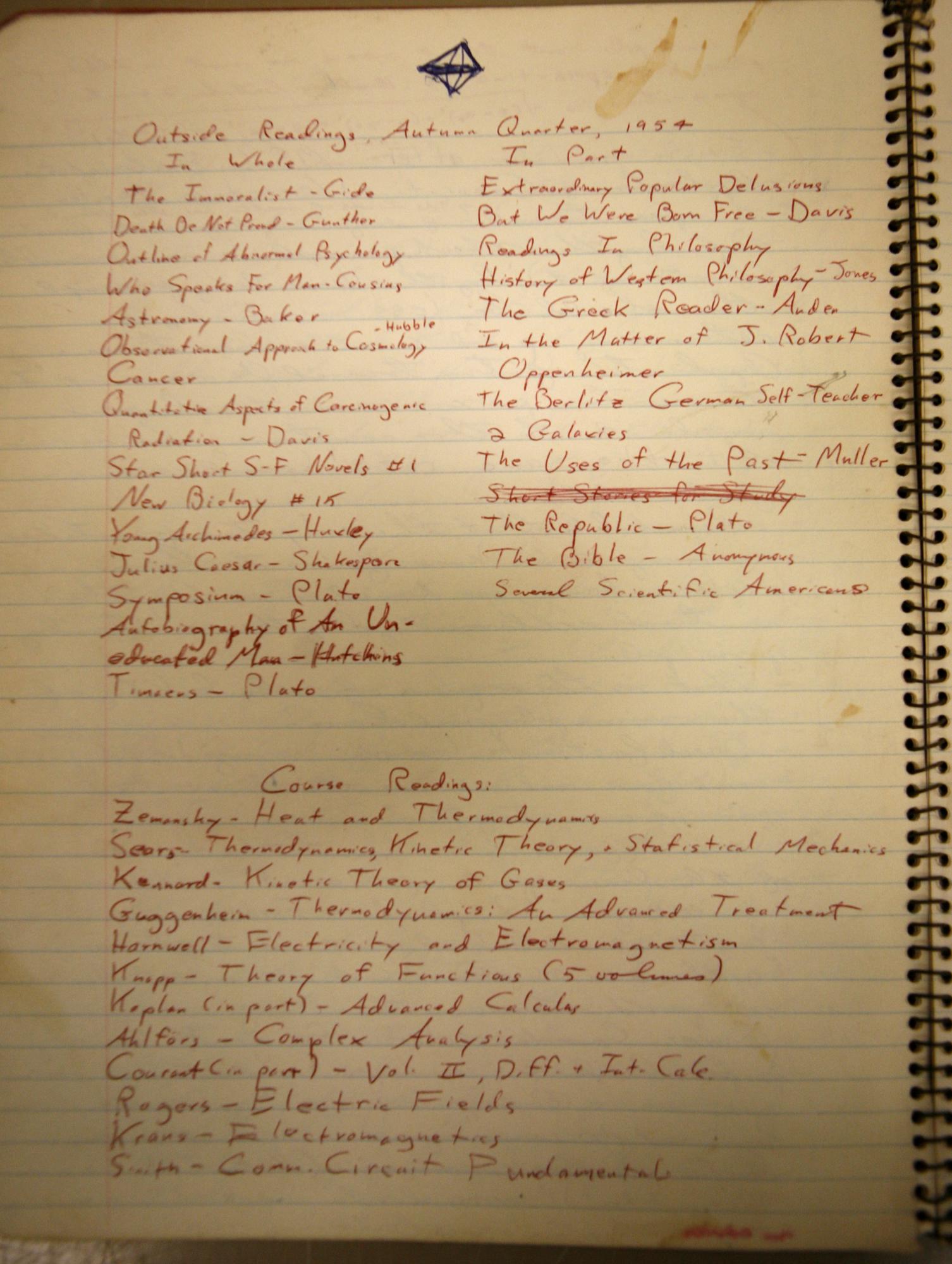
List of titles that Carl Sagan planned to read during one of his semesters at the University of Chicago. Library of Congress Manuscript Division

Carl Sagan may have passed away almost twen­ty years ago, but he con­tin­ues to influ­ence minds of all gen­er­a­tions through intel­lec­tu­al heirs like Neil DeGrasse Tyson (host of the remake of Sagan’s beloved 1980 TV series Cos­mos) as well as through the books he wrote in his life­time. But what books influ­enced Sagan, launch­ing him on the jour­ney toward astron­o­my, cos­mol­o­gy, astro­physics, astro­bi­ol­o­gy, and glob­al celebri­ty? Thanks to the Library of Con­gress’ Carl Sagan Archive, we now know at least forty titles from the no doubt volu­mi­nous amount of read­ing mate­r­i­al he digest­ed dur­ing his youth and edu­ca­tion.

Sagan wrote this read­ing list (which a fan has tran­scribed with links and post­ed to Red­dit) in 1954, as an under­grad­u­ate at the Uni­ver­si­ty of Chica­go. On it he iden­ti­fies the books, as a young Charles Dar­win once wrote on his own list, to be read, whether whol­ly, par­tial­ly, or as a part of his course­work:

In Whole

In Part

Course Read­ings:

Pret­ty ambi­tious mate­r­i­al for a twen­ty-year-old, but remem­ber: we’re talk­ing about some­one who, around a decade ear­li­er, had already sketched out his ideas for human­i­ty’s space­far­ing future. It makes sense that such a child would grow up to read sci­ence fic­tion — and with the pub­li­ca­tion of Con­tact thir­ty years after that, write it — and even that he would take up math­e­mat­ics and physics as a course of aca­d­e­m­ic study.

But it takes a mind like Sagan’s not to lose sight of the impor­tance of com­mu­ni­cat­ing with the non­spe­cial­ist pub­lic, as evi­denced by the pres­ence on his list of Sci­en­tif­ic Amer­i­can and Extra­or­di­nary Pop­u­lar Delu­sions. Nor did he neglect, even before his career began, the need to con­tex­tu­al­ize sci­en­tif­ic dis­cov­er­ies in the realm of human thought and feel­ing, which extends from Pla­to and the Bible to Shake­speare, André Gide, and John Gun­ther — that last writer’s work, and cer­tain oth­er vol­umes on his list, also show­ing an advanced con­scious­ness of human lim­i­ta­tions and mor­tal­i­ty. All of it placed Sagan well, despite his trun­cat­ed time on Earth, to do work that will out­last us all.

Relat­ed Con­tent:

See Carl Sagan’s Child­hood Sketch­es of The Future of Space Trav­el

Carl Sagan Presents His “Baloney Detec­tion Kit”: 8 Tools for Skep­ti­cal Think­ing

Carl Sagan on the Virtues of Mar­i­jua­na (1969)

New Carl Sagan Archive Fea­tures His Dig­i­tized Home Movies, Stu­dent Jour­nal­ism, Draft of His Pale Blue Dot & More

What Did Charles Dar­win Read? See His Hand­writ­ten Read­ing List & Read Books from His Library Online

Neil deGrasse Tyson Lists 8 (Free) Books Every Intel­li­gent Per­son Should Read

Based in Seoul, Col­in Mar­shall writes and broad­casts on cities and cul­ture. He’s at work on a book about Los Ange­les, A Los Ange­les Primer, the video series The City in Cin­e­ma, the crowd­fund­ed jour­nal­ism project Where Is the City of the Future?, and the Los Ange­les Review of Books’ Korea Blog. Fol­low him on Twit­ter at @colinmarshall or on Face­book.

What Character Traits Do Geniuses Share in Common?: From Isaac Newton to Richard Feynman

Back in 1993, James Gle­ick wrote Genius: The Life and Sci­ence of Richard Feyn­man. A decade lat­er came his biog­ra­phy on Isaac New­ton. As Gle­ick men­tions above, the two scientists–who lived, of course, cen­turies apart–shared very lit­tle in com­mon. New­ton (1643–1727) was “soli­tary, anti­so­cial, unpleas­ant, bit­ter.” Richard Feyn­man (1918–1988) could be best described as “gre­gar­i­ous, fun­ny, a great dancer.” Watch him joy­ous­ly play the bon­gos to see what Gle­ick means.

So the ques­tion remains: What did they have in com­mon? And par­tic­u­lar­ly what char­ac­ter traits con­tributed to their “sci­en­tif­ic genius”? Gle­ick goes on to explain:

They were both, as I tried to get in their heads, under­stand their minds, the nature of their genius, I sort of felt I was see­ing things that they had in com­mon, and they were things that had to do with alone­ness. New­ton was much more obvi­ous­ly alone than Feyn­man, but Feyn­man did­n’t par­tic­u­lar­ly work well with oth­ers. He was known as a great teacher, but he was­n’t a great teacher, I don’t think, one on one. I think he was a great lec­tur­er. I think he was a great com­mu­ni­ca­tor. But when it came time to make the great dis­cov­er­ies of sci­ence, he was alone in his head. Now, when I say he, I mean both Feyn­man and New­ton, and this applies, also, I think, to the genius­es that I write about in The Infor­ma­tion, Charles Bab­bage, Alan Tur­ing, Ada Byron. They all had the abil­i­ty to con­cen­trate with a sort of inten­si­ty that is hard for mor­tals like me to grasp, a kind of pas­sion for abstrac­tion that does­n’t lend itself to easy com­mu­ni­ca­tion, I don’t think.

Soli­tude. Con­cen­tra­tion. Abstrac­tion. In a nut­shell, that’s what goes into the mak­ing of a genius.

If you would like to sign up for Open Culture’s free email newslet­ter, please find it here. It’s a great way to see our new posts, all bun­dled in one email, each day.

If you would like to sup­port the mis­sion of Open Cul­ture, con­sid­er mak­ing a dona­tion to our site. It’s hard to rely 100% on ads, and your con­tri­bu­tions will help us con­tin­ue pro­vid­ing the best free cul­tur­al and edu­ca­tion­al mate­ri­als to learn­ers every­where. You can con­tribute through Pay­Pal, Patre­on, and Ven­mo (@openculture). Thanks!

Relat­ed Con­tent:

Neil deGrasse Tyson on the Stag­ger­ing Genius of Isaac New­ton

Sir Isaac Newton’s Papers & Anno­tat­ed Prin­cip­ia Go Dig­i­tal

Free Physics Cours­es (From Our Col­lec­tion of 1200 Free Online Cours­es)

Richard Feyn­man Cre­ates a Sim­ple Method for Telling Sci­ence From Pseu­do­science (1966)

‘The Char­ac­ter of Phys­i­cal Law’: Richard Feynman’s Leg­endary Course Pre­sent­ed at Cor­nell, 1964

The Feyn­man Lec­tures on Physics, The Most Pop­u­lar Physics Book Ever Writ­ten, Now Com­plete­ly Online

by | Permalink | Make a Comment ( 2 ) |

Videos Recreate Isaac Newton’s Neat Alchemy Experiments: Watch Silver Get Turned Into Gold

Yes­ter­day we fea­tured an online archive of “chymi­cal” man­u­scripts from the hand of Isaac New­ton, who, in addi­tion to mod­ern physics and math­e­mat­ics, prac­ticed the mag­i­cal, medieval art of alche­my. Found among his alchem­i­cal papers was a recipe for “soph­ick mer­cury,” a chem­i­cal believed to cre­ate the “Philosopher’s stone,” the occult sub­stance that sup­pos­ed­ly turns base met­als like lead into pure gold. Did such mag­ic ever rise to the lev­el of repeat­able sci­ence or was it pure mytho­log­i­cal fan­ta­sy?

For well over two hun­dred years after Newton’s death in 1727, near­ly every­one believed the lat­ter. How­ev­er, when the physi­cist and mathematician’s alchem­i­cal papers went on auc­tion at Sotheby’s in 1936, “the world of Isaac New­ton schol­ar­ship received a rude shock,” writes Indi­ana University’s archive project The Chym­istry of Isaac New­ton. Hun­dreds of alche­my man­u­scripts that had been qui­et­ly sup­pressed by New­ton’s rel­a­tives and hid­den away in pri­vate col­lec­tions came to light all at once.

In the inter­ven­ing years, New­ton schol­ars and sci­ence his­to­ri­ans have had to reassess his con­sid­er­able lev­el of invest­ment in occult arts. And they’ve come to see alche­my as an impor­tant pre­cur­sor to mod­ern chem­istry. As IU sci­ence his­to­ri­an William New­man “points out,” io9 tells us, “alche­my was­n’t always the laugh­able idea it is today.”

Although his alchem­i­cal man­u­scripts were in con­stant con­ver­sa­tion with ancient and mys­ti­cal sources, “Newton’s chym­istry was in many cas­es ful­ly oper­a­tional and explic­a­ble in mod­ern chem­i­cal ter­mi­nol­o­gy,” writes New­man, who has done much of the work to recov­er the chem­i­cal sci­ence amidst Newton’s alchem­i­cal pseu­do­science.

In the videos you see here, Indi­ana Uni­ver­si­ty seeks to “dri­ve this point home” with lessons that can “be employed in schools as an inte­gral part of their sci­ence edu­ca­tion cur­ric­u­la.” We begin at the top with a clas­si­cal alchem­i­cal exper­i­ment, the “trans­mu­ta­tion” of sil­ver into gold. In this case the medal­lion is already com­posed of a sil­ver-gold alloy. It’s an exper­i­ment in which “alchemists’ knowl­edge of chem­istry actu­al­ly helped them con their con­tem­po­raries into believ­ing they could trans­form sil­ver into gold,” notes New­man. Once the medal­lion is dipped in nitric acid, much of the sil­ver dis­solves, giv­ing the impres­sion of it hav­ing been changed into pure gold.

Fur­ther up, we have oth­er “chymi­cal” exper­i­ments from Newton’s alche­my, like the “transmutation”—or plating—of iron into cop­per and the cre­ation of a sil­i­ca gar­den, illus­trat­ing so-called min­er­al “veg­e­ta­tion.” In exper­i­ments like the one below it, the cre­ation of the “Tree of Diana”—in which a crys­talline growth emerges from an amal­gam of sil­ver and mercury—we see how alchemists were inspired to cre­ate alter­nate ter­mi­nol­o­gy for the prod­ucts of their exper­i­ment that sound to mod­ern ears like unsci­en­tif­ic non­sense. This mys­ti­cal jar­gon often served to con­fuse or ward off the unini­ti­at­ed, who would be unable to make a “Tree of Diana” even if they had the ingre­di­ents on hand, unless they already knew the pro­ce­dure and the prod­uct.

The last two mod­ules, fur­ther up and just above, demon­strate cop­per and iron shot dis­solv­ing in solu­tions of sil­ver nitrate and cop­per nitrate, respec­tive­ly. Edu­ca­tors and the gen­er­al­ly curi­ous should down­load Indi­ana University’s les­son plan on “Newton’s ‘Chym­istry’ of Met­al Sol­u­bil­i­ties.” There­in, you learn that “New­ton spent more time on his alche­my than he did on his physics and math com­bined!” though most of his alchem­i­cal work remains unpub­lished. The few, more respectably-word­ed, exper­i­ments New­ton did pub­lish in his life­time come from “Query 31” of his mas­ter­piece, the Opticks. It is from these pro­ce­dures that the lessons derive.

But even as we see the osten­si­bly straight­for­ward chem­i­cal instruc­tions New­ton pub­lished, we should remem­ber that these came from decades of research in the much murki­er, occult field of alche­my. You’ll find more infor­ma­tion on Newton’s chem­istry here and here, as well as at these many relat­ed web­sites.

via io9 

Relat­ed Con­tent:

Isaac Newton’s Recipe for the Myth­i­cal ‘Philosopher’s Stone’ Is Being Dig­i­tized & Put Online (Along with His Oth­er Alche­my Man­u­scripts)

In 1704, Isaac New­ton Pre­dicts the World Will End in 2060

Sir Isaac Newton’s Papers & Anno­tat­ed Prin­cip­ia Go Dig­i­tal

Josh Jones is a writer and musi­cian based in Durham, NC. Fol­low him at @jdmagness

Isaac Newton’s Recipe for the Mythical ‘Philosopher’s Stone’ Is Being Digitized & Put Online (Along with His Other Alchemy Manuscripts)

17th-century-manuscript

In his 1686 Prin­cip­ia Math­e­mat­i­ca, Isaac New­ton elab­o­rat­ed not only his famous Law of Grav­i­ty, but also his Three Laws of Motion, set­ting a cen­turies-long trend for sci­en­tif­ic three-law sets. Newton’s third law has by far proven his most pop­u­lar: “every action has an equal and oppo­site reac­tion.” In Arthur C. Clarke’s 20th cen­tu­ry Three Laws, the third has also attained wide cul­tur­al sig­nif­i­cance. No doubt you’ve heard it: “Any suf­fi­cient­ly advanced tech­nol­o­gy is indis­tin­guish­able from mag­ic.”

Clarke’s third law gets invoked in dis­cus­sions of the so-called “demar­ca­tion prob­lem,” that is, of the bound­aries between sci­ence and pseu­do­science. It also comes up, of course, in sci­ence fic­tion forums, where peo­ple refer to Ted Chiang’s suc­cinct inter­pre­ta­tion: “If you can mass-pro­duce it, it’s sci­ence, and if you can’t, it’s mag­ic.” This makes sense, giv­en the cen­tral impor­tance the sci­ences place on repro­ducibil­i­ty. But in Newton’s pre-indus­tri­al age, the dis­tinc­tions between sci­ence and mag­ic were much blur­ri­er than they are now.

New­ton was an ear­ly fel­low of the British Roy­al Soci­ety, which cod­i­fied repeat­able exper­i­ment and demon­stra­tion with their mot­to, “Noth­ing in words,” and pub­lished the Prin­cip­ia. He lat­er served as the Society’s pres­i­dent for over twen­ty years. But even as the fore­most rep­re­sen­ta­tive of ear­ly mod­ern physics—what Edward Dol­nick called “the clock­work uni­verse”—New­ton held some very strange reli­gious and mag­i­cal beliefs that we would point to today as exam­ples of super­sti­tion and pseu­do­science.

In 1704, for exam­ple, the year after he became Roy­al Soci­ety pres­i­dent, New­ton used cer­tain eso­teric for­mu­lae to cal­cu­late the end of the world, in keep­ing with his long-stand­ing study of apoc­a­lyp­tic prophe­cy. What’s more, the revered math­e­mati­cian and physi­cist prac­ticed the medieval art of alche­my, the attempt to turn base met­als into gold by means of an occult object called the “Philosopher’s stone.” By Newton’s time, many alchemists believed the stone to be a mag­i­cal sub­stance com­posed in part of “soph­ick mer­cury.” In the late 1600s, New­ton copied out a recipe for such stuff from a text by Amer­i­can-born alchemist George Starkey, writ­ing his own notes on the back of the doc­u­ment.

You can see the “soph­ick mer­cury” for­mu­la in Newton’s hand at the top. The recipe con­tains, in part, “Fiery Drag­on, some Doves of Diana, and at least sev­en Eagles of mer­cury,” notes Michael Greshko at Nation­al Geo­graph­ic. New­ton’s alchem­i­cal texts detail what has long been “dis­missed as mys­ti­cal pseu­do­science full of fan­ci­ful, dis­cred­it­ed process­es.” This is why Cam­bridge Uni­ver­si­ty refused to archive Newton’s alchem­i­cal papers in 1888, and why his 1855 biog­ra­ph­er won­dered how he could be tak­en in by “the obvi­ous pro­duc­tion of a fool and a knave.” New­ton’s alche­my doc­u­ments passed qui­et­ly through many pri­vate col­lec­tors’ hands until 1936, when “the world of Isaac New­ton schol­ar­ship received a rude shock,” writes Indi­ana University’s online project, The Chym­istry of Isaac New­ton:

In that year the ven­er­a­ble auc­tion house of Sotheby’s released a cat­a­logue describ­ing three hun­dred twen­ty-nine lots of Newton’s man­u­scripts, most­ly in his own hand­writ­ing, of which over a third were filled with con­tent that was unde­ni­ably alchem­i­cal.

Marked “not to be print­ed” upon his death in 1727, the alchem­i­cal works “raised a host of inter­est­ing ques­tions in 1936 as they do even today.” Those ques­tions include whether or not New­ton prac­ticed alche­my as an ear­ly sci­en­tif­ic pur­suit or whether he believed in a “secret the­o­log­i­cal mean­ing in alchem­i­cal texts, which often describe the trans­mu­ta­tion­al secret as a spe­cial gift revealed by God to his cho­sen sons.” The impor­tant dis­tinc­tion comes into play in Ted Chiang’s dis­cus­sion of Clarke’s Third Law:

Sup­pose some­one says she can trans­form lead into gold. If we can use her tech­nique to build fac­to­ries that turn lead into gold by the ton, then she’s made an incred­i­ble sci­en­tif­ic dis­cov­ery. If on the oth­er hand it’s some­thing that only she can do… then she’s a magi­cian.

Did New­ton think of him­self as a magi­cian? Or, more prop­er­ly giv­en his reli­gios­i­ty, as God’s cho­sen ves­sel for alchem­i­cal trans­for­ma­tion? It’s not entire­ly clear what he believed about alche­my. But he did take the prac­tice of what was then called “chym­istry” as seri­ous­ly as he did his math­e­mat­ics. James Voelkel, cura­tor of the Chem­i­cal Her­itage Foun­da­tion—who recent­ly pur­chased the Philoso­phers’ stone recipe—tells Live­science that its author, Starkey, was “prob­a­bly American’s first renowned, pub­lished sci­en­tist,” as well as an alchemist. While New­ton may not have tried to make the mer­cury, he did cor­rect Starkey’s text and write his own exper­i­ments for dis­till­ing lead ore on the back.

Indi­ana Uni­ver­si­ty sci­ence his­to­ri­an William New­man “and oth­er his­to­ri­ans,” notes Nation­al Geo­graph­ic, “now view alchemists as thought­ful tech­ni­cians who labored over their equip­ment and took copi­ous notes, often encod­ing their recipes with mytho­log­i­cal sym­bols to pro­tect their hard-won knowl­edge.” The occult weird­ness of alche­my, and the strange pseu­do­nyms its prac­ti­tion­ers adopt­ed, often con­sti­tut­ed a means to “hide their meth­ods from the unlearned and ‘unwor­thy,’” writes Dan­ny Lewis at Smith­son­ian. Like his fel­low alchemists, New­ton “dili­gent­ly doc­u­ment­ed his lab tech­niques” and kept a care­ful record of his read­ing.

“Alchemists were the first to real­ize that com­pounds could be bro­ken down into their con­stituent parts and then recom­bined,” says New­man, a prin­ci­ple that influ­enced Newton’s work on optics. It is now acknowl­edged that—while still con­sid­ered a mys­ti­cal pseudoscience—alchemy is an impor­tant “pre­cur­sor to mod­ern chem­istry” and, indeed, as Indi­ana Uni­ver­si­ty notes, it con­tributed sig­nif­i­cant­ly to ear­ly mod­ern phar­ma­col­o­gy” and “iatro­chem­istry… one of the impor­tant new fields of ear­ly mod­ern sci­ence.” The suf­fi­cient­ly advanced tech­nol­o­gy of chem­istry has its ori­gins in the mag­ic of “chym­istry,” and New­ton was “involved in all three of chymistry’s major branch­es in vary­ing degrees.”

Newton’s alchem­i­cal man­u­script papers, such as “Artephius his secret Book” and “Her­mes” sound noth­ing like what we would expect of the dis­cov­er­er of a “clock­work uni­verse.” You can read tran­scrip­tions of these man­u­scripts and sev­er­al dozen more at The Chym­istry of Isaac New­ton, where you’ll also find an Alchem­i­cal Glos­sary, Sym­bol Guide, sev­er­al edu­ca­tion­al resources, and more. The man­u­scripts not only show Newton’s alche­my pur­suits, but also his cor­re­spon­dence with oth­er ear­ly mod­ern alchem­i­cal sci­en­tists like Robert Boyle and Starkey, whose recipe—titled “Prepa­ra­tion of the [Socph­ick] Mer­cury for the [Philoso­phers’] stone by the Antin­o­mi­al Stel­late Reg­u­lus of Mars and Luna from the Man­u­scripts of the Amer­i­can Philosopher”—will be added to the Indi­ana Uni­ver­si­ty online archive soon.

Relat­ed Con­tent:

In 1704, Isaac New­ton Pre­dicts the World Will End in 2060

Sir Isaac Newton’s Papers & Anno­tat­ed Prin­cip­ia Go Dig­i­tal

Isaac New­ton Cre­ates a List of His 57 Sins (Cir­ca 1662)

Josh Jones is a writer and musi­cian based in Durham, NC. Fol­low him at @jdmagness

Goethe’s Colorful & Abstract Illustrations for His 1810 Treatise, Theory of Colors: Scans of the First Edition

goethe-2

The great Jew­ish philoso­pher Baruch Spin­oza, it is said, drew his con­cep­tions of god and the uni­verse from his work as an opti­cian, grind­ing lens­es day after day. He lived a life sin­gu­lar­ly devot­ed to glass, in which his “evenings to evenings are equal.” So wrote Jorge Luis Borges in a poet­ic appre­ci­a­tion of Spin­oza, of which he lat­er com­ment­ed, “[Spin­oza] is pol­ish­ing crys­tal lens­es and is pol­ish­ing a rather vast crys­tal phi­los­o­phy of the uni­verse. I think we might con­sid­er those tasks par­al­lel. Spin­oza is pol­ish­ing his lens­es, Spin­oza is pol­ish­ing vast dia­monds, his ethics.”

goethe-1

The pol­ish­ing of lens­es, and work in optics gen­er­al­ly, has a long philo­soph­i­cal pedi­gree, from the exper­i­ments of Renais­sance artists and schol­ars, to the nat­ur­al philoso­phers of the Sci­en­tif­ic Rev­o­lu­tion who made their own micro­scopes and pon­dered the nature of light. Over a cen­tu­ry after Spinoza’s birth, poly­math artist and thinker Johann Wolf­gang von Goethe pub­lished his great work on optics, just one of many direc­tions he turned his gaze. Unlike Spin­oza, Goethe had lit­tle use for con­cepts of divin­i­ty or for sys­tem­at­ic think­ing.

goethe-3

But unlike many free­think­ing aris­to­crat­ic dilet­tantes who were a fix­ture of his age, Goethe–-writes poet Philip Brant­i­ng­ham—“was a uni­ver­sal genius, one of those tal­ents whose works tran­scend race, nation, lan­guage-and even time.” It’s a dat­ed con­cept, for sure, but when we think of genius in the old Roman­tic sense, we most often think of Goethe, as a poet, philoso­pher, and sci­en­tist. When he turned his atten­tion to optics and the sci­ence of col­or, Goethe refut­ed the the­o­ries of New­ton and cre­at­ed some endur­ing sci­en­tif­ic art, which would lat­er inspire philo­soph­i­cal icon­o­clasts like Wittgen­stein and expres­sion­ist painters like Wass­i­ly Kandin­sky.

goethe-4

We’ve fea­tured Goethe’s most impor­tant sci­en­tif­ic work, Zur Far­ben­lehre (The­o­ry of Col­ors), in a pre­vi­ous post. Now we can bring you the supe­ri­or images above, from a first edi­tion scan at Stockholm’s Hager­stromer Med­ical Library, who host a col­lec­tion of scanned illus­tra­tions from dozens of first edi­tions of nat­u­ral­ist texts. The col­lec­tion spans a once sup­pressed phys­i­ol­o­gy text by Descartes—anoth­er optics the­o­rist—to Rachel Carson’s 1962 Silent Spring, the book that “launched the mod­ern con­ser­va­tion­ist move­ment.” In-between, find scans of illus­tra­tions and pho­tographs from the works of Carl Lin­naeus, Charles Dar­win, Louis Pas­teur, and dozens of oth­er nat­ur­al philoso­phers and sci­en­tists who made sig­nif­i­cant con­tri­bu­tions to med­ical sci­ence.

original

In the case of Goethe’s The­o­ry of Col­ors (1810), we get a high-qual­i­ty look at the images in what the author him­self con­sid­ered his best work. “Known as a fierce attack on Newton’s demon­stra­tion that white light is com­pos­ite,” writes the Hager­stromer Library, “Goethe’s colour the­o­ry remains an epochmak­ing work.” Goethe’s illus­tra­tions came direct­ly from “a large num­ber of obser­va­tions of sub­jec­tive colour-per­cep­tions, record­ed with all the exact­ness of a sci­en­tist and the keen insight of an artist.” It’s part­ly the bridg­ing of sci­ences and the arts—of Enlight­en­ment and Romanticism—that has made Goethe such a remark­able fig­ure in Euro­pean intel­lec­tu­al his­to­ry. But as many of the fine­ly illus­trat­ed, care­ful­ly observed texts at the Hager­stromer Med­ical Library show, he wasn’t alone in that regard.

goethe-optics-6

In addi­tion to these clas­sic texts, the Hager­stromer also hosts the Wun­derkam­mer, an eclec­tic archive of (often quite bizarre) nat­u­ral­ist images and illus­tra­tions from the 16th to the 20th cen­turies. One MetaFil­ter user describes the col­lec­tion thus:

Wun­derkam­mer is a col­lec­tion of high res­o­lu­tion images from old books in the Hagströmer Med­ical Library. Some of my favorites are sea anemonesnerve cellsroost­er chas­ing off a mon­ster16th Cen­tu­ry eye surgerymus­cles and bones of the hand and armele­phant-head­ed humanoid and cup­ping. It can also be browsed by tag, bro­ken up into sub­ject (e.g. beast), emo­tion (e.g. strange), tech­nique (e.g. chro­molith­o­g­ra­phy) and era (e.g. 18th Cen­tu­ry).

via Metafil­ter

Relat­ed Con­tent:

Down­load 100,000+ Images From The His­to­ry of Med­i­cine, All Free Cour­tesy of The Well­come Library

Old Book Illus­tra­tions: Free Archive Lets You Down­load Beau­ti­ful Images From the Gold­en Age of Book Illus­tra­tion

The British Library Puts 1,000,000 Images into the Pub­lic Domain, Mak­ing Them Free to Reuse & Remix

Josh Jones is a writer and musi­cian based in Durham, NC. Fol­low him at @jdmagness

Periodic Table Battleship!: A Fun Way To Learn the Elements

periodic-table-battleship

Nitro­gen.

Phos­pho­rous.

Arsenic.

Aw, you sunk my bat­tle­ship!

Mil­ton Bradley’s clas­sic board game, Bat­tle­ship, can now be added to the ros­ter of fun, cre­ative ways to com­mit the Peri­od­ic Table of Ele­ments to mem­o­ry.

Karyn Tripp, a home­school­ing moth­er of four, was inspired by her eldest’s love of sci­ence to cre­ate Peri­od­ic Table Bat­tle­ship. I might sug­gest that the game is of even greater val­ue to those who don’t nat­u­ral­ly grav­i­tate toward the sub­ject.

Faced with the option of learn­ing the ele­ments via show­er cur­tain or cof­fee mug osmo­sis, I think I’d pre­fer to take out an opponent’s sub­ma­rine.

Rules of engage­ment are very sim­i­lar to the orig­i­nal. Rather than call­ing out posi­tions on a grid, play­ers set their tor­pe­does for spe­cif­ic ele­ment names, abbre­vi­a­tions or coor­di­nates. Advanced play­ers might go for the atom­ic num­ber. the lin­go is the same: “hit,” “miss” and—say it with me—“you sunk my bat­tle­ship!

The win­ner is the play­er who wipes out the other’s fleet, though I might toss the los­er a cou­ple of rein­force­ment ves­sels, should he or she demon­strate pass­ing famil­iar­i­ty with var­i­ous met­als, halo­gens, and noble gas­es.

To make your own Peri­od­ic Table Bat­tle­ship set you will need:

4 copies of the Peri­od­ic Table (lam­i­nate them for reuse)

2 file fold­ers

paper clips, tape or glue

2 mark­ers (dry erase mark­ers if play­ing with lam­i­nat­ed tables

To Assem­ble and Play:

As you know, the Peri­od­ic Table is already num­bered along the top. Label each of the four tables’  ver­ti­cal rows alpha­bet­i­cal­ly (to help younger play­ers and those inclined to fruit­less search­ing for the ele­ments des­ig­nat­ed by their oppo­nent)

Fas­ten two Peri­od­ic Tables to each fold­er, fac­ing the same direc­tion.

Uses mark­ers to cir­cle the posi­tion of your ships on the low­er Table:

5 con­sec­u­tive spaces: air­craft car­ri­er

4 con­sec­u­tive spaces: bat­tle­ship

3 con­sec­u­tive spaces: destroy­er or sub­ma­rine

2 con­sec­u­tive spaces: patrol boat

Prop the fold­ers up with books or some oth­er method to pre­vent oppo­nents from sneak­ing peeks at your mar­itime strat­e­gy.

Take turns call­ing out coor­di­nates, ele­ment names, abbre­vi­a­tions or atom­ic num­bers:

When a turn results in a miss, put an X on the cor­re­spond­ing spot on the upper table.

When a turn results in a hit, cir­cle the cor­re­spond­ing spot on the upper table.

Con­tin­ue play until the bat­tle is won.

Repeat until the Table of Ele­ments is mas­tered.

Sup­ple­ment lib­er­al­ly with Tom Lehrer’s Ele­ments song.

Those not inclined toward arts and crafts can pur­chase a pre-made  Peri­od­ic Table Bat­tle­ship set from Tripp’s Etsy shop.

Relat­ed Con­tent:

Learn to Write Through a Video Game Inspired by the Roman­tic Poets: Shel­ley, Byron, Keats

Play Mark Twain’s “Mem­o­ry-Builder,” His Game for Remem­ber­ing His­tor­i­cal Facts & Dates

200 Free Kids Edu­ca­tion­al Resources: Video Lessons, Apps, Books, Web­sites & More 

Ayun Hal­l­i­day is an author, illus­tra­tor, the­ater mak­er, sec­u­lar home­school­er and Chief Pri­ma­tol­o­gist of the East Vil­lage Inky zine.  Her play Zam­boni Godot is open­ing in New York City in March 2017. Fol­low her @AyunHalliday.

Artificial Intelligence Program Tries to Write a Beatles Song: Listen to “Daddy’s Car”

Last May, we told you about Flow Machine, an arti­fi­cial intel­li­gence-dri­ven music com­pos­er that analy­ses composer’s styles and then cre­ates new works from that data. Devel­oped by François Pachet at Sony CSL-Paris, the ini­tial exper­i­ments demon­strat­ed Beethoven’s “Ode to Joy” as played in the style of bossa nova, the Bea­t­les’ “Pen­ny Lane,” and Ennio Morricone’s roman­tic work. Admit­ted­ly, it wasn’t the most stun­ning moment in A.I.—a com­put­er was now doing what arrangers have been doing for years, apply­ing genre rules to a melody cre­at­ed in anoth­er genre.

How­ev­er, Flow Machine has returned with an inter­est­ing devel­op­ment: two upcom­ing albums of A.I.-created songs, from which two tunes have been released to give you a taste of com­put­er cre­ativ­i­ty. French com­pos­er and musi­cian Benoît Car­ré helped out with the arrange­ments and pro­duc­tion of the songs, and also wrote the lyrics, so it’s not com­plete­ly an A.I. cre­ation, we should note.

So what should we make of “Daddy’s Car,” above, an attempt to cre­ate an A.I song in the style of the Bea­t­les? The open­ing sec­onds fea­ture the three-part har­mo­ny of “Because,” but when the band kicks in, it’s clos­er to the Beach Boys’ Pet Sounds than the Fab Four. (If any­thing, it’s clos­er to the High Lla­mas.)

But does it sound like it was writ­ten by a human? Yes.

For some­thing stranger, try the oth­er song released so far: “Mr. Shad­ow,” writ­ten “in the style of Amer­i­can song­writ­ers such as Irv­ing Berlin, Duke Elling­ton, George Gersh­win and Cole Porter.”

Now this is much odd­er, a mix of coun­try twang, Daniel Lanois-style ambi­ence, along with a vocal that sounds like a cor­rupt­ed audio file. If you are look­ing for a true glimpse of the future, wrap your ears and san­i­ty around this one. Musi­cians and music fans, let us know in the com­ments what you think about this brave new world that has such hit sin­gles in it.

Relat­ed Con­tent:

Two Arti­fi­cial Intel­li­gence Chat­bots Talk to Each Oth­er & Get Into a Deep Philo­soph­i­cal Con­ver­sa­tion

Noam Chom­sky Explains Where Arti­fi­cial Intel­li­gence Went Wrong

Stephen Hawk­ing Won­ders Whether Cap­i­tal­ism or Arti­fi­cial Intel­li­gence Will Doom the Human Race

Ted Mills is a free­lance writer on the arts who cur­rent­ly hosts the FunkZone Pod­cast. You can also fol­low him on Twit­ter at @tedmills, read his oth­er arts writ­ing at tedmills.com and/or watch his films here.

« Go BackMore in this category... »
Quantcast